



DECEMBER 22
Corps Orders Smaller Defensive Circle
At 0153, the following order from the CG US XVIII Corps (Airborne), was delivered orally by his Deputy Chief of Staff to the Division Commander: Gen Matthew B. Ridgway feels that the enemy forces, identified in the vicinity of Limmerlé is the 2.SS-Panzer-Division. In view of the loss of St Vith, he does not consider it safe to hold the 424-IR (US 106-ID) and the 112-IR (US 28-ID) in their present positions. He directs withdrawal under cover of darkness in the order US 106-ID, US 7-AD to positions along the general line Bovigny – Beho – Maldingen railroad. The exact positions on the terrain as agreed upon between CG US 106-ID and CG US 7-AD. The following towns are to be cleared of friendly troops by 0700 this morning for an air mission: Sterpigny, Cherain, Rettigny, Gouvy, Limmerlé, and St Vith. Covering force along this line (generally to the east of Gouvy) is to be left in place to cover the withdrawal.
Enemy Penetrates CCB
On Dec 22, the enemy infantry which had infiltrated the night before into Hinderhausen, reinforced by tanks, attacked Rodt from the west and got behind the left flank of CCB US 7-AD. This required that the left flank of CCB fall back to clean out this force and protect Hinderhausen which was the emergency exit route to Commanster and Vielsalm. This was done and the whole CCB line was adjusted to conform. Charlie Co 814-TDB was attached to CCB US 7-AD and placed to support the left of the line where contact with CCA US 7-AD had been lost. By dark, the CCB US 7-AD position was reestablished and strengthened by the addition of the 17-TB (-), which was used to tie in with CCB US 9-AD, in the south. During the day, all unessential vehicles were sent to the rear. At 1845, enemy tanks and infantry attacked along the railroad towards Crombach. Infantry broke through and occupied the town, necessitating the withdrawal of HQs 31-TB and HQs 87-CRS to Braunlauf. The 17-TB was able to fight its way out the next morning without heavy losses. During the night an effort to obtain a company of infantry from the 424-IR (US 106-ID) then attached to CCB US 9-AD, to counter-attack Crombach was unsuccessful. It was used later to defend Braunlauf during the withdrawal.
CCA – Holds Poteau against Fierce Attack
In view of the urgency of the situation and the paucity of roads available for a withdrawal, the Commanding General again instructed the Commanding Officer, CCA US 7-AD, on the morning of Dec 22 to hold his present position and control of the road at Poteau at all costs. The two platoons of Charlie Co 38-AIB, which had been with Task Force Jones were attached to CCA at 0830. They were sent at once to patrol towards the north and east of the heavy woods southeast of Poteau, for at this very time it was known that approximately one company of German infantry was encircling our troops southeast of the town. At 0945, a platoon of Baker Co 40-TB was sent to the vicinity of Rodt to repel an enemy company south of that town. By 1100, that platoon plus one from Able Co 40-TB were engaging 16 enemy tanks.
At about the same time, enemy infantry infiltrated through our positions in the heavy woods southeast of Poteau into the vehicle park of the 48-AIB where they managed to destroy several of our vehicles. The remainder were withdrawn to Petit-Thier. Hostile tanks gained control of Rodt, but two platoons of the 40-TB still held on. Beginning at about 1645, the CCA US 7-AD units were reestablished on a shorter line extending generally north and south, anchored on the left at Poteau. All contact with CCB US 7-AD on the right had been lost. Morale was not good and the combat efficiency was down to about 80%. The enemy did not rest. At 2210, another attack by tanks and infantry with Panzerschreck was launched from the east on Poteau, resulting in the loss of two of our tanks.
CCR – Maintains Screen in Assigned Zone
CCR US 7-AD had a relatively quiet day on Dec 22, receiving only scattered artillery fire and very slight contact with light enemy patrols on the high ground north of Petit-Thier. At 1115, the Division Commander ordered the CO of CCR to send all his tank destroyers to CCA US 7-AD and for him to go to CCA, get the situation, and return. Throughout this period telephone communication remained in with CCR and CCB, but not with CCA, with the consequence of an obscured understanding at Division Headquarters of CCA’s situation.
Task Force Jones – is Reduced in Size, Shortens Line
In the meanwhile, Task Force Jones was not too busy either. At 0320, Dec 22, the 17-TB was ordered to move at once to CCB US 7-AD and at 1045, Col Jones was directed to send his only remaining tank destroyer company and every rifleman he could find to CCB at Crombach. These changes rendered Task Force Jones considerably weaker. It still contained the Recon Co of the 814-TDB and a healthy detachment from the 14-CG, as well as some miscellaneous groups of stragglers which had been collected. In addition, the 440-AFAB was still in position near Bovigny supporting the force. By daylight, the defensive positions had been withdrawn in accordance with orders from the Division Commander to a ling generally from Bovigny to Vielsalm, with outposts 1000 yards behind the two towns Cherain and Gouvy. About noon the enemy began a build-up at Gouvy which was pounded throughout the day with artillery fire. He did not debouch in a heavy attack.
US 106th Infantry Division – Shortens Lines
To conform with the plan of tightening the defensive circle the 112-IR US 28-ID and the 424-IR US 106-ID closed into their new defensive positions southwest and southeast of Beho respectively, at 1300, and CCB US 9-AD drew back slightly to tie in with the right flank of CCB US 7-AD and the left flank of the 424-IR US 106-ID. At 1120, the CG US 106-ID, sent two battalions of infantry to Crombach to reinforce CCB US 7-AD and assist in stabilizing the position. Also to conform to the general plan of shortening our lines, elements of Task Force Lindsey began withdrawing positions at Thommen to the vicinity of Beho at 1120. Throughout the latter part of the day, there was strong pressure from the enemy on Task Force Lindsey between Thommen and Beho.
Withdrawal West of Salm River Commences
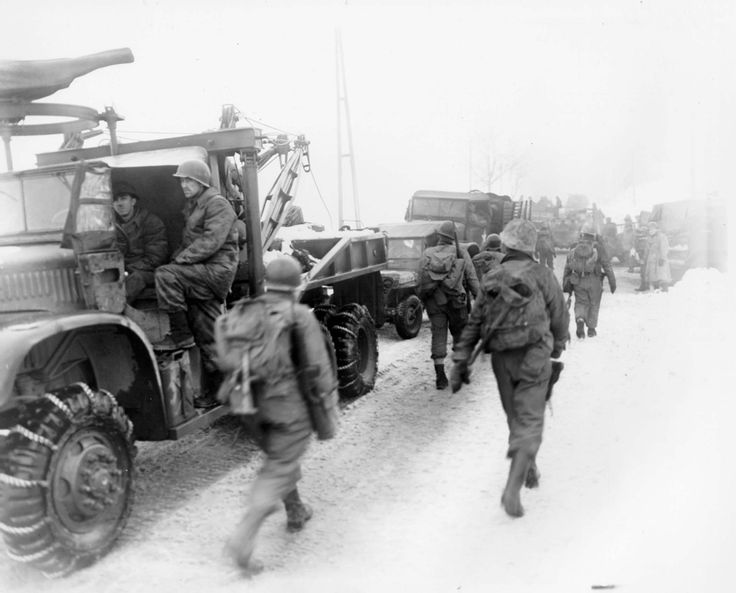
During the late afternoon and night of Dec 22, the enemy was pressing strongly on all positions. It was also definitely confirmed that the enemy was in strength along the Salm River from Trois Ponts to Grand Halleux and along the high ground from south of the highway running west from Salmchâteau. This meant that the US 106-ID, CCB US 9-AD, the 112-IR US 28-ID, what remained of the 14-CG, some corps troops including some corps artillery which had been attached to the US 7-AD, and the entire US 7-AD with attachments (less) Trains, were left east of the Salm River, low on supplies, and completely fatigued by five or more days and nights of continuous fighting, with only one sure exit route, a secondary road running west from Vielsalm, and one probable route, the road Salmchâteau – Joubiéval – Lierneux. The outnumbered troops were not holding well. As the position was obviously untenable a withdrawal was planned. All unessential vehicles were withdrawn at once, followed by part of the artillery (medium), which began displacing rearward at about midnight.
Enemy Attacks – Withdrawal Postponed
As CCB US 9-AD was the first unit scheduled to withdraw, the order was rushed to it by a staff officer before it was published to the other units. At 0125, CCB US 9-AD was so ferociously engaged with the enemy that the CG advised the Division CO that a withdrawal at the scheduled time would be unfeasible. Consequently, the initial time was postponed and the plan was published on the basis of an H-Hour. In the sectors of both CCs: CCB US 7-AD and CCB US 9-AD the fighting continued without abatement. At the same time, the enemy was building up strong forces in front of the US 82-A/B west of Salmchâteau. In view of the enemy’s relentless pressure the Division CG radioed Gen Clarke and Gen Hoge of the two CCBs that: the situation is such on the west of river south of the U 82-A/B that if we don’t join them soon, the opportunity will be gone. It will be necessary to disengage whether circumstances are favorable or not if we are to carry out any kind of withdrawal with equipment. Inform me of your situation at once, particularly with regard to the possibility of disengagement and execution of withdrawal. Shortly afterward, the enemy’s pressure from the east eased slightly, and H-Hour was announced as 0600. CCB US 9-AD, having received the announcement late, actually initiated the movement at about 0700.
CCB Withdraws
The plan of CCB US 7-AD was to bring out all the vehicles and troops at Crombach and southwest thereof through Beho to Vielsalm. The infantry company of the 424-IR US 106-ID at Braunlauf accompanied them. North of Crombach all troops and vehicles were to come out through Hinderhausen to Commanster then to Vielsalm. A covering force consisting of a medium Tank Co, a Tank Destroyer Co, and an Infantry Co, or its equivalent, was to hold Hinderhausen until all other troops had left and then fall back with maximum delay. All this was done. The 965-FAB and 275-FAB had withdrawn the night before. The 434-AFAB left just ahead of the covering force, giving it fire support as it withdrew under heavy pressure. Due to a frozen road between Hinderhausen and Commanster, the withdrawal was facilitated and practically all the vehicles were evacuated. So far as is known no men were left behind. The troops of the Combat Command were originally given instructions to assemble at Lierneux but later were directed that the assembly area had been changed to Xhoris. The Combat Command was closed in the vicinity of Xhoris at 2300 Dec 23.
CCA Withdraws
The plan of CCA US 7-AD was to withdraw by the northern route beginning at 1530 and to clear their area by 1830 moving through CCR US 7-AD at Petit-Thier. An Advance Guard composed of a company of tanks and one of infantry was to leave first. Then, the infantry was to withdraw, supported by fire and limited attacks by the 40-TB minus. Finally, the tanks would pull back, acting as a rear guard. All this was done. The 489-AFAB supported the entire section with prepared fires and smoke. Prior to the commencement of CCA’s withdrawal, a hostile attack was launched by enemy infantry at 1035. Artillery and tanks effectively broke it up by 1115. CCA received good air support from 1230 throughout the remaining daylight hours which materially assisted the operation. Support was also received from the 275-FAB beginning at about 1400. CCA successfully passed all elements through CCR, which then assumed responsibility for coverage of the rear, and proceeded to its new assembly area in the vicinity of Harzé.
CCR Withdraws
After CCA US 7-AD had withdrawn through CCR US 7-AD, the latter commenced its own withdrawal almost without incident. The artillery between CCA and CCR cleared the bridge at 1650, followed by CCR, which came out fast. All vehicles having cleared the railroad underpass at P725900, it was blown at 1715, and the final covering force of infantry was withdrawn at 1745. CCR was able to disengage both its defensive positions without committing any forces. One outpost was ambushed by an enemy force of 12 to 15 men who, after setting one M-8 armored car afire by Panzerfaust or Panzerschreck fire and wounding one enlisted man, were ultimately driven off. No other casualties, vehicular or personnel, were sustained, and the combat command closed in its new assembly area at 2000.