



Orders Issued. The Division Artillery was still tied up in the traffic jam north of Vielsalm. At 0300 a field order in fragmentary form was issued assigning troops and missions to each of the major subordinate commands of the Division as follows: CCR:
Your comd will have responsibility for defense north sector of the Division zone which includes roadblock established at Grand Halleux. Atchd your comd 1/38, 1/33, 1/814 (minus 1 plat), 1 plat/203, 1/87 all effective Dec 18, 0800. Establish and maintain contact with CCB vic. St Vith. CCB: Det your Comd 1/38 to CCR. Atchd 1 plat 203, 1/87, A/814; all effective Dec 18, 0800. Establish contact CCR. Your comd is responsible for the defense of the east sector of the Division zone including the roadblock established at Nieder-Emmels. CCA: Your Comd reverts to Division Reserve with normal local security on the south. Atchd 1 Rcn Tr effective Dec 18, 0800.
Corresponding orders concerning the changes of attachments were sent to:
– 203rd AAA AW Battalion (SP)
– 87th Cavalry Rcn Squadron
– 814th Tank Destroyer Battalion
– 33rd Armored Engineer Battalion
At this time information about the enemy was extremely sketchy, the only source being divisional units which had just arrived in the area. The Division Artillery observation planes had not yet arrived. As the enemy was strong on the east and was approaching Poteau from the northeast, and in view of the presence of CCB 9-AD and 424-IR (106-ID) on the south giving protection to that flank, the Division Commander decided to have CCA attack the enemy in Poteau.
CCA’s mission
Take Poteau, secure the St Vith – Poteau road. The plan included having CCB push to the east of St Vith sufficiently to allow CCA to move from Beho via Maldingen, St Vith and Rodt against the enemy at Poteau. At the same time CCR, less the 17-TB still in position southeast of Recht was to establish patrols on the Division’s north flank from the Salm River along the high ground north of Petit-Thier to Poteau and make contact with CCA on its right.
– At 0800, the enemy attacked CCB from the northeast and east. Two medium tank companies from the 14-TB, and Able Co 811-TDB, all from CCB 9-AD, were sent north to reinforce the 87-CRS line. By 1100 this attack had been stopped and the line was restored to its original position. At 1200 the tank destroyer company of the 814-TDB which had been ordered forward the night before finally arrived in CCB sector and was sent into position. D Troop 87-CRS was detached from CCB and attached to CCA in accordance with the orders of 0300 that morning, but it was never possible to send a recon troop to CCR. At 1530, a second attack, estimated to be a battalion of infantry, was launched against the positions east of St Vith. This attack was repulsed. A readjustment of troops was made at approximately 1600, and the elements of CCB 9-AD were withdrawn and returned to their parent headquarters at 2130. At 2230 attacks by enemy tanks were repulsed, but continuous noises and troop movements were audible throughout the night.
Combat Command A – Attacks
CCA 7-AD moved out at 1010 from its assembly area at Beho to proceed to Poteau. D Troop 87-CRS, was to remain on the south to occupy outpost positions vacated by the 48-AIB vicinity Thommen, Espeler and Deifelt. Likewise, Dog Co 40-TB and Able Co 33-AECB, remained in positions near Beho and Rogery respectively. As the advance guard approached Poteau, contact was made with a hostile tank. The infantry company of the advance guard dismounted and entered Poteau at 1320. Hostile resistance was strong and at 1530 CCA was still held up at Poteau. At 1600 the Division CG sent a message to the Commanding Officer, CCA: Imperative you seize Poteau this PM and hold it.
By 1700 the road junction was in our control and by 1800 our infantry and tanks were in Poteau. At the end of the day Poteau was in our hands, outposts had been established, and strong defensive measures on avenues of approach to the town were organized. Nevertheless, there was no contact between CCA and CCR on the west, nor was the road between Petit-Thier and Poteau safe to travel, as it was covered by enemy fire.
Combat Command R – is Attacked
At midnight, Dec 17, CCR was almost completely ignorant of the enemy situation. Having received increasing numbers of reports of enemy troops in the vicinity of Recht and information indicating that the 14-CG had been withdrawn from their north, northeast, and east, CCR increased local security with all available personnel and equipment. After continued reports of enemy activity, including an ambush 800 meters east of Recht, one tank company of the 17-TB moved into town to the outpost to the west, north, and east, supported by existing outposts. After an enemy attack and infiltration commencing at 0200, CCR determined that in the absence of infantry attachments it would be impossible to hold the town without great loss of vehicles. Consequently, at 0245, troops in the town were ordered to evacuate to the southwest covered by the tank company which withdrew in a southeasterly direction towards the 17-TB assembly area. The CC’s CP moved initially to Poteau but was forced by enemy action from there to Ville du Bois before daylight. However, the 17-TB remained in its original position southeast of Recht.
At 0600, Charlie Co 38-AIB was attached to CCR for outpost duty with the tanks and was further attached to the 17-TB. During the day the 17-TB held its position. Furthermore, CCR established a strong outpost composed of its attached engineers and tank destroyers along with a platoon of Baker Co 23-AIB and a number of straggler vehicles and personnel which it collected. These troops held their positions throughout the day. The railroad overpass at (724901) was prepared for demolition by Charlie Co 33-AECB, to be blown on the order of CO CCR. During the day of Dec 18, two M-16 AAA units, a pair of M-36 tank destroyers, and a recon platoon of the tank destroyer battalion were placed north of Vielsalm to block the road from Trois-Ponts. Initially, under the command of the 814-TDB, this force was attached to CCR at 1500, Dec 20.
Division Trains – Move West
The Division Trains closed into their assigned assembly area in and near Vielsalm and Salmchâteau at 0600, Dec 18. Due to the enemy threats on the Division’s east, Trains were ordered to move at 1030 to the west and select new positions near Samrée or La Roche en Ardenne, and by 1230 they had cleared their area en route to the vicinity of La Roche en Ardenne. HHQ Co of the engineer battalion followed the Division Trains to the west in order to clear the combat area for combat troops.
14-CG – Is Attached
On Dec 17, the Division had had telephone communication with the Corps HQ, but on Dec 18, when the Corps HQ was forced to move, all contact was lost. At 1600, Dec 18, the Division Liaison Officer to Corps arrived and reported that the US 30-ID at that time had one regiment in Malmedy and that by the dawn of Dec 19, the US 82-A/B was expected to be in the area centered about Lierneux. Corps was out of contact with the 112-IR of the US 28-ID, still thought to be south of the 424-IR (US 106-ID). The only other contact with Corps HQ was a visit to the Division CP by the Corps Deputy Chief of Staff during the afternoon of Dec 18. At the time of his visit, the picture from Corps’ viewpoint was hazy. At 1345 he informed the Division CO that the 14-CG was attached to the Division effective 1300. This order was confirmed by a letter of instructions, HQ VIII Corps, dated Dec 18, 1944. It was immediately ordered to concentrate near Vielsalm, collect its stragglers, and reorganize as quickly as possible. It was in an extremely disorganized state and badly in need of rest and a chance to regain its feet.
DECEMBER 19
Attack Continues Against CCB
At 0930, an attack developed against CCB 7-AD north of Hünningen. The attack moved west and then turned south. Difficulties were experienced in firing due to haze, but by 1300 the situation had quieted. At 1355 the 17-TB with Charlie Co 38-AIB, which still remained southeast of Recht were attached to CCB 7-AD. At the same time, CCB 7-AD was ordered to defend a sector between CCB 9-AD on the right and the Recht – Rodt road inclusive on the left. At 1510 the 434-AFAB and two batteries 965-FAB were attached to CCB 7-AD and placed in position. The only artillery support on Dec 18 and 19, prior to the arrival of the 434-AFAB, was the 275-AFAB. The Corps artillery observers had left during the night of Dec 17 to 18. In the afternoon, a conference was held between the CG of CCB 9-AD and the CG of CCB 7-AD. At this conference, it was pointed out that CCB 9-AD was ahead of the stream and a railroad south of St Vith and its only exit was through St Vith. In case St Vith should be lost, CCB 9-AD would be cut off. Therefore, it was agreed that CCB 9-AD should withdraw through St Vith during the night of Dec 19-20 and occupy its original zone in the rear of the railroad and stream running south from St Vith. This withdrawal was accomplished without difficulty. Close liaison was maintained between the two Combat Commands during the whole period in the vicinity of St Vith.
CCA – Organizes Positions Poteau
In Poteau, the enemy resistance against CCA 7-AD continued to be strong. The CG instructed CCA 7-AD to prepare plans for an attack on Recht and also plans for a withdrawal via Petit-Thier and Vielsalm. Assault gun, tank, and artillery fire commenced falling on Poteau at 0850 and at 1100 a heavy artillery concentration fell on Poteau. However, the situation remained the same, and CCA 7-AD continued to improve its positions. During the afternoon it cleared the woods east of Poteau and established roadblocks at Rodt at 1615. At 1730, CCA 7-AD was warned to expect friendly units of CCR 7-AD from the west, and at 1850, physical contact between the two combat commands was actually made.
All-Around Security Established
In the meantime, the Division was receiving all manner of reports indicating the enemy to be on every side. The enemy was reported to be in strength at Houffalize, La Roche en Ardenne, Samrée, and Trois Ponts as well as on the southeast, east, and northeast of St Vith. Hence, Able 33-ECB and Dog 40-TB – elements of CCA 7-AD which had been left on the south flank – were ordered shortly after daylight to outpost Cherain and Gouvy. At Gouvy they found an army ration dump containing 50.000 rations which had just been set on fire by army quartermaster personnel to prevent its capture by the enemy, already threatening with small arms fire. Dog 40-TB drove off the enemy and extinguished the fire, which had done little damage, and began the issuance of rations to all units of the Division.
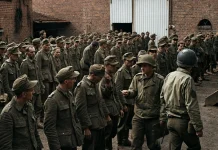
Also found at Gouvy, was an abandoned army prisoner of war camp containing over seven hundred German prisoners of war guarded by one officer and eight military police. These prisoners were successfully evacuated by the Division. D Troop 87-CRS was relieved of all CCA 7-AD missions at 0800 and directed to proceed at once to Salmchâteau, then west, dividing into two columns to the northwest at points 655867 and 576852 with the mission of screening the north flank of the Division rear as far out as the general line Basse-Bodeux – Vaux Chavanne until relieved on order or until pushed back by enemy action. To replace D Troop 87-CRS, on the southeast Task Force Lindsey was created from the 14-CG’s 11 armored cars, 11 light tanks, 6 assault guns, 236 enlisted men, and was placed in positions at Grüfflingen, Thommen and Espeler with the mission of protecting the southeast flank of the Division.
In assigning this position to Task Force Lindsey the Division Commander had in mind the lack of depth in the defensive position of the 424-IR to the east. Two other security groups, known as Task Force Hawks and Task Force Wanke, were formed from the 14-CG. The former, with 5 light tanks, 1 recon team, and 30 enlisted men established a roadblock at Bovigny, and the latter, with 8 vehicles and 80 enlisted men was attached to CCR 7-AD for additional security on the north flank between Poteau and Vielsalm. In addition to all of the above, a tank destroyer section with a recon section was dispatched at 1030 to eliminate an enemy tank reported to be harassing friendly traffic in Houffalize. This force, however, met with ill fate; it did not find the enemy tank at Houffalize. On the return trip, it was ambushed at Sommerain and lost 1 tank destroyer, 3 jeeps, 2 officers, and 5 enlisted men.
The 112-IR (US 28-ID) is discovered
Along with the numerous reports continuously arriving of enemy activity in the sector, some very heartening information of friendly troops was received at about 1030 on Dec 19. Officers from the 112-IR visited the Division CP and stated that their unit had lost all contact with the balance of the US 28-ID and that the regiment upon the initiative of the Commanding Officer was adopting a defensive position on the southern edge of the woods about one and one-half kilometers south of Haldingen. They knew nothing of our own or any other friendly dispositions at that time. Fortunately, this placed the 112-IR on the 7-AD’s south flank, although there was a gap between the 112-IR and the right flank of the 424-IR. Effective Dec 19, 1600, the 112-IR was attached to the US 106-ID, and on the following day, it was moved to its left so that the gap was closed.