



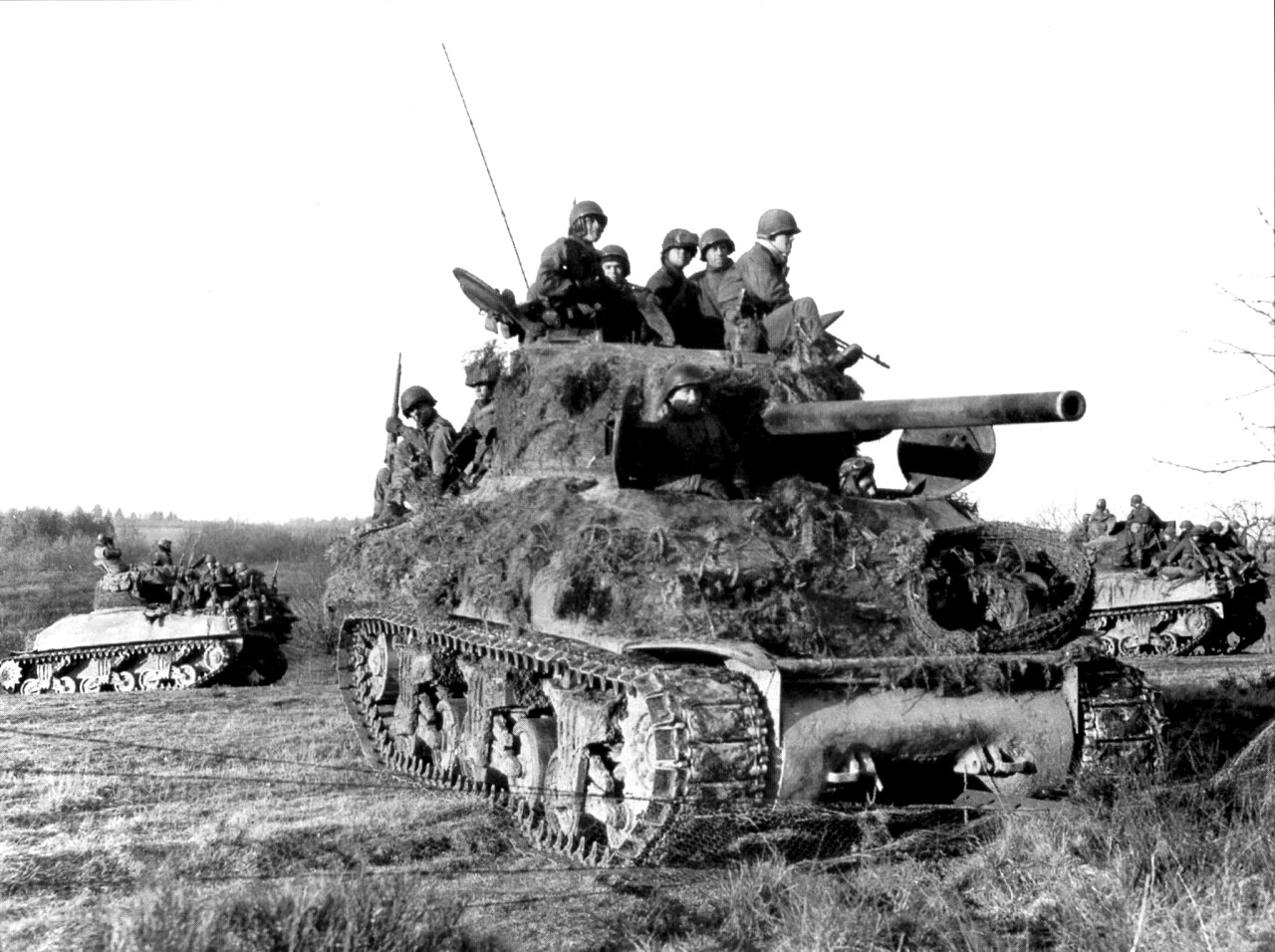
During the period, detailed plans were made for seizing the town of Brachelen. The town was defended by the German 694.Infantry-Regiment, the 695.Infantry-Regiment and the 696.Infantry-Regiment from the 340.Infantry-Division. The attack was dependent upon the destruction of the Roer River Dams which would isolate the town. When one of the dams was broken it would take from 4 to 5 1/2 hours for the crest of the flood to reach Brachelen, and as the dam could not be bombed before 1000, the attack was to be launched the day after the destruction of the dam. CCB 7-AD was assigned the job of taking Brachelen. The plan of attack was outlined in Operations Instructions on December 11, at 0900, known as plan Dagger. CCA 7-AD was to move east of the Wurm River after CCB’s attack. Both combat commands were constituted as follows:
CCA
– 40th Tank Battalion
– 48th Armored Infantry Battalion
– Able Co, 33rd Armored Engineer Battalion
– Dog Co, 87th Cavalry Rcn Squadron (Mecz)
– Able Co, 814th Tank Destroyer Battalion
– 1st Co, Recon, 814th Tank Destroyer Battalion
– Detachment, 77th Armored Medical Battalion
CCB
– 23rd Armored Infantry Battalion
– 31st Tank Battalion
– 38th Armored Infantry Battalion
– Baker Co, 33rd Armored Engineer Battalion
– Baker Co, 87th Cavalry Recon Squadron (Mecz)
– Charlie Co, 814th Tank Destroyer Battalion
– 1st Plat, Baker Co, 814th Tank Destroyer Battalion
– Detachment, 129th Ordnance Battalion
– Dog Co, 203rd Antiaircraft Artillery Battalion
– Detachment, 77th Armored Medical Battalion
CCR
– 1 Squadron Recon, 814th Tank Destroyer Battalion
– Charlie Co, 33rd Armored Engineer Battalion
DECEMBER 10
Today, Col Bruce C. Clarke, Commanding CCB 7-AD, was promoted to brigadier general. At 1000, CCB 7-AD was placed in the Corps reserve.
DECEMBER 11
At 1500, CCB was released from the Corps Reserve and replaced by CCA 7-AD.
DECEMBER 13
Division Main Headquarters moved from Robroek to Heerlen, Holland, while the rest of the division continued training and maintenance, pending the destruction of the Roer River dam and the beginning of the operations Dagger.
DECEMBER 16

 At about 1730, the division was alerted for early movement to the US VIII Corps in the vicinity of Bastogne. The Assistant G-3, Maj Moeller, and the CO, CCB 7-AD, left at 2100 for the VIII Corps HQ. Instructions were received outlining the division assembly area as generally between Vielsalm and St Vith, Belgium. Advance billeting parties departed for the new area at 2130.
DECEMBER 17
Movement South. The Division was alerted to move at 0200. It received orders to cross the initial point on the west route at 0330. The column was on the road when further orders were received to delay the movement for one hour. The trouble commenced even before the division arrived in the prescribed assembly area. The east route was cut by the enemy south of Malmedy, Belgium, just between the 7-AD Division HQs (TAC) and the 7-AD Division Artillery, necessitating the latter and all following elements to turn back and place themselves on the west route in the rear of the troops already moving thereon. This was successfully accomplished but resulted in a considerable delay in the arrival of the artillery to its firing positions. Traffic on the west route continued to roll fairly well until noon on Dec 17, then it was slowed by congestion resulting from the ever-thickening stream of friendly troops flowing west and northwest from the threatened areas in Poteau, Vielsalm, Beho, St Vith, Belgium. Towards nightfall, the traffic congestion increased, and the 7-AD column which extended from Poteau through Vielsalm, then Trois-Ponts and Stavelot to the north, was brought to a complete standstill. The only troops which had arrived in the Vielsalm – St Vith area were the 87-CRS, CCR, CCB, CCA, and the Division HQs (TAC). The artillery, the tank destroyers, the anti-aircraft artillery, the engineers, and the Trains were still on the road unable to move.
CCB Goes into Position. CCB had closed in an assembly area near Vielsalm at approx. 1100. Gen Clarke had visited CG VIII Corps, at Bastogne and had been partially acquainted with the general situation as well as it was known at that time. The Corps CG directed him to proceed to the Gen Allan W. Jones US 106-ID HQs at St Vith and give that division assistance. At 1200, the situation in the sector of St Vith was critical. The US 14-CRG (Cavalry Group) was retiring meanwhile, the communications with two US 106-ID surrounded regiments, the 422-IR and the 423-IR, was sporadic by radio. To the south, the situation of the third 106-ID regiment, the 424-IR, was more than hazy. There was no physical contact between the units. The CG of the 106-ID urged an immediate attack east from St Vith to take and hold Schoenberg in order to provide an escape corridor for the two surrounded regiments. This was prepared for and plans were made and approved by the Division Commander. However, due to the congestion of the roads, it was impossible to get troops of CCB from the vicinity of Vielsalm to St Vith in time to launch the attack that afternoon. In the meantime, the enemy had approached St Vith from the east and was only three to four thousand yards from the town.
At about 1530, the US 106-ID sent elements of HQs 81-ECB, 168-ECB (less one company), and one platoon of infantry, formerly used as CP guard, to block the road to the east of St Vith. The US 106-ID made the 275-AFAB located in positions around Ober-Emmels, available to CCB. During the afternoon, the 38-AIB, the first CCR unit to arrive southeast of Recht by the east route; the 87-CRS, the first unit to arrive by the west route; and troops of CCB were rushed to the east of St Vith, arrived piecemeal, and disposed of defensively by the CG of CCB. When this was accomplished, the CG of the US 106-ID turned over the defense of St Vith to the 7-AD at 1530. At 2030, the following message was received by telephone from the S-3, CCB:
Request that CCB liaison officer at Division Headquarters be released and returned to CCB HQs in order to get an overlay of CCB situation. Have set up defensive line east of St Vith which is tied in in all areas. These are being corrected at this time. While we have been receiving all manner of reports that there are as many as sixty (60) enemy tanks in our sector, the troops have received comparatively little fire – some small arms and mortar fire on their positions with very few casualties. The reserve of CCB consists of 38-AIB minus one company. We feel that we can handle the situation.
(It should be noted that at 1640 the 87-CRS and 38-AIB were attached (Vocal Order Commanding General) to CCB).
DECEMBER 18
By daylight, the column was rolling again but was again intercepted by the enemy, this time at Stavelot at 0800. Dog Co, 203d AAAB (AW) (SP) was attacked by fire from the southeast of Stavelot, but successfully disengaged and with the one company of ordnance to its rear withdrew to the north. They finally rejoined the division by a circuitous route through Spa and Aywaille.
CCR – Arrives in Assembly Area
During the afternoon of Dec 17, while CCB was thus establishing the defense east of St Vith, CCR was moving by the east route into its assigned assembly area generally south of Recht. There, it closed, less some stragglers, at 1500. As the 38-AIB was attached to CCB at 1640, the only unit remaining under CCR control was the 17-TB. The CP of the Combat Command was established in Recht.
CCA – Arrives in Assembly Area
Also during the afternoon of Dec 17, CCA, which had marched behind CCB on the west route, assembled in the vicinity of Beho. HQs CCA closed in Beho at 1755 and the remainder of the command closed in the new area in the vicinity of Beho at 1905. Due to the gravity of the situation east of St Vith and at Recht and in view of the enemy’s approach towards Poteau from the northeast, threatening to outflank CCB on the north, the CO of CCA was instructed at midnight of Dec 17 to report to the Division CP at Vielsalm and to have his command alerted to move on thirty minutes’ notice after 0700, Dec 18.
814-TDB – Arrives in Assembly Area
During the afternoon, Dec 17, the Corps Commander ordered that the 7-AD establish a roadblock at RJ797944. Upon arrival, of the 814-TDB in the assembly area at Vielsalm at 2300, a platoon of destroyers with reconnaissance elements of the 814-TDB was dispatched on this mission. The platoon reached the road junction without incident where it stayed until 1525, Dec 18, at which time it was recalled. Also, the CG of the 814-TDB was instructed to send one tank destroyer company to CCB by way of Beho at first light on Dec 18.