

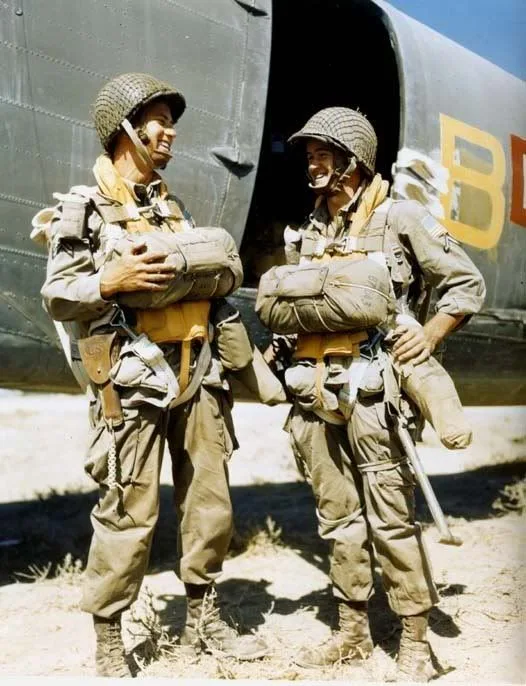


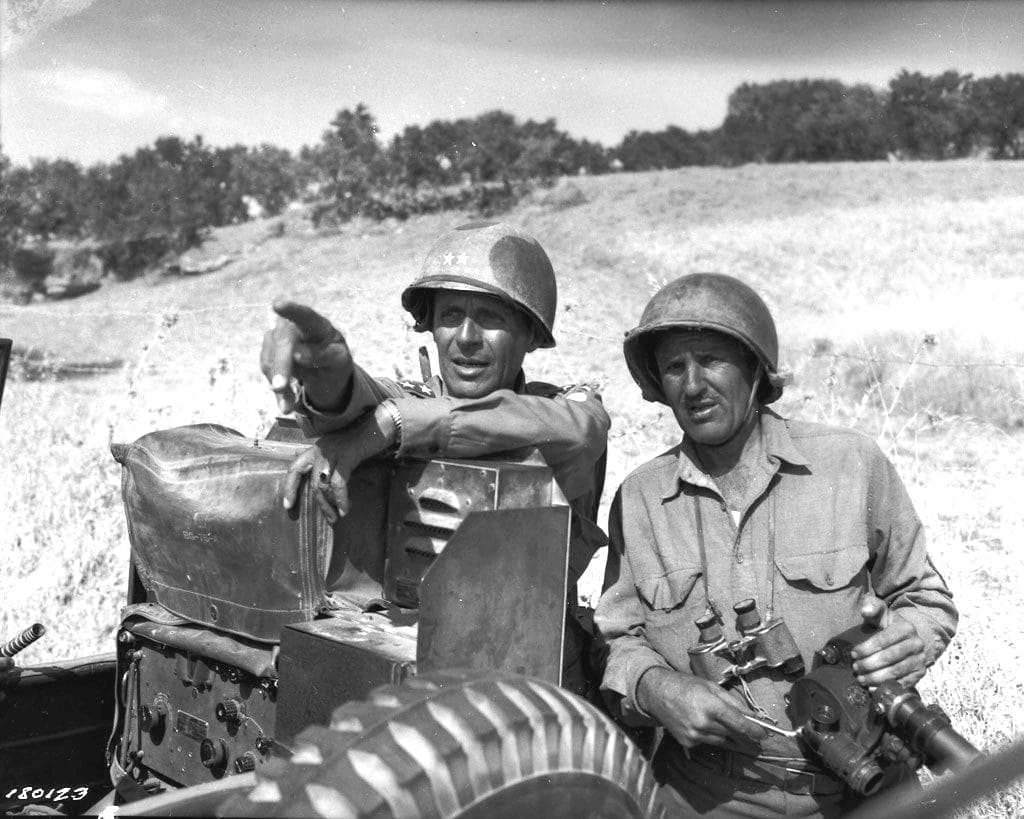
The grueling Mediterranean sun, however, told on the foot-weary paratroopers; it was march, march, march, day and night. They prayed for the enemy to make a stand so that they could stop and fight – and rest. For five days and nights, this continued and in an outstanding tribute to the physical stamina of parachute troops, men of the 504 waited and fought their way from Agrigento to San Margherita – a distance of 150 miles. At 0830, July 23, Corps orders were received by the Division to move without delay to seize Trapani.
The Surrender
The 505-PRCT was moved by truck to Trapani. A treaty of surrender was immediately dictated by Gen Ridgway to Adm Manfredi, Commander of the Trifani district, requiring cessation of resistance, preservation of stores, and the posting of guards on all military and naval property. In addition to Adm Manfredi, Gen Antonio Sodero, who was to have succeeded the Admiral in the command of the district, and 2639 other prisoners were taken during the evening of July 23 and the day of the 24, in and around the city of Trifani. Also captured were an uncounted amount of guns, other artillery and naval material, and stores, which, were hidden in tunnels in the mountains.
During the afternoon of July 23, Col Yarborough, CO 2/504, entered Castellammare Di Gulfo with a recon party and persuaded the Italian Colonel to surrender his forces. The defenses were strong. The shoreline was rocky and sharp. All beaches were mined. Coastal guns were covered by small arms and automatic weapons. All approaches were covered, except that inland. The defenses were all pointing out to the sea. The approach to Castellammare was a winding road on the face of a steep bluff. An anti-fascist reported this road as being prepared for demolition. He disclosed the position of the charges to the engineers before they could be blown. Approximately 10 tons of explosives (similar to TNT blocks) were tamped with sandbags underneath the road in a tunnel 3 feet square and 24 feet in length, with electric detonating leads running up to a farmhouse several hundred yards from the road. These charges were immediately neutralized and removed by Capt (Spike) Harris and his men of Charlie 307-A/B Engineers. Had this road been demolished, Castellammare would not have been accessible by vehicle. Due to the nature of the terrain surrounding the town, it would take a considerable length of time, effort, labor, and material (not available) to reconstruct the road. Apparently, the individual or group assigned the mission of demolishing this road decided it most unwise since they would be merely isolating themselves and cutting their own lifeline.
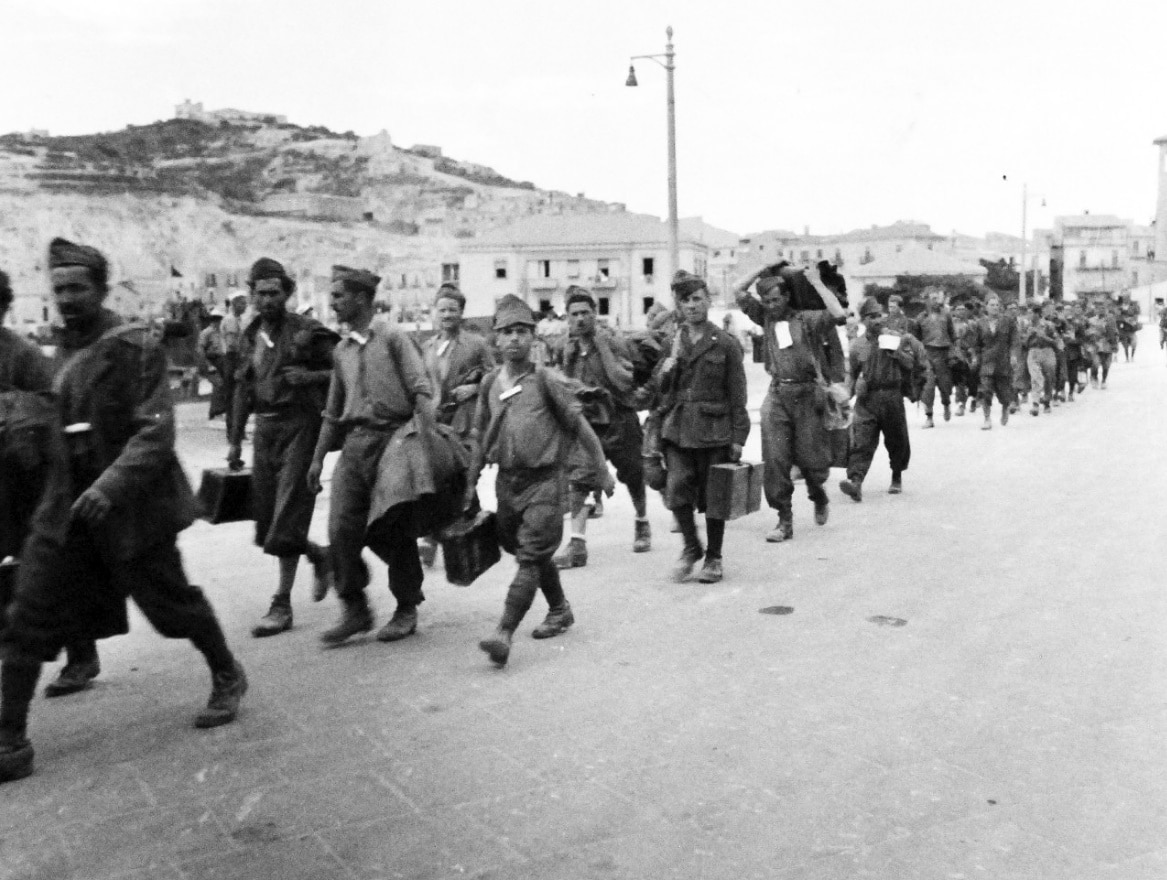
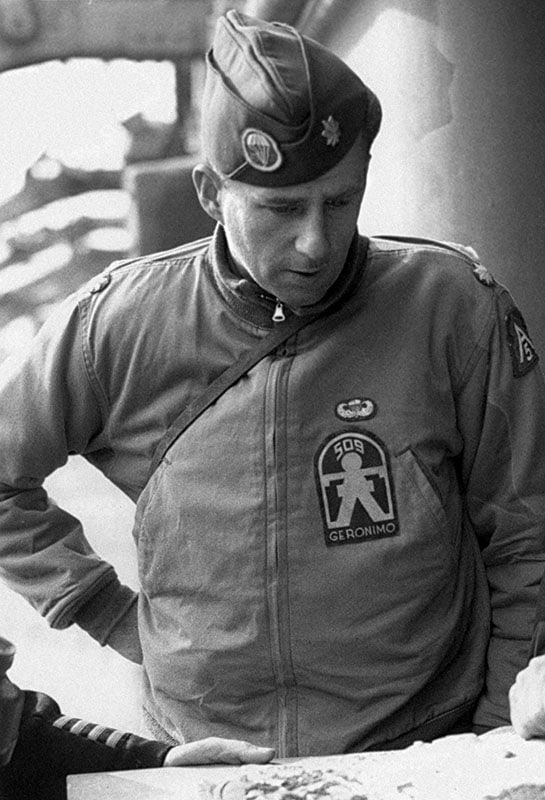 On the morning of July 24, Combat Team 504 proceeded to Alcamo where a Division Command Post was captured along with large enemy equipment and stores. The final objective was taken, the south and western portion of Sicily was in the hands of the Americans, The Regiment then moved south to Castelvetrano to police the occupied area and garrison it against the possibility of enemy counterattack, assembly captured stores, and gather in straggling prisoners. This was to be the work of many days. Prisoners were still being picked up and drifted in from isolated outposts for weeks to follow. Enemy barracks and stores which were being looted were placed under guard and the food stores were later appropriated to feed prisoners. Among the food stores taken were 28.000 hard rations from one warehouse, 700 pounds of beef, 2000 pounds of sugar, 600 pounds of coffee, 400 gallons of tomato paste, and a huge supply of Italian uniforms. The Egadi Islands, Favignana, Levanza, and Marettimo are situated 10-20 miles off Trifani which had been out of communication with the mainland since July 23, surrendered July 29 to Capt Richard Gerard, of the G-5 Section and Lt Louis P. Testa, PWI, who approached Favignana in a sailboat and negotiated a surrender with Col Silvio Serralunga. The population of the islands is about 6000; their garrison was nearly 1000.
The Relief – Return to North Africa
The 82-Abn was relieved and directed to return to its base in Kairouan. Orders were received to send staff representatives to the 7-A HQs in Palermo to formulate plans to move the division by truck to Palermo, thence by sea to Bizerte and thence by truck to Kairouan. The G-3 and assistant G-3 departed from Trifani on August 17, on this mission. The Division Commander was in Algiers when these orders were received. At 1500, Aug 18, a radio from the Division Commander at Algiers was received at Trifani, directing the Chief of Staff and two parachute Combat Team Commanders to meet him at 1600 on Castevetrano Airfield. At Castelvetrano the Division Commander informed these officers that all arrangements had been made and that, commencing the next morning, the troops in Sicily would be prepared for air movement back to Kairouan. During the night units scattered over the western end of Sicily were alerted by radio, telephone, and courier. The Division had only 24 trucks to move personnel and equipment to the airfields, which were as much as 45 miles away. At 0200, the orders were confirmed. On that day, August 19, the Combat Team moved out to the Castelvetrano Airfield, loaded up quickly into C-47s, and was transported back to Kairouan. Speed was essential and it is well indeed that the movement was executed by air without red tape and complicated coordination. The troops and equipment simply loaded up and took off for North Africa, the staff officers who had been in Army HQs at Palermo formulating the move by sea to North Africa arrived with approved but complicated plans for a rail-water journey just in time to board the last transport plane to Africa. The official confirmatory orders for the truck and sea movement arrived three days later after the Division closed in the Kairouan Area. Only sixteen days until D-Day (Italy).
