

 Their mission was thus stated in Field Order #6 issued by the II Corps, 1. Land during night D-1/D in areas K and E of Gela, and capture and secure high ground in that area. 2. Disrupt communications and movement of reserves during the night. 3. Be attached to the 1-ID effective H+1 on D Day and 4. Assist the 1-ID in capturing and securing the landing field at Ponte Olivio. In compliance with Field Order #1, of Force 543 (7-A), the division devised a Movement Table, under which the 504-PRCT, as a second lift, was alerted for movement the evening of D-Day or, in the event of negative instructions at that time, the evening of D plus 1, or any day thereafter.
The mission posed a number of problems never before encountered. First, should the transports fly into formation in order to quickly deliver a mass of troops on the objective? There were two disadvantages in formation flying, 1. inflexibility in the event of hostile interception and heavy flak, 2. a necessity for intensive pilot training in formation flying of C-47s. The advantages were that the accurate delivery of troops would depend on fewer skilled navigators and the troops would be delivered en masse, not by single ship drops, over the objective. If delivered in the wrong area, each unit would be still a complete fighting force. It was decided to fly in a nine-ship formation, i.e., a V of V’s, with approximately one and one-half minutes between each flight. Serials contained up to 52 planes. When to drop was the next question. Training, the experience had led the troopers to believe that at least a half moon would be necessary both for the flight and drop. Moonlight would greatly facilitate the assembly and reorganization of the troops after landing. On the target date selected (July 10, 1943) the moon would be almost full. The ideal solution would be to complete the dropping of all units before the moonset. Thus there would be several hours of darkness to carry out defensive organization and operations against the enemy. The exposure to interception by hostile fighters and the risk of extensive enemy attack causing heavy casualties eliminated the day drop.
 D-Day – H Hour
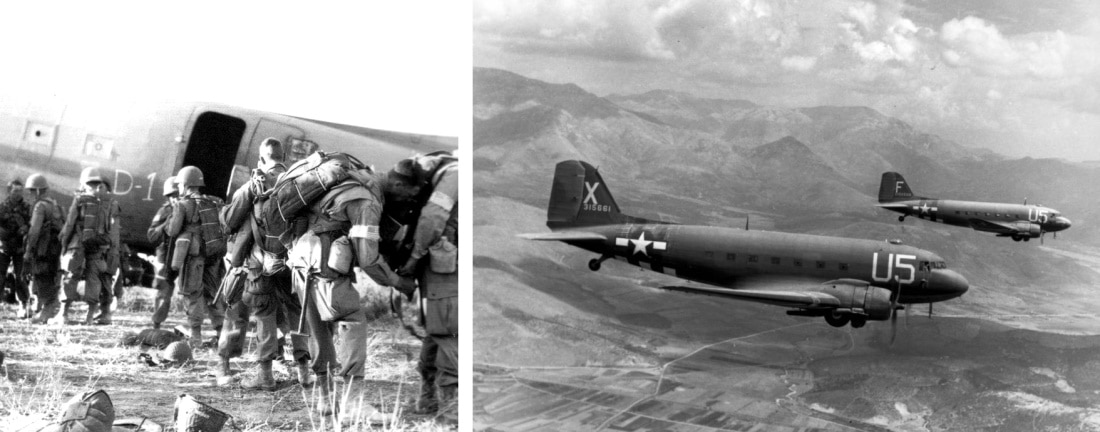
July 10 was selected as D-Day. At dusk of July 9, the 505-PRCT and the 3/504-PIR departed in 226 C-47s from ten airfields near Kairouan, Tunisia. The estimated flight and air rendezvous time between Kairouan and the intended Drop Zone in Sicily was three hours and twenty minutes. The 3/504-PRCT, (Col Charles W. Kouns), was alerted throughout D-Day for the second lift, at the fields and loaded in the planes, waited while a negative message from Gen Ridgway was delayed in delivery, but was finally received at 1840 when Col Hal Clark of the 52-TCW decided that it was too late for the mission to be undertaken.
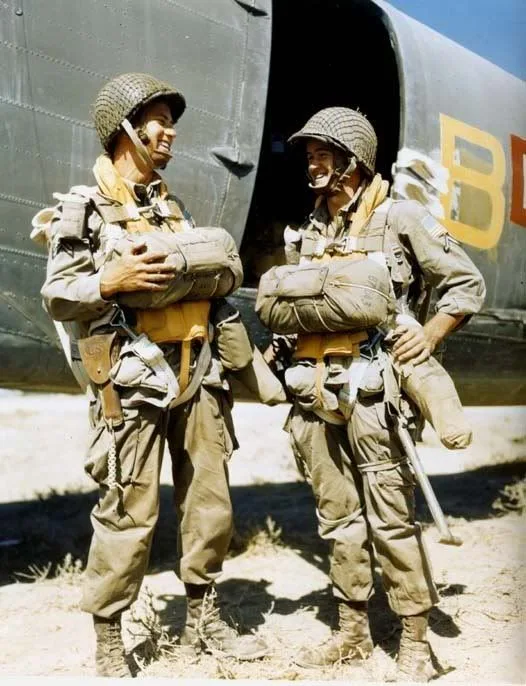
The next day, D+1, at 1100, orders were received that the second lift would be flown that evening. The basic load of combat equipment for the individual paratrooper was checked. The bundles and equipment were complete and the aircraft were dispersed according to the parking plan at the departure airfields. The equipment bundles were raised and hooked into the para racks under the bellies of the planes. Plane loads were lined up near their respective planes. The chutes of each individual were checked by each plane jumpmaster. The troops then enplaned 30 minutes before takeoff. The planning for the final takeoff had been complete and thorough, which, with the execution of the final plans, were probably the outstanding features of the entire airborne operation. Bundle and para racks loading, dispersal arrangements, and parking plans, all went off like clock-work.
 Allowance was not made for the time required to inform all shipping and shore batteries of the impending flight. Ground units beyond the 1-ID area knew nothing of the operation. The 504-PRCT was not familiar with the situation or countersign of units on the flanks of the 1-ID area. The African sun, like a bloody curious eye, hung on the rim of the world as one hundred and forty-four planes coughed into life, spewing miniature dust storms across the flat wastes of desert airfields. Thin aluminum skins of C-47s vibrated like drawn snare drums and, as paratroopers sought their predesignated seats, they wrinkled their noses at the smell of gasoline and lacquer that flooded the planes’ interiors.
The takeoff proceeded in three planes V formations as planned. Flights, squadrons, and groups assembled at rendezvous points. By dusk the planes were airborne and the formations started flying their course for Sicily. The planes were to cruise north over the churning sea to Malta, thence to the southeastern coast of Sicily at Sampieri, thence along the coast to the Biviere Lake southeast of Gela, and thence inland to the Forello Airport. The approach was to be low level, keeping a low and closed formation across the Mediterranean, rising to a jump altitude on the approach to the Drop Zone to 600 feet. A twenty-minute oral warning was to be given to the jumpmaster by the crew chief, then a five-minute red light warning, and finally the GO on the green light. The air was relatively quiet; the night was lighted by a quarter moon and the highest hope for a safe crossing seemed justified. Some men closed their eyes and dozed off to sleep, while others anxiously craned their necks to peer ahead or to look down at the white-capped waves which tossed fifteen feet below the planes. Some formations missed Malta, planes lost their leaders and a few planes followed a British formation which was at the same time flying a token parachute force into the vicinity of Siracusa.
Parachute Drop on Sicily
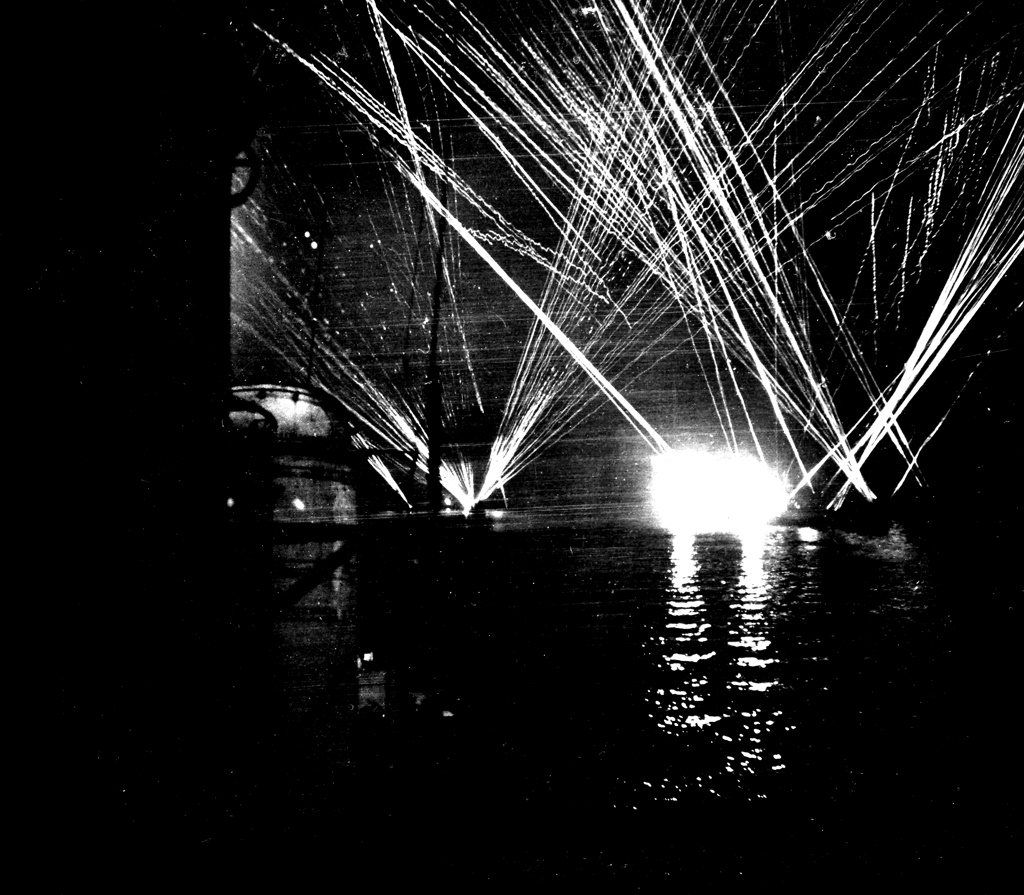
Approaching the Sicilian Coast, the plane formation was suddenly fired upon by one American machine gun. At first, it appeared as a flare. Then the fire suddenly became very intense. Immediately, as though a prearranged signal, friendly anti-aircraft and US Naval vessels lying offshore fired a devastating torrent of AAA fire. The plane has no slit trench to get into, nor can it assume the prone position or take cover. We felt like trapped rats. It was a most uncomfortable feeling knowing that our own troops were throwing everything they had at us.
(An account from Robert F. Door) Troop transport planes carrying American paratroopers careened all over the sky, bursting into flames, disintegrating, and spraying men in all directions. It was horrible, recalls Capt Charles E. Pitzer, who was a pilot of one of the planes. Elements of the 504-PIR were shot to pieces by friendly fire on July 11, 1943, as they approached Gela, Sicily, for a jump. More than 300 brave men died. A day earlier, on July 10, 1943, the Allies had landed 170.000 troops into Sicily in the largest amphibious operation to that point in history. Now, 2000 paratroopers of the 504-PIR were scheduled to make up a second attack wave, jumping into the harbor city of Gela from C-47 Skytrains and C-53 Skytroopers (C-47s customized for parachute operations). Instead, fellow Americans would kill many of the men in the greatest friendly fire disaster in American history. The operation was codenamed Husky, the Invasion of Sicily, and it began on the night of July 9–10, with Pitzer and 226 other pilots dropping 2200 paratroopers of Col James Gavin’s 505-PIR into Gela. The 82-A/B (Gen Matthew B. Ridgway), thus launched the first-ever significant combat parachute assault by Americans. Several transport planes were lost, but that gave no hint of what was to come.
Amphibious landings started in the morning. German aircraft spent the day attacking the invasion fleet, fraying gunners’ nerves. Ridgway considered too old to parachute, reached Sicily by sea. He concluded that a second airdrop was unnecessary, but by then the momentum was unstoppable. A second drop, initially planned for July 10, was hastily rescheduled for July 11. One hundred forty-four transport planes would carry the soldiers of the 504th. An order was issued to ensure that ships would be informed about the paratrooper transport planes passing overhead. But many of the ships’ crewmen insist to this day that they never saw the order. Incredibly, naval commanders told Ridgway that the Navy could not guarantee the safety of his force.
Pitzer remembers cruising at 400 feet, the altitude at which drops were made. It was radio silence and lights out, said Pitzer. Approaching the armada of Allied ships offshore from Gela, Pitzer, and other transport pilots flew in V formations of nine planes each. Gunners aboard the ships had been shown recognition slides to help them distinguish aircraft types. Twin-engine aircraft of similar appearance in these briefings included the C-47 as well as the German Junkers Ju 88 bomber. But as darkness fell, most gunners would never see the aircraft they were about to shoot.
 The first two formations of transport planes followed their prescribed course and discharged their paratroopers squarely on target. These would be the only airborne soldiers to float down safely to the correct drop zone. When the next formation appeared over the shoreline, a never identified nervous gunner on the beach began shooting. Other scared gunners onshore and aboard ships sent volleys of fire lofting into the night sky. Accusations would later descend on the gunners like artillery fire. Maurice Poulin, a coast guard seaman 1st class who manned a 20-MM AAA gun on the troop transport USS Leonard Wood (APA 12), calls the blame a bum rap. We had been under attack by German dive bombers, he says. We did not know paratroop planes were coming. Poulin went on to say that ships had given orders to elevate the guns at 75 degrees and fire when attacked. Crews in the gun tubs aboard the Leonard Wood sent their volleys of fire soaring skyward without seeing their targets. We shot down many planes but had no knowledge of whose they were, Poulin said.
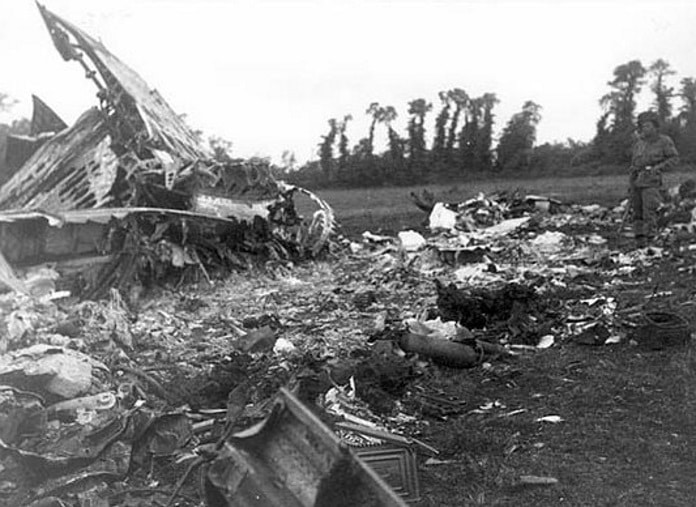 Tucker was aboard a C-53 that began to disintegrate before reaching the shoreline. After a very confusing conversation between him and the pilot, the plane made a U-turn to fly back toward Gela. Under intense fire from friendly guns, Tucker and his paratroopers jumped. On the ground, he removed his helmet and banged it against a tank hull to alert the crew to stop firing on the planes. It seemed as though every Allied gun battery on the Sicily Beachhead and offshore was blowing C-47s and C-53s out of the sky. The US Army’s own official history reads the slow-flying, majestic columns of aircraft were like sitting ducks. Dozens of transport planes were hit. One exploded in midair. Others, on fire, tried to ditch to save the paratroopers. Squadrons broke apart, tried to re-form, and scattered again. Eight pilots turned back for Tunisia still carrying their paratroopers. Those over Sicily dropped paratroopers wherever they could. Some of the jumpers descended into the sea and drowned. Some were killed by friendly fire while dangling from their chutes in the night sky. One transport plane caught fire and headed down, veering sharply to avoid hitting an Allied ship. Careening across the water, the plane trailed a long orange plume of flame as men, some of them on fire, rained from the fuselage. (End of Account)

Planes dropped out of formation and crashed into the sea. Others, like clumsy whales, wheeled and attempted to get beyond the flak which rose in fountains of fire, lighting the stricken faces of men as they stared through the windows. More planes dived into the sea and those that escaped broke formation and raced like a covey of quail for what they thought was the protection of the beach. But they were wrong. Over the beach, they were hit again and this time by American ground units, believing the planes to be German. Before planes fell and from some of them, lucky men jumped and escaped alive, the less fortunate were riddled by flak before reaching the ground. 27 planes were shot down over the beach area and many more were damaged, some of which never did reach their base.
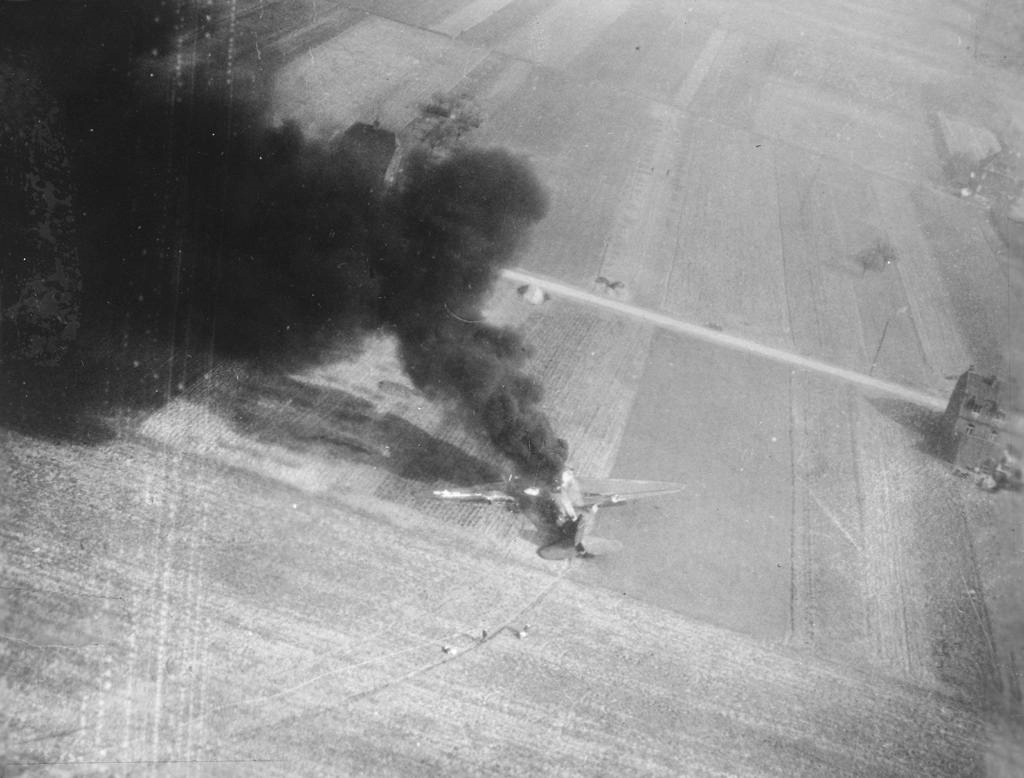
Planes forced down near the coast were machine-gunned by shore parties as paratroopers attempted to launch rubber boats which were a part of the plane equipment. The pilot of one of the planes which did return told of his difficulties: a few minutes before reaching the DZ with the paratroopers, a shell smashed into the starboard side of the fuselage and knocked out a hole, four by six feet, while a fragment from the shell slit the aluminum and every rib from hole to rudder. Passing through the plane the fragment ripped off a door as a second ack-ack blast carried away a portion of the left stabilizer. The explosions also blew away a large piece of equipment, and the impact was so great that it felt like a motor crash in the pilot’s cabin. The airplane spun at a right angle and nearly pulled the controls from my grasp. For a second I didn’t realize what happened, then finding myself out of formation I began a violent evasive action. I saw three planes burning on the ground and red tracers everywhere as machine gunners sprayed us as if potting a flight of ducks. Meanwhile, I had out into a less dangerous spot to give the parachutists a fighting chance to reach the ground. But I’ve got to hand it to those boys; one, who had been pretty badly hit by shrapnel, insisted on leaping with the others although he had been ordered to remain in the plane.
One of the more harrowing reports was that of Lt C.A. Brew, Fox Co. His statement shows that some men were lost because a warning of the flight had not been conveyed to the men of one unit, and others because each division then had its own password. I was the jumpmaster in plane 531. This plane was leading a formation of 3 planes and was number 7 in our company. The pilot of my plane gave me the warning 20 minutes out of the DZ. After the red light came on, he had to give me the green light in about 1 minute, due to the plane being on fire. We jumped into a steady stream of AAA fire and not knowing that they were friendly troops. There were 4 men killed and 4 wounded in my platoon. Three of these men were hit coming down and one was killed on the ground because he had the wrong password. After landing we found out the countersign had been changed to (Think)-(Quick). The AAA we jumped into was the 180/45-ID. They also were not told that we were coming. Later we found out that the 45-ID had been told we were coming but word never got to the 180-IR. We tried to reorganize but found we didn’t have but 44 men including 3 officers. We searched all night for the rest of the men. After accounting for them we took care of the dead and wounded and started toward our objective. We arrived at the 504 CP at 0200 Jul 12, 1943. About 75 yards from where I landed, plane 915 was hit and burned. To my knowledge, only the pilot and three men got out. The pilot was thrown through the window. Another plane was shot down on the beach and another plane was shot down, burning about 1000 yards to my front. Although there were three planes I know of, being shot down.
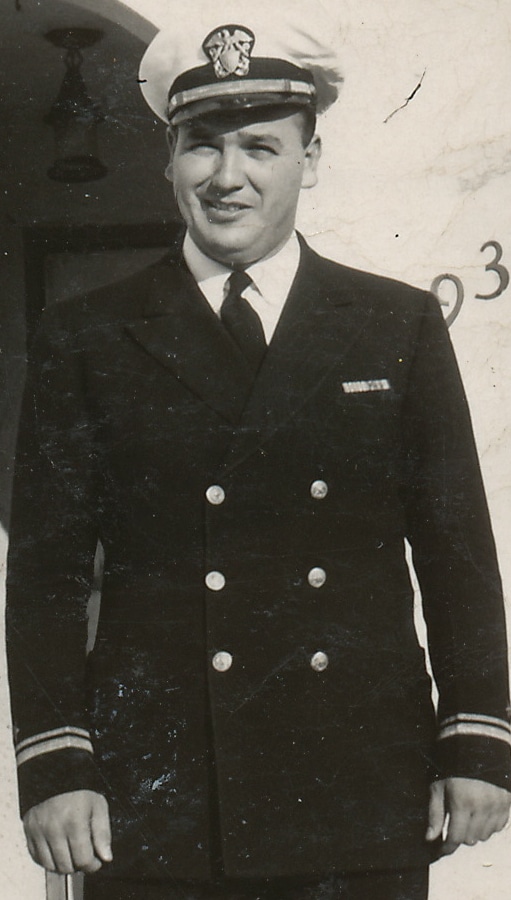 Capt James Frederick Parr, USN, on DD-618 (USS Davison) was also an eyewitness of the tragedy. His son, Terence, reports the story as follows, in 2007, on Father’s Day, as we approach the anniversary of that invasion, I decided to record what I remember from a conversation I had with my father, a few months before his 90th birthday. The conversation started out normal enough. Dad told me about the German Heinkel bombers. Oh, that was an effective bomber. I remember an attack by three Heinkels during the invasion of Sicily. They flew towards our invasion fleet from inland, soared up and over the hills lining the beach, and turned 90 degrees for a bombing run along with our ships, which were sitting like ducks in a row.
I said, Wow! What happened? They almost got our ship. I looked up at the bombers and saw one of the bomb bay doors open, a bomb fall out and arc just over our ship to explode in front. While I’m sitting there trying to process that, I hear my dad say quietly to himself, we shot down 23 aircraft. I looked at him and he had this glassy faraway look in his eye that I had never seen before. But, dad, you said there were only three bombers. No, they were ours, he said. Dad, you’ve got me totally confused. Son, there was a tragic friendly fire incident during the invasion where we shot down our own C-47 planes filled with paratroopers. Huh?! Are you talking about the famous incident? Yes, he said. How did it happen? I’ve never heard an explanation. Dad began, I was on the bridge when the admiral in charge of the invasion fleet called on the radio to tell us that the paratroopers were coming in on a different vector than we expected and not to fire on them. The Admiral said they are friendly, repeat, they are friendly. Then, some kid in a radio room in the bowels of one of the ships replies, Friendly hell! They just dropped a stick (slang for a bomb) on me. And then the whole world just opened up on ’em. It was raining bodies and body parts. Shrapnel from a 5-inch shell would literally rip open a C-47 like a tin can, spilling the paratroopers out over the ocean.
I’m thinking, Jesus Christ! It was just a terrible coincidence that the Heinkel bombers had come over the fleet just before the paratroopers were coming in. I sat there stunned for a second and then asked, well, couldn’t people tell they were C-47S not German bombers? Jittery kids with binoculars? I once saw a beat-up American fighter slowly drift towards the beach to ditch and somebody on a nearby LST open up with an AAA gun, ripping one wing off. The fighter flipped over and smashed into the surf, killing the pilot. I was really shaken up and moved by what he had told me. On my drive home, I realized that I somehow felt disconnected from him. He had given me a glimpse into the atrocities of the war he’d experienced, revealing a side none of us had ever seen. There was a hidden compartment that he kept tightly locked, like many WW-2 veterans. In later conversations, he would point blank and refuse to answer further questions because I had not experienced combat. He only would say that the bond between men that have faced death together was stronger than between brothers. It’s not something we can discuss.