




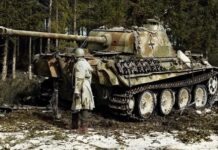
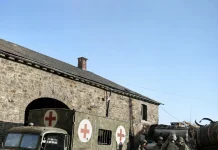

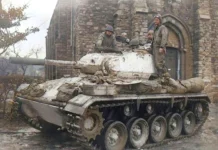

Tactical Exploitation Force (T-Force)
 During the final phases of the Second World War, the Allied command recognized the critical need to seize and safeguard enemy scientific, industrial, and technological assets before they could be destroyed or fall into Soviet hands. This led to the creation of the so-called T-Force — a clandestine field unit with a specific mission: tactical exploitation of strategic enemy infrastructure and personnel in real-time combat conditions. Formed under the umbrella of SHAEF (Supreme Headquarters Allied Expeditionary Force), T-Force operated as an intelligence-driven assault detachment, often attached directly to front-line formations, with orders to move in immediately behind advancing troops to secure designated targets. Its early structure — a modest detachment of fewer than 20 men in 1944 — quickly evolved into a highly mobile exploitation force with over 3000 personnel by spring 1945.
Operational Purpose and Strategic Value
T-Force’s objectives were threefold: (1) Prevent the destruction or sabotage of critical infrastructure (ports, research facilities, laboratories, communication hubs, factories); (2) Secure enemy scientific and industrial experts, including nuclear physicists, engineers, and senior industrial managers, and (3) Extract intelligence assets, technical documents, archives, prototypes, and systems of military interest. In practice, this meant T-Force would often move alongside or just behind conventional combat units, entering towns, ports, or facilities with precompiled target lists. Their actions were preemptive, fast, and surgically executed, often involving unorthodox methods such as unannounced seizure, coercive interrogation, or extraction of individuals under escort — sometimes in direct violation of zone boundaries or formal chain of command. The unit operated across the Western Front — including France, Belgium, Luxemburg, Holland, and Germany — but became especially active during the final Allied push into the Rhineland and the Ruhr Industrial Basin.
Composition – December 1944
By December 1944, in the midst of the Ardennes Campaign, T-Force operated from a forward base near Remouchamps (Belgium), with its headquarters temporarily set up at Bradley’s Twelfth Army Group and Hodges First Army HQs in Balmoral-Spa (Belgium). Its structure at the time included:
– 6860th HQ Detachment, Core command element (8 officers + enlisted staff); Anglo-American staff.
– 526th Armored Infantry Battalion, Assigned for physical security of high-value sites and personnel extraction.
– 99th Infantry Battalion (Separate), Norwegian-American light infantry used in defensive and assault support.
– Able Co, 825th Tank Destroyer Battalion, provided mobile firepower for site seizure or defense.
– Engineer Bns, Specialized in explosive ordnance disposal, infrastructure assessment, and demolition prevention.
– Sig. & Intel. Liaison Teams, Managed communication between SHAEF, local commands & intelligence repositories.
This configuration allowed T-Force to operate with speed, autonomy, and targeted precision, often deploying in small combat teams reinforced with engineers, linguists, and scientific advisors.
Activities and Actions
Throughout late 1944 and early 1945, T-Force conducted dozens of raids and seizures, including: the capture of technical laboratories and communication centers in the Ardennes, often under German artillery threat; the prevention of German demolitions in towns such as Stavelot and Malmedy; the advance on Kiel Naval Base in May 1945, in breach of Allied boundary orders, to prevent the Soviets from accessing German naval research. T-Force’s actions not only preserved infrastructure vital to postwar reconstruction, but also provided the technical groundwork for Western advancements in rocketry, nuclear physics, radar, chemical engineering, and industrial metallurgy — long before Operation Paperclip formalized such transfers.
Legacy and Historical Significance
T-Force is often overlooked in the broader history of Allied military operations, yet its role was foundational in the transition from wartime intelligence to Cold War exploitation doctrine. It represented the first real-time integration of intelligence with front-line operations — setting precedents later seen in CIA and MI6 field activities. By securing physical control over German intellectual capital, the Allies gained an overwhelming advantage in the postwar technological race. Equally, the work of T-Force laid the groundwork for multiple war crimes investigations by seizing intact archives and interrogating key witnesses on-site.
Conclusion
The T-Force of December 1944 was not a conventional combat unit — it was a covert, purpose-driven force at the intersection of military intelligence, battlefield exploitation, and strategic foresight. Its ability to act decisively behind enemy lines, with limited oversight, contributed directly to the dismantling of the Nazi war machine and shaped the contours of Western scientific dominance for decades to come.
I wish to add another aspect to this account because I believe it had a profound overall effect. I mentioned that the 526 was a separate unit with a special mission. We were the fighting element of T Force. The mission of T Force was to apprehend and capture specially designated personalities and specially selected building targets. Our companies, in turn, were broken down into highly mobile, hard-hitting, target teams that were expected to operate with a lot of autonomy, were expected to be self-sufficient, and capable of independently securing their targets without support, help, or detailed supervision. I believe what happened was that when the first fights started, Abel Co personnel subconsciously reverted to their team concept. I believe instead of a single battle occurring, in reality, about 20 independent fights were going on, each superbly interacting without the knowledge or recognition of each other. When I joined Capt Mitchell and his men beyond the gas dump, I was struck by the comparatively few men assembled. (Our Battalion was huge – we were authorized 110% of our authorized TO&E. And each of our squads had the firepower of a platoon of regular infantry.) My initial fear was that we had suffered huge losses. In actuality, we suffered surprisingly few casualties when the intensity of the battle is considered. As the fighting progressed, these target teams disappeared into the bowels of the building or rubble until the battle swept over them and would then resurface. There were many incidents where the same building was occupied by both Abel Co personnel and Germans.
 When compared to the well-disciplined and coordinated action of the highly trained and seasoned veterans of the 30-ID, the action of the task force might have appeared like the action of a mob out of control. However, to a skilled observer familiar with the training and mission of the 526-AIB, it can only be considered one of the great good fortunes of the war that the 526-AIB was readily available and that this small task force was chosen to go to Stavelot. I strongly believe that no other unit in the army could have done as much as Able Co 526-AIB. They valiantly achieved their mission, they slowed the drive of Hitler’s famous Leibstandarte until the arrival of the 117-IR, and they prevented the gas dump from falling into the hands of the enemy. I also confirm that the 526-AIB, and especially Able Co, while they may bow their heads in deference to other famous units in the Army, they never have to bow in humility.
Lt John V. Pehovic

 APPENDIX
AAR Able Co 825-TDB – CO Capt Joseph H. Dibert
NB During the month of December 1944, the 825-Tank Destroyer Battalion (less detached unit, particularly Able Co, which was located in the vicinity of La Reid (Belgium) was stationed in Luxembourg City. Its primary mission is the perimeter defense of the Headquarters, Twelve Army Group TAC. On December 16, an enemy breakthrough was reported in the vicinity of Berdorf (Luxemburg), Lauterborn (Luxemburg), Osweiller (Luxembourg), and Dickweiller (Luxemburg). Security and AT defenses were immediately tightened. Able Co, in La Reid (Belgium), was alerted by HQs T Force Twelve Army group at 1130, December 17. At approximately 1600, orders were received from the T Force Commander that the Provost Marshall of the US First Army directed the Company move to Malmedy (Belgium), and occupy firing positions east of town. The Company was to be attached to the 526th Armored Infantry Battalion (S) (Maj Paul Solis) for the move to Malmedy. Upon reaching the town, the CO was to report to Lt Col Harold D. Hansen, Commander of the 99th Infantry Battalion (S). The Company joined the 526-AIB and passed the IP at La Reid at 2200, December 17.
While en route to Malmedy, the column was ordered to halt and await further instructions. Written orders were received that one Company of the 526-AIB and one Platoon of A-825-TDB should be moved to Stavelot (Belgium), and occupy positions south and southeast of the town, whereby the road blocks already established could be covered with fire. The force was placed under command of Maj Paul Solis, Executive Officer, 526-AIB, and was made up of Able Co 526-AIB and the 1st Platoon, Able Co, 825-TDB, This force moved to Stavelot and the remainder of the column moved to Malmedy. The column arrived at Malmedy at 0200, December 18. I reported to Lt Col Hansen as ordered upon arrival, who ordered my company to occupy positions already chosen to cover the road blocks by fire. Orders were furnished by the CO of Charlie Co, 291st Engineer Combat Battalion, and Platoon Leaders moved guns into position. The 3rd Platoon, Able Co 825-TDB took up positions in the vicinity of road blocks at (792052) and (778037). One Section of the 3rd Platoon occupies positions at each location. The defense was set up, and guns were in positions at 0430.
The 1st Platoon, Able Co 825-TDB arrived at Stavelot at approximately 0330, December 18. Maj Paul Solis, the force commander, sent one Platoon of Able Co 526-AIB and one Section of the 1st Platoon Able Co 825-TDB across the Amblève River to occupy positions on high ground south of the town. The other Section of the 1st Platoon, Able Co 825-TDB, and the AT Platoon of Able Co 526-AIB were held in reserve. The 1st Section Able Co 825-TDB crossed the river at approximately 0605. This Section was unable to reach the positions designated due to enemy fire, and upon trying to withdraw to take up positions to return enemy fire, they were hit by the direct fire of the enemy, knocking out the two guns and half-tracks. As a result of this action, six EM were missing, and two were battle casualties. At daylight, the enemy placed considerable fire on the town of Stavelot. The fire was coming from machine guns and heavy weapons, which were set up in the houses overlooking the town. One gun was put in position at (721013), whereby fire could be placed on the fixed enemy positions. By 0930, the gun had set fire to six houses and hit approximately ten others. At 1100, the rumble of tanks could be heard, and the tanks appeared on the hill south of the town. One gun was put in position at (721013), whereby fire could be placed on the fixed enemy positions. By 0930, the gun had set fire to six houses and hit approximately ten others. At 1000, the rumble of tanks could be heard, and the German Armor appeared at the top of the hill, south of the town. The Battle for Stavelot and the Amblève River Bridge was about to begin.
 APPENDIX
526th Armored Infantry Battalion (Separate)
NBIn addition to the divisions, there were also a large number of (Separate) infantry, parachute infantry, and glider infantry regiments and battalions. Most of them were utilized as garrisons or for guard lines of communication. For example, only a single separate armored infantry battalion (the 526-AIB) saw combat; the remaining fourteen were disbanded or converted to other units. In the Europan Theater of Operations, the 3rd Puerto Rican Regt, the 29th Puerto Rican Regt, the 65th Puerto Rican Regt), the 99th Infantry Battalion, the 118th Infantry Regiment, the 156th infantry Regiment, the 159th Infantry Regiment, the 442nd Regimental Combat Team, the 473rd AAA-AW Regiment, and the 474th Infantry Regiment (organized in France on Jan 6, 1945, with the 99-IB and the remnants of the 1st Ranger Battalion, the 3rd Ranger Battalion, the 4th Rangers Battalion, and 1st Special Service Force), the 517th Parachute Infantry Regiment, the 1st Ranger Battalion, the 5th Ranger Battalion, the 100th Infantry Battalion (442-RTC), which in mid-1944 replaced the old 1st/442d which was disbanded while the 100th Infantry Regiment retained its original designation, the 509th Parachute Infantry Battalion, 526th Armored Infantry Battalion, 550th Glider Infantry Battalion, and the 551st Parachute Infantry Battalion.
On Oct 26, 1944, the 526th Armored Infantry Battalion, assigned to the 10th Armored Group, was located in the vicinity of Granville, Normandy, France. This battalion claimed the distinction at that time and still does, of being the only separate armored infantry battalion in the Army. On that day, orders came in for the battalion to move to Verdun and become a part of the Special Troops of the 12th Army Group. From Verdun, the battalion departed for its destination in Belgium and Luxembourg. From Oct 30 to Dec 17, 1944, the battalion was stationed with the headquarters at Harze, Belgium. It was here that the battalion received its first taste of Buzz bombs and V-2’s. In one incident, a bomb landed 500 yards away from the battalion CP and broke windows and damaged the building.
At 1600 hours, Sunday, Dec 17, the battalion was ordered by US 1-A to move to Malmedy, Belgium, with Able Co of the 825th Tank Destroyer Battalion attached, and to join the 99th Infantry Battalion (Norwegian) at Remouchamps en route. In 1900, the battalion was formed on the Aywaille – Remouchamps road and was waiting to fall in with the 99th Infantry Battalion at Remouchamps. The 99th Infantry Battalion failed to show up by 2100, so the battalion was ordered to move alone at once, picking up Able Co 825-TDB en route at La Reid, Belgium. It was during this period that the Luftwaffe suddenly came to life, strafing and bombing roads between Spa and Malmedy.
The 526-AIB plus Able Co 825-TDB then proceeded on to Malmedy. Road conditions were bad, and it was exceedingly difficult to maintain control in the blackout. En route, one rifle squad, a half-track, and one half-track with a towed 57-MM AT gun dropped out of the column as a result of accidents. The 57-MM AT gun and half-track, in following, took a position at Trois-Ponts and engaged an enemy column of 18 tanks (Kampfgruppe Peiper). Knocking out the lead tank with a Daisy Chain, the German advance was blocked. However, the 57-MM was, in turn, knocked out, four men were killed, and one was wounded. Shortly after midnight, December 17-18, a message was received from US 1-A that enemy tanks were approaching Stavelot and ordered one rifle company and one platoon of tank destroyers dispatched there to form roadblocks and hold the enemy. Able Co 526-AIB with the 1st Platoon, Able Co 825-TDB were selected for this assignment, and the executive officer was placed in command of the task force. The balance of the force continued on to Malmedy. On arrival, it immediately began to reinforce roadblocks already established by the men of the 291-ECB and other defensive positions. This battalion, plus the tank destroyers, was the first combat unit to take up positions for the defense of Malmedy. The 99-IB arrived immediately following the arrival of the 526-AIB and took positions in and around the town.
APPENDIX
HQs 1111th Engineer Combat Group (Certificate of Circumstances Involving EM of the 526-AIB (Capt Robert N. Jewett)
To: Commanding Officer, 526-AIB
This is to certify that the following named enlisted men of Able Co, 526-AIB, did engage the enemy, who far outnumbered them, on December 18, 1944, under the circumstances narrated here:
T/Sgt Settlemeyer – Returned to organization
S/Sgt Albert Smith (34082797) – Returned to organization
T/5 Evin E. G. (39329120) – Returned to organization
Pfc Edward R. Burdine (35139106) – Returned to organization
Pvt Boyle Isaacs (35798443) – Returned to organization
Pvt John H. Surdo (39288375) – Returned to organization
Pvt Lillard B. McCollum – Killed in Action
Pvt Donald D. Hollenbeck – Killed in Action
Pvt Dallas N. Buchanan – Killed in Action
Pvt James L. Higgins – Killed in Action
Frazier – Missing in Action
Ralf J. Bicker – Missing in Action
Donald J. Devoto (?)
Frazier (?)
On Dec 18, 1944, the above-named enlisted men did establish a roadblock consisting of a string of AT mines (Daisy Chain) and one 57-MM gun in the vicinity of Trois-Ponts. An enemy armored column was reported on Highway 23 (N-23) as approaching from Stavelot. At approximately 1230, the first tanks approached and were stopped by Frazier and Bicker pulling the Daisy Chain in front of the leading tank. Although there were 8 tanks visible, the above-named enlisted men showed no panic and manned the 57-MM gun, with the result of the lead tank being disabled, and possibly the second one. A direct hit on the gun manned by McCollum, Hollenbeck, Buchanan, and Higgins resulted in the gun being disabled and the gun crew killed. The remainder of these enlisted men escaped and joined elements of the Engineer in the defense of Trois-Ponts, assisting in operations against the enemy for the next few days.
APPENDIX
Defense of the Spa Gasoline Dump, 1/Lt Walter R. Butts, Jr
On Monday, Dec 18, 1944, HQ Co, 9th Armored Group, received orders from Lt Col Lowell S. Love, Armored Section, US 1-A, to take up defensive positions south of the Gas Dump in the vicinity of Spa and provide a radio security net for the 1-A. The company had never been in action before.
Initially, 3 company officers were in charge: Capt Olaf W. Christopherson, CO; 1/Lt Walter Butts, radio net officer, and 2/Lt Donald Miles, in charge of the assault gun. Equipment consisted of 5 half-tracks and 3 assault guns. The half-tracks had their regular crews, each consisting of a driver, an assistant driver, and 3 radio men.
Initial reconnaissance of four proposed positions was carried out by the 3 officers in the morning, and it was evident that additional officers were needed. Capt Christopherson and 1/Lt Butts returned to Spa, and the 1-A assigned 2 additional officers, Capt John L. Fellows, and Capt John W. Gooley. The men had moved to their positions about 1000. The officers returned to their positions about 1530. Positions of the 4 roadblocks follow:
1. 2/Lt Donald Miles, in charge, was located north of Francorchamps at road junction 735087. Its defenses included 3 assault guns and one half-track.
2. Capt John L. Fellows, in charge, was located near Baronheid at the road junction 745104. This block was defended by a single half-track.
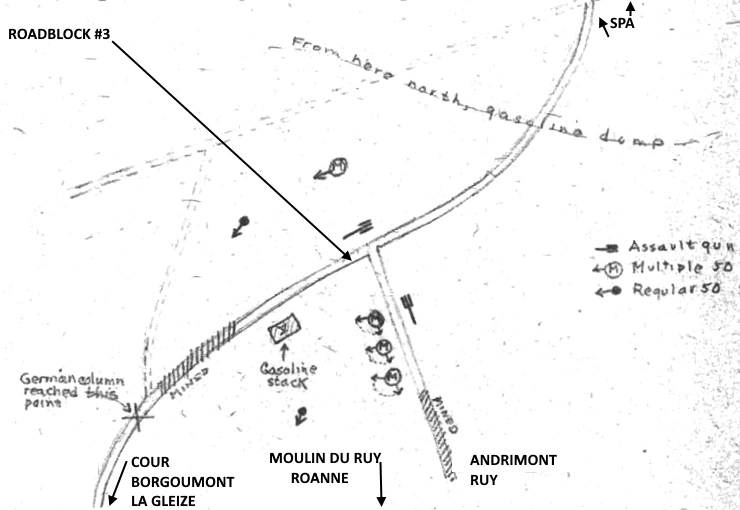
3. 1/Lt Walter Butts, in charge, was located at the road junction 679071. This block was defended by a single half-track and was the block at which the action to be described took place.
4. Capt John W. Gooley, in charge, was located on a hill above Stoumont, south of Monthouet. This block was defended by one half-track. One radio was at Spa to act as net control.
At 1500, before the officers returned from Spa, the men at roadblock #3 saw 3 US P-47 Thunderbolts fly over the valley to the south, and they saw German AAA in the valley open up on the planes, knocking down 2 of them. This was in the vicinity of Moulin du Ruy. This was the first indication that the enemy was in the vicinity. 1/Lt Butts and the other officers believed that the enemy was a considerable distance away, and the blocks were simply security measures against individual enemy troops who might infiltrate behind the lines.
The enemy, however, was coming up the valley in force, apparently searching for a weak point. It is evident that the Germans had no knowledge of the existence of the Gasoline Dump in the Spa area because they never made a serious attempt to break through there. One column was sent against 1/Lt Butts’ position and was driven away. Later, another column was sent against Capt Gooley’s position. The fight here was a much larger action and again was driven back.
The significance of the small action fought by 1/Lt Butts’ little group, however, rested in what might have happened rather than in what actually did happen.
1/Lt Butts’ roadblock was located on the southern edge of what is said to be the largest Gasoline Dump on the continent. At least 4 million gallons of gasoline (15.141.650 L) were stored there, and the southernmost stacks were actually south of the roadblock. For a short period, from Monday, Dec 18, at 1000 to Tuesday, Dec 19, at 1600, the men of the roadblock were the dump’s only defenders. The ten-minute action fought by the men may have saved millions of gallons of gasoline.
At the end of the period, the 30th Infantry Division came in with tanks, and reinforcements continued to arrive until a division was in position between the dump and the enemy. From Monday through Thursday, truckers hauled the gasoline back to a safer place, working 24 hours a day.
At 1530, Monday, 1/Lt Butts returned to the roadblock, and the position of the track was changed. There was no immediate evidence of the enemy in the vicinity.
The night about 2030, the men began hearing tank engines turning over in the valley and an immediate attempt was made to obtain reinforcements. At 2100, a gasoline company that was working in the dump sent out 16 men in a 2.5-ton truck to help outpost. Patrols were sent out, and the roads were outposted. It was very foggy and there was practically no visibility. About midnight, Lt Col Love came to the roadblock and 1/Lt Butts asked for additional support. About 0400, the 110th Antiaircraft Artillery Battalion sent in two 90-MM guns and four Quad Cal.50 AA HMG. A Capt Rivers was in charge of the detachment but left the defenders of the crossroads ti 1/Lt Butts while he took charge of the guns themselves.
The guns were set up in the following manner (map right).
1/Lt Butts says, It was simply a case of sweating out the night. We couldn’t see anything, but we could hear the tanks every now and then. We just waited for something to happen, and thank God, nothing did.
Tuesday, Dec 19, at about 1030 morning, Lt Col Love returned. One of his reconnaissance men had reported a thank to the south of the roadblock. 1/Lt Butts and a patrol went down the road toward Cour to the hill overlooking Borgoumont. They saw one enemy thank (type unknown but probably a Mark V Panther) just outside the town. The crew members were out of the tank and were working on it. They were blue uniforms (overalls) and leggings. They apparently had no security and no fear of any enemy in the vicinity.
The patrol returned at 1130, and 1/Lt Butts sent out foot patrols to cover the southeast and the southwest. One patrol set off to the southeast just before noon. The other was ready to set out at noon. It was at noon that the detachment’s only action took place. A German column came up the road from the west. It consisted of two armored cars, two trucks, and two self-propelled 88-MM canons (with prime movers), and, according to the inhabitants of Borgoumont, a tank. This tank was to the rear of the column and was not seen by any men in the detachment.
The men had orders no to fire on any enemy column until it actually got into the minefield, but 1/Lt Butts believes that the minefields was placed a bit too far to the west. The road curved and the idea was to place the field so that enemy vehicles would hit it before they could stop. As it was, the enemy saw the mines too quickly and the column halted just around the bend and beyond the line of fire of our 90-MM at the crossroads. Two men got out of the leading German armored car and went up to the minefield. A member of the 110-AAA Bn, who was manning a Quad .50 furthermost south, could see them through a clearing and had the best line of fire. Although he had been ordered not to fire until the order was given or until the column was within range on our 90-MM, he opened up on the men. The column immediately returned the fire and killed the gunner.
That was the signal for everything to open up. The other Quads .50 sprayed the column, making a terrific racket. The men let go with small arms. The two ground-mount .50’s joined in. Jerry must have thought he hit a regiment, 1/Lt Butts said. I don’t know how much damage we did, but something I know is that we made a hell of a lot of noise, after ten minutes or so, the column pulled out. We just let it go. We didn’t have anything to follow up with, and there was nothing to do but sit there. The enemy column returned down the road to the valley, and the men on the roadblock continued to patrol. At the time, there were about 100 men in all.
At about 1600, 400 men of the 30th Infantry Division came through the roadblock with a company of the 743rd Tank Battalion. These units moved into Cour, combing the woods as they went. Throughout this period, enemy tanks could be heard in the valley below. The block was maintained until 1200 Thursday when the company was drawn back and relieved. During this time, a number of stragglers came in from the 202nd Engineer Combat Battalion at Stavelot.