




Reviewed by Doc Snafu on May 30, 2026.
Document Source: Text written by Lt John V. Pehovic, Able Co, 526th Armored Infantry Battalion, Ferris Archives, Task Force Hansen AAR
 My personal feelings have always been that the 12-hour period in Stavelot, from 0000 to 1200 on December 17, 1944, was a crucial period that ranks in significance with top recorded battles in history. The tragic events that would have occurred are too large to contemplate had the Germans gained access to one of the largest supplies of gasoline in Europe.

 The true significance was never disclosed heretofore because nobody took the time and effort to officially record and make the event public. The 526th Armored Infantry Battalion (Maj Paul Solis) was a comparatively small, separate unit with a secret mission, assigned to the 12-AG and called T Force. Consequently, the unit was sheltered and insulated from the usual news media; in fact, its very existence was known to only a relatively few people. Other military units had publicity teams whose purpose was to boost and maintain morale, especially among the folks back home. In contrast, the policy of T Force was to downplay our activity – thus no publicity.

 The battle at Stavelot erupted with such a quick, dynamic force that it almost defies description. A full-pitched battle developed and was underway as soon as the task force arrived. We knew nothing of the terrain; there were no lines of communication, we had no idea what troops were in the area, nor what this disposition was – we moved into a complete vacuum with no time to evaluate nor time to develop a plan of resistance. All orders were conceived and given on the fly. I am sure, from the information you already have, that you gained a good picture of the situation, nevertheless, I am taking the liberty to take you back in time when we were first alerted on December 17, and in a narrative way carry you forward to approximately noon on December 18, when elements of the 1st Battalion of the 117th Infantry Regiment, 30th Infantry Division arrived.

 When the battalion was alerted on the afternoon of December 17, the information initially received was very sketchy. We were told essentially that there was a major breakthrough by the Germans in the Ardennes, that an American unit had been captured and massacred in the general vicinity of Malmedy, and our battalion was to go to Malmedy. Word was also received that the infamous Otto Skorzeny was given the task to capture Eisenhower; we were to be on alert for German Fallschirmjäger and especially a company of Germans wearing US uniforms and driving US vehicles. At the time, the Battalion was billeted in various communities south of Liège.
 On October 26, 1944, the 526-AIB, assigned to the 10th Armored Group, was located in the vicinity of Granville (France). This battalion claimed the distinction at that time and still does, of being the only separate armored infantry battalion in the entire US Army. On that day, orders came in for the battalion to move to Verdun (France) and become a part of Special Troops of the Twelve Army Group. From Verdun, the battalion departed for its destination in Belgium and Luxembourg. From October
 30 to December 17, the battalion was permanently stationed with the headquarters at Harzé (Belgium). At about 1600, Sunday, December 17, the battalion was ordered by the HQs US First Army to move to Malmédy, with Able Company of the 825th Tank Destroyer Battalion attached, and to join the 99th Infantry Battalion (Norwegian) at Remouchamps en route.

 At about 1900, the battalion was formed on the Aywaille – Remouchamps road and waiting to fall in with the 99th Infantry Battalion at Remouchamps. The 99th Infantry Battalion failed to show up, and by 2100, the 526-AIB was ordered to move alone at once, picking up Able 825-TDB en route at La Reid. The 526-AIB plus Able Co of the 825-TDB then proceeded on to Malmédy. The road conditions were really bad, and it was exceedingly difficult to maintain control in the blackout. En route one rifle squad half-track and one half-track with a towed 57-MM AT gun dropped out of the column as a
 result of accidents. The 57-MM AT gun and half-track, in following, took a position at the eastern entrance of Trois-Ponts, the road to Stavelot, and engaged an enemy column of 18 tanks belonging to the Kampfgruppe Peiper (1.SS-Panzer-Division), knocking out the lead tank, which detracked and blocked the advance of the entire column. However, the crew of the AT gun, as well as the gun itself, was knocked out, four men being killed and one wounded.

(Appendix)
By late afternoon, the companies began assembling. Despite the early darkness and confusing traffic heading westward, the rendezvous was accomplished without any major problems. Considering the conditions facing the Battalion the spirit and morale were exceptionally high. There was frequent stop-and-go movement and meetings among the higher echelons caused numerous changes in plans and strategy. Finally, Lt Col Carlisle B. Irwin, the Battalion Commander, received orders to send a Task Force to Stavelot to stem the drive the Germans were mounting in that area. Maj Paul J. Solis, the Battalion Executive Officer, was put in command of the Task Force. Maj Solis requested that I also should be assigned to the team. My initial reaction was disappointment because I wanted to go to Malmedy where I thought all the action was going to take place. How wrong I was.
 Capt Lloyd B. Sheetz, of the 291st Engineer Combat Battalion, met the task force when it neared Stavelot. As I recall, the night was extremely dark, making it exceptionally difficult to move about in the village. I became separated from Maj Solis, and it took me about 15 minutes to locate him. What I considered impressive about our entrance was the fact that, in spite of the darkness, Capt Charles Mitchell was able to get his troops and vehicles deployed and into position in a relatively short time, which was a good thing because almost immediately all hell seemed to break loose. The situation was very fluid and uncertain. Solis and
 Mitchell had moved into Capt Sheetz’s CP located in a big brick building facing the river and near the bridge. The situation, as Capt Sheetz informed us, was that he had earlier set up two roadblocks across the river, one in Malmedy on the road to Baugnez and the other on the road to Wanne. Little did Sheetz, or any of us for that matter, know that those two outposts were pitted against the onslaught of one of the more famous crack armored divisions, which formed the backbone of the German blitzkrieg. Because radio communication had been quickly lost to the Baugnez Roadblock, Capt Sheetz sent a two-man patrol in a jeep to reestablish contact. About a half-mile beyond the bridge, the jeep came under enemy fire, and the driver was badly wounded. The other man managed to get out of the jeep and was able to return to the command post. That briefing was the last time I saw Capt Sheetz. Thus I am unable to comment on the collaboration between Able Co 526-AIB and the 291-ECB.
With Sheetz’s information in hand, Capt Mitchell immediately organized a relief to locate and return the wounded man and also to reestablish the roadblock. The wounded man was located; however, the relief force itself quickly came under fire, and while trying to extricate itself, discovered that the Germans were using American vehicles, and also had already infiltrated into the homes along the sides of the road, and were firing at the vehicles from the second-floor windows. Radio traffic was extremely heavy and it was difficult to get a clear picture of the situation or to understand the messages because the operators were interfering with each other. While this tense situation was unfolding, a guard brought in a GI who had been found near the CP. We had been alerted earlier that some of Skorzeny’s Panzer-Brigade, 150 people, were being infiltrated and parachuted behind our lines. They reportedly were to try to capture Eisenhower, to disrupt traffic by altering directional traffic signs, and in general, raise as much trouble and havoc as possible. In spite of this warning, the interrogation of this GI was perfunctorily carried out because we were concerned about the firefight then going on across the river. Because of this distraction, his answers did not immediately arouse suspicion. For example, he said he worked for the burgemeister (Mayor).
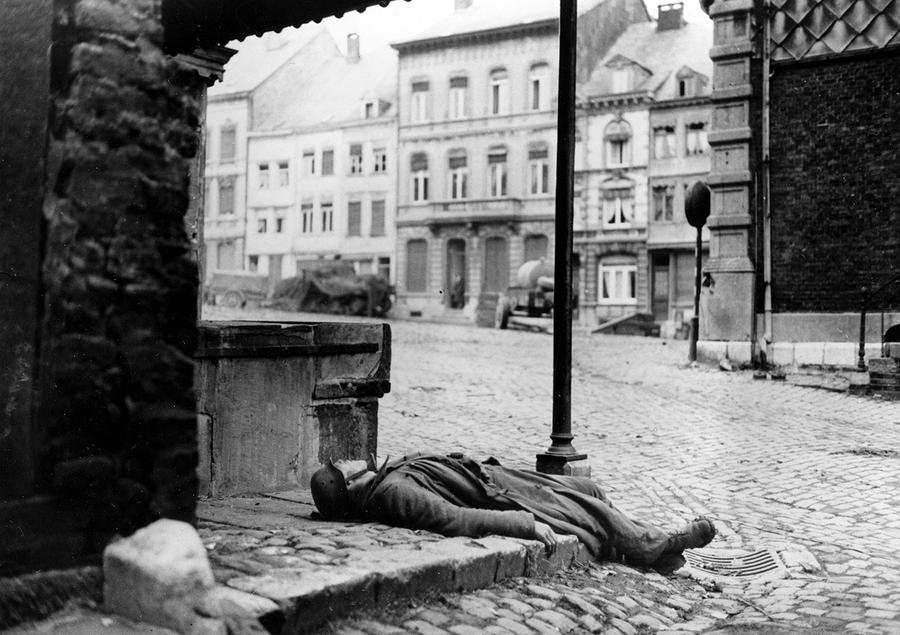
That should have alerted us because the military government was not operational in the area. Then he said he lost his helmet when he started to run when the firing began. We found out later that the lack of a helmet was one of the features that Skorzeny’s men used to distinguish themselves from the American GI. He also spoke in broken English. This did not seem strange or unusual to me because I grew up in northern Michigan and Minnesota where many 1st generation Americans spoke broken English. Besides, some of the interrogators and translators in the T Force also spoke in broken English. While the interrogation was going on, the situation across the river was becoming more desperate. Consequently, everyone’s attention was drawn to that problem, and the GI was finally told to get out of the CP and return to his unit. It was not until several days later that it began to register that his answers were questionable and that he could have been one of Skorzeny’s agents. More and more information kept coming in that the Germans were using American vehicles 
 including half-tracks. This information, coupled with the fact that the Germans had already infiltrated as far as the bridge crossing the Amblève River in Stavelot, caused Maj Solis to direct that all troops be pulled back to the western side of the river and that defenses be beefed up around the bridge. While I’m not certain about the big guns of the tank destroyer platoon, I do know that some of Able 526-AIB’s AT guns were moved into positions to cover the eastern approaches to the bridge.

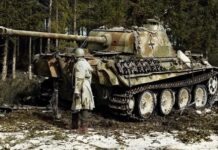
It was still fairly dark; therefore, to improve visibility of the bridge, some enterprising individuals set on fire some makeshift flares from old oil drums, which illuminated the eastern end of the bridge. This created a tremendous lull in the German advance; nevertheless, they soon attempted to get a wheeled vehicle across the bridge. One of the AT guns quickly destroyed the vehicle. The German brought up a tank that towed the wreck off the bridge. A tank next attempted to cross, but it was quickly immobilized. The Germans then brought up a monstrously huge Mark VI-2 King Tiger tank, which pulled the wrecked tank from the bridge. The AT guns proved ineffective against the King Tiger. In the meantime, Maj Solis had gotten in touch with Battalion HQs in Malmedy and had requested that the Battalion’s assault guns be sent to Stavelot, and he also asked for artillery support. By this time, it was obvious that the Germans had an overwhelming force, and we had nothing that could stop any of these King Tiger tanks. In the early morning light, it quickly became apparent that the CP was too vulnerable. Its entrance faced the river, and the building would be one of the first to be overrun if the Germans got across. Maj Solis ordered us to move to the center of the town.
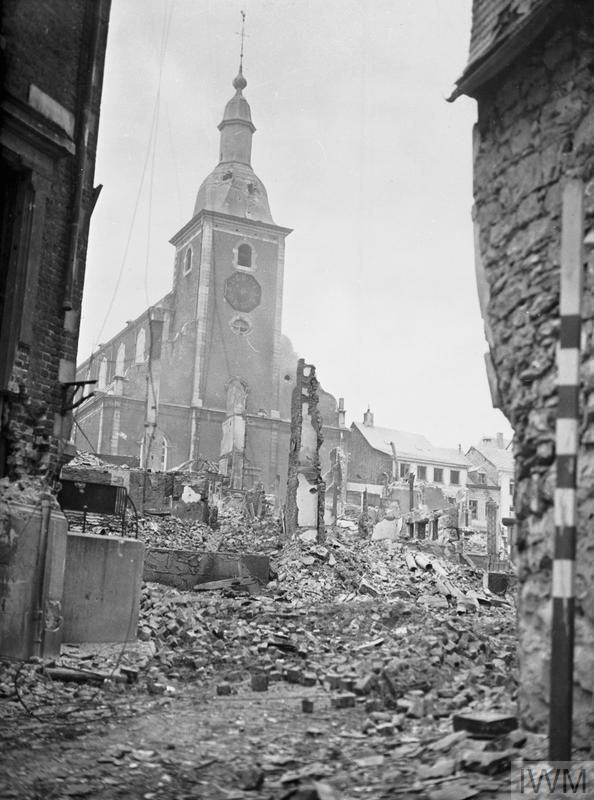
Maj Solis at this time directed me to reconnoiter the area and to get an overall evaluation of our situation. In the town square, I ran into Lt Goddard, the commander of the Battalion’s Recon Platoon. It seemed that Maj Solis’s request for artillery support brought to a head a problem that was confronting all units moving into the Malmedy – Stavelot area. The irony of the situation was not immediately apparent because Stavelot was the Army Map Depot, yet no one had detailed large-scale maps of the area. The artillery didn’t know where to lay down indirect fire because they did not have maps. We did not have appropriate maps to plot the coordinates that we wanted to be covered. Col Irwin ordered Goddard to Stavelot to get the necessary maps.
The situation at the river was very tenuous. No one was aware of anything beyond his immediate area. Consequently, when Goddard arrived, he was unable to find anyone who could help him. By sheer luck, we ran into each other, and the only reason I was able to help was that the CP had earlier been located in the Map Depot. By this time, it was very light, and I knew we couldn’t return directly to the old CP because the entrance was under observation and fire of the Germans. I had earlier tried in vain to find an entrance on the west side of the building in order to recover my trench coat, which I had left behind. I figured, however, that we could successfully approach the entrance from the south end of the building. Once inside, we were faced with another dilemma. The building contained hundreds of thousands of maps, but there was no one around who knew the storage system. We finally found an index and thus were able to determine and locate what we needed. While we were there, I searched for my trench coat but could not find it. I did, nevertheless, find a strange, sturdy, camouflage coat that had a lot of zippered pockets, so I appropriated it. This led to another incident, which I’ll describe later. Goddard and I retraced our route from the building, and he was soon on his way back to Malmedy. I encountered Maj Solis in the town square. We were having difficulty getting information from the elements along the river, so I suggested to Maj Solis to put a couple of observers with radios up in the church steeple. We were about 100 yards from the church. One would almost think the Germans were listening to our conversations. A German machine gun began to chatter, and a bright reddish scar appeared where the bullets smashed into the bricks just beneath the opening at the top of the steeple.
 About the same time, a lady approached us. She was wearing a steel helmet with a red cross painted on it, and she was carrying another steel helmet that was full of carbine ammunition, which she gave to us. Although we did not speak French or German and she did not speak English, she managed to convey the idea that she would help us if we needed medical attention. I regret that I did not get that lady’s name. (In 1956, I visited Stavelot and tried to find her in order to thank her for her kindness, but I was unsuccessful) If you are aware of this incident or know the lady, I would appreciate learning her name.
Incidentally, that was the last time I saw Maj Solis that morning because he wanted me to continue reconnoitering the area. I worked my way around and up the high ground west of town. I encountered stacks of gasoline in five-gallon cans and to my consternation, could not locate any guards. As I started back into Stavelot, I stopped several of our half-tracks heading west. I made them turn around and had them take up positions about halfway down the hill along what appeared to be an old roadbed. From this high ground, we had a clear view of the riverbank, and the machine guns would provide a good base of fire to support the defenders in town. About this time, one of the platoons, mounted in their half-tracks, passed me going toward the gas dump, so I figured they had been sent there to guard the facility.
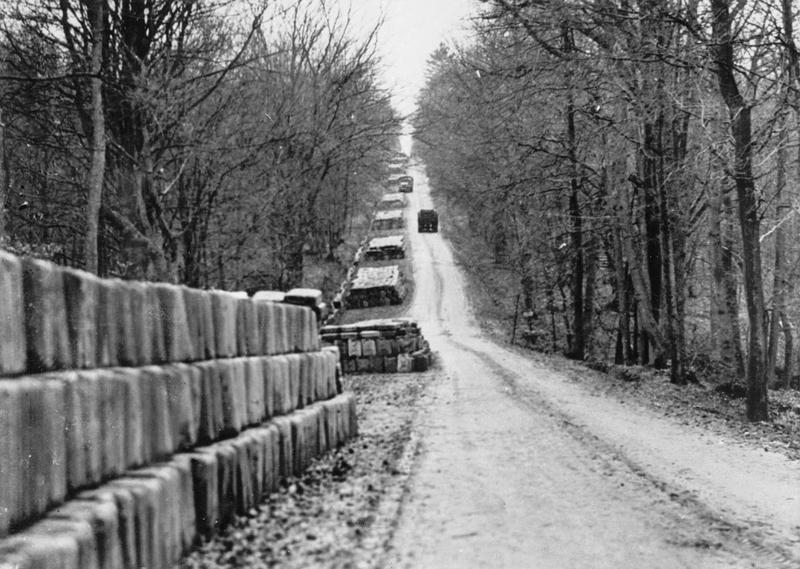
After positioning the half-tracks, I continued on foot into town when I met Capt Mitchell. After exchanging information on the situation, Capt Mitchell continued up the hill in the direction of the gas dump. I, in turn, worked my way back to the town square where I expected to find Maj Solis. Instead, I found only a couple of men from the Engineer Map Depot who said their unit had left without them. They said they understood the order had been given to pull back to the high ground west of Stavelot.
By the time, the road leading to the high ground and the gas dump was under direct observation by the Germans and under continuous small arms fire, which made me feel that the route was badly infiltrated already. I figured the best thing was to move to the southern edge of the village and then move to the high ground. I ordered the men to follow me, and as we moved, I became acutely aware that we were the only Americans in sight around there. As we progressed, we encountered more individuals, however, not of the 526-AIB but rather of units that had pulled out or had become separated from their outfits. I soon had a sizeable force of about 30 men. As we continued our move, it became apparent that the Germans were getting close on our heels so I created three fire teams to help our withdrawal. Our plan was for one team to rapidly fire into the intersections and buildings in the direction of the Germans. The next team would set up about 30 to 50 yards further along our route, and the third team would, in turn, set up beyond the second team. When the first team would start to withdraw, the second team would cover them with fire. The first team would draw back and take up positions beyond the third team.
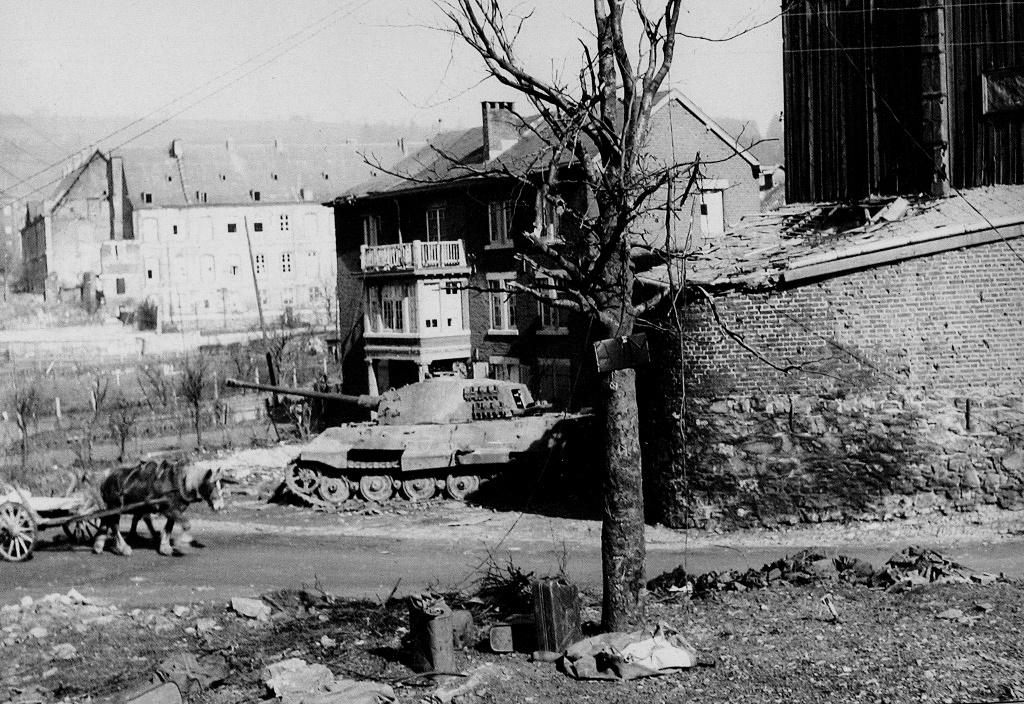
 This tactic proved successful because we noticed the Germans slowed and then finally stopped their advance. We finally drew back to an area where we had some fair cover and concealment in order to move to the high ground. By this time, we could hear the ominous clanking and creaking of tank treads. We had climbed about 100 yards up the hill when three huge Mark VI-2 King Tigers went by on the road toward Parfondruy or Trois-Ponts. I wanted to continue to observe the enemy, but it was soon apparent that the men were anxious to get out of the area, so I released them.
A couple of men stayed with me. Soon, there was a steady stream of enemy traffic heading south. There was nothing we could do to stop or impede the Germans, but we continued to watch them for about 30 minutes. Then we decided to move on. We gained the top of the hill, then turned in a northerly direction toward the gas dump where one of the stacks was burning. It appeared that it would not be too much of a problem for German vehicles to bypass the burning stack, so I decided to spread the fire. We found that simply shooting into the cans would not ignite them. When the top row of cans was ruptured, however, the gas flowed down toward the stack that was burning. The resulting eruptions and explosions were like the infernos of hell turned loose on the countryside. The fires spread back to several more stacks, and our fears and concern, then, were that maybe the entire dump would burn.
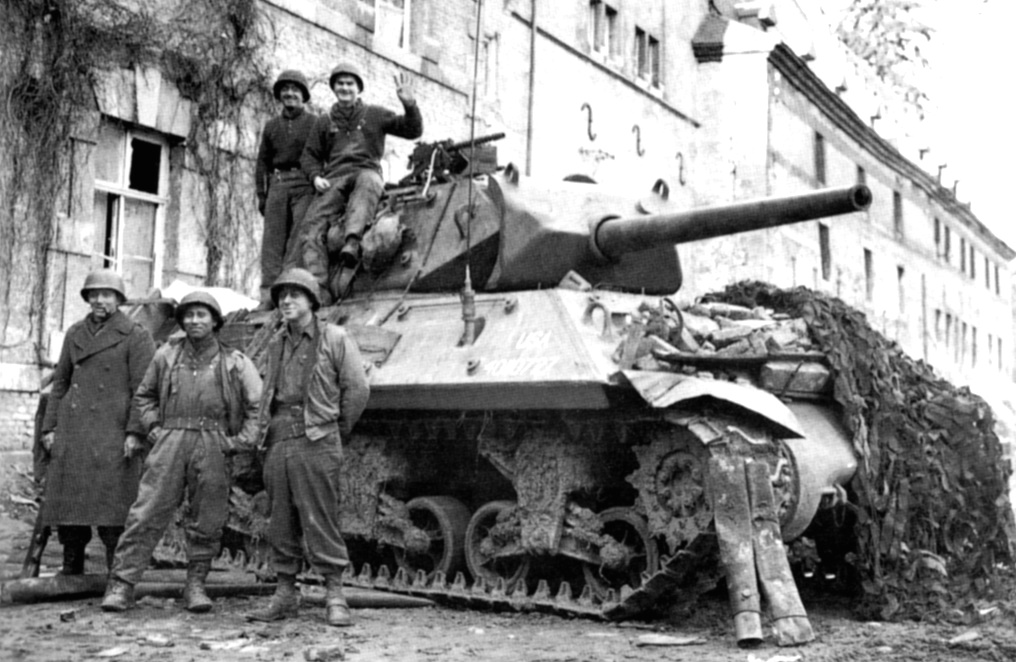
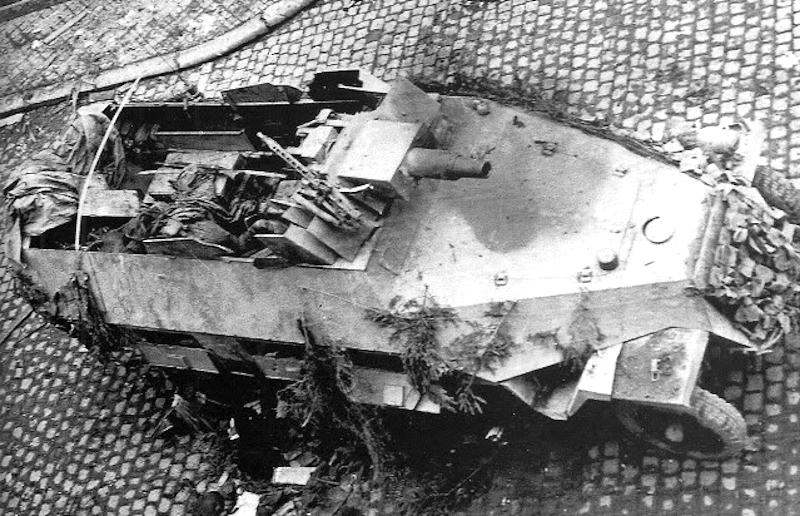
During this period, we did not see any other military personnel, so we started walking. About a mile further on, we ran into Capt Mitchell and his men. In a few minutes, the lead elements of the 1/117-IR (30-ID) arrived. Lt Col Robert E. Frankland (CO 1/117), after being briefed, had his battalion detrucked and formed into assault formation with a company deployed on each side of the road. These troops were battle-hardened veterans who had been in combat almost continuously from Normandy on. I accompanied the point squad. This caused some raised eyebrows because never before had a 1/Lt accompanied them. I must say I admired their professionalism because we regained the town square very quickly. Hanging onto the town square was another matter because it did not take very long before the Germans dressed in US uniforms and driving American vehicles stormed the town square. To the great credit of Col Frankland’s men, they quickly recognized the deception and turned back the attacks of the Germans.
The CO of the 117-IR had arrived with his staff and took over one of the farmhouses as his command post. About this same time, the 526-AIB assault guns that Maj Solis had requested arrived on the scene. These guns, as well as Able Co 526-AIB, were assigned areas of responsibility and integrated into the plans of the 117-IR. Maj Solis and I stayed with the 117-IR until December 19, when we returned to our Battalion HQs in Malmedy.
I mentioned earlier the incident of my acquiring the overcoat in the Map Storage building. The weather had turned bitterly cold so I wore that new overcoat constantly. On December 21, I had to make a trip back to the T Force Headquarters, which was now located west of Liège. When I was getting ready to start my trip back to Malmedy, one of the interrogators said to me, ‘Lieutenant, your overcoat looks exactly like a German paratrooper’s jacket. Everyone is looking for German infiltrators, and you might get shot’. We figured that when we vacated the CP in the Map Depot, some Germans must have sneaked into the building. One of them apparently took my trench coat and left his behind. When Lt Goddard and I returned to the CP for maps, the Germans were hiding in the building, and we were unaware.
 In conclusion, let me speak directly concerning Maj Solis. He was the overall commander of the 526-AIB – 825-TDB Task Force in Stavelot. He had radio communication with the Battalion Headquarters; however, his radio did not mesh with Lt Doherty’s TD Platoon or the engineers. He could communicate with Capt Mitchell’s radio but not with the platoon leader’s radio. The battle in Stavelot actually started before we arrived, and before we even knew what the situation was like, we had a full-fledged battle underway. During the initial period, Maj Solis was in the CP (Map Storage Building) because it had a radio. Capt Mitchell soon left to be with his troops and to try to get them settled down. I never did see Maj Solis and Capt Mitchell together after that, although I did see both of them at different times in Stavelot. The tank destroyers were towed units that did not lend themselves to the door-to-door type of fighting that occurred. Their greatest effectiveness occurred where they could be employed and sited in open areas. The exception was at the bridge, where the big guns of the tank destroyers and the more highly mobile anti-tank guns of Able Co 526-AIB performed outstandingly. I am at a loss concerning the engineers. There was a close collaboration initially. I cannot even recall when Capt Sheetz departed. I wish to add that some of the men I gathered together as I was leaving Stavelot did belong to Capt Sheetz’s unit.