

Reviewed by Doc Snafu on May 28, 2026.
Document Source: Operations of the 3/5307 Composite Unit (Provisional) (Merrill’s Marauders)(Galahad), Battle of Myitkyina, Burma, July 27, 1944, to August 3, 1944. Personal Experience of a Company Commander, Maj John J. Dunn

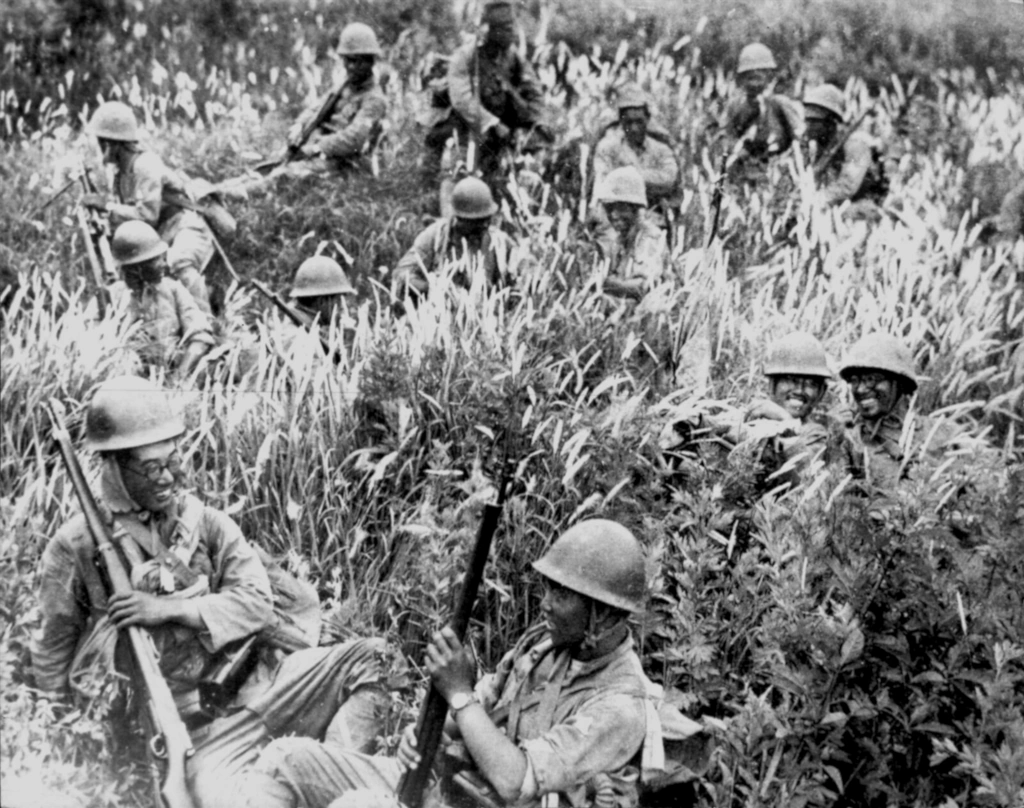
(Photo) Hsamshingyang (Burma), April or late March 1944: The international character of 5307 Galahad, is shown by groups (rear l to r) Sgt Harold Stevenson (Irish), Pfc Stephen Komar (Ukrainian), Pvt Geo D. Altman (German), Sgt Carl Hamelic (Dutch), Pvt Jose L. Montoya (Spanish), Capt A. E. Quinn (Anglo-Burmese), Capt D. G. Wilson (Anglo-Burmese), Pfc Joc Yuele (Italian). (3rd-row l to r) Pvt Kai L. Wong (Chinese), S/Sgt C. N. Dulien (Polish), Cpl Perry E. Johnson (Swedish), Pfc Louis 0. Pederomo (Cuban), T/Sgt Jack Crowl (American). (2nd-row l t r) T/Sgt Russell Hill (English), Sgt Werner Katz (Jewish), Sgt Miles Elson (Swedish), S/Sgt F. Wonsowitz (Polish), Sgt Edw Kucera (Bohemian), Cpl Bernard Martin (French), Sgt Wilbur Smalley (Irish). (front row l to r) Father James Stewart (Irish), N’Ching Gam (Kachin), Li Yaw Tank, Maru, Purta Singly (Gurkhas), Hpakawn Zau Mun, (Atzi).
 For the conquest of Burma, the Japanese concentrated two divisions in Southern Thailand. In mid-January 1943, they struck across the border toward Moulmein, which fell on the 30. Rangoon, the capital and principal port, was taken on March 8. The Japanese then turned north in two columns of division strength. One pushed up the Sittang Valley, the other division moved up the Irrawaddy Valley. Toungoo on the Sittang River fell on April 1, and on April 2, they took Prome on the Irrawaddy River. They pushed north to Yenangyaung and then swung westward and on May 4, took the Port of Akyab on the Bay of Bengal. A third Japanese force of two divisions landed in Rangoon on April 12, 1942, drove rapidly northward into the upper Salween Valley, and took Lashio, the junction of the rail and highway sections of the Burma Road. Mandalay, now completely outflanked, was evacuated and was occupied by the Japanese on May 1. From Lashio, the Japanese pushed up the Salween Valley into the Yunnan Province. In north-central Burma, they sent patrols as far as Fort Hertz, and to the west, they took Kalewa on the Chindwin River.
The remnants of the Chinese forces retired from North Burma to India by way of Shin Bway Yang, while British, Burmese, and Indian survivors withdrew up the valley of the Chindwin and across the Chin Hills. The Allied withdrawal was made on foot, for no motor or railroad connected India with Burma. When the monsoon rains came in June, the Japanese held all of Burma except for the fringes of the mountain, jungle, and swamp on the north and west. The conquest of Burma menaced India and cut the last land route for supply to China.

General Situation
 At the Quebec Conference in August 1943, Lord Louis Mountbatten (UK) was appointed commander in chief of the Southeast Asia Command. During the talk with Gen George C. Marshall (US), Marshall asked him if there was anything he could do for him, and Mountbatten requested an American regiment to participate in the forthcoming offensive in Burma. Five months later, in January 1944, the 5307 Composite Unit Provisional (US) (aka Merrill’s Marauders) (code Galahad) was organized, equipped, trained, and ready to participate in the Allied offensive.
In 1944, the operations in Burma reached a large-scale proportion for the first time in two years. The action took place on four separate, though strategically related fronts. One front was west of the Arakan Range, in the Maungdaw–Akyab Area; another was in the Chin Hills, in the Kohima–Imphal Region; a third was in the Hukawng Valley, southeast of Ledo; the fourth along the Salween River in Southeastern China. There, Chinese troops attacked westward astride the Burma Road. At the beginning of the year, the American trained the 22nd Infantry Division (CNA) and the 38th Infantry Division (CNA) under Gen Joseph Stilwell (US) (aka Vinegar Joe) began to push down the Hukawng Valley toward Maingkwan in order to clear the way for the construction of the Ledo Road, which was to link the Indian Railhead at Ledo with the old Burma Road to China. By early February, the offensive had made good progress, and the highway had been extended 100 miles from Ledo. However, the main defense of the opposing 18th Infantry Division (JAP) had not yet been reached.

The 5307 Composite Unit had by now arrived at Ledo, and Gen Joseph Stilwell decided to send it on a wide envelopment across the mountains in order to get the rear of the enemy opposing the Chinese and to facilitate the advance by disorganizing the supply line and communications. By late April, Myitkyina, with the only hard-surfaced airdrome in northern Burma, was at least within striking distance. Stilwell’s 22nd Infantry Division and 38th Infantry Division (CNA) were fighting just north of Inkangahtawng. British-led Kachin and Gurkha troops were fighting south toward a large supply base at Nsopzup. The Marauders were in Nhpum Ga.
 Myitkyina was the principal Japanese Base for the defense of Burma from the north. Situated 170 air miles southeast of Ledo, it was the northernmost point of a railroad from Rangoon and also the head of navigation of the Irrawaddy River. It lay in the proposed path of the Ledo Road, being 170 air miles north of the Burma Road Junction with the railway at Lashio. Its capture would dispose of the principal air base from which Japanese aircraft had menaced American transport planes flying supplies to China over the Hump (Himalaya). Since February 9, the Marauders had marched and fought through several hundred miles of exceedingly difficult country. The troops were physically worn out. During most of the 80-day period, they had lived on K-rations, and nearly all of the men suffered to some extent from dysentery and fevers.
The unit had lost about 700 men killed, wounded, and sick from their original strength of about 3000. There were no American replacements in the theater to refill the Marauders ranks. To provide strength enough for the mission, Stilwell decided to reinforce the 3 battalions of Marauders with the 150th Infantry Regiment (CNA) and the 88th Infantry Regiment (CNA) and about 300 Kachins, giving them a strength of about 7000 for the Myitkyina Operation. They were organized into three groups, designated as H-Force under Col Charles N. Hunter (US) composed of the 150/50th Infantry Division (CNA), the 1/5307 Galahad; 3rd Co Animal Transport Regiment, and a battery of the 22nd Division Artillery, while K-Force under Col Henry Kinnison (US) composed of the 88/30th Infantry Division (CNA) and the 3/5307 Galahad; M-Force under Col George McGee (US) composed of the 2/5307 Galahad plus 300 Kachins).

Moving out on April 27, they established several roadblocks behind enemy lines and directed a strong column toward Myitkyina. This column, H-Force, reached the Myitkyina Area on May 16. Col Hunter in command set the time for the attack at 1000 on May 17. The 1/150th Regiment (CNA) to the southwest end of the airfield, left the regiment to attack the strip at that point, and then proceeded southwest and took the ferry terminal at Pamati. The attack on the airfield came as a complete surprise, and the Chinese took the strip against very light opposition. The CO of the 1/5307, Lt Col William Osborne (US), was ordered to leave part of his force to hold Pamati, to proceed southeast and seize Zigyun, the main ferry point for Myitkyina.
Immediately upon capturing the airstrip, Col Hunter radioed Gen Frank Merrill (US) asking for more troops and supplies. The strip was ready to receive transport planes. The Chinese 89th Regiment was ordered to leave Myitkyina, and one battalion arrived by air from Ledo late afternoon on May 17. Hunter also sent an urgent message to M-Force and K-Force for their assistance. Both of these were about two days trip from Myitkyina but started immediately for Myitkyina by forced marches.
(Below) Air Strip Myitkyina


When enemy reinforcements did not appear at the airstrip on May 17, Col Hunter concluded that the Japanese did not hold Myitkyina in strength, so he decided to attempt to take the city before they could reinforce their garrison. One battalion of the 89th Infantry Regiment (CNA), which had arrived by air from Ledo, would defend the airstrip while two battalions of the 150th Infantry Regiment (CNA) attacked Myitkyina. The remaining battalion of the 150-IR (CNA) would be in reserve at the strip. Part of the 1st Battalion of the 5307 would hold the ferry terminal at Pamati, while the remainder of the battalion would continue toward Zhijiang to secure the ferry crossing south of the city.
By 1000, May 18, Col Osborne’s group took Zhijiang. During the 18th, the two battalions of Chinese attacked Myitkyina from the north. Good progress was made, and after taking the railroad station in the center of the town, the attacking force got out of control, due primarily to the looting of a jewelry store and the discovery of a supply of native liquor. During the night of May 18-19, approximately 1000 Japanese reinforcements arrived, and on the morning of May 19, counter attacked. The Chinese withdrew to a line about 800 yards west of the town. There, they dug in. Also on May 19, K-Force, consisting of the 3rd Marauder Battalion and the Chinese 88-IR (CNA), arrived and took Charpate. The 3/5307 dug in around the village while the 88-IR (CNA) moved to the southwest on a line extending roughly from Charpate to the railroad. Later, the elements of the 1/5307 who were holding Pamati were relieved by a company of Chinese, and they took up positions along the Namkwi River, south of the town of Namkwi.

During the evening, M-Force reached Namkwi, ill and weak from hunger, for supplies of food which they had anticipated during the trip had not been dropped. After getting food from H-Force, they outposted Namkwi. The Allied troops were now disposed in a semicircle covering all approaches from the northwest, west, southwest, and south. Japanese reinforcements could reach Myitkyina only from the Irrawaddy River or along the Myitkyina–Mankrin Road or the Myitkyina–Radhapur Road. So far, enemy activity has been slight in the area.
The Japanese succeeded in reinforcing the Myitkyina Garrison and by May 23, were passing over to the offensive. At 2200, they attacked Charpate. The attack was repulsed, but on May 24, they attacked again and took the town. The 3/5307 retired to the railroad 2.5 miles to the south. On May 26, they attacked and took Namkwi. The 2/5307 pulled back to a ridge about halfway to Myitkyina. On May 27, Charlie Co 209th Engineer Combat Battalion (US), which had been working on the airstrip, was attached to the 2/5307, and shortly thereafter the battalion was evacuated to Ledo, leaving C-290-ECB to carry on. The 1/5307 and the 3/5307 were now both back near the airstrip, both badly depleted. Evacuations had rescued the Marauder strength of about 700 by June 1. Evacuations continued until July 15, and less than 200 original Marauders were left in the Myitkyina Area.

Let us now leave the Myitkyina Scene and return to the United States for the background to the second chapter of the Myitkyina Operation. In late March 1944, organizations in the US were canvassed for volunteers for special assignment in the tropics, with no further information on the nature of the assignment.
Qualifications were either experience with tropical troops or duty in the tropics and basic arm – Infantry. The volunteer status was filled 100 per cent as far as officers were concerned, with the exception of a couple of medics who were given no choice. Most of the officers came from two sources: about 36 from the 2nd Filipino Infantry Regiment and the remainder from the 71st Mountain (Infantry) Division from Camp Carson (Colorado). Many of the officers from the 71st Division had had tropical experiences, but the officers from the 2nd Filipino were accepted under the erroneous impression that, because they were with a Filipino outfit, they were jungle-trained. The enlisted side presents a different picture. They came from just about everywhere and from almost every branch of service, and, as far as I am able to ascertain, no more than 100 in the total of 3000 had volunteered. They were mainly Shanghai’s castoffs, misfits, and men whom someone wanted rid of for one reason or another. These people were assembled at Fort Meade (Virginia) and augmented by an additional group of odds and ends that were at Fort Meade, men who had missed other shipments by being in the hospital, AWOL, etc. The officers spent about ten days at Fort Meade being processed and waiting. During this time, they had no definite idea that they were going to take enlisted men over. The afternoon that they left Fort Meade for Cam Patrick Henry, they were taken to a loading point and there, for the first time, received shipping lists and saw their men. Two days were spent at Camp Patrick Henry in checking equipment and preparing to sail. The group finally boarded the USS H. W. Butner (AP-113) on April 24, and sailed at 1860 that evening. The group was not combat loaded.

On board, organizations were split and scrambled. Some of the men were in compartments commanded by Air Corps officers of a different unit shipping on the same boat. There was neither space nor opportunity for any kind of organizational activity. The whole lot was commanded by Transportation Corps escort officers who had one mission to deliver this crowd in Bombay and get a receipt. These TC officers and the so-called ‘convoy officer’ complemented each other in forming the perfect useless team. On May 18, the ship’s newspaper carried a story of the fall of Myitkyina and many aboard wondered if they would ever see that part of the world. A little over two weeks later, many of these men were dead at Namkwi.
The ship arrived off Bombay on May 26. Before docking, a lieutenant colonel from Gen Frank Merrill’s staff came aboard. All officers were assembled in the ship’s wardroom, and this officer informed them that they were to join the Marauders in forming a light division. He stated that they would train in India as a regiment, and then join in the Burma Fight. He did say that the present situation was in a state of flux and plans were subject to change.
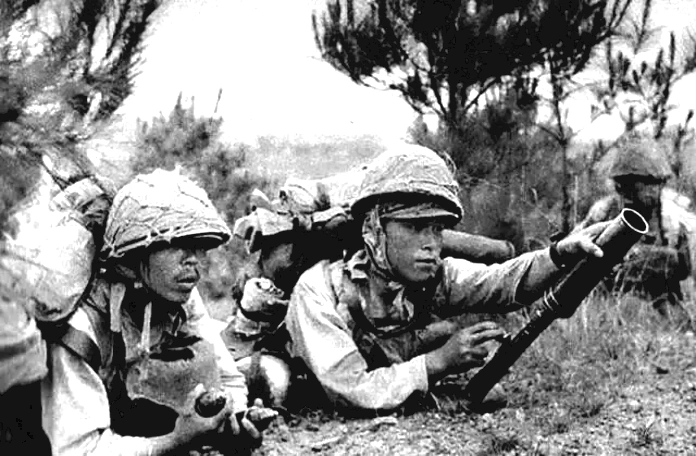
The troops debarked in battalion order, wearing woolen OD uniforms, Field Jackets, full packs, and carrying even overcoats, this being in India in May, absolutely an essential item. The 1st Battalion disembarked first (upon reaching Myitkyina, this unit was redesignated the 3d Battalion; henceforth, I will refer to it as the 3rd Battalion) and immediately boarded a ‘troop train’ for the trip across India. There apparently was no planning connected with the transportation across India by anyone in authority. Troops suffered for lack of water, and upon arriving at Ramgarh on May 30, after four hot dusty days, no one was prepared to receive the battalion. Apparently, they had not been advised of its coming. The battalion was finally billeted in some tents, and an improvised mess was set up to serve K-rations, tea, and lemonade.
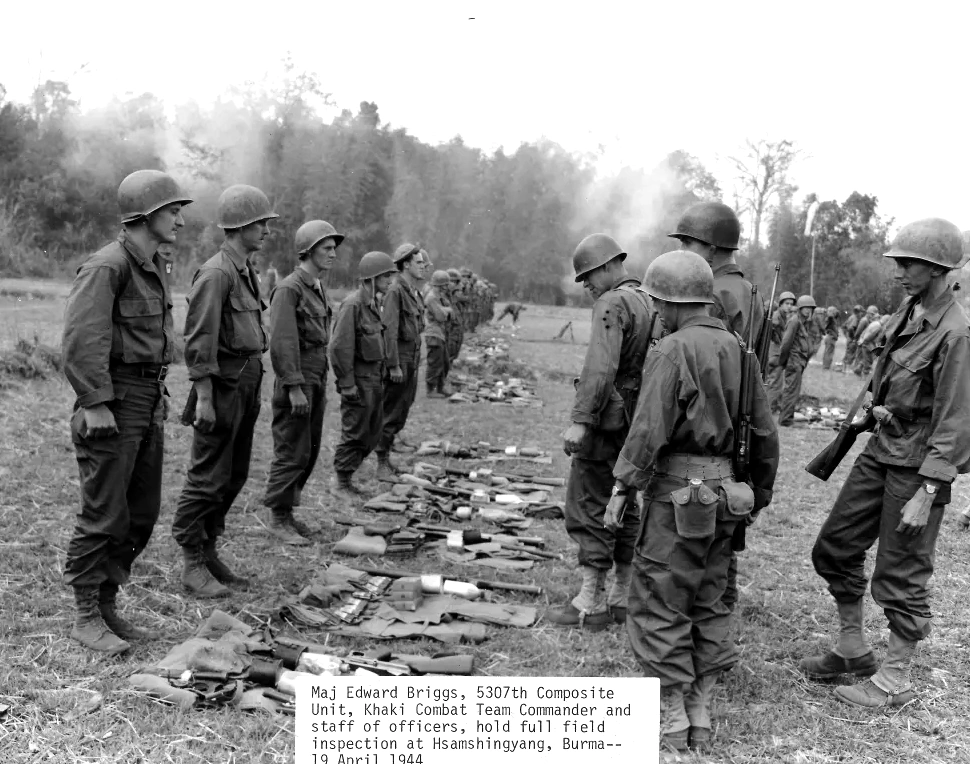
After some hurried staff conferences, things began to happen. Planes were flown from Calcutta for weapons. Lt Haraldson, designated Battalion S-4, began to issue a hodge-podge assortment of weapons at 2000 that night: M-1 Carbines (cal 30 short), M-1 Rifles (cal 30.06), M-1911-A-1 45-ACP, Thompson 45-ACP Sub Machine Guns, and even British Lee Enfield Rifles (cal 303 British). That same night, the battalion was alerted for an air lift to Burma. The Battalion Commander took off in the first plane with most of his staff, leaving no one in definite charge of the battalion. The Battalion HQ’s Co Commander took off in plane N°2 and landed at Chabua (India), and found great difficulty in obtaining transportation to get to Burma. No one seemed to be advised of their coming or knew what to do with them. Maj Holland talked to the base commander in Chabua into furnishing another plan to complete the trip. The first plane carrying the Battalion Commander had already left for Burma. The groups that were following the Battalion CO’s plane had no idea where they were going. They were not briefed – had no maps or orders. What little information they did get was from the pilots of the planes. In spite of a lack of planning, the battalion managed to reach Myitkyina after two days of confusion and tie-ups.