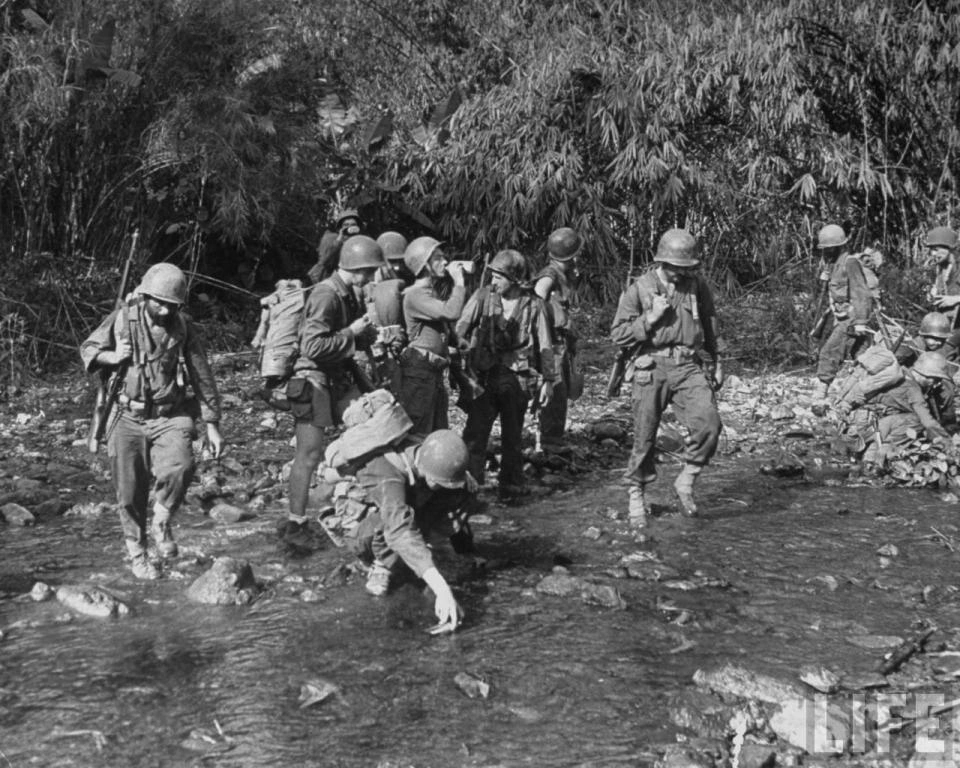
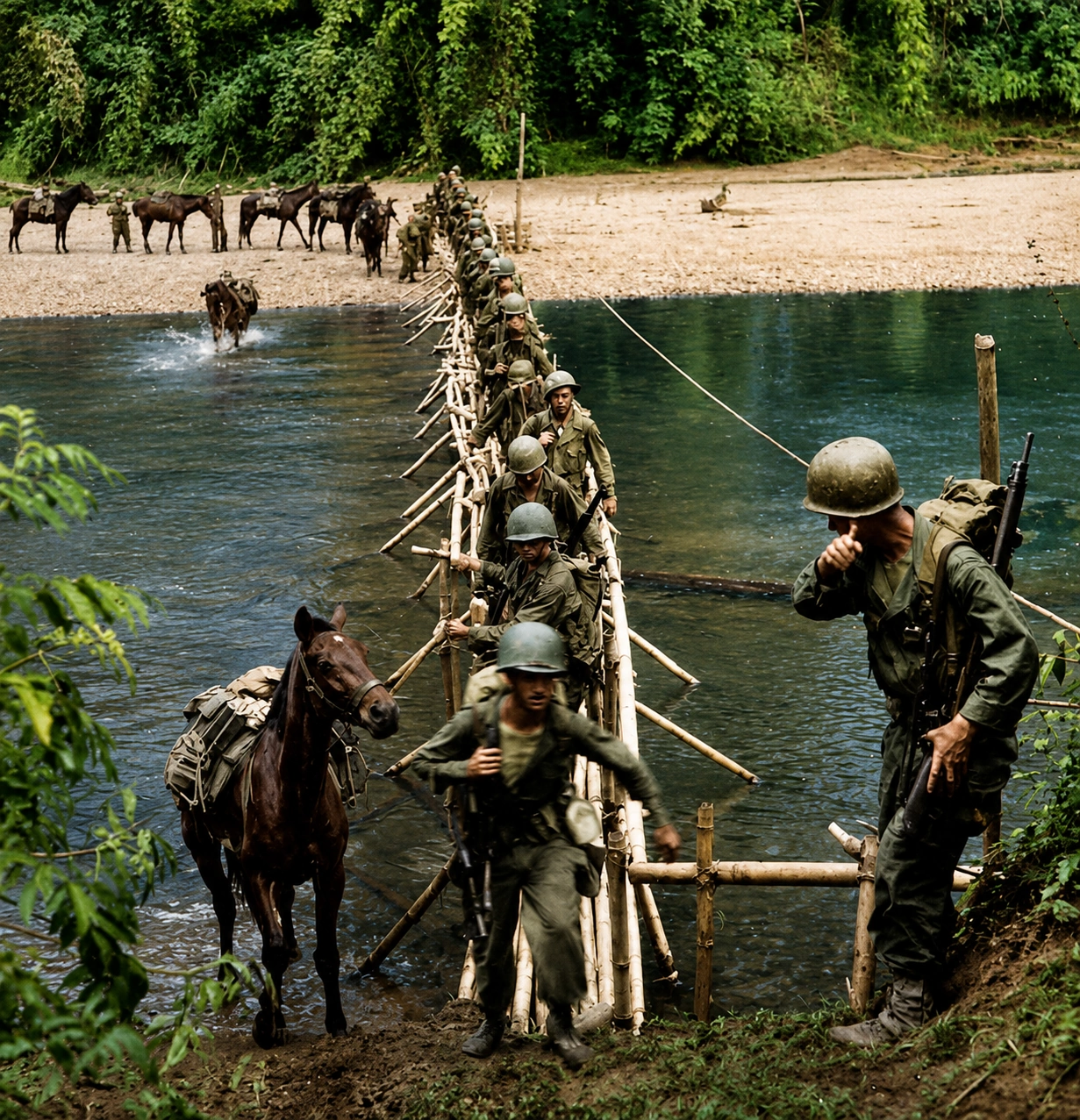


The following day was spent attempting to organize this group into a tactical battalion. This was easier said than done. With absolutely no knowledge of their men, all officers could do was line them up and ask for all those who had ever fired a machine gun, a mortar, etc., or who had any special training. Capt Holland (not yet Major), the CO of Hqs Co, assisted Lt McFadden, the Battalion S-1, and, with the aid of the shipping list, attempted as best he could to assign the men according to MOS numbers whenever possible, although the percentage of infantrymen was small. Men who had apparently never done anything became riflemen and medics. The Heavy Weapons Company was equipped with three castoff 81-MM mortars (plus an extra mortar base plate) and four heavy machine guns, all of which had been through the Marauders’ campaign and were in foul condition. The few 60-MM mortars issued to the Rifle Companies were from the same source. Communications equipment consisted of a few SCR-536 radios and a few field telephones with some salvage wire.

Statement Maj James D. Holland, then Bn Hq Co CO; This battalion boarded a troop train at Bombay four hours behind the 3rd Battalion, but due to British hospitality and the remarkable inefficiency of the Indian Railway System, this grew into a 36-hour interval. The train was watered at Bombay and by the end of the second day had not been resupplied. The Battalion Commander put two officers in the cab with pistols and refused to allow the train to move until a supply of water was put aboard. It was not until then that they got the first inkling of what was in store for them. A British official appeared greatly agitated, informed them that they were a high-priority shipment, greatly needed in Burma, and could not stop for such trivial things as water. He threatened with court-martials and firing squads, but the train did not move until water was put aboard.
The battalion was then given the mission of setting up a perimeter defense of the airstrip and immediately did so. The 2nd Battalion, after similar experiences and difficulties, arrived at Myitkyina during June 1, 2, and 3, went into bivouac northeast of the airstrip, and on June 5, took over the perimeter defense of the airstrip from the 3rd Battalion.
The Most Tragic and Controversial Marauders Operation
According to many of the company grade officers, they were told that they were going out on a Field Problem when the battalion moved out from the Airstrip on June 5. The battalion, less King Co, which had been assigned a separate mission, bivouacked about two miles southeast of Namkwi. That night, a lieutenant colonel joined the battalion whose place in the picture has never been made clear. He acted as a sort of advisor and gave the battalion its mission, which was to take Namkwi, then turn right and drive on the Irrawaddy River. They were told that there was about one platoon of Japanese in the area and that they were in bad shape. This was the first of a long series of misinformations that plagued this battalion. The officers and NCOs spent most of the night instructing the men in the use of their weapons. Many of them had never seen an M-1 Rifle of a Thompson Sub and the great majority had a little or no range firing.
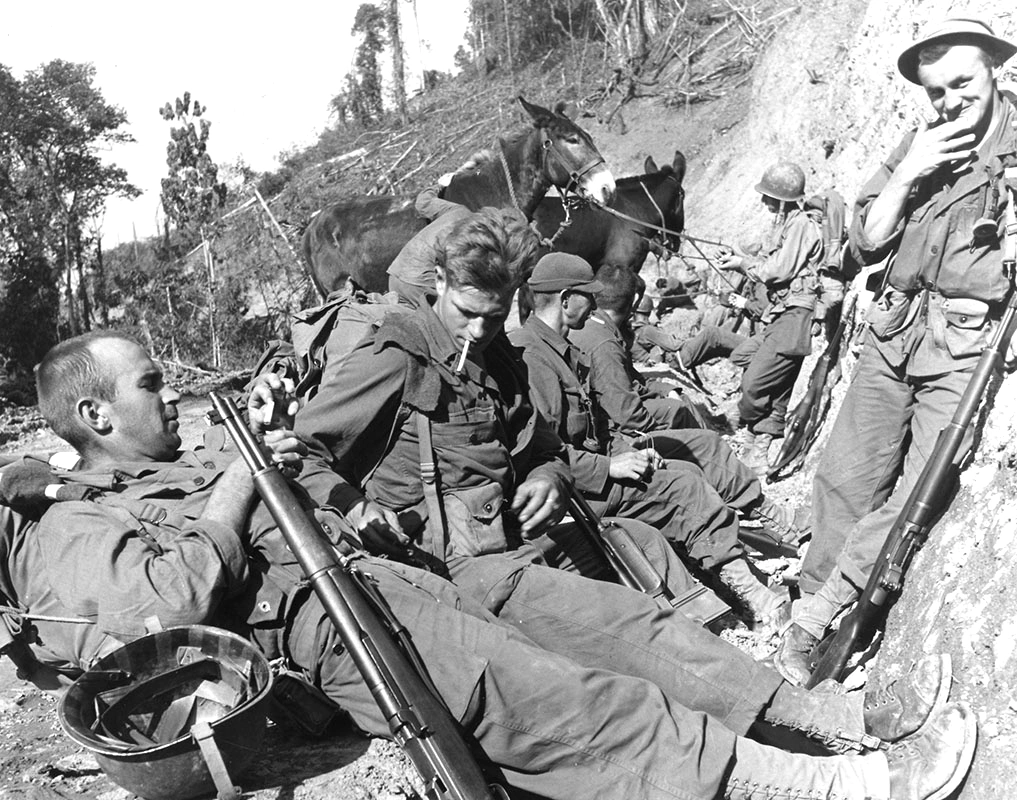 Capt Brubeck, who up until this time was not sure of his place in the battalion because of the indecision of the Battalion Commander was finally told that he was in command of the Heavy Weapons Company. He spent the remainder of the day and night canvassing the battalion for men with experience to fill out his MG and Mortar Crews. The battalion was to attack with two companies abreast, Item on the left with its flank on the Namkwi River and Love Co on the right with its flank on the Railroad. On the right of the railroad was a unit of the 236th Engineer Combat Battalion (US). Capt Brubeck was to provide support with his 81-MM mortars from the high ground on the south side of the Paddy Field. The heavy machine guns were attached to Love Co., and there were no reserves.
Three phase lines were established, and these were drawn on all of the serial photos that were available and issued to the officers. The companies were to move forward until phase line one was reached, halt there and send out patrols to reconnoiter to the front, then move forward to the second and third lines in a similar manner. Many of the officers in the attacking companies and apparently all of the men were under the impression that they were going on a Field Problem. The companies moved out, and the first phase line was reached without incident. Soon after leaving the first phase line, the unit lost contact with each other and shortly after crossing the Paddy Field, the companies were out of radio contact with the battalion due to the short range of the SCR-536 Radios.
They continued on. The men, taking no interest in the problem, appeared bored with the whole thing. Halfway to phase line 2, the leader of the 1st Platoon of Love Co noticed some officer equipment on the trail with blood on it, but attached no importance to it as he had been told that there had been a few Japs in the area, but they had been cleaned out. However, he was suspicious enough to warn Sgt McDowell, his platoon sergeant, to be alerted as they crossed the flooded paddy field. The men were being hurled forward, bored with the whole affair, when suddenly the Japanese opened up with mortar, rifle, and machine guns. Men went down; near panic ensued. The officers making gallant attempts to establish order and to press the attack were going down like ten pins. Almost complete disorganization was prevented from becoming a route only through the heroic actions of Lts Schwarta, Ken Campbell, Jim Applegate, Jim Blocker, Billy Payne, Patsy Algieri, Item Co’s 1/Sgt, whose name I do not recall, and Lt Mitchell, who was wounded. Capt Corey, CO of Love Co, and his radio operator were killed in the first few minutes, and the radio was destroyed.
The leader of the 1st Platoon of Love Co, who was next to the railroad, determined that the fire in his platoon was coming from the vicinity of a railroad bridge to his right. His platoon sergeant reported that many men were hit. The Platoon leader, Lt Algieri, sent out two runners, one to the left in an effort to contact the 2nd Platoon on his left and the other to the rear to obtain support from the machine gun and mortar sections that were supposed to be following the 1st and 2nd Platoons. Soon, these runners reported that they could not contact either one. He then ordered Sgt McDowell, his platoon sergeant, to employ all the automatic weapons against the bridge while he attempted to pull back the platoon with the wounded.
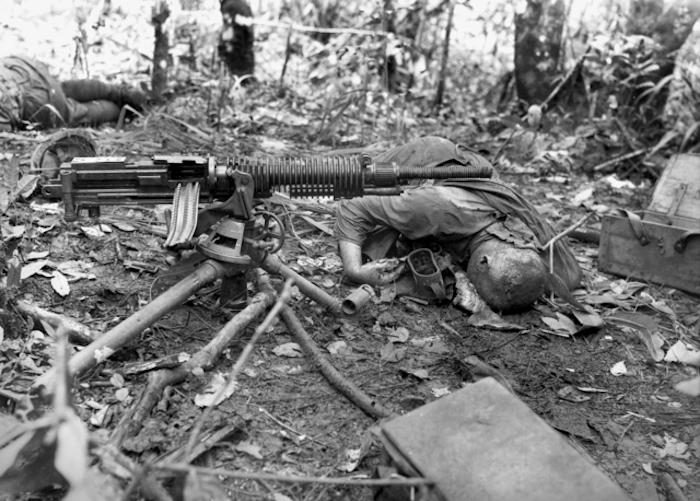
During the withdrawal, the men of the light machine gun and mortar section were discovered sitting under a group of trees and smoking cigarettes. The fuming Platoon Leader, demanding to know the reason for this, was told that they had heard the firing but thought it was part of the problem and so did not bother to investigate. The platoon had 8 wounded, one of whom was to die reaching the aid station.
 Suddenly, a noise was heard from the other side of the railroad. Upon investigating, Lt Algieri discovered the combat engineers digging in there. They joined forces and dug in. The engineers had a radio, and Lt Algieri contacted the battalion and was informed that the battalion had withdrawn to its original position on the south side of the paddy field and for him to stay where he was for the night and rejoin the battalion the next day. Upon rejoining the battalion the following day, he was informed that he was in command of the company as the Company Commander, Capt Corey, had been killed. Casualties in the battalion were very heavy, including 12 officers. Two days later, on June 8, the battalion was moved to the vicinity of the road fork at Radhapur where it remained for one day. The following day, it moved on to Mankrin on the river without opposition, thus cutting the enemy route from Myitkyina to the north. It then turned south with its left flank on the river, and had the opportunity been properly exploited, could probably have advanced almost to Myitkyina. However, the enemy was given adequate warning, and the opportunity was lost. King Co was sent out to reconnoiter the area. All was quiet, and everything appeared clear when suddenly the enemy attacked. The company broke and fell back in confusion, leaving their wounded and dead. The twice-wounded Company Commander, Capt McMasters, was killed while trying to rally his men.
The next day, the battalion attacked and moved forward about 150 yards, then stalled, and the men dug in. They had advanced far enough to recover some of their dead. In some cases, these were found to have been mutilated. This fact posed a new morale problem for the officers. The men developed a morbid fear of having their bodies fall into the hands of the enemy. Half-hearted attacks were continued for the next two days without gaining a yard. The battalion remained here until June 24, when they were relieved by the 2nd Battalion. The 3rd Battalion then moved back to the airstrip and took over the defensive perimeter that was vacated by the 2nd Battalion. The author took command of King Co on July 15, 1944. At that time, the company was occupying a section of the perimeter around the Airstrip. It was during the monsoon season, and the rain and sun alternated during the day, with the rain dominating the night. The men were in pitiable condition. Many did not have either blankets or shelter halves and were simply living on the ground without the slightest cover, exposed to the elements. Sleeping in the rain and mud. Many were even without toilet articles. Their weapons, for the most part, were in a rundown condition due to a lack of cleaning materials and a general feeling of despair and bitterness that permeated the whole battalion.
Every effort on my part to obtain supplies was unsuccessful. The Battalion Commander would refer me to the S-4, and the S-4 insisted that he had tried many times and could not get any supplies. He stated that he had several times requested the Battalion Commander to do something about it, but with no results. A startling contrast was immediately apparent between the miserable conditions existing in the companies and the relatively regal splendor of the Battalion CP. This consisted of a British wall tent for the exclusive use of the Battalion Commander and three American pyramidal tents for the staff and the remainder of the CP personnel. In the CO’s tent was a sand bagged foxhole at least eight feet deep. Next to it was another excavation six feet deep, six feet long, and three feet wide, lined with sandbags and with an additional four feet of sandbags protruding above the ground. At the bottom of this excavation was a cot with numerous blankets and four chairs with two folded blankets on each chair as cushions. (Many men in my company were without blankets) Numerous souvenirs and two orderlies completed the picture.
The following days were a struggle against the weather, official apathy and negligence, and a general feeling of suspicion, bitterness, and despair, to try to whip the company into condition for what I was certain was in the offing – a death struggle against the enemy in Myitkyina. My chief concern was in correcting the mental attitude of the men. There existed an under current of distrust. Every new project or field exercise was greeted with suspicion.
Second in importance was instruction in the care and use of their weapons, and third, organization. Although these men had been associated as a company for six weeks, they were so spread out, occupying such a large section of the perimeter and almost never assembled, that outside of their own squads and, in many cases, within squads, they still did not know or have any confidence or trust in each other.
To correct this, I assembled as many as possible and as often as possible for informational talks and instruction. I required daily inspections of weapons and succeeded in impressing on the men the vital necessity of keeping their weapons in such condition that they could be depended on in any emergency. I preached the great importance of teamwork and the right of every soldier to feel that he could absolutely depend on the man on his right and on his left to do his part as they moved forward in the attack. At the same time, discipline was not overlooked. I refused to allow them to feel sorry for themselves. They were required to shave daily. It was necessary for many men to share their razors with others.
 On July 25, I was instructed to send a representative to go with the Battalion Executive Officer, Maj Harrold, to reconnoiter a new area that the battalion was to occupy. It was understood that the 3rd Battalion would occupy a position extending from the rifle range to the 236th Engineer Combat Battalion area, thus relieving two Chinese battalions and the 236-ECB. This would have given us a front of about 2000 yards.
The next morning, July 26, the battalion, under the Executive Officer, moved out and after proceeding for about two hours, we were about to move into the new positions when some runners met the column with instructions for the battalion to move into the area behind the engineers. We did as directed and bivouacked along the road to Radhapur. The engineers moved out, and the Battalion CP was established in the one vacated by the engineers. Late that afternoon I was instructed to report to the Battalion CP. There I found the other Company Commanders, the Executive Officer, and staff, but the Battalion Commander was not present. Everyone was simply sitting around and waiting – waiting for what, no one knew or showed much interest in – all appeared bored. I asked, ‘What’s up?’ Someone mumbled, ‘Who knows?’
Along toward dusk, the Battalion Commander came in. No one paid any attention to him, nor he to anyone else. He was in no hurry and gave not the slightest indication that anything unusual was afoot. He spoke a few words to different people around the CP and had some coffee. Time was the least of his worries. I was getting impatient, as were the others. About thirty minutes after he arrived, he called the Company Commanders together and informed us that we would attack the next morning at 0500. The formation would be a column of companies with the companies in a column of platoons. My company was to lead the attack, followed by Item, Love, and Mike. One platoon of Love Co under Lt Lee Nelson was across the Irrawaddy River under direct control of Task Force Headquarters.
The I & R Platoon, under Lt Jordan Adkins, was on the river at Pamati, also under Task Force Headquarters. The plan was to attack directly across a flooded Paddy Field nearly 400 yards wide, and establish a perimeter on the other side. No further mission was given, but everyone assumed that after building up supplies, we would continue the attack into Myitkyina.
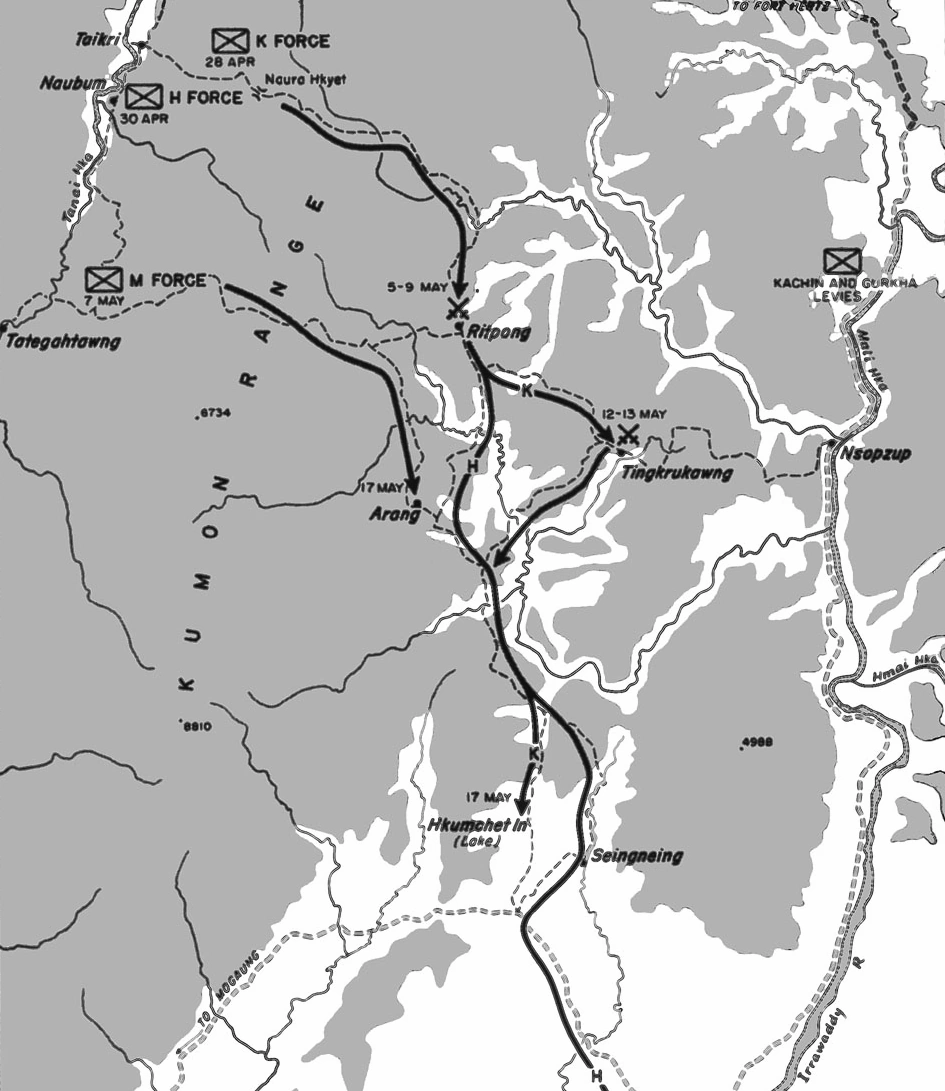 Love Co’s mission was to turn north and defend against the Japanese force supposed to be between us and the 2nd Battalion. The 2nd Battalion was then occupying a position south of Mankrin, and they too were to attack on July 27. The attack was to be supported by a 30-minute artillery preparation that was to start at 0430.
The plan was to have my company move out at 0415 to a point about 150 yards from the enemy side and then wait for the artillery to open. When the artillery lifted at 0500, we were to move in. I considered this plan to be unnecessarily risky. The field was covered with water – in some places knee deep – and a body of troops moving across in the stillness of early morning would probably alert the enemy into firing his FPL. Inasmuch as there was no cover available, this could result in excessive casualties and would probably cause the attack to fail.
My suggestion was to wait until the artillery opened and then to move out under the cover of the noise. We had nothing to gain by moving out early and everything to lose. This suggestion was ignored. I was to have the head of my company on the road opposite the Battalion CP at 0330. There, I would pick up one platoon of heavy machine guns that was to be in direct support of my company. I was to pick up one reel of wire and then proceed on down to the Jump-off point.
I was not satisfied with either the plan or the formation. The critical period in the attack would be the few seconds from the time the artillery lifted until we could reach the enemy position. Common sense dictated the necessity of getting as many men as possible in on top of the enemy in the shortest possible time. This could only be accomplished by having two companies attack abreast and then charging the enemy the moment the artillery lifted. Going across in a column of platoons meant that only a few men would reach the enemy in the first critical moments, leaving the remainder of the battalion spread out in a long column, completely exposed to any flanking or mortar fire that the enemy could bring to bear. Another great disadvantage was in the necessity for reshuffling troops on the enemy side in the face of an almost certain counterattack.
My greatest concern was the reaction of the men if another blunder occurred. I was skeptical of the ability of these men to absorb heavy losses and still continue on. I felt that I had succeeded in convincing them that from now on things would be different, that all of the blundering was in the past, I was sure that another affair in which they were unnecessarily cut up would so disillusion them in their leaders that they would never become an effective force.
Following the issuance of the order, the Battalion Commander said he would show me the jump-off point. We left the CP and proceeded to a spot near the west side of the Paddy Field. In the gathering dusk, he pointed to the other side and said to go across there. Attacking across ‘there’ appeared to me to be a formidable undertaking. The place chosen was the widest part of the paddy. I said ‘OK’ and we turned back towards the CP. As we walked back in the gathering darkness, he amazed me by saying, ‘I want you to bring your lieutenants up here and show them the ground and bring your NCOs up too. Make sure everyone is thoroughly oriented. He completely ignored the fact that it was now almost dark and my company was over a half-mile distant. I left him at the Battalion CP and proceeded on down the road towards my company. I assembled the platoon leaders and NCOs and told them the plan. I had an aerial photo of the area over which we were going to attack, and by the use of a flashlight oriented them as best I could. I ordered the company to be alerted at 0200. They were to be on the road at 0230.
The Attack
The next morning we moved out on schedule. The night was pitch black. As we moved on down the road past the Item Co area, that unit, waiting by the side of the road, fell in behind. The night was so black it was like walking through an ink well. Leading the column, I tried vainly to make out some landmark. After walking for about twenty minutes, I heard some activity on the side of the road. I suspected we were close to the point on the road where I was to turn left to reach the jump-off point. I halted the column and contacted the leader of the heavy machine gun platoon that was to support my company, and told him to follow my last platoon. We moved on to the edge of the paddy field. It was now about 0345. I formed the company as silently as possible and waited. The night before, I had impressed on the leaders the vital necessity of moving in fast the moment the supporting fires lifted. If discovered and brought under enemy fire, the sensible way to go was forward. In any case, no matter what happened, once we started across the paddy, no man would take a backward step.
For purposes of morale, I decided to lead the attack. The operation looked like a suicidal one. I was uneasy that a sudden exposure to enemy fire in that naked field would cause panic and failure. I was certain they would follow me. At 0415, we moved out. We proceeded across as silently as possible until we reached a point about 150 yards from the enemy side. I halted the column. I checked my watch; it was 0425. There was not a sound from the enemy side. I now regretted that an artillery preparation had been planned. I was certain we could have moved in under the cover of the inky blackness without firing a shot. Too late now. I checked the time again, 0430, when a whistling swish told me that the artillery was right on time. The first few rounds fell short, less than 50 yards from my company. I was telling Sgt Smith, who was next to me carrying an SCR-300 radio, to inform the battalion that the artillery was short and to increase the range when an avalanche descended right on top of the column, and all the way back to the Battalion CP. Smith said he could not contact the battalion. I told the men to pass the word back to stop the firing. Stop the artillery went roaring back along the column, but the artillery kept coming.
The artillery that was firing was one Chinese battalion of 105-MM How firing from a position east of the air strip and one American battery of 76.2-MM from the vicinity of the road fork at Radhapur. I greatly feared this was the straw that would break the camel’s back. Not a man broke. They held their general formations while taking as much cover as possible. I moved from squad to squad and told them to stand firm and assured them we would get it stopped soon. The fire that was landing on the leading companies was from the 105-MM Chinese battalion. The battalion CP was being hit by the American 76.2-MM from Radhapur. The American battery was soon contacted, and its fire stopped, but that did the companies no good, especially mine, which was exposed in the middle of the paddy like ducks on a pond.
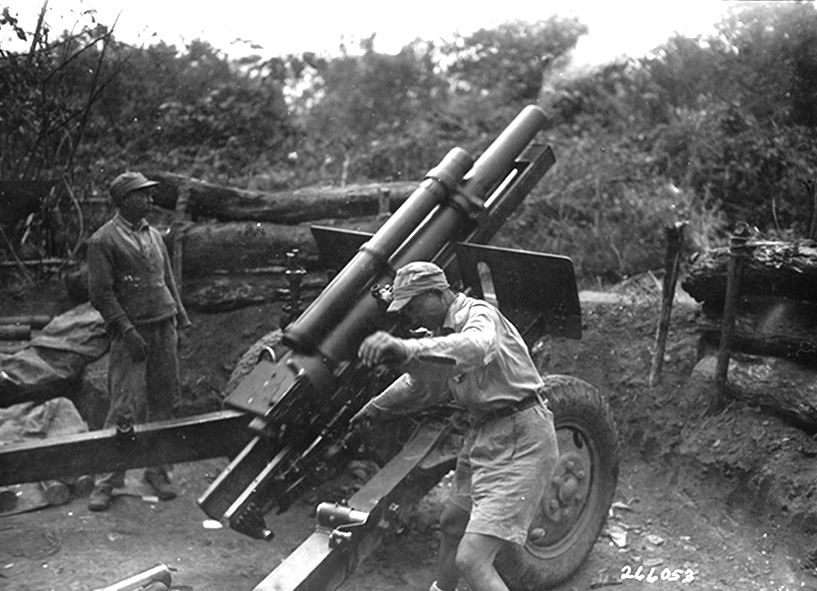
My chief concern now was in maintaining our formation. The fire continued on as intensely as ever as the hands on my watch moved closer to five o’clock. I could not understand why this fire could not be stopped. Later, I was to learn of the incredible fact that not only had the artillery not been registered in, but that there was no communication with the Chinese artillery, so the fire came down, men were hit, and nothing could be done about it. I checked the time again. It was 0455. The first streaks of light heralded the new day – only five minutes to go. I alerted my men and urged them to move in as rapidly as possible the moment the fire lifted. Five o’clock! The fire began to slacken. Get ready! I was too optimistic. The artillery was supposed to fire from 0430 to 0500. Now at 0500, when ‘Cease Fire’ should have been given, it came down with greater intensity than ever, most of it on my company. The men flattened as best they could in the flooded field.
Five past five. The fire continued. The morning now was becoming rapidly lighter. The enemy side could be clearly seen; so could the sitting ducks. Ten past five – geysers erupting all over the area. Five fifteen – no change. Broad daylight now. Five twenty – wont those bastards ever stop? I looked back towards the rear of the column. Everyone not in the paddy had taken cover. The mortars that were to support our crossing were not firing, the crews having been driven away from their guns by the fire. Five twenty-two – fire began to slacken. Five twenty-five – Still Firing! To hell with it – let’s go! The company moved forward as one man. We raced to the enemy side. Next to me was Sgt Smith and Pvts Sardella and Tickey, my runners. Immediately behind me was Lt Algieri with Cpl Duncan leading the 1st Platoon. I glanced to my left. Sgt Pete Pestrano, a tough Regular Army Indian, was driving forward. We gained the opposite side. Two Japs in the first dugout died. Ten yards in from the paddy’s edge, we knocked out a machine-gun crew of three. Cpl Duncan killed a Jap rifleman just beyond the machine-gun nest. The 1st Platoon was now driving up the trail. A machine gun opened into their flank from a position almost under my feet. It apparently was firing from the same dugout as the one we had just destroyed. This second gun was immediately destroyed, and three more Japs died.
The 3d Platoon was now across and pushing to the south along the paddy. The 2d Platoon moved in on the left of the first. The Machine gun and Weapons Platoon was now over. We now had a half-moon perimeter with its flanks on the paddy. I ordered the men to dig in quickly in anticipation of a counterattack. The machine guns were in position, and Lt Meade began registering his mortars. Item Co was pouring over now, the 1st Platoon led by Lt Newman. He asked, ‘Where do you want us?’ I pointed to the trail that separated the perimeter and told him to deploy from the trail to the left, that Item Co would occupy that part of the perimeter. When they were in position, I moved all of my men to the right side of the trail. We then moved the whole perimeter forward about 25 yards to make room for so many additional men.
Love Co followed, less one platoon, and drove to the north to guard against a Jap force that was supposed to be between us and the 2d Battalion. They established a number of outposts to the north and west and reached out as far as 900 to 1000 yards or almost to the 2d Battalion. They had no major action here, but encountered numerous Jap patrols and suffered casualties from infiltration groups. Mike Co now came over and was a welcome addition, for by now the Japs were putting heavy pressure on my right. We soon determined that the enemy was defending almost exclusively from the south (Myitkyina). We faced our whole line south with Item Co extending to the east. My right was now on the paddy with my left tied in with Item Co on the north-south trail. Item Co extended to the east 100 yards and bent back to tie in with Mike Co, which guarded the rear of the perimeter. I had three men badly wounded. Among other things, we were not provided with stretchers. I told my Executive Officer to call and have some sent over if available. After a short conversation, he said there were none at the battalion and that we would have to construct stretchers from bamboo. This was done, and the wounded were carried back across the paddy, which was under constant Japanese sniper fire.
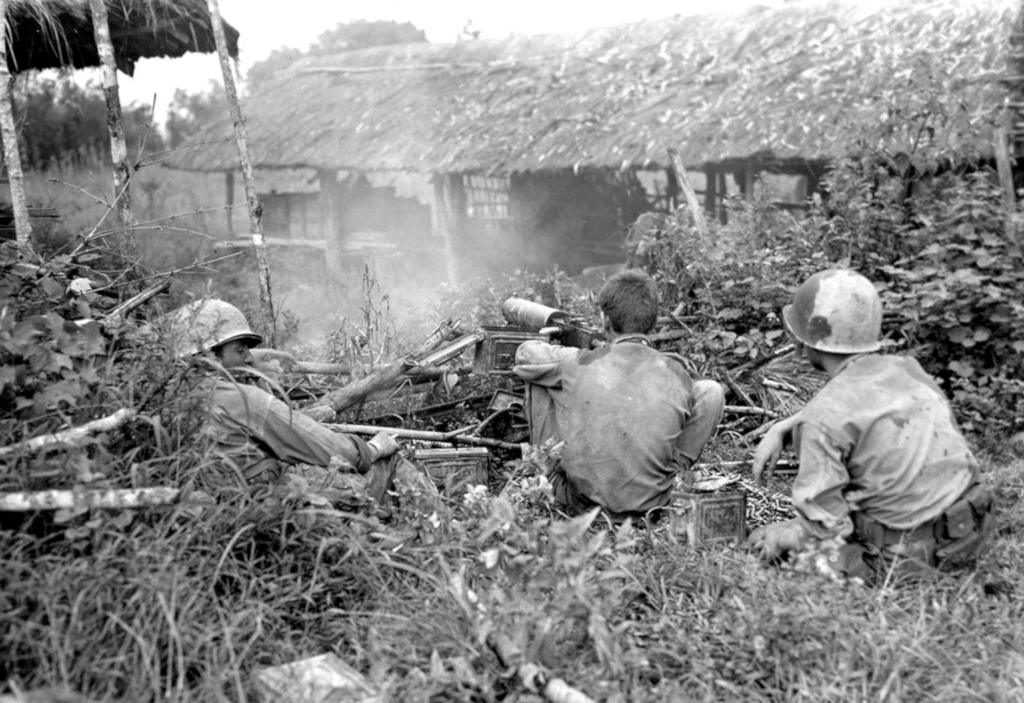
From my right platoon came a report of a Jap sniper that was making the right squad’s area untenable. This platoon was dug in in very thick jungle growth. Visibility was limited to a few yards. Every effort to locate him was fruitless. He had already hit two men. I had been checking the perimeter and was on my way to the CP when I was told that he got another. At the CP, my Executive Officer told me that the Battalion Commander ordered patrols sent out. As we were talking, a shell exploded near the edge of the paddy – not twenty yards from us. We took cover instantly, then a series of explosions raked the perimeter. Normally, an artillery shell can be heard coming in. We had no warning that these were coming. The answer was obvious. The Japs were firing a field piece from such an extremely short range that the shells exploded before the sound of the muzzle blast reached us. The soldiers immediately named it ‘Whistling Willie’. It was not a very appropriate name because it didn’t whistle or make any other noise until the explosion. When the firing, which had only lasted a few seconds, stopped, I asked the lieutenant if there was anything special that the Colonel wanted the patrols to do. He said that no mention was made of any specific mission, just to send out patrols.
As we were talking, the phone rang. The 3d Platoon reported another man hit by the same sniper. The phone rang again. It was the S-3. The Colonel wanted to know if the patrols had gone out. I asked him what the patrols were supposed to do. If it were to locate the enemy, then there was no need for patrols. I could throw a rock and hit a Jap in almost any direction. He said the Colonel didn’t state any mission, just sent out patrols. I called my platoons and assigned each a sector and told each of them to send out a patrol. Platoon Sgt Connery, of the 3d Platoon, sent word that he would lead a patrol, but he would get that sniper first. This gallant old Sergeant (5 years Marine service, 10 years Regular Army, carrying a submachine gun) walked boldly in the direction of the enemy. He had not taken five steps when he went down with a bullet through the heart. Shortly thereafter, all platoons reported their patrols had been fired on almost immediately upon leaving the perimeter. The remainder of the day was spent in improving our positions and in stocking ammunition. For several hours, this was accomplished by hand-carried across the paddy. These kids ran the gauntlet, many times carrying mortar and small arms ammunition from the battalion supply point. Then a mule train was made available. Those were heavily loaded at battalion with ammunition and rations and then led across. This greatly alleviated the supply situation, but unfortunately, the mules presented such a large target that at least one and sometimes two were lost on each trip.
To put down the casualties of men and animals crossing this field, our 81-MM mortars fired a smoke concentration along the edge of the paddy in an effort to blind the Jap snipers. This greatly aided the crossings. About the middle of the forenoon, the Artillery Liaison Officer, Capt McRae, introduced himself to me. He was attached to the Chinese artillery L Group. He was to direct the American battery of 75’s based at Radhapur. This battery had only 3 guns and seldom had any ammunition. After each attack, McRae would have a few rounds fired to register on the FPL, and that’s all they could afford. They never had enough to support an attack, and so we wisely saved what they did have for emergency fires on the FPL.