


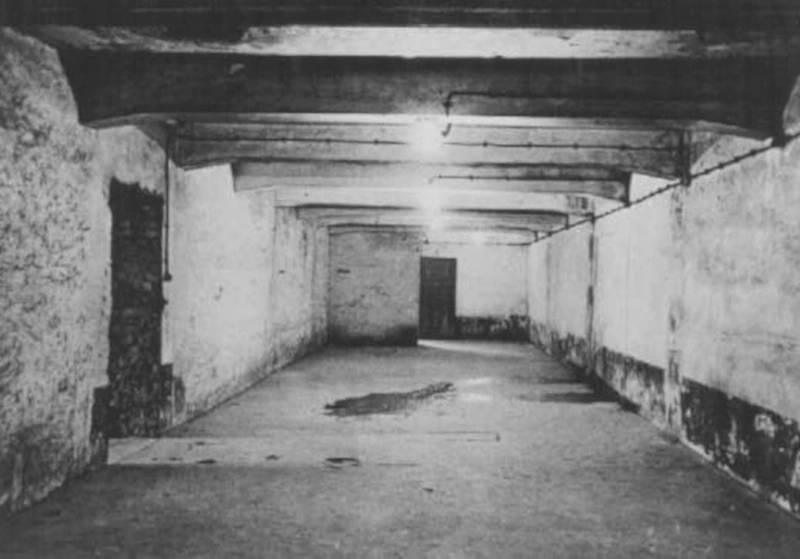
(In mid-August 1940, Auschwitz concentration camp authorities put into operation a crematorium adjacent to a morgue. This building was located just outside the boundaries of the Auschwitz main camp. In September 1941, the morgue was converted to a gas chamber for mass murder where several hundred people could be killed at a time. This gas chamber was used until December 1942, though the crematorium remained in operation as late as July 1943)
Deportation, Selection, and Murder
From 1942 onward, Jews were deported to Auschwitz from across German-occupied and German-allied Europe. Trains arrived first at the external unloading area known as the Judenrampe and, from May 1944, on the rail spur extended inside Birkenau. SS personnel separated deportees by sex and subjected them to a rapid selection. Those considered temporarily capable of forced labor were registered. Those classified as unable to work—commonly young children, many mothers with children, elderly people, sick people, and persons with disabilities—were generally sent directly to the gas chambers without being registered as prisoners. The proportion selected for immediate death varied between transports. It should not be converted into a universal percentage. During the deportation of the Hungarian Jews in the spring and summer of 1944, the killing system operated at its greatest intensity. Approximately 440,000 Jews were deported from Hungary to Auschwitz in less than two months; most were murdered shortly after arrival.
The SS used deception to reduce resistance. Victims were told that they were entering baths or disinfection facilities. They were ordered to undress and to remember the location of their clothing. Signs, numbered pegs, shower fixtures, and instructions concerning bathing reinforced the deception. Violence and intimidation accompanied the process, and those unable to walk could be transported to the killing installations by vehicle. After the chamber was filled, the doors were sealed. Trained SS disinfectors introduced Zyklon B through roof openings or wall apertures, depending upon the installation. Accounts also describe the delivery of the canisters to the killing sites in vehicles associated with the camp medical or hygiene service. The selection of deportees involved SS physicians, but the assertion that every introduction of Zyklon B occurred “under the authority of the supervising physician” is too absolute. Responsibility extended through the camp command structure, the Political Department, medical personnel conducting selections, crematorium staff, and SS men trained to handle the poison.
The time required for death varied with temperature, crowding, air circulation, dosage, and other conditions. Perpetrator and prisoner accounts commonly describe a period of several minutes, sometimes extending to approximately twenty minutes, before movement and cries ceased. SS personnel checked the chamber before it was opened and ventilated. Members of the Sonderkommando—primarily Jewish Prisoners forced under threat of death to work at the killing installations—removed the bodies. They cut hair where ordered, extracted gold dental work, gathered valuables and personal effects, and transported the corpses to furnaces or burning pits. These prisoners were not voluntary collaborators; they were coerced witnesses whom the SS periodically murdered and replaced in an effort to eliminate evidence.
Victims and the Problem of Numbers
The Germans murdered approximately 1.1 million people at Auschwitz, including about one million Jews, approximately 70,000 Poles, 21,000 Roma and Sinti, 15,000 Soviet Prisoners of war, and thousands of prisoners of other nationalities. Most of the Jewish Victims were murdered in the gas chambers of Birkenau with Zyklon B. Non-Jewish Victims were also killed with the chemical, particularly Soviet Prisoners of war and sick prisoners during the early experiments, and Roma and
Claims that approximately one million or 1.1 million people were killed “with Zyklon B at Auschwitz, Majdanek, and other camps” should be qualified. The Auschwitz total includes victims killed by shooting, lethal injection, starvation, disease, forced labor, and other causes. At the same time, the overwhelming majority of the approximately one million Jews murdered at Auschwitz died in the Zyklon-B gas chambers. Historical precision is stronger than a falsely exact chemical death toll.
Majdanek and Other Camps
Zyklon B was also used for homicidal gassing at Konzentrationslager Lublin, commonly known as Majdanek. The camp combined imprisonment, forced labor, extreme deprivation, shootings, and gassing. Current research by the State Museum at Majdanek estimates approximately 80,000 deaths there, including about 60,000 Jews, from all causes. It should no longer be described uncritically as one of six purpose-built extermination centers equivalent to the Operation Reinhard camps. It functioned primarily as a concentration and forced-labor camp, although selections and homicidal gassings took place there.
Hydrogen cyanide was used in killing operations at several other concentration-camp sites on a smaller scale, while other camps used carbon monoxide or different methods. Every claim must be made camp by camp. The presence of Zyklon B canisters or delivery records proves access to a fumigant; it does not by itself prove homicidal use. Evidence for murder requires corroboration from the design and operation of a gas chamber, documentary records, testimony, or other reliable sources.
Quantities Delivered and Why They Must Be Interpreted Carefully
Published studies have reconstructed substantial wartime deliveries of Zyklon B to concentration camps, including Auschwitz. Figures frequently reproduced in secondary literature state that approximately 56 tonnes out of 729 tonnes sold within Germany between 1942 and 1944 went to concentration camps, and that Auschwitz received roughly 23.8 tonnes. Such figures depend upon the surviving commercial records, the territorial meaning of “domestic” sales, the period counted, and the inclusion or exclusion of particular orders.
The further assertion that exactly six tonnes at Auschwitz were used for fumigation and that the entire remainder was either used for murder or lost through deterioration should not be presented as an established accounting fact. The surviving evidence does not permit every kilogram to be assigned securely to a particular use. Normal disinfestation could consume large quantities, while homicidal gassing required only a fraction of the camp’s total deliveries. The criminal use is established by evidence independent of a simple subtraction from procurement totals.
Likewise, a stated commercial storage period or warranty must not be transformed automatically into proof that every older canister had become unusable after precisely three months. Storage conditions, seals, temperature, formulation, and handling all affected the product. “Shelf life” and actual loss through deterioration are not identical historical categories.
Ending the Gassings and Destruction of Evidence
Mass gassing at Auschwitz ceased in the autumn of 1944 as the military situation deteriorated and the SS began dismantling evidence. The last generally cited mass gassing occurred on October 30, 1944. During November, the killing installations were taken out of operation and parts of the crematoria were dismantled. Prisoners were forced to remove equipment and conceal traces of the crime.
The Sonderkommando revolt of October 7, 1944, damaged Crematorium IV. On January 20, 1945, shortly before evacuation, the SS demolished Crematoria II and III. Crematorium V was blown up on January 26, one day before Soviet troops liberated Auschwitz. Bunker structures and documentary evidence had also been destroyed or altered. The ruins, surviving plans and correspondence, photographs, material remains, perpetrator statements, and prisoner testimony nevertheless preserved a large and coherent evidentiary record.
Corporate and Individual Responsibility
Responsibility did not rest upon an inanimate chemical. It rested upon people and institutions that made decisions: the SS (Germany) leadership that organized genocide; commandants and camp departments that administered killing centers; physicians who selected victims; SS personnel who transported and introduced the poison; guards who controlled victims; administrators who ordered supplies; and company officers who supplied the product with varying degrees of knowledge.
Legal responsibility required proof concerning the knowledge and conduct of particular defendants. Commercial association alone was not sufficient for conviction, nor did technical involvement automatically establish knowledge of homicidal use. The postwar trials therefore produced different results for individuals employed by different companies.
The Zyklon B Trial: Tesch, Weinbacher, and Drosihn
British Military authorities tried Bruno Tesch, Karl Weinbacher, and Joachim Drosihn before a military court at the Curiohaus in Hamburg from March 1 to 8, 1946. The charge was that they had supplied poison gas used to kill Allied nationals interned in concentration camps while knowing that the gas was intended for that purpose.
Tesch was the owner and director of Testa. Weinbacher was his deputy and authorized commercial representative. Drosihn was the firm’s senior gassing technician. The prosecution presented delivery records, testimony from company employees, and evidence concerning discussions of the homicidal use of Zyklon B. Tesch and Weinbacher were convicted and sentenced to death. Drosihn was acquitted because the court was not satisfied that his technical role established the necessary knowledge and responsibility.
Tesch and Weinbacher were executed at Hamelin Prison on May 16, 1946. The case became an important precedent concerning the criminal responsibility of civilian suppliers who knowingly provided a product used to commit mass murder.
Proceedings Against Degesch Management
Gerhard Peters, a senior Degesch executive, was prosecuted in postwar West Germany. His trials, convictions, reversals, and retrials reflected the legal difficulty of proving individual knowledge and causal participation within a complex corporate network. He was initially convicted, but later proceedings and changes in judicial interpretation reduced or overturned the consequences. The history should not be compressed into the misleading statement that he simply “served two years and eight months” without explaining the contested sequence of judgments.
The trials also revealed the limits of postwar corporate accountability. Degesch, Degussa, IG Farben, the distributors, producers, state purchasers, and SS Agencies occupied different positions within the production-and-delivery chain. Their economic and administrative connections can be documented, but criminal guilt must be attributed to named individuals on the basis of evidence about their knowledge, authority, and actions.
Postwar Production and Commercial Legacy
The defeat of Nazi Germany did not eliminate the legitimate industrial requirement for hydrogen cyanide or cyanide-based pest control. Production and fumigation continued after 1945 under regulated conditions and under different commercial names. In the German Democratic Republic, related pesticide production resumed under the name Cyanol, first at Dessau and later at Schwedt. In the Federal Republic of Germany, Degesch resumed business and marketed cyanide fumigation products under names including Cyanosil; the historically contaminated Zyklon name persisted for a time in some export contexts.
Corporate ownership changed during the postwar decades. Degussa eventually sold Degesch, and successor enterprises continued to work in pest-control technology. Hydrogen cyanide remains an important industrial feed stock used in chemical manufacturing, while its use as a fumigant is now heavily restricted or prohibited in many jurisdictions because of its extreme toxicity.
The postwar commercial history requires careful wording. A modern hydrogen-cyanide product is not automatically identical in carrier, warning agent, packaging, legal status, or trademark to wartime Zyklon B. Continuity of chemical principle, corporate lineage, and brand name are separate questions.
Evidence and Holocaust Denial
The homicidal use of Zyklon B is established by many independent categories of evidence. These include SS construction records and correspondence; orders for gas-tight doors and ventilation equipment; Zyklon B procurement and transport documentation; ruins and surviving architectural features; contemporary resistance reports; photographs; statements by Rudolf Höss and other perpetrators; testimony from SS personnel; testimony from Sonderkommando Prisoners and other survivors; deportation data; and postwar forensic investigation.
No single document bears the entire evidentiary burden. The historical conclusion rests upon convergence. Holocaust deniers commonly isolate one ambiguity—such as variations in witness recollection, the ordinary delousing function of the chemical, the destruction of a building, or differences in cyanide residues—and present it as if it invalidated the whole record. This method ignores the way historical proof is constructed from mutually supporting sources.
Forensic comparisons between delousing chambers and homicidal gas chambers must account for concentration, duration, repeated exposure, weathering, building materials, sampling location, and decades of exposure to the elements. A delousing chamber repeatedly exposed for long periods could retain different residues from a homicidal chamber subjected to shorter applications and later destruction. Chemical residue alone is neither the sole nor the principal evidence of mass murder.
Historical Significance
Zyklon B illustrates how a modern bureaucracy can redirect ordinary scientific, commercial, and logistical systems toward extraordinary criminal ends. The pesticide had inventors, patents, licences, factories, distributors, invoices, instructors, transport routes, purchasers, storage procedures, and trained applicators. Under SS Authority, elements of that ordinary commercial chain became connected to selection ramps, sealed chambers, crematoria, forced prisoner labor, and the systematic destruction of human beings.
The product must not be mythologized as the cause of genocide. Antisemitic ideology, state policy, occupation, deportation, forced labor, theft, and the decisions of perpetrators created the killing system. Zyklon B was one instrument within it. Nor should its legitimate pest-control history be used to sanitize the responsibility of those who knowingly converted or supplied it for murder.
At Auschwitz-Birkenau, the historical meaning of Zyklon B rests not merely in the chemical itself, but in the organized choices surrounding it: who was selected, who gave the orders, who sealed the doors, who introduced the poison, who removed and burned the bodies, who plundered the dead, who supplied the camp, and who attempted to destroy the evidence. The surviving record answers those questions with sufficient clarity to establish one of the most extensively documented crimes in modern history.
Recommended Image Placement and Corrected Captions
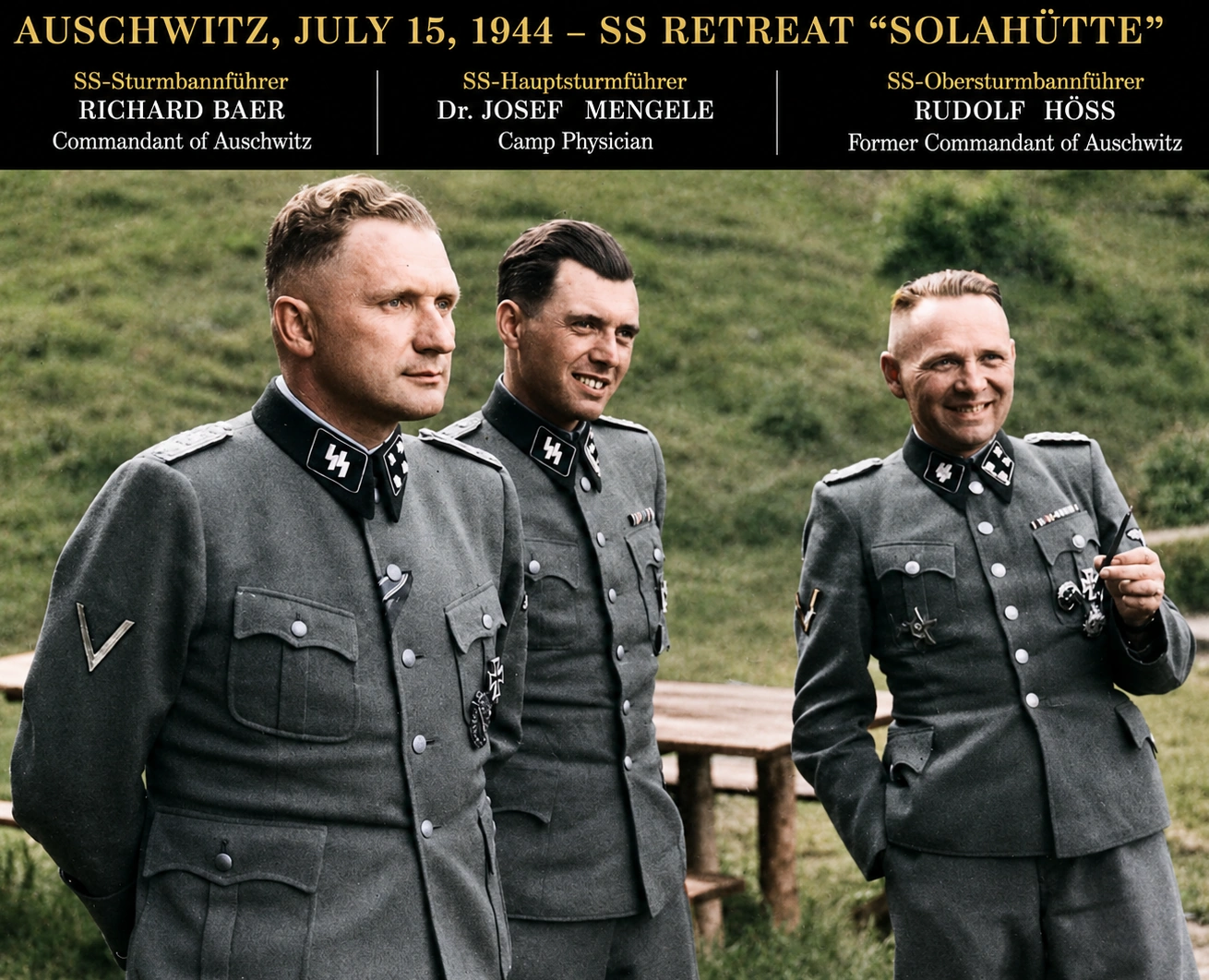
1. Title image: Baer, Mengele, and Höss, Use the corrected title caption printed above. Credit the United States Holocaust Memorial Museum and identify the Höcker Album if the usage rights permit.
2. Westerbork transport, May 19, 1944, Boarding and departure of a deportation train from the Westerbork transit camp in the German-occupied Netherlands, May 19, 1944. The transport carried Jews and Roma and Sinti toward Auschwitz-Birkenau. The exact identification of the transport and the people shown should follow the holding archive’s catalogue record. Do not use “Gypsies” except inside a clearly identified historical quotation or original archival title.
3. Zyklon B carrier material from Majdanek, Spent Zyklon B carrier material found after Soviet forces liberated the Lublin-Majdanek concentration camp in German-occupied Poland in July 1944. Hydrogen cyanide had evaporated from the porous carrier after exposure to air. Use “carrier material” rather than “pellets” unless the archive itself identifies that particular form as pellets.
4. Hungarian Jews on the Birkenau ramp, Hungarian Jews undergoing selection on the arrival ramp at Auschwitz II-Birkenau in German-occupied Poland, May–June 1944. SS personnel selected a minority for forced labor; most of the deportees were sent directly to the gas chambers. Photograph from the Auschwitz Album.
5. Zyklon B labels and canisters, Identify the manufacturer, distributor, canister capacity, date, and holding museum only if those details are visible or supplied by the catalogue. Do not infer them from label color alone.
6. Czesława Kwoka, Czesława Kwoka, a Polish Catholic child deported from the Zamość region, photographed as prisoner number 26947 at Auschwitz. She died on March 12, 1943, aged fourteen. Do not state in this article that she was killed with Zyklon B. Auschwitz Museum materials are not uniform concerning her immediate cause of death.
7. Franz Hössler, Remove this portrait unless the article contains a sourced paragraph explaining Hössler’s direct role in selections or killing operations. His rank and service history alone do not explain the industrial or homicidal history of Zyklon B.
8. Unidentified victim photographs numbered 01, 02, and 03, Do not publish captions such as “WW2 Victim.” Identify the people, location, date, photographer, archive, and event, or omit the images until this information has been established.
Core Sources for the Published Article
Auschwitz-Birkenau State Museum, “Gas Chambers,” history of the first Zyklon B killing on September 3, 1941, and the development of the Auschwitz killing installations.
Auschwitz-Birkenau State Museum, historical chronology and educational publications on Auschwitz I, Birkenau, the crematoria, deportations, selections, and victim totals.
United States Holocaust Memorial Museum, Holocaust Encyclopedia: “Auschwitz,” “The Mass Murder of Jews at Auschwitz,” “Nazi Gas Chambers,” “Nazi Killing Centers,” and the Höcker Album photographic catalogue.
State Museum at Majdanek, current research concerning the functions of KL Lublin and the number and categories of victims.
United Nations War Crimes Commission, Law Reports of Trials of War Criminals, “The Zyklon B Case: Trial of Bruno Tesch and Two Others,” British Military Court, Hamburg, March 1–8, 1946.
The National Archives, United Kingdom, records concerning the investigation and trial of Bruno Tesch, including WO 309/625.
Peter Hayes, From Cooperation to Complicity: Degussa in the Third Reich, for the corporate history of Degussa, Degesch, production, ownership, and distribution.
Centers for Disease Control and Prevention / Agency for Toxic Substances and Disease Registry, medical and toxicological profiles for hydrogen cyanide and cyanide.
German patent DE 438818, Walter Heerdt, Verfahren zur Schädlingsbekämpfung, filed June 20, 1922, published December 27, 1926.
Editorial Corrections Made to the Original Draft
Corrected “Zyclon” to Zyklon throughout.
Corrected malformed WordPress tags and removed incomplete bold tags.
Replaced “other camps” generalizations with camp-specific distinctions.
Corrected the first established Auschwitz gassing to September 3, 1941.
Distinguished the end of gassing in Crematorium I from the end of cremation there.
Removed the unsupported capacity claim of more than 700 people for Crematorium I.
Qualified Höss’s capacity figures for Bunkers 1 and 2 as perpetrator estimates.
Removed the claim that all Zyklon B not assigned to fumigation was necessarily used in gas chambers.
Qualified the “three-month shelf life” assertion.
Removed the universal claim that SS physicians supervised every introduction of Zyklon B.
Replaced the universal three-quarter selection figure with transport-specific language.
Corrected “Gypsies” to Roma and Sinti, except where the historical term must be quoted.
Removed Czesława Kwoka as an implied Zyklon B victim.
Flagged unidentified photographs that cannot responsibly be captioned as “WW2 Victim.”