



The Naval Air Drop
1/Lt Edward 0. Logan, Battalion Communication Officer, was given the mission of selecting a Drop Zone and also to mark the zone with fluorescent panels. The battalion asked for Rifle Caliber 30 Ammunition, 81-MM Mortar Ammunition, water and rations to be dropped, Col Nolan was anxious to receive the drop early on the morning of April 3, so as not to delay the attack scheduled for 0800. Final coordination and plans were completed with the naval carrier task force and the earliest the navy could make the drop was 1000. This was later than desired but the battalion could not move without additional supplies so the plan was accepted. The arrangements for the air drop were coordinated through the naval air liaison officer working directly with the battalion commander and splendid use was made of naval air communication.
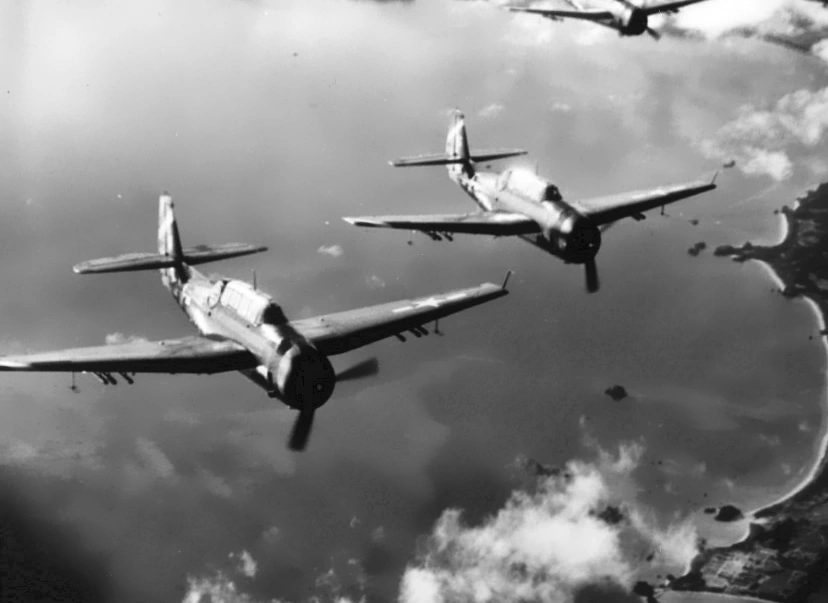
The night of April 2, was quiet except that a strong Jap Patrol of men moving along a trail toward the town of Shimabuku stumbled into a section of heavy machine guns on the left flank. The machine gun section opened up and with assistance from the riflemen and all Japs were killed. No casualties were sustained by the battalion during this action. The battalion made plans for the air drop early the morning of April 3, and continuation of the attack to the south. An area was cleared on the level and open ground 200 yards southwest of the town of Shimabuku. The air drop was to be made by 9 Navy TBF’s, and each different type of supply would be dropped by a different colored parachute. All available panels were used and the final signal for the air drop would be the use of a green smoke shell, in the center of the selected area.
The planes arrived 0945 and the drop commenced without any trouble. Each plane made two runs over the area dropping supplies on each run. Sixty gallon of water, 6000 rounds of Caliber 30 Ammunition, 100 rounds of 81-MM Mortar Ammunition and 1 D ration for the battalion and attached units were dropped. The supplies were quickly retrieved and separated. To our consternation the Caliber 30 ammunition was loaded in five round clips for the Springfield M-1903 rifle, mortar ammunition was rusty and about 40 percent of the rations were spoiled. Even though the drop was only about 50 percent effective it prevented any further delay in the attack.

 Ah yes, the Naval Air Drops – those glorious feats of airmail delivery that occasionally turned the battlefield into a surreal comedy sketch. Take the legendary April 3, 1945, drop where men desperately needed 8-round clips for their M-1 Rifles but were instead graced with Springfield M-1903s and 5-round clips. The result? Soldiers scrambling through the mud under fire, collecting discarded M-1 clips, then playing a battlefield version of arts and crafts as they painstakingly rebuilt the 8-round clips themselves. Just what every soldier dreams of: a DIY project in the middle of a war zone!
But wait, it gets better. There was also on the same day and during the same drop a request for 81-MM mortar rounds and received ones so rusty they could have doubled as shipwreck souvenirs. The mortars operators had to clean each round thoroughly before they could even attempt to fire them, because nothing screams ‘efficiency’ like polishing ammunition mid-battle. And we mustn’t overlook the spoiled D and K rations that arrived smelling and tasting like regret – just what every hungry soldier needed to boost morale.
And let’s not forget the classics from other campaigns: in one drop, crates of boots were sent to a winter-bound unit, but the sizes were so mismatched that soldiers had to trade among themselves just to cobble together a wearable pair. Or the time an ammo resupply meant for machine guns somehow turned into a delivery of artillery shells – useless unless the enemy kindly parked a cannon nearby. Truly, these air drops weren’t just logistical missteps – they were inadvertent tests of soldierly patience and creativity. Bravo, once again, to the unsung heroes of mis-delivery!
Beachhead Secured – April 3, 1945.
The time of the attack was set for 1030. The battalion plan was to move out and advance in column of companies until resistance was met. The battalion would now turn to the south since the 7-IDt was moving along the western coastal road and the boundaries had been moved to the west. The objective for the day was the L plus 10 line which would overrun Hill 138, Unjo and reach Hill 165. The battalion moved out in a column of Companies, King, Item, Battalion Headquarters Co, Love and Mike (-) at 1030. The rate of advance was increased due to the lack of opposition and to compensate for the initial delay caused by the air drop. Hill 138 was reached at 1130 and no enemy was encountered. The advance continued at a rapid pace and as the time passed the gap between the companies increased. The last message received from King Co was about 1500, stating they had passed through Unjo and would move on the prominent hill mass around Hill 165.

 The battalion commander ordered Item Co to pass through Unjo and search the town for any bypassed Japanese meanwhile contact with King Co was lost. The Battalion Command Group decided to halt the remainder of the battalion in the town of Unjo. No enemy was discovered in Unjo and a message had been received that the divisional boundaries were being changed for the attack of April 4. The 381/96-ID would be passed through by the 184/7-ID and upon relief the 381-IR would move across the island into an assembly area near Futenma and be prepared to be committed anywhere in the division zone.
Communication was finally reestablished with King Co through artillery channels about 1730. Capt Harold W. Butler, Company Commander stated his company was ambushed on Hill 165. The company reached the base of Hill 165 without a shot being fired and started toward the hill top. Just as they reached the summit the company was pinned down by terrific machine gun, mortar and rifle fire. The initial fire killed the Artillery Forward Observer and injured one of the radio operators. Several casualties were sustained by King Co. The company could not move and they were about 1000 yards in front of the battalion. Capt Butler was ordered to remain in position and attempt to break off contact with the enemy after dark. The adjacent battalion commander from the 7-ID rendered fire support and aided the company in evacuating the casualties and withdrawing from the hill. King Co rejoined the battalion at 2200 near Unjo. The intentions of the enemy were becoming evident. He would remain in well prepared positions and only lightly man the outposts of his main line of resistance.
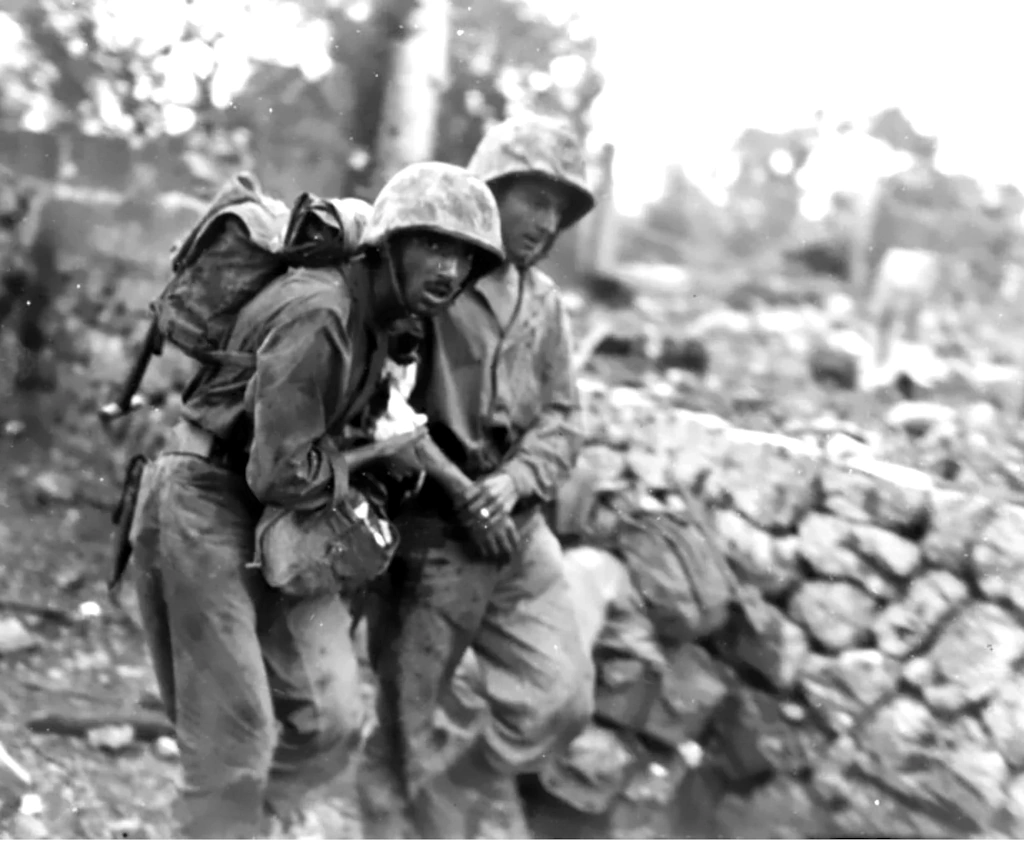
The beachhead was now secure. The Tenth Army had cut the island in two segments. On the north the 1st Marine Division and the 6th Marine Division had made substantial gains and the 7th Infantry Division and the 96th Infantry Division had driven south against light resistance. The Tenth Army now held an area about 15 miles long with their flanks anchored on the eastern and western shores.
Relief of the 381st Infantry Regiment
The 381st Infantry Regiment had driven across the island and secured the L plus 10 line on April 3, 1945. The casualties in the regiment were light and valuable terrain was secured. At 0730, April 4, the 184th Infantry Regiment of the 7th Infantry Division passed through the 381st Infantry, the latte reverted to division reserve at 0800. The 3/381 was tired and welcomed the relief, even though it would be of only a short duration. The regiment completed the movement into an assembly area near Futenma at 1730, April 4, 1945.
In summary, the amphibious landing was efficiently conducted and in three days the battalion had driven across the island and to the south a distance of 11.000 yards. The battalion killed approximately 93 Japanese during this three day engagement and our casualties totaled eight men killed and seventeen men wounded. The enemy did not fight, but the battalion landing was so organized that a determined enemy would have had difficulty slowing our advance. The initiative and aggressiveness displayed by the battalion was encouraging. Communications were excellent and the coordination between supporting fires left nothing to be desired. The Amphibious training had certainly paid off on the battle-field. The battalion was later to engage in the toughest fighting for
the Island of Okinawa.
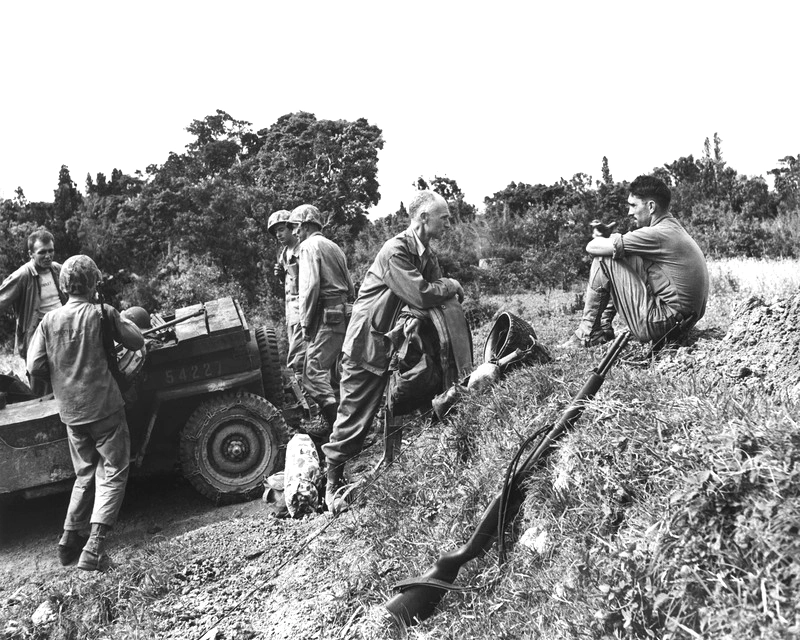
(Above) A text from Ernie: ‘After the ear-shattering pre-landing barrage, and the commotion of the landing, a strange peace descended on Okinawa. Anomalous as it was be speaking an absence of Japanese resistance to the invasion of the doorstep to their homeland, the hush was in a sense fitting, since the opening day of the operation was on April 1 Easter of 1945. Behind the forward thrusts of the spearheads, marines and soldiers first warily, then with delight took advantage of the pastoral calm. Their foxholes dug, and the primary installations set up, they broke open chow rations, chose pets from among the goats roaming about, strolled around the rolling littoral, or just stretched out for forty winks. The battle was not won, or even joined. But to these hardened Veterans of Guadalcanal, Bougainville, Tarawa, Palau and Leyte, this was the oddest invasion of them all one which was truly symbolized by the designation for the opening day of the assault: ‘Love-Day’. Halting for a moment during his jeep-tour of the beachhead, War correspondent Ernie Pyle chats with his ‘Chauffeur’, Pfc J. P. Murray of the marines, who hails from Winthrop, Mass., in Japan on April 11, 1945.
Additional Sources & Images
https://mighty90.com
https://www.ww2online.org
https://www.history.navy.mil
https://www.thearmorylife.com
https://www.wearethemighty.com
https://www.kration.info
https://salesbetov.best
https://www.ima-usa.com
https://usnhistory.navylive.dodlive.mil
https://www.army.mil
https://www.kadena.af.mil
https://www.reddit.com
https://www.96thinfantry.org
http://www.inert-ord.net
https://www.airuniversity.af.edu