

Battalion Ship to Shore Movement Plan
The battalion S-3 attended a meeting of all Infantry Battalion and Regimental S-3’s at Division Headquarters on February 5, 1945 to discuss the Ship to Shore Movement Plan for the impending operation to be known as Operation Iceberg. This plan prescribed the number of landing craft per wave; the general landing formation of each battalion to include the number of Landing Vehicle Track (LVT) per wave; the loading of assault personnel on Landing Ship Tanks (LST), and the number of boat teams. In amphibious operations the primary unit in the Infantry Division is the Battalion Landing Team (BLT) and in the Battalion Landing Team, the success or failure of the operation hinges on how well the boat teams are tactically organized as well as the fighting ability of each.
The 3/381 was to land on White 1. It was decided each battalion would land with two companies abreast and eight Landing Vehicle Track vehicles in each assault wave. Each battalion landing team was to be assigned three Landing Ship Tanks to transport the battalion and landing craft to the target. After considerable discussion it was decided that the assault companies plus attachments in each assault battalion would be loaded on one Landing Ship Tank. The Commanding General felt the advantages gained in coordination and final briefing would more than over shadow the danger of losing both companies in case of air or submarine attack. The second LST would carry the Reserve Company, miscellaneous Engineers with bulldozers and other heavy equipment. This plan was approved by the Division Commander and the Regimental Commanders on February 10, only five days after the initial meeting. Only six weeks remained for planning, training and rehearsals.
Col Nolan, Commander, 3/381, and his staff held a conference on February 11, to make preliminary arrangements for the battalion plan. The Battalion Commander decided Item and Love Cos would land in assault on White 1, Item Co on the right and King Co in reserve would land in the 5th Wave in the rear of both assault companies. Col Nolan ordered the Battalion S-3 to immediately prepare draft of boat assignment tables, Landing Diagram and LST Loading Plan for Operation Iceberg. The Battalion S-3 was notified all landing craft would be LVT-4 (Landing Vehicle Track – Capacity 25 boat spaces excluding weapons and ammunition) with the exception of three LVT-2.
The author will attempt to clarify a few points regarding these types of landing craft. The important differences bet we en the LVT-4 and LVT-2 are in size and construction. Both LVT’s are full track with 1/2 inch armor plating and capable of moving equally well on water or land. The capacity of the LVT-2 is only 15 boat spaces while the LVT-4 will handle about 35 soldiers fully equipped. The LVT-4 is much the superior type as the stern ramp makes for faster and safer debarking of troops and permits the handling of vehicles and all types of cargo.

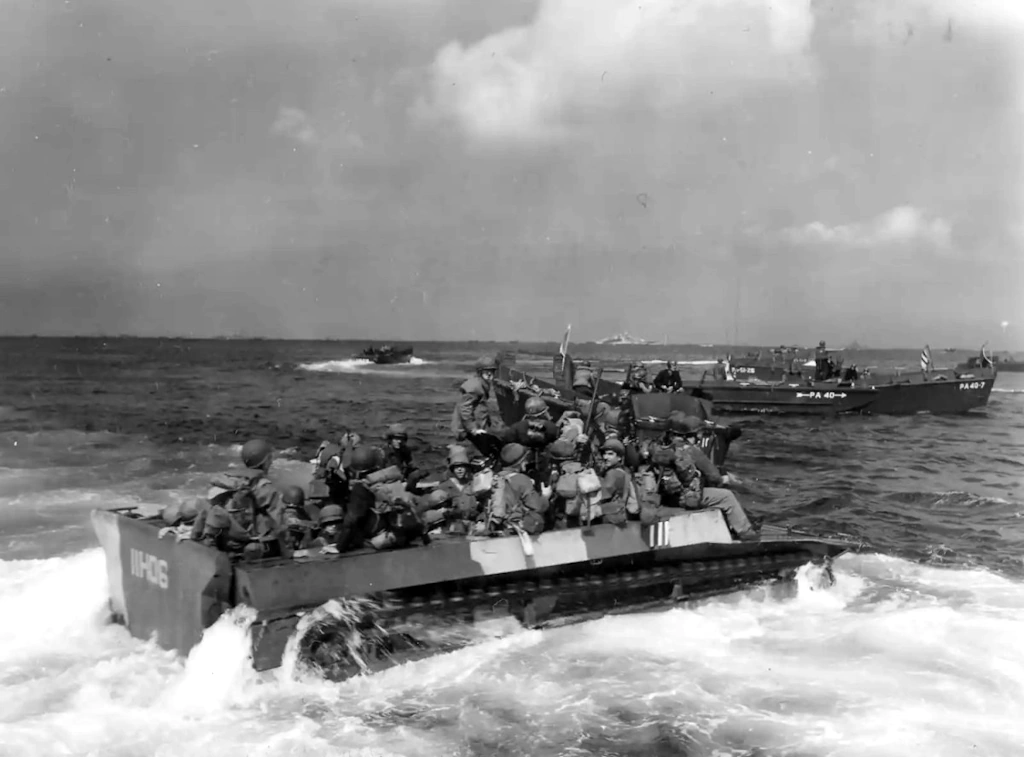
The LVT-4 and LVT-2 are both variants of the Landing Vehicle Tracked (LVT), a series of amphibious vehicles used extensively by the US forces during World War II. Despite their shared lineage and purpose, they have significant differences in design, capabilities, and usage.
Key Differences Between the LVT-4 and LVT-2: The LVT-2, nicknamed Water Buffalo, was an evolution of the original LVT-1. It had a cargo compartment in the middle, with the engine located at the rear. This design limited access to the cargo area and made loading and unloading slower and more difficult. the LVT-2 could carry up to 5950 lbs of cargo or 18 troops. The LVT-4 introduced a significant improvement: a rear-loading ramp. The engine was moved to the front, which allowed for the addition of the rear ramp for quicker troop and cargo loading or unloading. This design made it far more practical for amphibious operations. The LVT-4 could carry up to 8000 lbs of cargo or 30 troops, making it far more versatile for transporting troops, supplies, or even vehicles like small jeeps or artillery.
Armament: LVT-2. Typically armed with a combination of .30-caliber and .50-caliber machine guns for defensive purposes this vehicle focused more on troop and cargo transport, not direct assault roles. The LVT-4, had similar armament configurations as the LVT-2 but often featured better provisions for mounting additional guns. Later models were sometimes equipped with heavier weaponry to provide fire support in combat.
Operational Role: The LVT-2, primarily used in earlier amphibious operations, like Tarawa and the Marshall Islands. Its design was adequate but less efficient for quick unloading, which became a critical need in intense combat scenarios. The LVT-4, played a prominent role in later Pacific battles, such as Saipan, Peleliu, and Okinawa. The rear ramp design made it ideal for supporting larger-scale landings by expediting troop and equipment deployment under fire.
Production: Around 2962 LVT-2 units were produced during the war. The LVT-4 production reached 8351 units built, making it the most-produced LVT variant.
Performance: Both the LVT-2 and LVT-4 used a Continental radial engine, giving them similar top speeds (about 20 mph on land and 7.5 mph in water). However, the LVT-4’s design allowed for improved usability and better performance during large-scale operations.
Summary: The primary difference lies in the location of the engine and the addition of a rear ramp in the LVT-4, which made it far superior for amphibious landings, allowing faster deployment of troops and equipment. The LVT-2 was effective but less practical for sustained combat operations, and its design was eventually phased out in favor of the more versatile LVT-4.
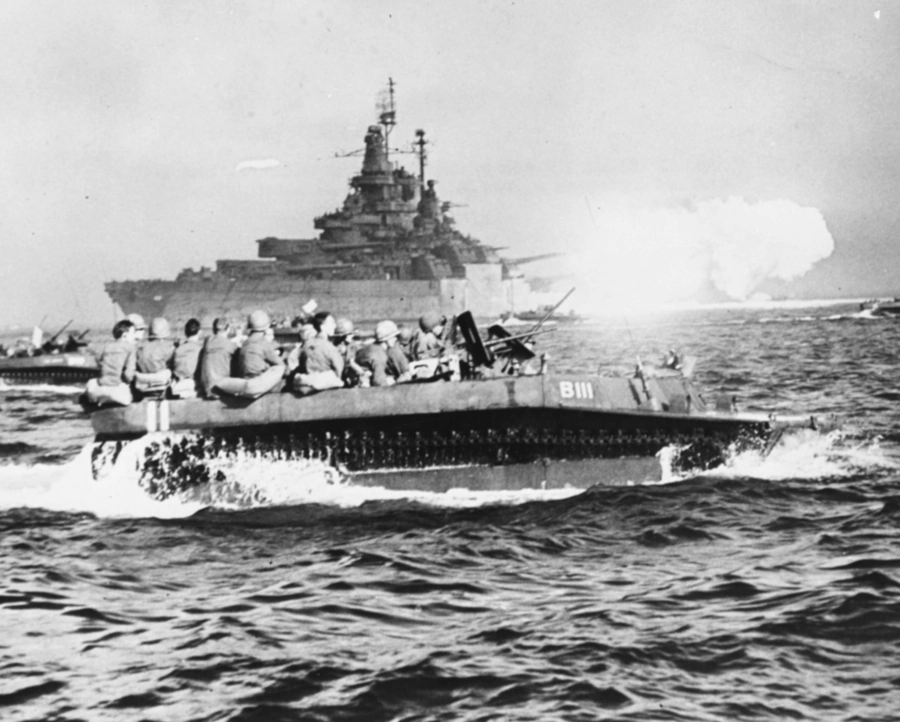
The following troops were attached to the battalion and comprised (BLT-3) Battalion Landing Team 3 – 381st Infantry.
| Battalion Landing Team 3 | Officers | Enlisteds |
|---|---|---|
| 3d Battalion 381st Infantry | 35 | 825 |
| 3d Platoon Antitank Co 381st Infantry | 1 | 33 |
| 3d Platoon Cannon Co 381st Infantry | 1 | 21 |
| 3d Platoon Able Co 321st Engineer Battalion | 1 | 44 |
| 3d Platoon Able Co 321st Medical Battalion | 2 | 30 |
| Battalion Medical Section | 2 | 20 |
| Liaison Officer & Forward Observer Section 361-FAB | 3 | 28 |
| Detachment 596d Join Assault Signal Co | 3 | 14 |
| 3d Platoon Charlie Co 519th Military Police Battalion | 1 | 46 |
| Photo Assignment Team | – | 1 |
| Recon & Forward Section 88th Chemical Battalion (4.2) | 1 | 9 |
| Charlie Co 170th Engineer Combat Battalion | 5 | 183 |
| 3d Platoon 293d Port Company | 1 | 64 (a) |
| 1/2 728th Am Track Battalion | 5 | 255 (b) |
| Charlie Co 780th Am Tank Battalion | 4 | 112 (c) |
| Naval Gunfire Liaison Officer & Party (Naval Officer) | 1 | 8 |
| Naval Gunfire Spotter Officer & Party (Arty Officer) | 1 | 8 |
| Total | 67 | 1695 |
(Note) (a) The 3d Platoon of the 293d Port Company was attached to the landing team only for operational control and was not loaded on Landing Ship Tanks assigned to the battalion nor did they enter into the boat loading or landing on White Beach 1. (b) Personnel were crews of Landing Vehicle Track assault craft and did not figure in loading tables. (c) Able Company, 780th Am Tank Battalion was assigned one Landing Ship Tank and formed the first wave comprising Am Track Tanks with 75-MM howitzers mounted. Able Company, 780th Am Tank Battalion landed with 14 assault tanks in the first wave.
The Battalion S-3 decided to set aside for planning purposes two landing craft for the command group. These two vehicles were arbitrarily numbered 0 and 00 for control purposes and in this manner easily distinguished as not a part of a wave. The battalion executive officer was separated from the battalion commander in case the assault LST was sunk, and loaded on the LST with King Co in reserve. The battalion commander and his observation post group were transported with Item and Love Companies. The complete Ship to Shore Movement Plan, after considerable shifting of personnel, was submitted to the battalion commander on March 4, and after minor changes, approved on March 5, 1945.
Table Number 1 – Landing Diagram – H Hour 0830 – April 1, 1945.
1st Wave – Amphibious Tank H Hour
14 Tanks – 75-MM Howitzers
2nd Wave H Plus 2
Assault Platoons, Light Machine Gun Sections Love and Item Companies
| 28 | 27 | 26 | 25 | 24 | 23 | 22 | 24 |
3rd Wave – H Plus 6
Support Platoons, 60-MM Mortar Section Love & Item Cos, HMG Section Mike Co, Forward Observer 361st FAB, Naval Gunfire Spotter.
| 37 | 36 | 35 | 34 | 33 | 32 | 31 |
4th Wave – H Plus 12
Mike Company (-), 3rd Platoon Able Company, 321st Engineers
| 47 | 46 | 45 | 44 | 43 | 42 | 41 |
5th Wave – H Plus 18
King Company (-), Ammunition and Pioneer Platoon, Battalion Communication Platoon (-), Battalion Execitive Officer, 2-1/4 T Trucks.
| 58 | 57 | 56 | 55 | 54 | 53 | 52 | 51 |
6th Wave – H Plus 24
Battalion Antitank Platoon, Battalion Communication Platoon (-), Charlie Company 170th Engineers (Shore Party), Battalion Medical detachment.
| 68 | 67 | 66 | 65 | 64 | 63 | 62 | 61 |
Free Boats – Not assigned to a Wave
| 0 | 00 |
Forty Amphibious Track Vehicles were necessary to transport the assault echelons of the battalion landing team. This does not include the 14 Amphibious Tanks which comprised the first wave.
The Assault – April 1, 1945.
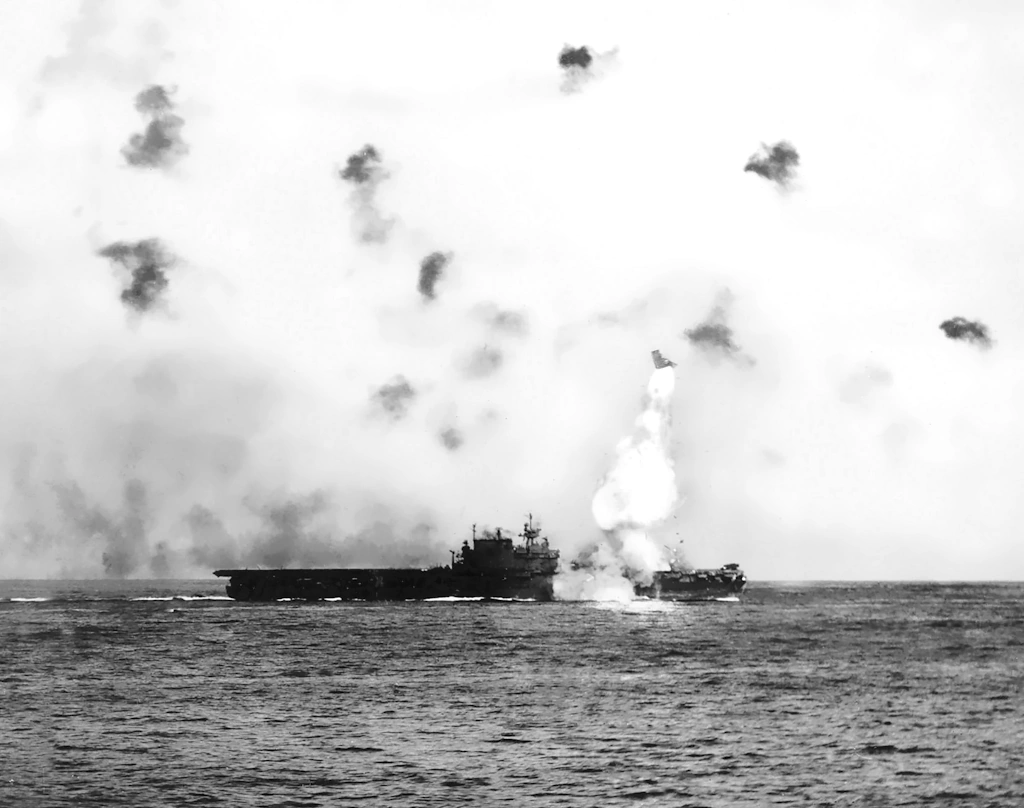
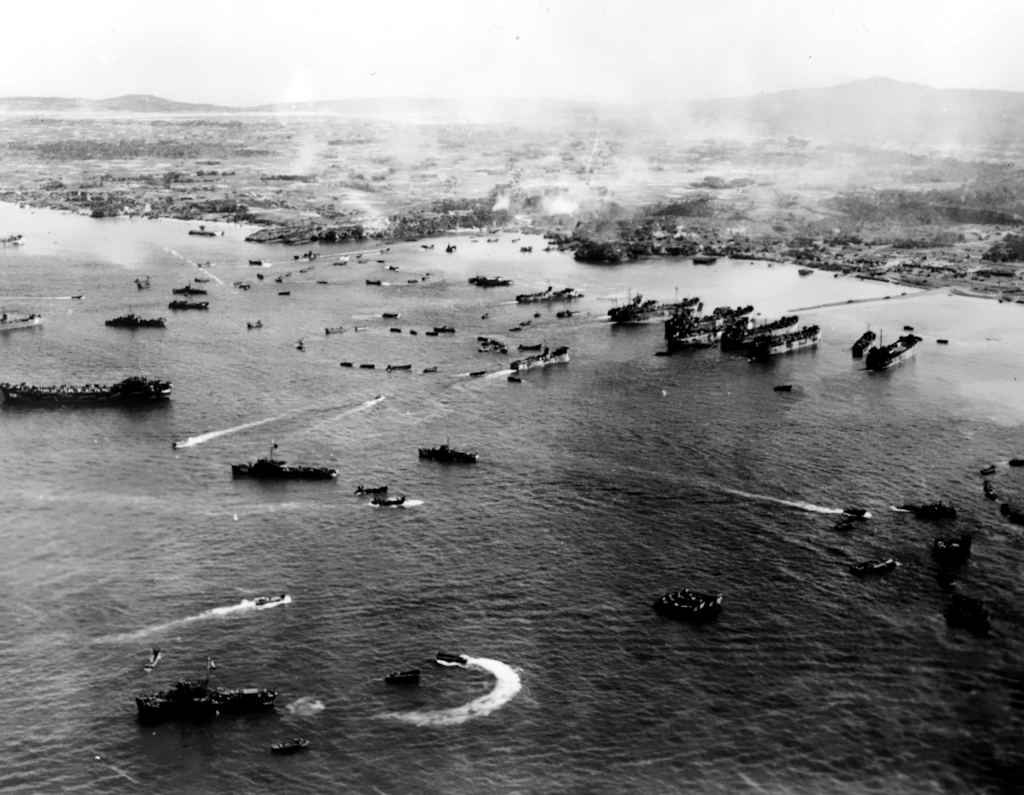
On Easter Sunday at 0705 on April 1, 1945, LSTs of the 3/381-IR arrived in their respective areas and proceeded to launch amphibious craft according to plan. The long awaited landings were about to begin. The Battalion Landing Team ate an early breakfast aboard ship with the uppermost thought in every soldier’s mind, ‘What will the Japanese do to prevent our landing?‘ The public address system announced, ‘All personnel proceed to the tank deck and prepare to load LVT’s’. The veterans of the Philippines knew the stage was set. The troops were loaded by 0705 and the assault craft began driving off the loading ramp into the China Sea and headed for the Line of Departure approximately 2000 yards off shore. The rumble of supporting naval gunfire and air bombardment grew intense, LCI Rocket, 40-MM and 4,2 mortar boats pounded the beaches. The assault waves were formed according to plan and headed for White Beach 1. The 75-MM guns of the 780th Amphibious Tank Battalion in the first wave opened fire on the beaches and continued to fire on beach installations while advancing toward the beaches. The landing time was selected at high tide to enable craft – other than track landing vehicles – to get over the reef. About 350 yards off shore the alligators hit the reef but continued toward shore without interruption.
The 3d Battalion Landing Team, under heavy supporting fire hit the beaches at 0830 and surprisingly not a single shot was fired by the enemy. Item and Love Cos quickly pushed inland. The battalion commander and his Observation Post group landed at 0838 in rear of the 3d wave. All boat teams landed per schedule and the assault echelons headed for the vital railroad 660 yards inland. After a hasty reorganization, Item and Love Cos made contact by SCR-300. By 0930 the railroad was cut and the battalion had not suffered one casualty. The town of Sakugawa, Hill 160 and the coastal road to our front were the next objectives. Item and Love Cos moved forward when suddenly a large shell exploded in rear of Item Co on the right flank. The battalion S-3 believed the navy was firing short. In a few minutes two more rounds landed in the battalion zone. Item Co immediately radioed the firing was coming from Hill 160, about 300 yards to the front. Col Nolan, the battalion commander only gave one command to the company commander, Get that gun now!. Lt Kline notified his 1st and 3d Platoon Leaders that due to the nature of the hill and the dangers of a two platoon assault he would use only the 1st Platoon. Item Co Lt Salvatore E. DiNuzzo, platoon leader 1st Platoon made a quick estimate of the situation and decided to use two squads in the attack. Four Amphibious Tanks were moved forward, just in the rear of the 1st Platoon to provide direct fire support of the 75-MM guns mounted on the AmTracks. Each squad was organized into an assault detachment carrying demolitions, fragmentation and white phosphorous grenades. The support squad was organized similarly and was carrying a flame thrower in addition to its organic weapons.
The platoon was able to advance within 100 yards without drawing fire from the Japanese Outpost. Suddenly the Japs opened fire with rifles and one Light Machine Gun as the platoon reached the base of Hill 160. The Amphibious Tanks with direct fire quickly silenced the small arms fire but the Nips started throwing satchel charges and grenades. The platoon halted and was hesitant in advancing so Lt DiNuzzo quickly moved in front of his platoon and after this display of leadership the squad moved forward. By the use of fire and movement the two assault squads moved close enough to cause the enemy to abandon the five inch coastal gun and seek refuge in a small cave. The flamethrower was moved forward and the full force of the flame was placed in the cave aperture. The flame destroyed the remaining Japs. Twenty-three Japanese were killed and the only casualty suffered by the 1st Platoon was Lt DiNuzzo, the Platoon Leader. It was necessary to evacuate the platoon leader and the platoon sergeant assumed command. The gun was demolished by placing several ten pound charges under the carriage. Hill 160 was in our possession.
The 1/381-IR on the regimental right flank advanced very rapidly but their advance was delayed when friendly naval planes subjected the troops to a bombing and strafing attack. The naval air liaison officer quickly halted the air attack and luckily the men of the 1/381 suffered only a few casualties. The 1/381 was delayed in their advance by the strafing and a gap in depth was discovered between the assault battalions of the 381-IR. By 1300, Highway 1 and Sakugawa were captured without resistance. Col Nolan and the battalion S-3 were closely watching the hours tick by and knew the prominent terrain feature Hill 102 must be captured prior to darkness. From Hill 102 the enemy could launch a counterattack with observation over the entire landing beaches. Capt Frederick C. Caldwell, Company Commander How Co on the battalion left flank reported no enemy could be observed on Hill 102. The battalion commander decided to take no chances so he turned to the Air Liaison Officer and asked for an air strike consisting of rockets, bombs and ending in a strafing mission on Hill 102. The air strike was quickly cleared and the carrier radioed a squadron of 7 planes from one of the carriers would make the strike in five minutes. The planes rocketed, dive bombed and strafed the hill. Love Co jumped off immediately and to their surprise the hill was captured without a fight. Hill 102 was a large undefended fortress. A series of caves were dug through the base of the hill and tunneled to meet an attack from any direction. The enemy was aiding our attack by yielding important terrain without a fight.