


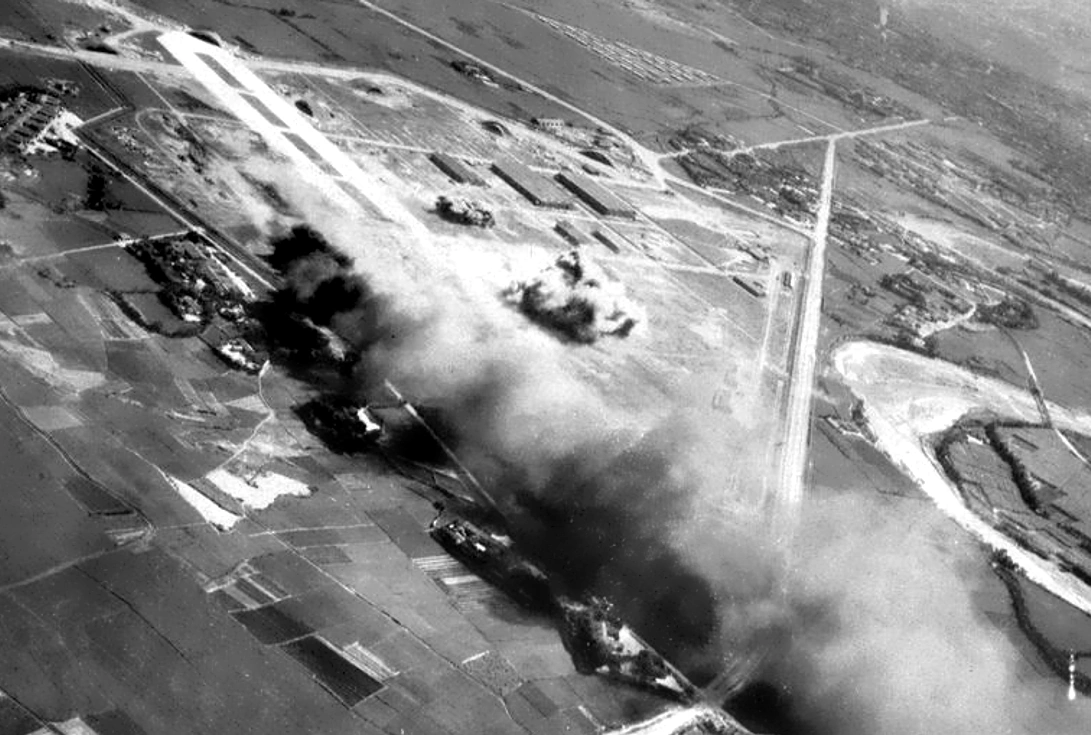
(Above) The Japanese forces on Formosa positioned their fighter planes in two groups, one covering Taihoku and the other covering Takao. In Kyushu, the T Attack Force prepared for night missions while other air units planned a large formation attack against the American carriers.
It appears that the Japs were going all out to try to prevent us from completing our landing operations on Saipan. While they had launched this carrier-borne attack, at the same time there were land-based planes that were coming up from Guam, which evidently had been staged in from the islands to the south, Yap and Palau. So, it was an all-out attack with everything they had, to try to stop the invasion of Guam and Saipan. That evening we started in pursuit of the Jap fleet which had a head start on us, having launched upwind and turned and run downwind. When we pursued this fleet we had to pause and turn frequently to launch and recover our search planes. This was a distinct disadvantage. They were steaming rapidly downwind heading apparently for Formosa. It is my own personal belief that this was not the whole Japanese fleet but only a good-sized task force, and that they undoubtedly had other units of their fleet lying in wait to the westward of us beyond the range of our air searches so that if we did follow them too closely back towards Formosa they probably would have had us in a tight spot from land-based bombers and also from any other carriers that they might have ready to hit us.
There has been considerable criticism of the decision to attack on the afternoon of June 20 instead of waiting until the next day. It is also my personal belief that if we had attacked the next day instead of that night when we saw them we would have missed the chance to hit them or that we would have gotten too close to the Philippines and Formosa and their land-based bombers to get away intact. In any event, the decision was made to hit the Japanese that afternoon after they were located.
First Wave Took of About 1600
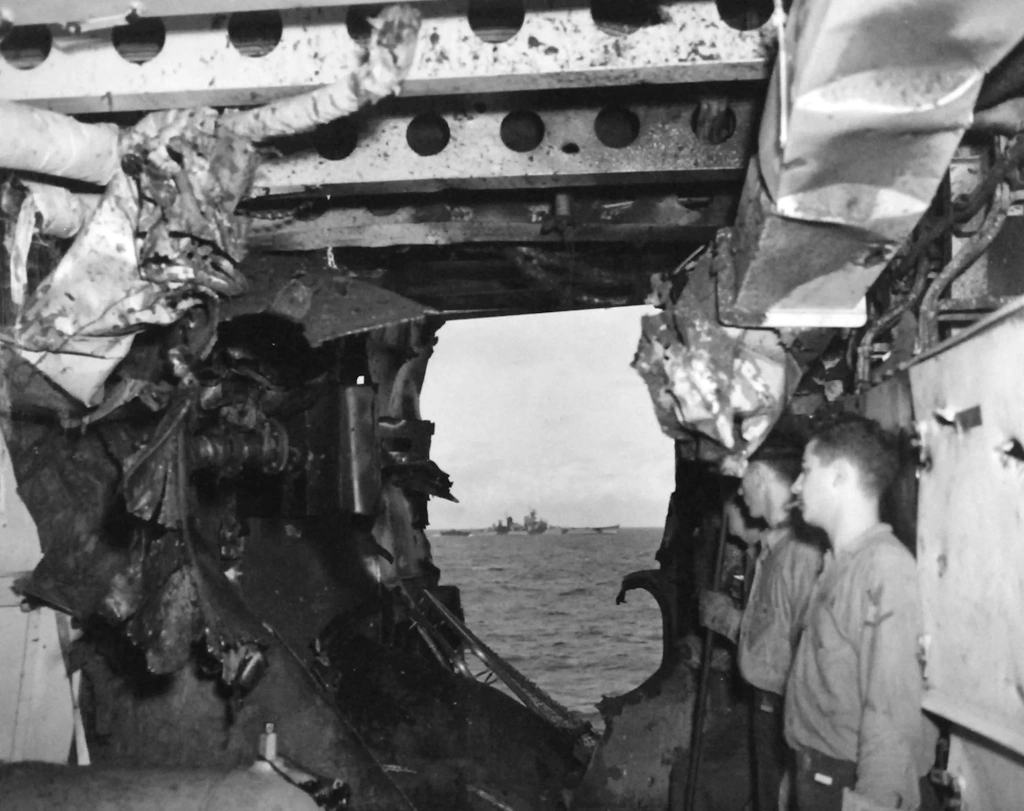
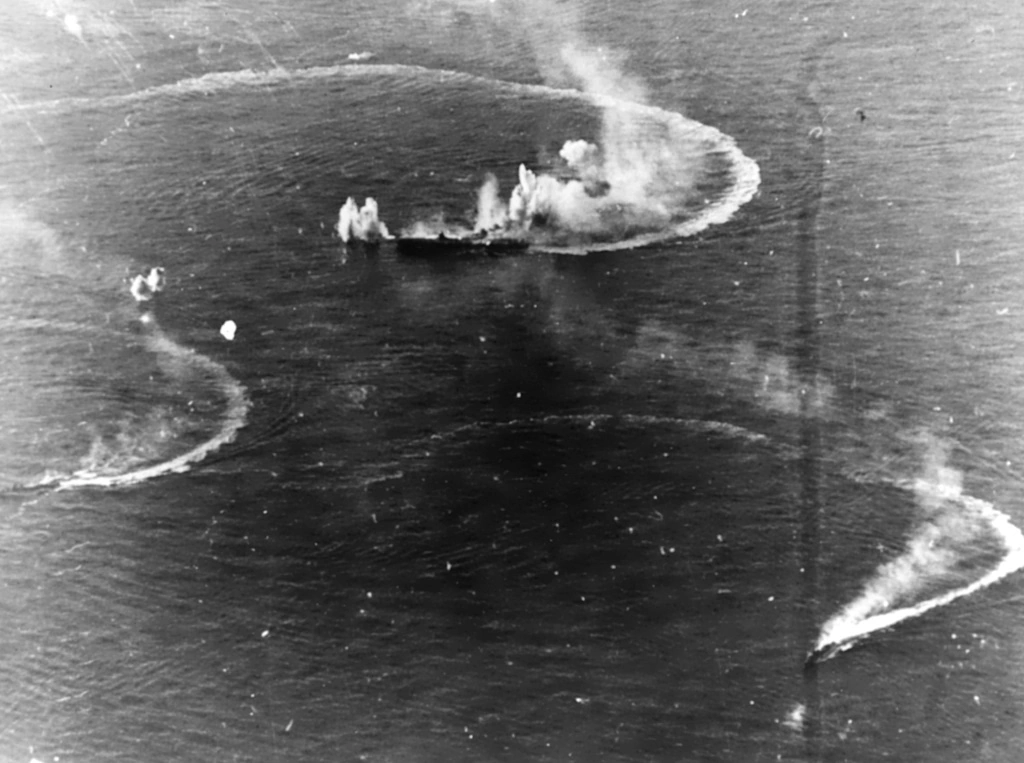
The first wave of our attack took off about 1600 in the afternoon to hit the Japs. Most of these planes were armed with general-purpose bombs to clean off the decks, it being the plan as I understand it to follow up with a second attack wave with armor-piercing bombs. In any event, our own four torpedo planes which were the only planes from our group launched on that first attack, were loaded with four 500 pound general-purpose bombs each. These pilots of ours were to tail onto the group from the USS-Wasp and the USS-Bunker-Hill, which they did. The Jap fleet was a considerable distance further to the west than had been anticipated. My pilots told me later that they had to fly through heavy AA fire which they described as being four or five different colors. They had to fly through this heavy fire from the screen of destroyers and oilers of the Japanese task force for 20 or 80 miles before they got to the carriers which were their primary objectives. These Japs carriers, one of which was a Shokaku class carrier, had no planes on deck. The Squadron Commander of Torpedo Squadron 31, Lt E. E. Wood of Pittsburgh (USA), was the one who led the dive. They were worked over by several Zekes during their approach but their rear gunners drove off these Jap fighters.
They started their dives at about 8000 feet, according to Wood, and released at about 4000 feet, using unusually high-speed dives for Avenger Torpedo planes. Wood and his wing mate, Lt J. B. Russel of Huntington (West Virginia), each scored two hits with 500-pound bombs on the stern of this Shokaku class carrier and left it afire. Their rear seat men brought back confirming pictures of this. The other two pilots, Lt (jg) D. E. Smith of Denver (Colorado), and Ens Jimmy Jones of Washington (USA) each scored bomb hits on a Kongo class battleship. They then started back with the other planes which were coming back. Back on the carrier, those of us who were waiting knew that these pilots would have to land in the dark. We went into radar plot and saw that there were several Jap bogies which were in our vicinity at the time. I believe that there were two bogies to the south, each of three to four planes, some as close as 18 or 20 miles, and we felt at the time that there would be no possibility of showing the neon landing signal wands in order to help our pilots get back aboard, because if we had showed these lights, any Jap planes in the vicinity could have attacked with bombs or torpedoes, and any Jap submarines in the vicinity could have spotted us easily. It was therefore felt by those of us who were aboard that our pilots would have to be written off as the Japs had written theirs off when they launched their attack the day before.
Another complicating factor was that there was a thunder storm to the southwest with intermittent lightning which was a false beacon to our returning pilots. They followed this lightning and we could hear them over the radio telling each other that it was probably gun fire from our ships and that this was probably where their waiting carriers were.
Surprised to see Lights
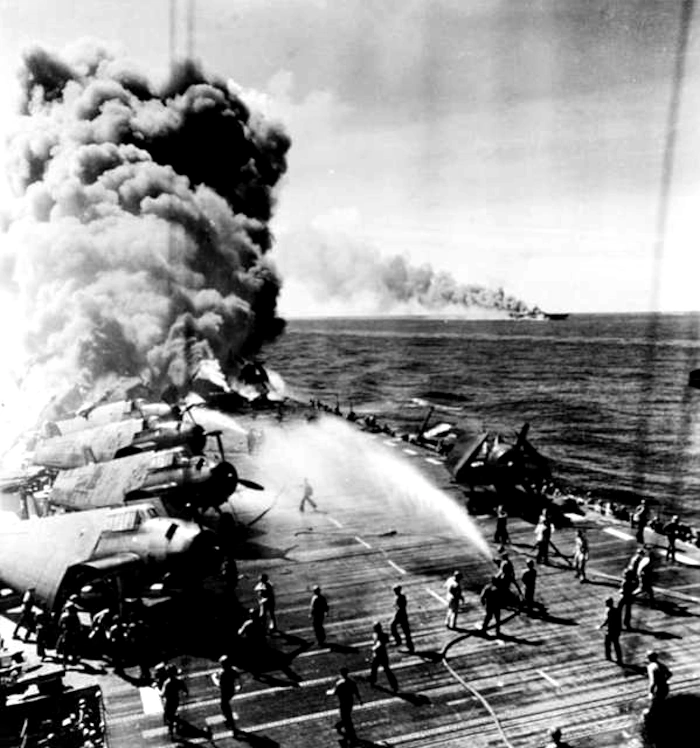
About that time we were very much surprised to see lights of all kinds go on. There were flashing truck lights, the glow lights on deck, and in addition there were bright search lights pointed straight up to indicate the exact location of our task groups. There were star shells and there were search lights from destroyers laid out along the water so that any pilot out of fuel could land safely in the water. It also appeared that the Lord was with us again because the sea at that time was remarkably calm so that many of our pilots who might have been injured in these night landings were able to get down safely. In the case of one of our pilots, Lt Smith made a water landing in the dark, was slightly injured and picked up about three hours later that night by a destroyer. Both of his crewmen were saved, Lt Russel and Lt Wood both got back aboard the CABOT. Wood had only five gallons of fuel left. Lt Jones was severely burned when he landed on the Bunker Hill and his plane caught fire. This was typical of the experiences of many of the pilots that night. Some got back on their carriers, some on other carriers. Our own carrier took aboard more airplanes than it was theoretically able to hold. Great deeds of strength and bravery all that night helped men get back safely who would otherwise have been lost.
It was the greatest sight that anyone had ever seen in that task group and we were all profoundly moved to know and to realize what the High Command had done, to risk the destruction of their ships in order that our pilots could get back, I believe this decision was without equal in any action that I know of. I doubt if any other high command in any other nation would have risked what ours did in order to save their pilots. All of our pilots realized this, and it has done much for pilot morale. This is one reason why our pilots don’t hesitate to tackle much larger enemy formations at any time because they know that the high command will spare no effort to see that they are picked up and this mutual confidence is doing much to make our naval aviation the best in the world.
That night the Japs outran us and the following day a very intensive search was made of the entire area for those pilots who had gone down the night before or who had been shot down by Japanese aircraft. As a result, a great many key personnel, including squadron commanders and air group commanders, were picked up who would have otherwise been lost. I sat on the deck of the CABOT the next morning scheduled to lead a strike. My fighter was armed with a 500 round
armor piercing bomb and a blackboard was sent up to give us the location of the Jap fleet. At that time they were supposed to be 350 miles to the west of us. A few minutes later another blackboard information message came up to inform us that the carriers were another 50 miles beyond this. We realized at that time that if we had been launched we would undoubtedly have had to land in the water, and we doubted very much if they could risk going in that close to pick us up.
Again the high command made the decision not to expend their pilots and the strike was not launched. This probably was decided by the fact that we were getting too close to the Philippines and also by the fact that we would undoubtedly have been expended if we had been launched. Needless to say we were again very grateful to whoever made this decision to let us live to fight another day. That decision was also probably influenced by the fact that our destroyers were very low on fuel, that we did not have time during this chase to refuel them and because our oilers were far astern on the way out to refuel us. The next day our oilers came very far out to meet us. I think they were well west of a line running north and south through Yap, and it was a very welcome sight to see these big fleet oilers steaming all the way out there to come up and refuel us. The following day we went on back in to support the landings around Saipan and Guam. Guam was still very active and we had a lot more shooting there. The Japs were running planes in from Palau and Yap, and each night as our combat air patrols were recovered after their last flight those Japs would come out with their night torpedo attacks. Most of these were beaten off by AA fire and also by night fighters. From then on in it was merely a matter of supporting our own troops by bombing Jap installations on Guam and Saipan.
Gives Reasons for High Morale
Regarding the night action when the lights were turned on, I do not think that any damage was caused by Jap planes or submarines. I did see some tracers that night being fired, but I saw no Japanese flamers as we head seen previously in other actions. There was a rumor to the effect that one Japanese plane made an attempt to land on one of our carriers. How true this may be, I don’t know, but it is definite that there were Jap planes in the vicinity. Whether or not there were many planes present, the risk from submarines was sufficient to make this one of the greatest decisions ever handed down by any task force commander.
As I said before, the morale of our pilots is high for two main reasons. One is that they have great faith in their equipment, especially their armor and their self-sealing tanks and they know that their 50 caliber guns will out shoot any Jap plane that comes at them head on, or any other way. They have no hesitation about fighting it out, shooting it out with a Jap on even terms or more than unequal terms. I’ve seen pilots in our squadron on several occasions attack when badly outnumbered. On one occasion, Lt D. W. Mulcahhy attacked five Japanese fighters by himself, shot down one and attacked again. I have also seen four pilots attack over a dozen Jap fighters. I’ve seen that happen on two different occasions, and as I said before when 12 of them attack 50 that was typical of the attitude they have towards their ability to shoot it out with the Japs. The other reason for their lack of hesitation to take on great odds is the rescue service. On each of these big strikes such as the one at Palau, the two at Truk, and the ones at Saipan and Tinian, we had submarine rescue in addition to the OS2U and SOC rescue planes which were sent out from the cruisers and battleships. These submarines have done such an outstanding job out there that I would like to mention it particularly, I remember on one occasion at Woleai a pilot was shot down and stranded on a reef in shallow water, too shallow for the submarine to get in to him. The submarine, ignoring the land-based Japanese shore batteries, went right up into the shore and got the pilot off by letting a life raft drift down wind with a long line, and hauling him in on it,
I flew fighter cover for a submarine out there which had picked up pilots off Guam. This submarine there was cruising around in plain view of the Japs on Orote Field about the third day of the Saipan invasion. He had picked up four pilots from two different carriers. The job that these submariners are doing out there is unbeatable. That is one reason why our pilots’ morale is so high. The pilots appreciate this very much and think that nothing is too good for the submariners.
Navy Department
Immediate Release
Press and Radio, July 8, 1944
Commanding Officer of Meataxe Squadron Awarded
Air Medal
 Lt Cmd Robert A. Winston, US Navy, 36, of Washington (Indiana), and Vienna (Virginia), has been awarded the Air Medal for action in the Marshalls. The citation accompanying his award reads:
For meritorious achievement in the line of his profession as fighter plane pilot commanding a division of four fighters engage in combat air patrol over Roi Island, Kwajalein Atoll, Marshall Islands, on January 29, 1944. His division encountered a much superior force of enemy fighters and through his courageous and skillful leadership, his division not only evaded the enemy attack without loss, but he personally shot down one enemy fighter plane and probably another one. His effective performance of duty, daring, and aggresiveness on this occasion were in keeping with the highest traditions of the Naval Service.
From November 9, 1942, to March 22, 1943, Lt Cmd Winston was Aviation Assistant to the Director of Public Relations, Navy Department, Washington (USA). In April, 1943, he was assigned to duty in the fitting out, commissioning and command of a fighter squadron which became known as the Meataxe Squadron operating in the Pacific.
A native of Washington (Indiana, where he maintains his permanent residence at 4 Pine Street, he has a home at Back Acres, Rural Free Delivery 1, Vienna (Virginia), where his wife, Mrs. Anne Winston, resides. Before entering the Naval service, he was associated with the New York Times and the New York Daily News.
Additional Images & Information
https://naval-aviation.com
https://upload.wikimedia.org
https://www.reddit.com
https://www.criticalpast.com
https://www.taskforce58.org
https://www.usni.org
https://vintageaviationnews.com
https://laststandonzombieisland.com
https://www.history.navy.mil
https://www.vf31.com
Link exchange
Copy the banner bellox, load it to your page and link it to https://eucmh.com
Thank You

