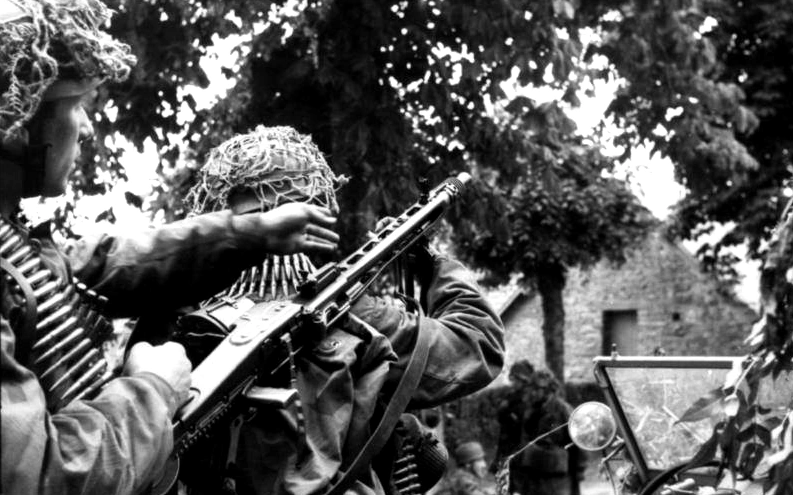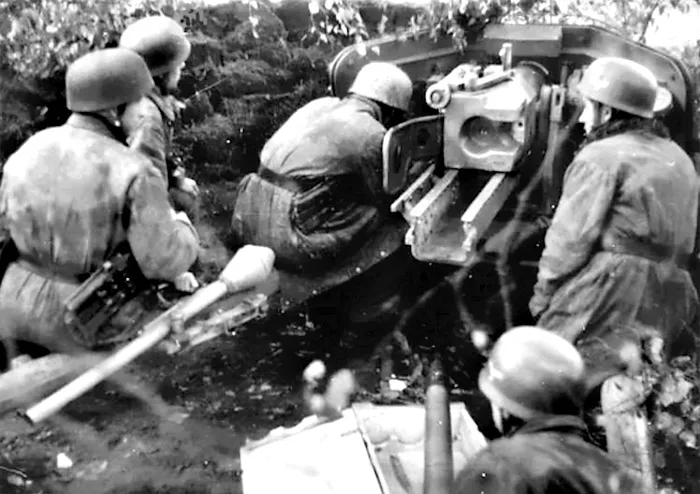
In the new position the defense of the road block was entrusted to the 16.Company of the Regiment, which was composed of highly qualified soldiers, under the direct control of the regiment. To the left of this company, but on the right flank of the regiment, the reconnaissance battalion of the 17.SS-PGD was committed. Whereas at Carentan the Americans had always pursued the withdrawing Fallschirmjäger with caution and had thus always given them enough time to establish themselves in a new position of defense. This time, the Americans remained close on the heels of the withdrawing German units. The next morning, the Americans launched an attack against the new position along the entire width of the regimental front. This position had been improved in some measure but only on the left flank. The reconnaissance battalion of the 17.SS-PGD, for instance, had at dawn not yet been able to dig in. During the day various lesser breakthroughs took place as expected. However it was possible everywhere to halt and seal them off. Only in the sector of the reconnaissance battalion of the 17.SS-PGD did the situation remain obscure and critical. Alarming reports were received from the unit on the right, where individual American tanks and infantry troops had apparently succeeded in penetrating the thin line held by infantry and the tanks. It was impossible to gain a clear picture of the situation. I am no longer able to state exactly whether the regiment remained in this position for one or for two days; in any event, during the first or second night it withdrew to its final position in the Sèves sector.
This withdrawal too was considerably handicapped because of the deep penetration which the Americans effected during the afternoon in the sector of the reconnaissance battalion of the 17.SS-PGD and which led to the complete disintegration and annihilation of this battalion. Again, the regimental command post appeared to be threatened by individual American tanks which had rushed ahead and again, a determined continuation of the American infantry attack during the night would have meant the certain annihilation of the regiment and the consequent rolling up of the entire German position in the Sèves sector.
(2) Fighting in the Sèves Sector
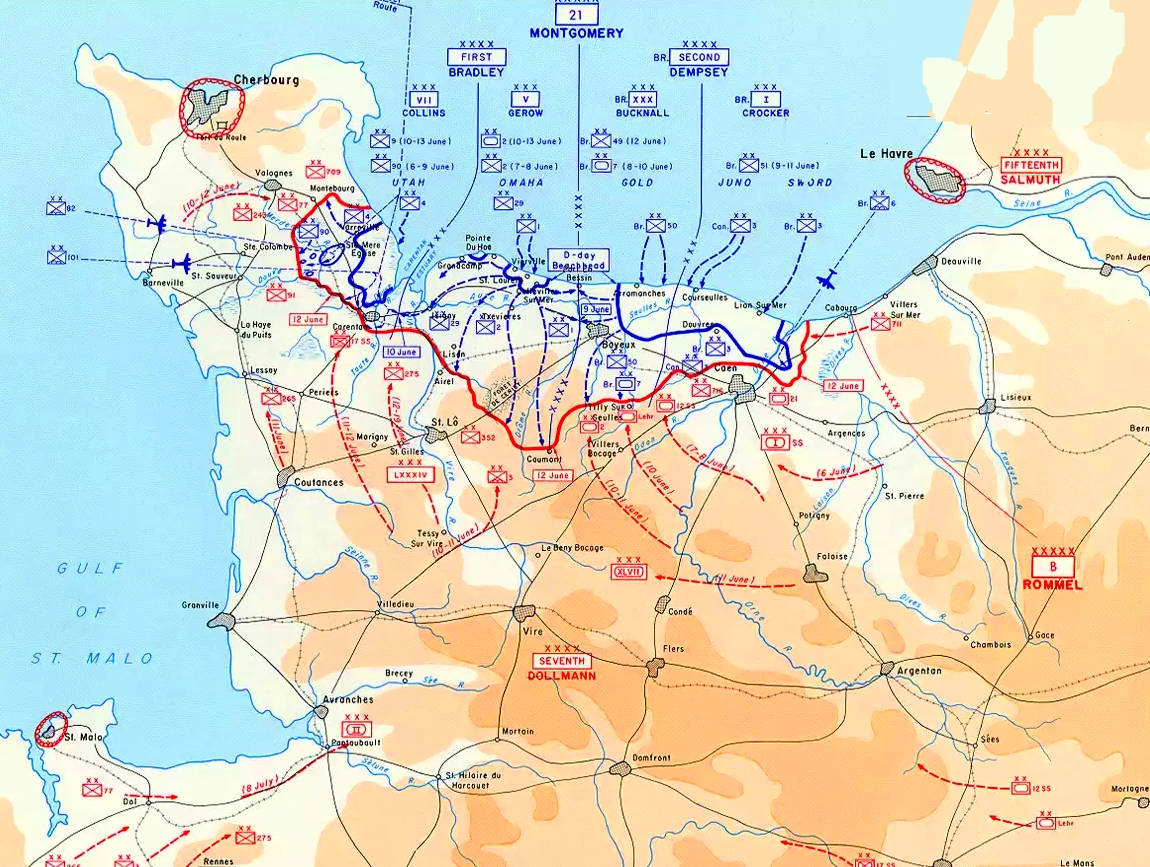
 The position of the 6.FR in the Sèves sector was in more than one respect similar to the position held in the area of Raffoville.0 In this new position too, the main line of resistance formed a 90 degree angle with the right flank of the regiment and then ran for the most part parallel to the Carentan – Périers road. Although the regiment had been relieved of the responsibility for the Carentan – Périers road, any breakthrough at this road would nevertheless endanger the entire position of the regiment. After the position had been occupied there was a lull in the fighting which lasted several days, and which made it possible for the regiment to improve its position. On the night during which the front was finally withdrawn to the Sèves sector the 2.SS-Panzer-Division arrived in the Périers area and took over the sector formerly held by the 17.SS-PGD. The latter division and the 6.FR were placed under the command of the 2.SS-PD. The two motorized infantry regiments of the 2.SS-PD, the 4.PGR (Der Fuehrer Regiment) and the 3.SS-PGR (Deutschland) were committed on the right of the 6.FR between Auxais and the Carentan – Périers road (included); the remnants of the 17.SS-PGD, combined into a single combat group, were inserted at the extreme right wing of the 2.SS-PD. The 2.SS-PD was placed by battalions behind the individual infantry regiments (Jägerregiment) and instructed to cooperate with these regiments. The division’s request for the commitment of tanks as strong points in the main line of resistance was rejected, except for a few individual cases. In the sector of the 6.FR, in conformity with the wishes of the regimental commander, no such commitment took place.
In the 2.SS-PD, SS-Gruppenführer Heinz-Bernard Lammerding served as division commander and SS-Obersturmbandführer Stoecker as operations officer. After Lammerding was wounded, command of the division was assumed by SS-Obersturmbannführer Christian Tychsen on July 24, until Tychsen was killed in action on July 28, and replaced by SS-Oberführer Otto Baum, the former commander of the 17.SS-PGD. The division’s unit commanders and troops were well trained and experienced in combat. Their equipment was excellent. Between the end of June and the beginning of July the division had been transferred to Normandy from southern France where it had been fighting the French Resistance forces.
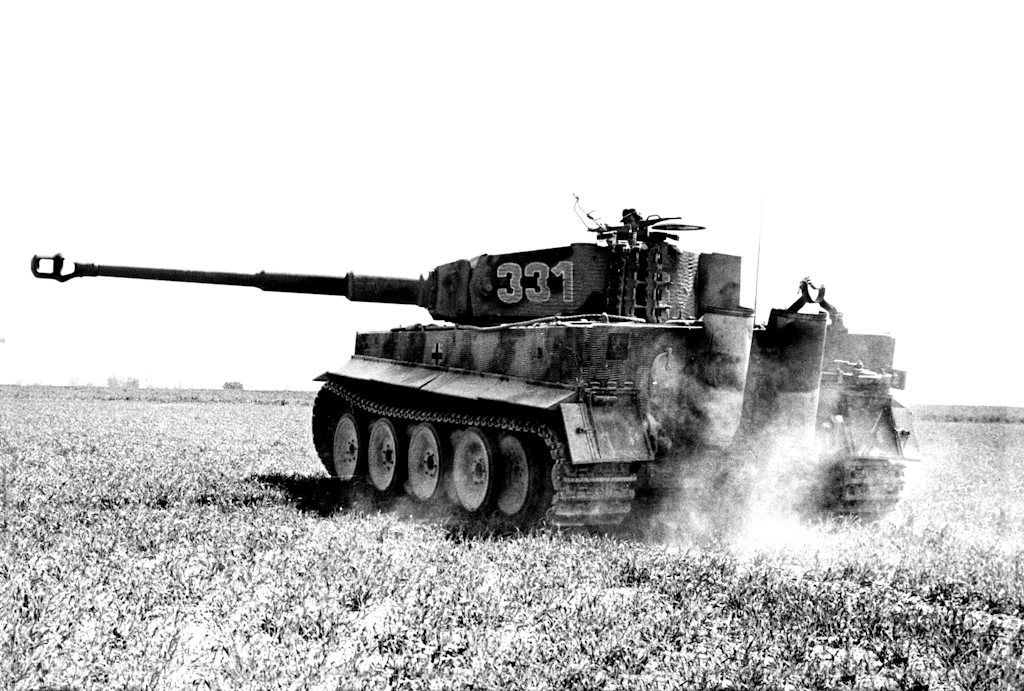
The combat efficiency of the 2.SS-PD was far superior to that of the 17.SS-PGD. It was more powerful from the standpoint of organizational structure alone, for instead of one assault gun battalion the division had a tank regiment consisting of five battalions. However, the main difference was not in organization but in the quality of the officers. Most of the unit commanders up to and including the regimental commanders had several years of combat experience and those up to and including company commanders had a sufficient knowledge of tactics to enable them to fill their posts satisfactorily. The enlisted men were, consequently, also better trained. In this division one frequently came across men of a type probably best described as mercenary or legionary. It may be significant that among the parachute troops the so-called penal company, composed of men convicted of minor military or political offenses, was very soon looked upon as the best unit in the entire division.
The artillery of the 2.SS-PD was particularly good. Perfect observation facilities, for which the commander of the 6.FR had constantly and fruitlessly struggled with the artillery commander of the 17.SS-PGD, were taken for granted in the artillery of the 2.SS-PD. The rigid plan of fire, employed during recognized enemy attack under fog or smoke screen or when observation was otherwise impeded; the barrage fire belt, which was the prerequisite for this rigid plan of fire, and the necessary supplementation of the barrage fire for areas covered by heavy infantry weapons were no longer merely a pious desire of the infantry but a reality and consequently constituted a valuable strengthening of the defense. In order to impede the sound and flash reconnaissance of the Americans, it was an established rule during sudden concentrations to combine all available guns of the division artillery and any special supporting artillery, with the result that every gun fired only a few rounds. In the 2.SS-PD cooperation between artillery and infantry, from the advanced observers in the forward line up to regimental commander, was outstanding, requests made by the infantry, even if they involved only such matters as noise deception, were always taken into consideration.
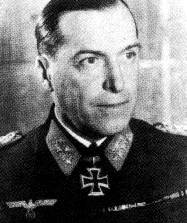 (Note) The author is correct in stating that the 2.SS-Panzer-Division was one of the best German Armored Division. The weaknesses in the command of the artillery, which were present in almost every SS Division, did not exist in the Das Reich Division. (Pemsel)
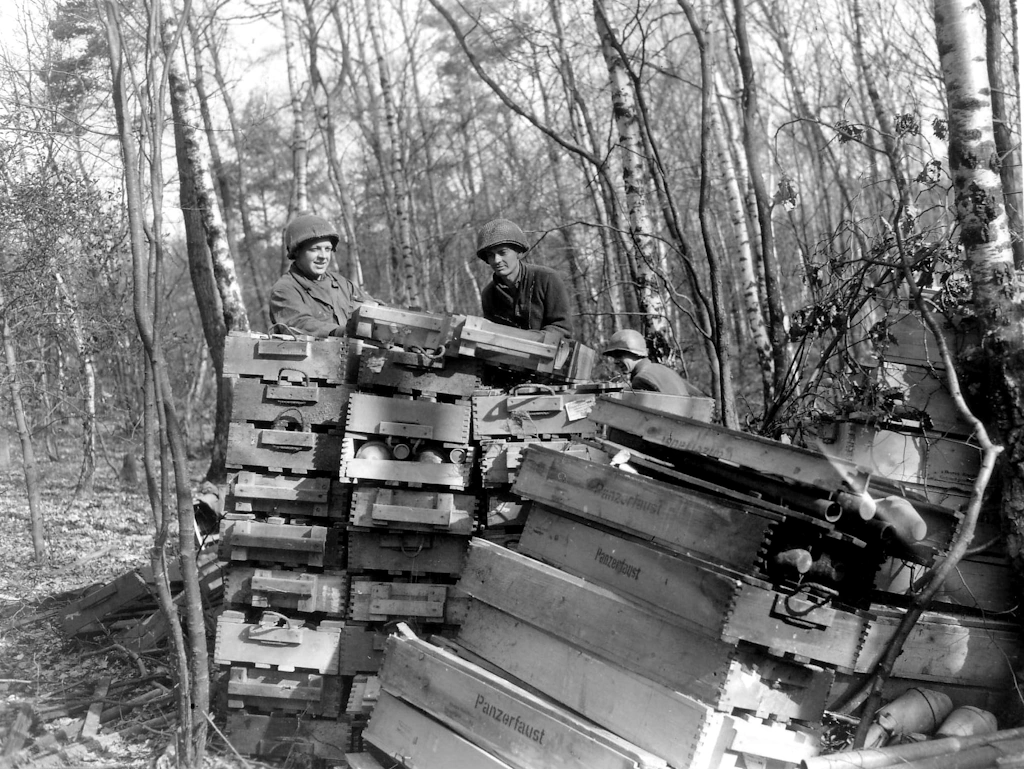
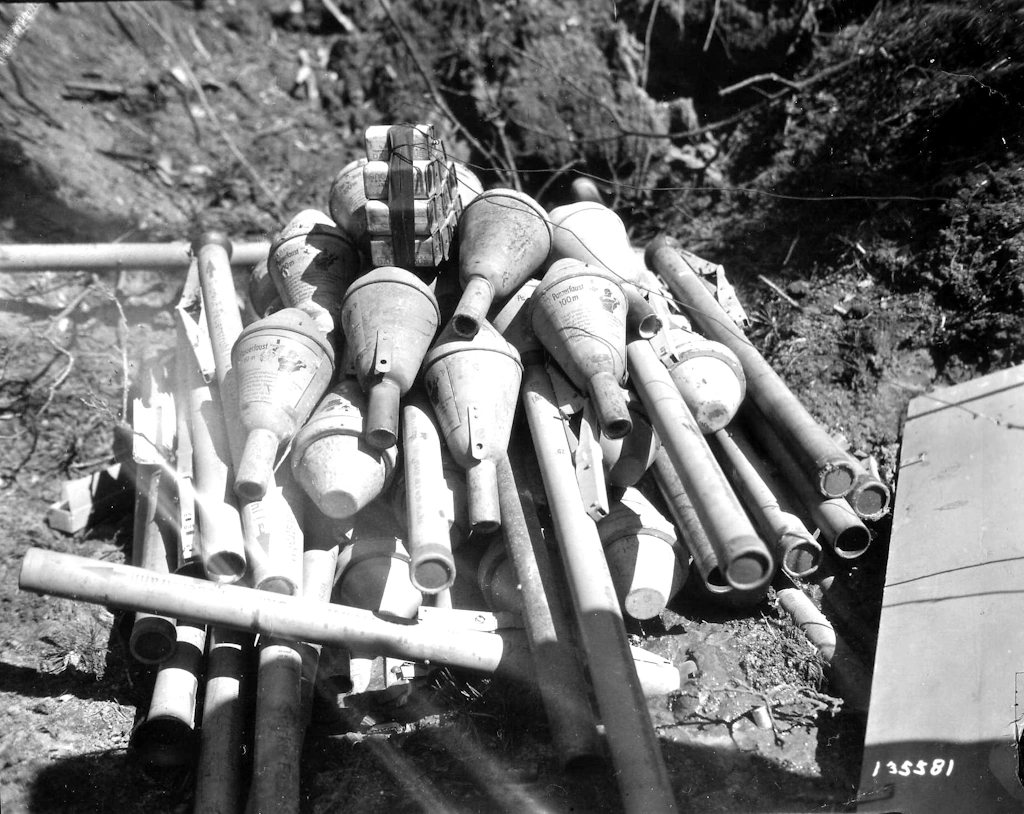
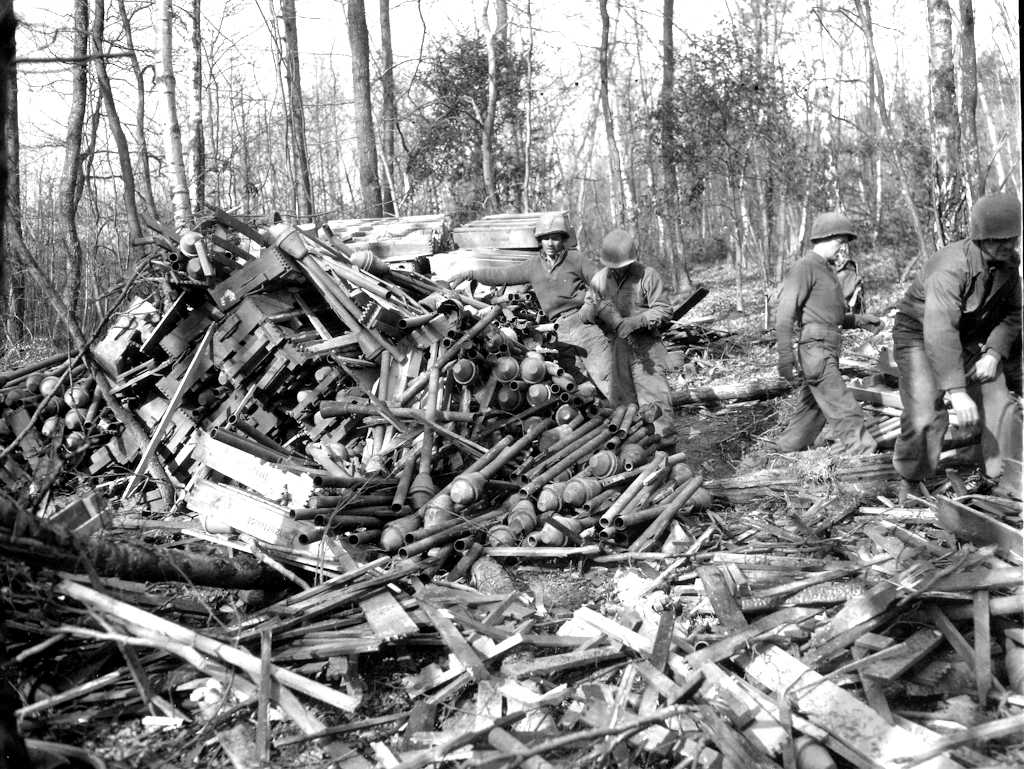
For over a week no major operations took place in the sector of the 2.SS-PD. It was not until about July 20, that strong American forces launched an attack on the left wing of the 6.FR. Owing to the fact that the main line of resistance was thinly manned, approximately one enemy battalion succeeded in penetrating this line and holding out for one night in a group of farm buildings after the gap in the line was again closed. The regimental commander did not know the exact strength of the Americans who had infiltrated but according to his own observation, he believed it to be a reconnaissance patrol and therefore ordered the 16.Company which, at the time, was still twenty men strong, to annihilate this reconnaissance patrol with the aid of one tank from the 2.SS-PD; the tracks of a second tank which was to have participated in this action, were damaged during the advance. A brief engagement followed during which the German forces for the first time employed Panzerfausts as a close combat weapon against infantry forces in concrete or brick buildings. They were surprisingly successful. The company captured more than three hundred prisoners, among them thirteen officers including a battalion commander. During the mopping up of this American breakthrough, the regiment captured more than five hundred prisoners, including wounded Americans, who were assembled behind our main line of resistance by our medical non commissioned officers. This was the largest number of prisoners captured since the beginning of the invasion.
(Note) The almost incredible victory achieved by twenty paratroopers with one tank against an American battalion which had broken through and of which five hundred enlisted men and thirteen officers were recaptured occurred because the actual strength of the Americans was at first underestimated, the attack was launched audaciously in spite of the uncertainty of the situation the field of vision was obscured, and the first large-scale use of Panzerfausts in house to house fighting had a significant effect on morale. (Pemsel)

PANZERFAUST
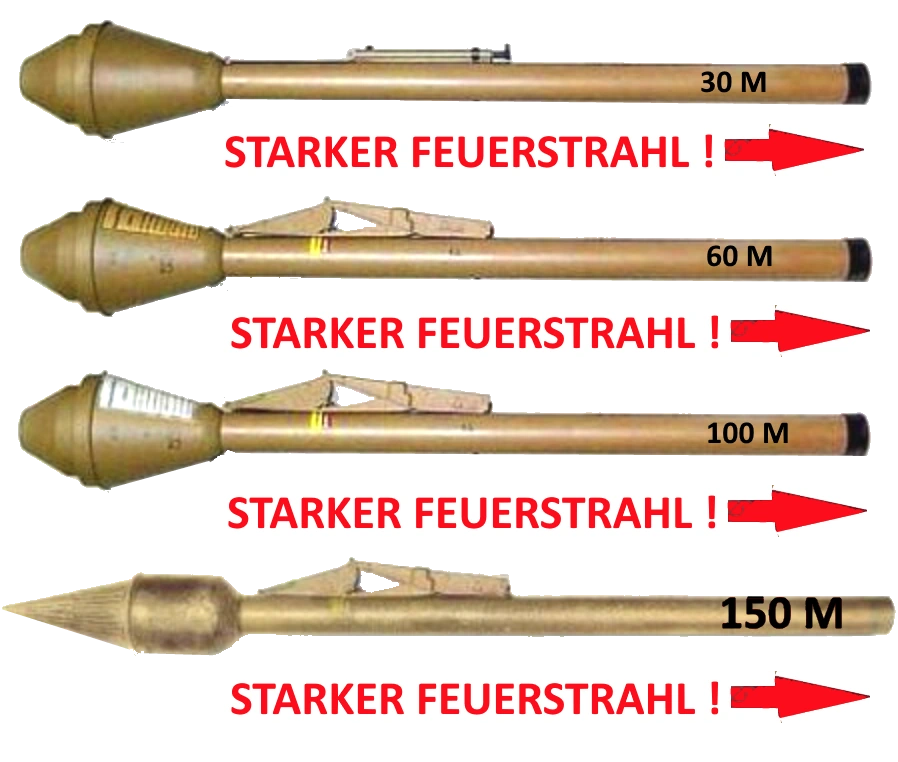
The Panzerfaust was a series of German anti-tank weapons developed and used extensively during World War II. It was designed as a disposable, single-use recoilless launcher that allowed infantry to combat tanks and armored vehicles effectively. Purpose: The Panzerfaust was developed as a response to the increasing presence and threat of Allied armored vehicles. Its simple design enabled untrained soldiers, including Volkssturm Militia and youth forces, to operate the weapon effectively. Operation: The Panzerfaust was a recoilless weapon. It launched a hollow charge (HEAT) warhead capable of penetrating thick armor by focusing explosive energy on a small area. The warhead was inserted into a steel tube pre-loaded during the manufacturing with a small propellant charge. Lightweight and portable, the aiming was accomplished using a flip-up sight with range markers for different distances. Effective range was limited, usually between 30 to 150 meters, depending on the model. The Panzerfaust evolved through several versions during the war, each with improvements in range, penetration, and usability.
Panzerfaust 30 (Klein) – The first production model was introduced in 1943, had an effective range of 30 meters, an armor penetration capability of approximately 140 MM of steel. It was lightweight but limited in range, making it effective only in close combat.
Panzerfaust 60 – Introduced in mid-1944 this Panzerfaust was an improved version with an effective range of 60 meters, an armor penetration capability of about 200-MM due to the larger propellant charge and improved sighting system. This Panzerfaust was more versatile.
Panzerfaust 100 – Entered production in late 1944 this Panzerfaust had an effective range of nearly 100 meters and an armor penetration capability of 200-MM. This weapon was heavier and slightly bulkier but offered greater standoff capability.
Panzerfaust 150 – Designed in 1945, but only a few prototypes were made. With an effective range of around 150 meters it was improved durability with a reusable firing mechanism, unlike earlier disposable models. This was meant to address the growing need for long-range engagement but was introduced too late for mass deployment.
Panzerfaust 250 – A planned version with a greater effective range (250 meters) and reusable launchers but this was never produced due to the end of the war.
The Panzerfaust was developed by the German arms manufacturer Hugo Schneider AG (HASAG), headquartered in Leipzig. The chief designer was Heinrich Langweiler, working under the direction of HASAG. The design was influenced by earlier German anti-tank weapons like the Panzerschreck and the Faustpatrone. HASAG was the principal manufacturer, but production was subcontracted to various factories across Germany and occupied territories. Factories produced millions of Panzerfaust units between 1943 and 1945. The production prioritized the simplicity and the cost-efficiency, allowing rapid mass production. The Panzerfaust proved highly effective against Allied tanks like the Sherman, T-34, and Churchill. It was used primarily by infantry in urban and defensive combat. The weapon’s simplicity made it a favorite among German forces and even Axis allies. Its proliferation during the final years of the war ensured its legacy as one of the most iconic anti-tank weapons of WWII.
The design philosophy of the Panzerfaust influenced post-war developments in anti-tank weaponry, such as the RPG series used by Soviet forces. The simplicity and efficiency of recoilless launchers became a standard in modern infantry tactics.
It might be appropriate at this point to say something about the manner in which operations were conducted. With certain exceptions, the fighting on both sides was invariably gallant and fair, at least in the 6.FR’s sector both at Meautis and
(Note) The character of the forces is evidenced by the fact that in the battle of materiel during which men were massacred ruthlessy, they nevertheless succeeded in maintaining a gallant and fair attitude in man to man combat. (Pempel)
Aside from the above-described attack in the Sèves sector, it is probable that only one other major American attack was launched at this time in the sector of the 2.SS-PD; as I recall, this took place along the Carentan – Périers road and south of it. Otherwise, the Americans, according to the impression gained by the German lower commanders, made only cautious probing movements against the division’s positions with strong assault detachments. The situation seemed to be less stabilized on the right of the division in the area west of St Lo where the 2.SS-PD was joined by the 5.FD, the quality of whose officers was reputed to be extremely poor. They consisted for the most part of officers from the Air Force ground personnel, who had no infantry experience and no technical knowledge. The division commander was regarded by all the parachute troops as an ignoramus. When a battalion commander of the 6.FR was ordered by the LXXXIV Korps to take over for a short time a regiment of the 5.FD, whose previous commander had been-killed at the front, reported through channels to the Parachute Army that conditions in the command setup of the 5.FD were absolutely shocking.
(Note) The Seventh Army was aware of the extremely low combat efficiency of the 5-FD. Owing to its poor composition, the operations staff of the division was committed at the front by the army for only a very short period if at all. The army’s plan to withdraw the regiments of the 5-FD from the front after the first failure was not carried out because no replacements of any kind were available. This was particularly unfortunate because of the decisive importance of this front. (Pemsel)
During the night of July 12, the engineer battalion of the 17.SS-PGD surrendered Tribehou on the right wing of the 2.SS-PD, and a gap of about 2000 meters developed on the right, following which the Gebhardt Kampfgruppe of the Panzer Lehr Division went into position at Le Hommet. During the night of July 12, the 3.Battalion of the 13.FR (5.FD) was placed in this gap. On July 13, Le Hommet was lost and American tanks, pushing ahead toward the west, advanced on Les Champs de Losque. On July 13, and July 14, fluctuating battles took place around this locality, during which the above-mentioned parachute battalion was completely annihilated. On July 14, additional elements of the 5.FD were inserted. The German forces, up to and including the regimental commander, and probably even up to division level, were in general kept far to much in the dark concerning the situation of adjacent units. For information regarding the overall situation on the Normandy front they had to depend on reports made by the Allied radio station Calais,(which frequently broadcast surprisingly accurate information and was listened to regularly by all staffs and probably by the troops as well, on the Allied Troop Information propaganda sheets, and on rumors. The 6.FR frequently detached officer reconnaissance patrols to adjacent sectors in order to keep informed about the situation there.
(3) Withdrawal From the Périers Area
A few days after the defensive victory, of the 6.FR in the Sèves sector strong American bomber formations, totaling about two thousand planes, attacked about noon the area on the right of the 2.SS-PD and west of St Lo. This raid lasted almost two hours including the approach formation and the return flight, the latter over the sector of the 6.FR, the air attack being concentrated on the sector of the 14.FR. It provided an enormous impressive picture. One or two hours later the commander of the 6.FR inquired by telephone how this bombing attack, the heaviest thus far, had affected the 2.SS-PD. The reply was completely reassuring. He was informed that the forces in the forward line had been struck only lightly by the area bombing which had been concentrated on the rear area occupied quite sparsely by combat trains; only a few artillery positions had been hit, though telephone communications had been disrupted to a considerable degree.
The commander of the 6.FR was all the more surprised when, on the afternoon of the same or the next day, the regimental adjutant was summoned to the division where he was given the following instructions and orientation concerning the situations: ‘Americans have effected a breakthrough in the sectors of the 5.FD and the Panzer Lehr Division. The front has collapsed in these sectors. American tanks have crossed the Périers – St Lo road and advancing via Marigny, are approaching the St Lo – Coutances road. The 2.SS-PD will accordingly fall back this very night to a reconnoitered position south of Périers, near St Sauveur-Lendelin. The 6.FR will be committed at the northern edge and west of St Sauveur-Lendelin, with its greatest strength along the Périers – Coutances road.
The withdrawal of the regiment to St Sauveur-Lendelin was affected without enemy interference. The 16.Company, which had in the meantime been brought up to a strength of one hundred men by new replacements and men taken from other battalions, was instructed by the regiment to occupy the positions in the Sèves sector. It was to feign greater than actual strength and to fall back southward to the new positions of the regiment only after enemy pressure, while constantly maintaining contact with the enemy.