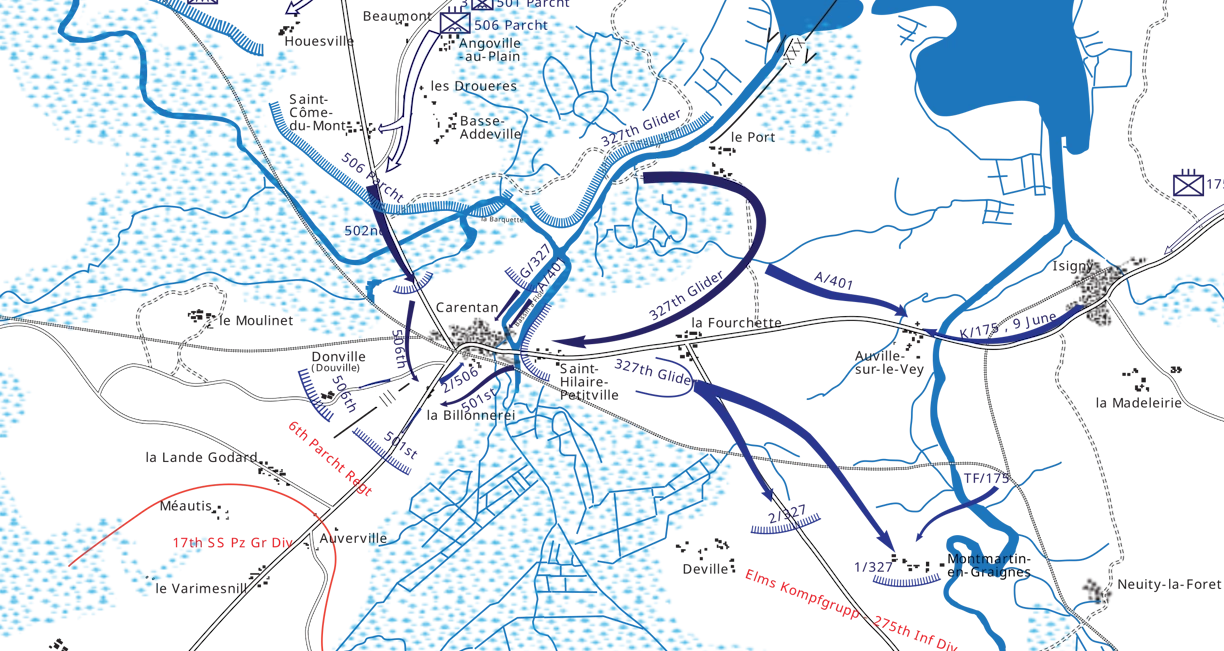



The 2.Battalion was engaged in combat between St Come du Mont and Ste Mère Eglise on both sides of the road with American units attempting to advance southward. On June 7, severe clashes took place principally in the area of Appeville, which was held by the enemy. After nightfall, enemy pressure increased in the east. Enemy reconnaissance patrols succeeded in infiltrating the weakly held German main line of resistance in terrain hidden from observation. About 2200, two American armored reconnaissance cars broke through and succeeded in reaching the Carentan road. A regimental messenger destroyed one of them directly in front of the regimental command post with a magnetic AT hollow charge, and the other was put out of commission at the southern exit of St Come du Mont by AT fire.
In the early morning hours of June 8, the positions of the 13.Company and the regimental command post were subjected to a heavy enemy barrage, which lasted about thirty minutes and resulted in casualties. At daybreak, American assault detachments penetrated the sector of the Seventh Army reserve battalion and pressed forward as far as St Come du Mont. Again, its defense line began to disintegrate. From the regimental command post, it was possible to observe first individual soldiers and then whole groups retreating westward from St Come du Mont. The site of the battalion command post had also been changed and could not be located. Violent firing indicated that the elements of the 3.Battalion committed east of St Come du Mont were engaged in heavy fighting. In view of this situation, the regimental commander had no choice but to fall back behind the Douve Canal and conduct the defense of Carentan from there. He no longer had any reserves to close the gaps caused by the collapse of the Seventh Army reserve battalion, throw back the enemy troops who had broken through, or seal off the penetration. He issued the necessary orders to the regimental units fighting in the vicinity and to the two companies of the 3.Battalion. Since radio contact with the 2.Battalion had now also been disrupted, the order to withdraw was transmitted to the 1.Battalion as well as the 2.Battalion but with no way of determining whether or not it was received. Neither battalion ever received this order. The 1.Battalion, as the regimental commander learned later, had already been annihilated on June 7, and the battalion commander had surrendered; only twenty-five men succeeded in making their way back to the regiment on June 9, through the marshy terrain along the Douve River. The commander of the 2.Battalion also tried in vain to establish contact with the regiment; when this failed, he decided on his own responsibility to break through to Carentan by piercing the lines of the Americans who were already in his rear.
It was not easy for the regimental elements committed at St Come du Mont to withdraw across the Douve River. The majority of the men had to swim in order to reach the embankment of the Cherbourg – Carentan railroad line. The Americans apparently did not realize until later that this withdrawal was taking place; in any case, the widely scattered German paratroopers who were swimming across the Douve were subjected to but little fire, while the railroad embankment itself, which offered some cover, was not fired upon. The regrouping of the elements which had crossed the Douve also took place without being affected by enemy action, so that it was possible for the 3.Battalion to be moved into positions in broad daylight and in fairly good order on the southern bank of the Oure Stream, a short distance from the northern edge of Carentan. In the afternoon, the 2.Battalions advancing over the railroad embankment also reached Carentan without being subjected to serious enemy action. The regimental commander committed this battalion on the eastern edge of Carentan, the news having filtered through in the meantime that the Americans had entered Isigny, thirteen kilometers east of Carentan, and were advancing on Carentan from the east as well.
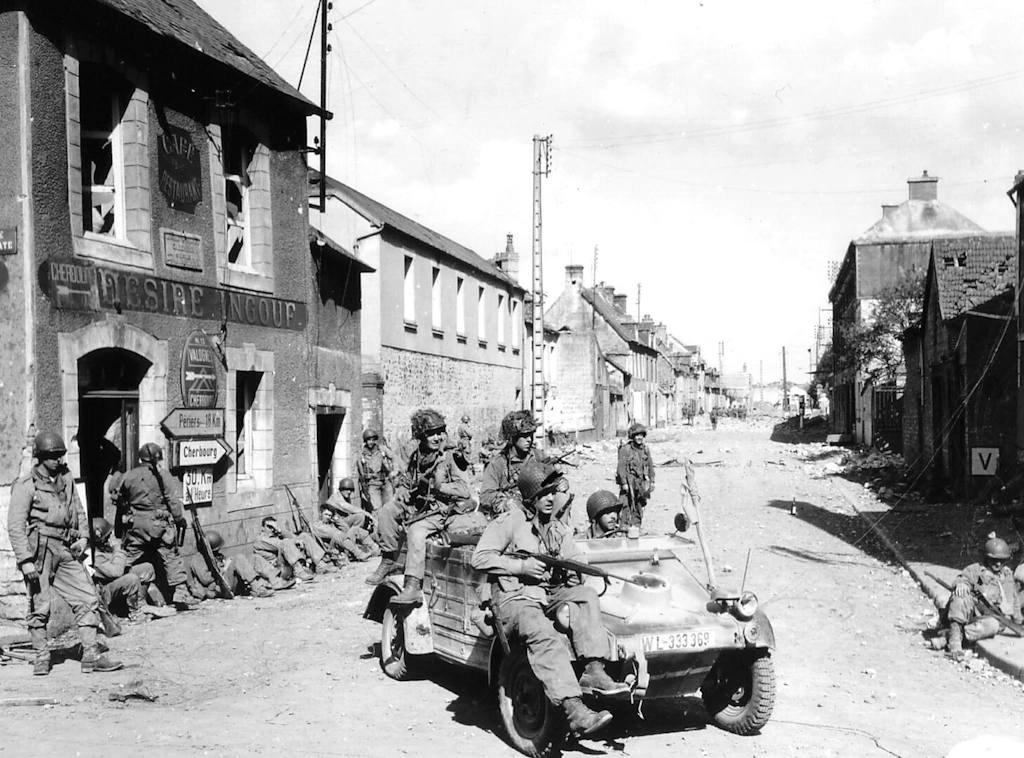
(4) The Battle for Carentan
Up to the morning of June 8, 1944, at least the regiment’s NCOs, officers, and other enlisted men still hoped that it would be possible to drive back into the sea the Americans who had landed and to mop up the bridgehead north of the Vire Estuary. After the withdrawal behind the Oure, even the private soldier knew that the first battle of the invasion had been lost by the Germans. The morning of June 8 marked the beginning of the second catastrophic act of the drama in Normandy for the 6.Fallschirmjäger-Regiment: the battle for Carentan. During the night of June 8, elements of the 2.Battalion was, for security reasons, moved eastward as far as the Carentan – Isigny Carentan – St Lo road fork, 3500 meters east of Carentan. These elements were not withdrawn to the eastern edge of Carentan until the evening of June 9. On June 9, reconnaissance patrols of the regiment pressed forward on a wide front as far as the Vire. The reconnaissance patrols of the regiment did not come across any German troops in position in the reconnoitered area. On June 9, elements of the 2.Battalion of the 709.Infantry-Regiment or 710.Infantry-Regiment, which was committed at the Canal du Port de Carentan, moved back toward Carentan. Other troops, including an Eastern Battalion (POA) under the command of a Maj Becker, withdrew to Carentan from the Isigny area. On June 9, a reconnaissance patrol of the regiment blasted the railroad bridge across the Vire, 4000 meters southwest of Isigny.
(Note) The Oure stream has not been identified. The area between Carentan and the Douve River is a maze of streams and ditches. (Pemsel) – After spending hours on the 1944 map of the area, I strongly believe that Oberst von der Heydte is misidentifying a river in the area of Isigny, and what he called the Oure was in fact the Aure. (Doc Snafu)
For the defense of Carentan, which separated the two Allied bridge heads south and north of the Vire Estuary, the corps attached to the regiment which still remained under its direct control, two Eastern Battalions composed of Russians Troops, and the remnants of the Seventh Army reserve units from the Isigny area. The combat efficiency of these units was limited. In view of the fact that the main attack on Carentan was to be expected from the north, these units, which did not belong to the regiment, were for the most part committed on the eastern edge of Carentan, while the 2.Battalion and the 3.Battalion established itself in defensive positions at the two likely points of main effort: the demolished Douve Bridges north of the city and at Pommenauque where the railroad embankment reaches the southern bank of the Douve.

On June 10, the commander of the American 101st Airborne Division, Gen Maxwell D. Taylor, called upon the regiment to surrender; the regimental commander refused.
It was not so much the steadily increasing enemy pressure which made the defense of Carentan difficult as three unfavorable factors on the German side. The first of these was the lack of any artillery, except for one 88-MM AT & AA battery, which was attached to the regiment. The second was the slow but steady giving way of the units adjacent to the regiment. On the rights east of Carentan, the regiment was compelled to turn its front more and more southward until finally there was a southern front as well as an eastern front, while the actions of the units on the left, west of Carentan, forced the regiment to keep on extending its front until in the end it became necessary to maintain strong reconnaissance patrols to keep watch – not to occupy or to hold – over the area as far as the bridge at Baupte. The third factor was the shortage of ammunition, especially for the heavy infantry weapons, which were the mainstay of the defense. Originally, the regiment had been instructed to obtain its ammunition from an ammunition distributing point where no ammunition had as yet been stored; then it was assigned one which, it turned out, had been destroyed in an enemy air raid; and finally, it had to depend on an ammunition point which because the bridges leading to it had become impassable, could be reached only by making long detours. By June 11, the ammunition situation in the regiment had become so critical that the commander requested the Parachute Army via radio to have Junkers 52 or Heinkel 112s supply ammunition by air. All the rifle ammunition of the rifle companies was collected and used for machine guns, with the result that the riflemen were reduced to fighting with nothing but hand weapons.
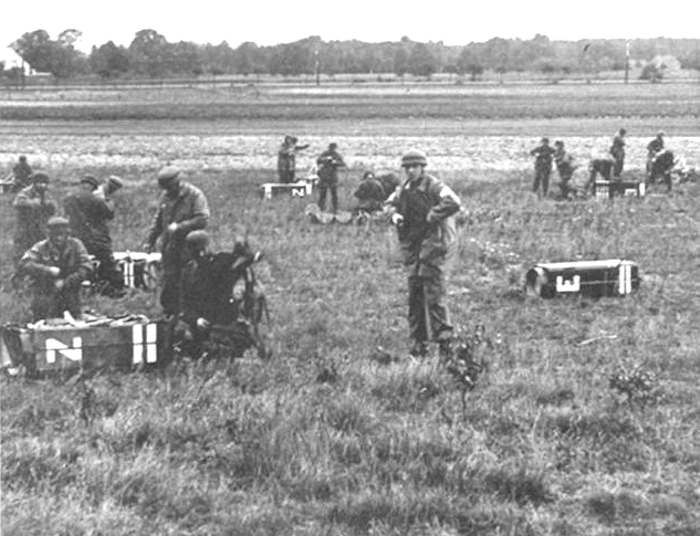
During the night of June 11, supply by air was actually carried out by the Parachute Army in an exemplary fashion. The ammunition dropped south of Raids on a field which had been marked off by lights, about fourteen kilometers behind the front line.
 On the morning of June 11 at Pommenauque, the Americans succeeded in forcing the first deep penetration through the regiment’s main line of resistance. It was not possible to clear up this penetration, but it was halted and sealed off by assault detachments. As a result of the steady extension of the front and the heavy casualties, the regiment’s main line of resistance was thinned to such an extent that the regimental commander had no doubt that on June 12, the Americans would succeed in effecting additional breakthroughs and consequently in capturing the city. In view of these circumstances, he no longer felt able to take responsibility for sacrificing the remainder of the regiment in the battle for Carentan and decided to evacuate the town in the late afternoon of June 11. Contrary to expectations, he succeeded in evacuating Carentan in broad daylight without interference by the enemy, who seemed to be reorganizing his forces. There is no doubt that during this evacuation of Carentan, as during the crossing of the Douve on June 8, a determined pursuit by the Americans would have led to the annihilation of the regiment. The regiment, together with subordinate elements, occupied a new defensive position southwest of Carentan, Hill 30, at the south-western edge of the city, which constituted the most important point of the new position. The regimental commander had advised the LXXXIV Corps of his decision to surrender Carentan, and the Corps had approved this step. The regimental commander was therefore all the more astonished when, on the afternoon of June 11, just after the main body of the regiment had evacuated its former positions, the commander of the 17.SS-Panzer-Grenadier-Division (Goetz von Berlichingen) suddenly appeared and informed him that the division would arrive in the Carentan area the same night to take over the defense of Carentan. If the commander of the 6.Fallschirmjäger-Regiment had known only a few hours earlier that this division, whose foremost elements had already reached the Périers area early on the morning of June 11, would be brought up, he would certainly never have decided to surrender Carentan.
The LXXXIV Korps too had apparently not been informed in time of the arrival of this division for there is no doubt that the corps, which maintained constant radio communication with the regiment, would have immediately transmitted this information, which after all had considerable bearing on the regiment’s decisions; besides, the corps would never have approved the regiment’s decision to evacuate Carentan. Consequently, it can only be assumed that the army, the army group, or the Wehrmacht High Command, in this case going over the head of the corps, had ordered a division into the Carentan sector.
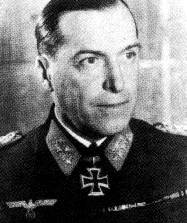 (Note) The premature surrender of Carentan on the afternoon of June 11, which the commander of the 6.Fallschirmjäger-Regiment decided on his own responsibility, which was an incomprehensible and ill-advised step on his part, since he had been informed of the commitment of the 17.SS-Panzer-Grenadier-Division at Carentan in advance and not afterward, as claimed by the author. According to the records of the Seventh Army, they informed the LXXXIV Korps by telephone as early as 1300 on June 10, and then again on June 11, at 1145, that the 17.SS-Panzer-Grenadiers-Division was assembled for attack at Carentan. According to statements made by the chief of staff of the LXXXIV Korps, he apprised the commander of the 6.Fallschirmjäger-Regiment in person of the commitment of this division not later than June 10. (Pemsel)
(Note) Neither the army nor the corps was in accord with this independent decision of the commander of the 6.Fallschirmjäger-Regiment because one of the most essential tasks of the Seventh Army of necessity should have consisted in preventing, as long as possible, the Americans from establishing contact between their forces on the Cotentin Peninsula and their forces stationed east of the Vire and with the British Troops. Afterwards, an attempt was made to justify the premature surrender of Carentan, which was a vital junction point, by pointing to the shortage of ammunition. It was at that time impossible to unequivocally fix the responsibility for this action. As a result of the previous severe and disastrous battles, the commander of the 6.Fallschirmjäger-Regiment had suffered a temporary physical and mental breakdown. This also explains his misguided order, which, following the surrender of Carentan, he issued in connection with the occupation of the decisively important Hill 30 southwest of Carentan. Only the fact that his command of the regiment had so far been outstanding and that he made a speedy recovery prevented the commander of the 6.Fallschirmjäger-Regiment from being punished or relieved of his command. (Pemsel)
In June 1944, the 17.SS-Panzer-Grenadier-Division was commanded by SS-Gruppenführer Werner Ostendorff, who was wounded in action on June 15. SS-Obersturmbannführer Otto Binge took the command over on June 16, 1944, but two days later, he was replaced by SS-Standartenführer Otto Baum. The COS and operation officer of the division was SS-Obersturmbannführer Carl-Heinz Conrad. After the division arrived in the vicinity of Carentan, the division installed its Command Post in St Sébastien-du-Raids, about sixteen Km southwest of Carentan. The division was composed of two motorized infantry regiments, three battalions each, one reconnaissance battalion, one assault gun battalion, one artillery regiment, one engineer battalion, one signal battalion, and supply services.
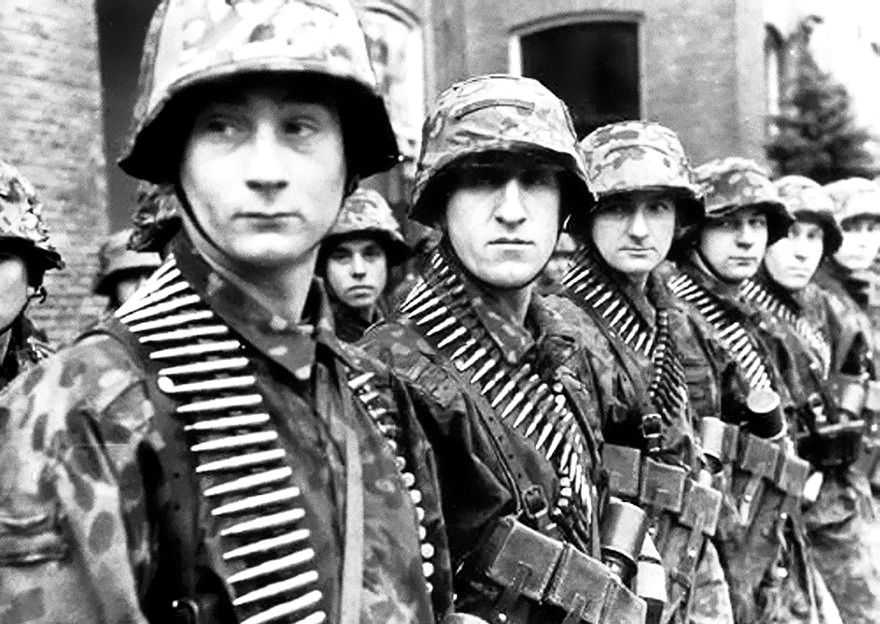
The 17.SS-Panzer-Grenadier-Division had been activated during the first months of 1944, and as yet, only a few of its elements had had contact with the enemy in the area extending from Caen to Bayeux. Although the division was well armed and well equipped, it was surprisingly poorly trained. The majority of the officers had had neither the training nor the combat experience to enable them to fill their positions adequately. In general, the commanders of the regiments, the artillery, and other battalions did not possess the elementary knowledge of tactics required of an officer candidate. The low standard of training of the officers of the division’s artillery regiment was particularly noticeable. Like the Italian artillery with which I had become acquainted in North Africa, the artillery of the 17.SS-Panzer-Grenadier-Division was not able to concentrate its fire flexibly in brief bursts after observation or to fire ahead of attacking infantry from sector to sector (or in Normandy, from hedge to hedge). The artillery of the 17.SS-PGD usually fought a private war without paying any attention to the infantry.
Since the units of the 6.Fallschirmjäger-Regiment were already in the process of withdrawing when the commander of the 17.SS-PGD arrived, and as the Seventh Army reserve units subordinated to the 6.FR had already occupied their new positions, it was no longer possible to revoke the regimental commander’s decision to evacuate Carentan. The commander of the 17.SS-PGD therefore decided to attack and capture Carentan, and on the evening of June 11, he and the commander of the 6.FR reconnoitered the prospective terrain of attack.
During the occupation of the new position southwest of Carentan, the commander of the 6.FR made a fateful error. He had at first ordered this position to be occupied not by his own regiment, but by the Eastern Battalions, and other Seventh Army units under his command, which he had withdrawn from the old position east and north of Carentan, where they had been distributed among the organic units of the regiment. He had intended to rehabilitate and reorganize on June 12, immediately behind the new position, the regimental units and the two battalions of the regiment still under his command, and not commit them again in the foremost line until the night of that day. On the basis of his previous, although very limited, experience with the Americans, he did not expect them to attack until June 13.
 In fact, on June 12, the American 101st Airborne Division, seemed to have had in mind nothing more than combat reconnaissance for the time being. However, during these operations, an American reconnaissance patrol or assault detachment succeeded in capturing Hill 30, which was apparently halfheartedly defended by an Eastern Battalion. This event also threatened the new position of the regiment; the regimental commander believed it was out of the question to attack Carentan before recapturing Hill 30. Attacks on Hill 30, which were launched on June 12 by the engineer platoon under the personal leadership of the regimental commander, were unsuccessful.
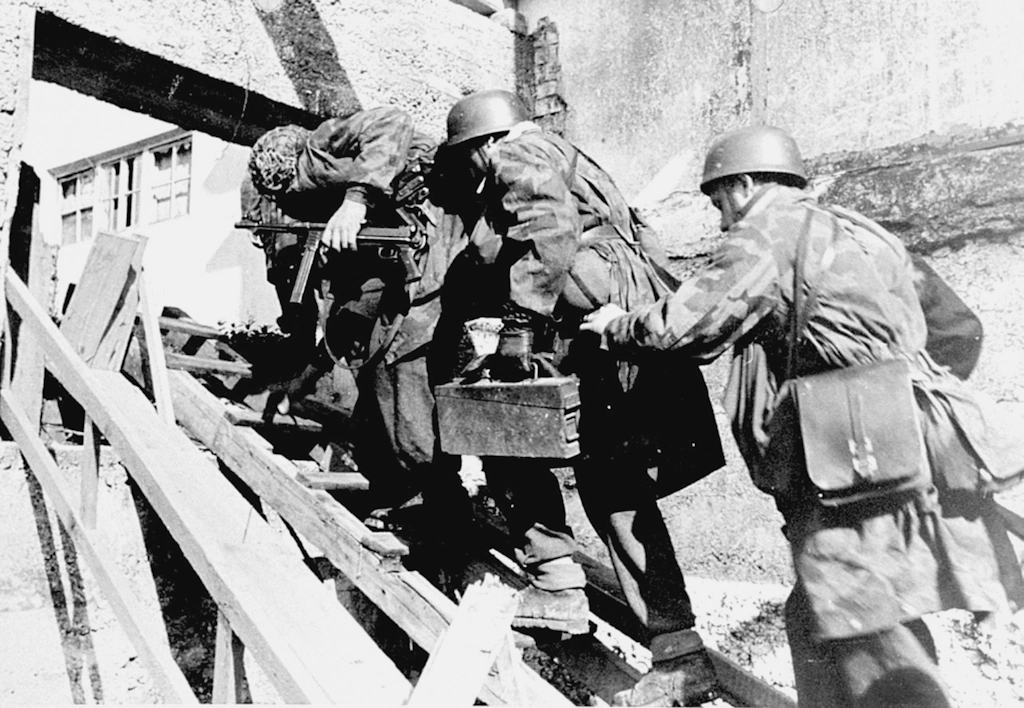
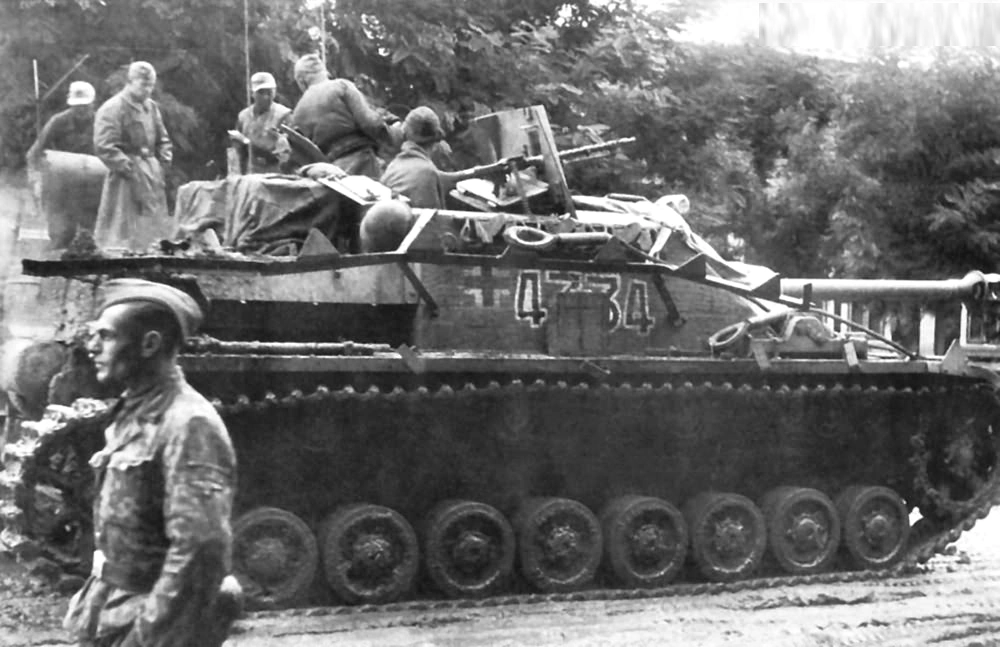
While the German paratroopers were fighting for Hill 30, one motorized infantry regiment, one assault gun battalion, and the main body of the artillery regiment of the 17.SS-PGD moved into assembly positions in the area north of Meautis for the attack on Carentan. It was the aim of the commander of the 17.SS-PGD to attack eastward on both sides of the Baupte – Carentan road, to capture Pommenauque, and to push on into Carentan from the northwest corner of the city. He expected that the Americans would of their own accord give up Hill 30 without a fight as soon as the division elements succeeded in penetrating the northwestern part of Carentan. Although the assault guns would be restricted to the Baupte – Carentan road and a few narrow side roads by the nature of the terrain, the division commander expected a great deal from them because he felt certain that the Americans would fall back in the bocage terrain to the right and left of the road, where observation was impossible, as soon as the assault guns succeeded in breaking through. The division commander did not wish to use any artillery preparation in order to maintain, as far as possible, the element of surprise. The 6.FR as such did not participate in the attack; only its 2.Battalion was placed under the command of the attacking SS regiment and committed by the latter at the left of the above-mentioned road, on both sides of the railroad embankment extending from Baupte to Carentan, in very difficult terrain poorly suited for attack. The 3.Battalion of the 6.FR was placed at the disposal of the division, but the regimental staff and units were not included in the framework of the plan of attack or in the order based on this plan.
The same reasoning that prompted the division commander to forego any artillery preparation also induced him to be totally opposed to battle reconnaissance operations on June 12. As a result, the enemy situation was still completely obscure when the attack began. Reconnaissance reports on the foremost enemy positions and the strength of the enemy were not available. The attacking forces were consequently compelled to grope their way while advancing in terrain quite unfavorable for offensive operations. Nevertheless, the division commander was confident of success. One of the questions he put to the commander of the 6.FR on June 12, when issuing instructions was as, follows: ‘after Carentan has been captured, would you prefer to continue advancing towards Isigny or wheel to the left toward Ste Mère Eglise?‘
On the morning of June 13, about 0700, the attack was launched from the assembly positions. On June 12, the Americans had apparently only employed patrols in order to reconnoiter the new German position. In any event, during the first two hours of the attack, the 17.SS-PGD elements did not come into contact with the enemy. About eight hundred meters west of the northwestern edge of Carentan, the assault gun units encountered AT elements that prevented them from advancing any further. About 0900, the SS troops and paratroopers made contact with strong American elements; it was my impression that these were not organized for defense but were in the process of advancing.
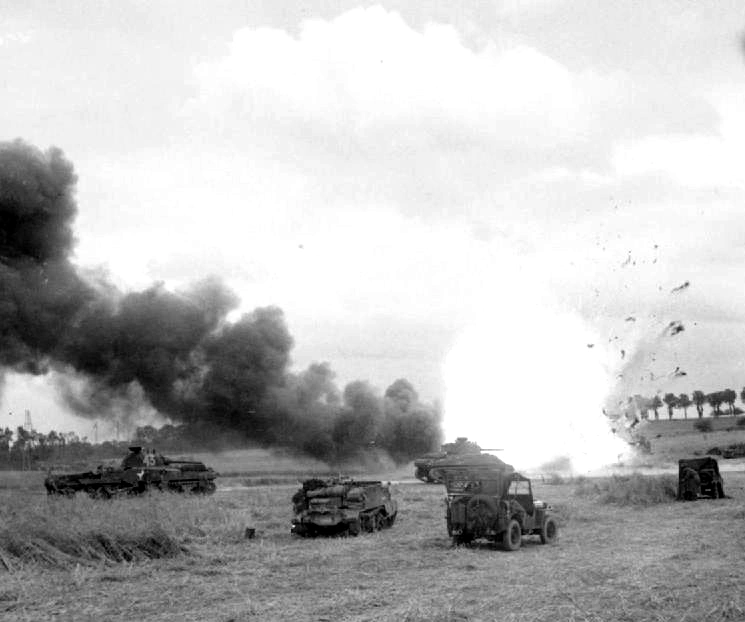
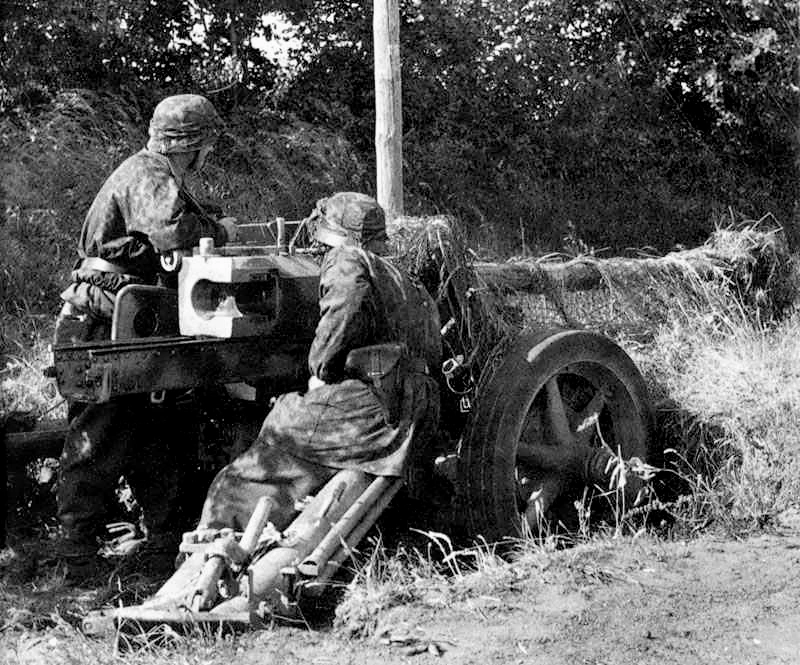
Severe fighting raged from hedge to hedge at close quarters and hand to hand. The Fallschirmjäger forces nevertheless succeeded in gaining several hundred meters of terrain north of the railroad embankment, while the SS Panzer Grenadier units were stopped cold in unfamiliar terrain where observation was obstructed. The exercise of command in such terrain is extremely difficult. During combat, the SS units became disorganized, and commanders, no longer masters of the situation, lost control of their units to an increasing degree; communications were disrupted, sometimes at one point and sometimes at another point; gaps developed through which the enemy skillfully infiltrated. At one farm, the division commander himself was for several minutes engaged in close combat with enemy troops who had broken through. In short, by about 1200, it was obvious that for this day the attack on Carentan had failed. The casualties among the SS forces were unusually high; the fighting spirit of the inexperienced troops was weakened; and an ever-increasing number of individual SS soldiers as well as whole groups straggled to the rear, so that the Commander of the 6.FR had to instruct his adjutant to check the fleeing SS forces and assemble them in the vicinity of his regimental command post. In some instances, the adjutant was compelled to enforce this order at the point of a gun.
While the attack on Carentan launched by the SS troops was thus hopelessly bogged down, the commander of the 6.FR received about noon alarming reports from Baupte. The 100.Panzer-Battalion of the Seventh Army reserve had been committed at the Douve River in the area of Baupte, at first facing eastward. For unknown reasons, the commander of this battalion evacuated these positions on the Douve on the morning of June 12, and dug in in Baupte proper, after which he and a few other officers left his battalion. In the meantime, the Americans had apparently crossed the Douve without encountering resistance and had cautiously approached Baupte. There, utter chaos apparently prevailed among the German forces; some of the troops who had been forsaken by their commander surrendered, while others still tried to fight. There was no doubt, however, that it would be only a matter of hours before the Americans were in undisputed possession of Baupte and thereby threaten the flank and the rear of the 17.SS-PGD. In view of this situation, the commander of the 6.FR sent one company of the 2.Battalion which was engaged in combat west of Carentan, to protect the bridge east of Baupte against forces advancing from Baupte to attack the rear of the division. Anxious hours passed until this company arrived at Baupte, for there was a distinct possibility that the American commander in Baupte would recognize his opportunity and make a quick decision to push across the bridge. The danger was not over until about 1600.

In the meantime, the situation west of Carentan continued to deteriorate. The commander of the 6.FR was under the impression that a single energetic thrust by the Americans would be sufficient to induce large portions of the SS regiment to take to headlong flight, which would result in a deep breach at a decisive point in the German lines – a breach which might make possible a breakthrough during the night. He therefore employed his 3.Battalion and the regimental units to form a rear line along the road leading from Raids southeastward to the Carentan – Périers road. He placed the dazed commander of the SS regiment under his command and ordered the SS and Fallschirmjäger forces to fall back to a position which had been reconnoitered and in part improved prior to the invasion. This extended from Le Varimesnil, southwest of Meautis which was to be given up, and along the southern edge of a marshy valley to a point north of Raffoville, about 3000 M northeast of Bléhou at the eastern edge of the big swamp, Prairie de Gorges. In relation to the jump-off point for the attack on Carentan, the withdrawal to this position amounted to retiring generally about four kilometers. The regimental commander considered it absolutely essential to get beyond the range of the American heavy infantry weapons, which would require the Americans to shift the position of these weapons and especially to advance their artillery to the south side of the Oure River.