


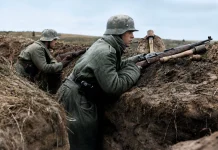
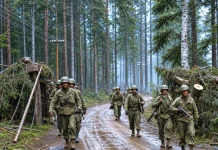


The enemy situation was completely obscure. There were one or two antitank guns or tanks and a few machine guns. Unfortunately, the German situation was also totally obscure. It became apparent immediately that the armored column had been cut in half in the morning fog and that the second half of the column of tanks on which the forces of the 3.Battalion of the 6.FR was mounted and had evidently lost its way. The command status was equally confused. The Commander of the armored regiment, an SS commander with rank equivalent to major, refused to obey the commander of the 6.FR, or even accept his suggestions, although the commander of the 6.FR held the rank of lieutenant colonel. On the other hand, the SS commander himself was unable to come to any decision. His column of tanks standing at close intervals was helpless. The 2.Battalion had in the meantime been deployed on both sides of the road and distributed over an area of perhaps five hundred meters in width. It was able to advance a few hundred meters in terrain which offered practically no cover but was then brought to a stop by a fire of American machine guns and mortars.
In view of this situation, the commander of the 6.FR decided to have his 16.Company, make a wide detour to the left around the antitank obstacle in order to either break up the obstacle in a flank attack or at least find a way to bypass it. Led by the regimental commander, the company advanced single file to the vicinity of a village, probably Notre-Dame-de-Cenilly, without encountering enemy troops. In this village, American trucks were being peacefully driven up, and for about ten minutes, an estimated two companies of infantry were unloaded. At the outskirts of the village, the regimental commander believed he saw a well-camouflaged tank. It would have been useless for the 16.Company to attack the village. The regimental commander and the company turned back and reached the command post by the route over which they had come. Here, the picture had not changed greatly. The American forces had noticeably increased in number; the parachute forces had not been able to advance a foot; and for the last two hours, the SS tanks had been standing idle at close intervals on the road. The regimental commander called on the SS commander, who informed him that one armored vehicle of his regiment, which had lost its way, had reported by radio at about 0900 that the road via St Denis-le-Gast was still open and clear of enemy troops.
The commander of the 6.FR thereupon proposed to the SS commander that he withdraw from action and try to reach St Denis-le-Gast by the quickest route possible, before this means of escape was also blocked and before the enemy air force could take a hand in the fighting. This was the first suggestion made by the regimental commander, which was immediately accepted by the commander of the SS tanks. However, he did not comply with the request of the regimental commander that the SS tanks delay the evacuation until the parachute troops had had a chance to break off action with the enemy and remount their vehicles with some degree of order. On the contrary, he ordered immediate withdrawal. The commander of the 2.SS-Panzer-Regiment was one of the first to leave the field of combat to take his place behind the newly formed armored spearheads which headed the column of his regiment advancing via Roncey toward St Denis-le-Gast.
The commander of the 6.FR was in an unfortunate situation. There was still no news whatever from his 3.Battalion; when the SS tanks drove off without taking along the elements of the 2.Battalion, these had to try to reach the opening at St Denis-le-Gast on foot. It was highly questionable whether the gap would still be open by the time they reached it. The commander of the 6.FR therefore issued an order to cease fighting immediately and to break off contact with the enemy; all who could reach the SS tanks were to mount them, while the rest were to be collected by the commander of the 2.Battalion and under his command seek a way out of the pocket.
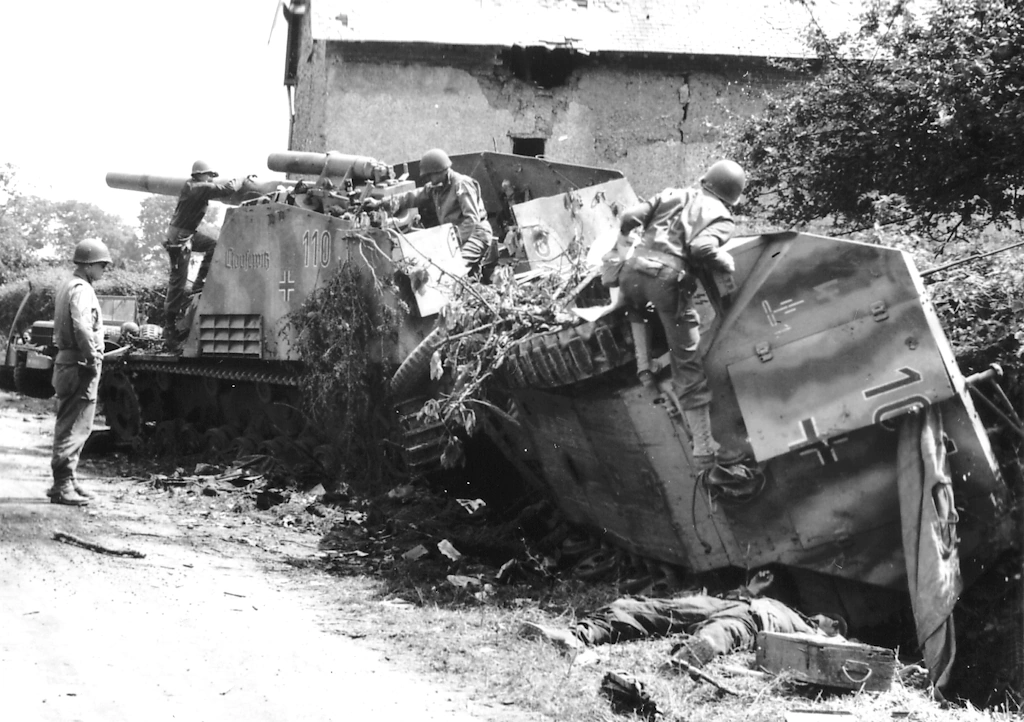
After he had transmitted the order to the commander of the 2.Battalion, the regimental commander, joined the tank column in order to take over, if necessary, the command of those portions of his regiment which had mounted the armored vehicles. The regiment was thus divided into three separate groups: the first group led by the commander of the 3.Battalion and consisting of the troops which had mounted the SS armored vehicles which had lost their way in the morning; the second group, in charge of the regimental commander and composed of those troops which after the battle at the antitank obstacle at St Martin-de-Cenilly had again reached the SS tanks and mounted them; and finally, the third group consisting of those elements which had remained at the battlefield at St Martin-de-Cenilly and had been placed in charge of the commander of the 2.Battalion.
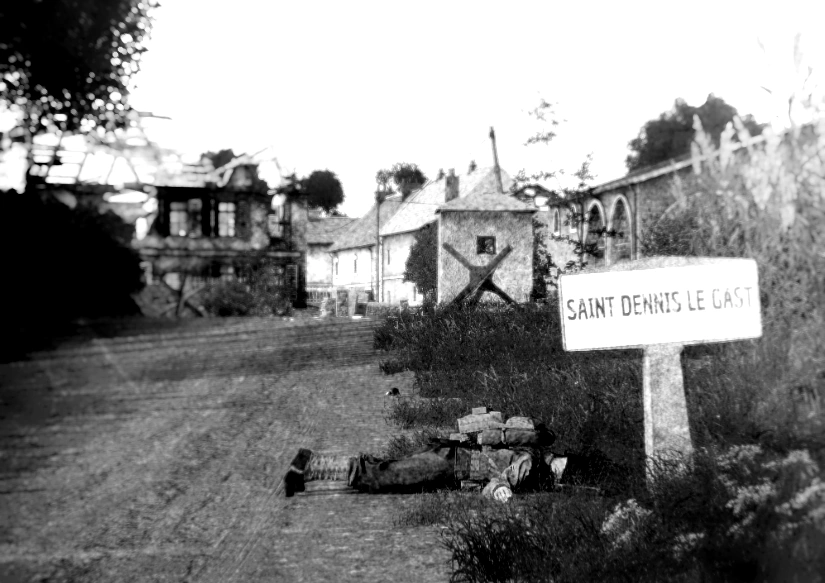
Little is known concerning the fate of the first group. They apparently succeeded in escaping through the opening at St Denis-le-Gast without encountering enemy troops. Just south of St Denis-le-Gast, however, the column of tanks was apparently attacked by American strafing planes and in part annihilated and in part dispersed. The commander of the 3.Battalion, who had been leading this group, was killed during this air attack while seeking cover under a tank. The column of tanks carrying the second group was attacked north of St Denis-le-Gast by American fighter planes. The regimental commander rallied the parachute troops (to whom motorcycle messengers sent in advance had previously called out instructions that in case of an enemy attack they were to leave the attacked vehicles and withdraw to the left) and in a march covering more than sixty kilometers led them to the area of La Mancellière, four kilometers southwest of Percy. No casualties were suffered during this movement.
By the time the third group reached St Denis-le-Gast, it had already been occupied by the Americans. The commander of the 2.Battalion who was in charge of this group therefore waited until dark and then led his men out of the pocket past the American armored security elements without encountering any enemy troops. A large number of stragglers from the Seventh Army units and members of the first group of the regimental troops made their way to the second and third groups.
(5) The Villedieu Pocket
Independently, the regimental commander and the commander of the 2.Battalion each decided to grant their exhausted troops a day of rest and sleep after the withdrawal from the Coutances Pocket. Consequently, on the day following the withdrawal, both groups of the regiment, although separated, were concealed even from other German troops in barns off the main march routes. It was not until the next day that the regimental commander and the commander of the 2.Battalion made successful efforts to reestablish contact with the division. Through the division these two groups learned about each other’s fate. Each of the two groups had considered the other lost. The regimental commander then reassembled the remnants of the regiment, approximately one battalion (not quite 1000 men) in strength, and sent the commander of the 2.Battalion to the Parachute Army headquarters at Nancy, where he was to make a verbal report concerning the fate of the regiment and explain why resistance in Normandy was doomed to failure. The commander of the 2.Battalion left the regiment on August 1, 1944. It was evident to everyone that units which in the smaller area of the Cotentin Peninsula and with unimpaired fighting power had not been able to withstand the force of the American attack would now, when they had been defeated and scattered, be less able than ever to check the advancing American armored formations. Officers and men therefore clung to the hope that there was truth in the rumor, which was circulating among the troops about August 1, that the German High Command had decided to give up southern and western France, to withdraw the Seventh Army behind the Seine River, and to establish a new defensive front on the Seine and the Yonne River. The troops themselves no longer believed that they would be able to hold out in Normandy; however, during these first days in August, they still felt strong enough to offer effective resistance behind a strong sector like the Seine – Yonne line if they were able to reach it in time. Only too soon, it turned out that this rumor regarding a withdrawal behind the Seine and the Yonne was not based on fact. In France, too, it seemed to be the aim of the High Command to apply the tactics of ‘holding at any cost’ and allowing the units to be encircled. The troops had already become acquainted with this policy in Russia.
 (Note)I must agree with the author that after the American breakthrough at St Lot the only possible decision for the German top-level command was to make a timely withdrawal acroas the Seine. The practice of exposing whole armies to annihilation by having them remain too long in front of river barriers was to continue until the end of the war. This happened when, after heroic battles, Army Group Italy was given orders to hold out to the last man in front of the Po River in spite of the hopelessness of the situation. (Pemsel)
It first appeared that an attempt was being made to form a defensive flank along a line extending from Percy to St Denis-le-Gast to Avranches in order to prevent a widening of the American breakthrough. In the sector extending from Percy to St Denis-le-Gast, in which the 2.SS-Panzer-Division was committed, this defensive flank consisted of a thin line formed by infantry security detachments. Dispersed elements of the Army and the Navy and remnants of the 5.FD (the latter committed on both sides of the main road running almost due north and south from Hambye via Sourdeval to Villedieu and joining the St Denis-le-Gast – Villedieu road north of Villedieu) had been inserted between the remnants of the two panzer grenadier regiments, the 2.SS-Panzer-Division regiments, and the remnants of the 17.SS-Panzer-Grenadier-Division Kampfgruppe. There was practically no artillery remaining in the 2.SS-PD sector, the 2.SS-Panzer-Artillery-Regiment still had seven guns. The 2.SS-Panzer-Regiment probably still retained about one-fifth of its original strength or one battalion.
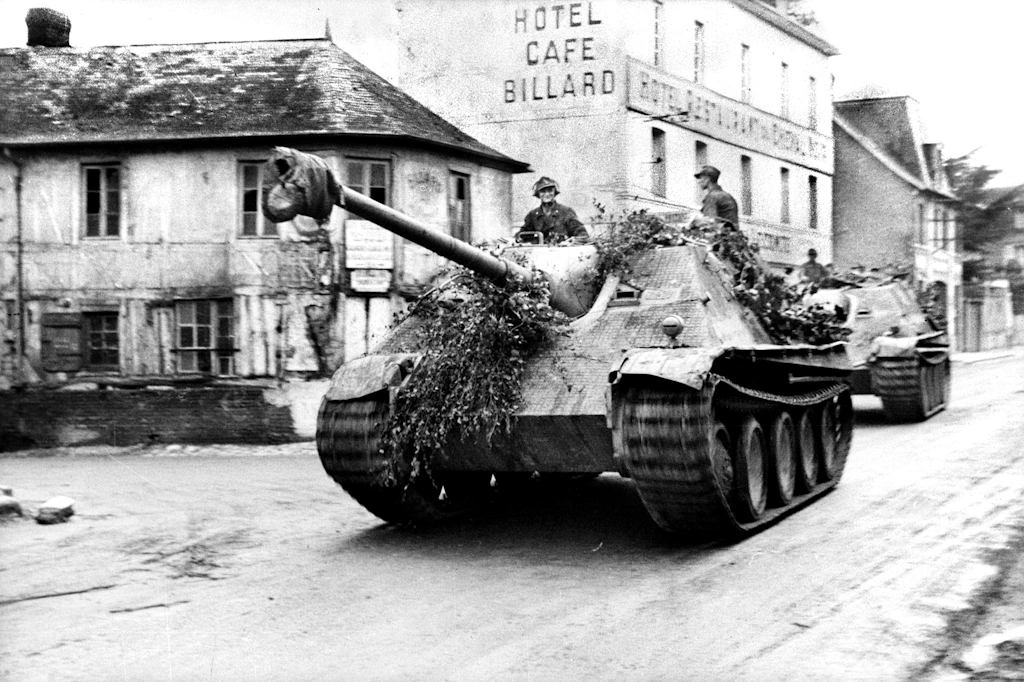
On the afternoon of the second day after the escape from the Coutances Pocket, almost exactly forty-eight hours after he had passed St Denis-le-Gast the commander of the 6.FR, who was on the way back from the division to his unit, crossed the road running from Hambye via Sourdeval to Villedieu, on which he had in the morning seen elements of the 5.FD. On this road, he now observed the first American tanks rolling southward in the direction of Villedieu with no German resistance in sight. Although the commander succeeded in crossing the road, the rest of the regiment and the SS forces committed east of the road were cut off by this American armored thrust from the division command post located west of the road.
In view of this situation, the regimental commander decided to act on his own responsibility. The remaining elements of his regiment did not have a single antitank weapon at their disposal, not even Panzerfausts. It seemed useless to resist or even to remain. Consequently, after nightfall, the commander of the 6.FR led the remnants of his regiment in a march covering a distance of more than fifty kilometers, bypassing Villedieu, to the area of St Martin-le-Bouillant, south of Villedieu, which they reached about 0800.
The regimental assembly point for minor casualties at Alençon was designated by the commander as the collecting station for the dispersed elements of the 6.FR; messengers also guided to that point the regimental trains which, four days previously, had been assigned by the regimental commander to the area of Avranches where some of the elements had been employed by the garrison commander in a futile and brief battle against the American armored columns which had broken through. At St Martin-le-Bouillant, the regimental commander found the command post of the 353.Grenadier-Division. The remnants of this division had been combined into two combat groups and placed on the heights west of St Martin-le-Bouillant with the front facing westward. This force was to provide protection against the American armored units, which had broken through and were advancing on Avranches, and to narrow down the enemy breakthrough. The regimental commander placed the remaining portions of his 6.FR under the 353.GD. On the same afternoon, American tanks, which had probably advanced from the north, pushed forward up to the northern edge of St Martin-le-Bouillant. This thrust again divided the remnants of the 6.FR into two groups: a smaller group of approximately a company strength which remained with the regimental commander and a stronger group which, after contact with the regimental commander, was disrupted, fought its way through to Alençon.
The regimental commander and the company that remained with him fought as a reserve of the 353.GD south of Saint-Sever-Calvados and south of the Vire River; these engagements were in general of no consequence. The company, which was stationed in the vicinity of the division command post, was as a rule alerted around noon and sent forward in order to seal off any breakthrough in the division sector. These sealing-off operations were invariably successful because in the area south of Saint-Sever-Calvados and south of Vire, the American infantry was feeling its way forward only gradually and very cautiously. In the evening, the division was, as a rule, instructed to change positions, the order usually specifying that the front be withdrawn a few kilometers.
(7) Withdrawal From Normandy
About August 10, the regimental commander received an order from the Parachute Army instructing him to withdraw the remnants of the regiment from the front and to lead them back to the Nancy area. However, it was several days before the Seventh Army released the sixty men who were still with the regimental commander.
By August 14, the regimental commander and the sixty men with him advanced via Tinchebray and were able to reach the Dreux Air Base, to which point the regimental commander also sent the elements of the regiment which had in the meantime been assembled at Alençon. They still totaled 1007 men, although they lacked heavy weapons, were inadequately equipped, and were clothed in tatters. After a few days of rest at Dreux, which the German administrative agencies already seemed to have abandoned, the regiment was transported in motor vehicles to Nancy advancing via Paris (where utter confusion seemed to prevail among the German agencies, particularly those of the Luftwaffe), Saint-Dizier, and Toul. Not the slightest sign of any activity on the part of the French resistance movement was observed between Tinchebray and Nancy by either the regimental commander who from Tinchebray on was riding in an armored car, about six hours ahead of the regiment, or by the main body. As had been the case in Normandy, the French civilians along the entire route proved to be friendly and helpful when they were treated with kindness.
The regimental commander had not reported to his superiors the establishment of the assembly point at Alençon for minor casualties and stragglers of the regiment. Instead, the men assembled there were first reported as casualties according to regulations, being listed as either wounded or ill, or, in the case of men who had become separated, as missing. There was great danger that the higher Army authorities would learn of this secret assembling of the men by the regiment and that those who had been collected at Alençon would again be sent to the front and thrown into a battle which had become meaningless. Consequently, the regimental commander and his men felt relieved when on August 20, all the elements of the regiment that had escaped from the battle in Normandy were assembled at Nancy and received orders transferring them to Güstrow (Mecklenburg), where it was to be rehabilitated.
In order to depict the conditions prevailing in France behind the disintegrating German front in the middle of August 1944, it should be noted that the regiment, on its own initiative, took steps to begin its rehabilitation while it was still in France during the march to Nancy. The units were brought up to strength because a number of stragglers from the Army, the Waffen-SS, and other parachute regiments reported to the advance message centers of the regiment, which had been set up along the march route, and requested to be taken into the regiment. They were taken into the regiment, and clothing procured for them from supplies which were found at Dreux. Among other items, the regiment succeeded in purchasing on the French black market in Paris practically all the equipment needed to bring the regiment up to war strength.
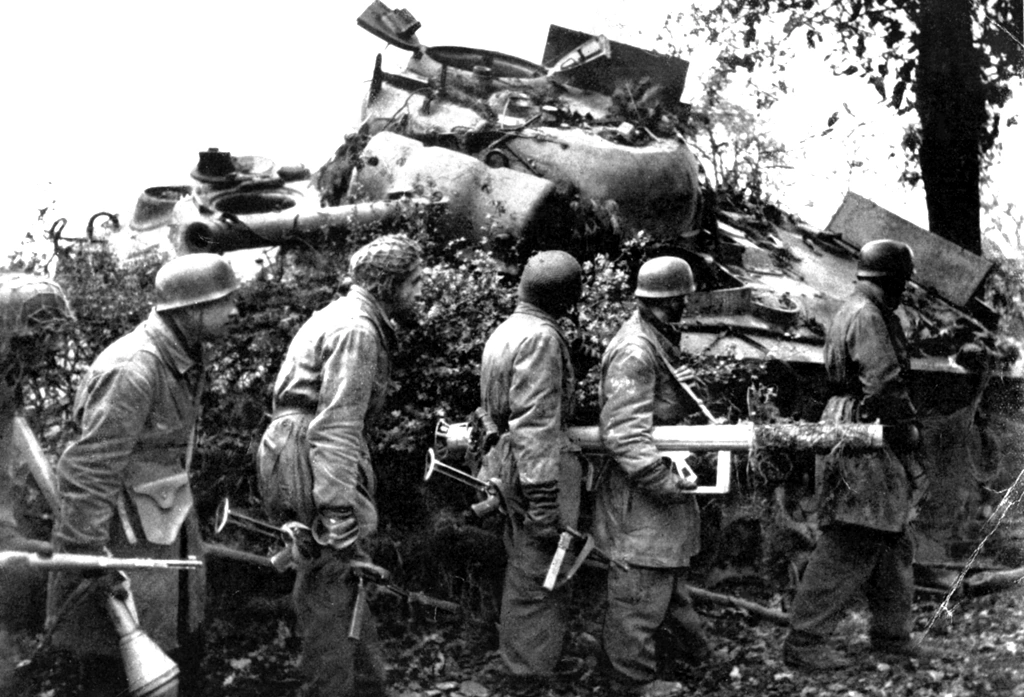
(Note) The regimental commander’s decision to assemble the regiment secretly at Alençon, located far to the rear, and to submit inaccurate reports to his superiors is not commendable. The regimental commander was still in command of sixty men and as a result of his orders found more than one thousand stragglers belonging to his regiment when he arrived at Alençon. None of the divisions which were being drained of their last resources at the front had such numbers at their disposal at this time. It is furthermore incomprehensible that the regimental commander incorporated in his regiment stragglers who naturally had been attracted by the news that the regiment was to be transferred to the zone of interior, instead of turning them over, in accordance with regular procedures, to the collecting points for stragglers. A curious feature is that the regimental commander equipped his forces by making large-scale purchases on the French black market. (Pemsel)