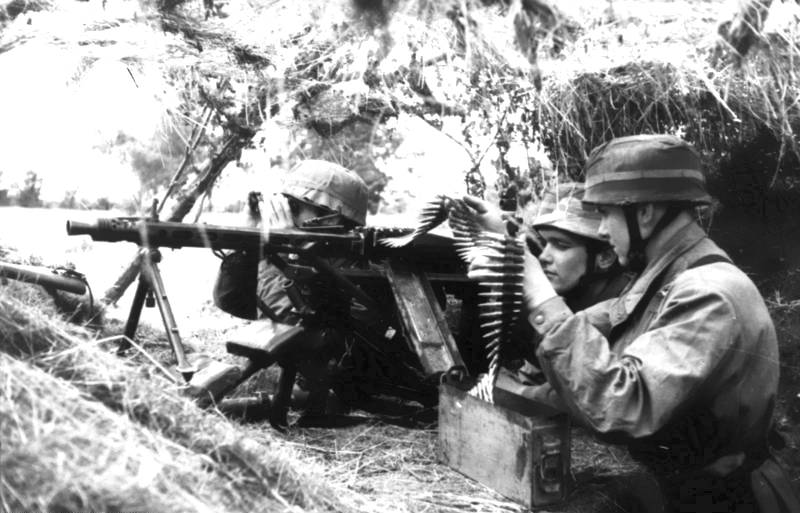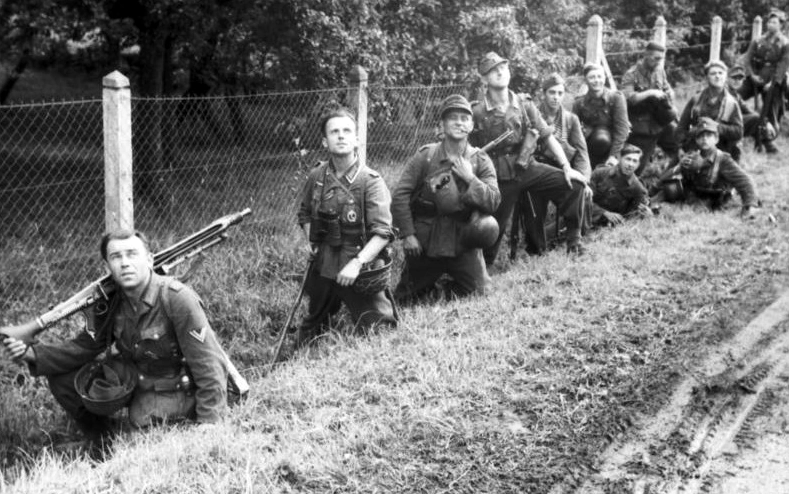
The various members of the German command group in the West also disagreed on the location of possible and probable points of Allied landings; Gen Marcks expected the landings to take place north of the Vire Estuary and on the eastern coast of the Cotentin Peninsula (as the author recalls, in the Coutances area) and found support for this assumption in maps which were carefully kept up-to-date and which showed the focal points of enemy air reconnaissance in March 1944. At the top level, it was evidently expected that landings would be concentrated north of the Seine Estuary, approximately in the Boulogne area. Apparently, the members of the command group were in agreement only in completely underestimating the potentialities of the parachute and air landing forces. It was the general opinion that Paratroopers would prefer wide open spaces. When Generaloberst Kurt Student, the Commanding General of the German Parachute Army objected to this conception on the grounds that modern paratroopers were also prepared to jump in wooded areas and villages, his objection was dismissed on the ground that he was boasting. The obvious dissension prevailing among members of the higher command on questions of supply had the most disastrous effect. Two views were in conflict. Those who believed that the Allied air force would destroy all supply lines and railroad stations demanded that supply depots be established on a large scale in the rear of the forces. Others expected the attacks of the Allied air force to destroy immediately any depots set up prior to the start of the invasion, since their location would undoubtedly be betrayed to the Allies by the civilian population and wanted the supply located as far as possible from any prospective front.
(Note) The statements with regard to the dissension on question of supply existing among members of the higher command, and the explanation therefor, are not based on facts. In this case, everyone was completely aware of the fact that the decentralization of the depots was a matter of necessity. As far as the effectiveness of enemy espionage and enemy air raids was concerned, it was immaterial whether the depots were located at the coast or deep in the interior. The shifting of depots in the long run always involved a major problem of transportation facilities, which, of course, were never available in sufficient measure. (Pemsel)
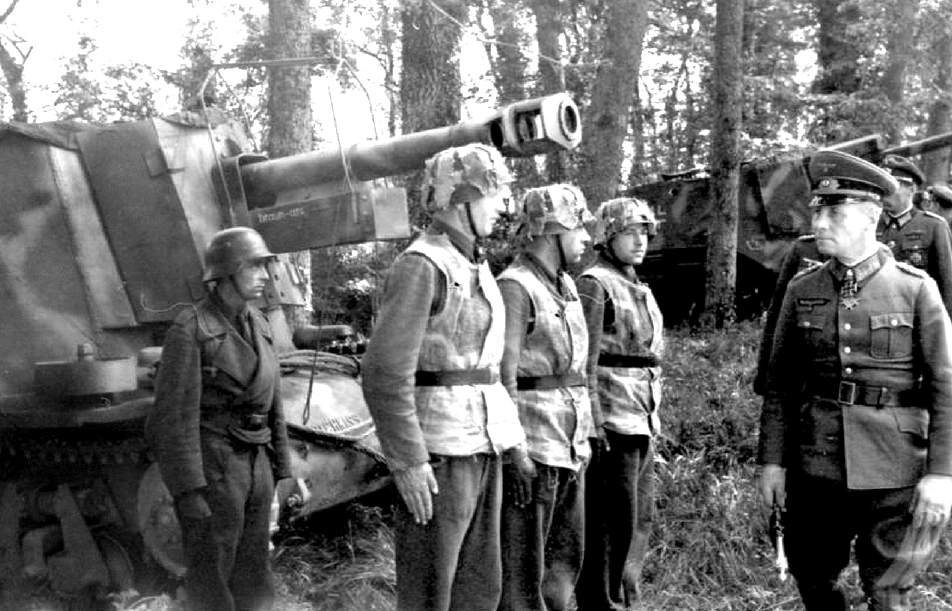
The troops available for the defense against and Allied landing were not comparable to those committed in Russia. Their morale was low; the majority of the enlisted men and noncommissioned officers lacked combat experience, and the officers were in the main those who, because of lack of qualification or on account of wounds or illness, were no longer fit for service on the Eastern Front. I should, of course, add that this is the personal opinion of a regimental commander who was transferred to Normandy in May 1944 and that his impressions were gained from attendance at training maneuvers and tactical rides, during the first days of combat. It is possible that his experience was particularly unfortunate. It should not lead to any generalization. The situation with regard to the weapons and equipment of the forces in Normandy was nothing short of deplorable. Weapons from all over the world and from all periods of the twentieth century seemed to have been accumulated in order to convey the impression of a mighty force. Later on, at Carentan, in the sector of the 6.Fallschirmjäger-Regiment, four different types of mortars (ranging in caliber from 78-MM to 81-MM) of German, French, Italian, and Russian make and seven kinds of light machine guns were committed on a front barely two kilometers wide.
In order to take the LXXXIV Korps mobile to some extent, or at least to make sure of essential transportation facilities for the units, each regiment of the corps was ordered to brand or otherwise mark horses and vehicles belonging to French civilians; these horses and vehicles were, however, to be left with their owners and were to be utilized only in case of an Allied invasion. It was, I believe, quite obvious to troops with combat experience from the lowest rank up to the regimental commander, that this order could not be carried out. Such orders were not conducive to improving combat morale or faith in victory on the part of the troops.
The top-level command itself did not appear to have any great confidence in the troops in the west. Certainly only lack of confidence could account for one of Hitler’s orders, which lower head quarters repeated but did not implement. This was the order issued in May 1944 which required every ‘strong-point commander’ and every independent commander to give his written word of honor not to desert in case of an Allied invasion. Like many other ‘Fuehrer’ orders issued at the time, this one was transmitted by the higher commands without comment. It was not enforced. When the commander of the 6.Fallschirmjäger-Regiment refused to give his word of honor or to compel his officers to do so, his refusal was readily passed over by his superiors.
The most disheartening comments were those made by Gen Marcks during a conversation with the author following a training maneuver in the Cherbourg area, when he described the situation as follows: ‘Emplacements without guns, ammunition depots without ammunition, mine fields without mines, and a large number of men in uniform with hardly a soldier among them‘.
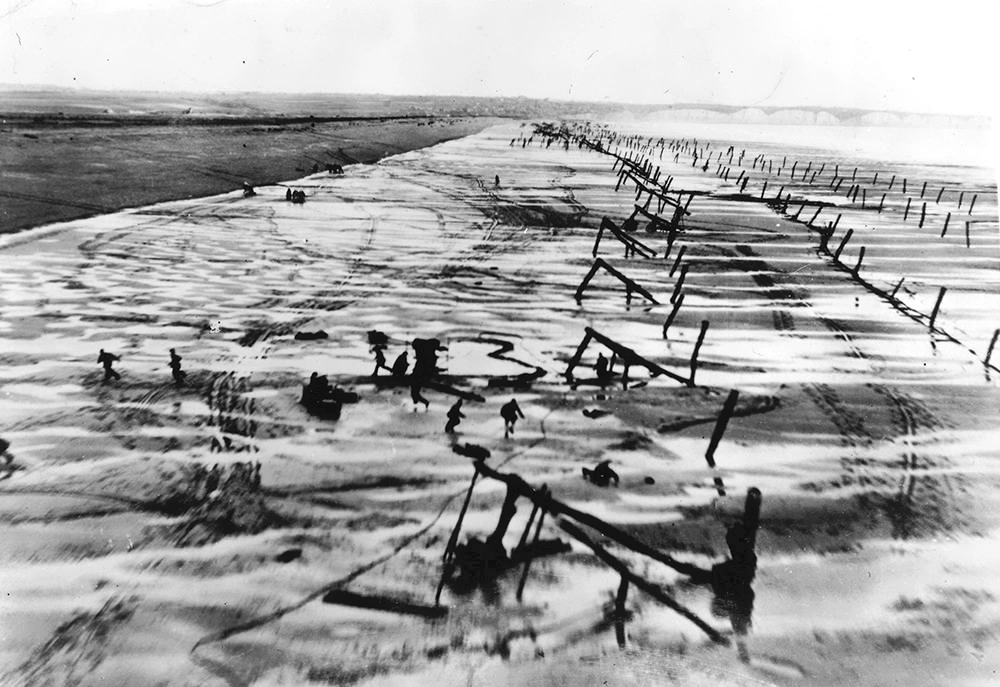
(3) The Allied Attack
Although the authorities were frequently at odds in their estimates as to where and how the Allied invasion would take place, it was nevertheless apparent that since the middle of May commanders as well as troops were agreed in assuming that an invasion was to be expected during the first ten days of June 1944. Consequently, the lower headquarters were astonished when all division commanders and one regimental commander from each division, the corps artillery commanders, and the commanders of corps headquarters reserves, were ordered to report to Rennes (France) on June 6, 1944, at 0830 in order to spend the entire day in an army group map exercise. It was rumored that this map exercise had been ordered by the Wehrmacht High Command, although the possibility existed that it was an idea of Rommel, who, in North Africa, liked to issue his orders in the fond of map exercises. The majority of the officers, who had been to report, left for Rennes on the evening of June 5, and spent the night there. Consequently, about 50 percent of the division commanders and possibly 25 percent of the regimental commanders were not with their troops during the night of June 5/6, 1944.
(Note) The map exercise at Rennes, had been scheduled by the Seventh Army for 1000 on June 6, 1944, not for 0830 as stated by the author. Instructions had been explicit that the departure of the participants for Rennes was to take place after a quiet night and not before the morning of June 6. It is incomprehensible why some commanders left for Rennes as early as the afternoon of June 5. (Pemsel)
On June 4, there had been increasing signs that the invasion was imminent. The French civilian population openly discussed the fact that an Allied landing was close at hand. On June 4, a cousin of Gen Leclerc laughingly told me a rumor that the invasion had been planned for the night of June 4. During that night, all the French-speaking soldiers from Alsace-Lorraine, who had been serving in the regiment as drivers, deserted, with the exception of one who was found shot the next morning. These driver’s had presumably been in contact with the French Resistance groups and had deserted immediately upon hearing that the invasion was imminent.
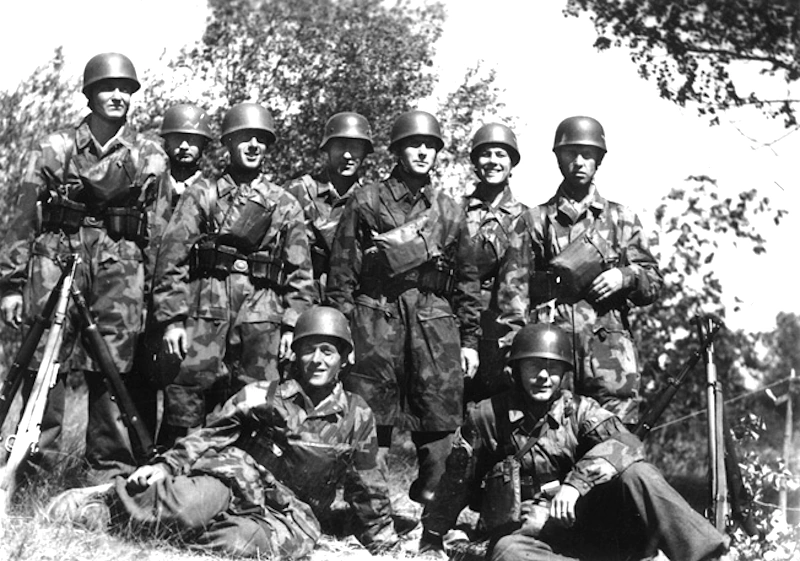
Since the middle of May 1944, the 6.Fallschirmäger-Regiment had, in accordance with instructions been distributed over a long line in field-type positions in the Lessay-Perierb-Raids-Mont Castre area. The regiment was subordinated for tactical purposes to the LXXXIV Corps, for supply matters to the 91.Grenadier Division, and for administration to the 2.Fallschirmjäger-Korps. As a ‘flight unit’, the parachute troops being considered ‘flight personnel’, the regiment had been linked with the Cherbourg aircraft warning network.
 The 91.Grenadier-Division, the so-called air landing division of the Army general reserve, was activated on January 15, 1944, as an Army unit at the troop training grounds Baumholder (Germany) and place under the command of Generalleutnant Bruno Ortner. When the division moved to France with the 6.Fallschirmjäger-Regiment and the 100.Panzer-Replacement-Battalion on April 25, 1944, Generalleutnant Wilhelm Falley took over command. On the morning of June 6, 1944, while returning to his headquarter from the Rennes Kriegsspiel, Falley was killed and Oberst Bernhard Klostermeyer took over the division to be replaced four days later by Generalleutnant Eugen König. The division command post was located near Etienville (France). Originally, the 91.Division had probably been designated for combined parachute and air landing operations, (Operation Tanne Ost – (Fire Tree) or (Operation Fichte Ost – Pine Tree) planned for the beginning of March 1944 in conjunction with the 6.Fallschirmjäger-Regiment in one of the northern countries, possibly Finland. After this plan was abandoned, the 91.Grenadier-Division, like the 6.Fallschirjäger-Regiment, was sent to the LXXXIV Korps about May 1, 1944. The combat efficiency of this division was poor. As told earlier, the division commander was killed in front of his command post either by American paratroopers or by members of the French resistance. Command of the division was temporarily taken over by one the regimental commanders, Oberst Bernhard Klostermeyer, and later by Generalmajor Koehler, the commander of an adjacent division. The division was decimated during the first three days of the invasion; its remnants were for the time being attached to other divisions or withdrawn. The division staff was employed as a special assignments staff for the purpose of reconnoitering and preparing defensive positions behind the invasion front.
However, apart from the disruption of telephone connections, the death of the commander of the 91.Grenadier-Division, and the demolition of the railroad tracks south of Périers, there was, during the first days of the invasion, not the slightest sign of any activity by the French resistance movement in the district of the 6.Fallschirmjäger-Regiment and its immediate neighbors.
<
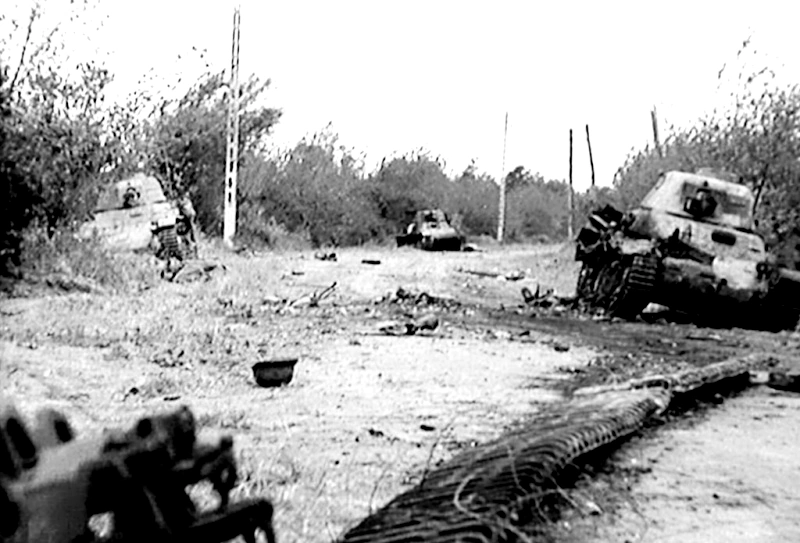
Late, in the evening of June 5, about 2230, the commander of the aircraft warning service in Cherbourg, a lieutenant serving with the signal troops, informed his regimental commander by telephone that Allied ship movements and the concentration of transport aircraft at British airfields seemed to indicate the possibility of an invasion that very night. Soon after, the signal officer of the 6.Fallschirmjäger-Regiment made the same report, and from 2300 on, the regimental commander was able to follow the approach of the Allied transports and fleets on the aircraft warning chart. At 2300, the regiment was alerted.
(Note) It is strange that the Seventh Army knew nothing of the approach of the Allied transports on June 5, beginning at 2300 hours, as reported by the author. (Pemsel)
A few minutes after the alert order had been transmitted to all elements of the 6.Fallschirmjäger-Regiment, a severe air bombardment began to the north and northwest of the regimental sector, about twenty Km from the regimental command post, which was located north of Périers. Shortly after midnight, the 1.Battalion, which was located in the Raids Area, reported the landing of Allied paratroopers, and about 0130 it reported the capture of the first prisoners, Americans, who reported that they belonged to the US 101st Airborne Division. After midnight the regimental commander made futile attempts to establish telephone contact with the adjacent regiments, the 91.Grenadier-Division, and the LXXXIV Korps. All German telephone lines in the regimental sector had apparently been cut by the French resistance groups, as had the underground connection with the aircraft warning center in Cherbourg. Linesmen who were sent out were attacked at several locations; darkness made it impossible to ascertain whether they were fired on by isolated American paratroopers or French partisans. By dawn, the 3.Battalion had captured a few score prisoners and had pushed to the southeast the American paratroopers who had dropped in their sector.

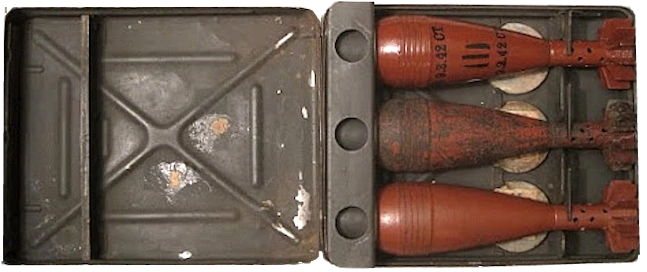
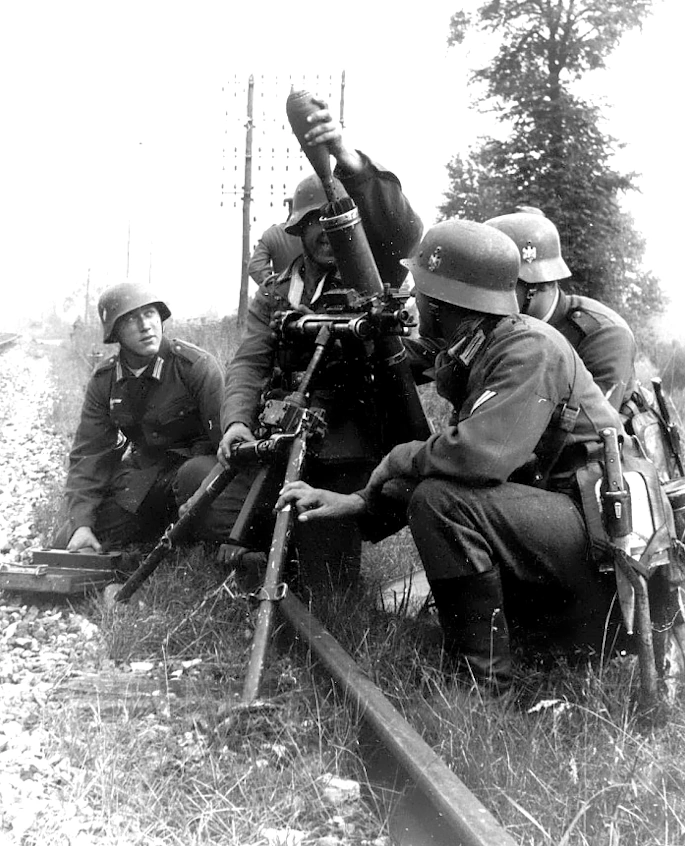 The German 8 CM Granatwerfer 34 (GrW 34) (Mortar 34) was a medium mortar used by the Wehrmacht during World War II. Known for its robust design and reliable performance, it played a significant role in German infantry operations, providing indirect fire support. This medium mortar introduced in 1934 was manufacturer by Rheinmetall. The mortar weighed 62 Kg in the firing position with the 1.14 M (44.8 inches) barrel. The caliber was in fact 81.4-MM (3.2 inches), the rate of fire was up to 15-25 rounds per minute with a maximum range of 2400 M (2,600 yards). To be operated, this gun typically used a team of 3-4 soldiers. This weapon consisted of three main parts for ease of transport and assembly; the barrel, the bipod; and the base. The GrW 34 fired a variety of 81.4-MM rounds, providing versatility for different combat situations. The shells were fin-stabilized to ensure accuracy. HE shell (Wurfgranate 34) was used against infantry and light fortifications. It weighed 3.5 Kg (7.7 lbs), was with TNT or Amatol and could be used with an impact or delayed-action fuse. Smoke shell (Nebelgranate 39) was used to create smoke screens for concealment or signaling as well as igniting fire because the shell was loaded with white phosphorus or a chemical smoke agent. Illuminating shell, (Leuchtgranate 40), was used to provide illumination during nighttime operations, a small parachute being use to achieve and extended burn time.
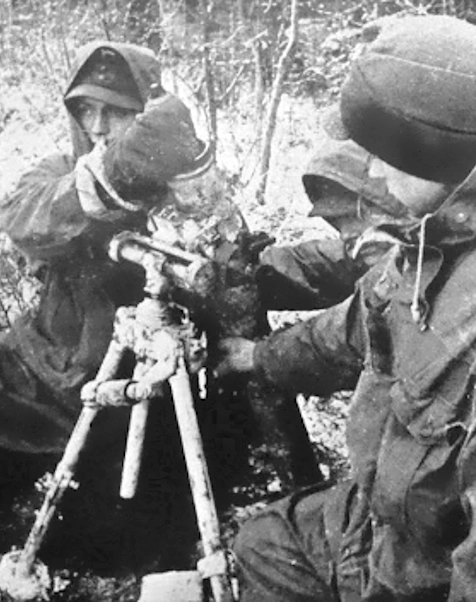 The other variant of the 8 CM Mortar 34 was the 8 CM Mortar 42 (8 CM GrW 42). This weapon was developed because of the ease of manufacturing, the weapon being simplified and for the cost-reduced introduced to address production constraints. Paratroopers required lightweight and easily portable weapons for rapid deployment and mobility. The GrW 42 was designed to be simpler and more robust than the GrW 38, suiting airborne operations. The GrW 42’s construction reduced the need for complex assembly and disassembly, making it faster to set up during combat drops. The GrW 42 used a cost-reduced manufacturing process compared to earlier models like the GrW 38. This reduction in complexity also made it more durable and easier to maintain under combat conditions. Fallschirmjäger often operated in challenging environments where lighter, more manageable equipment was essential. The GrW 42 offered improved ease of handling compared to the GrW 38. While the GrW 42 maintained similar performance characteristics to the GrW 38 in terms of range and firing rate, it was significantly more economical to produce, aligning with wartime production needs.
Differences Between the (GrW 42) and (GrW 38) were first weight: the M-38 was heavier due to more refined components while the M42 was lighter, with simplified construction. Second, was the design complexity. The M38 was more complex, and generated more higher production cost. The M-42 was simplified, robust, and cost-efficient. The material quality was for the M-38 high-quality components and finishes while for the M-42 the manufacturers utilized cheaper materials for mass production. Beside this, the M-38 was suitable for standard infantry without any problem while the M-42 was optimized for airborne and rapid deployment. The preference for the GrW 42 among paratroopers stemmed from its lighter weight, ease of use, and simplified design, which better suited the fast-paced and rugged operations typical of airborne units. The GrW 38, while effective, was heavier and more refined, making it less ideal for such specialized troops.
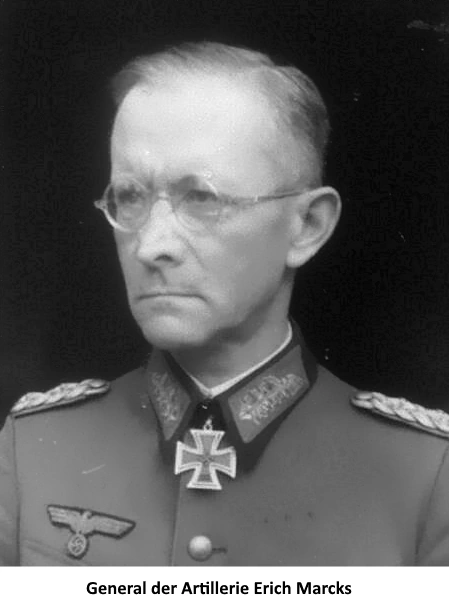 About 0600, the regimental commander succeeded in establishing contact with Gen Marcks by way of the private telephone of his landlady and the French post office at St Lo. After the regimental commander had informed Gen Marcks regarding the situation in the regimental sector he received this order from General Marcks: ‘Beginning immediately, the 6.Fallschirmjäger-Regiment will clear the Carentan area of enemy paratroopers and attack from that area the enemy paratroopers who have landed in the region between Carentan and Ste Mère Eglise in the rear of the 709.Grenadier-Division, and destroy them. All German troops still holding out the combat zone of the regiment will be placed under its command‘.
Because the regiment was insufficiently motorized, it was no easy task or the battalion commanders to withdraw their units from the widely separated strong points and to assemble them in the Meautis Area, west of Carentan. South of the Carentan Périers road, the 3.Battalion was still engaged in combat with scattered groups of enemy paratroopers who fought stubbornly; to the southeast and east the battalion covered in that area the assembly of the rest of the regiment. The 1.Battalion and the 2.Battalion reached the assembly area in the early afternoon without making contact with the enemy.
The regimental commander had driven to Carentan in the morning in advance of the regiment. He found Carentan free of Allied troops and almost free of German troops; and between 1000 and 1100, without encountering enemy troops, he reached St Come du Mont, where a German battalion had dug in. There he awaited instructions.
(Note) The fact that the 6.Fallschirmjäger-Regiment did not reach its assigned assembly area until the afternoon of June 6, proves that the extensive dispersal of the regiment for immediate protection against enemy air landings in endangered areas, as ordered by Field Marshal Rommel, was not prudent. Even if the enemy air landings had actually taken place in the quartering area of the regiment, assembling the regiment would have been out of the question. It was necessary to keep the regiment quartered closely together as much as possible so that in case of enemy air landings, the regiment would be able to attack with concentrated force in any directions. In 1944, in Normandy, we committed the same error which the British made in Crete in the spring of 1941, and which was the main reason for their loss of the island. (Pemsel)
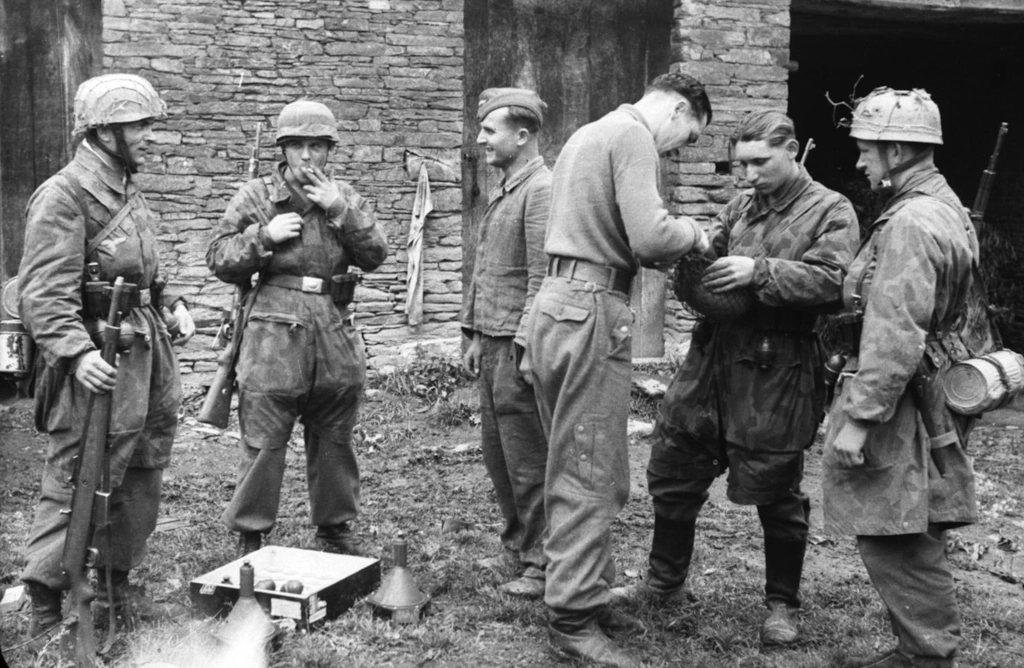
An overwhelming picture presented itself to the regimental commander from the church tower of St Come du Mont. Before him lay the coast and the sea. The horizon was strewn with hundreds of ships, and countless landing boats and barges were moving back and forth between the ships and the shore, landing troops and tanks, It was an almost peaceful picture; in the combat report which I submitted at the time to the Fallschirmjäger Army, I wrote that it reminded me of a beautiful summer day on the Wannsee. The noise of battle could not be heard, and from the church tower there was no sign of German defense activities. Only a shot rang out here and there whenever the sentries of the German battalions came in contact with Allied paratroopers.
The regimental commander established his command post in a defile just south of St Come du Mont and ordered the 1.Battalion and the 2.Battalion to be brought forward to the area of St Come du Mont via the Douve Canal. He issued the following order to the battalion commanders: ‘the 2.Battalion will advance on Ste Mère Eglise on both sides of the St Come du Mont – Ste Mere Eglise road; it will attack the enemy troops immediately upon contact and annihilate them. The 1.Battalion will cover the regiment on the line of Ste Marie du Mont against enemy troops who have landed from the sea. The 13.Company will cover the advance of both battalions‘.
Order of Battle – 6.Fallschirmjäger Regiment – June 6, 1944.
6. Fallschirmjägerregiment
CO – Oberst August Friedrich von der Heydte
Adj – Hauptmann Peiser
1.Fallschirmjäger Battalion
CO – Hauptmann Emil Priekschat
Adj – Oberleutnant Reese
– 1.Company (Rifle) – Oberleutnant Billion
– 2.Company (Rifle) – Oberleutnant Schulz
– 3.Company (Rifle) – Hauptmann Bucher
– 4.Company (Heavy) – Leutnant Scherer
2.Fallschirmjäger Battalion
CO – Major Rolf Mager
Adj – Hauptmann Schulte
– 5.Company (Rifle) – Hauptmann Herrmann
– 6.Company (Rifle) – Leutnant Bruunklaus
– 7.Company (Rifle) – Leutnant von Socha-Borzestowski
– 8.Company (Heavy) – Oberleutnant Graf Bethusy-Huc
3.Fallschirmjäger Battalion
CO – Hauptmann Horst Trebes
Adj – Leutnant Treuherz
– 9.Company (Rifle) – Oberlautnant Wagner
– 10.Company (Rifle) – Oberleutnant Prive
– 11.Company (Rifle) – Oberleutnant Märk
– 12.Company (Heavy) – Oberleutnant Pöppel
– 13.Company Schwere GrW (Heavy Mortar) – Oberleutnant Nahde
– 14.Company Panzerjäger (Anti-tank) – Leutnant Geck
– 15.Company Pionere (Engineer) – Hauptmann Hauch
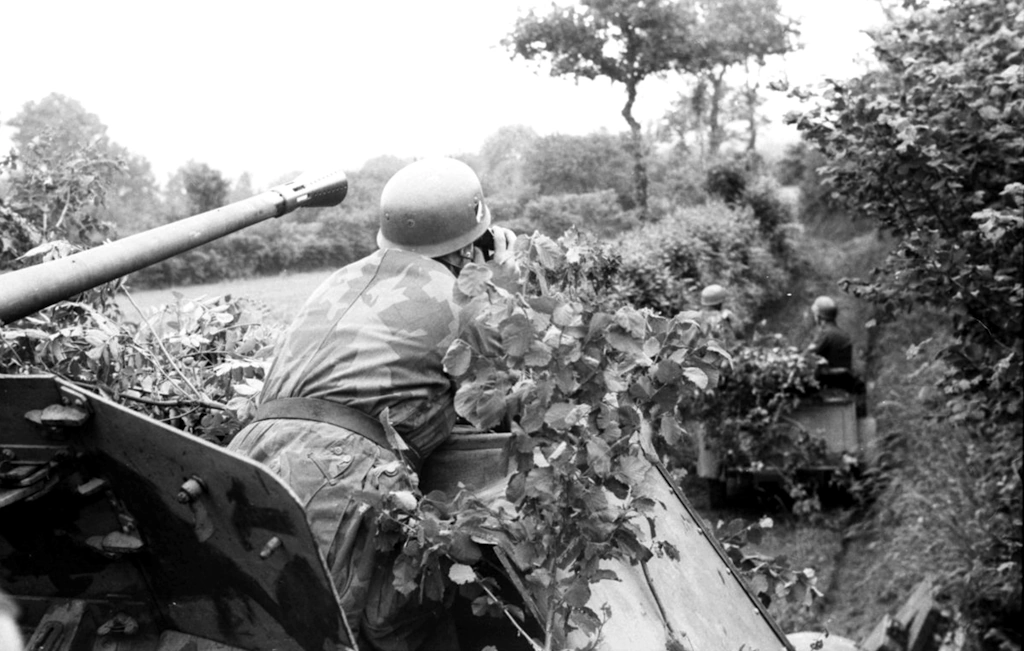
The 3.Battalion of the regiment remained in the Carentan, area in order to protect the rear and the deep flanks of the regiment; the battalion of the Seventh Army reserve was placed under the control of the 6.Fallschirmjäger-Regiment and remained in its positions around St Come du Mont. At 1900, the 1.Battalion and the 2.Battalion advanced from the area of St Come du Mont. At first, both battalions proceeded rapidly. By nightfall they had not yet come into serious contact with the enemy. Around midnight, the advance elements of the 1.Battalion had arrived at Ste Marie du Mont while the 2.Battalion had reached a point about five hundred meters from the southern edge of Ste Mère Eglise. Both battalions sent a number of prisoners back to the regiment.
Some time after midnight (the author can no longer recall exactly when) matters took an unexpected turn. Throughout the entire combat zone of the regiment, American parachute and air landing units were again descending in large numbers. American paratroopers of the 82nd Airborne Division (according to the statements made by prisoners) had landed northwest of St Come du Mont, threatened the rear and the deep left flank of the 2.Battalion. The units which had landed to the north and northeast of St Come du Mont cut off the 2.Battalion from the regiment and from the 1.Battalion, while the American paratroopers who had jumped east of St Come du Mont landed in the very center of the area of the 1.Battalion which was still advancing, threw this battalion into hopeless confusion.
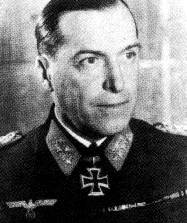 (Note) During the encirclement of the enemy air landing forces on the Cotentin Peninsula, the German elements in the north, west, and south made the same mistake. While their attempt to attack as soon as possible was commendable, they failed to wait until stronger forces had been assembled for action; the attack was not launched in a coordinated manner; the security measures involved too great a drain of resources, and in view of the uncertain situation, they were very soon forced to assume the defensive. (Pemsel)
On the evening of June 6, the regimental commander was informed by the LXXXIV Korps that an attack coordinated. by the Seventh Army and with strong artillery support was planned for June 7. This attack was to be launched from the north, from the area of Montebourg, in direction of Ste Mère Eglise, and the regiment was given the mission of joining these elements in the area of Ste Mère Eglise. A defensive front was to be established on the Merderet River west of Ste Mère Eglise.