


Stilwell’s anger deepened when he learned that Mountbatten was preparing to dispatch a mission to London and Washington in February to promote his new plan. Without notifying Mountbatten, Stilwell sent his own mission led by Gen Hayden L. Boatner, his chief of staff and deputy commander of the Chinese Army in India, to Washington to present his views to the JCoS. After the JCoS strongly opposed Mountbatten’s plan, Mountbatten blamed Stilwell’s mission for influencing their actions and asked that Stilwell be relieved of his SEAC duties on the grounds of insubordination. Marshall quickly intervened and saved Stilwell’s job by explaining to the British that the JCoS had consistently opposed the concept underlying Mountbatten’s proposed operation and that Stilwell’s mission had not affected their position. In characteristic fashion, Marshall also sent a message to Stilwell on Mar 2, directing him to see Mountbatten at once and reestablish good personal relations. The meeting was held on Mar 6 and achieved that objective. Mountbatten assured Stilwell that he supported his campaign.
While Stilwell was meeting with Mountbatten, the first combined operation involving the 5307 and the Chinese was drawing to a successful conclusion. This strengthened Stilwell’s position that the Japanese could be defeated, northern Burma retaken, and the Ledo Road completed. But, Stilwell told Mountbatten, that holding northern Burma would take more than two Chinese divisions. He encouraged Mountbatten to put pressure on Chiang Kai-Shek to get the Y-Force committed. He also asked Mountbatten to help squelch the detractors of the American-Chinese campaign in northern Burma. These people, in Stilwell’s opinion, were hurting his efforts to build up Chinese confidence and make Chiang feel that his troops in Burma were gaining glory for both China and for Chiang himself.
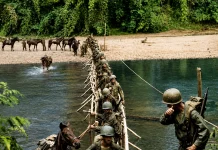
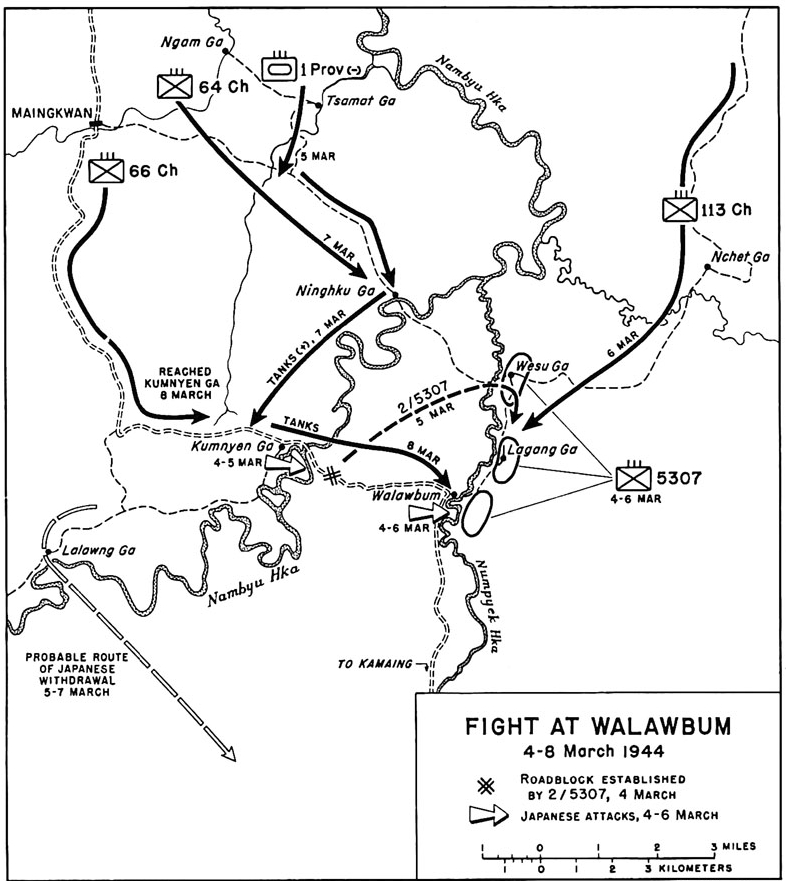
The first operation involving the 5307 had begun on the morning of Feb 24, with the front line positioned approximately fifteen kilometers north of Maingkwan, the former administrative center of the Hukawng Valley and the largest town in northern Burma. While the main body of the Chinese 38th and 22d Divisions and the Chinese 1st Provisional Tank Group put pressure on the 18th Japanese Division front north of Maingkwan, the 5307, with the 113th Regiment (38th Division) following, moved east around the 18th Division’s right flank. Stilwell’s intention was to have the 5307 establish a roadblock well behind the front and trap the 18th Division. On Feb 28, Stilwell, having decided that the roadblock should be located at Walawbum, a small village some fifteen kilometers south of Maingkwan, sent out a liaison aircraft to deliver his order to move there as rapidly as possible. On Mar 2, the 5307 crossed the Tanai River, some twenty kilometers northeast of Walawbum, set up an assembly area, and received its final orders from Stilwell’s headquarters. The movement toward Walawbum began at dawn on Mar 3. During the day, the 1/5307 secured a dropping zone at Lagang Ga, and the 3/5307 set up heavy weapons commanding the road south of the town. On the morning of Mar 4, the 2/5307 reached the road about a mile and a half west of town and set up a roadblock.
The Japanese response was quick in coming. After learning of the 5307’s presence, Gen Giichi Tanaka, the commander of the 18th Japanese Division, decided that he could use a small rear guard to delay the cautious Chinese and turn the bulk of his two regiments to face the threat in his rear. On Mar 3, just as the 5307 was moving forward to establish its positions, the Japanese 55th Regiment began to move south toward the 5307’s right flank and the 56th Regiment began to move southeastward toward its left flank. Heavy Japanese attacks began on Mar 4 and continued through the next day.
The 2/5307 received especially heavy blows, and after fighting for thirty-six hours without food and water and with ammunition running low, it abandoned its roadblock on the night of Mar 5 and withdrew to Wesu Ga. During this time, Allied aircraft bombed and strafed apparent Japanese troop concentrations. The air attack diminished Tanaka’s ability to execute his plan, but his failure to destroy the 5307 was due more to the arrival of the Chinese tank force led by Col Brown. On the afternoon of Mar 5, this unit pushed into an area between the 18th Division headquarters and 56th Regiment headquarters and, without realizing the significance of its target, began firing on Tanaka’s command post. The tanks were also blocking the trail that the 55th Regiment was to use for its attack. Face with this situation, Tanaka decided, late on Mar 5, to move his force to the west between the advancing 22nd Division and the 261st Battalion roadblock and reestablish a line across the Kamaing Road south of Walawbum. Because of the slow advance of the 22nd Division, Tanaka was able to accomplish this maneuver and escape what could have become a trap.
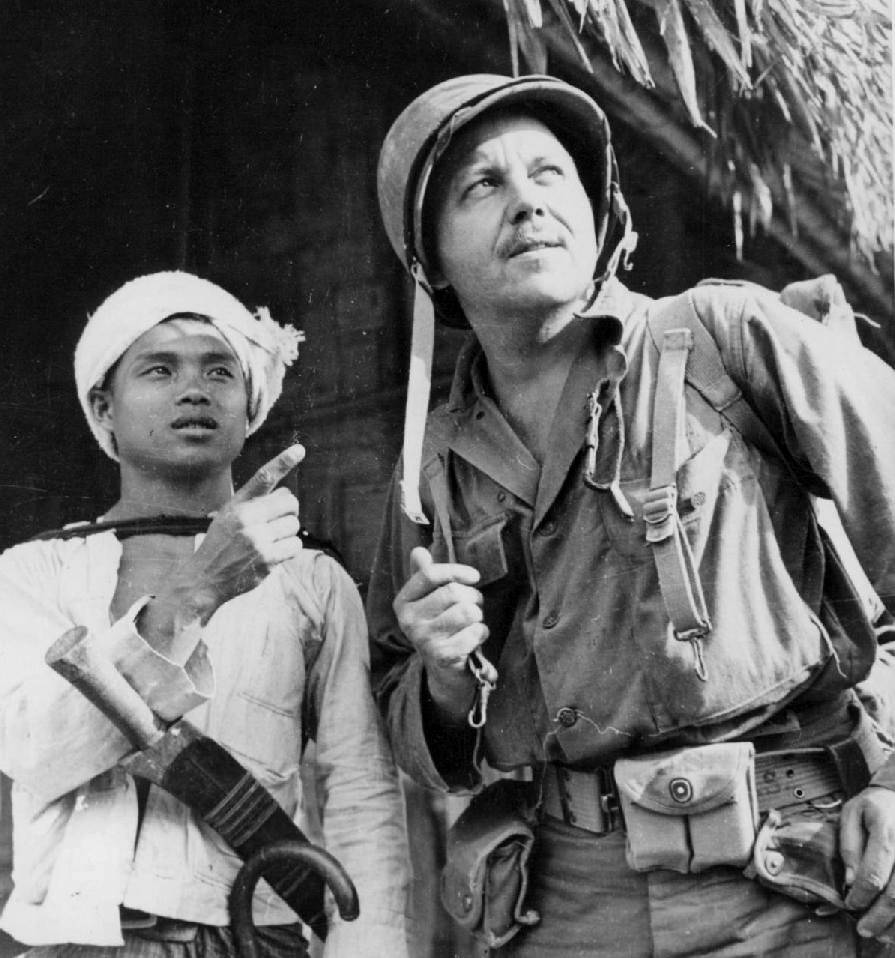
On Mar 7, in keeping with Stilwell’s orders to keep casualties low, Merrill arranged for the 113th Regiment to take over the 5307’s positions, and the Marauders withdrew from the battle. Its first mission thus ended as a success. Casualties had been light, only eight men had been killed and thirty-seven wounded during the fighting in which an estimated 800 Japanese had died. The 5307 had proven its ability to move cross-country supported by long-distance radio communication and regular airdrops. It had also worked successfully with the Chinese and another group that had become part of the combined force, the native Kachin people. The importance of support from the local inhabitants cannot be overestimated.
Gen William J. Slim has noted the value of the help given to the Japanese by the Burmese in the spring of 1942: for warning of our proximity they relied largely on Burman informers, and for their routes on local guides. Charlton Ogburn, a veteran of the 5307, writes in his book The Marauders that, in northern Burma, the situation was reversed to the great benefit of the Allies. The advantage the Japanese had in having only to hide and wait and hold on would have forced us to pay an exorbitant price for any successes, despite the Allies’ superiority in numbers and virtual command of the air, but for one asset we had the local population was with us. Thinly settled as the hills of northern Burma were, that factor made a critical difference.
The Americans made a conscious effort to gain and nurture this asset. Boatner directed the medical units attached to the Chinese Army to furnish medical attention to the natives as far as practicable to obtain their friendship with the US Army. Col Hunter mentions how the 5307 never watered their pack animals at village springs and sometimes carried water a fairly long distance to their animals in order to avoid damaging the springs and irritating the natives in whose good graces we wished to remain.
Ogburn notes that enlisting the cooperation of the Kachins was an important job of one of the most important members of the 5307, our British liaison officer, Capt Charles Evan Darlington. Darlington had served as a political officer in the area before the war and had lived in Maingkwan for five years. He was known and respected among the Kachins and in Ogburn’s words, was indispensable not only as a supplier of guides but as a guide himself.
The 5307’s first mission also showed its ability to coordinate action with Chinese Army units. Despite the language barrier and differences between the Americans and the Chinese in diet, methods of cooking,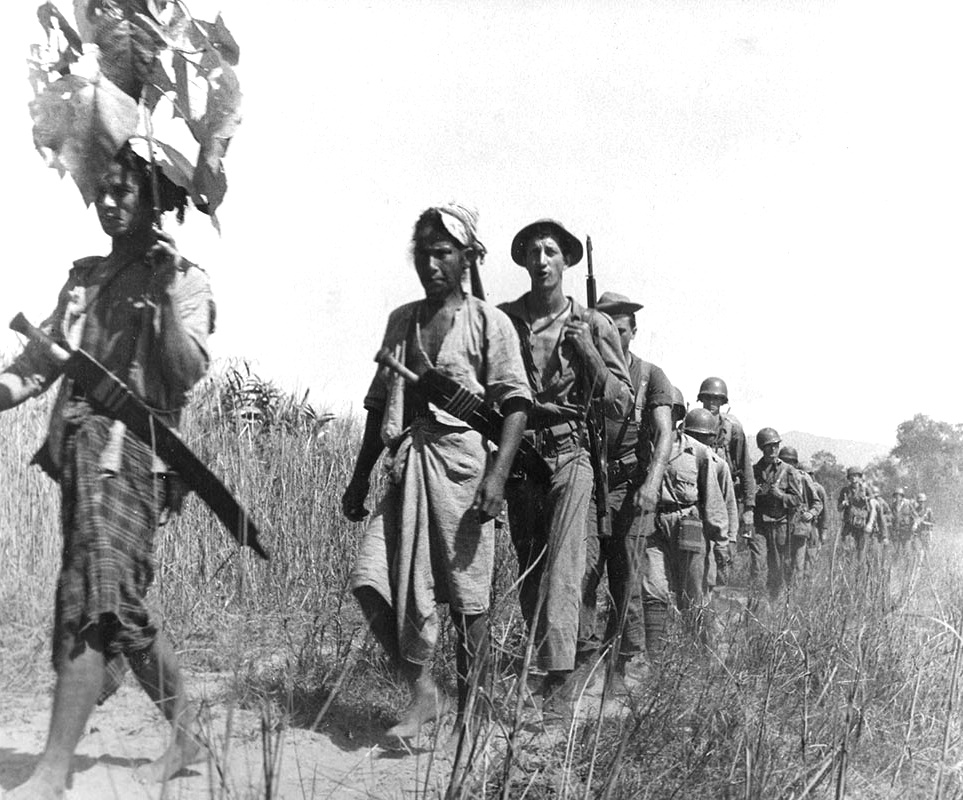 personal mannerisms, and ways of setting up camp, they developed a feeling of mutual respect. The Americans understood that they needed the numbers provided by the Chinese. Because the 5307 had no artillery, the Americans also appreciated Chinese firepower.
Ogburn describes the warm welcome given the Chinese artillery when the 113th Regiment relieved the 5307 at Walawbum: as the columns moved past each other, we heard cheering in American voices from up ahead. It grew louder, coming down the line toward us, and when it reached us, we could see the cause. In the Chinese column, a battery of pack artillery was moving forward with the infantry. We too cheered while the Chinese beamed. The pieces were only 75-MM howitzers and hardly a match for the 105s and walloping 150s with which the Japanese had visited humiliation on us, but all the same, they were guns and they could throw shells and they were on our side and they were a stirring sight.
Unfortunately for the 5307, however, even as the Chinese were helping them fight the Japanese at Walawbum, they were seriously degrading the health of the unit by unintentionally contaminating the drinking water. Hunter notes that before the 5307 pulled out of Walawbum, 350 cases of amoebic dysentery were diagnosed because of contaminated drinking water: only too late at Walawbum did we learn that the Chinese units were using the stream, from which we obtained our drinking water, as a latrine. Those men who, through force of circumstance or by choice, relied on halazone tablets to purify their drinking water soon became the victims of amoebic dysentery of the worst type. This situation was undoubtedly exacerbated by a difference in Chinese and American habits.
 Ogburn states that the Chinese took time to boil all their drinking water, while far from boiling what they drank, many of the Marauders could not even be bothered to await the action of the halizone tablets in their canteens but would pop the tablets in their mouths like aspirin and wash them down with a pint of water dipped out of a trailside stream.
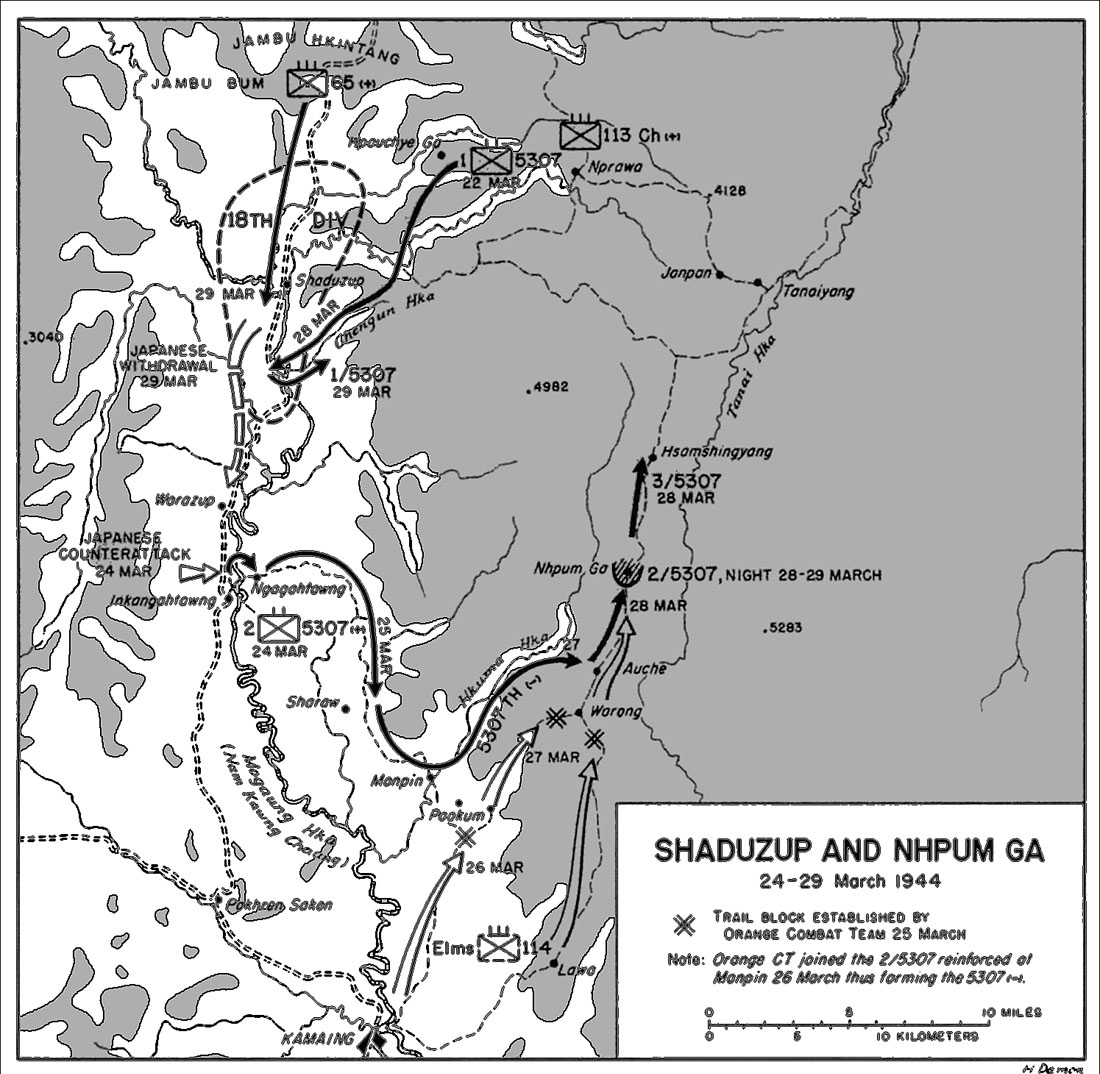
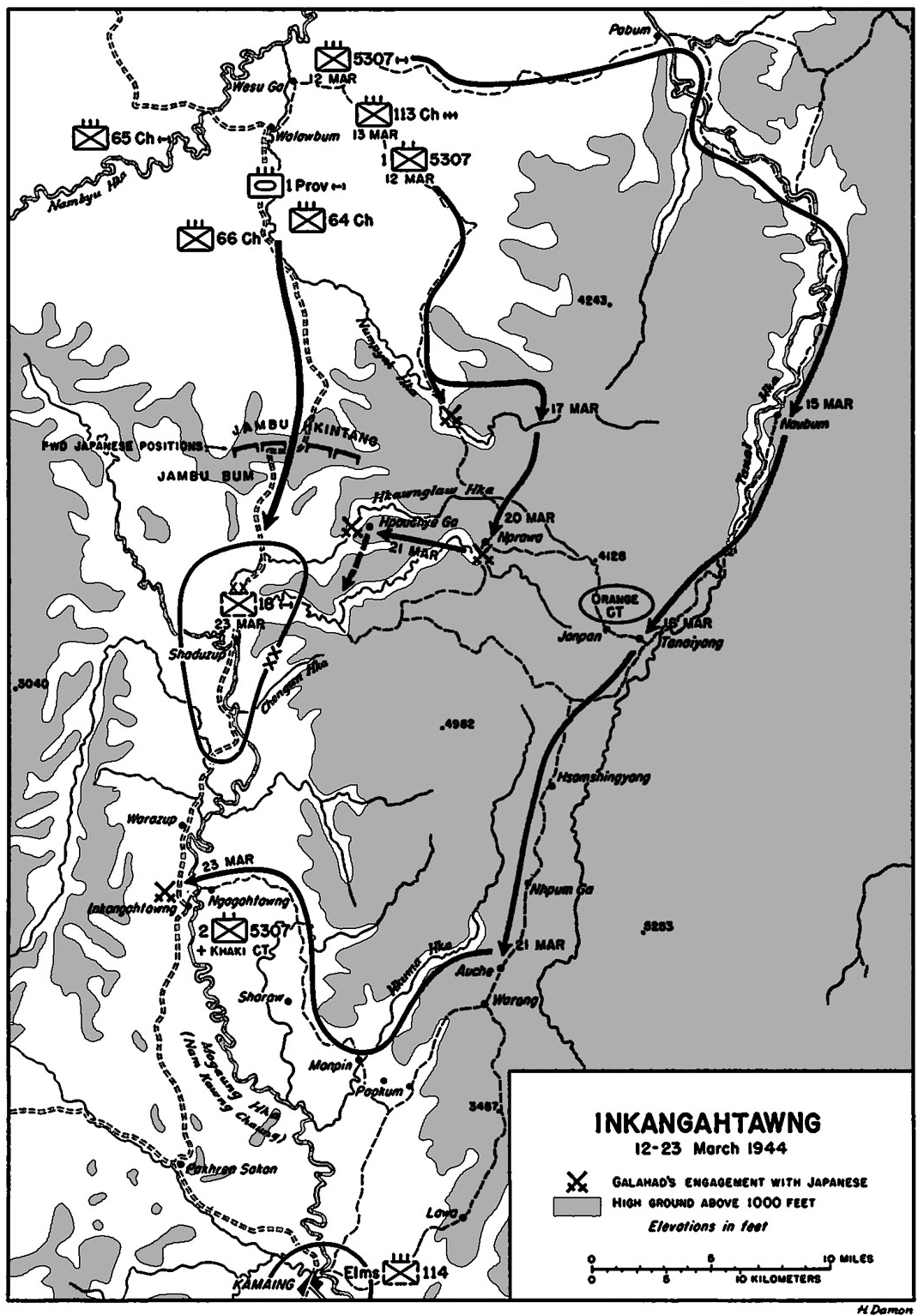
After the battle for Walawbum, the Japanese retained control of only a small part of the southern Hukawng Valley. To keep the momentum of the Chinese advance, push the Japanese out of the Hukawng Valley, and enter the Mogaung Valley, Stilwell now directed the 5307 to undertake another envelopment of 18th Division positions. The 1/5307, followed at a day’s interval by the 113th Regiment, was to conduct a shallow envelopment and block the Kamaing Road south of the Japanese positions along the Jambu Bum Ridge. the high ground that divided the Hukawng and Mogaung Valleys. Meanwhile, the 2/5307 and 3/5307 were to swing farther east around the Japanese and then move west to block the road in the Inkangahtawng area, some five miles south of the 1/5307’s roadblock. At the same time, the 22, (Chinese) Division and the 1st (Chinese) Provisional Tank Group were to launch an attack south along the Kamaing Road over the Jambu Bum Ridge.
The movement of the 5307 began on Mar 12. Rugged terrain and delaying actions by the Japanese slowed the advance of the 1/5307. Not until early Mar 28 did the force establish a roadblock just below Shaduzup. At this point, they were some ten miles south of the 22nd Division’s lead elements. Fighting was heavy throughout the day, with the Japanese using artillery to support repeated infantry assaults. During the night, the 113th Regiment moved in to relieve the 1/5307 from its roadblock responsibility. On Mar 29, the battalion moved a mile to the northeast to rest near a mobile hospital unit. During the action on the Kamaing Road, the 1/5307 had lost eight men killed and thirty-five wounded. Merrill’s instructions to the Battalion were to rejoin the main body of the 5307 after its mission was completed. Accordingly, on Mar 30, the battalion began to backtrack north to Japan. Its orders were to make this march in easy stages because the route was difficult. In one area, a day’s march of ten hours yielded only one mile of progress.
On Apr 1, the importance of long-distance communication for the 5307 was demonstrated when a sack of grain being dropped from a supply plane fell on the Battalion’s only long-range radio and put it out of operation. On Apr 3, after two days out of contact with his headquarters, the battalion commander felt so uneasy that he decided to go to Shaduzup and find out what was happening.
Using the Chinese radio net there, he learned that the 2/5307 and 3/5307 were in desperate straits at Hsamshingyang and Nhpum Ga and received orders to move to that location as rapidly as possible to render assistance. The difficulty now facing the 5307 had been caused by Stilwell’s decision to divide the force in an attempt to accelerate the destruction of the 18th Japanese Division. 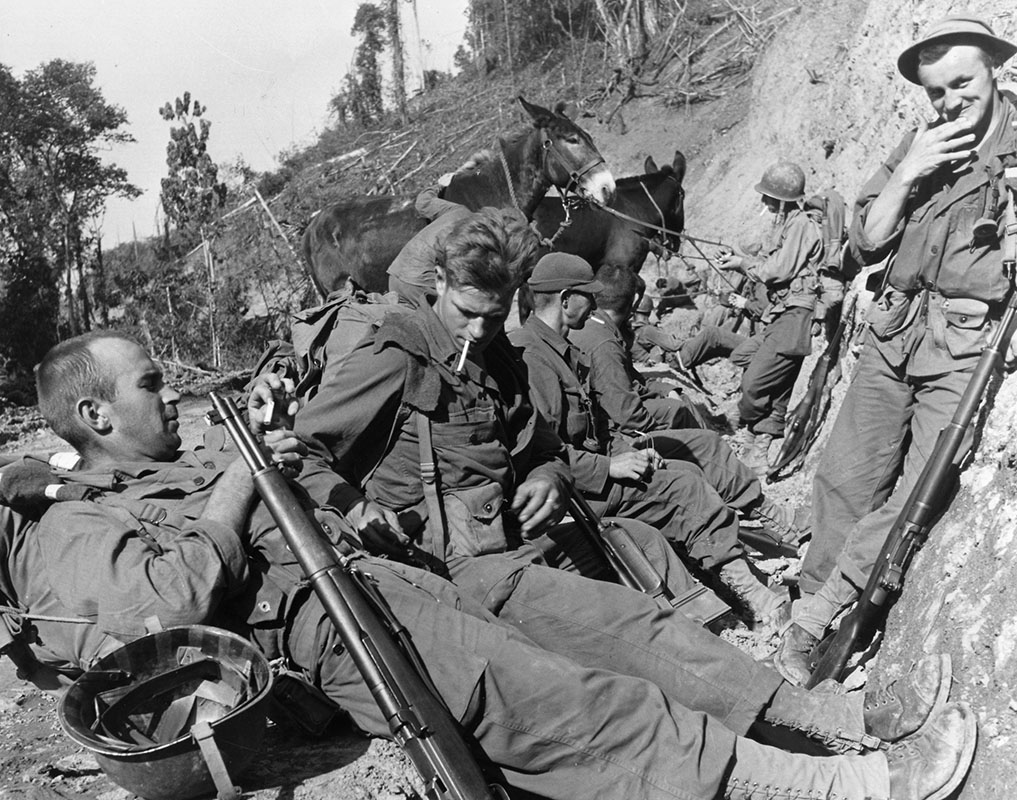 When planning for this operation had begun, Merrill and Sun Li-jen, the 38th Chinese Division commander, had advocated keeping all of the 5307 and the 113th Regiment together to establish a single roadblock at Shaduzup. Stilwell, however, wanted two roadblocks, one at Shaduzup and a second one ten miles farther south in the Inkangahtawng area. He believed that a force making a wide swing around the right flank of the Japanese could make a deep penetration without being detected. His concept, then, was to have two simultaneous attacks on the Kamaing Road while the 22nd Division attacked on the Jambu Bum front. It was assumed that, with Japanese attention divided three ways, it would be impossible for them to mount a coherent defense. It was also assumed that soon after the 2/5307 and the 3/5307 established their roadblock, the 113th Regiment, moving down from Shaduzup, would make contact with them.
Simultaneity in these attacks, however, was not achieved. During the night of Mar 22, Stilwell sent a radio message to Merrill: Japs withdrawing down the road. Jambu Bum fell today. Come fast now.. On Mar 23, Merrill responded by ordering the 2/5307 and the 3/5307 to rush forward. While these two units reached the Kamaing Road thirty-six hours earlier than originally planned, the 1/5307 had fallen far behind schedule because of the rough terrain and was still four days from Shaduzup. Nevertheless, due to Stilwell’s message, the 2/5307, after reaching the area north of Inkangahtawng early on the morning of Mar 24, proceeded to attack the village.
If the Chinese had moved south from Jambu Bum more quickly, and if the 1/5307 roadblock had been established at this time, this attack might have been successful, but with a slow Chinese advance and no distracting roadblock at Shaduzup, the Japanese were able to concentrate their forces against the two 5307 Battalions. Soon, these two battalions were imperiled. The lay of the land had forced them to move into a position where they had a long, exposed left flank, and they were susceptible to being cut off. The Japanese began moving to do exactly that.