



– (6) Communications
For the setup of communications for this force see Inclosure No. 4. In this operation communication nets did not function initially satisfactorily. Many instances were noted where personnel came ashore in boats without all of their radio equipment for which they were responsible. A considerable number of extra radios was furnished to the force. (See Inclosure No. 5.) As may be noted by this tabulation, the number of radios was far in excess of the number of qualified operators who were available, and, in many cases, necessary repairs to the sets could not be made in order to keep them in operation. As has been previously indicated, communication between the shore party and ships was not satisfactory initially and not really established completely until D + 2. Civilian lines were used to some extent, but effective use of them was hindered because many of these lines
I found a general feeling that the SCR-284 is too heavy a set to be carried by personnel. The SCR-610 set performed satisfactorily and was liked.
CONCLUSION
Radio sets to be used in amphibious work should not be divided into separate loads but be an individual unit, or mounted on one vehicle whenever possible. In cases where sets are constructed in parts, frequently some essential element will be missing at the time when the set should be placed in operation. A force should not be encumbered with a greater number of radio sets than it has operators to handle. Waterproofing must be completed on all radio sets which it is anticipated will be carried ashore in small landing boats.
– (7) Air Support
Air support in this operation was confined to the use of naval planes from aircraft carriers. They did superior work and performed all missions requested with speed and accuracy. In some instances, I was told that battalions and regiments were not able to contact the aircraft carrier through the SCR-193 which was assigned for that purpose. The fact that early in the morning of November 11 Division Headquarters was able to contact naval bombers and dive bombers through this set and notified them that the attack of Casablanca had been called off about five minutes before the time the bombers were to attack is evidence that the set can be made to work and that the naval aviators were on the job.
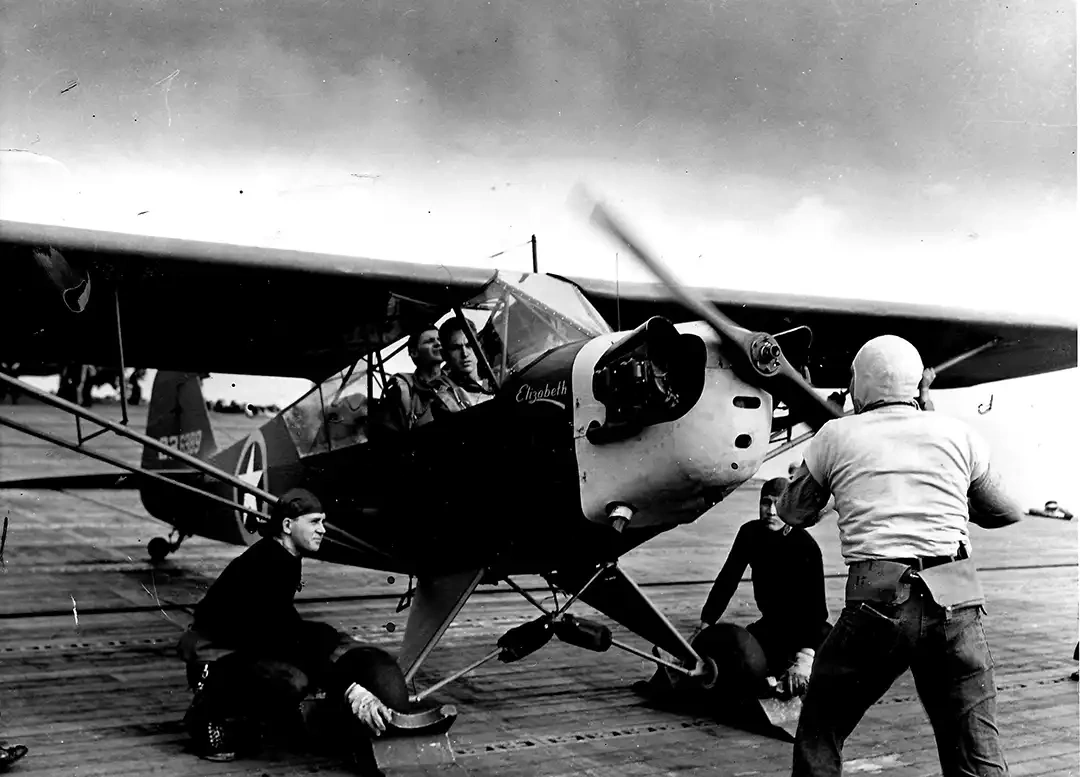
No use was made of the artillery Piper Cub planes. Three of these planes accompanied the force and were carried on the aircraft carrier USS Ranger (CV-4). When a suitable landing field was found for them during the afternoon of November 9, the planes took off from the carrier for shore. While flying over the transports, a destroyer opened fire upon them and they dispersed in various directions. One of the planes, unfortunately, came down low over our own troops and appeared just after a French plane passed, strafing our forces. Our ground troops immediately opened fire upon the Cub plane and seriously injured the pilot. The plane fell and Capt Alcorn, the pilot, was pulled out prior to the time that it burned. He was later evacuated to the Ranger with several small arms bullets in one of his legs. The other two pilots were successful in evading the ground troops and landed at the assigned field.
After the armistice, the remaining two planes were assigned to the artillery stationed on the outskirts of Casablanca. I visited one of the pilots while he was working on his plane in the field and found out that the plane arrived without a mechanic’s kit, and although the mechanics had been assigned, they had no repair tools with them. The planes which accompanied this force had been stationed at <Langley Field and no information was available to the pilots or mechanics concerning the status of the motor or the number of hours which the planes had been flown since last repaired. The pilot told me that both planes were old, having been previously wrecked and repaired. The pilot and mechanics seemed to think that the instruction they had received at Fort Still had been adequate in all respects. Prior to my departure from Africa, instruction had been issued to paint the under surface of all artillery planes yellow, a,d each individual organization was given a demonstration of the plane’s use.
CONCLUSION
Conclusion. In order to prevent our own planes from receiving anti-aircraft fire from friendly troops, it is essential that complete information concerning them be disseminated to all personnel. Suitable distinctive markings should be placed upon the artillery planes now assigned to divisions. Repair kits for L-4 or artillery planes should be furnished to each plane mechanic assigned to the division. If not already required, complete records concerning the life of the plane should accompany a plane when it is transferred from one place to another.
– (5) Naval Gunfire Support.
The 3rd Infantry Division was prepared to utilize observed naval gunfire by means of naval shore fire control parties formed from personnel of the division artillery. Each battalion landing team had one shore fire control party and one naval ensign attached for the landing operation. The parties consisted of the following personnel and major items of equipment:
| Personnel | Equipment |
|---|---|
|
1 Officer, Artillery 1 Naval Ensign 1 Staff Sergeant 1 Sergeant, T/4 2 Corporals, T/5 2 Privates, 1cl. |
2 SCR-284 1 SCR-610 2 CE-11 1 DR-4 with 2 mi W-130 1 Climbers, LC-6 2 Sound Power TBS 1 Remote Control System 1 Panel Set AP-30C 1 Cart M34 Waterproof bags for radios Magnifying glass Alidade |
The general plan of naval gunfire did not include any prearranged fires on targets prior to or after H-Hour. Fire support groups were to engage only shore batteries, and only if those batteries opened fire on the ships. These groups were placed under the control of the battalion commanders through the shore fire control parties.
The following is a summary of what occurred to the nine shore fire control parties:
– Seven of the nine landed on the correct beaches; the remaining two landed on incorrect beaches, considerably distant from their assigned landing areas.
– Two parties were able to communicate with their assigned destroyers.
– One additional party established communication with a destroyer, but not with the one to which it had been assigned.
– All nine SCR-284 radio sets functioned properly.
– Only one fire mission was requested by any of the parties, and that mission was canceled before actual fire was delivered. Consequently, no naval fire missions were executed at the request of the division troops.
The authorization for fire support group ships to engage shore batteries if fired upon resulted in some friendly troops being subjected to naval shellfire. This occurred in the town of Fedala, which had already been entered by elements of a battalion of the 7th Infantry prior to the opening of naval fire against a shore battery near the town. The Navy employed a special grid system for use in supporting landing operations. It was essential that both the fire support ships and the shore fire control parties operate from maps gridded in an identical manner. In this operation, this was accomplished through direct coordination between a staff officer of the division artillery and a Navy representative. All maps were checked prior to embarkation to ensure identical grid application.
Prior to embarkation, the naval liaison officer assigned to each shore fire control party was attached to the battalion with which he would operate for a period of approximately three weeks. As three naval officers were physically unable to maintain the pace of cross-country movement during operations, it is believed that a longer period of training with the assigned battalion would be desirable. Each fire support group ship was equipped with an SCR-284 radio set for communication with the shore fire control parties. These sets were operated by Navy personnel. It is believed that the lack of effective communication between ships and shore parties was, to a great extent, caused by the fact that naval radio operators became involved in internal naval communications during the initial engagement against French forces, thereby failing to monitor the frequencies used by the shore parties. The staff officer of the 3rd Division Artillery in charge of shore fire control parties recommended that communication equipment be simplified by eliminating unnecessary items.
– 1 pair climbers
– 1 magnifying glass
– 1 remote control unit
– 1 SCR-284
– 1 panel set
– 1 DR4 with 2 miles wire (substitute 3 RL 39 units with same amount of wire)
CONCLUSION
In making plans for naval gunfire support in an amphibious operation, necessary restrictions must be imposed to prevent erratic firing from falling on friendly troops. In order to maintain communications, a radio operator must continuously guard the frequency with which he is charged and must not be diverted to other duties. It was recommended by the 3rd Division that the SCR-284 set, now placed aboard naval vessels, be manned by a radio operator who is a member of the shore fire control party.
– (9) Engineers
The organic engineer unit (10th Engineer Battalion) of the 3rd Division was divided into platoons, and each platoon accompanied a battalion landing team. The opposing force did not attempt to destroy any bridges, and the roadblocks that were established were constructed in such a manner that they were easily circumvented. As a result, the engineers had relatively little to accomplish in their primary role. The 36th Engineers, designated as the Shore Party Regiment, operated under difficult conditions and, as previously indicated in this report, experienced considerable difficulty in establishing dumps after supplies had been brought ashore. The difficulties encountered were undoubtedly due in large part to failures in communication, as well as a lack of proper supervision, organization, and control.
– (10) Motors
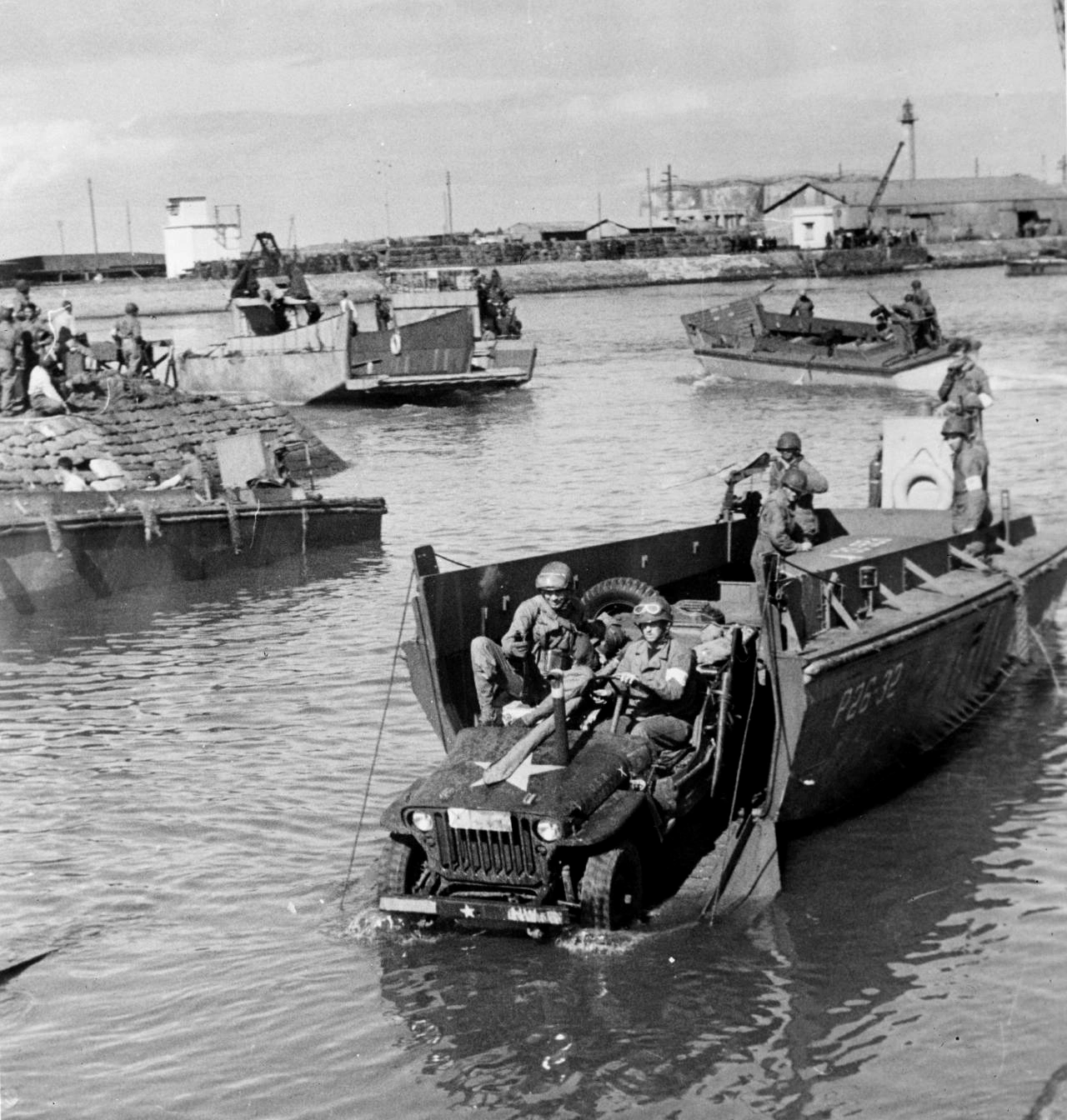
Prior to departure from the United States, the majority of the motor vehicles of this force were waterproofed under the supervision of the Ordnance Department. Light tanks were modified to operate in water depths of approximately four to five feet. Upon landing, many vehicles entered water depths of two to three feet; where footing was sufficient to provide traction, all were able to operate under their own power. Waterproofing by the Ordnance Department proved highly satisfactory and materially assisted in bringing vehicles ashore which otherwise would undoubtedly have been lost. Due to the limited number of maintenance units accompanying the force, garage facilities in Casablanca and Fedala were not initially available to the units for repair and maintenance of vehicles. These facilities became available only after the towns were secured. After the capture of Fedala, numerous French vehicles were commandeered. Although the majority required modification in order to operate on gasoline, they proved of material assistance in the transportation of supplies and personnel.
Difficulty was encountered in placing the vehicles in proper operating condition, inasmuch as they had originally been designed to run on gasoline but had been operating on alcohol for some time. Shortly after the cessation of hostilities, the 3rd Division ordered an immediate inspection of all motor vehicles, and the necessary maintenance work was instituted. Equipment for patching tires and tubes was included among the supplies carried by the motor maintenance units. Many tires were punctured, and facilities were not available to make the necessary repairs.
CONCLUSION
For amphibious operations, vehicles should be completely waterproofed in order that they may operate across beaches even when unloaded in appreciable depths of water. A limited quantity of supplies for patching tubes and tires should be included in all motor repair kits for operations of this character.
– (11) Medical
(See Inclosure No. 2)
– (12) Chaplain Activities
(See Inclosure No. 2)
– 2. h. Recommendations for Future Training and Equipment
– (1) Too much emphasis cannot be placed on the necessity for having expert coxswains of landing craft. Personnel assigned to such duties must be thoroughly competent, trained, and capable of diagnosing changing situations and exercising initiative as required. Their training, in order to prepare them for landing operations, should be conducted under conditions similar to those expected in actual operations. Training coxswains in calm water and expecting efficient performance in moderate surf is unsound. Each coxswain, upon leaving the ship for a destination ashore, should be given complete instructions and be fully acquainted with the situation he may encounter upon reaching the shore.
– (2) Training in the United States should place strong emphasis on the identification of friendly and allied aircraft expected to operate within the sector of operations. It is natural for personnel to consider all unidentified aircraft as hostile; therefore, greater emphasis should be placed on recognition of friendly aircraft rather than solely on enemy types.
– (3) Impress on troops armed with small arms the futility of firing on enemy airplanes until such planes come within effective range of their weapons.
– (4) Give to our troops as much combined training as possible, and permit infantry units to conduct problems with artillery using live ammunition. Impress upon the troops the importance of recognizing the sound of shells and estimating the distance at which artillery fire is falling.
– (5) Field equipment, for both officers and enlisted men, should be lightened, especially for amphibious operations.
– (6) In amphibious operations, all necessary replacements to bring a unit to its required strength should join the unit at least two months prior to embarkation. This applies both to units attached to an amphibious force and to individual replacements, officers as well as enlisted men.
– (7) Training in the use of the anti-tank grenade and rocket should be emphasized, and the limitations of these weapons should be clearly understood by all troops employing them.
– (8) Suitable covers for the rocket launcher should be designed and issued with the weapon.
– (9) Further tests should be conducted on the .30-caliber gun which forms part of the automatic equipment issued to the 443rd Coast Artillery Battalion, particularly with regard to jamming issues.
– (10) Radio sets used in amphibious operations should, if possible, be contained within a single unit rather than divided into separate components, as in the case of the SCR-284 set.
– (11) Suitable carrying cases, preferably of a suitcase type, should be designed for carrying antitank rockets as well as infantry mortar ammunition for use in amphibious work.
– 12 Necessary steps should be taken to permit the automatic weapons mounted on the half-tracks of the type used by the 443rd Coast Artillery Battalion to be depressed to an angle below the horizontal of at least five degrees. This will permit these weapons to afford protection against armored vehicles.
– (13) Instructions regarding life aboard ship should be furnished to all personnel as they embark.
– (14) In amphibious operations where more units than purely fighting units are involved, additional service troops should be landed early in order to handle supplies as the shore party is normally constituted cannot be expected to clear the beaches as well as maintain and operate elaborate distributing points.
– (15) In all training, officers and men should be required to wear normal combat field equipment in order to accustom themselves to its weight and bulk.
– (16) Hardening of personnel cannot be stressed too much.
– (17) The K and C rations have proved themselves very successful. An opener key should be furnished with each can of the C ration. At present, the meat and vegetable component has no key, the key for it being enclosed in the biscuit component can.
– (18) A small stove, burning either gasoline or condensed fuel, should be furnished on the basis of one per motor vehicle, in order to heat the meat and vegetable component of the C ration.
– (19) The identification tag chain now worn by many officers and enlisted men should not be authorized. It is too fragile and very susceptible to burning.
(Recommendation of 3rd Division Surgeon)
2. i. General Observations and Conclusions
One of the secrets of success in amphibious operations is, in my opinion, coordinated control of fighting units. The initial fighting unit being a battalion landing team, we should have a ship capable of completely combat-loading this team, and the ship should be equipped with sufficient small boats to carry the team ashore. Extra equipment and extraneous units should not be placed aboard this ship at the expense of impairing the fighting ability of the team. Should a ship be lost in transit, a unit would be lost, and plans should be flexible enough to permit operations to continue with a reduced number of units.
Further study should be made of the quantity of supplies to be initially loaded with an amphibious force. To expect large ships to remain offshore, with limited protection, for a protracted period of time while unloading supplies is wrong. The loss of four transports of this force while waiting offshore to unload supplies is evidence of the hazard involved. Complete plans for the coordination of naval gunfire and land operations must be more carefully made.
One extremely bad feature of the voyage to the destination was the fact that although the troops went aboard in good physical condition, they lived aboard ship in cramped quarters, with poor ventilation and had practically no opportunity for exercice during the entire trip. thus undoubtedly, impaired them physically and if and when we meet a more formidable foe, this condition may well determine the success of the operation.
In amphibious operations, units will, in many cases, land at incorrect locations. I believe that at each beach a point should be designated and properly marked where information can be disseminated. At this point, an officer thoroughly familiar with the entire operation should be stationed. He can then direct units or elements that are out of position to their proper locations, or, if the situation demands, temporarily attach them to adjacent organizations. Although, in general, the shore party is now charged with such duties, I believe it is impractical for the shore party to perform this task. Considerable difficulty was encountered by the 3rd Division in compiling complete and accurate lists of casualties. The main trouble appeared to be that units did not have records of their personnel at organizational headquarters and lacked personnel familiar with such records. I believe each company, or similar organization, should have a qualified clerk available for the compilation of such records. (Clerks were left behind for this operation.)
The 3rd Division, under the command of Major General Jonathan W. Anderson, performed its mission with a minimum loss of life and deserves high praise for its conduct throughout the operation. At no time were units stampeded, and practically all officers and men performed their duties efficiently under conditions which often left much to be desired. The planning of this operation by the commander and his staff was sound in all respects. Preliminary information and orders were adequate, and I believe all necessary preparations to conduct the operation on a sound basis were made prior to the movement of the transports from the United States. Many of the plans, particularly the boat employment plan, could not be executed due to circumstances beyond the control of division officers. Had the operation been conducted as originally planned, and had the units landed at the designated beaches, I believe that the results obtained could have been achieved more rapidly and with considerably less loss of life and equipment on both sides.
At all times during the operation, the commander and his staff remained calm, and I am not aware of a single poor tactical decision. In this connection, I believe great credit for the success of the operation should be given to Major General Jonathan W. Anderson, Division Commander; Brigadier General William W. Eagles, Assistant Division Commander; Colonel Walter W. Hess, Chief of Staff; and Lieutenant Colonel Ben Harrell, G-3, all of the 3rd Division. Most of the other members of the staff also performed excellent work; however, I believe these four individuals were particularly outstanding in the performance of their duties in planning the operation.
The assembling of specialists from various arms and extraneous organizations at a port of embarkation in order to form a balanced combat force upon debarkation on a hostile shore should not be attempted if it is humanly possible to organize these units into a team prior to embarkation. The keynote of success in combat is smooth teamwork. To assemble a group of specialists just prior to combat does not produce an effective team. Units should be made to function together and not separately. Quickly organized headquarters, whose staffs are not familiar with their own problems or with the purpose and limitations of the units of the force, do not lend themselves to smooth and efficient operations.
The Counter-Intelligence Service units which operated in the vicinity of this operation deserve high praise for the work accomplished. The attack on Fedala achieved almost complete surprise, and it is believed that no one, except those informed by our counter-intelligence personnel, had any knowledge of the impending landing of American forces. The German authorities were caught completely unprepared. Apparently, this force was misinformed as to the proper approach toward the native population. All personnel had been instructed to treat the natives with care and consideration. The general impression was to provide them with food, cigarettes, and other appeasing items. It is believed that, initially, this attitude caused a loss of prestige among French military and civilian personnel, due to the contrast with established French practices toward the Arab population. It would have been preferable to adopt an approach more consistent with that traditionally employed by the French authorities. The completeness and accuracy of the information concerning French military units and installations in the vicinity of Casablanca and Fedala were nearly perfect. Practically all advance intelligence proved correct and materially assisted in the success of the operation.
Prisoner of war interrogator teams and interpreters were well trained and proved of great assistance to commanders in making tactical decisions. The attachment of interrogator teams to lower-echelon units enabled rapid acquisition of information concerning enemy dispositions and facilitated its prompt transmission to higher headquarters. All commanders interviewed expressed high regard for graduates of Officer Candidate School.
The general feeling among the officers of the French army is one of cooperation and a desire to assist us in fighting the Germans. The equipment of these forces is mediocre. In order to make them ready for combat, they must trow away there 1918 uniform and be furnished equipment and ammunition.
I return with the definite feeling that the principles and doctrines of our army are sound and if followed will lead to success. No unit will be successful unless each individual officer and enlisted men is thoroughly disciplined and has complete confidence in himself and his leaders.