



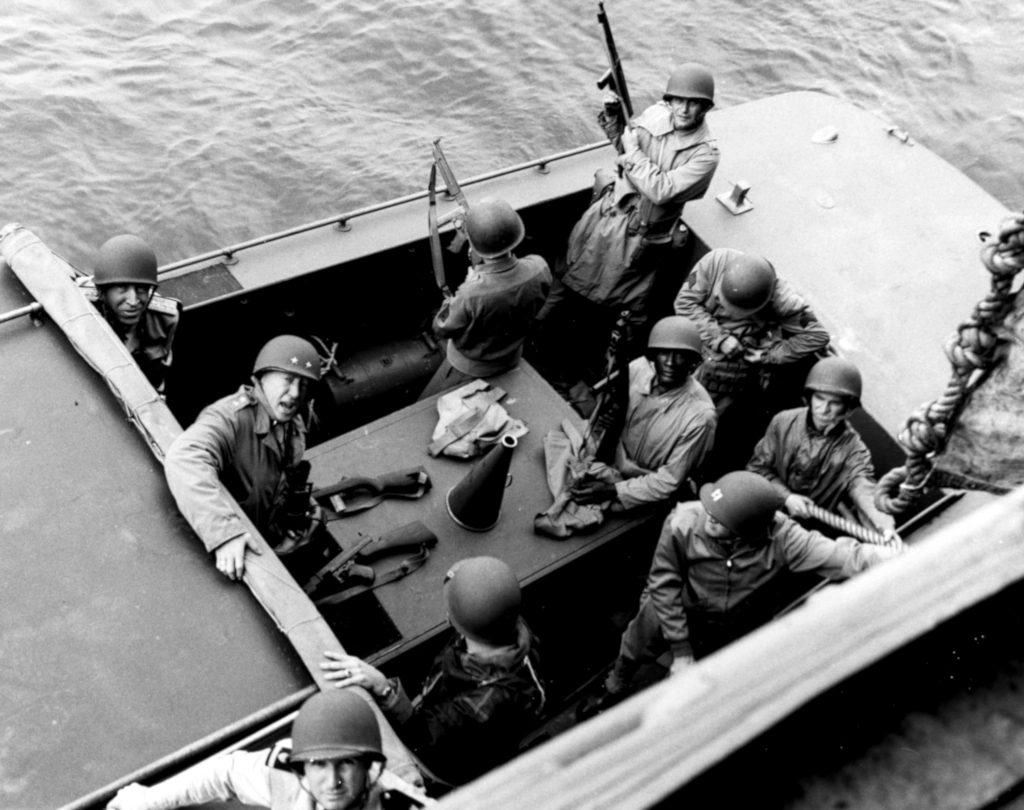
After the tour of the port, Gen Eagles and his party returned to the French Division Headquarters where he met Adm Michelier and started to Fedala to meet Gen Patton. At this time, Gen Anderson went into a conference with Gen Noguès and VAdm Pierre-Jean Ronarc’h. The following points were covered in the conference between Gen Anderson and the French officers:
– (1) The French desired to send certain troops, then in Casablanca, to their barracks in a town at a distance of about 30 miles from Casablanca. General Anderson agreed to this.
– (2) Mutual arrangements were made to clear the battlefields of the dead on both sides, and places were designated for burial of American dead.
– (3) Arrangements were made to get our personnel into the morgue to identify and secure our dead.
– (4) Necessary agreements were reached for exchange of prisoners.
After this friendly conference, Gen Anderson took leave of the French authorities and awaited the results of the conferences between Gen Patton, Adm Michelier, and other high-ranking French officials. As a result of all these conferences, agreements were reached between the American and French authorities for mutual cooperation and control of the city of Casablanca, and for police and guard of the dock area, pending the result of final negotiations.
On November 21, after the arrival of units of the second convoy, all units of the 3rd Infantry Division were removed from Casablanca and occupied bivouac positions on the outskirts of the town. These positions were generally selected so that defensive positions could be quickly occupied and, if necessary, a defense of the city be maintained.
2. 2. Landing of Supplies from Transports
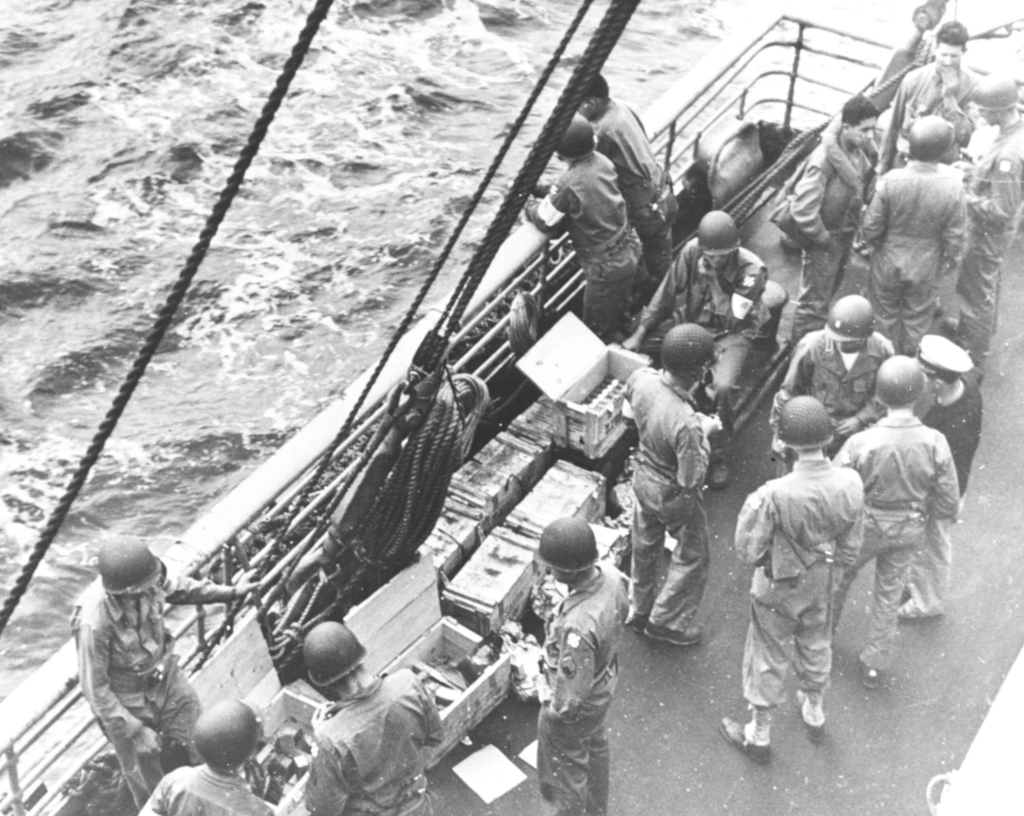
Original plans called for the unloading of supplies on three beaches, the beaches to be handled by shore party personnel from the 36th Engineer Regiment (Combat) (9-ID). During the day and night of November 8, a limited supply of ammunition, gasoline, water and rations was unloaded at these beaches. Most of this time (November 9) the beaches were under fire by artillery, machine guns and bombs from planes, while supplies were carried back of the sand dunes about 200 yards inland. It was impractical to establish elaborate dumps. Communication between the shore party and ships was not satisfactory and was not effectively established until about 1600, November 9. Complete communications were not in operation until Tuesday, November 10. This lack of communications was due to incomplete assemblage of sets arriving at the shore and to the drowning out of the equipment which did arrive. At about 1800, November 8, the port was available for landing of supplies directly and in safety. In spite of this, small boats continued to use the beaches during the night of November 8-9, and until about noon of November 9 with subsequent loss of boats and supplies. Finally, during the afternoon of November 9, use was made of the port and small boats began to pour into the harbor with supplies and personnel.
Land transportation facilities were few and great piles of ammunition, rations, water, gas, etc, accumulated at the various unloading points because of the lack of transportation to move supplies from the harbor to rear lying dumps. In this connection, the amphibious tractors were used mainly as trucks for moving supplies on shore. In only a few instances were those tractors used amphibiously.
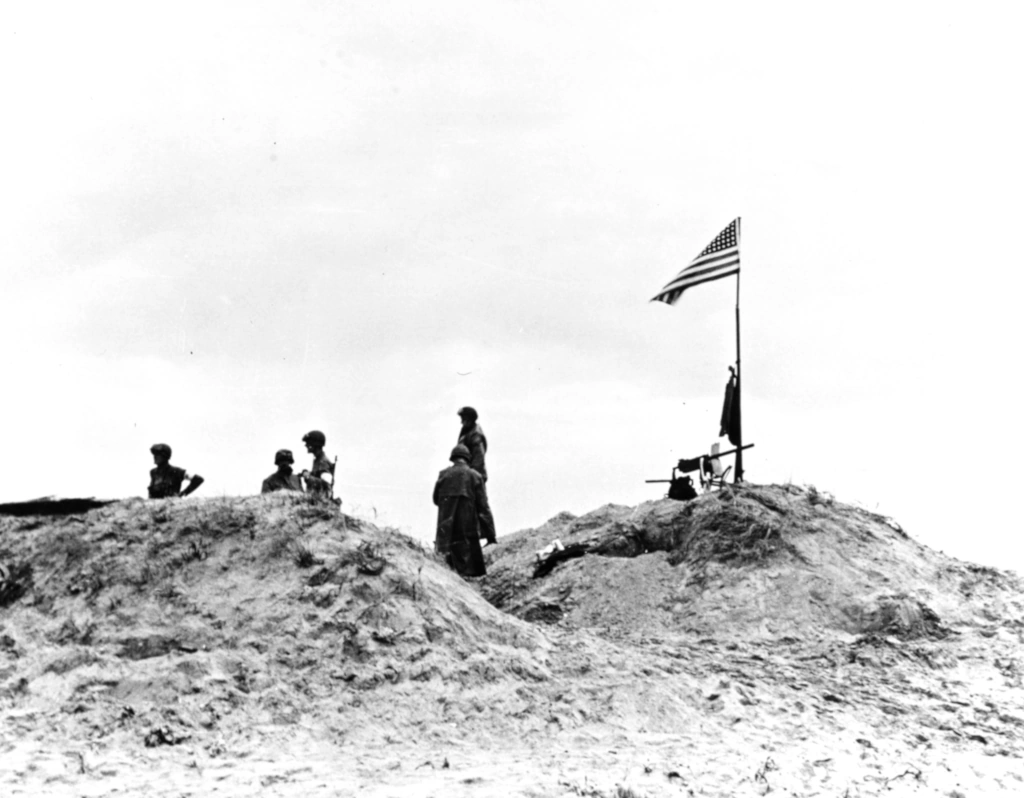
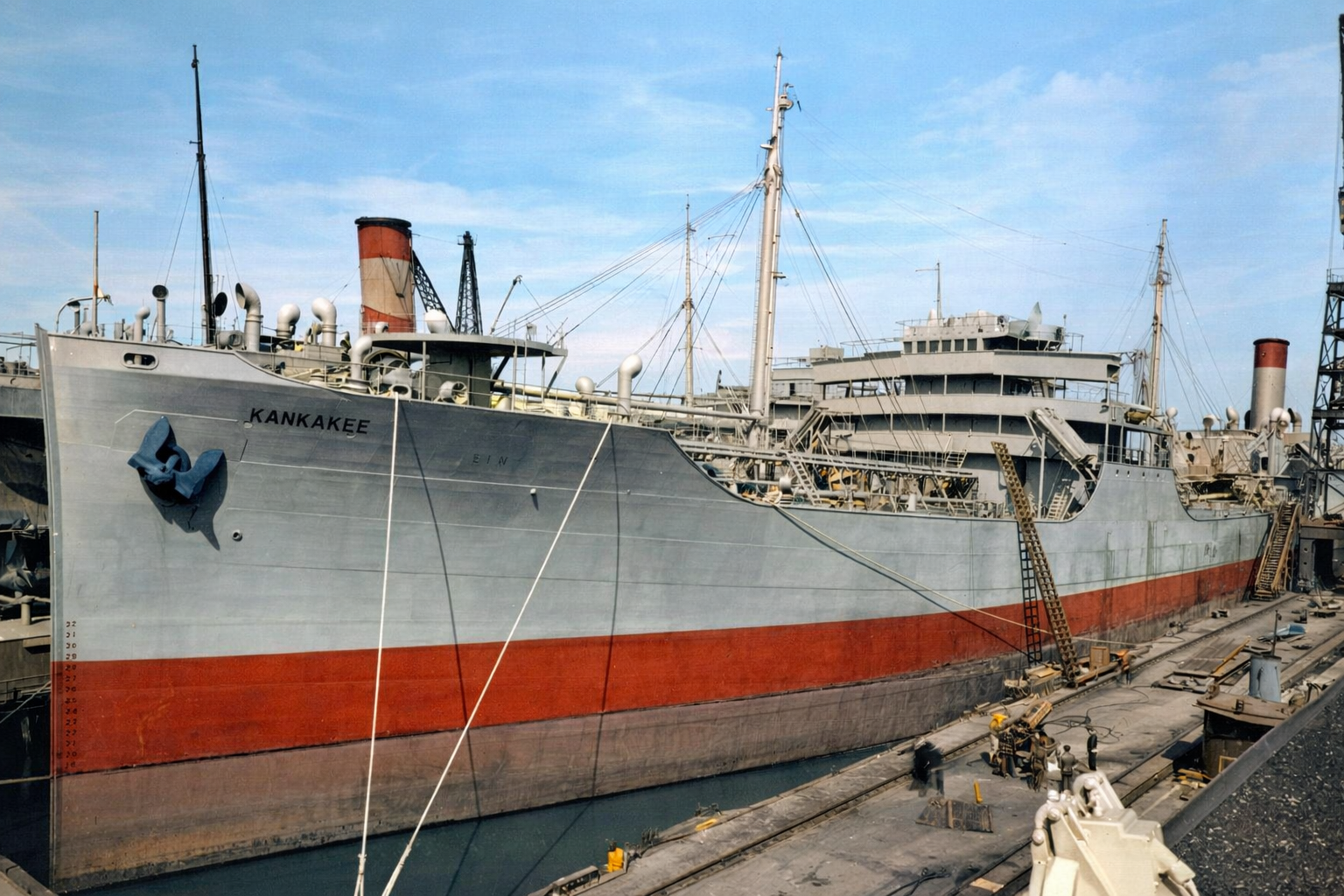
At about 1300, November 9, the first transports came into Fedala Harbor, this being the vessel which carried part of the armored team. Upon the unloading of this vessel, another was brought in as docking facilities were only available for one large ship. During this period, November 8–11, the transports remained off Fedala in a rather dangerous place and at about 1600, November 11, the USS Joseph Hewes (AP-50) was sunk by a torpedo. The other transports remained in the Fedala area on November 12, and at about 1645, November 12, three cargo ships, the USS-Edward Rutledge (AP-52), the USS-Hugh L. Scott (AP-43) and the USS-Tasker H. Bliss (AP-42), were sunk by torpedoes. About 2000 survivors from these ships came into Fedala and the medical authorities did excellent work in handling them. The Casino, the Army hotel, the Catholic church, civilian homes and other places were used as hospitals. The doctors handled about 500 cases and 100 plasma transfusions were given with flashlights as the only means of illumination. Most of the bad cases were from burns.
The 3rd Quartermaster Battalion was not landed until November 10 at 1300. Had it been landed sooner, it would have materially assisted in the setting up of distribution points in the Fedala area much earlier. On November 13, the remaining transports entered Casablanca Harbor and proceeded to finish unloading. The 20th Engineers Regiment and the 36th Engineers Regiment were unable to cope with the tremendous task of handling the supplies and it was necessary to keep three battalions of the 3rd Infantry Division on duty at the docks to assist in unloading. Transportation facilities being limited, the stores piled high on the docks. Time was essential in order to unload the ships to take care of the D+5 convoy which had arrived in the area, and the unloading could not wait the movement of the supplies then on the dock. The Western Task Force Headquarters supervised these operations using the engineer troops and the three battalions from the 3rd Infantry Division as laborers. The transports being unloaded, they left Casablanca during the night of November 18–19 for their return voyage to the States.
In the afternoon of November 19, the D+5 convoy entered the harbor and all ships were safely inside the protected area by night. One ship of this convoy went to Fedala for unloading.
CONCLUSION
The amphibious tractors which accompanied this force were not used to any great extent amphibiously, and I do not believe they were worth the cargo space which was taken in loading them. In an operation of such magnitude as this one, with many units other than purely fighting units attached, it is believed that the shore party, as normally constituted, cannot handle both the unloading of boats at the shore and the establishment of distributing points. Additional service units should be assigned and given an early priority in being unloaded.
NOTE: As part of Inclosure No. 2, there is included a tabulation giving the losses in vehicles by units of the 3rd Infantry Division in the course of the landing of that unit at Fedala.
2. 1. Landing of Troops and Supplies in Second Convoy (D+5)
Upon arrival of the ships of this convoy in the harbor it was necessary to dock most of them side by side at the piers with two ships adjacent to each other. Space was not available for all, even using this procedure, due to French ships which had been bombed occupying valuable space. Immediately upon docking, troops began to be debarked and were moved to previously selected bivouac areas on the outskirts of Casablanca. All troops were off by noon of November 21. Among the troops in this convoy was a port of debarkation unit, so the engineer and divisional troops were released from the arduous task of unloading the second convoy. There was no special incident to this unloading. In order to protect the harbor from air attack the Brushwood Commander used the 443rd AAA-AW and 436th AAA-AW units which had accompanied his force. No air attack was made on either convoy while in the harbor. In addition to the antiaircraft protection, the Air Force maintained a group of eight P-40 fighters on continuous air alert over the city for most of the period.
2. g. Particular Observations Concerning
– (1) Infantry: The Infantry of the 3rd Infantry Division appeared to be determined, well trained and well commanded. The soldiers seemed to know exactly where they were to go and, in instances where previous plans went awry, they used their initiative to straighten the situation. This was especially evidenced by the fact that two companies of the 2nd Infantry Battalion of the 7th Infantry Regiment, after having been landed far away from their assigned beach, attacked Fort Blondin in conjunction with the 1st Infantry Battalion of the 30th Infantry Regiment, whose mission it was to take it. Throughout the division I do not believe that the Infantry had received enough combined training with field artillery using live ammunition fired over the infantry’s heads.
Although the use of slit trenches should be emphasized, I failed to see anyone who dit not dig in when he stopped for any length of time. Two of our planes were shot down by our ground troops. One of these planes was a navy fighter, the other an artillery cub. In spite of these successful attacks much ammunition was wasted by men armed with small arms firing at planes. Because of lack of more communications in this and probably in most amphibious operations, much emphasis must be placed on the use of messengers. The training of such personnel should be stressed. It was, and will frequently be, difficult for a battalion commander to know exactly where the regimental CP is located and I, therefore, believe that regiments should, as soon as a CP is established, send a messenger to the battalions who can return with the battalion messenger.
This division received many officer and enlisted replacements just prior to sailing. This was unfortunate, as practically none received amphibious training. The equipment now carried by officers and men is too heavy for amphibious work. I am sure that some men were drowned in capsized landing boats because of heavy equipment. I heard no complaints concerning the inadequacy of infantry equipment other than its weight. I observed no malfunctioning of equipment due to faulty design or construction.
CONCLUSION
In training, every opportunity should be taken to conduct exercises in which infantry and other ground units will undergo the experience of having artillery fire over their heads. In this training an infantry soldier can be taught to estimate the distance in which shells are bursting from him and not take cover unnecessarily in making an advance. Similarly, he should be able to distinguish between the sound of supporting artillery and that of the enemy. It is believed that troops armed with small arms should not open fire on a plane until a plane opens fire on them, for not before that time will a plane be usually within effective range of their weapons. Emphasis in identification of planes should be placed on the identification of Allied planes rather than those of the enemy. All unidentified planes will be considered as enemy planes. Replacements for units going into combat should reach that unit at least two months prior to the time in which operations are to begin. Careful study should be made with a view of lightening equipment carried by officers and men in amphibious operations. The use of messengers in landing operations, especially in the initial phases of them, is essential and training of this personnel should be emphasized.
– (2) Field Artillery
The field artillery in this operation was used initially with a battery of 75-MM pack howitzers attached to each battalion landing team and a battery of 105-MM howitzers mounted on half-tracks attached to each regimental landing group. The artillery is normally landed in one of the battalion waves and comes in on call. Because of the failure of the boat waves to come in together, and because of the lack of sufficient still boats, the batteries, in practically all cases, came in by increments. The actual movement of the units is covered in the history of the battle. (Inclosure N° 3).
On the whole, the artillery functioned well and was able to give support to the infantry when needed. Although the idea of pushing artillery forward to the support of infantry is commendable, on several occasions the artillery was pushed too far forward and was practically in the front lines of our infantry. This gave them no maneuver room and did not take advantage of the range of their weapons. On one occasion, Battery A of the 30th Field Artillery was uncovered by its infantry and had to retire without its weapons. The unit then went forward and with its rifles re-took its positions which had not as yet been touched by the French. Although the artillery of this force was furnished approximately 75% of their ammunition with M-54 time fuzes, little opportunity had been offered to fire this type of shell in their training. Very few of the officers with the artillery units had ever adjusted time fire.
A suitable fuze setter for setting the M-54 fuze was not furnished but hand wrenches had been improvised. The ammunition furnished was of many different lot numbers. In the 39th Field Artillery Battalion there was present for the final attack on Casablanca approximately 1500 shells with twelve different powder lot numbers for the M-54-fuzed shell and 19 different lot numbers for the M-48-fuzed shell. In one cluster of shells, I found two shells with one powder lot number, the third shell having a different lot number. The battalions divided the service battery into three ammunition sections and attached one to each firing battery. This functioned well and in no case was any battery out of ammunition.
CONCLUSION
Ammunition should not be furnished to any unit going into combat when that unit has not had sufficient training in its use. Care should be taken in the supplying of ammunition to see that sufficient ammunition of the same lot numbers is furnished for an operation.
– (3) Antitank Weapons
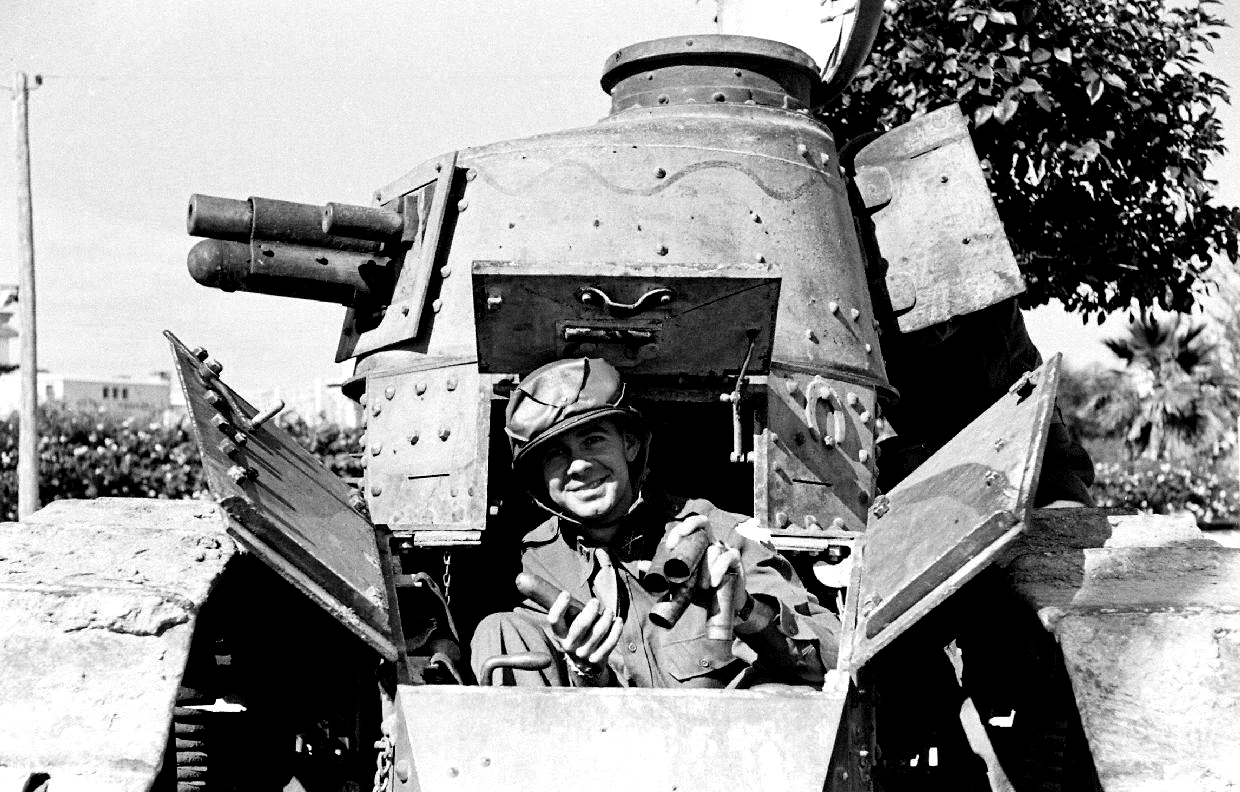
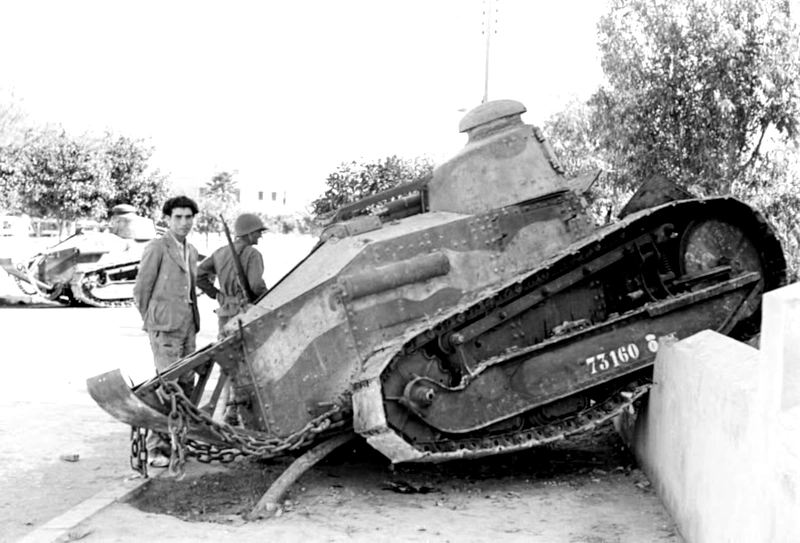
In addition to the 37-MM guns, this force was equipped with both, the AT rifle grenade and the AT rocket with the AT launcher 2.36′. From investigation, I found that the grenade was not used but that the Rocket Launcher was used on several occasions. One rocket was fired against a Renault light tank; the tank was hit and it appeared that it was lifted about five feet in the air and destroyed. I find a great confidence exists among the personnel in the use of the rocket.
Unfortunately, no training in the use of the rocket launcher had been given the members of the division prior to embarkation and no instructions had been received by the organizations on many of the ships of the convoy as to how to fire the rocket from the launcher. The commanding officers of units on most transports had the launcher fired while at sea and instructed as many men as possible in its use after figuring out how to use it themselves. The launcher is fragile and susceptible to bending. It is believed that some protective carrying case for it should be developed to protect it from injury and dirt. No means for carrying the rockets was furnished. The bags used for carrying mortar ammunition are not suitable for use, as the rockets are too long for this bag.
I found that on at least one occasion the rocket was fired against a concrete house. I was told that the house had been blown up and that the personnel in the house immediately surrendered when the rocket hit. I personally investigated this report and found that the rocket had not ‘blown up’ the house but had accomplished exactly what it was designed to do. The rocket hit the side of the house and put about a three-inch hole completely through 45 centimeters of solid concrete. I was unable to find the shell inside the house, but inasmuch as it was about 75 feet long by 30 feet wide and open at one end (under construction), I doubt if much damage was done. In this case, a mortar would have been much more effective. Our personnel should be definitely instructed in the capabilities of such a weapon and not expect too much. From seeing the results of this rocket, I believe it would be effective against concrete pillboxes. Inasmuch as the French had few tanks in this sector, not much use was made of antitank weapons.
CONCLUSION
No weapons should be furnished to a unit just prior to entering combat unless that unit has been trained in its use. Sufficient ammunition must be made available for training in order to acquaint all using personnel with the power and limitations of a weapon. Suitable protective carrying cases should be developed for the antitank rocket launcher. A suitable carrying case for antitank rockets should be developed and issued. The bags similar to that used for carrying mortar ammunition are faulty in that when a man hits the ground for protection there is a tendency for the ammunition to fall out of the bag and, if progress must be made rapidly to the front, frequently the ammunition which has rolled upon the ground is not picked up. Although the rocket launcher has considerable range, it is believed that it should not be fired except at short ranges, generally less than 100 yards.
– (4) Antiaircraft Fire.
The Brushwood Task Force had with it two antiaircraft units, namely portions of the 443-AAA-AW Battalion, armed with automatic equipment consisting of a 37-MM gun with two .50 caliber machine guns mounted on a half-track, and the 436-AAA-AW Battalion armed with 40-MM Bofors. The 443-AAA-AW Battalion was organized prior to the embarkation of the Western Task Force into 17 platoons with four half-tracks in each platoon or a total of 68 guns. A platoon was attached to each landing team; to each regimental landing group; and two platoons with the armored teams. In addition to the above attachments, the Brushwood force had in addition 12 platoons of this battalion. The platoons landed with the respective landing teams to which they were attached and accompanied their battalion throughout the operation. Because of the limited air activity of the opposing forces, the antiaircraft artillery fired a limited amount of ammunition.
Some difficulty was encountered with the feeding apparatus of the 37-MM guns of the 443-AAA-AW Battalion. This battalion left the United States lacking certain essential parts, such as two pairs of sights, loading frames, and some smaller parts. These parts were lacking when the guns were issued to this unit. Repeated efforts were made to obtain the parts prior to embarkation with no result. Most of the officers connected with this antiaircraft artillery recommend that some improvement be provided for that weapon, and also that that weapon be altered so that it may be depressed below the horizontal. In its use in this operation, it should have been able to protect itself by firing at ground targets, and had this weapon been attacked by tanks, they could have afforded little protection for themselves, especially in close-in operations. The 436-AAA-AW Bn with its 40-MM Bofors guns did not get into action in
sufficient time to fire on enemy planes.
– (5) The Armored Force Team
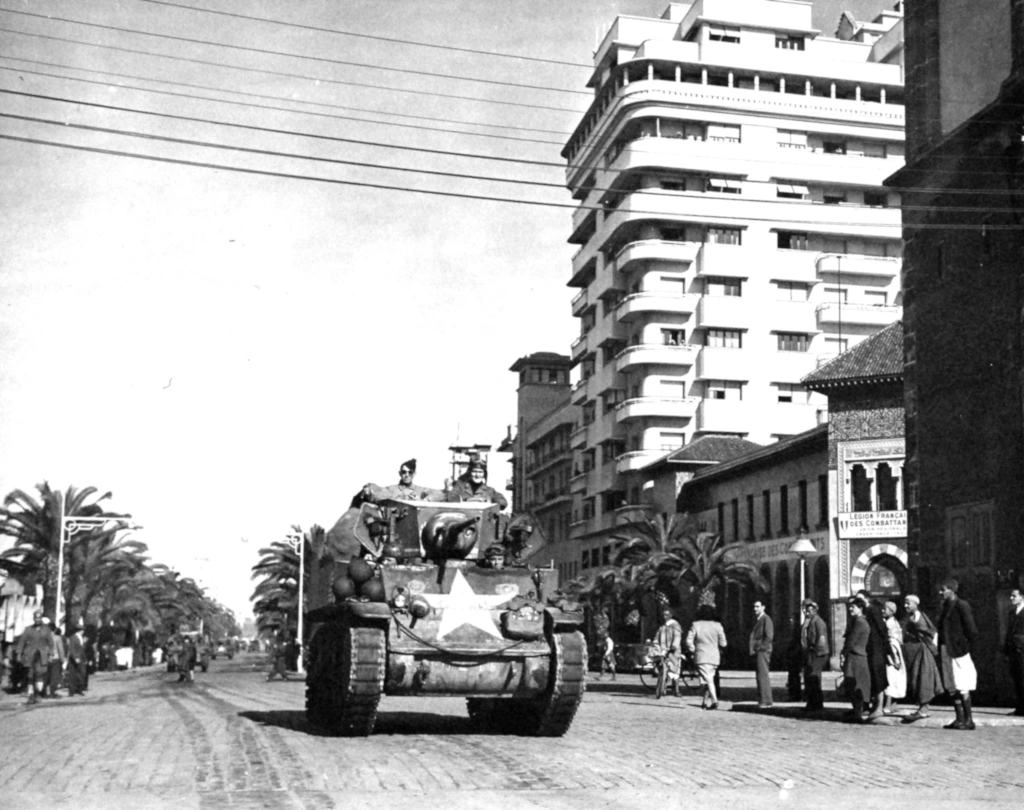
The Armored Team of the Brushwood Task Force was ordered ashore on Sunday, November 8-9 and were supposed to be landed at one beach. Vehicles and personnel were put ashore on then night of November 8-9. The various vehicles of the team were landed at three separate beaches and had to be collected into a unit during the night. At about 1300, November 9, the transport USS Arcturus (AKA-1) carrying a large portion of the armored team, docked in the Fedala harbor and unloaded at that point. During the night of November 9-10, the entire team with the exception of a maintenance platoon and an engineer platoon were ashore and placed in division reserve. The armored team lost only one half-track during the unloading.
One platoon of this team was sent to a small village about 20 miles to the south of division headquarters to protect against the advance from that direction of opposing French forces on Tuesday, November 10. During the night of November 10–11, the entire armored team moved to an assembly area in preparation for the attack on November 11. For detailed information concerning this attack see Inclosure No. 3. In view of the limited use of the armored team, little opportunity for observing its use was afforded. It is believed that in future operations, high priority should be given to unloading of light vehicles of the armored team early, as these vehicles can be especially useful in reconnaissance and control of the unloading and assembling of the remainder of the team. The radios of the armored team were not waterproofed in many instances and practically all the radios on the vehicles were useless with the unit ashore. The radios are normally used for reconnaissance vehicles.
CONCLUSION
In planning for the debarkation of armored units, light vehicles should be unloaded early in order that they may be used in control of the unloading and assembling of the entire team. All radios, including those of reconnaissance vehicles, should be waterproofed for amphibious operations.