

Reviewed by Doc Snafu on November 27, 2025.

 During the course of my research while researching info for this post : (3/135th Infantry Regiment – 34th Infantry Division – Operations at Algiers (North Africa) – November 7-10 1942 (Maj Leslie W. Bailey), I came across a 1944 document that carries the following cautionary statement: Combat Narratives were written to fill a temporary requirement before the appearance of official and semiofficial complete histories.
Due to hastily gathered and oftentimes incomplete information, there are certain inaccuracies. With this warning in mind, the following pages present the complete raw version of that document (without images) as originally issued by the Publication Branch of the Office of Naval Intelligence under the title ‘The Landings in North Africa, November 1942’. The text is reproduced in its entirety, exactly as disseminated at the time, despite its acknowledged limitations.
Note Most of the Photos of the US Naval Institute where found on this (French) [Website]
Doc Snafu
Added Notes (More Data to this Archive)
— (1) One of the probable reasons why our landings on the Moroccan Beaches met with such light opposition was the fact that the French did not believe a landing through the surf possible and were expecting attacks on more sheltered spots, such as harbors or, in the case of Mehdia, a beach along the Sebou River.
— (2) The famous Chasseurs d’Afrique have been motorized. A French Infantry Regiment normally consists of 3120 men, a Cavalry Regiment of 1140 men, an Artillery Regiment of 1683 men. The strength of batteries varies. The 75-MM usually have 98 men to a battery, the 105-MM 108 men. The motorized batteries of 75-MM. guns muster about 170 men.
— (3) Considerable confusion has crept into the reports due to the similarity of these last two names. By the time our forces reached Casablanca, the Gloire and one Submarine had been detached, one destroyer and two sloops added. Numbers identifying task forces have been omitted from all Combat Narratives in the interest of security. Navy flag names for the first letter of surnames of commanding officers have been substituted.
— (4) Boats that had been broached were abandoned at the critical time when a little judgment might have saved them, and having been abandoned to the mercy of the surf, soon were hopelessly battered to pieces. No doctrine had been laid down nor had men been instructed in the salvage of equipment that was undamaged and still serviceable. Two or three men with a few tools could have effectively salvaged enormous quantities of clocks, boat compasses, anchors, fire extinguishers, tools, propellers, etc. As it was, a few machine guns were saved but lack of transportation facilities and the utter lack of guards to prevent pillaging at night by natives prevented any worthwhile efforts in this line. (From the report of a ranking officer)
— (5) The cruise of this vessel sounds like a story by Conrad. After a hectic voyage during which she lost her way, the Contessa turned up at Safi a few hours prior to that landing. She was thereupon headed up to Mehdia, escorted by the Cowie. Up the winding channel, over sand bars, past obstructions, the Contessa scraped her way in spite of dented plates and leaking seams. Two miles south of Port Lyautey she ran hard aground and, before she could be floated, the ebb tide swung her around until she was pointing down stream. She had accomplished her mission, however. Lighters were rushed out from the airport, which had just been occupied, and her invaluable cargo was safely disembarked. Unless otherwise specified, the term Task Force is applied to the Western Naval Task Force and the term Task Force Commander to RAdm Hewitt.
— (6) A distress signal undoubtedly was sent by the SS Alaska (Nor. ego. 5681 tons), which was torpedoed about 1900, October 30, at 35—06 N., 16-59 W., and sent distress signals on the October 30, and October 31. When torpedoed, she had just picked up 55 survivors from the SS President Doumer hit at 1856. The Alaska ultimately made port.
>br>
— (7) Task Group How consisted of: Barb (FR), Lt Comdr John R. Waterman, off Safi, Blackfish, Lt Comdr. John F. Davidson, off Dakar, Herring, Lt Comdr Raymond W. Johnson, off Casablanca, Shad, Lt Comdr Edgar J. Macgregor, off Mehdia, Gunnel, Lt Comdr John S. McCain, off Fedala. (All times given hereafter are Zed time).
— (8) The Jean Bart was moored to the southeastern end of the Mole du Commerce, the other vessels were berthed along the Jetée Delure.
— (9) No track chart of the French ship movements is available. The track chart of the Center Fire Support is too involved to reproduce. The evolutions of those vessels covered a small area and were designed to keep them within range of the French as long as possible without prejudice to the protection of the transport area.
— (10) Color splash of the AP ammunition used by the Massachusetts and the Brooklyn was green, that of the Augusta red. The destroyers did not use color splashes. The bombardment ammunition of our cruisers was also free from color. The French timetable, from which these times are taken, only gives approximate times.
— (11) Only AP 16-inch shells (406-MM) had been issued to the Massachusetts, the damage inflicted on shore batteries was less than that obtainable had HC shells been employed. The Massachusetts, however, had to be prepared to fight the Richelieu as well as the Jean Bart.
— (12) In view of the fact that the Jean Bart had never had any target practice and could not use her large range finder because of the neighboring buildings, her accuracy of fire was remarkable. Her rate of fire, however, was slow. So was that of the other French vessels.
— (13) Unofficial estimates place the French losses at about 500 killed and 800 wounded. Among the seriously wounded was RAdm Gervais de Lafond. The morale of the French Naval Forces has been summed up by one ranking officer as follows: Honesty demands that the lassitude, notwithstanding their bravery, of the French, and the providential good luck attending the US Forces, be recognized as heavy contributing factors. No other enemy would have failed to lay mines and prepare beaches at least in the vicinity of strategic points. No other enemy, equipped with air and submarines, would have failed to detect the approaching force by or before dark the day before their appearance offshore, or failing that, could have been alerted 6 hours before daylight by the presence of enemy ships 16 miles from his principal base, and failed to use his 11 submarines before daylight and his air force by or before daylight.
— (14) In Morocco the landings were effected mainly by the following types: LCP (L). Landing Craft Personnel (Large). Displacement: 12.500 lbs. Dimensions: 36 ft. by 10 ft. 6 in. Draft: 3 ft. Capacity: 30 to 36 men or 6700 to 8100 lbs. cargo. Speed: 10 mph. Endurance: 200 miles. Armament: two .30-caliber machine guns. LCP (R). Landing Craft Personnel (with ramp). Specifications same as above except for 2 inches additional beam and 42-inch ramp forward. LCS (L). Landing Craft Support (Large). Displacement: 25 long tons. Dimensions: 46 ft. 11 in. by 12 ft. Draft: 3 ft. forward, 4 ft. aft. Capacity: Crew only, 1 officer and 11 enlisted men. Speed: 11.4 mph. Endurance: 70 miles. Armament: one 2-pdr.; twin .50-caliber MG; one 4″ smoke mortar; 1 smoke apparatus. Armor: 6-, 9-, and 14-mm. non-magnetic. Propulsion: .two 165-hp. Diesel engines. LCS (S). Landing Craft Support (Small). Displacement: 20.000 lbs. Dimensions: 36 ft. 6 in. by 10 ft. 9 in. Draft: 3 ft. Capacity: 3 or 4 in addition to crew of 6. Speed: 16 mph Endurance: 60 miles at full speed. Armament: two .50-caliber and three .30-caliber MG. Armor: !4 in.
— (15) The twin-engined French bombers used during this Operation, were either Glenn Martins or L. E. O. planes. The exact type is seldom given.
— (16) Your airplanes arrived at the psychological moment and caused hasty precipitation of enemy resistance which was threatening to become ugly. They gave up immediately. The credit for the surrender of Mazagan should be given to the Sanlee and her squadrons according to the report of the air liaison officer at Mazagan. The operations of the Air Group, being necessarily scattered over the entire theater, have not been covered in detail in this narrative. The Ranger alone made 420 launchings on 61 separate missions and her planes dropped 48 tons of high explosives besides firing 20.900 rounds of machine-gun ammunition. Nine 1000-lb. and six 500-lb. bombs were dropped at the Jean Bart and seven 1000-lb., fourteen 500-lb., and twenty 100-Ib. bombs were dropped at the El Hank Batteries. In aerial combat the Ranger shot down 16 enemy planes and destroyed 71 grounded ones. Twenty-one tanks and 86 military vehicles were immobilized or set on fire. These results were accomplished with the loss of only one killed and 10 missing. On the morning of the November 12, however, the Ranger had a narrow escape from 5 torpedoes launched by a wolf pack of submarines.
The Santee launched 143 flights, which dropped 96 bombs and fired 5308 rounds of ammunition. Two French aircraft were shot down, 48 damaged on the ground and over 40 trucks damaged or destroyed. As an indication of the spirit animating our airmen the following incident is stirring. As H-hour approached one rear seat gunner was offered $230 for his place in the first flight. He declined the offer. When the plane landed on board the carrier he was found dead in the cockpit.
— (17) For the fixed defenses in the Fedala-Casablanca Area, you can check the section referring to fixed defenses. The battery at Table d’Aukasha proved to be four 90-MM mobile AAA guns in fortified positions, not heavy artillery as reported. The surrender of Fedala was attended by one amusing incident, the capture of the German Armistice Commission. The first news these officers had of the American invasion was when they looked out their windows and found their hotel surrounded by our troops. After making a mad dash for their plane parked on a neighboring golf course and going through the motions of resistance, they were rounded up and taken prisoner.
— (18) (LCA) Landing Craft, Assault, had the following specifications: Capacity: 25 troops and 800 lbs. equipment besides crew of 4. Length: 41 ft. Beam: 10 ft. Draft: Forward 1′ 9″, Aft 1′ 11″. Speed: 11.5 mph. Endurance: 65 miles. Displacement: 18.000 lbs. Armament: one .50-caliber and Bren Gun. Armored from forward bulkhead to stern. Twin screw.
— (19) Information regarding British Operations in this area had not been received as this Narrative went to press. The Algiers attack was, however, predominantly British. Readers are cautioned against any false impression which might be derived from the fact that the following text deals of necessity almost exclusively with our relatively small part in the affair.
Combat Narratives
The Landings in North Africa
November 1942
Combat Narratives were written to fill a temporary requirement before the appearance of official and semiofficial complete histories. Due to hastily gathered and oftentimes incomplete information there are certain inaccuracies.
Office of Naval Intelligence
United States Navy
Foreword – January 8, 1943
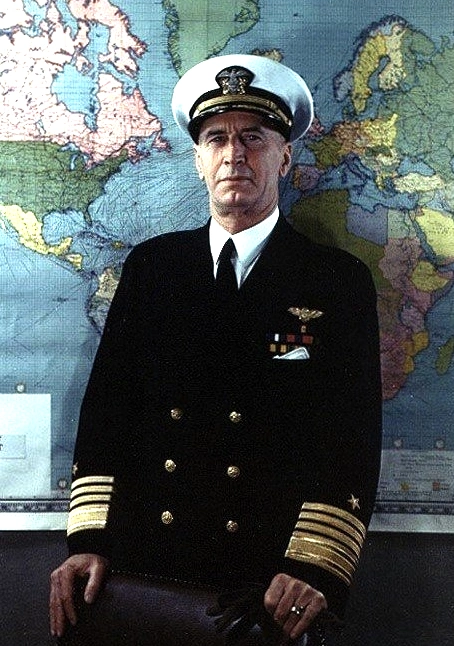 Combat Narratives have been prepared by the Publications Branch of the Office of Naval Intelligence for the information of the officers of the United States Navy. The data on which these studies are based are those official documents which are suitable for a confidential publication. This material has been collated and presented in chronological order. In perusing these narratives, the reader should bear in mind that while they recount in considerable detail the engagements in which our forces participated, certain underlying aspects of these operations must be kept in a secret category until after the end of the war.
It should be remembered also that the observations of men in battle are sometimes at variance. As a result, the reports of commanding officers may differ, although they participated in the same action and shared a common purpose. In general, Combat Narratives represent a reasoned interpretation of these discrepancies. In those instances where views cannot be reconciled, extracts from the conflicting evidence are reprinted. Thus, an effort has been made to provide accurate and, within the above-mentioned limitations, complete narratives with charts covering raids, combats, joint operations, and battles in which our Fleets have engaged in the current war. It is hoped that these narratives will afford a clear view of what has occurred, and form a basis for a broader understanding which will result in ever more successful operations.
Ernest J. King
Admiral, United States Navy
Commander in Chief, US Fleet, and Chief of Naval Operations
ORDER OF BATTLE – TORCH
Task Force HOW (Organization for Departure)
At the time departure was taken, and during the assembly period that preceded it, the Task Force was divided into a Covering Group, an Air Group, and two Detachments. The Covering Group (Task Group HOW-1), under the command of RAdm Robert C. Giffen (COMCRUDIV SEVEN), consisted of:
Battleship
— Massachusetts (F), Capt Francis E. M. Whiting.
Cruiser Division SEVEN
— Wichita, Capt Francis S. Low.
— Tuscaloosa, Capt Norman C. Gillette
Destroyer Squadron EIGHT, Capt Don P. Moon.
— Wainwright (F), Lt Comdr Robert H. Gibbs.
— Jenkins, Comdr Harry F. Miller.
Destroyer Division SIXTEEN
— Mayrant, Lt Comdr Edward K. Walker.
— Rhind, Comdr Henry T. Read.
— Rowan, Lt Comdr Robert S. Ford.
Oiler
— Chemung, Comdr John J. Twomey.
Air Group (Task Group HOW-2), RAdm Ernest D. McWhorter (COMCARLANT), consisted of:
Aircraft Carrier
— Ranger (F), Capt Calvin T. Durgin.
Auxiliary Aircraft Carriers
— Santee, Capt William D. Sample.
— Sangamon, Capt Carlos W. Wieber.
— Suwannee, Capt Joseph W. Clark.
Cruiser Division TWELVE
— Cleveland, Capt Edmund W. Burrough.
Destroyer Squadron TEN, Capt James L. Holloway
— Ellyson (F), Comdr John B. Rooney.
Destroyer Division NINETEEN, Capt Charles Wellborn.
— Hambleton (F), Comdr Forrest Close.
— Rodman, Comdr William G. Michelet.
— Emmons, Lt Comdr Harold M. Heming.
— Macomb, Comdr William H. Duvall.
Destroyer Division TWENTY, Capt Thomas L. Watdes.
— Forrest (F), Lt Comdr Merle Van Metre.
— Fitch, Lt Comdr Henry Crommelin.
— Corry, Comdr Eugene C. Burchett.
— Hobson, Lt Comdr Robert N. McFarlane.
Plus additional destroyers
— Dallas, Lt Comdr Robert Brodie.
— Cole, Lt Comdr Geo. G. Palmer.
— Bernadou, Lt Comdr Robert E. Braddy.
Oiler
— Housatonic, Comdr Alfred R. Boileau.
Detachment One-H (Task Group HOW-3), RAdm Monroe Kelly (COMBATDIV), consisted of:
Battleships
— New York (F), Capt Scott Umsted.
— Texas, Capt Roy Pfaff.
Transport Division FIVE, Capt Augustine H. Gray.
— Henry T. Allen, Capt Paul A. Stevens.
— John Penn, Capt Harry W. Need.
— George Clymer, Capt Arthur T. Moen.
— Susan B. Anthony, Capt Henry Hartley.
— Electra, Comdr James J. Hughes.
— Algorab, Comdr Joseph R. Lannom.
— Florence Nightingale, Capt Edwin D. Graves.
— Anne Arundel, Capt Lunsford Y. Mason.
Transport Division SEVEN, Capt Wallace B. Phillips.
— Harris (F), Capt Otto M. Forster.
— Dorothea L. Dix, Capt Leo B. Schulten.
— Titania, Comdr Victor C. Barringer.
— Lyon, Capt Martin J. Gillan.
— Lakehurst, Comdr Harold J. McNulty.
Destroyer Squadron FIFTEEN, Capt Charles C. Hartman
Destroyer Division TWENTY-NINE, Capt Charles C. Hartman
— Meruine (F), (Capt Hartman), Lt Comdr Solomon D. Willingham.
— Quick, Lt Comdr Roger B. Nickerson.
— Beatty, Lt Comdr Frederick C. Stelter.
— Tillman, Lt Comdr Francis D. McCorkle.
Destroyer Division THIRTY, Comdr Horace C. Robison.
— Cowie (F), Lt Comdr Charles J. Whiting.
— Knight, Lt Comdr Richard B. Levin.
— Doran, Lt Comdr Howard W. Gordon.
— Earle, Lt Comdr Hamilton W. Howe.
Mine Division TWENTY-ONE, Comdr Albert G. Cook. (COMINRON SEVEN)
— Raven (F), Lt Comdr Colby G. Rucker.
— Osprey, Lt Comdr Cecil L. Blackwell.
— Auk, Lt Comdr William D. Ryan.
Tug
— Cherokee, Lt Joseph H. Lawson.
Detachment Two-H (Task Group HOW 14), RAdm Lyal Davidson (COMCRUDIV EIGHT), consisted of:
Cruiser
— Augusta, Capt Gordon Hutchins. (Admiral Hewitt’s Flagship.)
Cruiser Division EIGHT
— Philadelphia (F Adm Davidson), Capt Paul Hendren.
— Brooklyn, Capt Francis C. Denebrink.
— Savannah, Capt Leon S. Fiske.
Destroyer Squadron ELEVEN, Comdr Dashiell L. Madeira.
— Roe (F), Lt Comdr Rathel L. Nolan.
— Parser, Lt Comdr John W. Bays.
Destroyer Division TWENTY-ONE, Comdr Dashiell L. Madeira.
— Livermore, Comdr Vernon Huber.
— Kearny, Comdr Adolph H. Oswald.
— Ericsson, Lt Comdr Clyde M. Jensen.
Destroyer Squadron THIRTEEN, Capt John B. Heflerrian.
— Buck (F), Lt Comdr Bosquet N. Wev.
— Murphy, Lt Comdr Leonard W. Bailey.
Destroyer Division TWENTY-FIVE, Comdr John S. Reese.
— Woolsey (F), Comdr Bernard L. Austin.
— Ludlow, Lt Comdr Liles W. Creighton.
— Edison, Lt Comdr William R. Headden.
— Bristol, Lt Comdr John A. Glick.
Destroyer Division TWENTY-SIX, Comdr Edward R. Durgin.
— Wildes (F), Lt Comdr John B. McLean.
— Nicholson, Comdr John S. Keating.
— Swanson, Lt Comdr Lewis M. Markham.
Mine Division NINETEEN, Comdr Albert G. Cook, (COMINRON SEVEN)
— Hogan (F), Lt Comdr Ulysses S. G. Sharp.
— Hamilton, Lt Comdr Robert R. Sampson.
— Howard, Lt Comdr Charles J. Zondorak.
— Palmer, Lt Comdr Joshua W. Cooper.
— Stansbury, Lt Comdr Joseph B. Maher.
Transport Division ONE, Capt Robert R. M. Emmet (Commander Transports, Amphibious Force, US0 Atlantic Fleet):
— Leonard Wood (F), Comdr Merlin ’Neill, (USCG).
— William P. Biddle, Comdr Paul R. Glutting.
— Thomas Jefferson, Comdr Chauncey R. Crutcher.
— Arcturus, Comdr John R. McKinney.
— Procyon, Comdr Lemuel P. Padgett.
Transport Division THREE, Capt Robert G. Coman.
— Charles Carroll (F), Capt Harold Biesemeier.
— Joseph T. Dickman, Comdr Charles W. Harwood (USCG)
— Oberon, Comdr Ion Pursell.
Transport Division NINE, Capt William M. Quigley.
— Ancon (F), Capt Paul L. Mather.
— Elizabeth C. Stanton, Capt Ross A. Dierdorff.
— Thurston, Capt Jack E. Hurff.
Additional Vessels, Auxiliary Aircraft Carrier:
— Chenango, Capt Ben H. Wyatt.
Transports
— Hugh L. Scott, Capt Harold J. Wright.
— Edward Rutledge, Capt Myron W. Hutchinson,
— Taster H. Bliss, Capt Gerald L. Schetky.
— Joseph Hewes, Capt Robert M. Smith.
Mine Layers
— Miantonomah, Lt Comdr Raymond D. Edwards.
— Monadnock, Comdr Frederick O. Goldsmith.
Oilers
— Kennebec, Comdr Stewart S. Reynolds.
— Merrimack, Capt William E. Hilbert.
— Winooski, Comdr John E. Murphy.
Special unit
— Calvert (AP), Capt James W. Whitfield.
— Boyle (DD), Lt Comdr Eugene S. Karpe.
— Eberle (DD), Lt Comdr Karl F. Poehlmann.

In order to forestall an invasion of Africa by Germany and Italy, which, if successful, would constitute, a direct threat to America across the comparatively narrow sea from Western Africa, a powerful American Force equipped with adequate weapons of modern warfare and under American Command is today landing on the Mediterranean Coast and the Atlantic Coast of the French Colonies in Africa. The landing of this American Army is being assisted by the British Royal Navy and Royal Air Force, and it will in the immediate future be reinforced by a considerable number of divisions of the British Army.
This combined Allied Force, under American command, in conjunction with the British campaign in Egypt, is designed to prevent an occupation by the Axis Armies of any part of Northern or Western Africa and to deny to the aggressor nations a starting point from which to launch an attack against the Atlantic Coast of the Americas. In addition, it provides an effective second front assistance to our heroic allies in Russia. With these few words President Roosevelt announced the landing of American Troops on African Soil on Sunday, November 8, 1942.
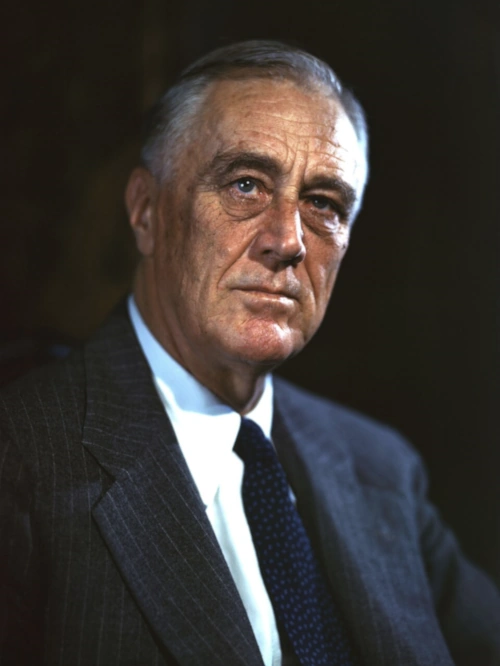 This announcement to the American People was accompanied by one in French Broadcast in the early hours of November 8, of which the English translation is as follows: ‘My friends, who suffer day and night under the crushing yoke of the Nazis, I speak to you as one who was with your army and navy in France in 1918. I have held all my life the deepest friendship for the French people—for the entire French people. I retain and cherish the friendship of hundreds of French People in France and outside of France. I know your farms, your villages, and your cities. I know your soldiers, professors, and workmen. I know what a precious heritage of the French People are your homes, your culture, and the principles of democracy in France. I salute again and reiterate my faith in liberty, equality, and fraternity. No two nations exist which are more united by historic and mutually friendly ties than the people of France and the United States. Americans, with the assistance of the United Nations, are striving for their own safe future as well as the restoration of the ideals, the liberties, and the democracy of all those who have lived under the tricolor. We come among you to repulse the cruel invaders who would remove forever your rights of self-government, your rights to religious freedom, and your rights to live your own lives in peace and security. We come among you solely to defeat and rout your enemies. Have faith in our words. We do not want to cause you any harm. We assure you that, once the menace of Germany and Italy is removed from you, we shall quit your territory at once. I am appealing to your realism, to your self-interest and national ideals. Do not obstruct, I beg of you, this great purpose. Help us where you are able, my friends, and we shall see again the glorious day when liberty and peace shall reign again on earth’.
‘Vive la France Eternelle’
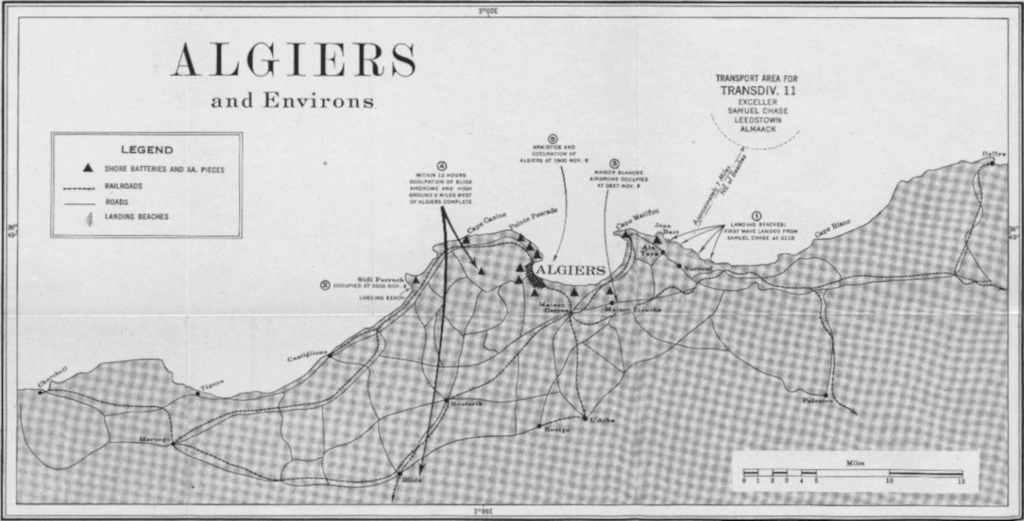
Operations in North Africa long antedated our entry into World War II. They had been limited, however, to Egypt and Libya. Their extension to preclude any Axis action in Morocco had been under discussion by the British high command for some time prior to December 7, 1941. The plan originally contemplated a landing of about 55.000 men in the vicinity of Casablanca. Upon our entry into the war, the plan underwent several expansions. It was first enlarged to provide for landings not only near Casablanca but at Mehdia (Port Lyautey) and Safi as well. It was thereafter further expanded to include the occupation of the entire North African Coast as far as Tripolitania. This occupation would facilitate the safeguarding of Mediterranean Convoys, thus enormously shortening the route to the Middle East and saving considerable tonnage previously employed in the long passage around the Cape of Good Hope.
The various stages through which the project passed need not be examined. Agreement in principle was readily reached. The United States was to have charge of both the military and naval operations on the Atlantic Coast of Morocco. Casablanca, therefore, became an essentially American objective? Oran and Algiers, two cities the occupation of which was contemplated, were to be captured by a joint British and American force, of which the British were to supply all the naval units except a few transports. The landing forces were to be partly American, partly British. Logistics presented a formidable problem, but by July 1942, a plan was formulated providing in detail for an offensive in North Africa under American command, prior to December 1942.