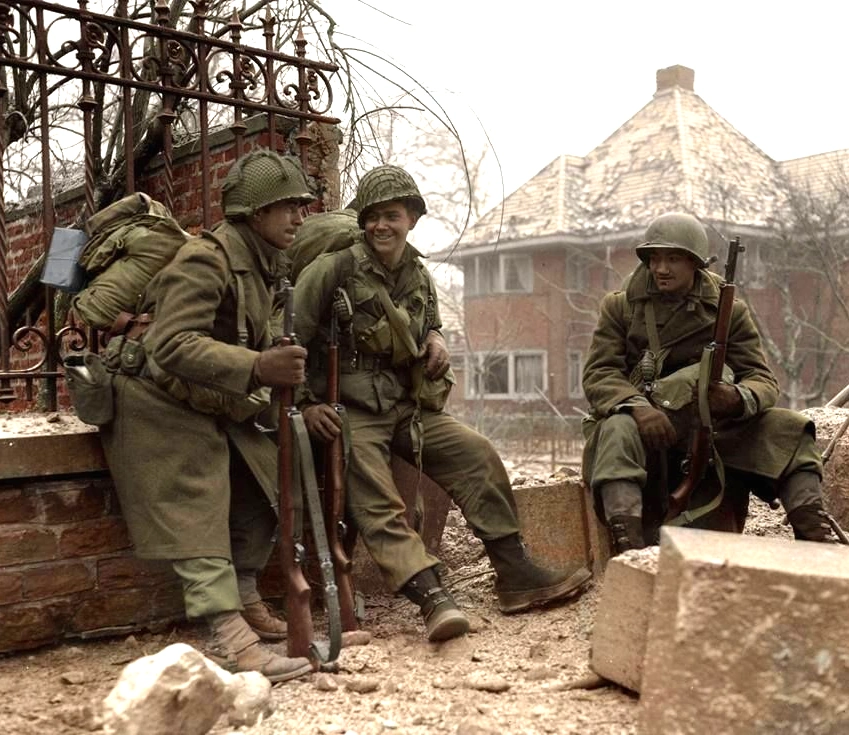


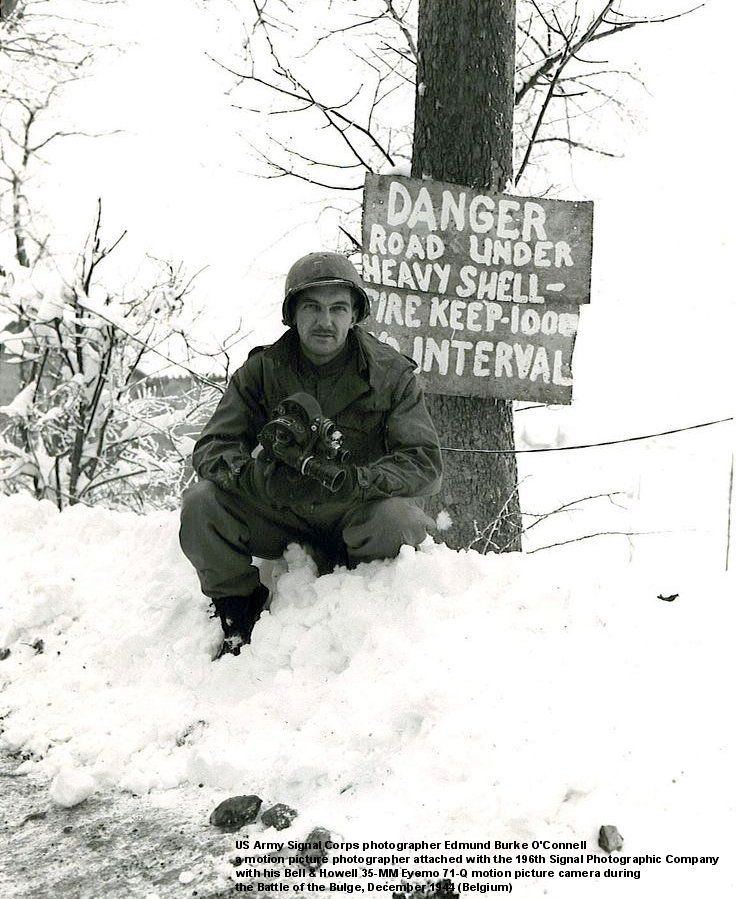
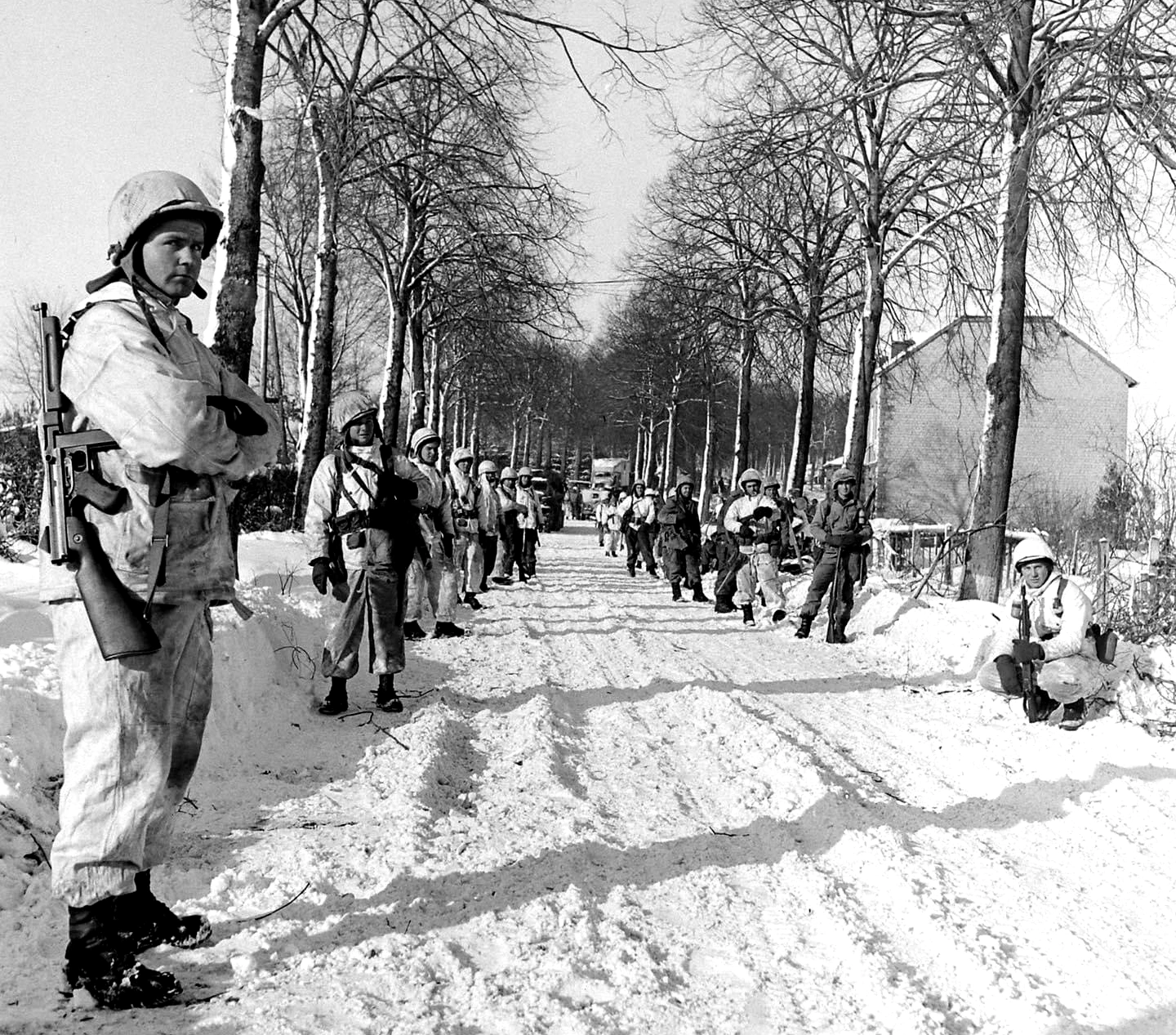
 I take the opportunity of publishing this image to pay tribute to the extraordinary courage of the men and women—war correspondents—without whom the photographs of combat taken right on the front lines would never have reached us. It is thanks to their determination, their willingness to risk everything, and often their ultimate sacrifice, that we are now able—some 80 years later—to illustrate historical archives with images that speak far more powerfully than words. Figures such as Robert Capa, Carl Mydans, George Silk, and Tony Vaccaro—alongside women like Lee Miller and Margaret Bourke-White—embodied an unflinching commitment to documenting history as it unfolded, regardless of the personal cost. These photojournalists did not operate from a safe distance. They embedded themselves with infantry units, shared the same risks as combat soldiers, and endured the same deprivations and dangers. Many of them were wounded. Some were killed. And yet, through their lenses, they froze in time moments of heroism, tragedy, resilience, and sometimes even unbearable horror. Their cameras were not mere instruments—they were extensions of their moral duty to bear witness.
Lee Miller, for instance, once a fashion model, became a war correspondent for Vogue and produced some of the most iconic and disturbing images of the European Theater—including scenes from the liberation of Buchenwald and Dachau. Margaret Bourke-White, pioneering staff photographer for Life magazine, was the first female war correspondent accredited by the US military and one of the first to enter the concentration camp at Buchenwald. Her fearless documentation reshaped the American public’s understanding of the war. The legacy of these correspondents extends far beyond the war itself. Their photographs now serve as vital historical records and emotional testimonies. Every image they captured is a thread in the fabric of collective memory—a visual echo of conflict that transcends generations.
Today, as we curate and preserve archives for educational and commemorative purposes, we remain deeply indebted to these individuals. Their work is not simply illustrative; it is foundational. Without them, entire chapters of history would be rendered faceless and abstract. With them, we retain a human, tangible link to events that otherwise risk fading into myth. Let us never forget that many of these photographs came at a terrible cost—not only to the soldiers depicted, but also to the photographers themselves. They chose the lens over the rifle, but they were no less brave. To those who fell in silence behind the camera, and to those who lived to tell what they saw, this image—and all images like it—stand as eternal testaments.
—Doc Snafu – Historian at the European Center of Military History
 The 3rd Battalion, which had jumped off with the 2bd Battalion at 0800, had as their objective the fairly large village of Hinderhausen. Capt George B. Rohkopi’s* Item Co, led the attack and had elements in the village by 0845. Once on the outskirts of the village, Love Co on the right of Item Co met strong small arms and automatic weapons fire. The enemy was cleared out of the houses, slowly and methodically, and it wasn’t until noon that the 3rd Battalion had covered most of the village. Even then, artillery fire lit the village throughout most of the afternoon every once in a while, and particularly ardent Nazi would infiltrate back into Hinderhausen, or suddenly come to life and begin sniping from the second story window of the brick houses. However, such fire was only harassing in nature and contact was quickly made on the left with the 117-IR.
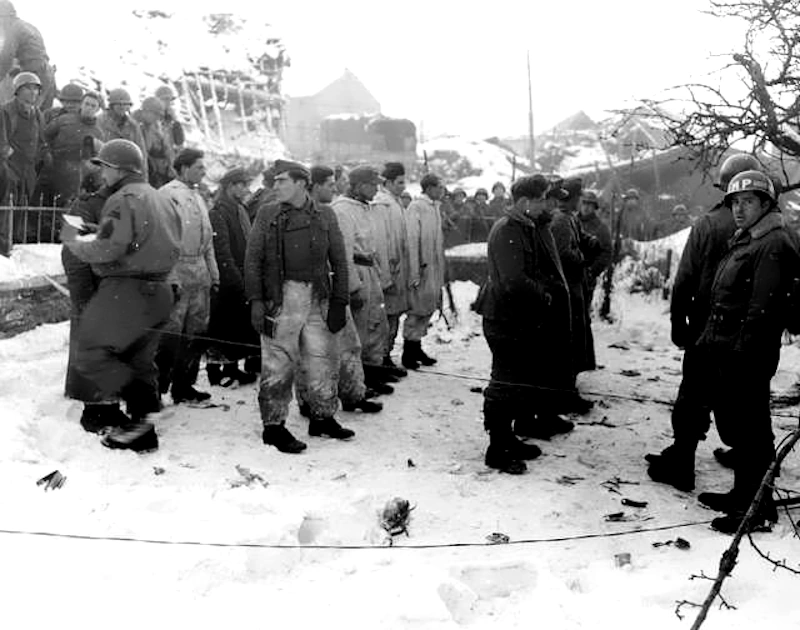
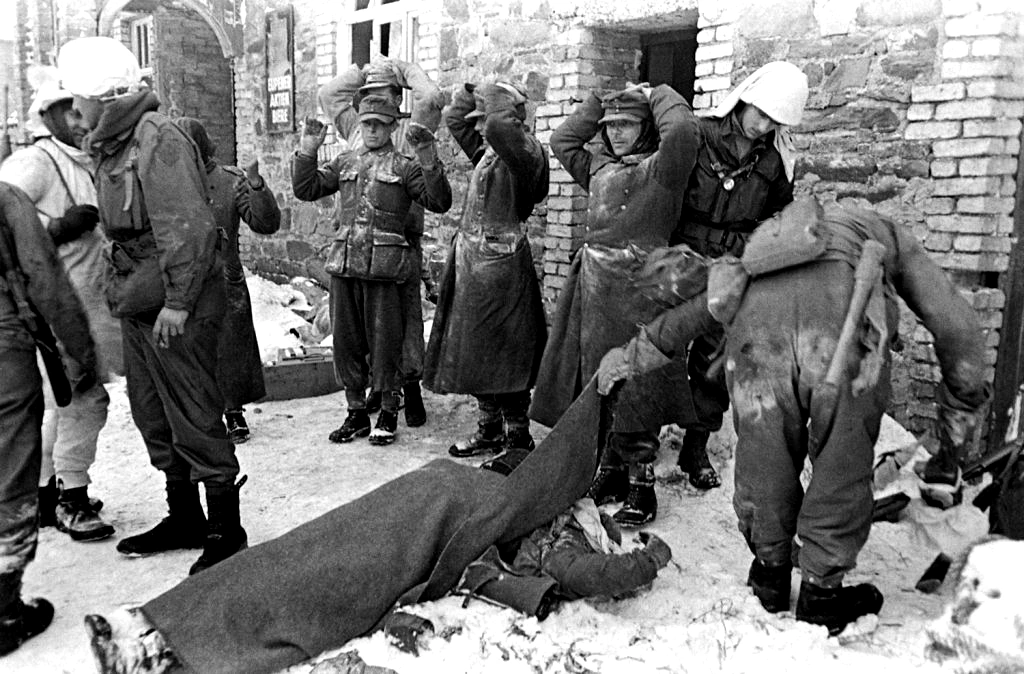
On the right, the 2nd Battalion spread their line east from b>Kapellen and as darkness closed down on January 22, the companies were displaceä from west to northeast, Easy, Fox, Love, and Item Cos, George and King Cos maintained in reserve position. On the enemy side, throughout January 22, fell back to St Vith as the 30-ID advanced. Ending at midnight January 22, for the preceding 24 hours, the Division captured 266 prisoners. Interrogated at the POW Cage, it was determined that most of them had been members of the 326.Volksgrenadier-Division, with a small number from the 18.Volksgrenadier-Division and the 246.Volksgrenadier-Division. Almost every one of the PW’s were partially incapacitated insofar as his locomotive abilitice were concerned. Frost bite and trench foot were prevalent. They all looked badly and many complained of having been in the lines for over a month. At least half of the dirty, unshaven Germans carried a loaf or a portion of loaf of brown bread clutched under his arm or protruding slightly from his overcoat pocket. They of course, had no idea that they would, shortly after captured, be eating better than they probably had in the preceding 4 years. Those who were not killed or wounded retreated toward St Vith, and on January 22, as on the day before, the roads leading out of St Vith were hit by heavy 30-ID artillery concentrations and elements of the IX TAC.
 On the same day, the 7-AD advanced into the outskirts of St Vith and during the next day, January 23, drove into the city. Once the 30-ID had captured Rodt, Hinderhausen and Hundheim, the city of St Vith was hardly tenable. Those last few villages seized in vhe 30-ID sector were situated on dominating terrain. From Rodt, one would easily look down i St Vith and the Division artillery units were in position of observation of the primary roads and the railroad leading into the city. It is no imply that once the 30-ID ‘ringed’ St Vith on the north and west the 7-AD had merely to walk into the city, and take possession. That was hardly the case, however, it is well to note the fact again that once the 30-ID captured the roads, the villages and the ridge lines, 2000 to 5000 meters north and west of the city, the great retreat from the city began for the Germans.
St Vith Offensive – The Final Drive
 The final objective line of the XVIII Airborne Corps in the St Vith operation, ran roughly along the Braunlauf River. The river flowed from west to east about 2000 meters south of St Vith. To reach the line in the 30-ID sector, required the ‘Old Hickory’ outfit to attack south from their 6000 meters front line for a distance of 3000 to 5000 meters, The area that was to be captured was for the most part, open ground that contained relatively small sections of heavily wooded areas. The four objectives in the area were labeled with the code
 names of Daisy, Mae, Little, and Abner. It is well to note also that the terrain features in these objectives, three of them enclosed dominating ground. One on the south of Weisten, another one south of Crombach, a third one southeast of Neundorf, and finally the last was a section of high ground between village of Crombach and the village of Neundorf. D Day was sets on January 23 while H hour was fixed at
 1000 hours. At that time, the 117-IR and the 119-IR attacked abreast. The 120-IR had been pinched out on the previous day and had returned to an assembly area for some well deserved rest and refitting. In the 117-IR, the 2nd Battalion was given the primary mission of the day by Col Walter M. Johnson. The 1st Battalion secured the left flank or the Regiment and the 3rd Battalion remained in Regimental reserve.

 The 2nd Battalion under Maj Benjamine T. Ammons attacked at 1000 hours with the village of Neundorf and the high ground to the southeast with George Co on the right, Fox and Easy on the left. The battalion, by noon, had taken up positions throughout the village and the enemy had withdrawn. Once the Germans were out of the village, the 2nd Battalion (117-IR), came under a terrific barrage of mortar fire. It proved to be extremely accurate and came from the high ground to the southeast of Neundorf. That was the area and and not the village of Neundorf, that was designated by the Division as the regimental objective.
At about 1300, Capt W. E. Parker led Fox Co to the east to seize the high ground. George Co advanced along with Fox Co, and attacked up the forward slope. The enemy employed machine gun and mortar fire in a desperate attempt to stop the slugging dough-feet. However, the Germans position was flanked and most of them were taken prisoner. At 1650, the Germans counter attacked with a force of about 50 men and three tanks. They were repulsed by our heavy machine guns and at least, one tank was damaged. By late afternoon the objective had bean completely cleared of the enemy. On the left of the 2nd Battalion, the 1st Battalion had cleared the woods of scattered German automatic weapon emplacements and held the left forward flank of the Division.
Over on the right, the 1st and 2nd Battalions (119-IR), were directed to attack at 1000 hours by Col R. A. Baker. The 1st Battalion advanced for the high ground slightly south of Crombach. They met practically no resistance und were successful in taking over 20 PW’s from the houses in Crombach. About 1500, Charlie Co (Capt Floyd B. Spurlock), moved to the dominating ground and immediately made contact with outposts of the 117-IR on the left.
 Jumping off at the same time, the 2nd Battalion encountered a strong enemy line on the northern edge of Weisten. An assault was made with Easy and George Cos on line. Almost 30 PW’s were captured and the push into the village completed. The battalion moved southeast out of Weisten and over the rail road line running northeast to St Vith. At the road junction (805847), Easy Co on the right flank was hit by German Armor supported by infantry. Division artillery fire was called for and at the same time tanks and tank destroyers, supporting the 2nd Battalion moved into position. With all the fire, plus automatic weapon fire directed at the enemy concentration, it soon dissolved and withdrew after leaving 26 PW’s. With the possession of those final objectives, the 30-ID activities in the operation had been completed. Since 2400, January 12, 1480 PW’s were captured. Losses had been heavy, however, and in the three regiments of the Division there were 1151 officers ands men killed, wounded or missing in the period January 13 – January 23. Plus that number there were 707 officers and enlisted men listed as non-battle casualties. A total of almost 2000 men lost, certainly high for a ten day operation. During the same day, January 23, the 7th Armored Division had taken full possession of St Vith and pushed to the south of it pursuing the enemy out of the remaining, but very small, area still left in the Belgian Bulge.