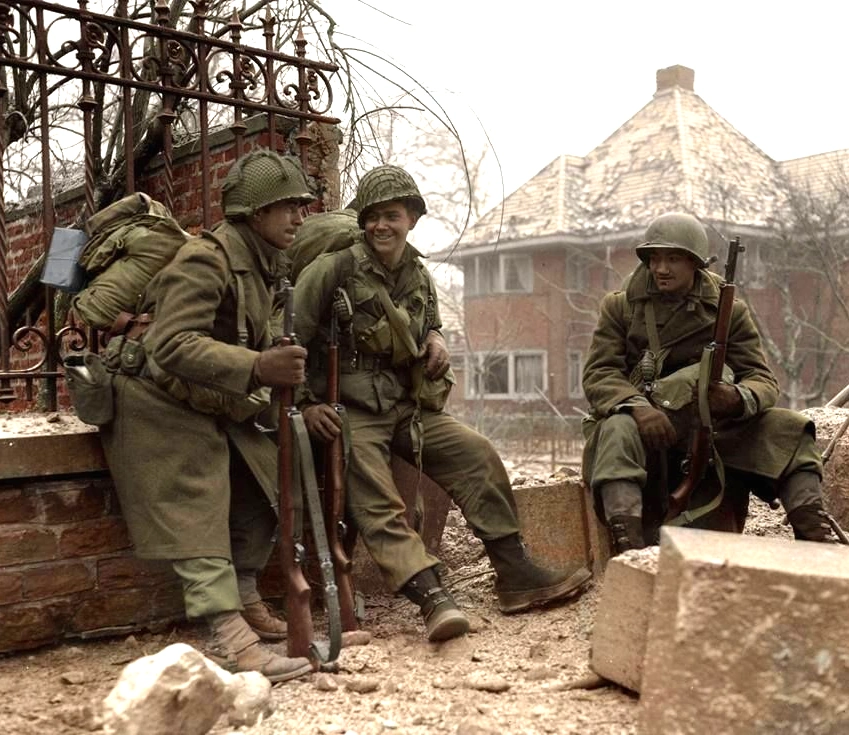



 The capture of Recht in such a short times, was not wholly due to the fighting capabilities of the infantry and the excellent tank and tank destroyer support. An exceedingly heavy artillery barrage was laid on the village prior to the attack. The 30-ID artillery hit the village heavily in a well planned pattern. First the outlying section of the town was bombarded and then the shells moved south, catching the center of the village and the area of building concentrations. Because of that terrific barrage, it was not surprising that the enemy who did remain to defend the town capitulated in approximately one hour. In the 119-IR, as stated earlier, the 1st Battalion relieved the 2nd Battalion 120-IR on the Wolfsbusch Hill. The 2nd Battalion retained their position on the right flank and maintained contact with the 517-RCT on the right and the 117-IR on the left.
 During January 19, new enemy troops were identified on the Division front that had most probably been brought in as reinforcements. At 0800, the 1st Battalion 117-IR, crossed their line of departure and attacked south for their objective. That was another goose egg area, about 2000 meters south of Recht and enclosed an area of dominating terrain. The terrain it contained was very heavily forested and an advançe on the objective was very difficult. However, the battalion met only small arms resistance and advanced easily against it. By early afternoon, consolidation on the objective had taken place. At the same jump-off time, Col Samuel T. McDowell’s 3rd Battalion 117-IR, moved south on the left flask of the 1st Battalion; from the vicinity of Feckelsborn. They advanced for an objective that measured approximately 600 meters in a north-south direction and 1400 meters in an east-west direction. The objective was about 1000 meters south of Feckelsborn and enclosed a portion of the secondary Recht to Rodt road.
With 1/Lt Gale Daugherty’s Love Co leading, and then Item and King Cos, the battalion encountered a small amount of enemy fire just south of Feckelborn. Made up of about a company of infantry supported by three light tanks, they were easily routed and the 3rd Battalion on their objective. Once they consolidated, they were on an approximate 2000 meters line with the 1st Battalion. At 1530, on division order, both battalions attacked to take a large area designated as Willie and Nillie, which lay about 500 yards 
 south of the areas taken earlier in the day. The 1st Battalion hit it on the west and the 3rd Battalion on the east. The latter met very little resistance and was in control of their objective by 1730 with King, Love and Item Cos, echeloned to the northeast. The 1st Battalion, with Able and Charlie Cos leading, met fairly stiff resistance consisting of approximately a company of infantry employing semi automatic weapon, but primarily
  small arms fire. By last light, they had possession of the reverse slope and had made contact with the 3rd Battalion by 1925 hours. The objective was important, for its center point was a steep elevation which provided observation of Rodt and led right into that village.
 On the right, of the 117-IR, the 119-IR swung into action nearly the morning of January 20. Col Robert H. Herlong’s 1st Battalion was relieved of the defensive position it held on the Wolfsbusch Hill at 1000 hours by tho 30th Mez Recn Troop. Plowing through heavy show a distance of approximately 5000 meters, the battalion at 1330, arrived at (762927), an area 1000 meters southwest of Recht. The position straddled the rond leading out of Recht, and was designed as a reserve point to back up the attack planned for the other two battalions of the regiment.

 The 2nd Battalion, also moved by foot, from tho vicinity of Houvegnez to an assembly area about 6000 meters to the south. The 3rd Battalion, working in coordination with the 2nd Battalion, left its rest area in the vicinity of Malmedy and was trucked to a point about 1200 meters northwest of Recht on the Pont – Recht road. There, Maj Hal D. McCown has his battalion detruck and led them south were they took up
 position on the left of the 2nd Battalion. In that area, two platoons each, from the 7743-TB and 823-TDB drove into position and at 1415 hours a combined attack was launched. Striking to the south, the 2nd Battalion with armor attachments hit the Wolkeshart Forest (782893), and drove as far south as
  Meisenberg (775881). The 3rd Battalion swinging in from the northeast, bypassed the 2nd Battalion and captured Ober Crombach (788885).
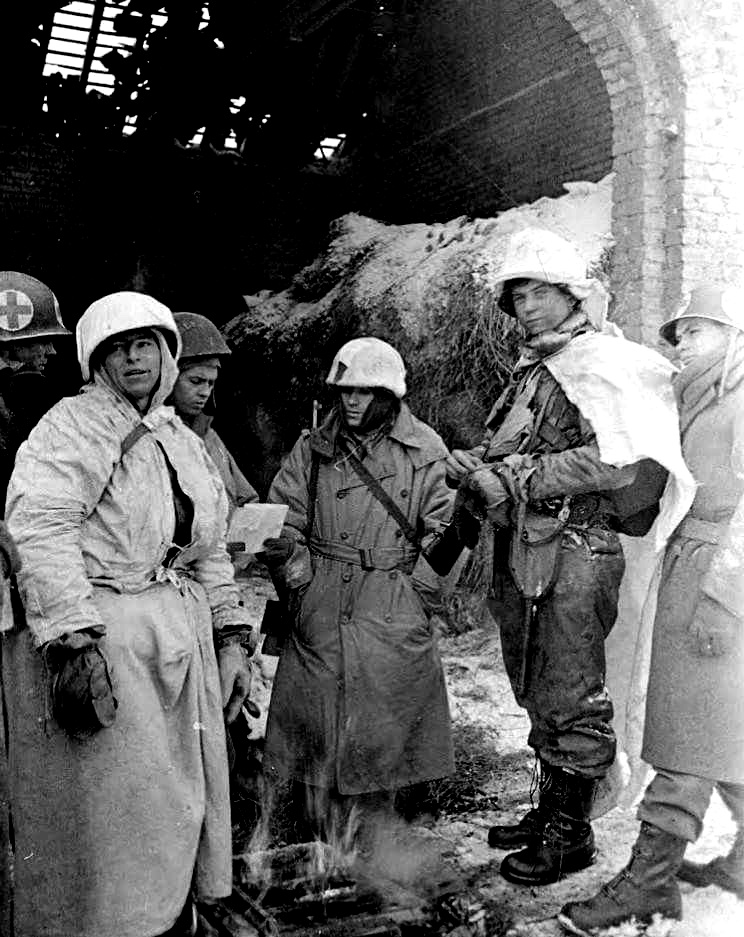 Both battalions met elemonts of this 18.Volksgrenadier-Division whose resistance consisted primarily of small arms and automatic weapons fire. Their amor support was not well displaced and did not hold up our advance to any appreciable extent. Nevertheless, it was almost 1900 hours before the objective were captured. The difficulties encountered were not only confined to the resistance of the enemy. The long march which the men had undergone earlier in the day had sapped their strength to a considerable amount. It was not the distance of the march, but the weather conditions that proved such en obstacle.
Plowing through a thickly forested area, through snon that was at least knee deep, and carrying heavy combat arms and equipment, the men were fatigued by the time they arrived at their line of departure. When the attack terminated and consolidation was made during darkness, many hours were spent in digging fox holes and gun emplacements in frozen ground. The use of the phrase, the attack was made under difficult conditions, was in this case a definitive under statement. In any event, thin salient was the most advance in the division sector at this time. The two Battalions took up their final positions during the night of January 20 in the shape of a rough V or echeloned to the north on the flanks. From west to east, positions were hold by George, Easy, and Fox Cos of the 2nd Battalion, and Love, and Item Cos of the 3rd Battalion. King Co under 1/Lt Robert J. Kane*, established a road block at (820894)* a point approximately 1200 meters north of Rodt on the primary road. (* non readable – archive quality)
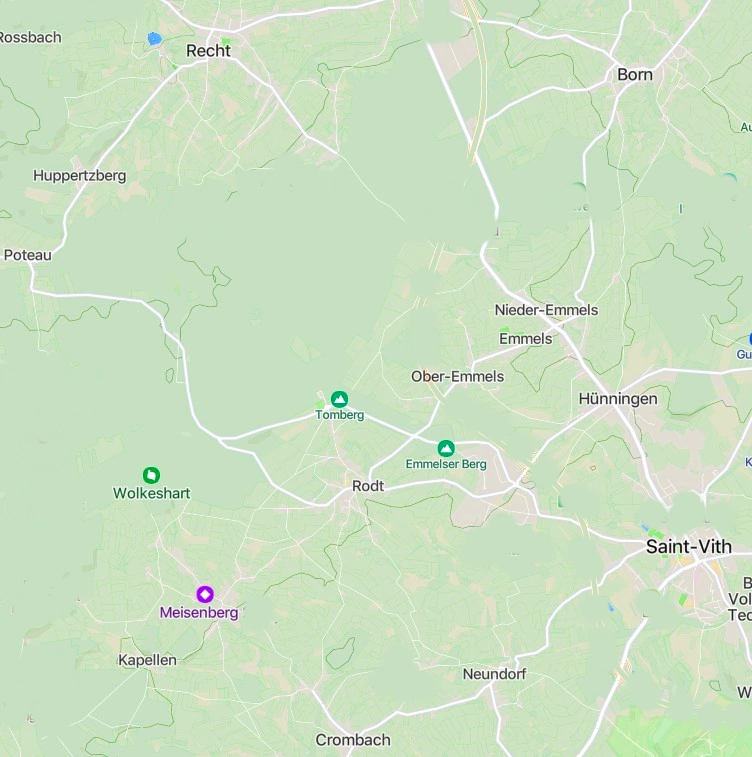
 In the 120-IR, the 1st Battalion sent again patrols at 0750, to objective T, which they had reconnoitered on the previous day. That area, so explained above, enclosed the two roads from Recht and Ligneuville where they converged and and ran into the St Vith highway. The patrols found the objective held fairly lightly and at 1030 the battalion moved down to the attack. Able and Charlie Cos led and keeping along the Recht road, the objective was hit on the north west. Primary resistance came from self propelled 75-MM guns,
  which were attacked and driven off. By mid-afternoon the western portion was in possession of the of the 2nd Battalion, and to companies began to dig in. The 3rd Battalion then moved down the Ligneuville – St Vith road and occupied positions on the east side of the objective, with Love and Item Cos to the south, and King Co echeloned to the northeast. By last light a line with the 1st Battalion had been set up and consolidated. The 2nd Battalion 120-IR, remained in the vicinity of Fekelsborn an ran down two self propelled guns that were in the read of the front lines, and from hidden forest positions frequently fired a harassing round of ammunition. George Co took over the road block on the Malmedy – St Vith road and relieved Charlie Co od the 1st Tank Battalion.
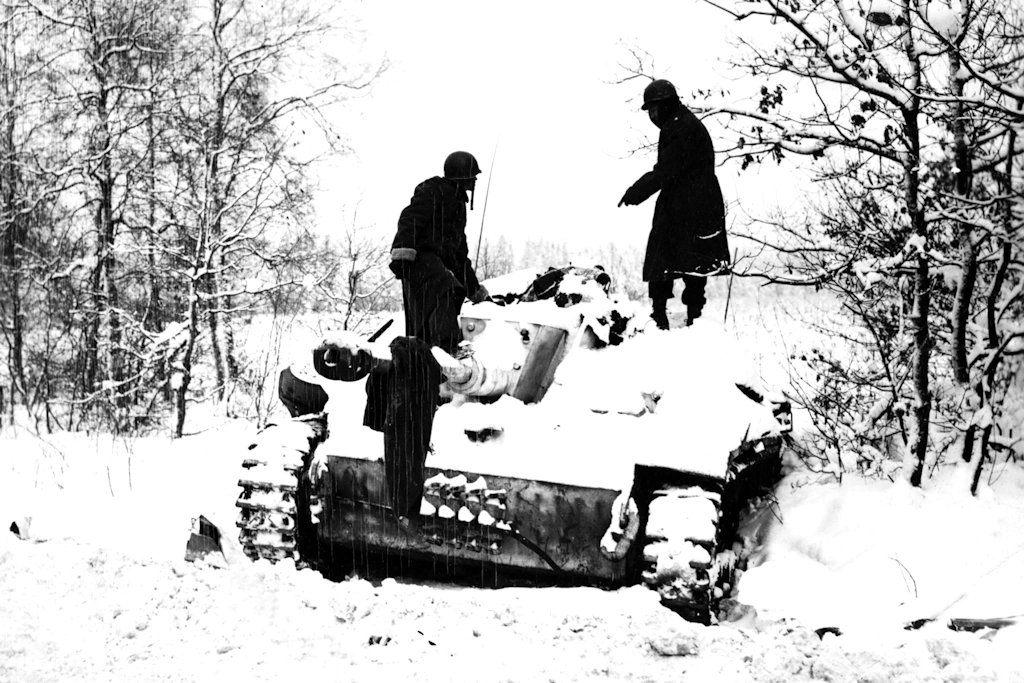
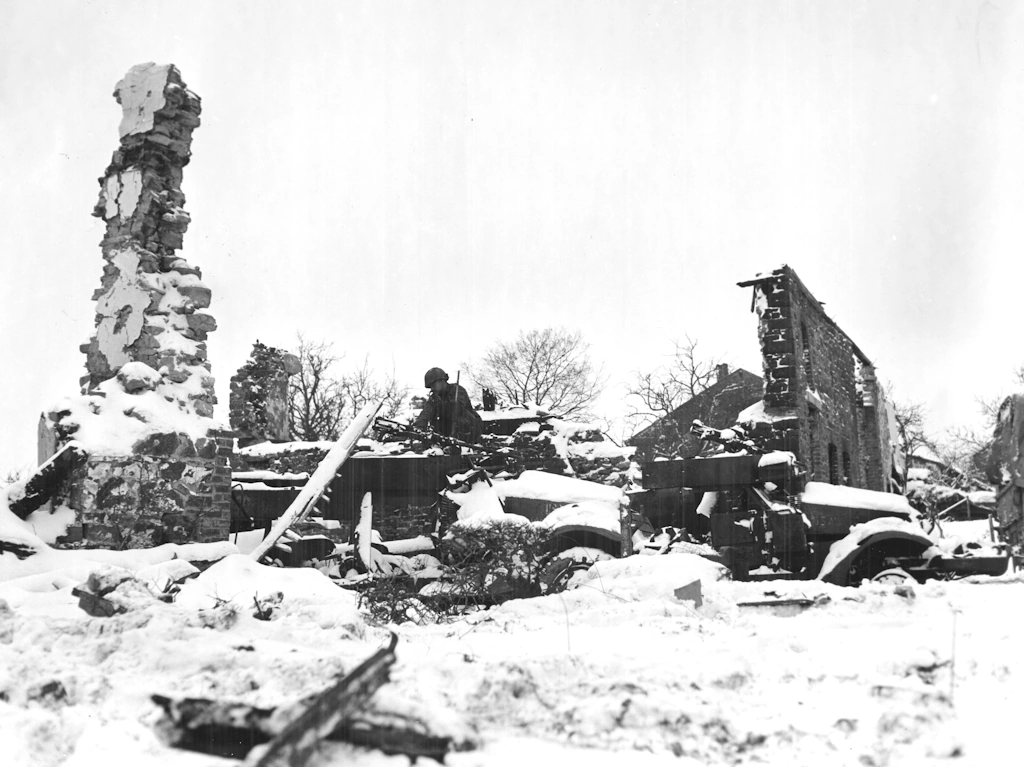
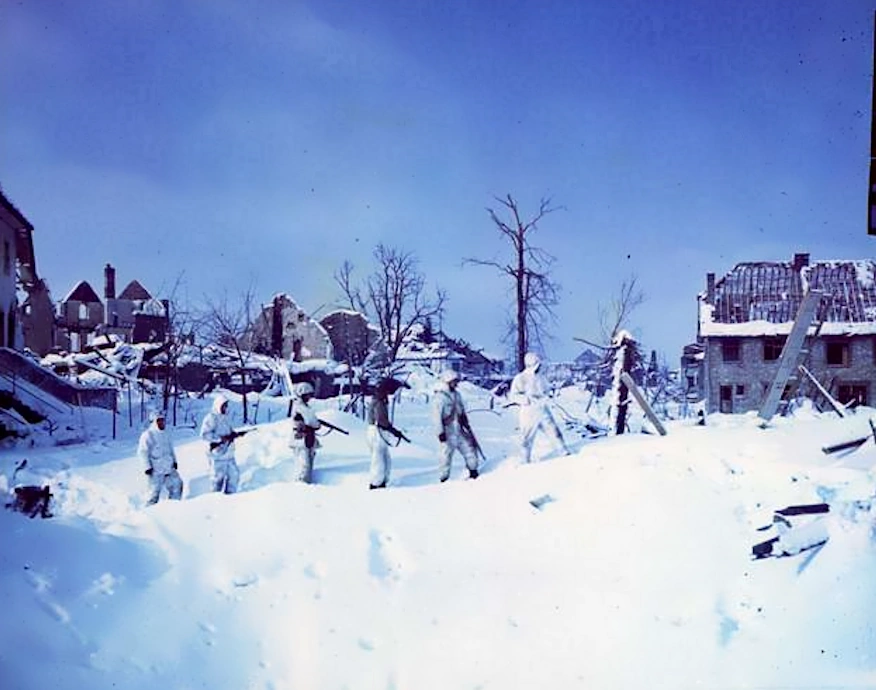
 With all assigned objectives for January 20 captured by the 30-ID troops, an other phase in the drive on St Vith had been completed. Through extremely dense woods eleven inches of snow, the Division had slugged its way forward. Buried AT mines were a constant source of trouble and in the seven day period from January 13 to January 20, the 105-ECB removed well over 200. But the many hardship and unusual
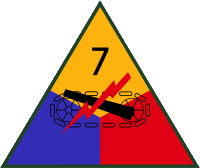
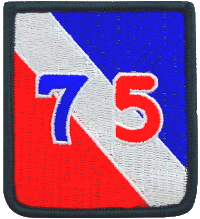 problem were met and solved. Snows capes, winter clothing, sleds for evacuation and many other ingenious items were utilized and on January 21, the Old Hickory Division could almost see St Vith. All that remained to be captured in the last phase, were four objectives north and west of St Vith and several to the south of the key city. On the right of the Division the 82nd Airborne Division had been pinched out by the 75th Infantry Division. On the left, the 7th Armored Division had
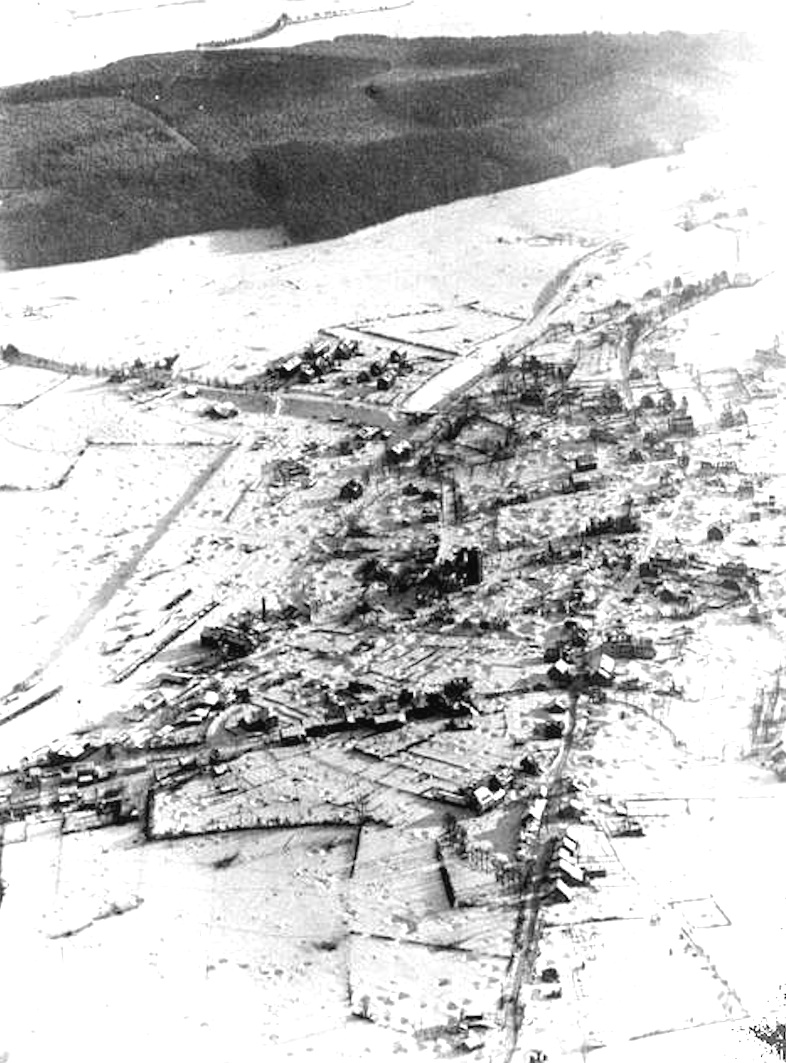
 just begun to move through the 1st Infantry Division, and over are of the roads in the 30-ID sector preparatory to positioning themselves for the strike on St Vith, which after days of relentless artillery and aerial bombardments had been reduced to rubble, resembled more a graveyard than a town. Like Bastogne, it commanded a vital road junction and remained a key position on the northern shoulder of the Bulge. Its capture was crucial to dislodging the last German elements and enabling further Allied advances eastward.
St Vith Offensive – Phase III
The day of January 21, 1945, marked the termination of over a week of fighting for the 30th Infantry Division. In that time they had fought step by step, approximately nine miles. Their losses were high, the enemy, a determined fighter and the weather conditions an extremely difficult obstacle. The military tactic had slipped into a pattern by that date, and for that raison, the line battalion’s had a rough idea of what to expect when they launched a battalion or two battalions attack. The small villages were usually defended most strongly on the outskirts from the protection offered by heavy undergrowth and dugouts. The cities themselves usually contained only a small number of troops who defended from behind the protection of any stone houses available. More difficult to capture were hills or ridge lines in the possession of the enemy. The men of the 30th Infantry Division very frequently found a great deal of difficulties in dislodging a stubborn enemy from well displaced positions that were supported by mortars and artillery fire. An over present obstacle were the AT mines that were buried on roads and covered over by snow and ice. As stated earlier, the ‘mine busters’ were employed to good advantage.
 The cold and wetness of the weather were combated by use of little tricks the men had learned and what comfort were readily available. Commanding officers took advantage of all available cover for their troops, and the artillery battered farm house did not offer too many conveniences, they nevertheless blocked a good portion of the winter blasts. The regular enlisted type overcoat was frequently found to be a hindrance, rather than an aid in warding off the cold. Soldiers found that the coats easily became moist or even wet from contact with the snow, and shortly thereafter froze almost solid and had to be discarded. Digging foxholes or gun emplacements near or on the front lines in the frozen ground was not only very hazardous, but back breaking job. With the beginning of the last phase in the operation, the Division was tired, but near their final objective line which ran roughly 2000 meters south of St Vith along the Braunlauf River. The boundary line between the 7-AD and the 30-ID in the area ran along in the vicinity of the 84th north-south grid line.
On January 21, there was little advance made by any of the Regiments of the Division. In the 117-IR, the 2nd Battalion remained in Recht, obtaining some much needed rest. The 1st and 3rd Battalions remained on the objective taken on the previous day with Able, King Love and Item Cos, on the line from west to east. Easy Co on the right (west flank) and Baker Co in reserve. Under cover of dusk reconnaissance patrols went 
 down to Rodt, Hundheim, and Steinerberg, and reported them apparently well held.
On January 21, the 119-IR, for the most part consolidated on the position they had seized on he previous day. Fox Co, under Capt Edward C. Arn occupied positions in Ober-Crombach, and there ran into small elements of the enemy. The Germans were scattered in houses, but were soon routed out of the villages or captured by the attacking company. By darkness the area was firmly held with Easy, Fox, Love, Item, and King Cos holding a semi-circular line to the northeast and George Co in reserve.
 To the left, in the n120-IR sector, the 3rd Battalion received a strong counter attack. The Battalion occupied a position in the general area (837922) noar the Malmedy – St Vith road. At 0958, the 1.Battalion, 352.Volksgrenadier-Regiment, 246.Volksgrenadier-Division, supported by three self propelled guns attacked on the front of King and Love Cos. The enemy came up from Ober Emmels, using the available woods to furnish cover and concealment. The 1st Battalion, 120-IR had been occupying a position on the right (west) of the 3rd Battalion. Thus when the attack
  struck, the 1st Battalion flanked the enemy on the right and the 3rd Battalion closed in on the left. Bu 1050 hours, the attackers retreated leaving 8 PW’s, 16 wounded an estimated 70 Germans killed, and one SP gun. Later in the same day, patrols from the 1st Battalion were sent south to reconnoiter the next day’s objectives, Ober Emmels and Nieder Emmels. They were driv en off, however, by strong enemy automatic weapon fire.
 On the left flank of the 30-ID, the 7-AD drove south on January 20 and January 21, in excellent coordination. The key village of Born had been cleared by Gen Robert D. Hasbrouck armored forces, and the defending enemy fell back to St Vith. The same was true for the 30-ID sector; the enemy retreated to St Vith. On January 21, large groups of Germans began to evacuate that city on the primary highway leading south. The road was jammed with troops, vehicles, armor, and guns, giving the IX TAC wonderful targets of opportunity. Working with the 7-AD, the 366th Fighter Group and the 404th Fighter Group destroyed an enormous number of vehicles, tanks, artillery, troops, and horse drawn wagons, using 500 pound HE GP and 250 pound fragmentation bombs for the job.
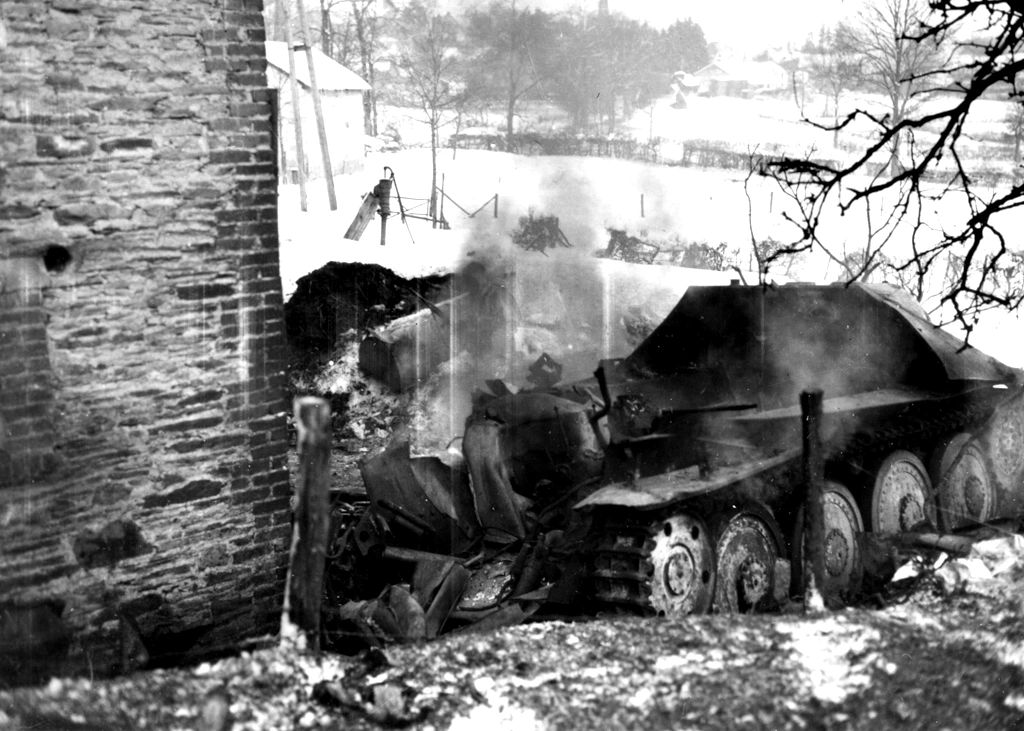
The next day, January 22, the 120-IR’s objective was the area containing Nieder Emmels and Ober Emnels. The former was the larger of the two and had the St Vith road running through it. In the early afternoon, the 2nd Battalion, supported by the fire of the 1st Battalion, attacked the village. Flanking the village cautiously, resistance from infantry and assault guns were met, but to no appreciable extent. By 1600 hours, the village was in the possession of the 2nd Battalion. Fox Co, had left the mopping up of the town to Easy and George Co, and had processed, at 1515 hours, to the west to seize Ober Emmels. The company encountered resistance however, and was unable to advance.
(! page 62 missing)
 At that time, the 7-AD had pushed down during the day to a line about 3000 meters north of St Vith. The advance south continued all along the Division front and on the right flank the 119-IR made subsequent gains, keeping pace with the other two regiments of the division. In a coordinated attack the 2nd and 3rd Battalions (119-IR) advanced from their line of departure at 0800, January 22. The 2nd Battalion left the area of Meisenberg and ran into scattered small arms fire. The battalion advanced south through a wooded area and an hour after the ‘jump off’ they had cleared the woods at (788878). Easy and Fox Cos advanced on a line with the former company on the right. Once under observation, the two companies came under extremely heavy automatic weapons and artillery fire coming from enemy positions located from the high ground immediately south of Kapellen (725969). Artillery fire was called for and brought down on the enemy locations. Support tanks of the 743-TB were brought up and the battalion assaulted Kapellen in the mid-morning. By 1315 hours the village had been cleared of the enemy.