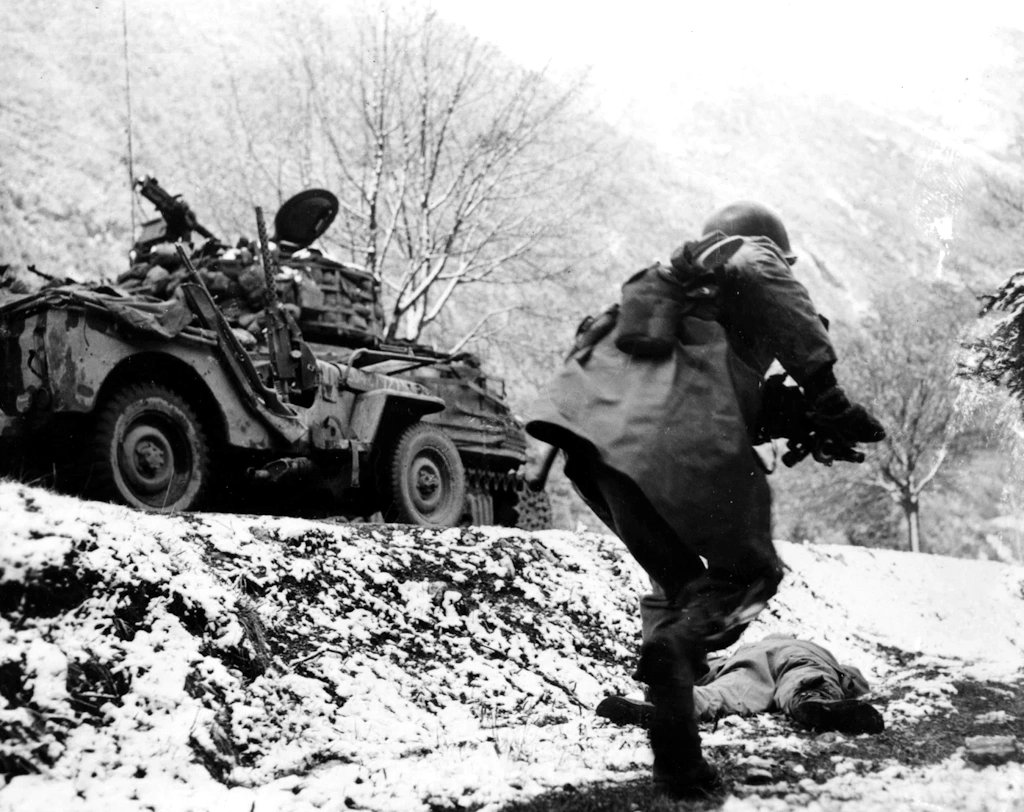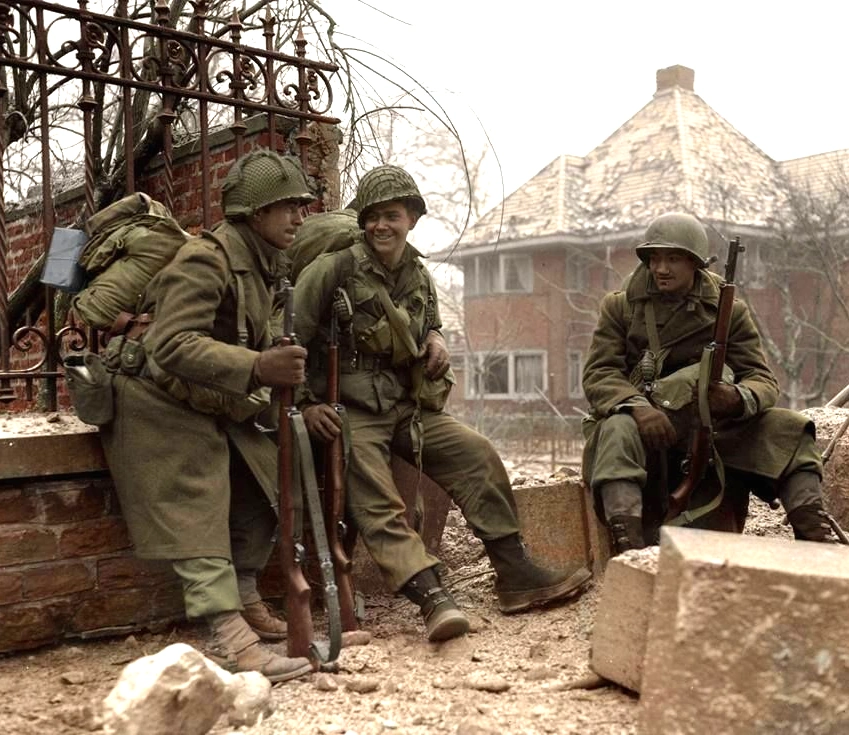


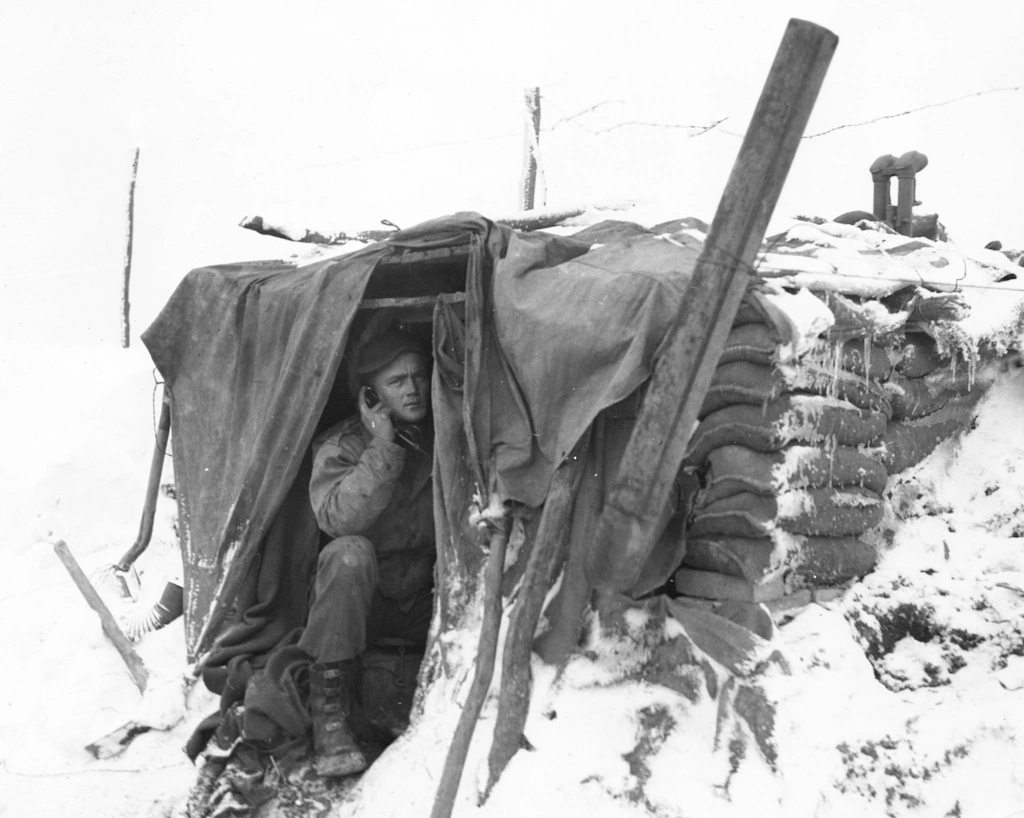

 Meanwhile, the 3rd Battalion 119-IR had been attached to the 117-IR, and under the latter’s direction attacked in coordination with the 1st and 2nd Battalions 117-IR, the morning of January 16. Advancing east from Ligneuville, a road block was established at (625985). The battalion was then disposed by Maj C. E. Stewart with the three companies abreast. The advance was almost directly south with Love Co on the left, Item in the center and King on the right or east. By noon the base of the Wolfsbusch Hill was reached. An
  attempt was made to advance up the slope, but it was pushed back by the enemy. Throughout the afternoon, fire fights continued and when darkness fell, the positions occupied by the 3rd Battalion 119-IR, were essentially the same as they had been at noon. The 3rd Battalion 117-IR remained in regimental reserve. Just south of Pont, the Companies were disposed from east to west, Love, King, and Item respectively.
 On the right, the two battalions of the 119-IR, the 3rd Battalion had been attached to the 117-IR, also did not make any great strides. The 1st Battalion held a defensive position throughout the day, regrouping and refitting. Charlie and Baker Cos maintained positions immediately southwest of Pont and Able Co attempted to get some rest on the north side of the Ambleve River. The 2nd Battalion, on the right flank of the 30-ID, moved off at 0900 and advanced south almost 1000 meters from Houvegnez. Easy Co led, and with Fox Co on the left, the
  heavy moods were searched. One tank of the 743-TB was lost from direct fire of an enemy self-propelled gun. Those SP’s were met in some number in the next week and always proved troublesome. They were 75-MM guns mounted on 8 Mark IV chassis. Not too large they drove through the forest fire breaks easily and maneuvered without too much difficulty in the snows. In any event Easy Co pushed to (765959), where they made contact with the 517-PIR attached to the 106ID, at last-light.
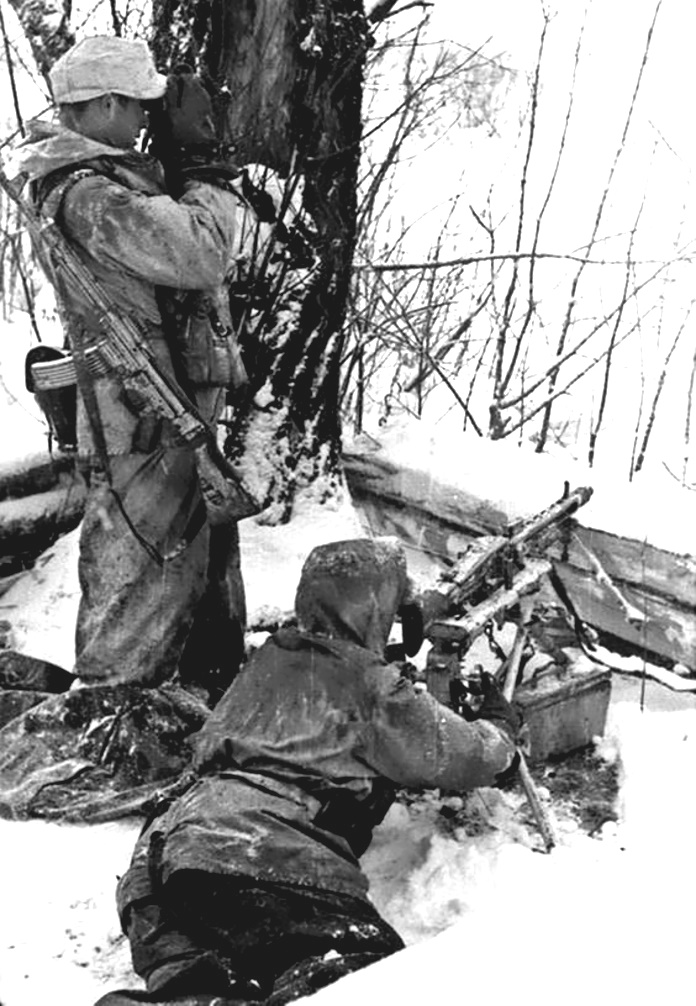
 The activity of the 120-IR, on January 16, was much like the other two regiments. Primarily resting and maintaining defensive
  positions. From slightly east of Thirimont to rest of Hauts Sarts positions were held by the 1st, 3rd, and 2nd Battalions respectively. Each had two companies in line and one in reserve.
 The following day, January 17, there were again no great advances made anywhere on the Division front. Again, as on the previous day, short movements were made, but regrouping and some rehabilitation were carried on primarily. In the 117-IR, Col R. E. Frankland’s 1st Battalion further consolidated their position on the Dillburg Hill 530. Able and Charlie Cos covered the entire elevation, cleaning out a few of the enemy that had infiltrated during the night, end then took up positions in a line on the reverse slope. At 0915 an estimated 50 enemy infantrymen, supported by 5 light tanks, and
  designated Kampfgruppe Hoffman, were encountered. A relatively short fire fight ensued, in which several PW’s were captured end the enemy routed. Baker Co took up a position in battalion reserve, slightly to the north of the other two companies. The 2nd Battalion 117-IR attacked for Hunnert, which was more correctly the designation of a 540 meters high elevation.
 On the previous day, January 16, the battalion had been unsuccessful in its attack on the objective. However, on the morning of January 17, they again struck at the hill. Because the objective was in the center of an extremely heavily wooded area, the enemy found adequate cover and concealment. An estimated 50 troops defended the hill. They were broken into small groups and each group had an assault gun set up in either a dug out or fire break. George and Easy Cos attacked and drove them off then patrols went down to Recht to make a reconnaissance. The 3rd Battalion took a crack at the road strong point at (820955), but were no more successful on January 17 than they were on the previous day. The difficulty in any attempt to take the block was not as much from the large amount of fire power set up, but from the tactical disposition and
 organization of the strong point. On the east side of the Malmedy – St Vith Road in the vicinity of the road block, the undergrowth was very thick. Because of that factor it was quite impossible for troops of the 3rd Battalion to bring up any armor or heavy weapons on that flank. Further the enemy had a series of machine guns, light and heavy, set up among the trees and in the fire breaks.
On the west side of the road, peculiarly enough, there was an open area which prohibited an advance in any force to cross it. Any attempt of that nature us immediately met by fire that come from the road block defenses. That fire, and fire on any friendly groups in the vicinity that came down the main highway or other approaches from the north, was observed from east of the road block on an elevated position. Such observations were then communicated to the gun positions at the road intersection. That was the reverse of the usual situations were the observer was near the target and the guns in the rear.
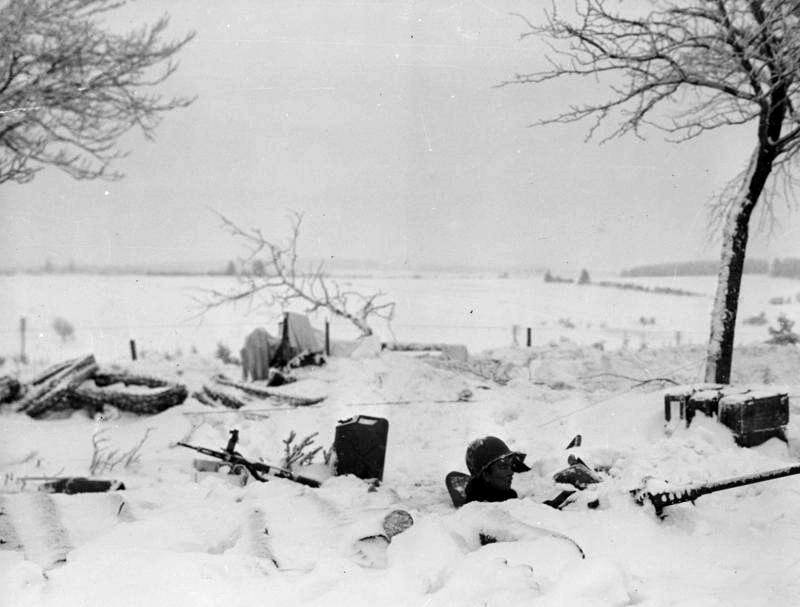
In the 119-IR, the only active Battalion was the 2nd. The 1st assembled in Pont and the 3rd, released from attachment to the 117-IR, closed into Malmedy. Fox and George Cos (2nd Battalion), maintained their positions in the vicinity of Houvegnez. Capt Werne E. Parker’s Easy Co sent out a strong combat patrol to establish a road block at Ochsenbaracke. That point was on the road from Pont to Recht and the most advanced position of the 30-ID. The Company pushed to the road block position slowly and carefully, following a course through the woods. The strength of the road block was made up of a platoon of infantry from Easy Co, 2 cal .50 M-2 heavy machine guns, two self propelled TD’s and three AT guns. Once the road block was set up and consolidated, outposts were sent out and contacted the 517-PIR on the right and the 117-IR on the left.
 In the 120-IR, the 1st Battalion remained in tho vicinity of Thirimont with Able and Baker Cos in the line. A combat patrol was sent down to reconnoiter the objective that enclosed Liervenn (vic 851910), some 2500 meters from the Wolfsbusch. The enemy was not in force, but a good defense north of the objective, and the patrol was forced to return to their starting point. The 2nd Battalion 120-IR, took over the occupation of the Wolfsbusch Hill and relieved the 3rd Battalion 119-IR that had tacken that objective on the previous day. There was little other activity on January 17, although more trouble was caused to our vehicles by road mines, that were laid in scattered patterns.
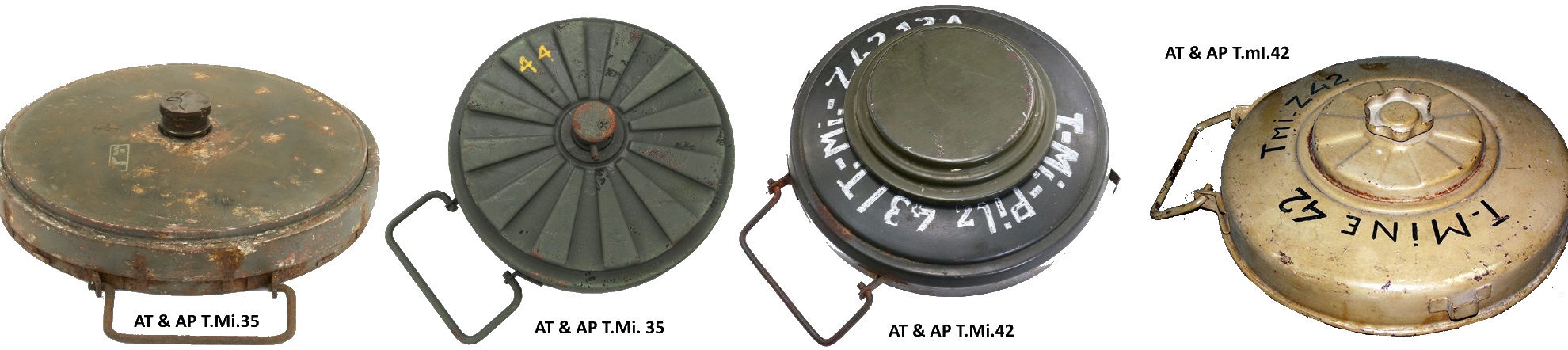
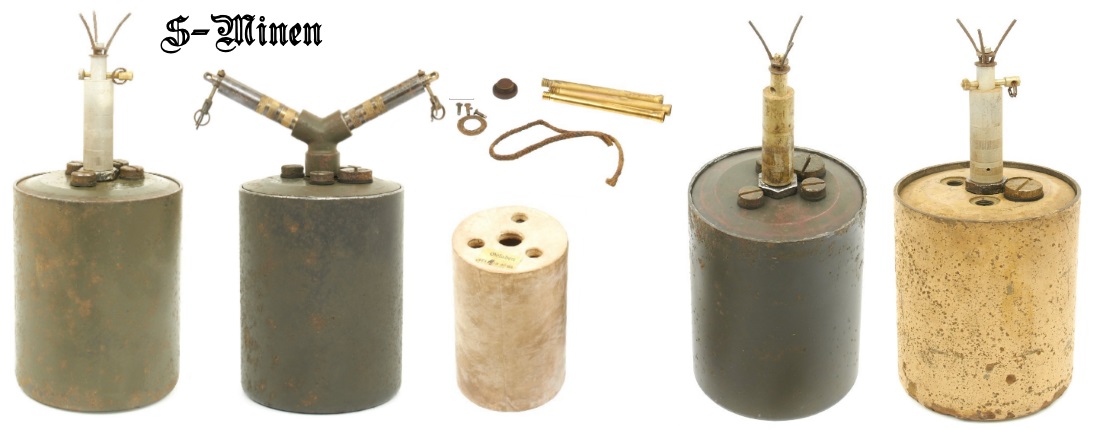
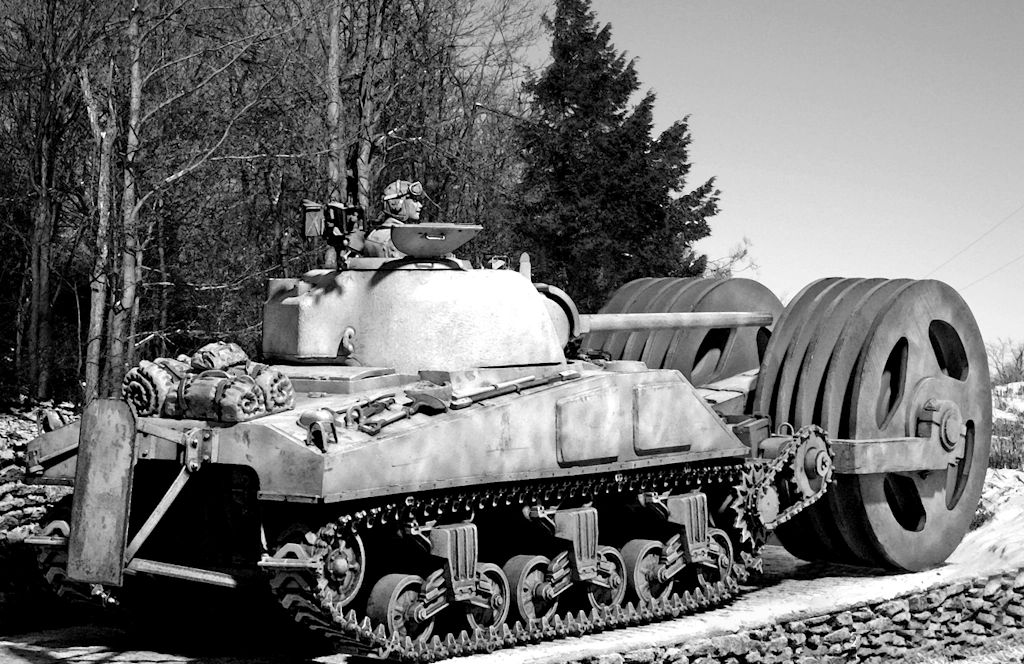 From January 13 to January 16, the 30-ID had 15 tanks disabled by AT mines. The mines, buried under several inches of snow and ice were not located by our mines detectors. Therefore a request was made of XVIII Airborne Corps for the use of mine busters. These were secured and used to excellent purpose a the Division roads. They were valuable because of the effectiveness with which they performed their primary function, detonating AT mines. They were also of great aid for the psychological effect they had on jeep, tank and truck drivers. Those man felt the road was safe, once mine buster had gone over it, and as such, their task of driving, with the nervous strain eliminated, was made easier. The mine busters of the 738-TB, utilized were of two types. One type had
 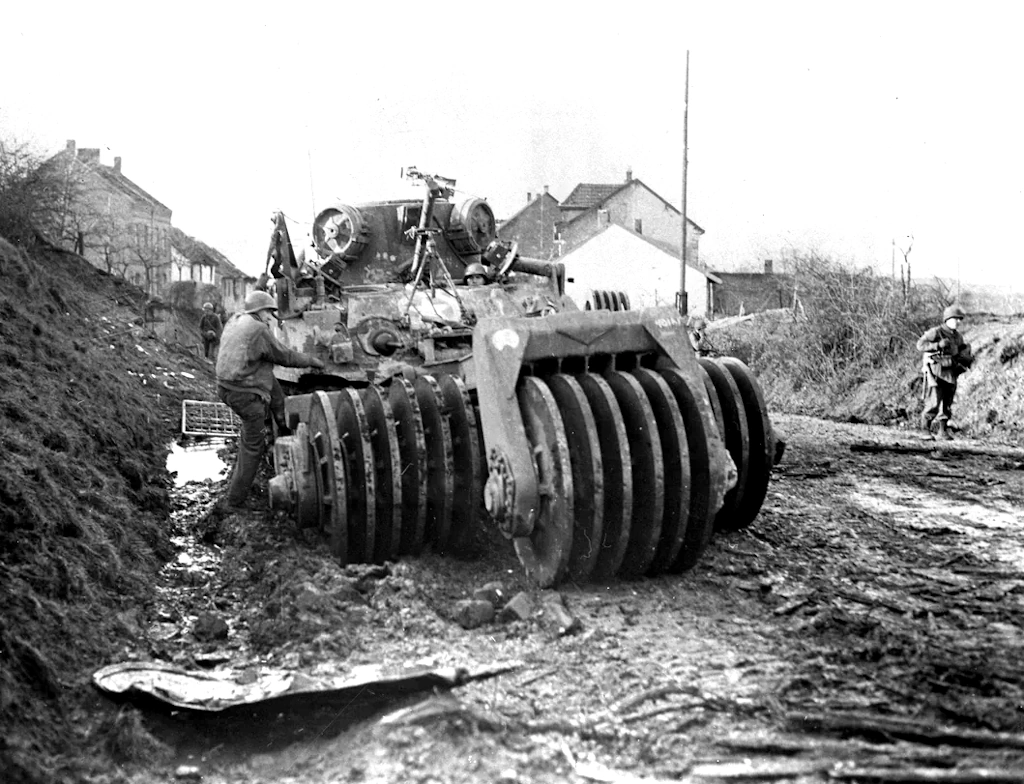 two sets of discs weighing 30 tons, mounted on the front of a medium tank. Each set contained five disks and each disk was almost nine feet in diameter. Each of the two sets were mounted directly in front of the tank’s treads. Thus an empty space was present between the two sets and mines which ley below that area were not exploded. That was the primary fault of the E-3. It was rectified by the T-1E1 type that had three sets of disks mounted on the front of the standard medium tank retriever.
These three sets contained six disks each, but their diameter was less than half of those mounted on the E-3. They were mounted with a set in front of each tank tread and the third set to the fore of those, and in the center of the tank. Thus the road in the front of the tank was completely rolled and performed its task more satisfactorily than theo E-1. There is also a great deal of interest that may be attached to the tremendous number of AT minus that were found scattered in the Malmedy Sector. Almost every one of these mines was found under heavy snow and ice. Inasmuch as the first heavy snow did occur in that sector until December 26, one may assume that the Germans abandoned the plan to attack through the Malmedy Sector in the direction of Liège, by Christmas.
The Drive Continues
 After two days, in which a short opportunity for some rest and refitting were snatched, the 30-ID, on January 18, again began the drive south. In a Division directive, the 120-IR was assigned an objective labeled Q, (vic 825937). The goose egg shaped area enclosed a portion of the Malmedy – St Vith road and also the Hill 522, a hill 522 meters in height. The whole was approximately 2300 meters east by southeast of Recht (796945) and also contained the tiny village of Liervenn, (831939). The 117-IR, witn the 2nd Battalion 119-IR attached, was to take Recht and if both regiments had completed their assignments satisfactorily,
  they were to attack for Feckelsborn (610950), which was situated approximately 1200 meters south by southeast of Recht. To aid in the operation, and to insure coordination of movement on the Division right flank, the 517-RCT (minus 2nd Battalion) was attached at 1600 hours, January 17.

 Before the 117-IR could attack for Recht it was perforce necessary to eliminate the road block which was, as stated earlier, near the junction of the Recht and St Vith road. Col Samuel T. McDowell’s 3rd Battalion was still attempting to knock out the road block at (820955). King Co under Capt Hammonds, was not able to eliminate the strong point, however, elements of his company did infiltrade behind it and were successful in laying some AT mines. Under cover of darkness the enemy withdrew from that first position and set up an even stronger block about 300 meters south on the same road at (823950). Again, mines were laid behind the road block and attempts were continued to force the enemy to withdraw. The resistance, if anything, increased and a number of assault guns and automatic weapons delivered an extremely punishing fire on the attackers. During January 18, the road block was not reduced and consequently the attack for Recht was not made. The 1st and 2nd Battalions of the 117-IR maintained their defensive lines on the elevated positions of Dillburg and Hunnertn respectively.
The 119-IR accomplished little during January 18. The 1st Baïtalion remained assembled in the vicinity of Pont, and the 2nd Battalion retained their lines on the extreme right flank of the Division. King and Love Cos of the 3rd Battalion remained in Malmedy Item Co (1/Lt John A. Doyle), moved from there to take over the high ground oh Hauts Sarts, relieving the 3rd Battalion 120-IR from that position. There was much more activity on January 18. At 0930, the 1st Battalion advanced south for objective Q in the vicinity of (831939) and two hours later it was followed by the 3rd Battalion.
The attack was made on the objective from the northeast, thus bypassing the enemy held road block at (823950). By early afternoon the area was captured and occupied by both battalions in a semi circular line by 1500 hours. Item Co was placed on the extreme east slope and from east to west. Able, Love, Charlie and Baker Cos, were disposed with King Co in reserve. At about dusk, the enemy counter attacked in strength from the south mit an estimated seven tanks and at least 100 infantrymen. Artillery was called down on the infantry and they were broken up and scattered at (827933), a point on the St Vith road approximately 400 meters south of the 1st and 3rd Battalion front line.
Groups of our infantry fanned out and attacked the tanks with rocket launcher (Bazooka) and small arms. Charlie Co knocked out two, and three additional tanks were destroyed. Of the five, two were mounted with 105-MM assault guns on a Mark IV chassis and the other three had 75-MM guns on the same type chassis. Though unusual, that illustrates that carefully directed infantrymen can destroy enemy light tanks with bazooka and small arms fire without any aid from armùor. While this counter attack was in progress, King Co, which had been in the rear of the line and consequently the nearest to the enemy road block at (823950), turned north to assist the 3rd Battalion 117-IR in their attack on that strong point. Driving at the road block from the north and south, elements of King Co (117-IR) and King Co (119-IR) got scattered groups behind the road block, planted AT mines and harassed the strong enemy concentration, but did not eliminate it.
 The 2nd Battalion 120-IR, on January 18, maintained their position on the Wolfsbuch Hill, and aided in bringing up supplies to the 1st and 3rd Battalions. The following day, January 19, the 2nd Battalion was relieved by the 1st Battalion 119-IR. The second then moved south 2000 meters, through the 1st and 3rd Battalions 120-IR and at 1415, attacked for their objective, Feckelsborn and the area in the vicinity. Feckelsborn lay 1200 meters southeast of Recht on the Recht – St Vith road. The attack was made after Recht had been captured that morning and the road block at (823950), eliminated. The 2nd Battalion with Easy Co on the east, Fox Co on the west, and George Co in the conter met light resistance and was consolidated in the village by 1700.
 The 1st and 3rd Battalions 120-IR, maintained their defensive positions in the vicinity of objective Q. King Co, of the 3rd Battalion, under 1/Lt Milton Smith, again assisted the 3rd Battalion 117-IR, in the final reduction of the road block at (823950) which took place during the morning of January 19. The 1st Battalion sent patrols to objective T to attempt to determine the size of the enemy force that was in possession of that important area. The goose egg T enclosed the junction where the Ligneuville – St Vith road converged with the Recht – St Vith road at (829917). From that area, reconnaissance was made 1200 meters to the west by the patrols.
On the right of the 120-IR, the 117-IR on the morning of January 19, prepared to attack to seize Recht in compliance with Division instructions. At 0800, the 2nd and 3rd Battalion 117-IR attacked. The former left Hunnert with Easy and Fox Co on line and in 20 minutes were on the outskirts of Recht. Resistance was light and consisted mainly of small arms fire. In a very short time, the enemy troops defending Recht were driven out. King Co led by Capt Sibbald took a center route with George Co on the northwest. By 0930 the 2nd Battalion was in possession of the village and sent patrols
to the east to assist the 3rd Battalion in the final reduction of the road block at (823950).