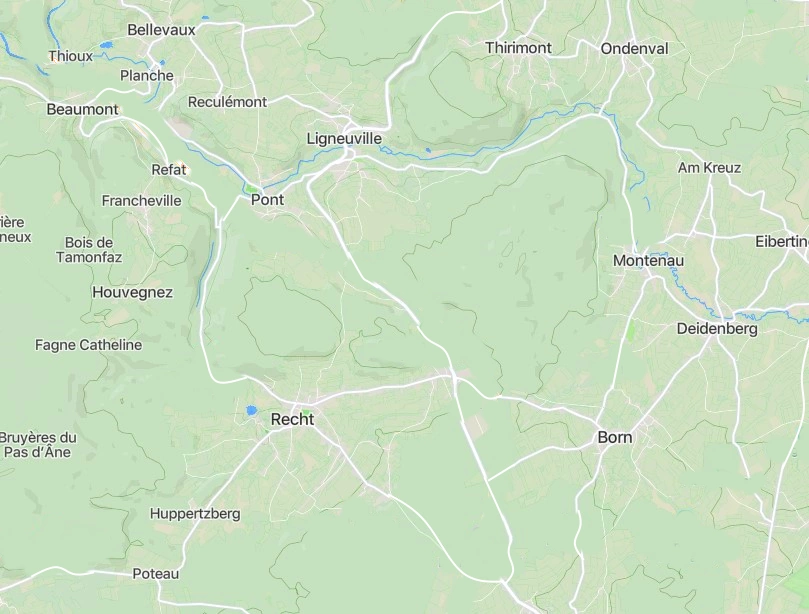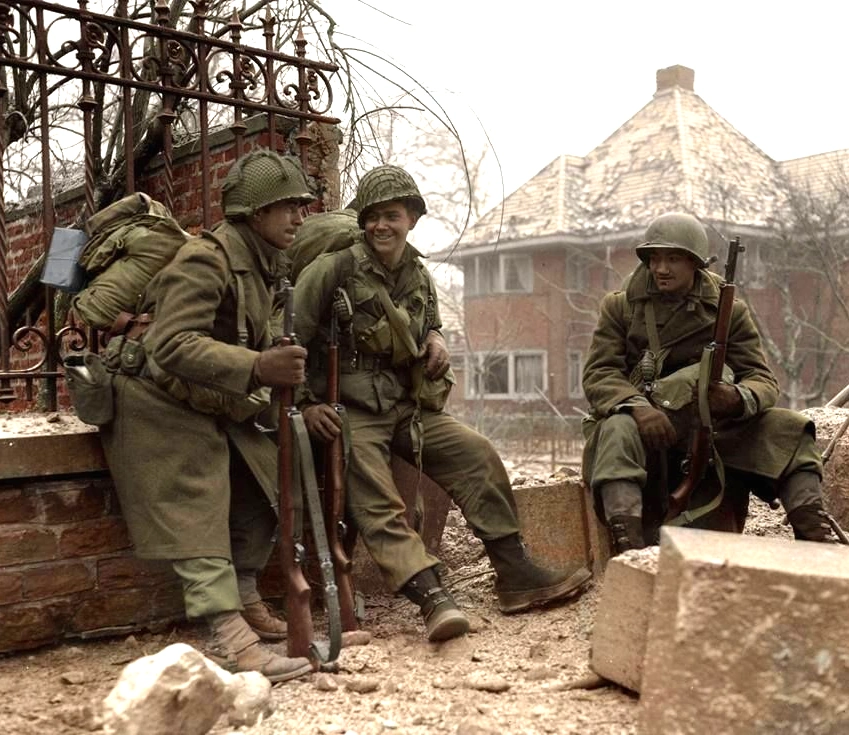


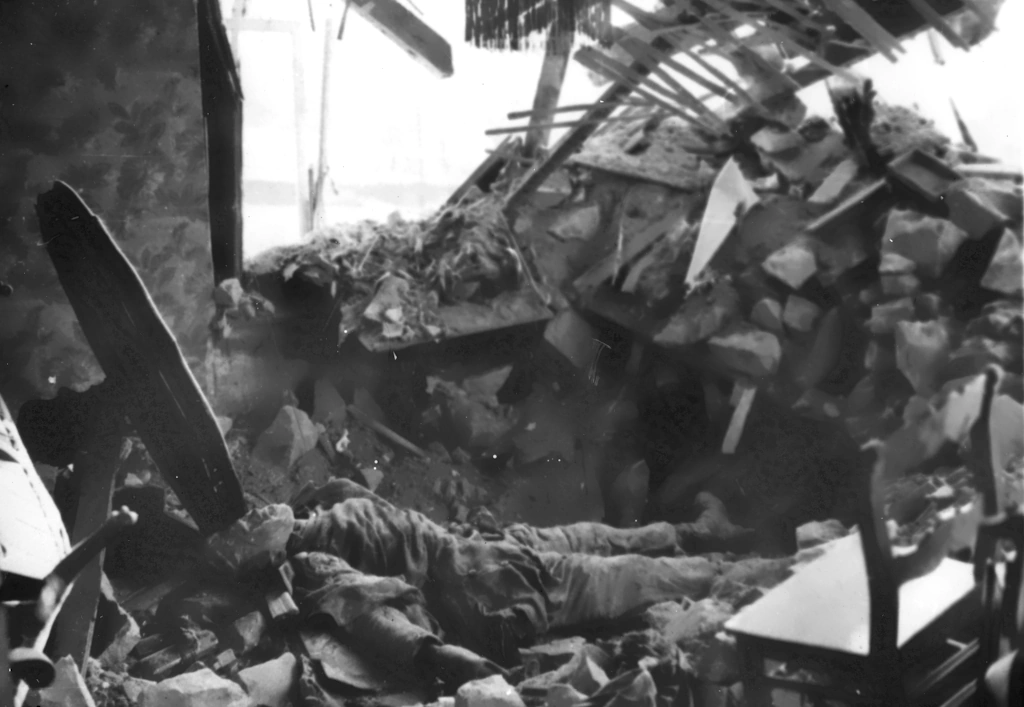

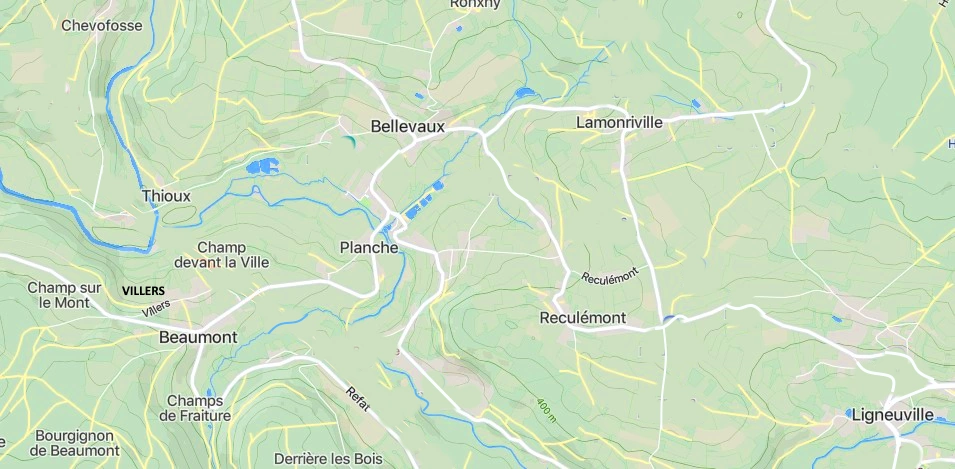
 On the west side of the Malmedy-Ligneuville road, the hill and vicinity designated as Houyire had been taken on the previous day by the 3rd Battalion 120-IR. The 2nd Battalion (117-IR) skirted the east slope of Houyire, and attacked south with Ligneuville as the objective. The original plan had contemplated the 119-IR and 120-IR of the division as handling the 1st phase of the St Vith offensive and committing the 117-IR, through the 119-IR after the latter had advanced as far south as the 96th east-west grid line. The unexpected
 resistance around Hauts Sarts and Thirimont, held up the advance of the 120-IR and in an attempt to out past the enemy at Thirimont, the 117-IR was committed to the attack. Moving south toward Ligneuville from Houyire, the 2nd Battalion 117-IR, avoided being observed to any great degree by advancing along the west side of the Malmedy-Ligneuville road. The trees were thick, the knee deep snow drifts were higher by 3 or 4 inches more of snow that had fallen during the night and communication was difficult.
At 1200 hours, January 14, the battalion was in the outskirts of Ligneuville. They were met by scattered units that were displaced in the stone buildings of the city. Fire fights continued throughout the afternoon and the village of Ligneuville 
 (Engeldorf), but by 1600 the enemy had been driven out. Moving through the village quickly, on the St Vith road, Easy Co approached the bridge spanning the Ambleve River. The bridge, at (806987), had been prepared for demolition by the Germans, but the Company CO, Capt George H. Sibbald, cut the wires and let his troops across. With all three companies in the village, the 2nd Battalion, 117-IR, consolidated their positions and were not taken unaware by the German counter attack launched at 2000 hours. Estimated at a battalion of infantry an supported by six tanks, the enemy attempted to regain Ligneuville. They were unsuccessful, and were forced to withdraw.

 Moving further to the right, or west, into the 119-IR sector, it will be recalled that during the early morning hours of January 14, after a terrific 30th Infantry Division Artillery barrage on Hedomont, the village was captured by the 3rd Battalion. At first light, January 14, after a terrific struggle, Col Robert H. Herlongs 1st Battalion passed through the 3rd and attacked south for Lamonriville (Belgium). The Battalion met practically no resistance at
  Lamonriville and wont through it rapidly. Still moving south from Lamonriville, with Able and Baker Cos leading and Charlie Co in the rear, the battalion headed for Reculemont. Shortly before noon they were halted north of the village by very accurate and damaging mortar fire and artillery.
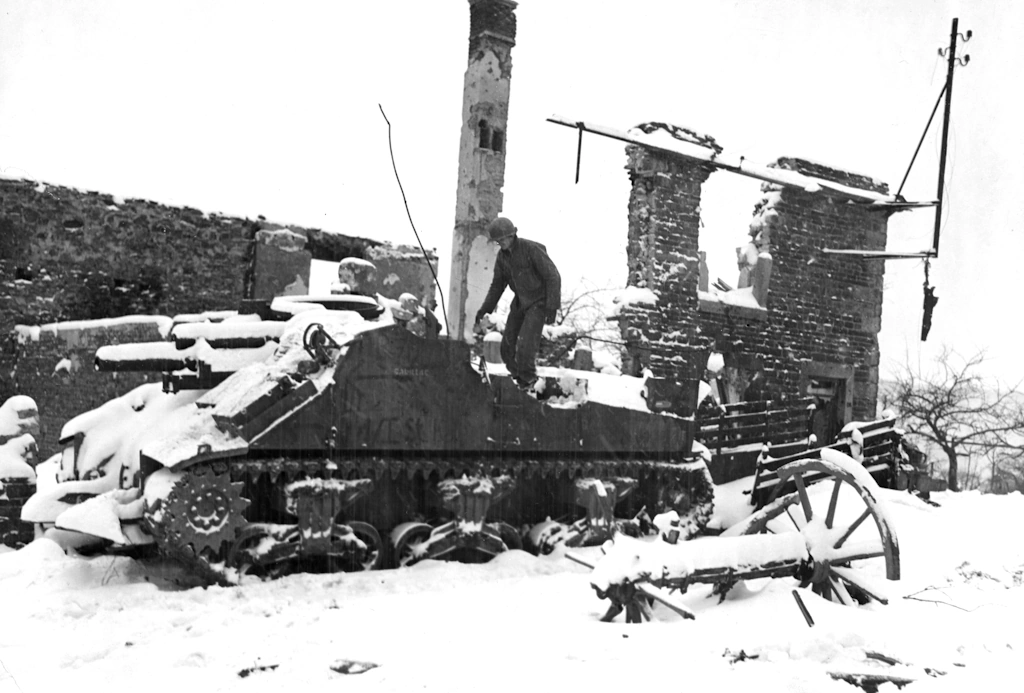
 With the support of tanks from the 743-TB, the energy line was broken north of Reculmont and 50 enemy were captured. With tanks leading the way, Abel and Baker Cos took up positions in Reculemont at dusk. With a firm base in the village, Capt Donald R. Fell led Charlie Co through the village and by darkness had gone another 1000 meters south to reach the north bank of the Ambleve River. Thus in once day, the 1st Battalion 119-IR had pushed, slugged, and battered their way through snow, woods, ice, and a determined enemy for a gain of approximately 4000 meters. Their casualties were relatively high, but so were the entire 30th Infantry Division on January 14.

 The 2nd Battalion 119-IR, moved off at 1000 hours, January 14 with George Co on the right and Fox Co pushing further into Bellevaux. Under 1/Lt G. L. Farris, George Co skirted Bellevaux on the west and attacked Thioux. They were met by heavy small arms fire but prior to noon they had possession of the village. Fox Co in Bellevaux was troubled during the morning, not only by the enemy, but also by the American Air Corps. A small group of medium bombers mistakenly several bombs on the village, but caused no serious casualties on the 2nd Battalion troops.
 Shortly after 1300 hours, a platoon was sent out by Capt Edward C. Arn of Fox Co for the purpose of securing a river crossing site. They crossed the Ambleve River at 1330 and shortly thereafter George and Easy Cos followed, and secured a bridgehead in the vicinity of Planche. Working in smooth coordination, Easy Co, 2nd Battalion, 119-IR, which had been the reserve company throughout the day, then moved past George Co and seized Villers, which lay about 1800 meters west of the river crossing site. In the vicinity of Villers, Easy Co established contact with the 517-PIR and the 424th Infantry Regiment (106-ID). With Easy Co in Villers, George Co
 attacked Beaumont which lay some 200 meters south of Villers. The enemy troops in Beaumont, had doubtless been reinforced by those who had withdrawn from Villers and by midnight, January 14, George Co had not yet been successful in taking the village. By 2400 hours, January 14, the 30th Infantry Division had made most of its progress on the right flank of the Division sector. Two bridge heads had been established; one at Ligneuville and one at Planche and plans for January 15, were stated in a letter of instruction. The most important factor mentioned was that the 1st Infantry Division, on the left flank of the Division, would attack south prior to daylight, on January 15.

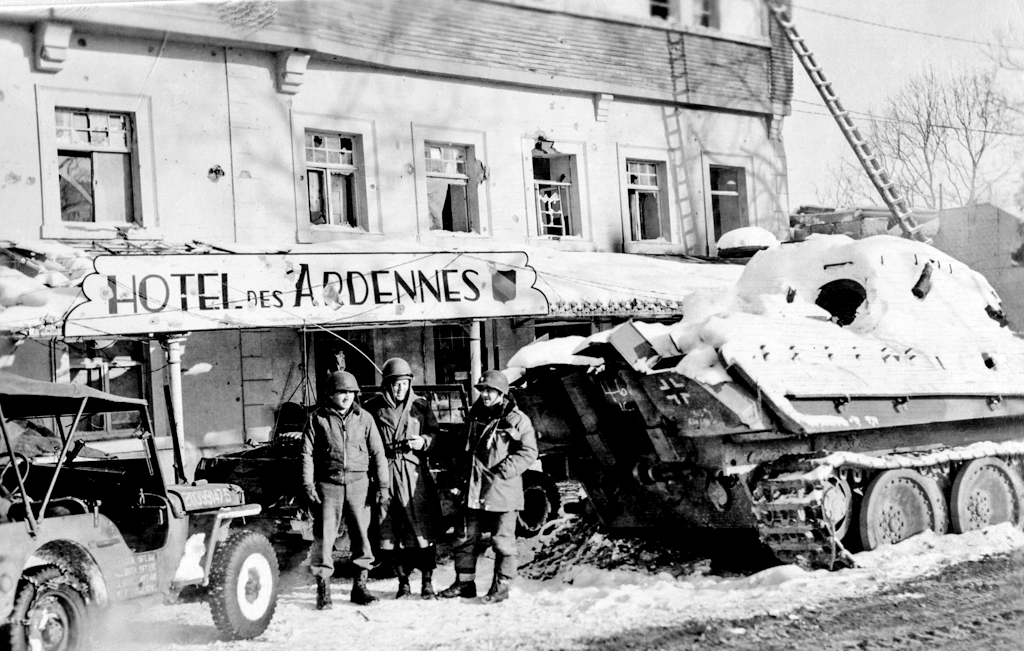
 In the 117-IR sector, January 15 was relatively quite. The 2nd Battalion remained in Ligneuville and eliminated scattered enemy groups in their zone that were found on the south bank of the Amblève River. The 3rd Battalion passed through the 2nd Battalion and proceeded south against light resistance for approximately 2000 meters and reached an area in the vicinity of (810967) by 1800 hours. The 3rd Battalion, 119-IR had been attached to the 117-IR and during January 15, moved in a line along the southeast section of Ligneuville and set up positions of defense along the Malmedy- St Vith roed. Further, they established outpost groups in the woods in an attempt to capture or destroy a few enemy harassing patrols and several German self propelled assault guns that had been bypassed or had infiltrated back into the lines and were causing some disturbance. The other two battalions of the 119-IR, continued to attack in the Regiment’s sector throughout January 15 and by nightfall, had reached the line marking the termination of the first phase in the St Vith offensive.
 The 1st Battalion, 119-IR used Able and Charlie Cos primarily during January 15. Able Co’s platoons worked between Borgueucé and the Ambleve River, hunting out harassing patrols and scattered enemy units. Charlie Co supported by a platoon of tanks of the 743-TB, swung east from Lamonriville and crossed the bridge in Ligneuville (805988) spanning the Ambleve. Once across the bridge, Capt Fell moved west in the direction of the objective, Pont (794977). The outskirts of Pont were reached before noon and an attack for the village was launched
  immediately. Driving the enemy out of the houses, Pont fell by 1430. 28 PWs were taken during the assault on the village. Moving south out of Pont, the same unit of the 119-IR advanced toward on Pont (794972), an ineffective natural road block of 22 heavy trees had been felled across the road by the retreating enemy. They were quickly removed and the company continued until Pont was occupied by dusk.

 In the 2nd Battalion, Fox Co had continued to attack against Beaumont until 0200, January 15. At 0745, George Co passed through Fox Co, at Beaumont and advanced along the Beaumont – Houvegnez road. The company met very strong small arms fire and very heavy mortar concentrations. All encountered, in lesser amounts, were artillery and rocket fire. By 1100, Francheville was taken and the attack pressed to the south to
  capture another small village, Houvegnez woods became thicker and the enemy resistance stronger. Division artillery fire was called for in greater volume by the 2nd Battalion 119-IR and following it, George Co pushed into Houvegnez where it captured over a score of stunned prisoners. The total number of PW’s taken by the 119-IR during January 15, numbered 108.
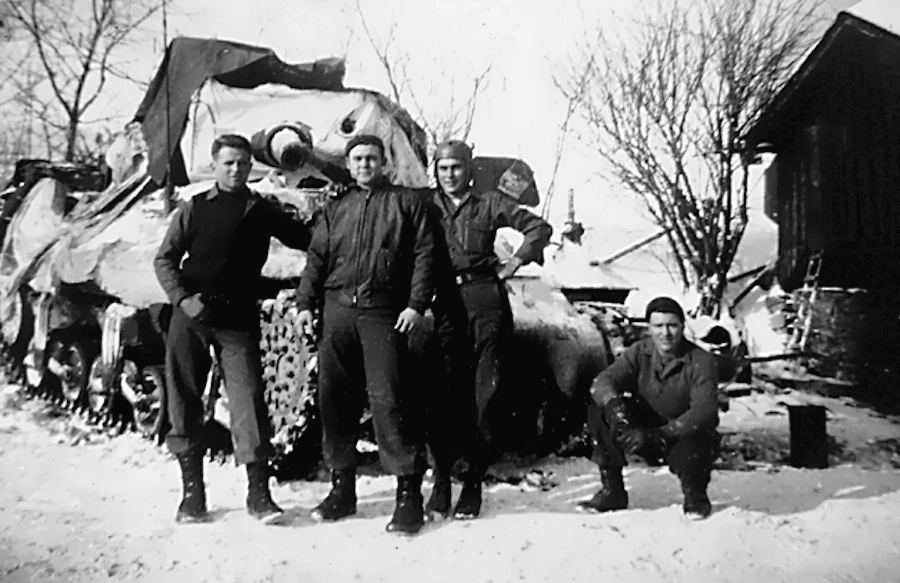
 In the 120-IR on January 15, the attack against Thirimont continues. The 1st Battalion managed to get into the village with armored support by noon. The enemy defended from house to house, an the village had been made into strong points of defense. It was against such defenses that Baker Co of the 823-TDB assaulted. Those brick houses in the small village had been turns into veritable pill boxes and heavy machine guns and other automatic weapons emplaced them. If it had not been for the supporting tanks from the 743-TB and the TD’s from the 823-TDB, it would only have been at an exorbitantly high price of infantry that Thirimont would have been taken on January 15. The 3rd Battalion 120-IR, attacked Thirimont at the same time as the 1st Battalion. Hitting at the village from the northeast. The battalion met very heavy sniper, small arms and automatic weapon fire, not only from the village, but also from the east. The 1st Infantry Division, on the left flank of the 30th Infantry Division attacked south the same morning, but did not advance fast enough to relieve the pressure on the 120-IR. Toward noon, January 15, fire on the 3rd Battalion increased to such an extent that it was necessary to call for help from the 2nd Battalion.
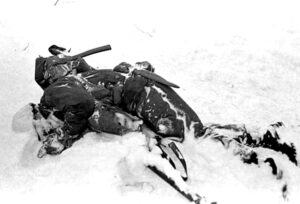
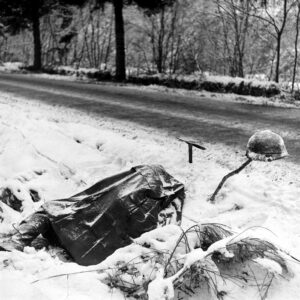
 The 2nd Battalion 120-IR had moved off early the same morning on the right flank of the 3rd Battalion and headed for the Wolfsbuch Forest area. That objective contained a hill whose elevation was almost 600 meters high and easily dominated the area. Col Cantey had moved his 2nd Battalion down the Malmedy – St Vith road when he was intercepted about 500 meters out of Ligneuville at (81698), and ordered to return to the Thirimont area and support the right flank of the 3rd Battalion. Throughout the day, January 15, fighting continued unabated. By nightfall, the 120-IR was finally in possession of Thirimont and Hauts Sarts. Division artillery expanded over 11.000 rounds of 105-MM and 155-MM ammunition that day, and most of it was called for and directed at the enemy in the Thirimont area. The job the support tanks and tank destroyers accomplished cannot be minimised and the final capture of those two strong points, in a large measure belongs to them. The rate of casualties for the 120-IR for that day was high and the total number for January 13, 14, and 15, amounted to over 450 killed, wounded and missing.

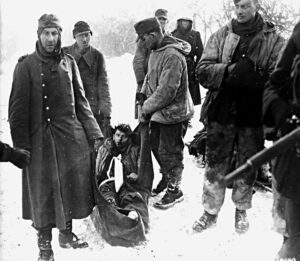
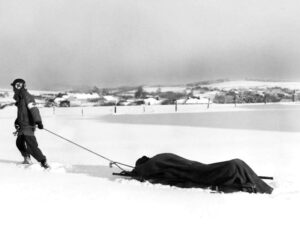
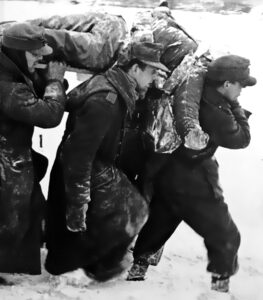
 Because of the nature of the terrain, that is the sharp rises and falls, plus the knee deep snow, ice, and heavy forest, litter bearers found it necessary to frequently carry wounded several thousand yards. Ambulances in many cases couldn’t get any where near the wounded. However, the 205th Medical Battalion improvised and borrowed sleds from farmers and the neighborhood. Frequently, they were pulled by horses and served admirably to get the wounded to ambulances for further evacuation.
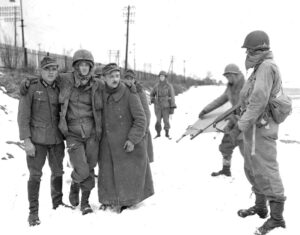

 With the fall of Thirimont, at the close of January 15, all objectives of the first phase of the St Vith offensive in the Division zones had been captured. The operation had gone according to schedule, except on the left flank where the cost had been high; unexpectedly high in fact. The 30-ID can only be commended highly for the job they did while operating with an exposed left flank. It can safely be assumed that had the 1-ID on the 30-ID left flank, been ordered to attack at H hour, D day, 0600, January 13, in coordination with the 30-ID, the losses sustained by the latter would have been much
 lighter, and the advance more rapid. When the 1-ID did attack, two days later, January 15, they quickly eliminated the strong automatic weapon and artillery positions in the vicinity of Ondenval and Faymonville that had been striking at the side of the 30-ID for two days.
As for the enemy tactics during the first phase, they have been touched on above. One of the most troublesome items needs additional emphasis. That was the mines the Germans laid in roads and possible routes of approach. In most cases, because of the haste of their withdrawal, the enemy made no attempt to lay mines in any careful or strategic pattern. They were again favored by the weather on this score for shortly after the mines were laid, they were covered by snow. Ice followed, more snow and again ice. That meant that scores of our vehicles would roll over the mines without setting them off. After a road became accepted as ‘safe’, by the number of vehicles that had gone over it, a light jeep, or a heavy tank would unexpectedly detonate the mine. As for infantry field positions occupied by the enemy, they were also aided by natural terrain features. Concealed wooded areas, rond-side dugouts, approaches to roads, firebreaks and trench lines on hill crest were only a few utilized. In the villages, infantry positions were invariably taken in stone houses. All in all, the entire sector was admirably suited to, and offered every tactical and strategic advantage to defending troops. In the two day period from January 13 to midnight January 15, the Division captured 497 PW’s. The caliber of the enemy soldier on the division front had risen materially from the attack hour on January 13. At that time almost all of the opposition was estimated to be from the 18.Volksgrenadier-Division. But shortly after the initial attack by the 30-ID, elements of the 3.Fallschirmjäger-Division hit the left flank of the 30-ID.
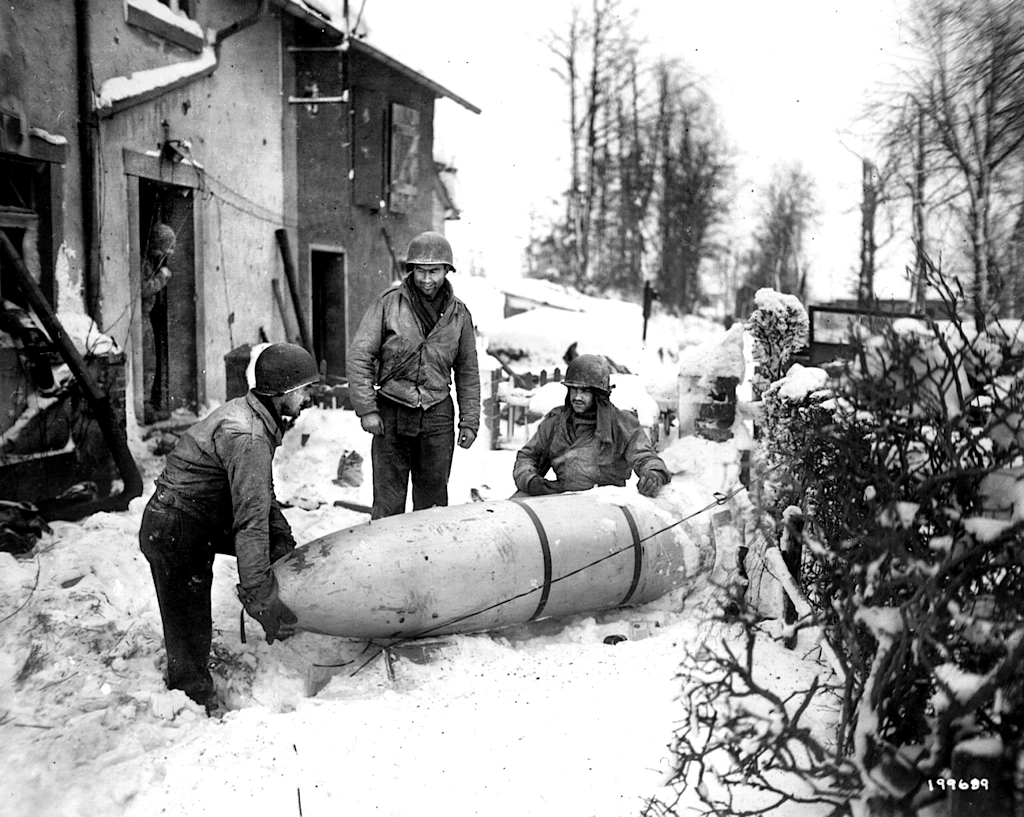

Filmed outside the village of Ligneuville, Belgium, this footage shows elements of the 1.SS-Panzer-Division (Kampfgruppe Knittel) making their way to Stavelot to link up with Kampfgruppe Peiper. These paratroopers were getting a lift because they had not enough airplane for the offensive and Gen Dietrich told them to mount the tanks to get to the front. The 3.Fallschirmjäger-Division had been involved in the initial wave. Relatively rare to be seen on the battlefield one of the trooper is using a 9-MM Neumunster sub-machine gun. One of the men sitting on the engine deck (with the G-43) is identified as Sepp Reiner. Other men include OGefr. Hof, Ltn. Reidl, OJg. Olten, OGefr. Rosenkranz, and OGefr. Kirchhof.
St Vith Offensive – Phase 2
 By midnight of January 15, the first phase line, which had been designated as such in the Division plan, had been reached. That line ran roughly along the Ambleve River where it crossed the Division zone. The line that marked the completion of the second phase ran from east to west and was south of the Ambleve, on the left flank, approximately 8000 meters and on the right flank, 11.000 meters. Within that area, 13 goose egg areas had been listed as objectives points. Of that number, three were high points that ran in a rough east west line and
  possessed an elevation of 530 meters in Dillburg, 540 meters in Hunnert, and 590 meters in the Wolfbusch Forest. That line would probably have been utilized as a (MLR) main line of resistance by the enemy, if he had adequate time for preparations. However, the rapid drive through extremely difficult natural conditions by the 30-ID, caught the enemy off balance and kept him in that condition all the way to St Vith.

 In a letter of instruction issued at 2200, January 15, the 117-IR was directed to attack south the following morning, to so secure the ridge line situated approximately 2000 meters south of its front. The 119-IR aimed to the west with the primary objective the (MSR) main supply road between Pont and Recht. The 1st Battalion 117-IR with Able and Charlie Cos leading and Baker Co in reserve, attacked for Dillburg. At 0900, the group left from the vicinity of Ligneuville and advanced against very light opposition to a point approximately 400 meters north of Dillburg. About 1000 meters to the southeast and enemy concentration of armor and infantry was observed at the road junction at Kaiserbarack. That road junction turned out to be an extremely hard nut to crack in the days that followed. It was the intersection of the Malmedy – St Vith road with
  the route from Recht. On January 16, the enemy began to fortify that point as a road block in strength. That activity was noted and Division artillery put a one concentration of fire on it from 105-MM and 155-MM guns, plus a good many rounds from eight inch howitzers (204.3-MM) fired by the 264-FAB.
The 2nd Battalion, 117-IR, under Maj B. T. Ammons, moved south at the same time and on the right of the 1st Battalion. South of the village of Pont, the Battalion advanced slowly through the exceedingly thick forest area. The base of Hunnert was reached by midafternoon and Capt Sibbald’s Easy Co out to the east slopes of the hill, while George Co under Capt Victor Salem, went to the west. Fox Co remained in battalion reserve throughout the day and followed midway between King and George Cos.