


 The 1st Battalion on the right of the 3rd Battalion moved off at the same time keeping well along the Salm River. At Derrière Spai (676982) they encountered an enemy strong point that overlooked the route of advance. Utilizing automatic weapons they eliminated the strong point and were in possession of the area by noon. The advance to the south continued for approximately 1500 yards, where at darkness they
 established a front line extending from (690960) to (699968). Contact was made with the 3rd Battalion on the left and the 517-PIR on the right. At 0900, January 7, the 112-RCT again attacked with the 3rd Battalion on the left, the 1st Battalion on the right and the 2nd Battalion in reserve in the vicinity of Aisomont. The 82-A/B Division advanced on the right of the 112-RCT and received extremely heavy fire from Spineux. It was therefore, imperative that the 112-RCT seize that
 strong point as early as possible so that the cross fire hitting the flank of the 82-A/B would be eliminated.
Aiming at Wanne, as the objective for the day, the 3rd Battalion moved south with Love Co on the left and King Co on the right. Overcoming stiff resistance, the battalion was on the outskirts of Wanne by 1300 hours. Shortly thereafter they were hit by a counter attack 
 composed of 3 tanks supported by infantry that came in from the southwest in the vicinity of Spineux. The elements of the 743-TB (attached), engaged the enemy armor, destroyed them and lost one tank from enemy fire. With that hazard eliminated, King Co (112-RCT) drove into Wanne from the northwest and Love Co from the northeast.
 When well into the village, another counter attack hit the 3rd Battalion coming from the direction of Spineux, and again the 743-TB tanks aided in the driving back of the Germans. Losses for the 3rd Platoon 743-TB, that were engaged, were four tanks. One from enemy tank fire, one from friendly artillery and two from mines. By dusk, Item Co had consolidated their position in Wanneranval with King Co in Wanne and Love Co on the east of King Co.
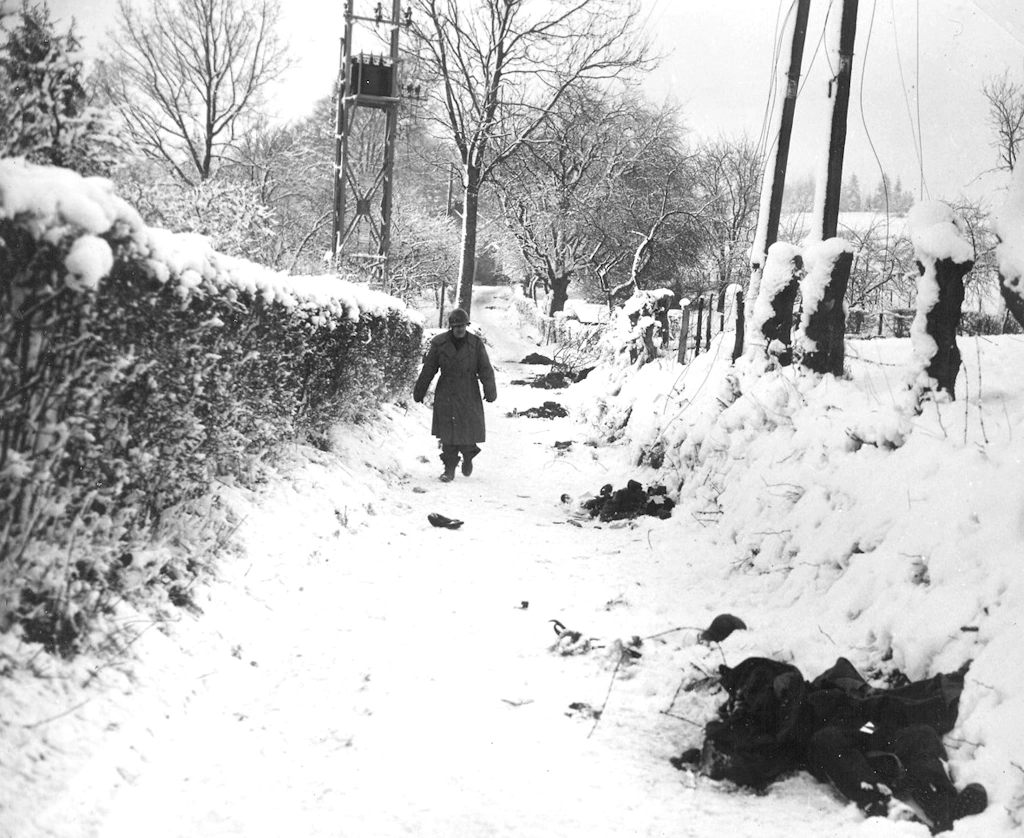
The 1st Battalion of the 112-RCT, had jumped off at the same time as the 3rd. They pushed southeast through a heavily wooded area for almost 1000 yards, and then reached and captured the village of Spineux and Le Tombeux by 1800 hours of January 7. Able Company of that Battalion holds the right, Baker Company on the left, and Charlie Company in the rear in support. The difficulties encountered, in addition to the enemy action, were the extremely heavily wooded area and the knee-deep snow through which the advance was made. The enemy utilized these natural obstacles, unfamiliar to our troops, from which to attack and fight.
By last light of January 7, Able Company was securely consolidated in Spineux, Baker Company in Le Tombeux, and Charlie Company to the rear, center of both. The 2nd Battalion of the 112-RCT (28-ID) remained during the day as regimental reserve with Fox Company in the vicinity of Aisomont,  Company in the vicinity of Grand Faye, and George Company to the rear and on the right flank of the battalion. Thus, in two days, the Ambleve River had been crossed, the enemy cleared out of the Salm-Ambleve Rivers pocket, and the first step taken in the rapid, relentless drive of the 30th Infantry Division to the vicinity of St Vith. At 1700 on January 8, the 424-RCT (106-ID) was attached to the 30-ID and began relieving the 112-
 RCT. Taking over the 112-RCT’s attachments, which had reverted to Ridgway XVIII Corps (Airborne) control, the 424-RCT was to relieve the former of its positions by 2400, January 8. Due to heavy snow, extremely poor road conditions, and inclement weather, the relief took until the afternoon of January 9 before it was completed.
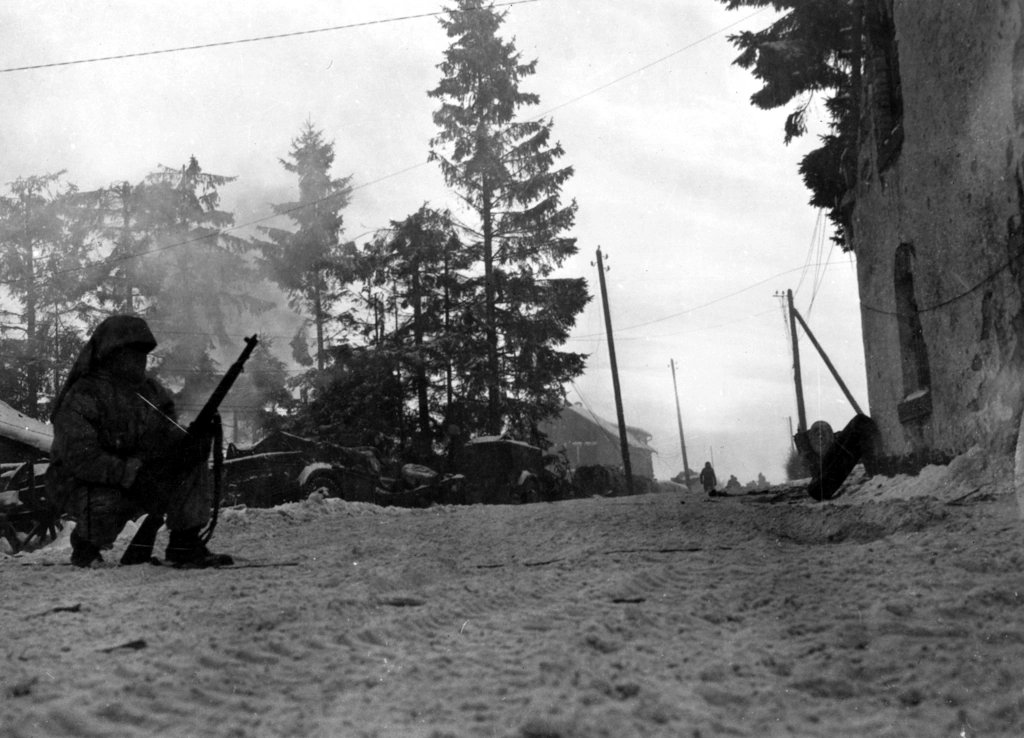
The St Vith Offensive – Phase 1

 The first day, January 13, of the ten day offensive was the most costly for the division and an explanation in some detail is valuable for the picture it portrays of the type of German reaction met on the main line of enemy resistance. At 0600 January 13, the 119th Infantry Regiment under the command of Col Russell A. Baker, attacked south for its objectives of Bellevaux (Belgium), and Hedomont (Belgium). Pushing south at 0600, from the outskirts of Malmedy, the 3rd Battalion reached the northern edge of Hedomont by 0735 where it was halted by extremely strong resistance. That village, it will be remembered was to be captured before 0800, so that it would form a base for further push south. As the situation turned out, Hedomont was not taken by darkness of the same day.

 Supported by a company of tanks of the 743-TB, the 3rd Battalion of the 119th Infantry Regiment reached a point, were mines damaged several tanks and held up the armor. The infantry received very heavy fire from the crest (500 meters) of the hill about 100 meters north of Hedomont. The infantry regrouped and with Love Company striking out of the woods at the west side of the village, and Item Company attacking from the northeast, some gain was made. But in the mid-afternoon, the fire power of the defending troops drove the 3rd Battalion back. The 1st Battalion had attacked for Hedomont at 0730, to support the unsuccessful 3rd Battalion. Advancing to the northern edge of the village, it could make no more progress than the 3rd Battalion. One platoon of tanks, supported by a platoon of infantry from Baker Company, attempted to edge into the village from the west side but were turned back with heavy losses. By 1800 hours, a definite penetration of the village had not been made at any point and Love, King, and Item Companies of the 3rd Battalion, plus Baker Company of the 1st Battalion, were in positions around the northern side of Hedomont. Able, and Charlie Companies were withdrawn to the north as regimental reserves.
In a letter of instruction dated 2000 hours, January 13, the 119th Infantry Regiment was directed to take Hedomont that same night. From 2200 to 2230 hours, Hedomont received a terrific artillery barrage, at the conclusion of which Item Company, under Capt George D. Rehkopf, again attacked from the east, and Love Company, led by Capt Lawrence J. Gagliano, from the west, with King Company coming down from the north. Stunned to some extent by the terrific barrage and the intensity of the infantry drive, the enemy fell back slowly and stubbornly. It required almost five hours of steady street fighting, but by 0920, January 14, the 3rd Battalion was in possession of Hedomont.
During the first days offensive the 2nd Battalion of the 119th Infantry Regiment did not experience the difficulty the other two battalions of the regiment encountered. At 0600, the 2nd Battalion moved off from its line of departure and keeping in the cover of the wooded area, proceeded about 2500 meters. By 0600, they were on the outskirts of the Bellevaux, but received scattered fire from enemy elements who occupied portions of buildings. Throughout the day fire fights occurred in the town and at night fall, tiny enemy pockets were still present. At last light, Easy, George, and King Companies occupied positions from wet to east, about 600 meters north of the town proper. So much for the western part of the 30th Infantry Division attack on January 13. It was the eastern portion that turned out to be so costly and even more difficult to penetrate.

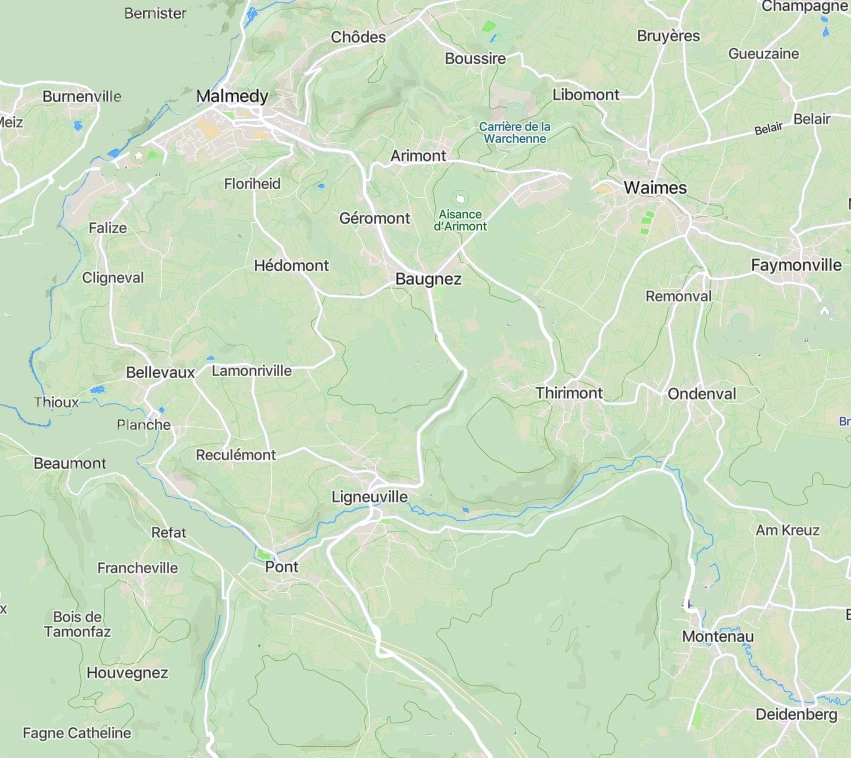
 The 120th Infantry Regiment attacked at 0800. The objective of the 3rd Battalion was Houyire, the dominating piece of terrain between Malmedy and Ligneuville (Belgium) and commanding the Malmedy – St Vith Road. The first goal for the 2nd Battalion was Thirimont (Belgium) and the 1st Battalion was to support those two battalions with its fire. Coming down the main highway as far as Baugnez (Five Point Crossroads), the 3rd Battalion cut to the west, through the woods and with King, Love and Item Companies, abreast, hit the forward slope of the hill and drove the enemy off by noon.
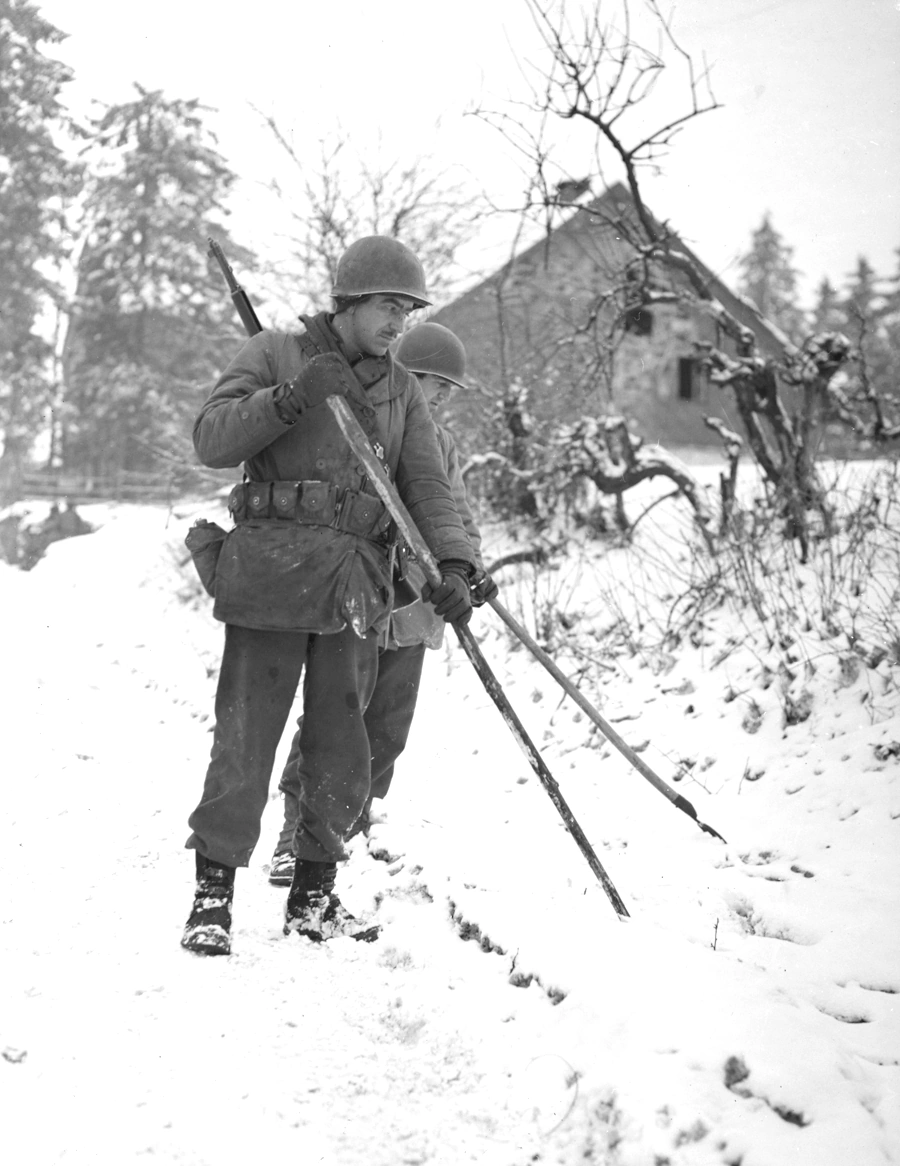
 By 1400, positions were consolidated with a road block emplaced, and with Love Co on the south or reverso slope, King Co on the west, and Item Co on the east. Also at 0800, January 19, the 2nd Battalion of the 120th Infantry Regiment moved to the east, and then when north of Thirimont (Belgium), and attacked directly south, toward the town. Thirimont was expected to be seized that day. That was not the case, however, and it took that day and almost two more, before the mission was accomplished. It must be remembered in following the action around Thirimont, that enemy
 resistance came not primarily from the town proper, or from forces coming in to reinforce the village from the south, but from the east; from the exposed left flank of the 30th Infantry Division. When the Division moved off in the attack on the morning of January 16, the 106th Infantry Division on the right flank, moved south in a complementary action. On the left flank, however, the 1st Infantry Division did not move and as elements of the 30-ID advanced south, their left flank was
 exposed to enemy artillery and infantry attacks coming from the direction of Ondenval (Belgium) (850001), and Faymonville (Belgium) (865017). With George Co on the left, Fox Co on the right, and Easy Co in reserve following closely, the 2nd Battalion attacked toward Thirimont. While it was still rather dark, George Co slipped past the outer ring of defenses of the town and got into the town proper.

 Fox Co moved down the Waimes (Belgium) strong point to Thirimont road, but was not as fortunate. Caught by the enemy strong point set up in the road and on both flanks. The Company, led by Capt John M. Jacobsen, was hit by small arms fire, automatic weapon and artillery fire.
 The artillery fire came from the east, estimated to be west of Faymonville by approximately 2000 meters. Because Hauts Sarts was a hill overlooking Thirimont and all the approaches to it, it was logically assumed that enemy observers, from posts on the crests, 1800 meters south of Fox Co, communicated fire direction information to the artillery, 2000 meters east.
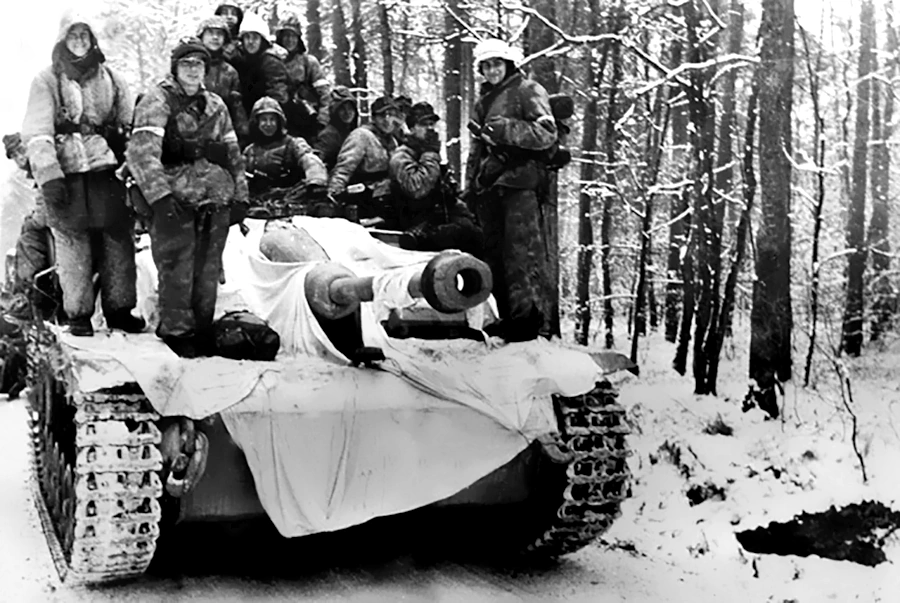
If Fox Co had had some armor support, they may have gotten by the road block. But the 2nd Battalion armor of one platoon of tanks and 2 platoons of tank destroyers were all held up near the line of departure when the lead vehicle hit a mine and stopped the entire column. Therefore the attack was launched without armor support. In any event, Fox Co slugged at the strong point (831015) until about noon, and then badly depleted, they were forced to retire. George Co, attacked to the left of Fox Co and bypassed the road block (839011) and was in the village of Thirimont by first full light. If the left flank had been secure, and German reinforcements could not have come from that exposed enemy held area, such a maneuver of bypassing a strong road block under the cover of early morning darkness would have been excellent. Once in Thirimont, George Co took up positions in the cellars of buildings. Fire fights were continued throughout the day and artillery fell heavily in the town. Enemy artillery came from the vicinity of Ondenval and Lt Monerieff called for artillery fire by radio throughout the day. He directed that fire capably, and frequently called for concentrations that landed among enemy troops and the house next to the one he was occupying.
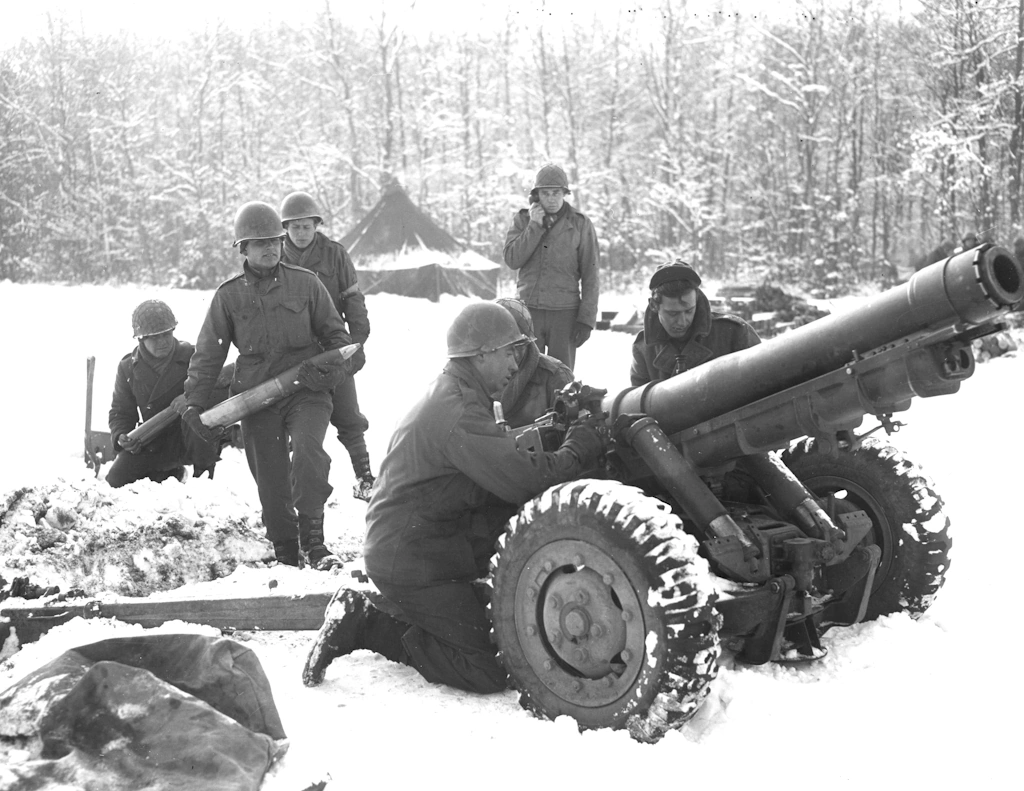
 Throughout the day, January 13, attempts were made by the 2nd Battalion, 120-IR to reinforce Lt Monerieff’s position. Fox Co could not get by the road block and enemy outpost positions in the vicinity of (839011). An attempt was made by 1/Lt Walter A. Wert, to push Easy Co through the woods and around the right of Fox Co to Thirimont. The woods were almost impenetrable and German troops in dugout positions effectively halted small groups from infiltrating. So, the fighting in Thirimont continued throughout the day and George Co’s casualties were mounting.
In a telephone conversation made at 1215, that day, to the Corps Commander, Gen Hobbs said, ‘I had come under the assumption that the big unit (1st Infantry Division) on our left would do something to relieve the pressure on our left, if anything could be done to have some elements on the left push along and take the pressure off, it is essential’.
During the early hours of darkness, small groups of Germans got into the village which they approached from the east. Then at approximately 2000 hours, under complete blackness, the enemy launched a counter attack of seven tanks supported by over 100 infantrymen. Lt Monerieff called for artillery fire, asking for HE shells mounted with proximity fuse. It was very effective in eliminating the enemy infantry, but the tanks were not damaged to any appreciable extent. Shortly after the initial counter attack, larger groups infiltrated to Thirimont from Ondenval. At about 2200 hours, Lt Monerieff called back to Battalion requesting permission to withdraw from the village with the men that remained. Permission was granted and Monerieff led his Company back through the woods, along snow covered trails and in inky blackness. Of a force of about 110 men that had moved out with George Co at 1700 that morning, approximately 40 officers and enlisted men returned. The strength of George Co on January 13, was 163 enlisted men and officers. On January 14, it was 84 enlisted men and 3 officers. Included in the 84 enlisted men was the company headquarters, cooks, mechanics, etc.
At about midnight, January 13, the 2nd Battalion, 120-IR had withdrawn to their position occupied before the morning attack had been launched. At 0030, January 14, the 1st Battalion, 120-IR, under Col Ellis W,. Williamson attacked through the badly mauled 2nd Battalion for the same objective, Thirimont. The battalion encountered extreme difficulty in attempting to move through the blackness of the night, the woods, and the heavily falling snow. At almost 0600, the battalion had advanced through the enemy outposts on the outskirts of Thirimont. The temperature was dropping steadily, and a further difficulty was encountered with radio communication. The cold caused the radios to malfunction in many cases and radio control of the units became difficult. Coupled with the fact that enemy artillery still rained down from German positions in the vicinity of Ondenval, very little progress was made against Thirimont. The 30-ID Artillery played an important role during the day and leveled a large amount of artillery fire on enemy vehicles,
batteries and infantry units. The fire was directed almost entirely by air observation and was doubtless costly to the enemy.
From noon, January 13 to noon of the following day, the division artillery units fired almost 10.000 rounds of 105-MM and 155-MM ammunition. The use of the artillery Cub planes for directing the fire was profitable and as Col Purdue, CO of the 120-IR pointed out, the planes also called back by radio important enemy movements, the results of friendly artillery fire, and served to keep enemy artillery batteries silenced for fear of being spotted by Cub plane observers, who in turn would call down artillery fire on such batteries. Throughout the day, the 1st Battalion, 120-IR supported by the 2nd Battalion, hammered away at Thirimont unsuccessfully. An attempt was made to strike at that village from the west by the 3rd Battalion with Hauts Sarts as the base. Groups of the enemy had infiltrated during the night of January 13/14 from the east, and had reinforced the already strong group on the steep hill that over looked Thirimont. The Germans maintained communication back to Ondenval, and artillery fire on friendly troops fell on the morning of January 14. At 1150 hours, Item and King Cos attacked for the hill, but were beaten back. Under ordinary conditions, driving an enemy from such a superior defensive position as afforded by the crest of a hill would have been difficult. But attempting to advance up the side of a barren slope against snow, ice, wind and a firmly entrenched enemy was an almost impossible task. The attackers were forced to a halt 500 meters from Hauts Sarts. That objective was very valuable to the enemy, for not only did he use the crest for an Observation Post (OP) to direct fire on troops moving toward Thirimont, but he could also direct artillery fire on anything in the area moving on the Malmedy – Ligneuville road south of Geromont.