


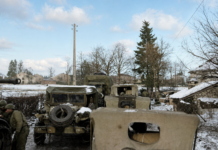
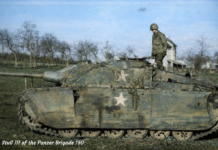


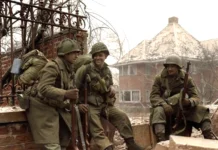
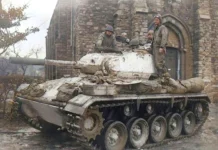

Securing the main road to Manhay, 2/424-IR, crossed open ground to the edge of the town under intense shelling. It pushed into the town, then was forced to withdraw. On Christmas day, the battalion punched its way into town again and held on against furious resistance by the 2.SS-Panzer-Division (Das Reich) and Volksgrenadiers. Manhay was one of the significant turning points of the Ardennes Battle. It too, was a story of valor. When Easy Co’s advance was halted by intense machine gun fire, S/Sgt John F. Goidesik advanced alone with a 60-MM mortar and destroyed an enemy position with three rounds permitting his company to advance. Sgt Richard J. Maslankowski, cradled a .30 caliber Browning machine gun in his arms and advanced to wipe out an enemy machine gun nest. The gun jammed; he repaired it under fire, pressed on to kill the enemy gunners with his last burst of ammunition. Capt Glynn Salyers, CO How Co, 424-IR, was wounded while leading his men across an open field. He refused medical attention until the objective was won and all his wounded men were cared for.
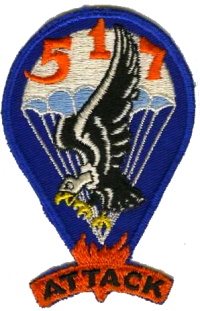 After Manhay, the 106-ID continued to hack away at the Bulge. The 517th Parachute Infantry Regiment was attached on January 11, and with the 424-IR, formed a tough battle-tried fighting team. The two regiments attacked on the northern side of the Bulge, jumping off along the Ambleve River between Stavelot (Belgium) and Trois-Ponts (Belgium) and along the Salm River to the south. Terrain was rugged-barren ridges, heavily wooded slopes, deep gullies. The enemy was well dug in and had been ordered to hold at all costs. But the men of the Golden Lion Division had a score to settle. Determined, they smashed ahead. The attack on January 13 drove the enemy from positions east of Henoumont (Belgium), and the infantry advance carried to Mouhipré (Belgium) by late afternoon. In Henoumont itself, resistance was rugged. The enemy made effective use of self propelled guns (Panzerfaust & Panzerschreck).
During an assault on the strongly defended town, sudden crossfire from well-concealed machine guns halted Item Co 424-IR, scattered men and mortally wounded Lt Raymond S. Kautz, the company commander, and the mortar platoon leader, Lt Robert A. Engstrom. Although wounded himself, T/Sgt Harold R. Johnson, assumed command of the company. He was hit twice more while rallying the men, preparing to renew the attack. He personally directed intense accurate mortar and machine gun fire on the enemy automatic weapons, eventually led the men to their objective. When his platoon of King Co 424-IR was pinned down by fire from an enemy emplaced machine gun, Pfc George S. Vasquez located the gun, went forward with his M-1 and wiped out the Nazi position single-handed. Charlie Co 424-IR, was held up by three enemy tanks. Lt Robert Honaker, led a bazooka team which destroyed one tank and repulsed the others. Lt Honaker later earned a battlefield commission and a Silver Star.

The 106-ID pressed south and east. The 1/424-IR, met serious opposition in front of La Coulée (Belgium) where the enemy was dug in on a strong and deep defensive line. Fighting was fierce, losses were heavy. While the 424-IR attacked to the front, engaging the main strength of the defenders, the 517-PIR swept around and cleared the town in a slam-bang action before the enemy could recover and regroup. After seizing all assigned objectives, the 106-ID was given the additional mission, on January 15, of taking the town of Ennal (Belgium) and the high ground to the east. Ennal was held by a strong force of Germans entrenched in the houses bristling with automatic weapons. (Note: Ennal, is the place where, in 1989, I dugged out an entire German machine guns position pulling out two complete MG-42 tripods with MG-42 still mounted on, several German Gas Masks and hundreds of Cal. 8.57 ammunition some boxed some not (none stamped SS) and 9 WSS Helmets. This was beaten a couple years later when we were called to pickup a very deep buried crashed P-38 with pilot inside. (Doc Snafu).

 Two platoons of King Co 424-IR, punched their way into Ennal but were pinned down by devastating enemy fire. Ennal had to be secured by night. Available forces were organized and, as darkness approached, the town was taken by assault and cleared. Gen Perrin personally led the attack, for which he was awarded the DSC. On January 16, the 517-PIR which had reached the road from Petit-Thier (Belgium) to Poteau (Belgium) by nightfall was on the outskirts of Poteau. But the advance of the 30-ID and the 75-ID pinched off the 106-ID. The division was then ordered to mop up and by-passed enemy troops in the area. On January 22, Gen Perrin issued the following: With the withdrawal of the 424-IR from the line on January 18, the major portion of the elements of this division completed a period of 34 days of practically continuous close combat with the enemy. Our artillery is still engaged. The events of that period are still fresh in your minds and in those of your men. The physical hardships endured, the constant exposure to rain, sleet and snow in freezing temperatures, and on terrain over which it was once considered impossible to wage effective warfare, have, so far as I know, rarely, if ever, been demanded of soldiers of any nation. Those twin enemies and weather and terrain have been our greatest problems, for certainly, wherever we have met the German, we have found that he is in no sense our equal. You and your men have met those demands and overcome them by a stubbornness of will, a fixed tenacity of purpose, and a grim and determined aggressiveness of body and spirit. You have accomplished your missions, and no bigher praise can ever be spoken of any military organization.
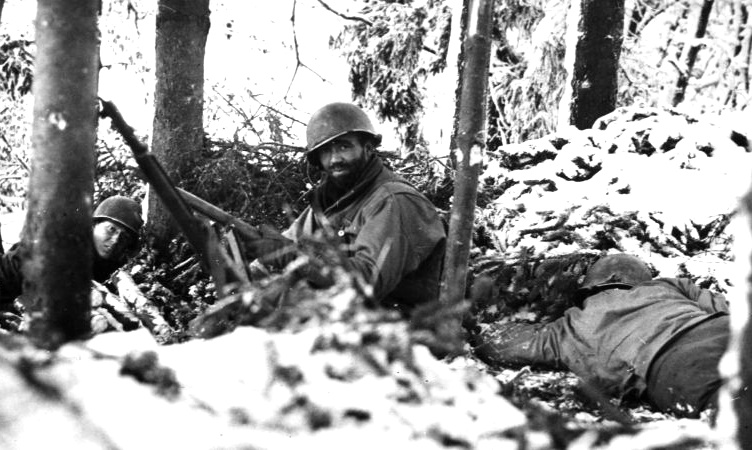
The 106-ID Has Record of Valor and Honor

 After a well deserved period of rest, the 424-RCT joined the 7-AD in the mission all Golden Lion men had been waiting for: retaking St Vith. The 424-IR struck southeast on January 25 from a point just north of St Vith with the objective of securing the main highway running through Amel (Belgium) to the northeast. A coordinated infantry-tank attack dislodged a main enemy outpost at a road junction. By late afternoon, in the face of automatic weapons, 88-MM guns and small arms fire, doughs cleared the town of Medell (Belgium). The following morning Meyerode (Belgium) fell to the furiously attacking 106-ID. The 7-AD then seized St Vith while the 106-ID took Deidenberg (Belgium) and Born (Belgium). The 106-ID now was back at the line where it had first met the enemy. It had taken fierce punishment but had come back in some of the bloodiest fighting of the war, a proud achievement for a division that had a history of less than two years. On February 28, 1945, Gen. Donald A. Stroh now was in command of the division and after another short rest, were back in the line on the south flank of 1-A near the Belgian town of Hunningen (Belgium). For three weeks they had patrolled and probed the thickly-sown mine fields to find a weak spot in the pillboxes, concrete gun emplacements, dragon’s teeth and anti-tank obstacles of the Siegfried Line.
Facing now the 106-ID was a division identified as one which had been in the attack on St Vith in December 1944. With the memory of the breakthrough still vivid, Lion men sought vengeance. They got it. Charlie Co 424-IR, with combat engineers from Able Co 81-ECB, knocked out a large, particularly troublesome Nazi pillbox. The team clawed its way under machine gun and rifle fire, over four rows of anti-personnel mines and up to the very walls of the fort. Germans in their foxholes outside the pillbox were killed or driven off. Fire from the embrasures was silenced by flame throwers, rifle grenades and bazookas.

 Pvt Dennis A. Wartigun, Able Co 81-ECB, approached the eight-foot thick walls and with a long pole, pushed a charge of TNT through an opening. The blast cracked the walls, blew open the door, killed three of the defenders. Doughs rushed in to capture nine other Germans who needed no further persuasion to surrender. Slowly, methodically, pillboxes fell.
 A week later, the 106-ID was well on its way through the bunkers and fortifications of the Siegfried Line heading toward the Rhine River. Fighting on the southern flank of V Corps and the 1-A, the 106-ID was in contact with 3-A to the south. Led by 3/424-IR, Lion men wrested Frauenkron (Germany) from the enemy. Driving through fields of anti-tank and anti-personnel mines, the 424 crossed Lemert Creek (Germany), seized the towns of Berk, Kronenburg and Baasem in Germany), as it advanced toward its objective along the Simmer River. Other divisions of the V Corps started to swing to the southeast as the Siegfried Line was breached, pivoting on the 106-ID. The 3-A continued to drive to the east, and the division was pinched out. After mopping-up operations, the division was pulled back to Corps reserve and the 517-PIR was relieved from the 106-ID control.
 Assigned to 15-A, the division moved to St Quentin (France), late in March. After a brief stay, it moved to Rennes (France), where reinforcements were brought in and the 422-IR and 423-IR, along with the 589-FAB and the 590-FAB, were reconstituted. For the first time since the division had gone into the line, it was up to full strength. A strenuous, tough training program was started for the reconstituted units at Rennes and later resumed at Coetquidan (France). While at Rennes, the 3/159-IR (7-ID), Aleutian veterans; and the 401-FAB and the 627-FAB were attached to the division. The 106-ID now was not only at full strength, it had a surplus — a far cry from the dark final days of December when the 424-IR and a few attached units were the division’s only force. An impressive ceremony was held on April 14, 1945, at the St Jacques Airfield near Rennes. Survivors of the original 106 regiments lost in the breakthrough presented their colors to the new members of the 422 and 423-IRs. While the division stood at present arms on the parade ground, commanders, with the old and new color guards armed with German rifles captured in the Battle of the Bulge, advanced to the center of the field where they exchanged salutes. Colors and guidon were then presented to the new color guard. When the units reformed, the augmented division of five regiments and six artillery battalions passed in review before Gen Stroh. A similar ceremony on a smaller scale was held later in Germany by the 424-IR. During the hectic see-saw battle in the early days of the Ardennes Breakthrough, the regiment lost its colors. After V-E Day, a medic of the 2-ID, then moving into Czechoslovakia, recovered the colors from a German prisoner and sent them back to the 106-ID. The colors were presented again to the 424th in an impressive ceremony.
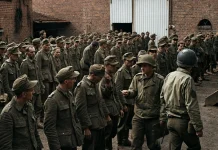
While in the Rennes Area, the 106th constituted the reserve for the 66-ID and French units containing the strong German garrisons on the coastal area of St Nazaire (France) and Lorient (France). Plans were being made to relieve the 66-ID but orders came through for the division to return to Germany. Leaving the reconstituted units to complete their reorganization and training, the 424-IR, 3-IR and the 159-IR, with other units, raced across France to corral the thousands of prisoners being taken in the final drive through Germany. Spread out along both flanks of the Rhine River from Holland to Switzerland, the 106-ID was reinforced to a strength of 40.000. Approximately, 1.500.000 PWs passed through 106-ID cages. It was a big job: receiving, screening, processing and discharging the hordes of former German soldiers. But it was a job the 106 relished; many of the Germans were the same ones whom they had battled in the Ardennes.
Meanwhile, the reconstituted units of the division moved from Coetquidan, to a training area near Mayen (Germany), named Camp Alan W. Jones for the former CG. They completed their training and were ready for action when Germany surrendered on May 8, 1945. Following the surrender of Japan, the 106, now under the command of Gen Francis A. Woolfley, was alerted to return to the States. The division had been through some of the hardest fighting in the European Theater. It had suffered huge losses. It had no record of blitzkrieg offensives or mile-devouring advances. But it had more than that. The 106th had a story of valor and honor; of men who had stuck it out against the most powerful force the Germans could muster and had lashed back with the courage of lions. The men of the 106th could wear their insignia with pride.
Note: my copy of this original document was not complete, page 27 was missing. Fortunately, I found this pages on the http://www.lonesentry.com.
The Golden Lions: Forever in the Heart of Belgium
In the cold, brutal winter of 1944, the hills and forests of Wallonia and the German-speaking regions of Belgium bore witness to one of the fiercest battles of World War II — the Battle of the Bulge. Among the brave American soldiers who stood their ground was the 106th Infantry Division, known as the ‘Golden Lions’. For the people of Belgium, especially in the south, this division is not just a name in a history book — it is a symbol of sacrifice, courage, and liberation.
Many of these young American men had never set foot in Europe before. They came not as conquerors, but as liberators, ready to face the horrors of war in a foreign land so that others might live in peace and freedom. The 106th bore the brunt of the initial German offensive, suffering heavy losses. But their resistance bought time — time that proved critical for the eventual Allied counterattack and ultimate victory.
Today, though most of the eyewitnesses have passed, their stories have not. Parents and grandparents have passed them down to children, and those children now pass them on again. We remember not only the battle, but the faces, the names, and the humanity of those who fought. The people of Wallonia and the eastern cantons hold a deep, enduring gratitude toward the Golden Lions. They did not just fight here — some gave their lives here. And in doing so, they became part of our soil, part of our story.
We teach our children about the Lion Men — who came from across the ocean to defend our homes and our future. We remember, we honor, and we promise: we will never forget.
PS Let it be clear: when we speak of Belgium, we speak of a proud nation in Europe the continent, not of the European Union or its political institutions. The people of Belgium stand for freedom, sovereignty, and dignity — and for the most part of us, we do not associate ourselves with the increasingly corrupted bureaucracy of the so-called European Commission & Union, which in some ways echoes the centralized control once dreamed of by tyrants like Hitler. Our national flag tells our story in three colors: Black for the lives of our men lost in the wars that scarred our land, Yellow for the courage and spirit of those who rose to defend it, and Red for the blood they shed so that Belgium might remain free.
Doc Snafu