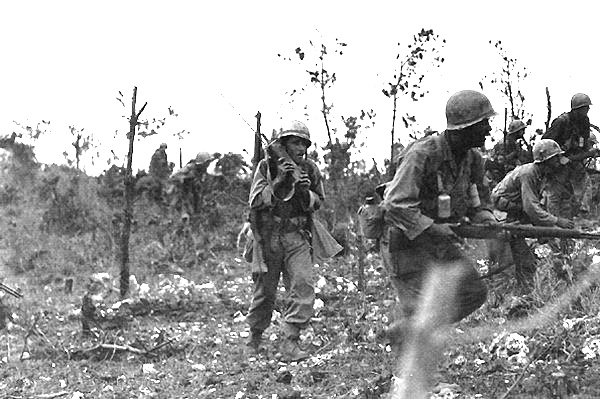


Attack on the Shimbu Line – (Mount Mataba)
 Charlie Co left the area of departure in a single file at 0215 April 10, in a column of platoons, according to plan. A four-man patrol preceded the company by one hundred yards with the mission of furnishing early warning of any enemy activity to the front. This patrol had communications with the company by means of an SCR-536 radio. The men selected for this patrol had previously been over this ground on reconnaissance missions looking for the best route of approach to Mataba.
The movement from the area of departure to the base of Mount Mataba was made over a well-defined trail and presented no particular problem of control. At 0330, the company reached the base of Mataba and continued in a northerly direction toward Ridge R, the company route of approach to the top of Mataba. Without warning, and sending chills down the spine of every man in the company, the silence of the night was broken by the ferocious barking of several dogs, terminating in a sharp whine and a brief order in a foreign tongue. The column halted but no further sound was heard. Several thoughts passed through the mind of the company commander at this time. Had the element of surprise, as essential to the successful accomplishment of the mission, been lost? Was this an outpost of the enemy, a series of listening posts, employing dogs? If it was an outpost, would it call for mortar and artillery fire? Did the enemy know the true size of the unit or possibly think that it was only a patrol?
 After several minutes had elapsed without further incident, the column continued in the direction of Ridge B. At 0245, the security patrol reported that enemy movement could be heard approaching from the north. The 1st Platoon was deployed to the left and right, while the security group was ordered to remain in their present position and to keep the company commander informed of the situation. From the excited reports that poured in from this group, a force of considerable size was approaching. Meanwhile, the company commander had moved forward to join the 1st Platoon, where machine guns on each flank had been set up, ready to commence firing on the order of the platoon leader. At 0355 the security group reported that the suspected enemy force was Able Co.
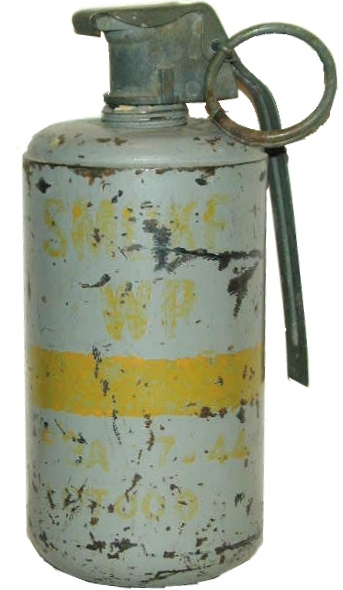
The two company commanders held a conference and decided that they had overshot their respective ridges. They felt they were located somewhere between Ridges R and 3. It was decided that the companies would reverse their respective routes and use the first ridges they came to as their routes to Mataba. While A Co was withdrawing, excited voices, jabbering in Japanese, could be heard a short distance away. The 1st Platoon sergeant and four men were sent to investigate the noise. They encountered a large cave from which the noises were plainly audible. White Phosphorous hand grenades (M-15) thrown into this cave resulted in cries of pain. One Jap, who ran out of the entrance, was quickly killed by a rifleman. No further sounds could be heard. A squad was left in the vicinity of the cave to furnish security as the company passed this location.
At 0420, the 1st Platoon Leader reported that he was at the base of Ridge K and he was ordered to advance up the ridge. Due to the narrowness of this ridge, the column remained in a single file. By daylight, all elements of the company, with the exception of the 60-MM Mortar Section, were advancing. At 0830, the company received sniper fire from Ridge Q, approximately four hundred yards to the south. The men were forced to hug the ground, taking advantage of any cover and concealment they could find. The fire was finally located coming from a cave on the forward slope of Ridge Q. Small arms and machine-gun fire were directed into this cave, resulting in one Jap being flushed out. He ran over the ridge and disappeared from sight. A check of the company revealed that three men had been wounded, including the company commander’s messenger and radio operator. One of the casualties could not walk and four men from the 3rd Platoon were used to evacuate this man on a litter.
Meanwhile, smoke was placed along with Ridge Q and denied the enemy further observation from this direction. At 0945, the company had advanced approximately two hundred yards forward when the company commander noticed for the first time that the remaining elements of the company were not following. The company commander turned to retrace, his route, but in so doing, twisted his ankle, lost his balance, and went head over heels down the north side of the ridge. Approximately three-quarters of the way down he stopped his descent in the midst of dense vegetation and amid the excited babbling of enemy voices. Without a lost motion, he unhooked his cartridge belt and began scrambling up the aide of the ridge with tiny puffs of dust kicking up all about him. He succeeded in reaching the top only to look into the muzzle of an M-1 rifle held by one of his men. In fact, this was the same man who had failed to see the column move out and consequently held up the balance of the command.
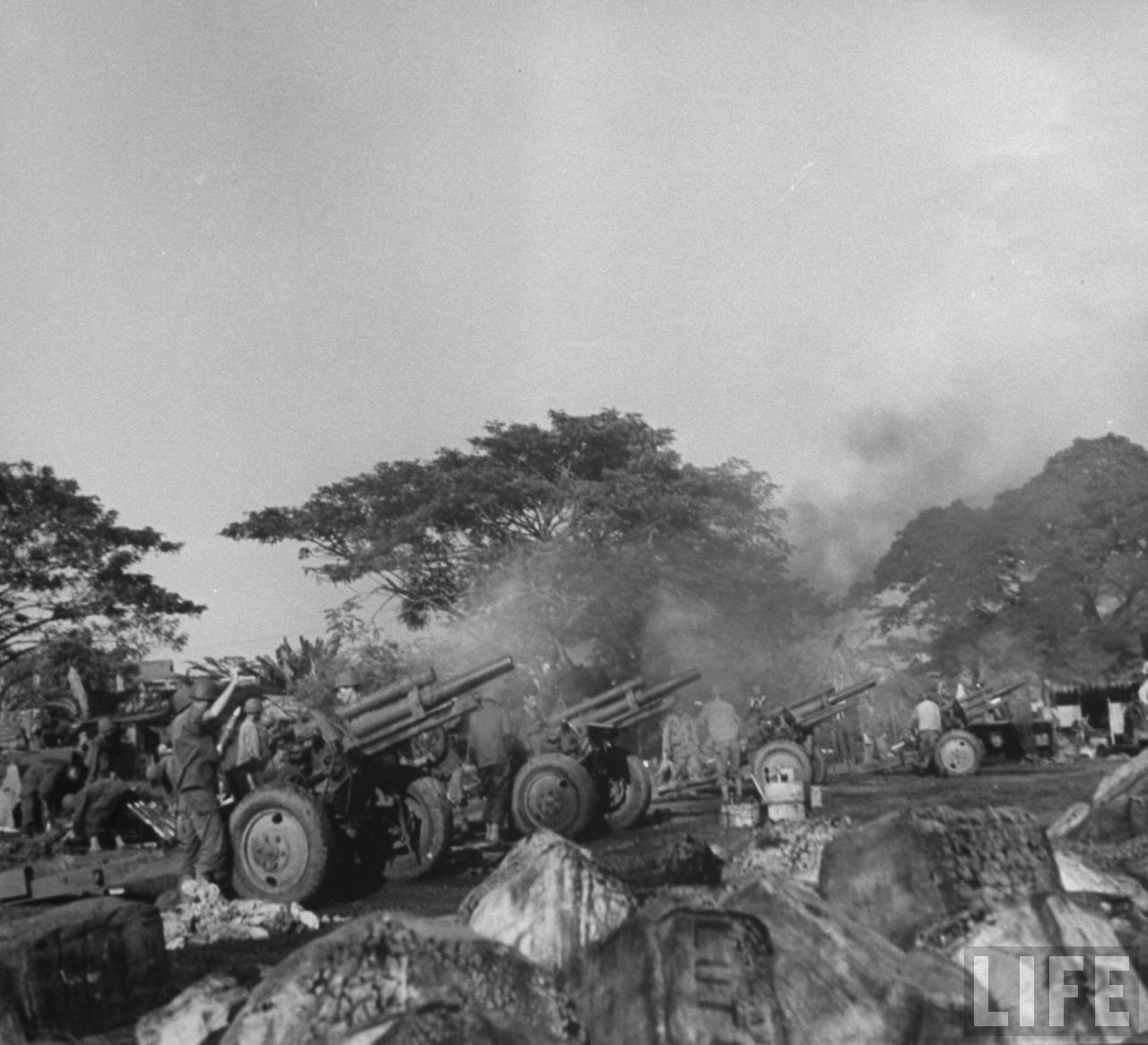
A radio message was received at this time from the 1st Platoon Leader reporting their location at Point W, approximately one hundred and fifty yards from the top of the main ridge running north and south. From there he had observed thirty-six Japs moving south along the ridgeline. The company commander moved forward without delay and joined the platoon leader. At 1045, they observed small groups of Japs moving to the south. This area, approximately one hundred fifty yards northeast of Point W, appeared to be covered with foxholes. A ten-minute artillery preparation of high explosives was placed on these positions. Since the wind was blowing from the north it was decided to end the concentration with smoke, which, drifting south, would obscure any enemy visibility from that direction.
At 1100, just as the artillery preparation finished, the 1st Platoon jumped off and succeeded in reaching this area without opposition. The 1st Platoon was ordered to hold this position and to protect the right (south) flank of the company as it turned left (north) and advanced to the north along the main ridge. The 1st Platoon was instructed that it would protect the rear of the company after all elements of the company had passed. The 2nd Platoon was directed to pass around the left flank of the 1st Platoon, turn north, and advance along the main ridge. The command group followed the 3rd Platoon and the remainder of the formation remained unchanged. The 60-MM Mortar Section had joined the column and had gone into a position to support the advance of the company. Meanwhile, the 1st Platoon had sent six men down the ridge to the south to secure the company’s right flank and rear. One of these men observed a patch of grass almost at his feet which seemed to rise out of the ground. He fired into it and was rewarded with a cry of pain. He discovered a very cleverly constructed foxhole.
 It appeared to be a normal foxhole, four feet deep, and two feet in circumference, with a cover constructed for the top. This cover consisted of a network of interwoven branches covered with a topping of sod which blended in perfect harmony with the terrain, affording excellent concealment for the hole as well as the occupant.
Apparently, the enemy planned on hitting the rear of the column as it moved north along the main ridge. The mere fact that this particular Jap had become over-anxious and was lifting his cover to observe the column led to his timely death. Two other similar holes, occupied by the enemy, were found and their occupants liquidated.
At 1200, the 2nd Platoon leader reported that he was maneuvering around a cave, east of the main ridge, where he had observed a Jap disappear. The company commander ordered him to send a security party forward along the ridge. By 1215, the resistance in the cave had been eliminated primarily by the use of white phosphorous hand grenades (M-15 WP) which had killed an undetermined number of Japs. At 1245, the 2nd Platoon reported that they had reached a small knoll approximately two hundred yards south of Knob 1. The company commander joined the platoon leader at this point.
A number of the enemy was observed moving westward in small groups. Artillery fire dispersed these groups and inflicted an unknown number of casualties. Part of Able Co, on the left of Charlie Co, was observed in a grenade battle with four enemies on Knob 1, which terminated when a white phosphorous grenade landed in the crater hole occupied by the Japs. Two of the enemy were killed by small arms fire when they left the crater hole in an effort to escape the effects of the grenade. Meanwhile, Charlie Co’s machine guns had gone into position and began firing on small groups of the enemy attempting to infiltrate across open ground to Knob 1.
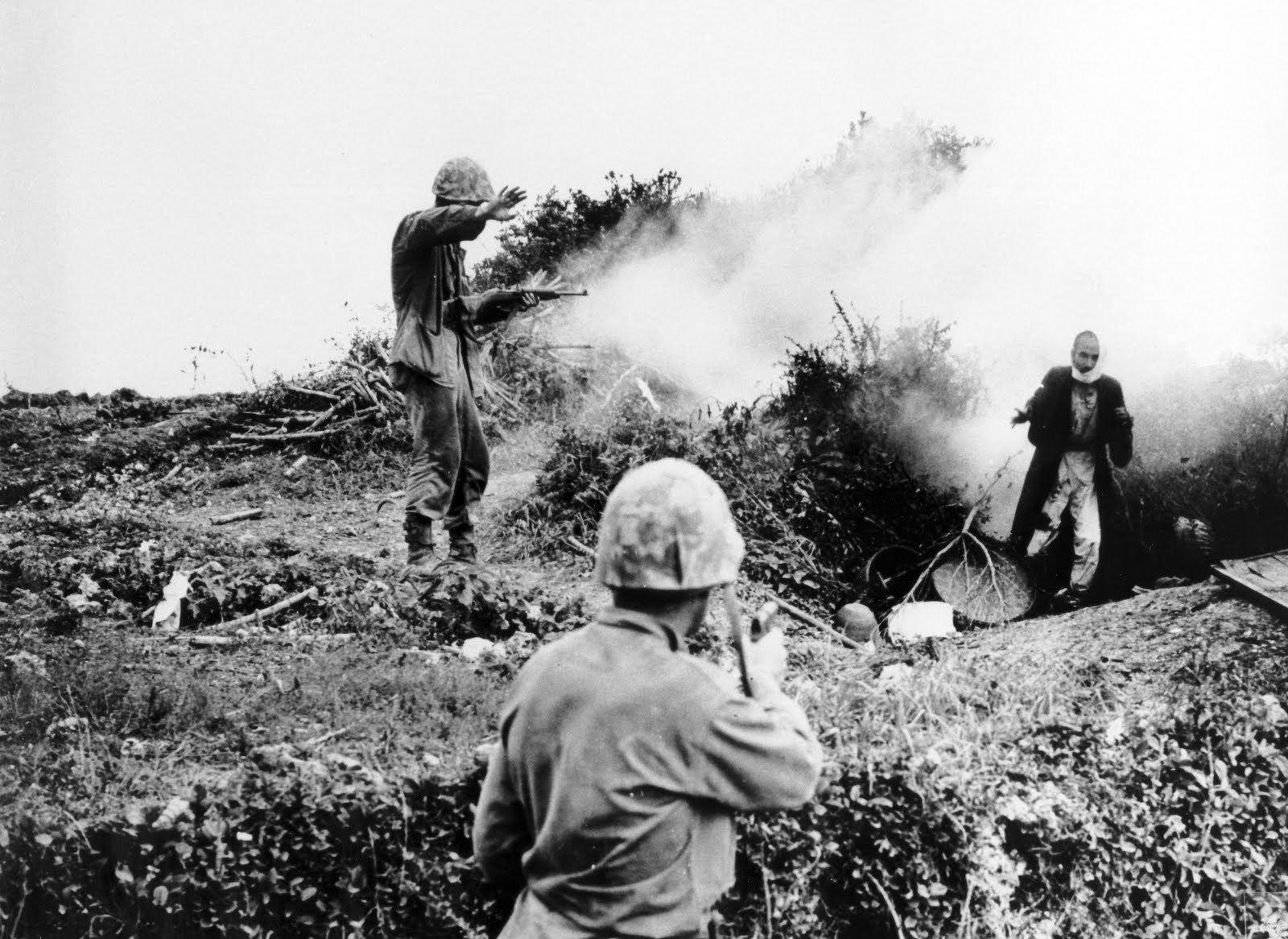
These groups dispersed arid and retreated toward the north. No further resistance was encountered and, at 1315, the battalion commander was informed by radio that Knob 1 was secured. He ordered Charlie Co and Able Cos to form a perimeter defense around Knob 1 and to dispatch recon patrols towards the north. Charlie Co-organized the north portion of the perimeter.
Meanwhile, a patrol of seven men from the 3rd Platoon had approached Red Top from the south. Several Japs were seen by the patrol moving toward the north along the main ridge. No resistance was offered, with the exception of harassing sniper fire from the front and flanks, and the patrol succeeded in reaching Red Top at 1600. The remainder of the platoon was ordered to join the patrol immediately and instructed to form a perimeter for the night. Artillery and mortar fire was adjusted around Knob 1 and Red Top Hill for the inevitable counterattack was expected.
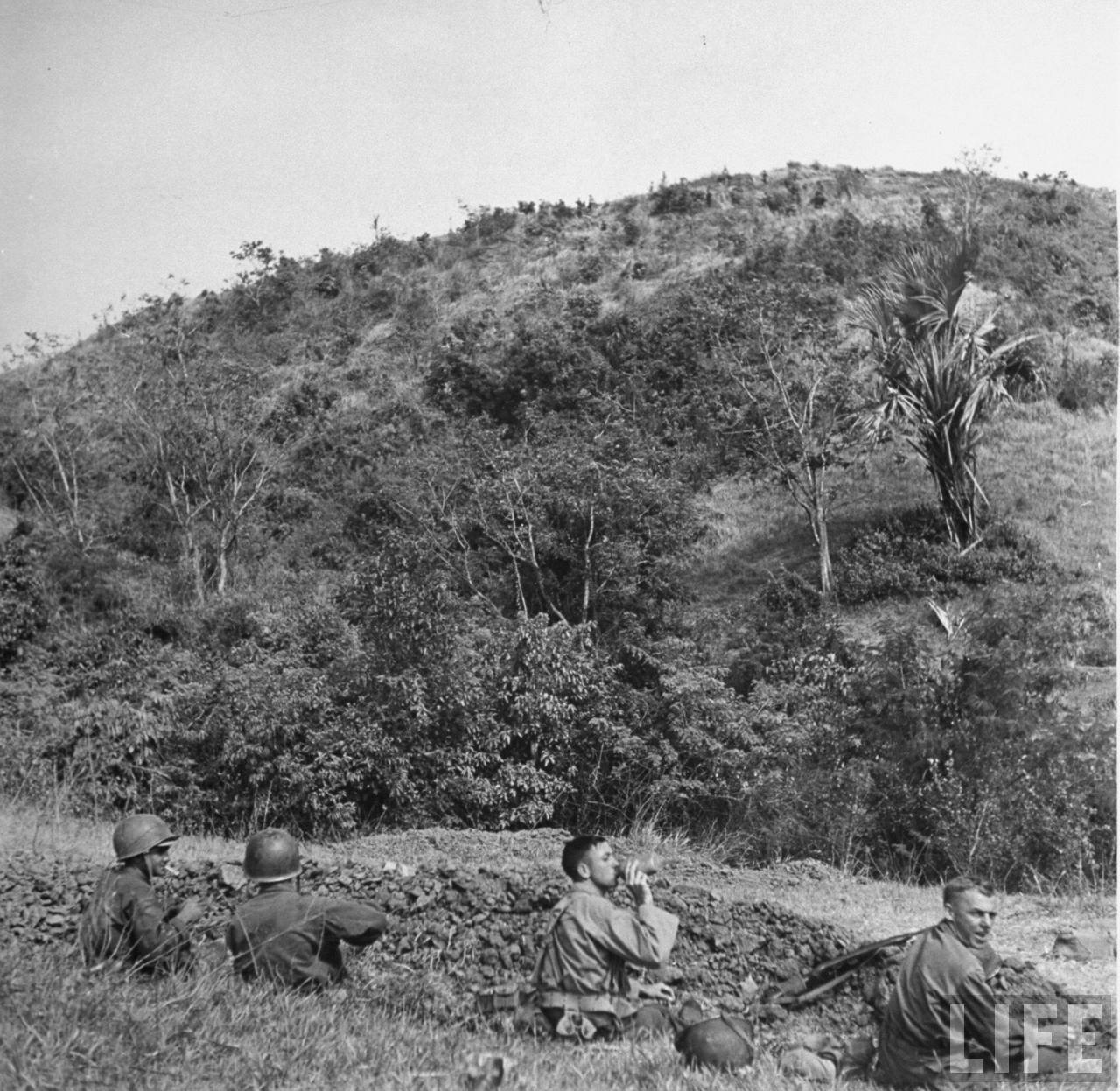
At 1730, the company (-), occupied the northern portion of the perimeter on Knob 1, while the 3rd Platoon dug in on Red Top Hill. At 1800, the company was notified by phone that an attempt to resupply the company by carrying party had failed due to enemy artillery and mortar fire, but a liaison plane would drop supplies the following morning at 0900. The company should be prepared, on call, to mark the drop area with a smoke grenade. Fortunately, the men still carried two combat-type K rations and sufficient rifle and machine-gun ammunition. Shortages existed in hand grenades, especially white phosphorous, and water.
At this time, Charlie Co had approximately fifty men on Mount Mataba. In addition to the men who were wounded and who had acted as litter bearers, a number of men suffered from heat exhaustion because of the strenuous climb up the slopes of Ridge R and were forced to fall to the rear. Among these men was the 1st Sergeant and Communication Sergeant. A radio message informed the company commander that these stragglers had been collected at the base of Ridge R by the 1st Sergeant. They would occupy positions in Baker Co’s perimeter for the night and would lead the carrying party forward the following day. Shortly after dark, the wireline to the battalion went out and arrangements were made to make reports on the even hours by SCR-500 radio. Charlie Co’s radio would be off the air between reports to conserve batteries while the battalion set would remain open in case of an emergency message. Although artillery and mortar fire was received on the position, the expected enemy counterattack failed to materialize.
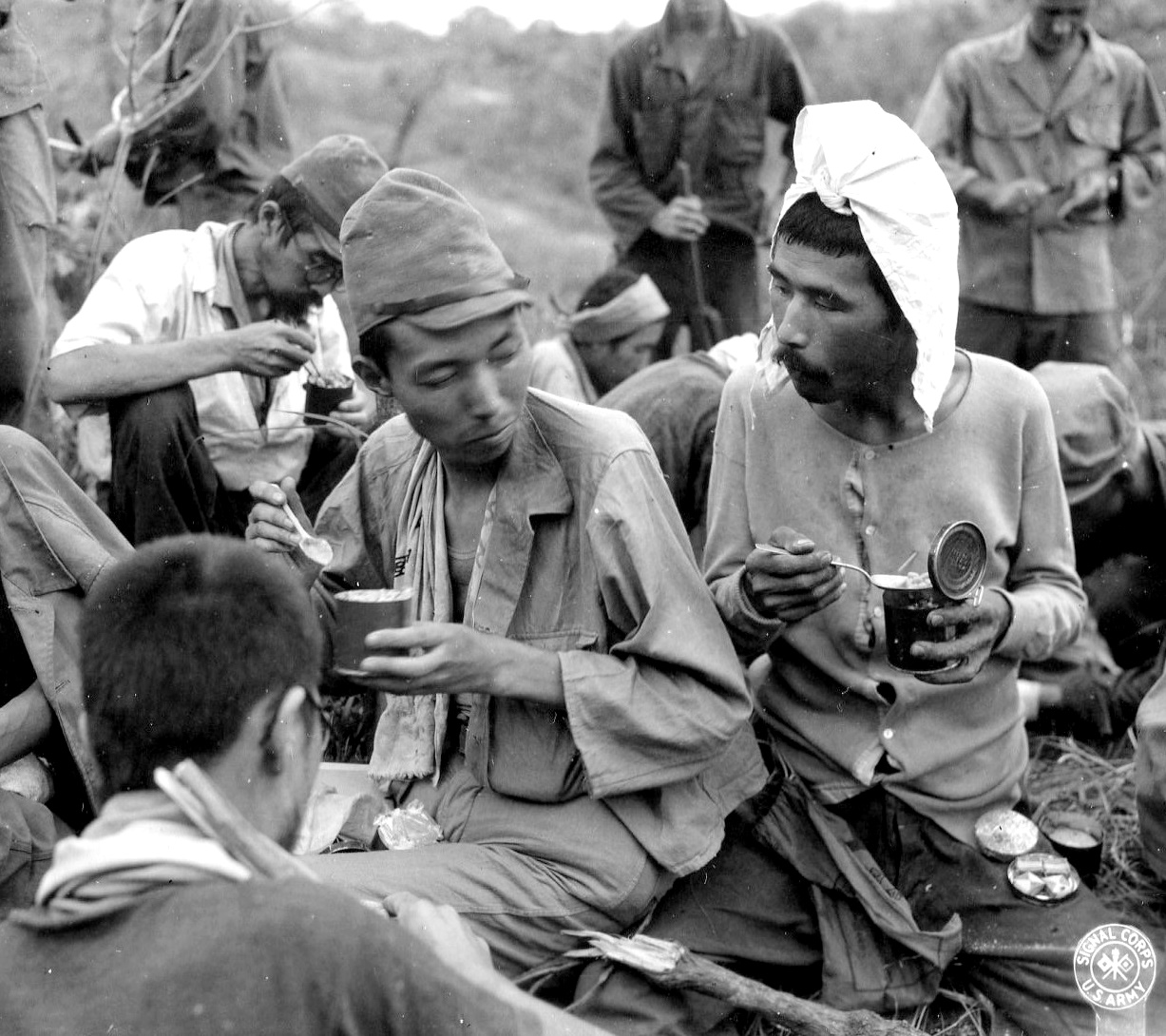
Second Day on Mount Mataba
The second day on Mount Mataba was spent improving the defensive positions on the northern portion of the perimeter. Recon patrols were sent north along the main ridge toward Knob 2 but withdrew after receiving small arms and mortar fire from this vicinity. At 0915, the liaison plane dropped supplies, including water, rations, ammunition, and blood plasma. Late in the morning, the battalion commander directed the company to endeavor to locate the enemy mortars that were firing on the 4.2 mortar positions. At 1125, artillery and mortar fire was received on the company’s positions. All attempts to locate these positions met with negative results. Meanwhile, information was received that the battalion supply train was hit by a 90-MM mortar fire and that one Filipino carrier was killed and five wounded. It was reported that the enemy mortars were firing from Mango Gorge. This supply train was carrying food, water, ammunition, and blood plasma. It became quite evident that the Japs were endeavoring to atop carrying parties by artillery and mortar fire in an effort to reduce the efficiency of the troops on Mataba.
In 1800, three men were wounded on Knob 1 by enemy mortar fire from the vicinity of Mango Gorge. It became increasingly apparent that observation must be obtained on the Gorge in an effort to locate the source of this mortar fire. As darkness descended the company withdrew all security elements and all men occupied positions on the perimeter. This perimeter consisted of a number of mutually supporting positions around the entire Knob. Each position was manned by three men in individual foxholes. In this way, one man would be on the alert, while the remaining two were able to rest. At 2100, the battalion commander notified Charlie Co to continue the attack to the north to seize and hold Knob 2. The following day it was believed that this knob was being used by the Japs to place observed fire on the battalion supply train and the 4.2 mortar positions, as well as other battalion installations in the Mariquina River Valley. Because of the narrow hog back ridge the approach to Knob 2 was canalized and limited the formation to a column in a single file.