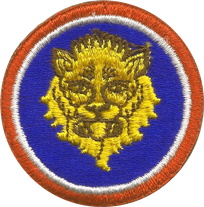
Infantry
38th CT – VIII Corps 21 Aug 1944 – 30 Aug 1944
38th FA Bn – VIII Corps 21 Aug 1944 – 30 Aug 1944
Co C, 2nd Engr C Bn – VIII Corps 21 Aug 1944 – 30 Aug 1944
2nd Bn, 38th Inf – Com Z 27 Sep 1944 – 13 Nov 1944
1st & 3rd Bns, 23d Inf – 99th Div 16 Dec 1944 – 18 Dec 1944
23rd CT – 1st Div 13 Jan 1945 – 24 Jan 1945
37th FA Bn – 1st Div 13 Jan 1945 – 24 Jan 1945
2nd Bn, 23d Inf – 9th Div 12 Feb 1945
38th CT – 78th Div 8 Mar 1945
38th FA Bn – 78th Div 8 Mar 45
Co C, 2nd Engr C Bn – 78th Div 8 Mar 1945
38th CT – 9th Armd Div 25 Mar 1945 – 5 Apr 1945
Co C, 2d Engr C Bn – 9th Armd Div 25 Mar 1945 – 5 Apr 1945
1st Bn, 23d Inf – 9th Armd Div 2 Apr 1945 – 5 Apr 1945
3d Bn, 38th Inf – 9th Armd Div 9 Apr 1945 – 21 Apr 1945
Narrative
The division landed on the evening of June 7, 1944, across Omaha Beach (Normandy), was committed in the Forêt de Cerisy, and next attacked across the Elle River and the Aure River. It assaulted the German strongpoint position on top of Hill 192 which commanded the approaches to St Lô on Jun 12, 1944. Fierce fighting for Hill 192 continued through June and into July when the division finally took it on July 11. The 2-ID gained control of the St Lô highway also. After regrouping the division went back on the offensive again on July 27 and took Notre Dame d’Elle as it exploited the St Lô breakthrough. It advanced to the Vire River by August 4 and halted to allow XIX Corps to cross its front and take Vire itself. The division advanced across the Vire and took Tinchebray on August 15, and on August 17, it moved west into Brittany. On August 25, began the assault on the strong outer defenses of the German-fortified city of Brest.

 By September 2, it had seized Hill 105 which dominated the eastern approaches. The all-out attack on Brest commenced on September 8 and the division gained the old city wall by September 17. The city surrendered after a 39-day battle.
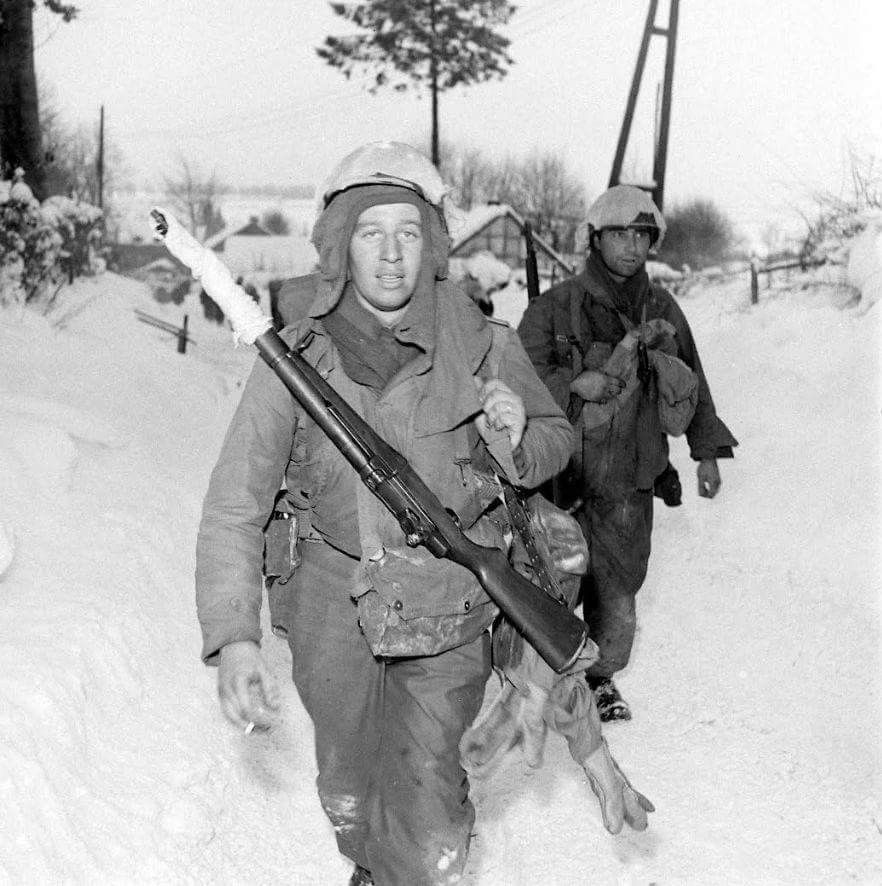
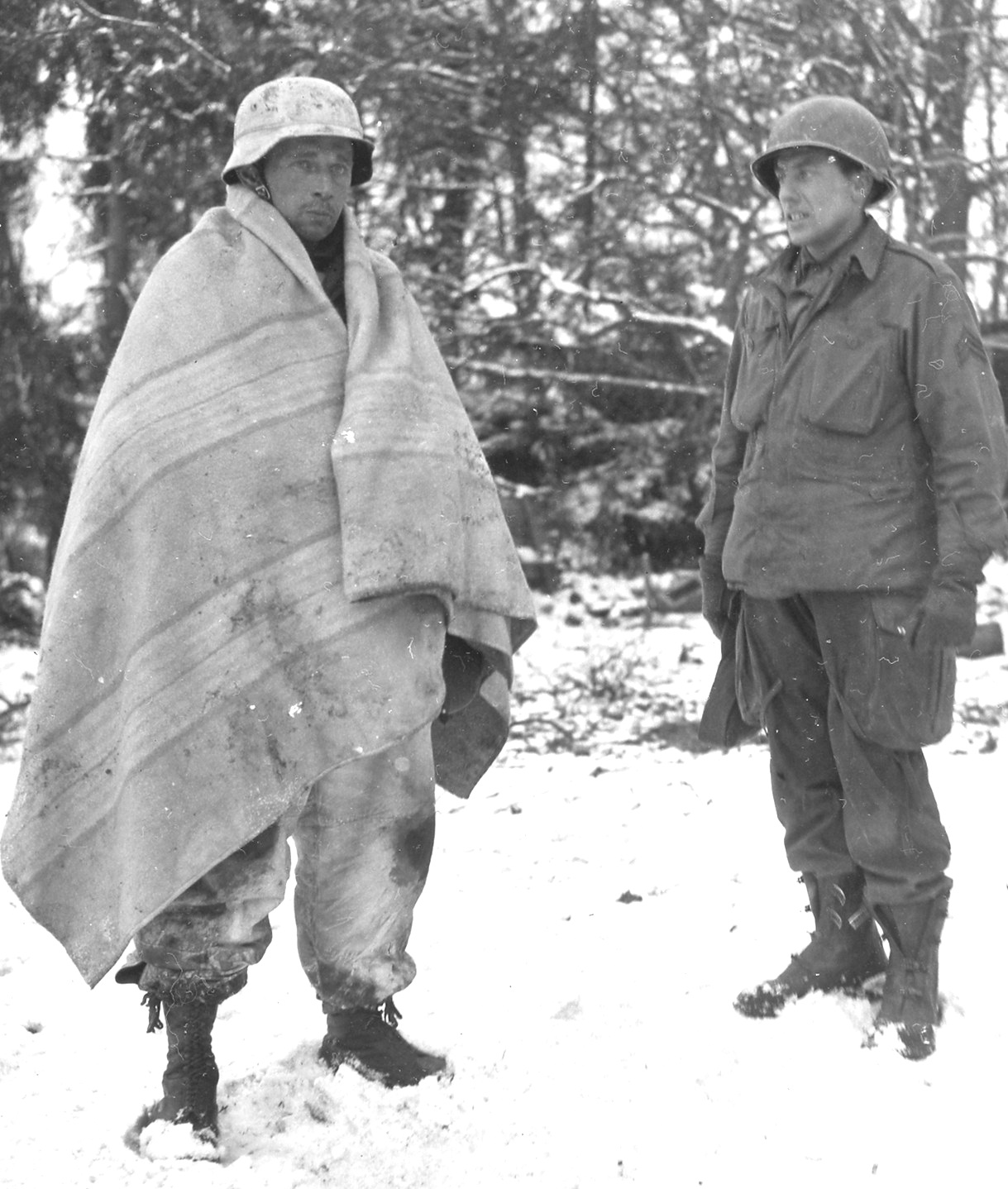
On September 26, the division moved by rail and motor and took up defensive positions between St Vith and Manderfeld in Belgium. The 106th Infantry Division took over its positions in the Schnee Eifel on December 11, and the 2-ID shifted to begin its offensive for the Roer River and the Urft Dams on December 13. However, the German Ardennes counter-offensive forced the division to shift positions again to the Monschau Forest on December 16. Under heavy attack, the division withdrew to defensive positions along the Ridge in Elsenborn, this until the German drive was halted.

 The 23-IR was attached to help the 1st Infantry Division clear Iveldingen and Rohrbusch on January 15, 1945. The 2-ID itself began its attack to breach the West Wall on January 30, and captured the twin villages of Krinkelt and Rocherath along the German border, the following day. On February 1, the Indian Head Division resumed the offensive for the Roer and Urft River dams and after gaining Scheuren on February 5, consolidated and switched sectors with the 9-ID. On March 3, the division crossed the Roer River with its 38-IR in the lead at Heimbach, while the 23-IR occupied Malsbenden. The 38-IR took Gemund on March 4, after it overran stubborn pillbox nests along the Urft River’s northern banks. Mounted on tanks and tank destroyers, soldiers of the 9-IR and the 23-IR gained seven miles toward Ahr and cleared 25 towns, enabling the 23-IR to take the Kreuzbach Bridge intact on March 7. The division moved then south to take Breisig on March 11. It improved positions along the Rhine and guarded the Remagen Bridge from March 12 to March 20.
 At 0400, March 21, the division crossed the Rhine River and the 38-IR cleared the region between the Rhine and Wied Rivers, Datzeroth, and Segendorf. The 23-IR crossed the Rhine on March 23 and the 38-IR fought to expand its Wied Bridgehead while attached to the 9th Armored Division. With the 9-IR and the 23-IR in the lead, the division took Ransbach and other towns on March 26 on the north flank of V Corps.
By March 27, it finished mopping up stragglers and clearing its zone. It next moved to Hadamar and Limburg to join the 9-AD and moved rapidly forward on their tanks and vehicles, reaching positions just north of Ederstau See by the end of the month. The division concentrated in the Sachsenhausen area, mopped up, and took responsibility for the Eder Bridges near Affoldern on April 1. It went into the attack on April 5 to take the Weser River heights north of Hann and Muenden. The 23-IR made the Weser River crossing at Veckerhagen, the division following on the tanks of the 9th Armored Division and making fast progress.

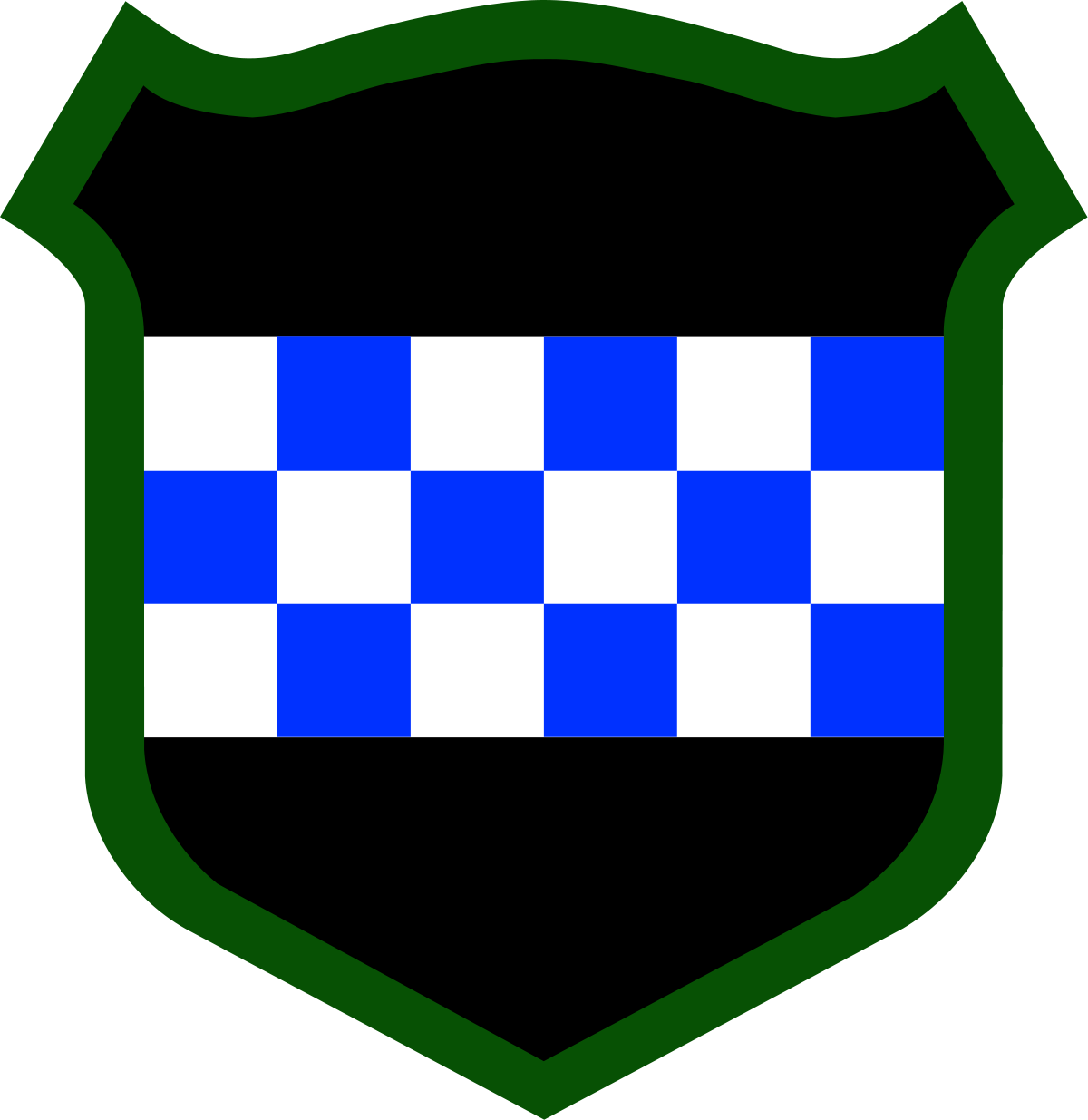 On April 14, the 9-IR and the 23-IR established a bridgehead across the Saale using a damaged railroad bridge, cleared Merseburg on April 15, and captured Leipzig on April 19. It was then ordered to withdraw to the east bank of the Mulde River on April 24. The division next moved 200 miles May 1/3 to the German-Czech border near Schonsee and Waldmungen where it relieved the 97-ID and the 99-ID. It was attacking Pilsen when hostilities ceased on May 7, 1945.

 S/Sgt Alvin P. Carey
S/Sgt, US Army, 38-IR, 2-ID
Vic. Plougastel, France, 23 Aug 1944
Entered service at Laughlinstown, Pa
Birth 16 Aug 1916, Lycippus, Pa
GO # 37, 11 May 1945
Citation: For conspicuous gallantry and intrepidity at the risk of his life, above and beyond the call of duty, on 23 Aug 1944. S/Sgt Carey, leader of a machine gun section, was advancing with his company in the attack on the strongly held enemy hill 154, near Plougastel, Brittany, France. The advance was held up when the attacking units were pinned down by intense enemy machine-gun fire from a pillbox 200 yards up the hill. From his position covering the right flank, S/Sgt Carey displaced his guns to an advanced position and then, upon his own initiative, armed himself with as many hand grenades as he could carry and without regard for his personal safety started alone up the hill toward the pillbox. Crawling forward under its withering fire, he proceeded 150 yards when he met a German rifleman whom he killed with his carbine. Continuing his steady forward movement until he reached grenade-throwing distance, he hurled his grenades at the pillbox opening in the face of intense enemy fire which wounded him mortally. Undaunted, he gathered his strength and continued his grenade attack until one entered and exploded within the pillbox, killing the occupants and putting their guns out of action. Inspired by S/Sgt Carey’s heroic act, the riflemen quickly occupied the position and overpowered the remaining enemy resistance in the vicinity.
Pfc Richard E. Cowan
Pfc, US Army, Mike Co, 23-IR, 2-ID
Krinkelter Wald, Belgium, 17 Dec 1944
Entered service at Wichita, Kans
Birth Lincoln, Nebr
GO # 48, 23 Jun 1945
Citation He was a heavy machine gunner in a section attached to I Co in the vicinity of the Krinkelter Wald, Belgium, on 17 Dec 1944, when that company was attacked by a numerically superior force of German infantry and tanks. The first 6 waves of hostile infantrymen were repulsed with heavy casualties, but the seventh drive with tanks killed or wounded all but 3 of his section, leaving Pvt Cowan to man his gun, supported by only 15 to 20 riflemen of I Co. He maintained his position, holding off the Germans until the rest of the shattered force had set up a new line along a firebreak. Then, unaided, he moved his machine gun and ammunition to the second position. At the approach of a German Panther tank, he held his fire until about 80 enemy infantrymen supporting the tank appeared at a distance of about 150 yards. His first burst killed or wounded about half of these infantrymen. His position was rocked by a 75 MM shell when the tank opened fire, but he continued to man his gun, pouring deadly fire into the Germans when they again advanced. He was barely missed by another shell. Fire from three machine guns and innumerable small arms struck all about him; an enemy rocket shook him badly but did not drive him from his gun. Infiltration by the enemy had by this time made the position untenable, and the order was given to withdraw. Pvt Cowan was the last man to leave, voluntarily covering the withdrawal of his remaining comrades. His heroic actions were entirely responsible for allowing the remaining men to retire successfully from the scene of their last-ditch stand.
T4 Truman Kimbro
T4, US Army, Charlie Co, 2-ECB, 2-ID
Rocherath, Belgium, 19 Dec 1944
Entered service at Houston, Tex
Birth Madisonville, Tex
GO # 42, 24 May 1945
Citation On 19 Dec 1944, as a scout, he led a squad assigned to the mission of mining a vital crossroads near Rocherath, Belgium. At the first attempt to reach the objective, he discovered it was occupied by an enemy tank and at least 20 infantrymen. Driven back by the withering fire, T4 Kimbro made 2 more attempts to lead his squad to the crossroads but all approaches were covered by intense enemy fire. Although warned by our own infantrymen of the great danger involved, he left his squad in a protected place and, laden with mines, crawled alone toward the crossroads. When nearing his objective he was severely wounded, but he continued to drag himself forward and laid his mines across the road. As he tried to crawl from the objective his body was riddled with rifle and machine-gun fire. The mines laid by his act of indomitable courage delayed the advance of enemy armor and prevented the rear of our withdrawing columns from being attacked by the enemy.
Sgt Jose M. Lopez
Sgt, US Army, 23-IR, 2-ID
Krinkelt, Belgium, 17 Dec 1944
Entered service at Brownsville, Tex
Birth Mission, Tex
GO # 47, 18 Jun 1945
Citation On his own initiative, he carried his heavy machine gun from K Co’s right flank to its left, in order to protect that flank which was in danger of being overrun by advancing enemy infantry supported by tanks. Occupying a shallow hole offering no protection above his waist, he cut down a group of 10 Germans. Ignoring enemy fire from an advancing tank, he held his position and cut down 25 more enemy infantry attempting to turn his flank. Glancing to his right, he saw a large group of infantry swarming in from the front. Although dazed and shaken from enemy artillery fire which had crashed into the ground only a few yards away, he realized that his position soon would be outflanked. Again, alone, he carried his machine gun to a position to the right rear of the sector; enemy tanks and infantry were forcing a withdrawal. Blown over backward by the concussion of enemy fire, he immediately reset his gun and continued his fire. Single-handed he held off the German horde until he was satisfied his company had effected its retirement. Again he loaded his gun on his back and in a hail of small arms fire he ran to a point where a few of his comrades were attempting to set up another defense against the onrushing enemy. He fired from this position until his ammunition was exhausted. Still carrying his gun, he fell back with his small group to Krinkelt. Sgt Lopez’s gallantry and intrepidity, on seemingly suicidal missions in which he killed at least 100 of the enemy, were almost solely responsible for allowing K Co to avoid being enveloped, to withdraw successfully, and to give other forces coming up in support time to build a line which repelled the enemy drive.
Sgt John McVeigh
Sgt, US Army, How Co, 23-IR, 2-ID
Vic. Brest, France, 29 Aug 1944
Entered service at Philadelphia, Pa
Birth Philadelphia, Pa
GO # 24, 6 April 1945
Citation For conspicuous gallantry and intrepidity at the risk of his life above and beyond the call of duty near Brest, France, on 29 Aug 1944. Shortly after dusk, an enemy counterattack of platoon strength was launched against 1st Plat, G Co, 23rd Inf Regt. Since the G Co platoon was not dug in and had just begun to assume defensive positions along a hedge, part of the line sagged momentarily under heavy fire from small arms and 2 flak guns, leaving a section of heavy machine guns holding a wide frontage without rifle protection. The enemy drive moved so swiftly that German riflemen were soon almost on top of 1 machine gun position. Sgt McVeigh, heedless of a tremendous amount of small arms and flak fire directed toward him, stood up in full view of the enemy and directed the fire of his squad on the attacking Germans until his position was almost overrun. He then drew his trench knife. and single-handedly charged several of the enemies. In a savage hand-to-hand struggle, Sgt McVeigh killed 1 German with the knife, his only weapon, and was advancing on 3 more of the enemy when he was shot down and killed with small arms fire at point-blank range. Sgt McVeigh’s heroic act allowed the 2 remaining men in his squad to concentrate their machine-gun fire on the attacking enemy and then turn their weapons on the 3 Germans in the road, killing all 3. Fire from this machine gun and the other gun of the section was almost entirely responsible for stopping this enemy assault and allowed the rifle platoon to which it was attached time to reorganize, assume positions, and hold the high ground gained during the day.
Pfc William A. Soderman
Pfc, US Army, King Co, 9-IR, 2-ID
Rocherath, Belgium, 17 Dec 1944
Entered service at West Haven, Conn
Birth West Haven, Conn
GO # 97, 1 Nov 1945
Citation Armed with a 2’36 bazooka, he defended a key road junction near Rocherath, Belgium, on 17 Dec 1944, during the German Ardennes counteroffensive. After a heavy artillery barrage that wounded and forced the withdrawal of his assistant, he heard enemy tanks approaching the position where he calmly waited in the gathering darkness of early evening until the 5 Mark V tanks which made up the hostile force were within point-blank range. He then stood up, completely disregarding the firepower that could be brought to bear upon him, and launched a rocket into the lead tank, setting it afire and forcing its crew to abandon it as the other tanks pressed on before Pfc Soderman could reload. The daring bazooka man remained at his post all night under severe artillery, mortar, and machine-gun fire, awaiting the next onslaught, which was made shortly after dawn by 5 more tanks. Running along a ditch to meet them, he reached an advantageous point and there leaped to the road in full view of the tank gunners, deliberately aimed his weapon, and disabled the lead tank. The other vehicles, thwarted by a deep ditch in their attempt to go around the crippled machine, withdrew.
While returning to his post-Pfc Soderman, braving heavy fire to attack an enemy infantry platoon from close range, killed at least 3 Germans and wounded several others with a round from his bazooka. By this time, enemy pressure had made K Co’s position untenable. Orders were issued for withdrawal to an assembly area, where Pfc Soderman was located when he once more heard enemy tanks approaching. Knowing that elements of the company had not completed their disengaging maneuver and were consequently extremely vulnerable to an armored attack, he hurried from his comparatively safe position to meet the tanks. Once more he disabled the lead tank with a single rocket, his last; but before he could reach cover, machine-gun bullets from the tank ripped into his right shoulder. Unarmed and seriously wounded he dragged himself along a ditch to the American lines and was evacuated. Through his unfaltering courage against overwhelming odds, Pfc Soderman contributed in great measure to the defense of Rocherath, exhibiting to a superlative degree the intrepidity and heroism with which American soldiers met and smashed the savage power of the last great German offensive.
2-ID – Command Posts
1943
20 Oct Armagh, Armagh, Northern Ireland
1944
19 Apr Tenby, Pembrokeshire, Wales
15 May St Donats Castle, Glamorganshire, Wales
7 Jun St Laurent-sur-Mer (Vic west), Calvados, France
9 Jun Formigny, Calvados, France
10 Jun Le Molay, Calvados, France
15 Jun Cerisy-la-Foret (2 miles south), Manche, France
29 Jun St Jean-des-Baisants, (1 mile NW), Manche, France
2 Aug Laveniere, Calvados, France
5 Aug Les Rairies, Calvados, France
10 Aug Coutances, Calvados, France
13 Aug Maisoncelles-la-Jourdan, Calvados, France
19 Aug Ploudaniel, (3 miles east), Finistere, France
22 Aug Kersaint Plebennec (1 mile west), Finistere, France
30 Sep St Vith, Liege, Belgium
12 Dec Wirzfeld, Liege, Belgium
18 Dec Camp Elsenborn, Liege, Belgium
1945
5 Feb Wahlerscheid, Rhineland, Germany
21 Feb Erkensruhr, Rhineland, Germany
5 Mar Kloster Mariawald, Rhineland, Germany
6 Mar Vlatten, Rhineland, Germany
7 Mar Mechernich, Rhineland, Germany
8 Mar Munstereifel, Rhineland, Germany
9 Mar Bruck, Rhineland, Germany
10 Mar Bad Neuenahr, Rhineland, Germany
21 Mar Honningen, Hessen-Nassau, Germany
25 Mar Nieder Bieber, Hessen-Nassau, Germany
27 Mar Hohr-Grenzhausen, Hessen-Nassau, Germany
29 Mar Hademar, Hessen-Nassau, Germany
30 Mar Homberg, Hessen-Nassau, Germany
1 Apr Sachsenhausen, Hessen-Nassau, Germany
5 Apr Oberlistingen, Hessen-Nassau, Germany
6 Apr Grebenstein, Hessen-Nassau, Germany
7 Apr Veckerhagen, Hessen-Nassau, Germany
8 Apr Dransfeld, Westphalia, Germany
9 Apr Wollmarshausen (3 mile SE), Westphalia, Germany
11 Apr Ober Gebra (1 mile east), Saxony, Germany
12 Apr Bad Frankenhausen, Saxony, Germany
13 Apr Barnstadt, Saxony, Germany
17 Apr Schladebach, Saxony, Germany
19 Apr Markranstadt, Saxony, Germany
21 Apr Bad Lausick, Saxony, Germany
2 May Ober Viechtach, Bavaria, Germany
4 May Rotz, Bavaria, Germany
5 May Klenec, Bohemia, Czech
6 May Horsovsky, Tyn, Bohemia, Czech
7 May Pilsen, Bohemia, Czech