

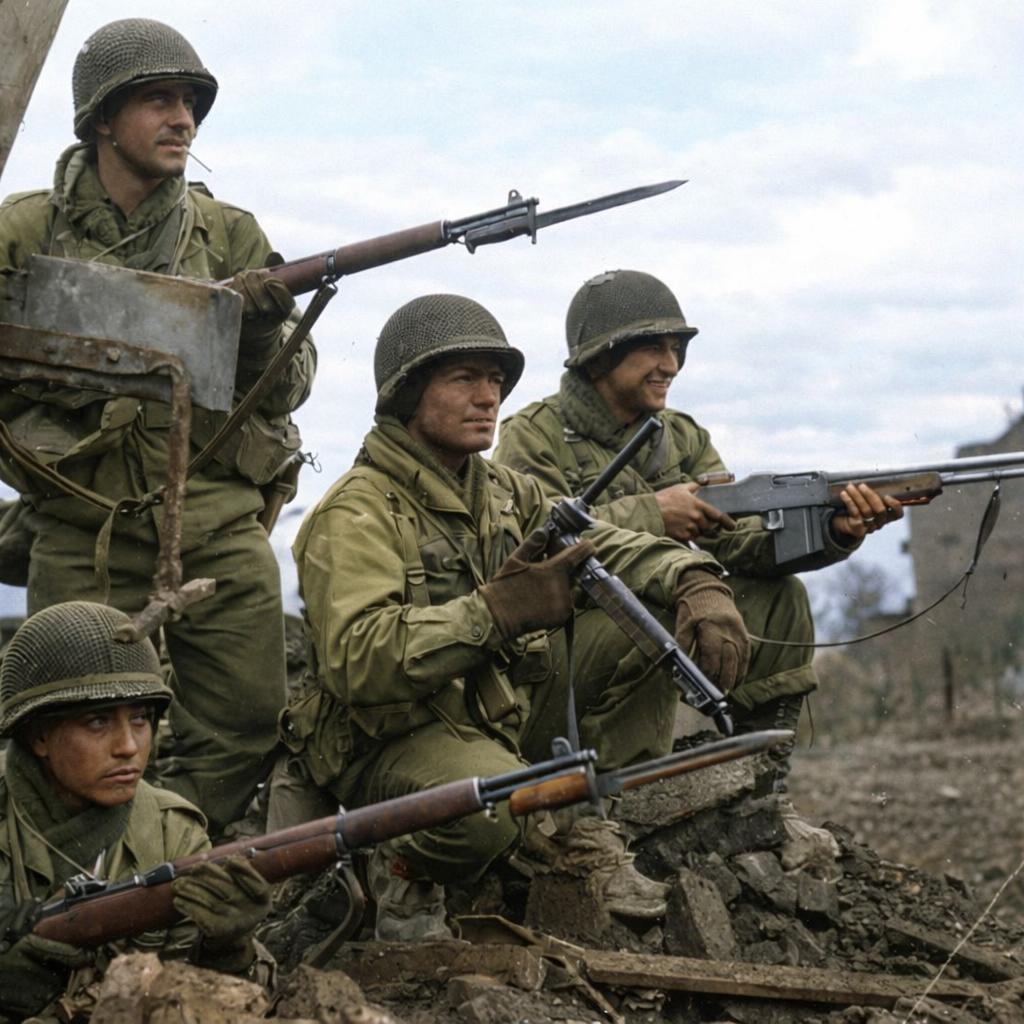
The first day’s advance was 1500 yards, the unit on the right was unable to advance with the first battalion. A strong counterattack was launched against the left flank, and it was necessary to call up the reserve company. While this was being stopped, a counterattack from the front was started. This was also repelled. Then a strong counterattack was launched against the open right flank. When the attack was ended , almost 5000 yards had been lost. The entire line was reorganized and the men dug in for the night. The first day’s casualties were 63 killed or wounded. During the night of July 8-9, the 2nd Battalion was committed on the left of the 1st Battalion, and at 0600 the two battalions attacked with Companies B and C of the 1st Battalion leading and Companies E and F of the 2nd Battalion leading. The 3rd Battalion remained in Regimental reserve. Progress was slow due to the greenness of the troops and inexperience in hedgerow fighting. Difficulty was encountered in maintaining wire communications due to enemy artillery fire. The attack carried about two kilometers to a point north of Le Barville, 30 prisoners being captured. The German counterattack on the exposed right flank of the First Battalion forced then to use the Second Battalion’s area to bring up supplies. The Division Commander continually insisted on the battalions advancing, regardless of whether the flanks were protected or not.
At approximately midnight the Division Commander relieved Col Webb as Regimental Commander and Col Kunzig assumed command. On the morning of the 1Oth of July the order came down, to attack at 0700 and both the 1st and 2nd Battalions jumped off on time. At 0800 both Battalions committed their reserve companies, holding a Platoon of each company in reserve. With artillery and Infantry coordinated, the attack continued in the direction of Le Barville. The location of the exposed right flank was given to the 79th Division on the right so that contact could be made. The 3rd Battalion was alerted to be ready to move to protect either flank or reinforce the attack. At the end of the day the 1st Battalion had reached a point 1000 meters south of Le Barville, but the 2nd Battalion had run into heavy opposition and was held up, outside of Mobecq. Two days later, the 3rd Battalion having replaced the Ist in the line, had advanced to a point south of Vesly, when their leading elements ran into extremely heavy fire ……..
Notice that this archive is not terminated but will very soon.
Gunter