

November 10
– 0600, Dallas enters river.
– 0737, Dallas lands Ranger Detachment at Port Lyautey.
– 0739, Savannah plane silences battery east of Port Lyautey.
– 1107, Port Lyautey Airfield occupied. Kasba isolated.
The airfield of Port Lyautey is situated about 9 miles up the Sebou River at the end of a long bend. The town itself is about 2 miles further upstream. Port Lyautey was undefended except for some mobile artillery and antiaircraft guns. The river mouth at Mehdia, however, was defended by the two batteries previously mentioned. Besides these fixed defenses the French had mounted two field pieces on flatcars that could be moved up and down the south bank of the river needed. A lagoon 3.5 miles in length runs parallel to the coast and added considerably to the strength of the French Position. The original plan of attack called for landings on five beaches and a run past the batteries of Mehdia and up the river by the Dallas.
At 1900, November 7, the destroyer Roe departed from the formation to locate the beacon submarine off the entrance of the river. Although she was challenged once, no action developed. In spite of a thorough search the submarine could not be located. Due to shortage of time and the necessity of obtaining fixes, the search was discontinued shortly after 2150, and the Roe approached the mouth of the river and reported several fixes by voice radio to Adm Kelly. This done, the Roe took station about 2000 yards from the river jetties. At 2321, the transports arrived in the transport area located about 7 miles off the mouth of the river.
On Sunday November 8, weather conditions were: wind from the northeast, force 5 to 12 knots, partly cloudy, sea smooth. At approximately 0200, the Dallas received on board the Ranger detachment from the transport Susan B. Anthony. Mr. René Malavergne of the Fighting French, former chief pilot of the Sebou River, came on board with the Rangers preparatory to piloting the Dallas up the river, her mission being the capture of the Port Lyautey Airport. At 0310, the Texas and the Savannah intercepted radio press reports from Washington announcing the landing of American and British forces in the vicinity of Oran and Algiers. The hour of the Algerian Debarkations had been set 3 hours ahead of the Moroccan Operations in order to land under cover of darkness. The Moroccan Landings were delayed nearly until morning twilight in order to enable these attack groups to continue as long as possible the deception as to real destination. In spite of these announcements a complete surprise was effected. At 0411, the destroyers of the Fire Support took their stations; the Roe to the south of the river mouth, the Kearny to the north of the river mouth, the Edison in reserve.
In the meantime, the assault troops had been placed in the landing boats, the operation having been begun shortly after midnight. Three methods of debarkation had been provided for, depending upon weather conditions. In the first the ships were to anchor at their positions in the transport area. This was considered the ideal method but was not used because of the increasing wind. The second method provided that the ships should keep under way, making a lee first to port then to starboard. The third method provided that the ships should anchor long enough to hoist out boats and lighters and then lie to with a lee to starboard. The second method was the one adopted. The boats used in the North African Landings represented the latest developments in amphibious equipment at the time, although many of the designs have since been superseded. The types used are too numerous to be described in detail, ranging all the way from small rubber boats with outboard motors and having a capacity of 7 men, to craft capable of carrying 120 men. All were flat-bottomed so as to permit running well up on the beaches. The larger ones were snub-nosed and equipped with ramps forward that lowered so as to form a runway for motor vehicles.
Some types were armored and mounted .30 and .50 caliber machine guns. The specially constructed fire-support craft carried on the Kennebec, Merrimack and Winooski were equipped with two multiple rocket projectors which permitted lobbing a shower of explosives on the enemy position immediately prior to the arrival of the assault troops. Owing to the weight involved, loading had to be made into waterborne craft. This procedure proved troublesome and risky as the men, even those in the first waves, were carrying full equipment. The metal nets down which the men climbed into the boats were found to be slippery and frequently cut the hands. The rope nets stretched easily and occasionally fouled the propellers of the boats. The Navy retained control of all boats during debarkation. In view of the many novel features of the landing craft employed, some Army reports have advanced the theory that the command of the landing boats should devolve on the Army as soon as they leave the side of the transports. The debarkation plan called for the formation of waves of combat-loaded landing craft around the three easterly transports, the Henry T. Allen, the George Clymer and the Susan B. Anthony. Once assembled, the boats of the first wave were to form a controlled V behind each of three escort vessels stationed at initial control points 1000 yards from the transport area, the Osprey for the Anthony Group, the Eberle for the Clymer Group and the Raven for the Allen Group. From these initial control points the groups were to proceed to final control points at designated lines of departure distant 10.500, 9.700 and 11.600 yards respectively from the initial control points and approximately 5.000 yards from the shore. By H minus 25, the V headed by the Osprey was due on the northern line of departure and at H minus 20, the Eberle and her V on the center and the Raven and her V on the southern line of departure.
The run from the lines of departure to the beaches was to be made under the cover of the Fire Support and the landing craft support boats. The succeeding waves were to follow at 10-minute intervals, each keeping the preceding wave in sight, and exercising care not to ‘pile up’. This schedule, had it been maintained, would have landed the first wave at H-hour, and the seventh wave at H plus 1 hour. The disembarkation operations, however, were attended with considerable delay and confusion owing to the darkness. As a result the first waves did not land until 0515, one hour and a half late. The most southerly of the beaches chosen for the landings was clear of the lagoon. Here aerial reconnaissance had disclosed what seemed to be a concrete pill box. When this proved to be a tomb, that landing was countermanded. About one-half mile to the north another beach had been chosen. These two landings were accordingly consolidated. The main attack, however, was to be delivered immediately south of the Sebou River.
Here a causeway leads from a bathing resort across the lagoon to Mehdia. Two landings were also to be made north of the river with the object of occupying two heights, one below the bend of the river and one at the bend. The two last-named landings were also consolidated at the last minute. These eliminations reduced the area to be attacked to three beaches, one 3 miles below the mouth of the Sebou River, one some 4 miles to the north of the river, and one close to the southern river jetty. The first two landings were practically unopposed so that the central attack at the river mouth is the only one we need consider. Here some of the sharpest fighting of the campaign occurred.
Although the 10-minute schedule could not be maintained, 7 waves were successfully landed before the shore batteries compelled the retirement of the transports to a position out of range. Eighteen boats were usually employed on each of the 7 waves, the total number of boats available on the transports being 162. The action began at 0523, when a searchlight was observed near the Kasba, followed by small arms fire. Mindful of the instructions not to precipitate a conflict with the French if it could possibly be avoided, the commander of the Task Force directed the Roe to ignore the fire. At approximately 0605, the Eberle reported that a shore battery had fired one salvo at the landing boats. The Eberle was thereupon ordered to return the fire. The searchlight was promptly extinguished.
At 0607, the Savannah catapulted four planes, two for spotting and two for antisubmarine patrol. Two Texas planes were also put in the air. At 0629 enemy shore batteries opened fire on the Roe, the first salvo landing about 500 yards on the port bow. The Roe returned the fire, at a range of about 5000 yards. Three more salvos were fired by the shore batteries, after which they ceased for about 10 minutes, then resumed firing, the salvos coming closer to the Roe, which immediately reversed course. At approximately 0630, the Texas broadcast in French the first American Army communique in North Africa, consisting of two proclamations by Gen Eisenhower. The first was addressed to the French Authorities in North Africa. The English translation is as follows:
Here is a communication from the American general, Eisenhower, Commander in Chief of the forces now disembarking in French North Africa. This is one of the general staff officers who speaks to you. This communication, of the highest importance, is addressed to the French Armies on land, sea and air in North Africa. Frenchmen of North Africa, the forces which I have the honor of commanding come to you as friends to make war against your enemies. This is a military operation directed against the Italian-German Military Forces in North Africa. Our only objective is to defeat the enemy and to free France. I need not tell you that we have no designs either on North Africa or on any part of the French Empire. We count on your friendship, and we ask your aid.
I have given formal orders that no offensive action be undertaken against you on condition that you for your part take the same attitude. To avoid any possible misunderstanding, make the following signals: By day, fly the French tricolor and the American flag, one above the other. I repeat, by day, fly the French tricolor and the American flag, one above the other, or two (I repeat, two) tricolors, one above the other. By night, turn on a searchlight and direct it vertically toward the sky. I repeat, by night, turn on a searchlight and direct it vertically toward the sky. Moreover, for reasons of military security, we are obliged to give you the following orders. Any refusal to follow them will be interpreted as proof of hostile intention on your part. Here are the orders: To all naval and merchant marine units: First, stay where you are. Secondly, make no attempt to scuttle your vessels. To Coast Guard units: Withdraw from the neighborhood of your cannon and your stations. To Aviation Units: Do not take off. All airplanes must remain in their usual places.
General Orders: In general you must obey all orders given to you by my officers. We come, I repeat, as friends, not as enemies. We shall not be the first to fire. Follow exactly the orders which I have just given you. Thus you will avoid any possibility of a conflict, which could only be useful to our enemies. We summon you as comrades to the common fight against the invaders of France. The war has entered the phase of liberation.
The second proclamation was addressed to the people of North Africa, and the English translation is as follows:
The President of the United States has asked me as commanding officer of the American Expeditionary Forces to convey to all the people in Morocco and in North Africa the following message: No nation is more closely bound by historic ties and deep affection to the people of France and their friends than the United States of America. Americans are striving not only for their own safe future, but also for the restoration of the ideals, the liberties, and the democracy of all those who have lived under the Tricolor. We come among you to save you from conquerors who would remove forever your rights of self-government, your rights to religious freedom, and your rights to live your own lives in peace. We come among you solely to destroy your enemies and not to harm you. We come among you with the assurance that we will leave just as soon as the menace of Germany and Italy is removed from you. I am appealing to your sense of realism, self-interest and ideals. Do no obstruct this great purpose. Help us and the day of a world of peace will be hastened.
In spite of these attempts to explain our intentions to the French People of Morocco, French Resistance continued. At 0652, the Savannah and the Roe were attacked by two French DeWoitine fighters. Enemy shell splashes from shore batteries began falling within 150 yards of the Savannah. The Roe was straddled by three salvos, and thereupon in creased speed to 30 knots and commenced zigzagging. The nearest salvo landed about 50 yards astern. At 0710, orders were accordingly given the northern attack group for a general offensive.
At 0720, two enemy planes strafed the landing boats. The Kearny, Ericsson, and Osprey opened fire on them immediately. Aerial fighting rapidly increased in intensity. At 0730 the Savannah reported that 10 French fighter planes were in the air. The commander of the Task Group thereupon requested air support and by 0747 at least 20 F4F’s had arrived in the area from the carriers. By 0950, a beachhead had been established south of the river mouth. Progress from then on was arduous. The garrison of the Kasba, which consisted largely of the Foreign Legion, was contesting every inch of ground. By noon, however, the Army had advanced as far as the light house, having crossed the causeway over the lagoon on the run. The small number of casualties suffered in charge was due to the failure of the French to cover that approach. This may have been due to an inability to depress the guns sufficiently.
In the meantime, the Dallas had received orders to attempt to run past the batteries at the river mouth, if not fired on, and at 1140 proceeded cautiously toward the jetties. No firing had been observed from the Kasba for several hours. The French batteries had been under fire from the Savannah intermittently ever since 0755. As the Dallas approached the mouth of the river the Kasba resumed firing. The Dallas thereupon turned and headed out. A second attempt at 1215 was equally unsuccessful. The Savannah continued to bombard both fixed defenses and mobile batteries until 1621, expending 892 rounds of 6-inch and 236 rounds of 5-inch ammunition, by which time the enemy batteries definitely silenced. At 1343, the Texas opened fire on ammunition dumps near Port Lyautey. Fifty-nine rounds of 14-inch bombardment ammunition were expended, apparently with only slight effect. Antisubmarine patrols reported no submarine activity. At sundown the Texas, Savannah, and a group of destroyers took up screening positions. No news had been received from the Army on shore although, as was subsequently learned, a detachment of about 60 men had succeeded in getting a foothold in the old Arab Kasba late in the afternoon.
On November 9, weather conditions were wind northeast, strength 5-8 knots, partly cloudy, sea smooth, medium swell from the northwest. D plus 1 day was to witness a vigorous French counterattack. It began with the capture of the small detachment which had penetrated the Kasha. At approximately 0750 plane spotters reported enemy tanks on the road coming from Rabat. The Savannah opened fire, putting three of the tanks out of action. The remainder thereupon retreated. The Savannah continued firing, causing the tanks to disperse. In the meantime, spotting planes reported that they were bombing these tanks with excellent results. At 1027 the Savannah ceased firing, as American tanks had advanced into the area. Artillery activity continued throughout the late forenoon and the early afternoon with American artillery on shore now joining. At around 1430, Gen John K. Cannon, the Army air commander, arrived in the area in an Augusta plane and conferred with Adm Kelly with a view to coordinating aerial and naval bombardments.
On November 10, the weather conditions were: wind northeast, strength 5-8 knots, partly cloudy, sea smooth, moderate swells from the northeast. During the night of 9-10 November, a Navy crew in a small boat from the George Clymer had succeeded in cutting the cable supporting the net extending across the mouth of the Sebou River. While so doing, the Navy boat was subject to rifle and machine-gun fire from the south bank of the river. The fire was returned. Although the boat was hit, there were no casualties. Thereupon, at 0430, the Dallas again attempted to enter the Sebou River. Due to extremely low visibility and lack of radar, the river jetties were not located until 0600. When these were sighted the French river pilot succeeded in bringing the Dallas through the jetty passage despite seas breaking over the stern and the ship yawing. The commanding officer of the Dallas was outspoken in his praise of the performance of the French pilot, which was all the more extraordinary as he was hampered by shallow water and a narrow channel. While proceeding up the entrance of the river the Dallas was continually touching the muddy bottom. Although the speed indicated in the engine room was 25 knots, the ship was actually only making 5 knots, because of the mud. Fortunately, she did not become fast.
On making the turn of the river just north of the Port Lyautey Airport, the Dallas had to maneuver between two scuttled steamers. This was done successfully, and at 0737 she took her position just off the landing dock at the Airport and disembarked the Ranger detachment. While these groups were being put ashore, an enemy battery of two 75-MM guns, located in the vicinity of the bridge over the Sebou River northeast of Port Lyautey, opened fire. Some shells landed within 10 yards of the ship. The Dallas returned fire with her 3-inch battery. While the Dallas was thus engaged, a Savannah spotting plane located the enemy battery and dropped two bombs, scoring direct hits which started an ammunition fire and silenced the guns. The Ranger detachment meanwhile had encountered machine-gun fire upon landing, but was nevertheless able to occupy the Airport with little delay.
At 0842, in response to a request from the Army, the Texas opened fire with 14-inch bombardment ammunition on the road leading to Meknes, using turrets No. 2 and 4, range 17.000 yards. This fire was maintained until 1131. In all, 214 rounds were expended. The object of the bombardment was to destroy enemy trucks which were moving out of Port Lyautey eastward. Spotting planes reported that the fire was well-grouped and had scored five direct hits on the road, thereby stopping all movement. Several French trucks were observed to be damaged and abandoned. In the meantime, spotting planes which were covering the Dallas reported that the bridge over the Sebou River had been blown up, apparently by a French demolition party, and that oil tanks near the bridge were on fire. Following the bombardment by the Texas of the Meknes Road, the following message from Adm Kelly was broadcast by the Texas to the people of Port Lyautey:
We have had to capture the Fort at Mehdia. We have had to take your Airfield at Port Lyautey. We have been forced to bombard the roads east of your city. We have had to bomb your trucks marching to reinforce you. These measures have been taken for only one reason: because your officials continue to oppose our purpose which is to assist in restoring France to Frenchmen and to Frenchmen alone. Such was the promise of the President of the United States. This promise will be kept. Why continue this unfortunate and useless resistance? You know that the United States because of its great power will not cease until it has broken the resistance of your chiefs. Join with us. Stop this useless waste of lives and use them later in the fight against your real enemy, Germany.
Adm Kelly’s broadcast met with no response. Operations continued. At 1107 the first US planes landed at the Port Lyautey Airfield. Meanwhile the Army was isolating the Kasba. In response to a request from Gen Lucian K. Truscott, who was in charge of the attack, the Savannah bombarded tanks and troop concentrations in and around that fortress, firing 14 rounds of 5-inch and 60 rounds of 6-inch ammunition between 1308 and 1409. The Fort was captured by a combination of dive bombing and bayonet assault. The final assault, to quote an Army memorandum, had touches of Beau Geste, the attack employing the most modern weapons against a 1918 enemy defending a walled fort. Notwithstanding the fact that the attacker disposed of a highly mechanized Task Force, the older weapons were not outmoded.
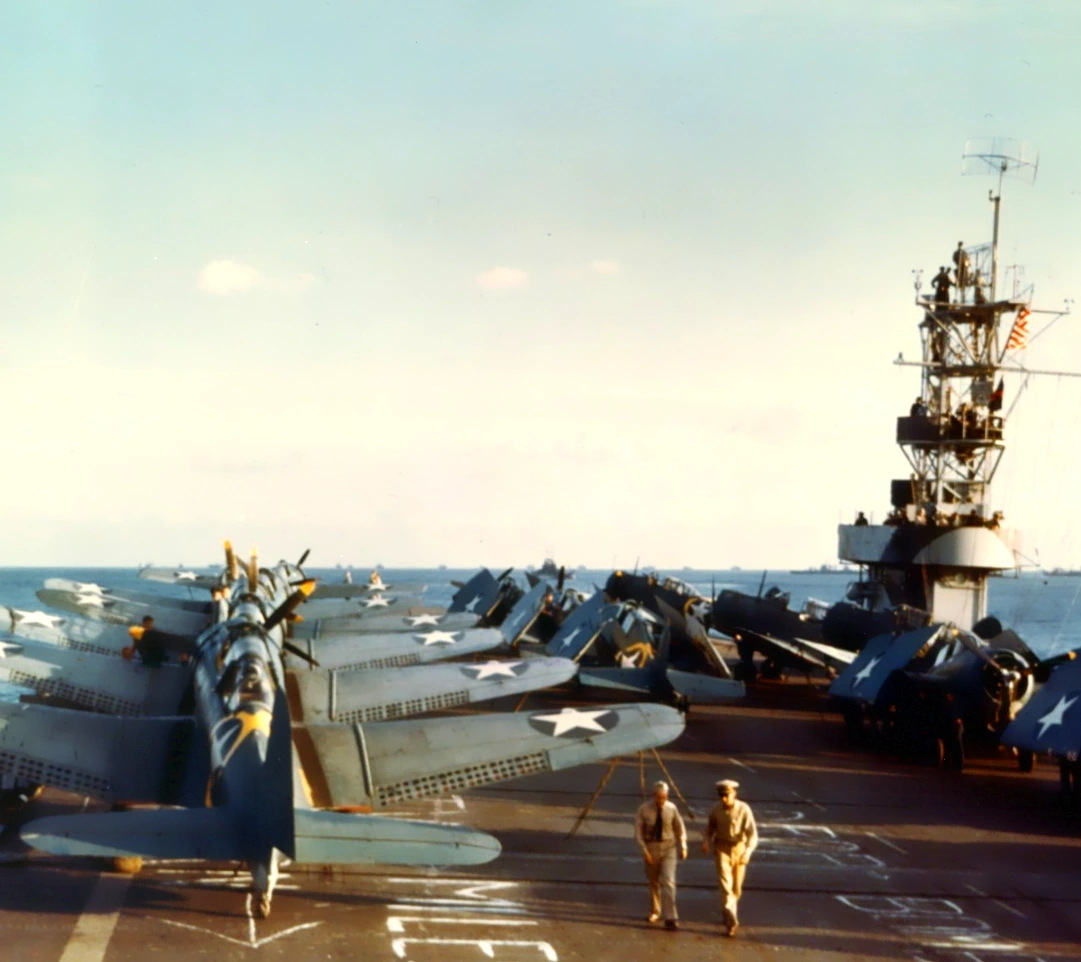
The northern attack was supported by the Sangamon, screened by the Hambleton and Macomb. In order that the Sangamon might devote herself entirely, to covering the landing, the Suwannee provided combat and antisubmarine patrols from the Casablanca Area. At 0600 on November 8, the Sangamon started launching planes for the attack upon the Port Lyautey Airfield. There was considerable difficulty because of the very light wind, and one plane went over the bow into the sea. Because of this, the catapult became almost the standard method of launching for the rest of the operation.
To Be continued