The passage was an uneventful one. On November 1, the Augusta radar spotted an unidentified aircraft crossing the convoy track from port to starboard, probably a clipper. On November 2, the Doran reported that her number three magazine had been flooded, apparently with malicious intent. The saboteur, who was probably mentally deranged, was apprehended. On November 3, a Ranger plane on anti submarine patrol crashed. The personnel were rescued but the plane sank. On November 4, the Miantonomah was forced to drop out because of excessive roll. The Raven was detailed to escort her, the two vessels to rejoin as soon as practicable. This was not until 4 days later. The voyage was drawing to an end, and as a result of the proximity of land, coastwise shipping was beginning to appear. On November 5, a Portuguese Steamer was sighted by the screen in time to be avoided by an emergency turn to port. The next day a Spanish Steamer was picked up by the screen but, as she did not sight the convoy, was allowed to proceed. On November 6, air contact was established with Gibraltar. Numerous fishing craft and coastal steamers were thereafter encountered. All were rounded up.
As the African Coast was approached ‘the progress of the political offensive fluctuated from day to day. One day it seemed that the French were going to resist, then word came that the Army and Air Forces would not oppose us, and then that the attitude of the French Navy was in doubt. Everyone hoped that they would save their bullets for the Nazis, but French war psychology is completely inexplicable and we could take no chances’. On the night of November 6-7, weather dispatches from Cominch, the War Department and the beacon submarines off the Moroccan Coast were received. From these reports the fleet meteorologist was able to state that both wind and swell would decrease and that favorable weather conditions would prevail during the next 48 hours. The Force Commander therefore decided to put the attack plan in operation and signals to that effect were dispatched to all units. D-day was set for November 8, and H-hour for 0400.
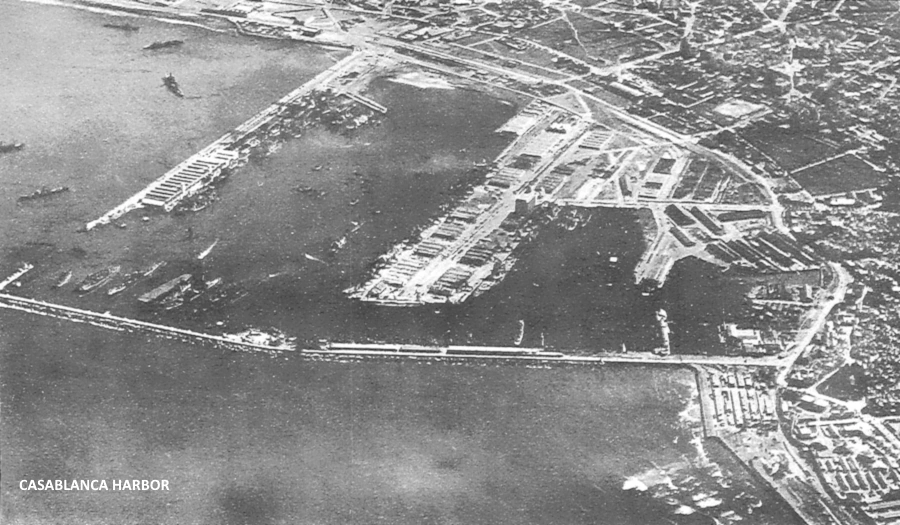
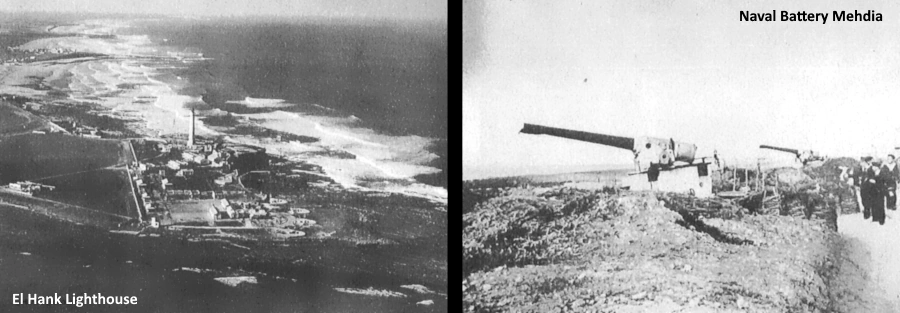
The good fortune that had attended the expedition in its approach maneuvers was well summed up by one officer who reported as follows: ‘Against no other inhabited civilized coast could an approach have been made to a point within 16 miles of the main base, in darkness, using radar of all types, whistles and light maneuvering signals, fathometers and radio telephone without bringing down instant and strenuous opposition… Without any intention to detract in the slightest from the success that was achieved, I must say seriously and emphatically that I do not believe that under identical conditions of organization and training this feature of the operation could be repeated once in ten tries’.
The Battle of Casablanca
Intelligence indicated that the French Naval Forces and land batteries on the Moroccan Coast would probably offer resistance. A battle plan had accordingly been adopted in which targets were assigned to specific vessels of the Covering Group. That group now consisted of the Massachusetts (F), Tuscaloosa, Wichita; the destroyers Wainwright, Mayrant, Rhind, and Jenkins and the oiler Chemung. The Massachusetts had been given the task of destroying the Jean Bart and the major caliber shore batteries. The forward turrets were to fire on the French battleship and the after turret on the heavier battery on Point El Hank. The Tuscaloosa had been assigned the submarines, cruisers, and other naval craft in Casablanca Harbor, in that priority. The Wichita was to open fire on the lighter battery on the tip of Point El Hank, then shift to submarines, cruisers, and other craft, thence to Table d’Aukasha. The destroyers were to provide antisubmarine screen for the heavy ships, destroy enemy submarines should they sortie, provide defense against air torpedo and bombing attacks, and destroy enemy light vessels and shore installations as might be directed.
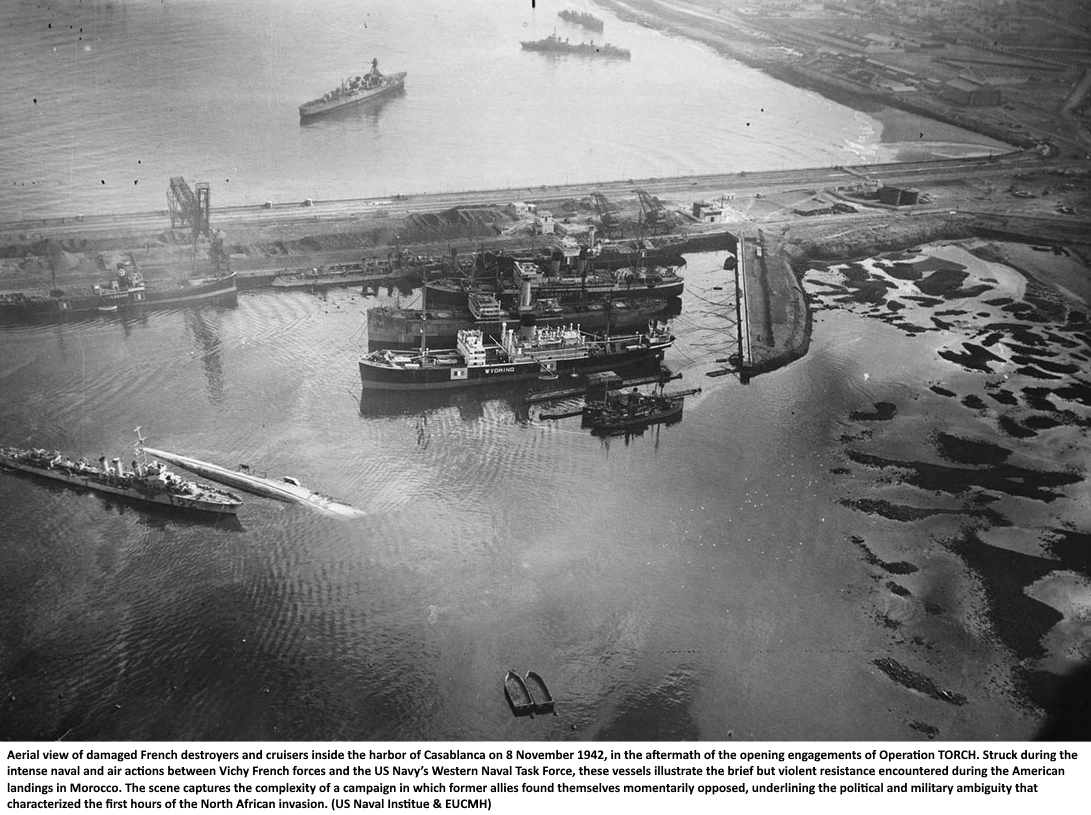
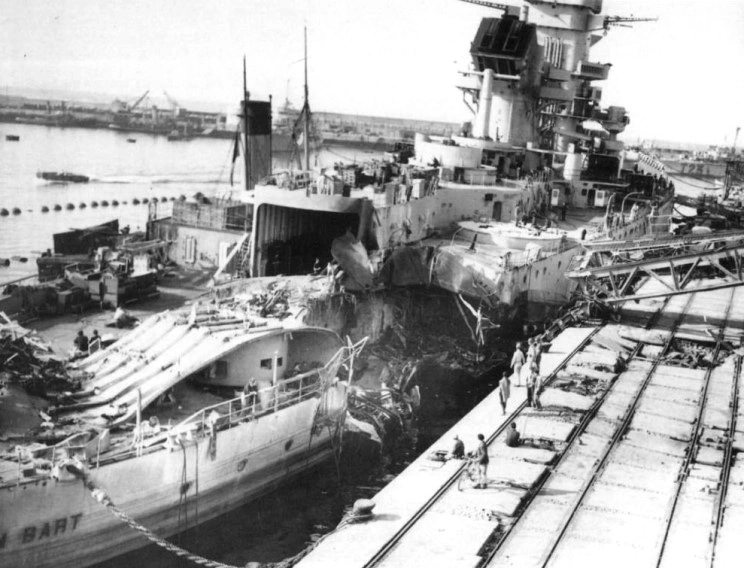
The Jean Bart was moored to the southeastern end of the Mole du Commerce, the other vessels were berthed along the Jetée Delure. In the event that the Task Force Commander should receive an indication of the surrender of the Port of Casablanca, or of the desire of the armed forces therein for the peaceful entry of the American armed forces, the commander of the destroyers (Capt. Moon in the Wainwright) would, upon signal, proceed with utmost regard for the mine fields, enter the harbor, and take the necessary steps to immobilize French naval vessels and shore batteries. This special mission was never called into operation in view of the hostile attitude of the French Forces. Adm Giffen was in command of the Covering Group, subject, how ever, to Adm Hewitt who was in command of the entire Task Force. The various organizations and subdivisions of the Task Force have been criticized as unnecessarily complicated. Without going into that mooted question, it should be pointed out that the detailing of an appropriate force to deal with the French Naval Units, leaving the fire support units of the attack groups to give direct protection to the landings, was tactically sound and certainly proved effective. The French Fleet was the main objective of the Covering Group, although in effecting its destruction that group inevitably came into contact with the shore defenses. The operations of the Covering Group at times seem to merge with those of the Center Attack Group, but they constituted a separate action designed to give indirect protection to the landing operations of all three attack groups by forestalling interference by the French Naval Units based on Casablanca.
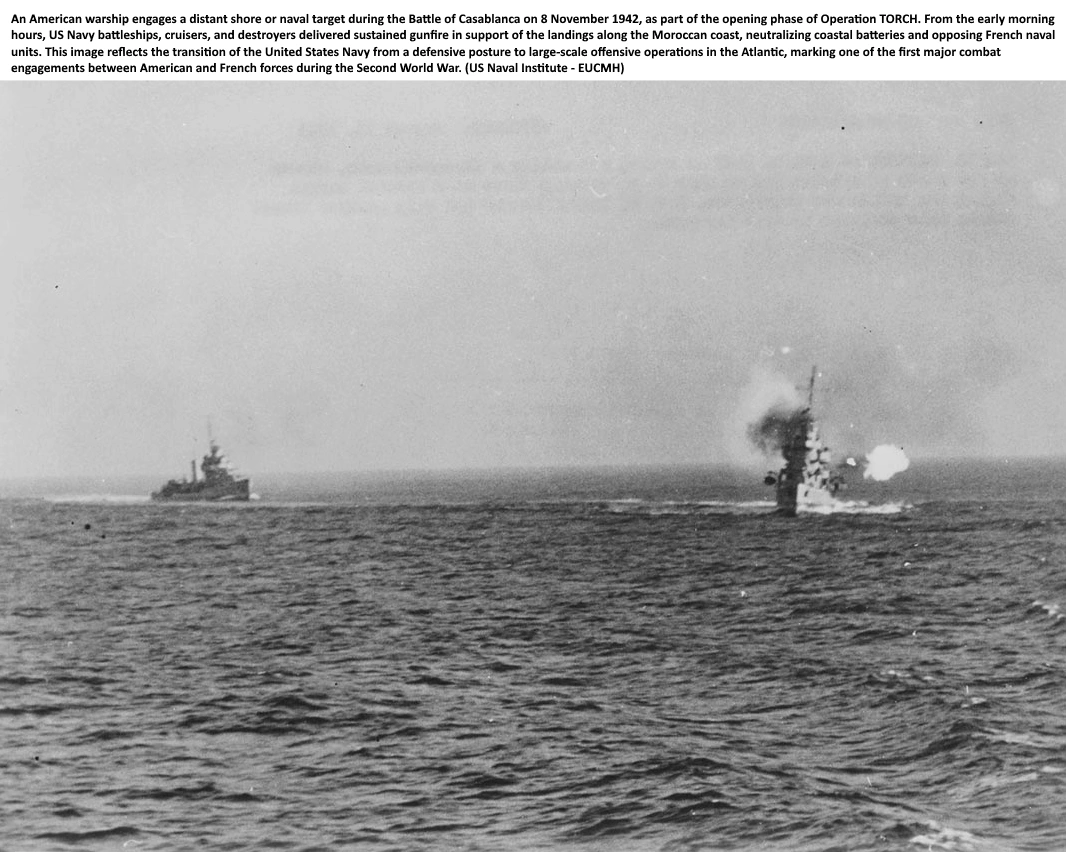
The Battle of Casablanca falls into three phases. The first began with the opening moves for position and continued until the sortie by the French Fleet which was completed at about 0830. The second phase is concerned mainly with the destruction of the French Fleet, which was practically complete by 1300. The third and last phase is concerned with the engagement with the El Hank Batteries and covers the period between 1300 until the retirement of the Covering Group at about 1600.
First Phase
November 7.
– 0653 Southern Attack Group released.
– 1515 Northern Attack Group released.
– 1535 Center Attack Group released.
– 2215 Covering Group changes course and begins maneuver on parallelogram.
– 2400 Casablanca receives first alert.
November 8.
– 0300 Casablanca receives second alert.
– 0610-0624 Nine planes launched.
– 0641-0642 Planes from Massachusetts encounter antiaircraft fire and hostile aircraft.
– 0702 Massachusetts opens fire on enemy planes.
– 0703 Gun flashes observed from El Hank and Jean Bart.
– 0704 Massachusetts opens fire on Jean Bart on first run. Tuscaloosa and Wichita follow.
– 0720 Massachusetts divides fire between El Hank and Jean Bart.
– 0741 Reverse run started.
– 0751 Wichita opens fire on Table d’Aukasha.
– 0818 Cruisers concentrate on harbor mouth.
– 0833 Covering Group ceases firing.
The morning of November 7, found the Task Force proceeding in a general southeasterly direction.
– At 0653, the Southern Attack Group was released and proceeded to its destination, Safi. Immediately thereafter the remaining groups changed course to 076.5° T., as if heading for the Straits of Gibraltar.
– At 1515, the Northern Attack Group was released and proceeded to its destination, Mehdia.
– At 1535, the Center Attack Group was released and, after some variations, ultimately settled down to a basic course of 145° T. In the meantime, the Covering Group, after a short run to the south, took an approximately parallel course of 144° T., which placed it about 10 miles to the southwest of the Center Attack Group is a position to cover it from any interference by the French Fleet based on Casablanca. The plan called for the arrival of the three attack groups before their objectives about midnight when debarkation was to begin.
– At 2215, the Covering Group changed course to 246° T. and proceeded to cover an irregular parallelogram designed to keep it between the Center Attack Group and Casablanca while debarkation was being effected and to bring it to a position to open fire on Casablanca at sunrise (0656) should it become necessary. After completing these four courses the Covering Group, at 0542 on November 8, took a course 245° T. and began the launching of planes. Between 0610 and 0624 nine planes had been launched as follows:
Antisubmarine Patrol
Tuscaloosa – 2 SOC—3
Wichita – 1 SOC-3
Spotting
Massachusetts – 2 OS2U
Tuscaloosa – 2 SOC-3
Wichita – 2 SOC-3
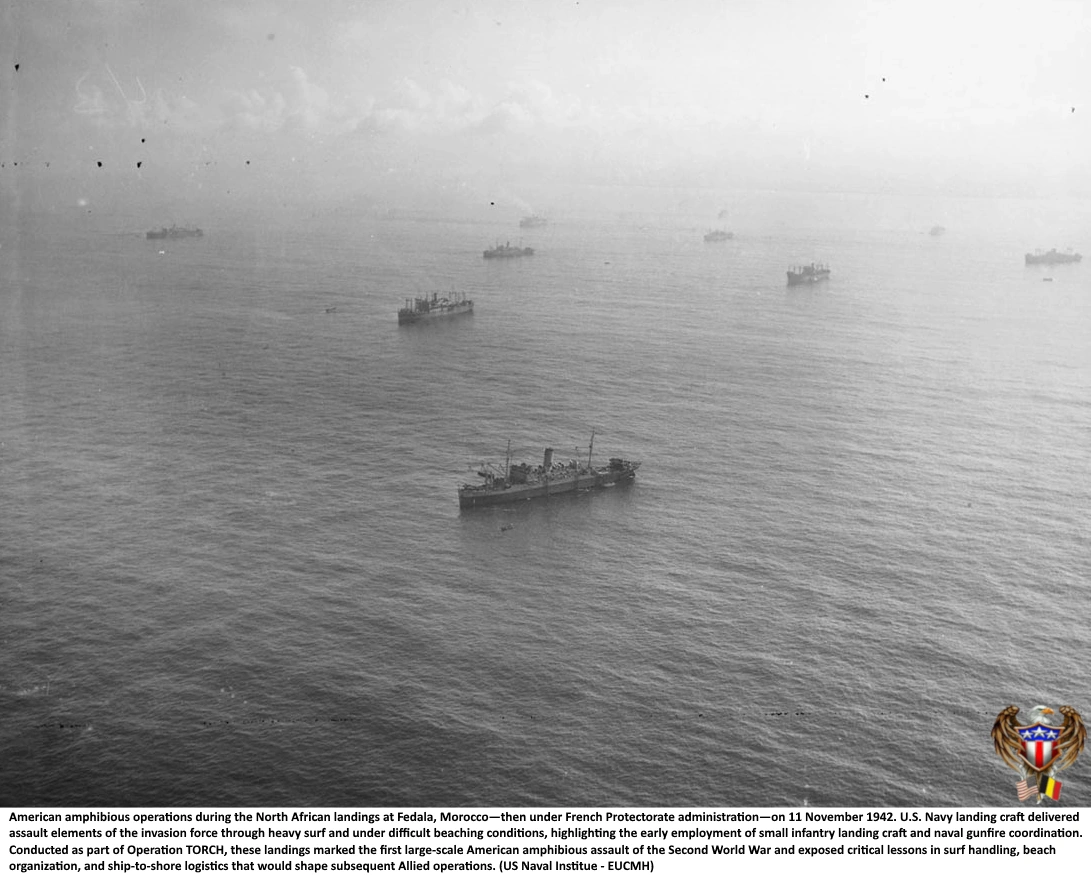
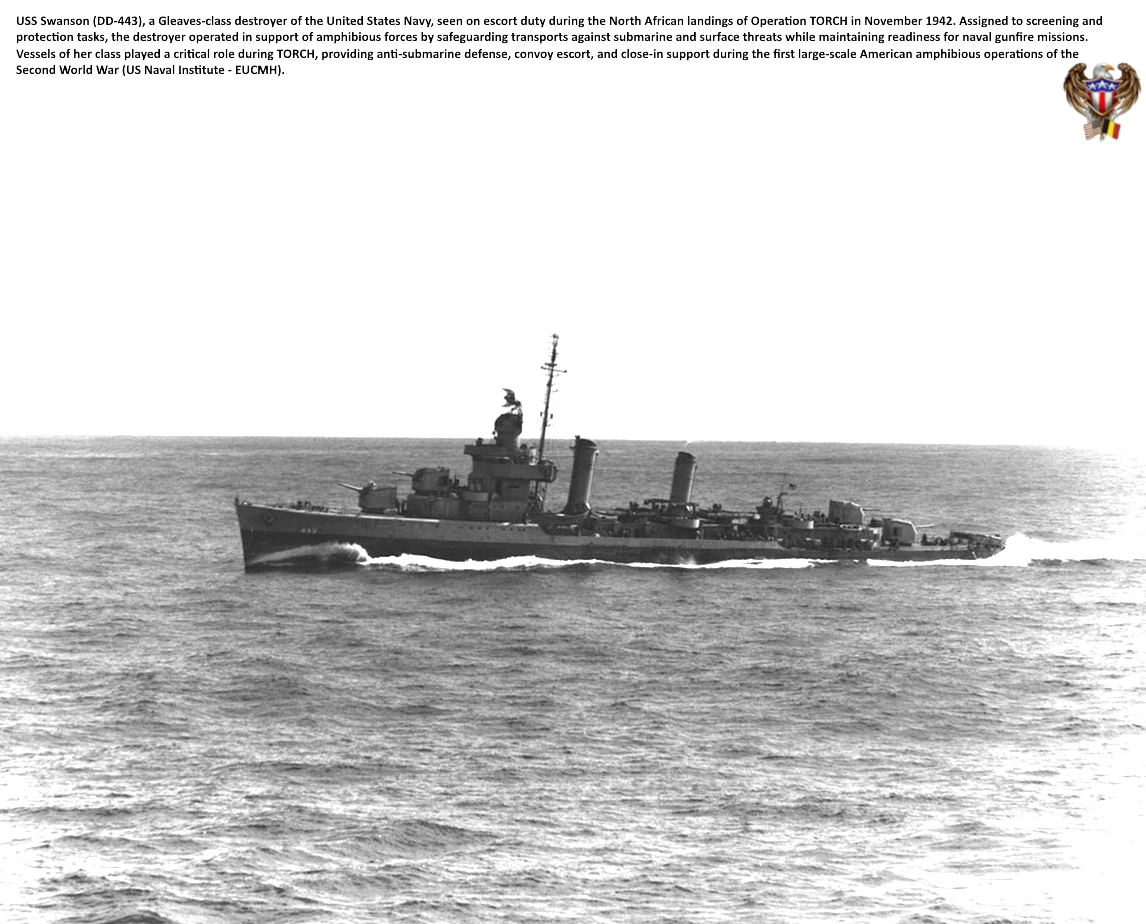
The normal formation of the Covering Group was as follows:
The heavy ships proceeded in column, distance 1000 yards, the Massachusetts (F) in the van, followed by the Tuscaloosa and the Wichita in that order. The heavy ships were screened by the four destroyers in a semicircular formation about 3000 yards ahead of the flagship, the Wainwright and Mayrant to starboard, the Rhind and Jenkins to port. In the meantime the French Naval Authorities at Casablanca had received a first alert shortly after midnight, followed by a more serious one at about 0300, November 8. Nevertheless, no reconnaissance patrols were undertaken. Whatever routine patrols were maintained were so ineffective that our arrival off Casablanca was a distinct surprise. When, shortly before midnight on November 7, our forces came within range of Point El Hank, the light was found burning. It was not extinguished until shortly after midnight.
It soon became apparent that the intelligence predictions to the effect that the French Fleet and land batteries would offer considerable resistance were about to be realized. Intercepted messages from the Southern Attack Group indicated that they were meeting with opposition. The Covering Group thereupon began to maneuver itself into a position for the first run past Casablanca. At 0640, the course being 090° T, the group began closing the range. At 0641 one of the spotting planes from the Massachusetts reported that it was under antiaircraft fire from the beach. One minute later the other plane reported that it had encountered hostile aircraft, followed at 0655 by a similar report from the first plane. At 0700 six fighter planes were observed ahead of the flagship at a very low altitude (about 1200 feet) pursuing several of our SOC-3’s and one of our 0S2U’s. The order was therefore given to the flagship to engage the enemy aircraft. At 0702, the flagship opened fire with her forward 5-inch battery against enemy fighter planes, followed almost immediately by the 5-inch anti aircraft batteries of the other ships of the group.
After a few salvos the enemy planes turned back toward the beach. One plane was shot down and another was seen out of control. At 0703, gun flashes were observed from the direction of El Hank and the Jean Bart, followed by several large splashes near the Massachusetts. Indeed, it is believed that the El Hank battery straddled the flagship on the first salvo. Five or six very large splashes, presumably from shells fired by the Jean Bart, were observed about 600 yards short, on the starboard bow of the flagship. The engagement, which up till then had been limited to aircraft, now became general. The cruisers had been previously directed to open fire when the flagship did so without further signal. On the morning of November 8, the wind was from the southwest, force one to two; sea moderate with slight swell. In general, weather conditions were excellent except for surface haze, particularly near shore. As the morning wore on, however, sun glare and reflection added to the difficulty of spotting and observation. Little could be done to improve conditions insofar as sun glare was concerned except by staying to the northeast of the harbor, from which point the batteries of El Hank could not be bombarded.
At 0704, the main batteries of the flagship opened fire on the Jean Bart, range 24.400 yards, bearing 131.5° T. Thereafter, during the first run, the range to the Jean Bart varied from 23.0200 yards at 0711, to 29.600 yards at 0740. During this period one hit on the Jean Bart, and two on the Mole du Commerce were noted. No radar ranges or bearings were obtainable since the fire control radars on the flagship became inoperative after the second or third salvo. Air spot was also uncertain during this period because of the smoke, antiaircraft fire, and enemy fighters. In direct fire based on a bearing obtained on the El Hank Lighthouse was used. After about 15 minutes, however, the main battery of the Jean Bart ceased firing and did not fire again during the day. At 0720, the flagship divided her fire. Turret No. 3 shifted to the El Hank battery while the forward turrets continued firing at the Jean Bart. The range of Point El Hank at this time was 22.900 yards, bearing ‘ 773° T.
During this opening period of the action the course of the Covering Group was 050° T. and thereafter, until 0730, speed varied from 20 to 27 knots. Various courses were steered, the mean course being 055° T. From 0730 until the end of the first run, at 0741 the course was 090° T. Small changes in course and speed were made at frequent intervals in order to make it as difficult as possible for the enemy fire control. In general, course changes were made towards the last splashes (i. e., ‘chasing the splashes’). Later, this became impracticable in view of the fact that the heavier ships, particularly the flagship, were often straddled. At 0705, the Tuscaloosa opened fire on the submarine berthing area in Casablanca Harbor, and at 0719, she shifted fire to the shore batteries at Table d’Aukasha, the opening range being 27.000 yards, minimum range 24.800 yards. Plane spot was used. After 20 minutes the batteries were silenced.
The Wichita opened fire at 0706 on El Hank, range 21.800 yards (using reduced charges) and at 0727, shifted fire (with full charges) to the submarine area in the harbor, range 27.000 yards. At this stage of the operations enemy planes appeared in considerable numbers. At one time what were believed to be several French torpedo planes were observed. These, however, did not come within antiaircraft range and made no attacks. At 0741, the course was changed to south, preparatory to a reverse run to the westward, and at 0748, the course was steadied at 270° T. The forward turrets of the Massachusetts resumed fire on the Jean Bart. The initial range was 26.000 yards. It varied thereafter from 25.000 yards at 0756 to 31.600 yards at 0828. At 0803, the course being, then 280° T., the flagship resumed firing at Point El Hank with turret number three, initial range 24.000 yards, the range thereafter increasing to 28.900 yards at 0818 and decreasing to 27.400 yards at 0831. Between 0828 and 0833 three salvos from all three turrets were fired at Point El Hank at a mean range of about 27.000 yards.
The Tuscaloosa commenced firing on a second run at 0759 on targets in the harbor (initial range 22.500 yards), shifting at 0810 to Point El Hank (range 24.000 yards) and at 0815 to a destroyer in the harbor entrance (range 28.000 yards). Firing ceased at 0823 as the harbor targets were then out of range. The Wichita opened fire at Table d’Aukasha at 0751, checked firing in a few minutes when a plane reported that the batteries there were not firing, and at 0806 resumed fire on the ships in the harbor, mean range 24.500 yards. Both cruisers had been ordered at 0818 to concentrate on the harbor entrance after the planes had reported that the enemy submarines were preparing to sortie. No hits were made on ships of the Covering Group during the first phase, although there were many splashes close aboard. At 0830, a message was intercepted to the effect that the Army was encountering no resistance and that the Navy fire was damaging the city. Cease firing was therefore ordered at 0833 pending clarification of the situation. The Covering Group started to withdraw on course 340° T., although the secondary battery of the Jean Bart was firing intermittently, as well as the batteries at Point El Hank.
At this point, what appeared to be two destroyers were observed standing out of Casablanca Harbor. The French were making a sortie from Casablanca, thereby initiating the second phase of the battle. The outstanding event of the first phase had been the wrecking of the Jean Bart, which had been hit by five 16-inch shells from the Massachusetts, besides being struck by two small bombs. As a result her stern settled until she rested on the bottom.
Second Phase
– 0610-0730 French submarines sortie.
– 0715-0745 French destroyers sortie.
– 0818 Augusta plane reports movement.
– 0820 Milan opens fire.
– 0843 Augusta opens fire, followed by Brooklyn.
– 0918 Massachusetts opens fire, followed by Wichita and Tuscaloosa.
– 0925 Massachusetts disables Milan and Fougueux.
– 1000 Primauguet sorties. Fougueux sinks.
– 1003-1021 French submarines attack.
– 1045 Boulonnais sinks.
– 1100 Massachusetts withdraws to save ammunition. Brestois, Frondeur and Primauguet hit.
– 1106-1142 Tuscaloosa, Wichita and Rhind engage enemy vessels attempting to regain Casablanca. Wichita hit.
– 1145 Cruisers of Covering Group sweep coast to southward. Albatros damaged.
– 1300 Cruisers rejoin Massachusetts and withdraw to northwest.
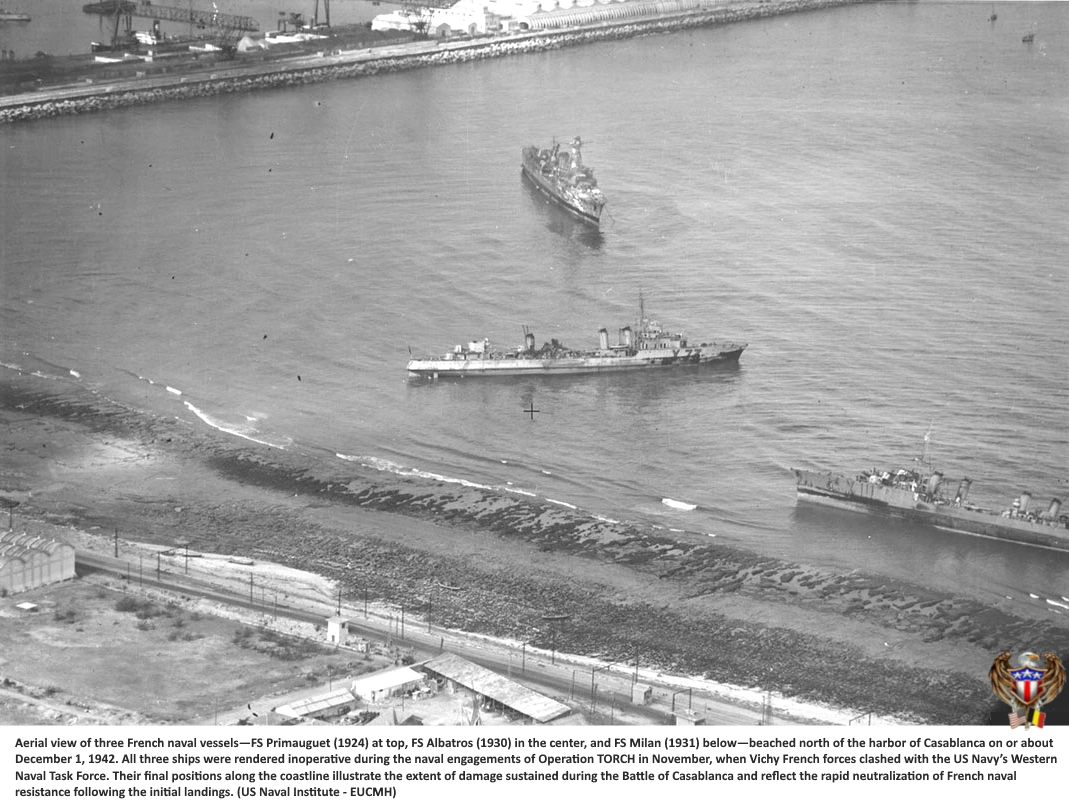
The second phase of the action was the destruction of the French Naval Units which sortied from Casablanca. The French warships in Casablanca Harbor proved to be the battleship Jean Bart, the light cruiser Primauguet, the flotilla leaders (contre-torpilleurs) Milan, Albatros, Le Malin, the destroyers Alcyon, Boulonnais, Brestois, Fougueux, Frondeur, Simoun, Tempête, the submarines Amazone, Amphitrite, Antiope, Conquérant, Méduse, Oréade, Orphée, Psyché, Sidi-Ferruch, Sybille, Tonnant, and the sloops Commandant Delage Gracieuse, Grandibre. They were under the command of RAdm Gervais de Lafond. As has been noted, the French Fleet in the harbor had for some time been subject to a devastating bombardment. The Jean Bart had been wrecked by the fire of the Massachusetts. The submarines Amphitrite, Psyché and Oréade had also been sunk at their moorings by the bombardment. The flotilla leader Le Malin, while moored to the Jetée Delure, was hit by a shell from the Massachusetts which struck the jetty, tunneled through, and entered the port side of the vessel without exploding, causing a bulge outward on the starboard side. The Le Malin did not sortie; nor did the destroyers Simoun and Tempête, then undergoing repairs.
Between 0610 and 0730, the submarines Amazone, Antiope, Conquérant, Méduse, Orphée, Sidi Ferruch, Sybille and Tonnant had sortied. The subsequent operations of these vessels cannot be definitely stated. Their ultimate fate is all that is known beyond doubt. The Méduse was beached near Mazagan. The Tonnant reached Cadiz and was scuttled by her crew on November 15. The Amazone and the Antiope managed to make Dakar. The Conquérant, Sidi Ferruch and Sybille were never reported. The Orphée was the only submarine to return to Casablanca.