

Between 0715 and 0745, the French destroyers put to sea and headed northeast in the following order: Destroyer Division 11 (Milan, Albatros), Destroyer Division 5 (Brestois, Boulonnais), Destroyer Division 2 (Fougueux, Frondeur, Alcyon). Each division was in column and the columns in echelon. The Primauguet did not sortie at this time. At 0818, a plane from the Augusta reported the movement to the Task Force Commander, who relayed the information to the
On the way they were engaged by the Covering Group. At 0918, the Massachusetts opened fire, followed by the Wichita at 0919, and the Tuscaloosa at 0925. The French returned the fire at once. Their fire control was excellent. The Massachusetts was hit twice, with slight damage. Another shell passed through the flagship’s colors. These hits, however, may have come from the El Hank Battery. It was during this period that the French sustained their first losses. At 0925, the Massachusetts reported that the flotilla leader with which she had been engaged was seen with only her bow out of water. This undoubtedly was the Milan, which had been hit by three shells below the water line and two or three near the bridge and had caught fire twice. She was ultimately (at 1400) beached near Roches Noires. The flagship then shifted to another target which appeared to be a destroyer. After three salvos the target completely disappeared. She was probably the Fougueux, which sank about 0930 in latitude 33°42′ N., longitude 07°37′ W. At 1016, the Covering Group ceased firing. At this point the Center Fire Support reengaged the retreating enemy, the Brooklyn opening fire at 1015, and the Augusta at 1025. At 1030, the Covering Group resumed firing. A ‘melée engagement’ with the French destroyers ensued during which, at 1045, the Brooklyn received her only hit by a shell which, although it did not explode, injured six men.
At this stage of the action the Primauguet sortied from Casablanca, rallied the Boulonnais, which had damaged her steering gear and had fallen behind, and proceeded once more up the coast toward Fedala with the other destroyers. The French vessels soon found themselves under the combined fire of the Covering Group and the Center Fire Support. Hits began to accumulate. At 1045, the Boulonnais sank in latitude 33°40′ N., longitude O7°34′ W., mainly as the result of fire from the Augusta. The remaining destroyers (Frondeur, Alcyon) formed on the Brestois. At about 1100, this vessel took a bad list and with difficulty managed to return to port where she capsized off the Jetée Delure at 2400. The same fate befell the Frondeur which returned to port about the same time down by the stern. She sank at her berth during the night. It is impossible to assign the hits on these three vessels. Their destruction was probably the work of several ships. The color splashes reported by the French would so indicate. The color splash of the AP ammunition used by the Massachusetts and the Brooklyn was green, that of the Augusta red. The destroyers did not use color splashes. The bombardment ammunition of our cruisers was also free from color. The French timetable, from which these times are taken, only gives approximate times. At 1102, the Center Fire Support ceased firing except for occasional long range shots by the Brooklyn.
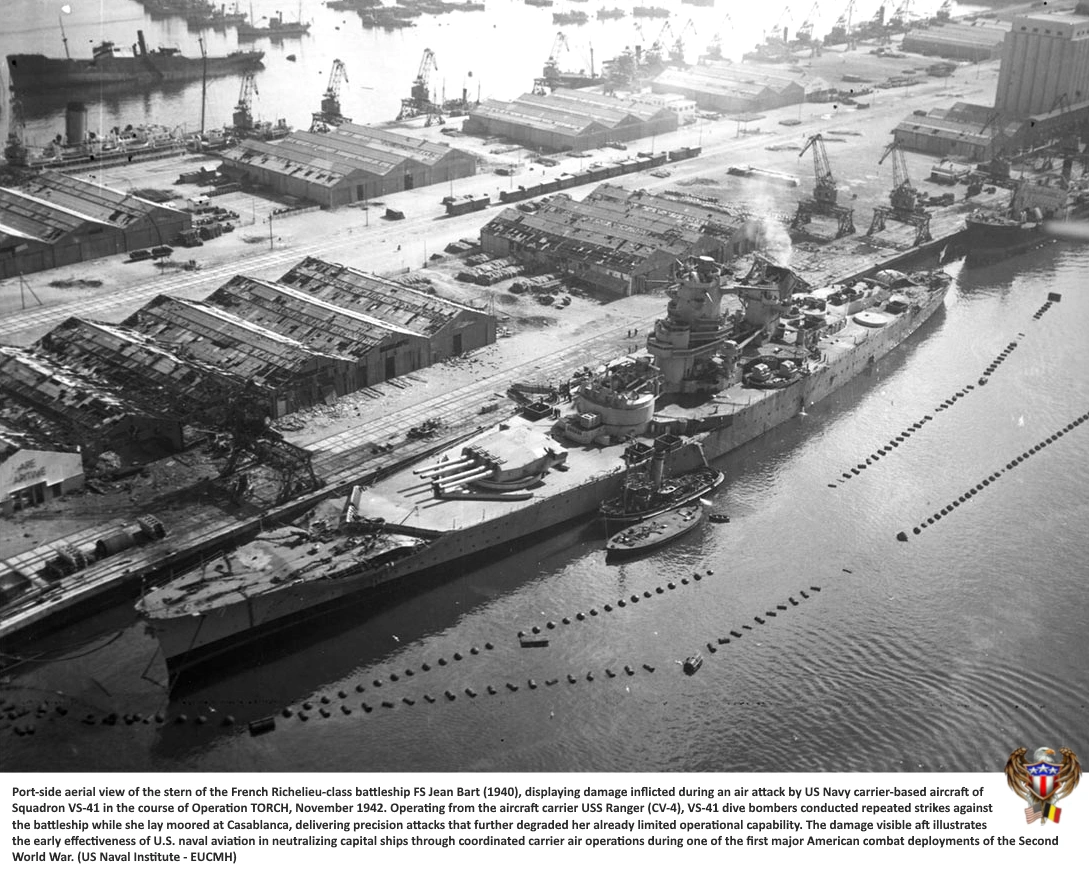
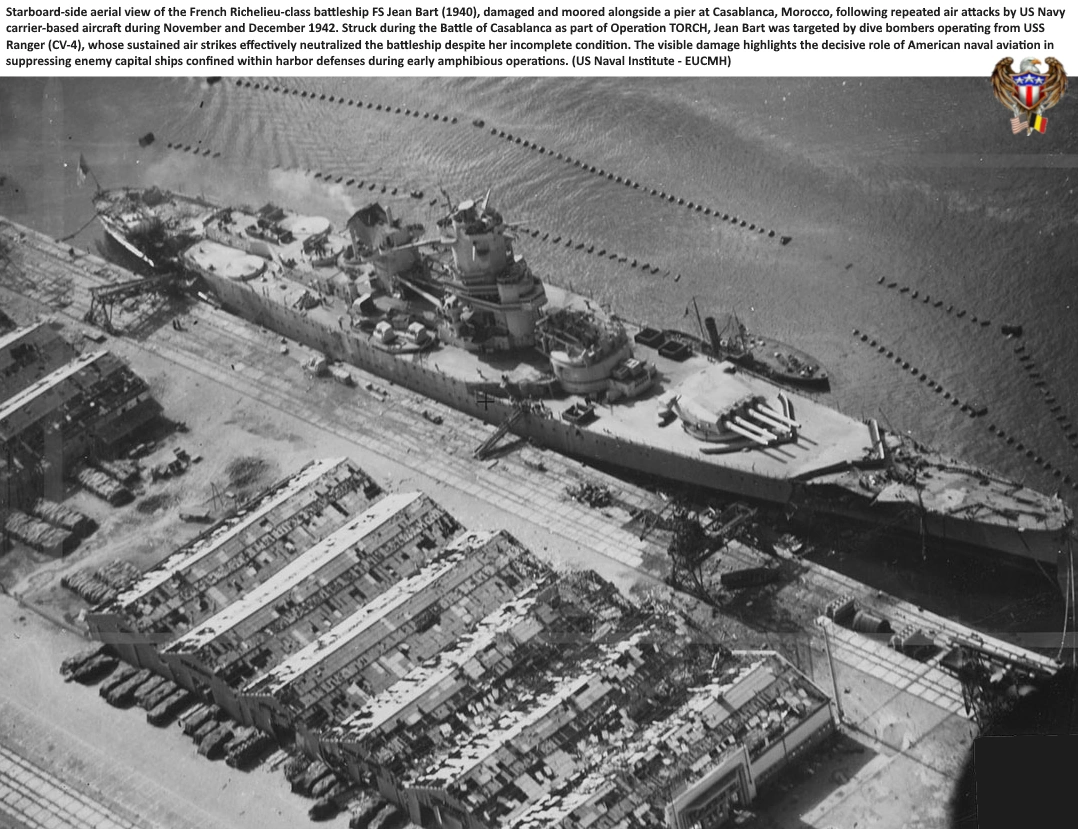
By 1100, the Massachusetts had expended 60 percent of her 16-inch ammunition and the preservation of the remainder was considered essential against a possible sortie by the Richelieu from Dakar. The cruisers of the Covering Group had expended an even higher percentage, but it was felt that their remaining ammunition could be used against the French forces without the risk attendant upon further depletion of the flagship’s main battery ammunition. Accordingly, at 1102, the commanding officer of the Tuscaloosa was ordered to take the Wichita and the Rhind under his command and close with the enemy light forces. At 1106, the flagship ceased firing and hauled away to the northward while the cruisers and the Rhind stood in and engaged the enemy vessels which were attempting to regain the harbor. Firing continued until 1142. It was while engaging the enemy at close quarters that the Wichita was hit by a French shell at 1128, which injured 14 men.
By this time, the only French vessels afloat were the Primauguet, Albatros and Alcyon. Shortly after 1100, the Primauguet was badly hit, five shells striking below the water line and an 8-inch shell in No. 3 turret. She came in and anchored off Roches Noires. Between 1400, and 1700, she was bombed and strafed and her whole forward half wrecked. A direct hit on the bridge killed the captain, the executive officer and 7 other officers. About one-half hour later, at 1130, the Albatros was hit by 2 shells, 1 of which was below the water line forward. At 1145, she received 2 bomb hits amidships. Completely helpless, she asked for a tow. While being towed back to Casablanca she was shelled and strafed. She was eventually beached at Roches Noires. Of a crew of 200, 25 were reported killed and 80 wounded. The only surface vessel to return safely to Casablanca was the destroyer Alcyon which made port about 1130.
At about noon, the three sloops Commandant Delage, Gracieuse and Grandière, which had remained in the harbor during the engagement, sortied to pick up the survivors of the Boulonnais, Fougueux and Milan. While so doing they became engaged with the Augusta and the Brooklyn at 1326. The Grandière was slightly damaged by bombs at 1330. At about 1145, a message was intercepted from the Task Force Commander stating that an enemy cruiser was laying a smoke screen south west of Casablanca and heading down the coast. The cruisers of the Covering Group, screened by the Rhind, were ordered to sink her. No trace of this cruiser was found so at 1300, our cruisers headed back to rejoin the flagship.
With the withdrawal of the Covering Group the second phase of the battle ended. It had witnessed the practical annihilation of the French Fleet.
 NOTE: The sortie of the French Fleet had been the occasion for some submarine activity. At 1003, just after the course had been changed from 250° T. to 230° T., the wakes of four torpedoes were sighted by the executive officer of the Massachusetts about 600 on the port bow at a distance of less than 1000 yards. By skillful maneuvering the flagship passed between numbers three and four in the spread, counting from the left. Number four torpedo passed a few feet outboard of the starboard paravane. All ran very shallow. It is believed that they were fired by a submarine at a range of between 4000 and 5000 yards. Emergency signals were made by flag hoist to the ships astern. After avoiding the torpedoes, the ship changed course to 240° T. At 1018, the course was changed to 090° T., in order to overtake what appeared to be a submarine on the surface and a ship on the port quarter. At 1021, another torpedo wake was sighted and passed about 100 yards to port. In the meantime, at 1010, an unsuccessful submarine attack was made on the Brooklyn. The wakes of four torpedoes were observed, as well as the bubbles from the tubes.
Third Phase
– 1326, the Covering Group begins search for enemy vessels reported proceeding to Fedala.
– 1341, the Massachusetts locates one destroyer. El Hank opens fire.
– 1355, Cruisers of the Covering Group continue search, advancing to mouth of Casablanca Harbor.
– 1450, Land batteries at Casablanca compel retirement.
– 1558, the Massachusetts fires salvo at El Hank, then retires with Covering Group.
The third phase of the engagement began with a search for French Units which were reported steaming along the coast with the probable intention of interfering with our landing operations. The action soon developed, however, into an attempt to silence the persistent batteries at Point El Hank which had maintained an intermittent fire during the entire battle. These batteries, as well as the other fixed defenses, were manned by naval personnel, which probably accounts for their determined resistance.
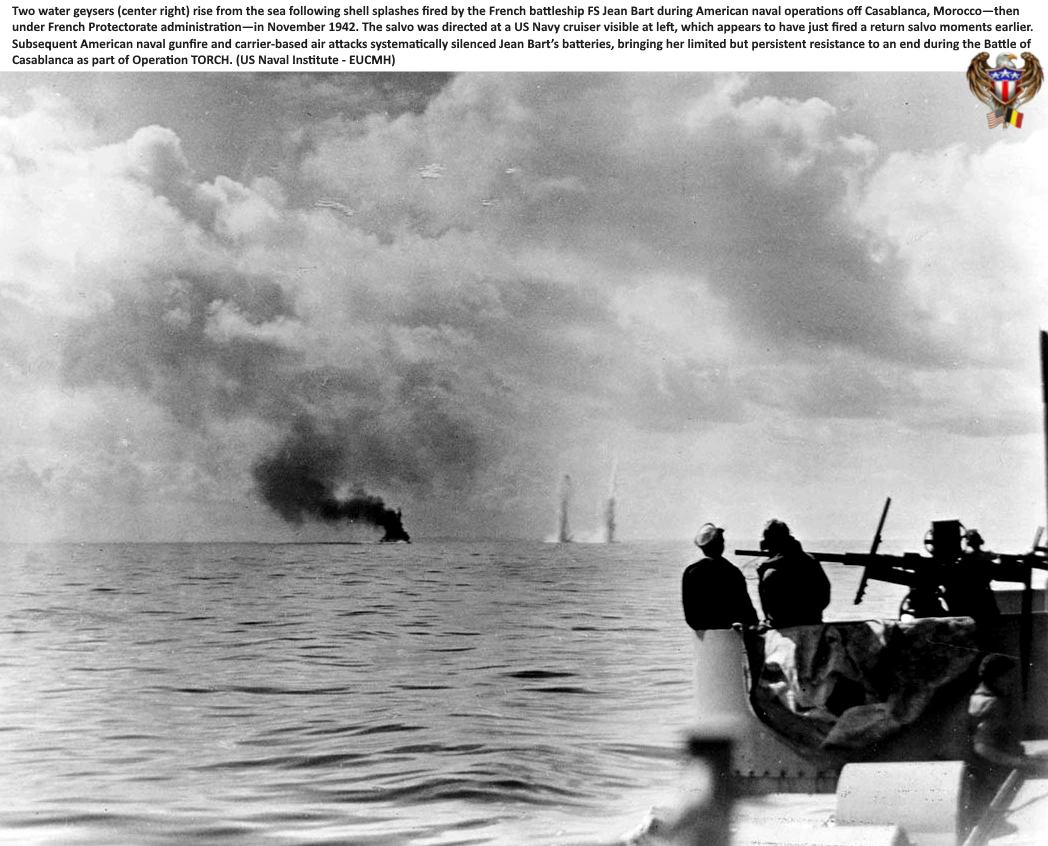
– 1302, a message was received from the Task Force Commander that two cruisers and a destroyer had been reported standing up the coast from Casablanca to Fedala. At this time, the Covering Group cruisers and the Rhind had not yet rejoined from their sweep to the southwest in pursuit of another French cruiser which had been reported as having slipped through.
– 1326, the Covering Group set course 080° T., toward Fedala and increased speed to 27 knots.
– 1340, the Massachusetts opened fire on a light vessel, bearing 136° T., range 22.000 yards. If the French timetable is correct, the only vessel that could possibly have been in the neighborhood of Fedala was one of the three sloops. Only two salvos, however, were fired at this target, as the El Hank batteries opened at 1341 with excellent aim. All turrets were shifted accordingly to that target at 1345. The range was 19.000 yards, increasing gradually to 23.000 yards when firing ceased at 1350.
About this time the Task Force Commander ordered the Covering Group to destroy before nightfall the light forces which appeared to be making sorties from Casablanca.
– 1355, accordingly, the cruisers, plus the Rhind, stood in toward the harbor, this time from the direction of Fedala in order to avoid gunfire from El Hank. An enemy vessel, undoubtedly the Brestois, was shelled near the entrance at a range of 17.000 yards. No gunfire was observed from the French ships but the shore batteries again forced retirement at about 1450. At that time two other enemy vessels were observed outside the harbor, near the entrance. One of them (obviously the Milan) was on fire, another (probably the Albatros) was beached.
– 1423, the Massachusetts received orders from the Task Force Commander to preserve ammunition for a possible sortie of the Richelieu from Dakar and, as a result, broke off the action. There were, however, several loaded 16-inch guns on the flagship and it was decided to unload them on Point El Hank. This was done at 1558 at a range of about 30.000 yards. After one ranging shot a six-gun salvo was fired. Although over, tire salvo apparently hit explosives or inflammable stores, as an unusually large explosion was noted. Shortly thereafter the flagship was joined by the cruisers and the group stood out to sea, thereby terminating the third phase of the battle.
Summary
The performance of the Covering Group in clearing the way for the troop landings had been an outstanding one despite the failure of the radar to function properly on the larger units of the fleet. The concussion of the large caliber guns soon put the greater number of the radar range finders out of commission. As a result the expenditure of ammunition was much greater than had been anticipated. The following table is illuminating.
Massachusetts
Battery & Expenditure: 16 inch (67%); 5 inch (2.25%).
Tuscaloosa
Battery & Expenditure: 8 inch (85%); 5 inch (1%)
Wichita
Battery & Expenditure: 8 inch (83%); 5 inch (7%)
Wainwright
Battery & Expenditure: 5 inch (25%)
Rhind
Battery & Expenditure: 5 inch (8%)
Mayrant
Battery & Expenditure: 5 inch (30%)
Jenkins
Battery & Expenditure: 5 inch (6%)
It will be noted that the Massachusetts, Tuscaloosa, and Wichita had expended so great a portion of their heavy caliber ammunition that they would have been seriously embarrassed if compelled immediately to go into action against the larger units of the French Navy. A similar state of affairs existed on some of the other vessels of the fleet. The Brooklyn, which had been operating off Fedala, reported a total ammunition expenditure of 75 percent. The performance of the French Naval Forces, both ships and batteries, throughout the entire engagement was excellent. Their gunnery was accurate, straddles being frequently made on the first salvo. That more hits were not scored on our vessels was due to the skill with which they maneuvered and to the high angle of fall of the French projectiles at long range.
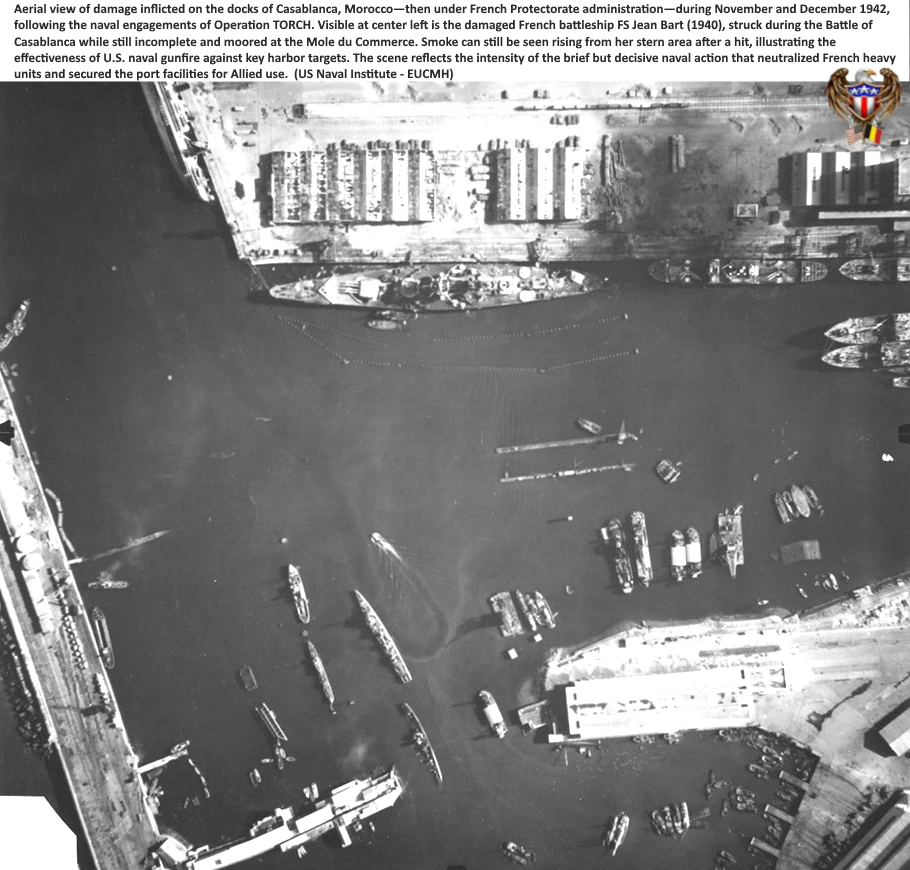
The opinion of the officers of the Massachusetts, which had been principally engaged in the destruction of the Jean Bart, was that the French ship fired only five or six salvos. In all probability she was receiving electric power from the shore, and fairly early in the engagement this power was temporarily cut off by a shell from the Massachusetts. During the engagement she put up a smoke screen generated from the dock and kept it over her throughout the day. As a result the Jean Bart was not definitely silenced until the afternoon of November 10, when she was bombed with 1000-pound bombs, one of which struck the water on her port beam, one forward of No. 1 turret and one on her starboard side aft. In spite of the destruction wrought by these bombs, the vessel’s 15-inch guns and fire-control apparatus were still serviceable.
Toward the end of the first run the officers in the Massachusetts believed that the batteries at El Hank were out of commission but this supposition proved to be erroneous. The shells from the American vessels probably temporarily compelled the crew of the batteries to seek shelter. After our vessels ceased firing the French repaired whatever slight damage had been caused and continued firing whenever the American vessels came within range. In the Battle of Casablanca our surface ships enjoyed excellent air support. The Ranger, accompanied by the Cleveland and screened by the Ellyson, Corry and Hobson, was operating off Casablanca. The Suwannee and Chenango, screened by the Forrest and Fitch, were in the same vicinity. The Suwannee conducted combat air and anti submarine patrols for the carriers as well as for the ships off Fedala.
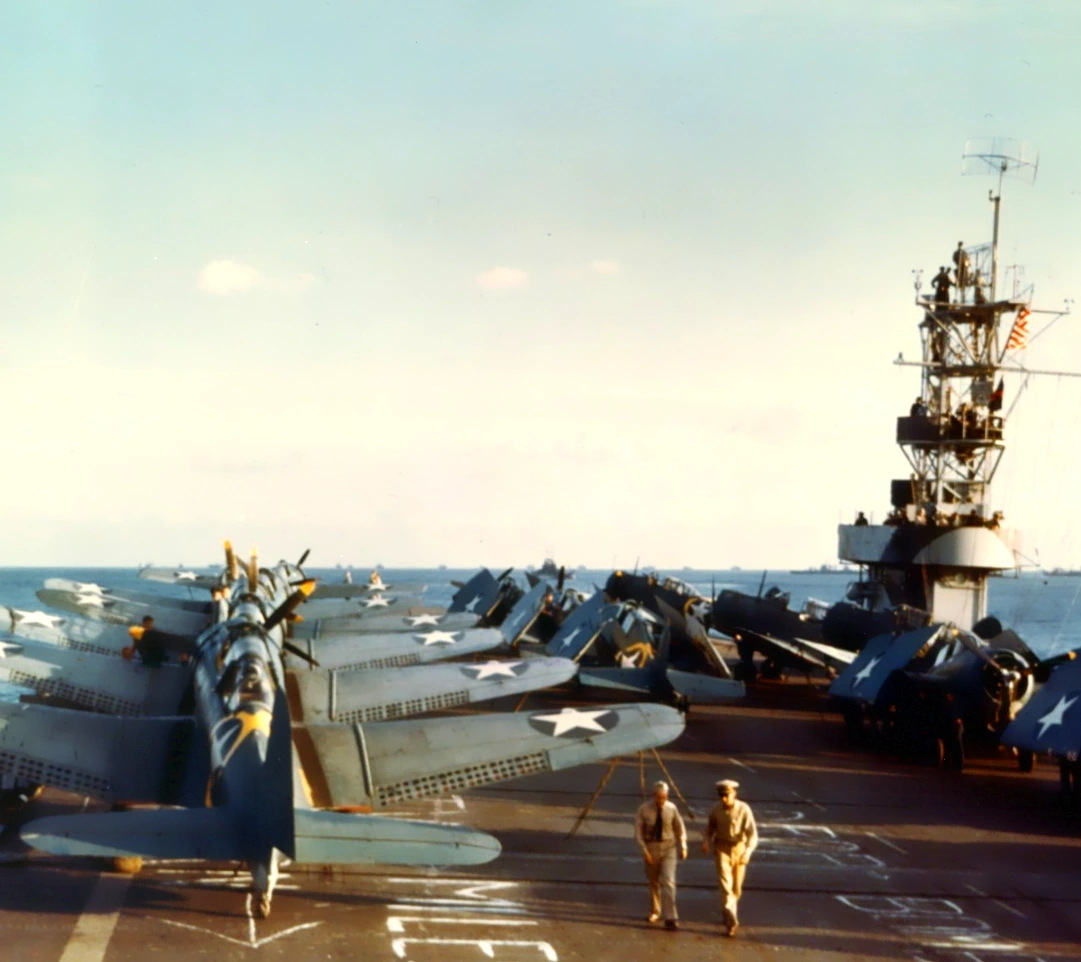
At 0615, the Ranger launched 18 fighter planes to neutralize the Rabat-Sale Airport, and at 0635, 17 scout bombers to attack submarines and surface ships at Casablanca and the batteries at El Hank and Table d’Aukasha. At 0700, the Suwannee launched 8 TBFs to destroy submarines and surface ships at Casablanca, while the Ranger sent 18 fighters to the same area. These planes supplemented the bombardment by our surface ships, and when the French vessels sortied our planes attacked them with bombs and by strafing. The latter was particularly effective against the lighter vessels, and our airmen believed it played an important part in turning them back to the harbor. At 1252, the Task Force Commander ordered our planes to cease attacking the French warships in the harbor, but to continue attacks on those outside. At 1306, the Ranger launched planes to destroy enemy vessels standing out of the harbor, but with orders not to block the channel. An hour later, 16 fighters were launched to attack the light forces which appeared to be making sorties.
Meanwhile the shore batteries had been bombed repeatedly. By evening, the Jean Bart had been hit at least once, and undetermined damage had been inflicted on other vessels. The Ranger alone had launched 205 flights, which ‘secured complete air superiority and gravely damaged Vichy Naval Units and shore batteries in the Casablanca area, which was the center of the military defense of French Morocco‘. In closing this summary of the naval action of November 8, it should be noted that the rank and file of the French Navy fought doggedly, courageously, and skillfully against heavy odds. What is less obvious, however, is their motive for so doing. It is probably to be found in the high sense of professional honor that has always characterized the French Naval Service. Our forces had not heard the last of the French Navy. Two days later, on November 10, the Gracieuse and Commandant Delage sortied again and started to shell our troops northeast of Casablanca. The Augusta, supported by the Edison and Rowan, engaged them, firing 10 salvos between 1139 and 1156, at ranges of 16.000 to 18.000 yards. The Commandant Delage was hit, whereupon the French Sloops withdrew. This sortie may well have been for the purpose of enticing some of the American vessels within range of the guns of the Jean Bart, which were once more in working order.
NOTE: Unofficial estimates place the French losses at about 500 killed and 800 wounded. Among the seriously wounded was RAdm Gervais de Lafond. The morale of the French Naval Forces has been summed up by one ranking officer as follows: ‘Honesty demands that the lassitude, notwithstanding their bravery, of the French, and the providential good luck attending the US forces, be recognized as heavy contributing factors. No other enemy would have failed to lay mines and prepare beaches at least in the vicinity of strategic points. No other enemy, equipped with air and submarines, would have failed to detect the approaching force by or before dark the day before their appearance off shore, or failing that, could have been alerted 6 hours before daylight by the presence of enemy ships 16 miles from his principal base, and failed to use his 11 submarines before daylight and his air force by or before daylight’.
The Attack on Mehdia and the Port Lyautey Airfield (Northern Attack)
The operations against Mehdia and the adjoining Airfield at Port Lyautey had as their object the securing of that harbor and airfield with a view of employing them in the subsequent attack on Casablanca, 65 miles to the south. The US Forces force engaged was the Northern Attack Group (Task Group HOW 8), RAdm Kelly, consisting of the following units:
Fire Support: Texas (F), Savannah, Roe, Kearney, Ericsson.
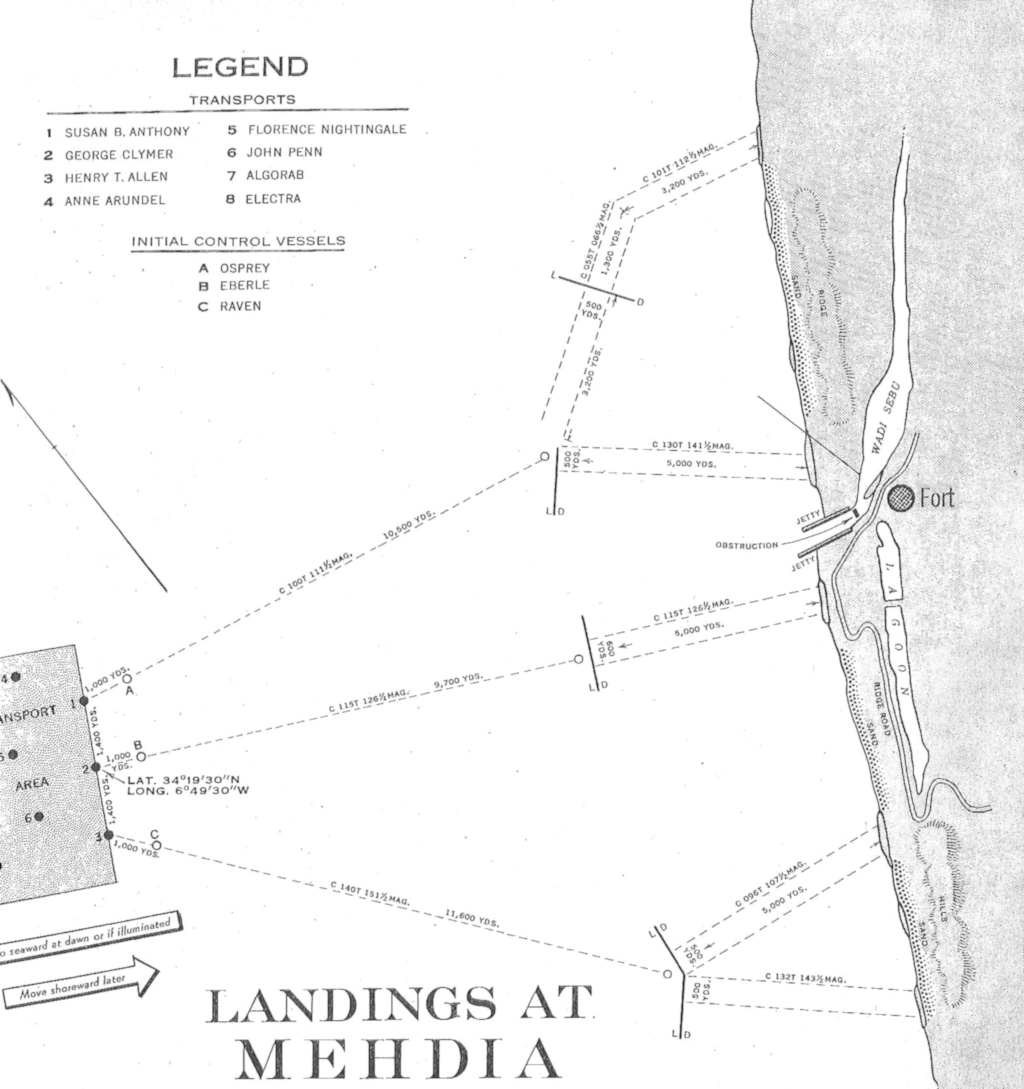
Transport: Algorab, Henry T. Allen, Susan B. Anthony, Anne Arundel, George Clymer, Electra, Florence Nightingale, John Penn
A/S Screen and Minesweepers: Livermore, Eberle, Parser, Raven, Osprey.
The destroyer Dallas was on a special assignment to proceed up the Sebou River to Port Lyautey. The oiler Kennebec, with two specially constructed fire support craft on board, was attached to the Northern Attack Group. The seaplane tender Barnegai, Commander Felix L. Baker, joined from the United Kingdom on November 7, and was assigned to the Port Lyautey operation.
The functions of the naval force were to be as follows:
(1) To land the troops at designated beaches at H-hour (0400).
(2) To unload equipment and land same ashore.
(3) To serve as fire support for the Army units ashore.
(4) To screen and support the transport area and to maintain anti-surface, submarine and air patrols.
The Army contingent (Task Group ZEBRA) forming part of the Northern Attack Group was under the command of Gen. Lucian K. Truscott, and consisted of the following units:
60th Infantry Division, 9th Infantry Division, reinforced; Ranger Detachment, US Army; One light armored battalion combat team, 2nd Armored Division. Total: 526 officers, 8573 enlisted men, 65 light tanks.
Following the general pattern of the campaign, command of the landing forces devolved on the Army as soon as satisfactory beachheads were established.
November 7
– 1900, Roe detached to locate beacon submarine.
– 2150, Roe retires after failing to locate submarine.
– 2321, Northern Attack Group reaches transport area.
November 8
– 0200, Dallas embarks Ranger Detachment and Fighting French Detachment.
– 0411, Fire support vessels take station.
– 0515, First landing made.
– 0605, French open fire on landing parties.
– 0607, Six planes launched.
– 0629, Shore batteries at Mehdia open fire on Roe. Roe replies.
– 0652, Savannah and Roe attacked by enemy planes.
– 0710, Orders for general offensive given.
– 0720, Enemy air offensive increases. Landing parties strafed.
– 0747, Twenty F4F’s arrive to give air coverage.
– 0755, Savannah opens fire on the Kasba.
– 1140, Dallas attempts to enter river. Forts compel retirement.
– 1343, Texas opens fire on Port Lyautey. th Kasba penetrated.
– 1621, Shore batteries silenced. Savannah ceases fire.
November 9
– 0750, Savannah opens fire on enemy tanks.
– 1027, Savannah ceases fire as American tanks advance.