


 Patrols Reach Yonabaru
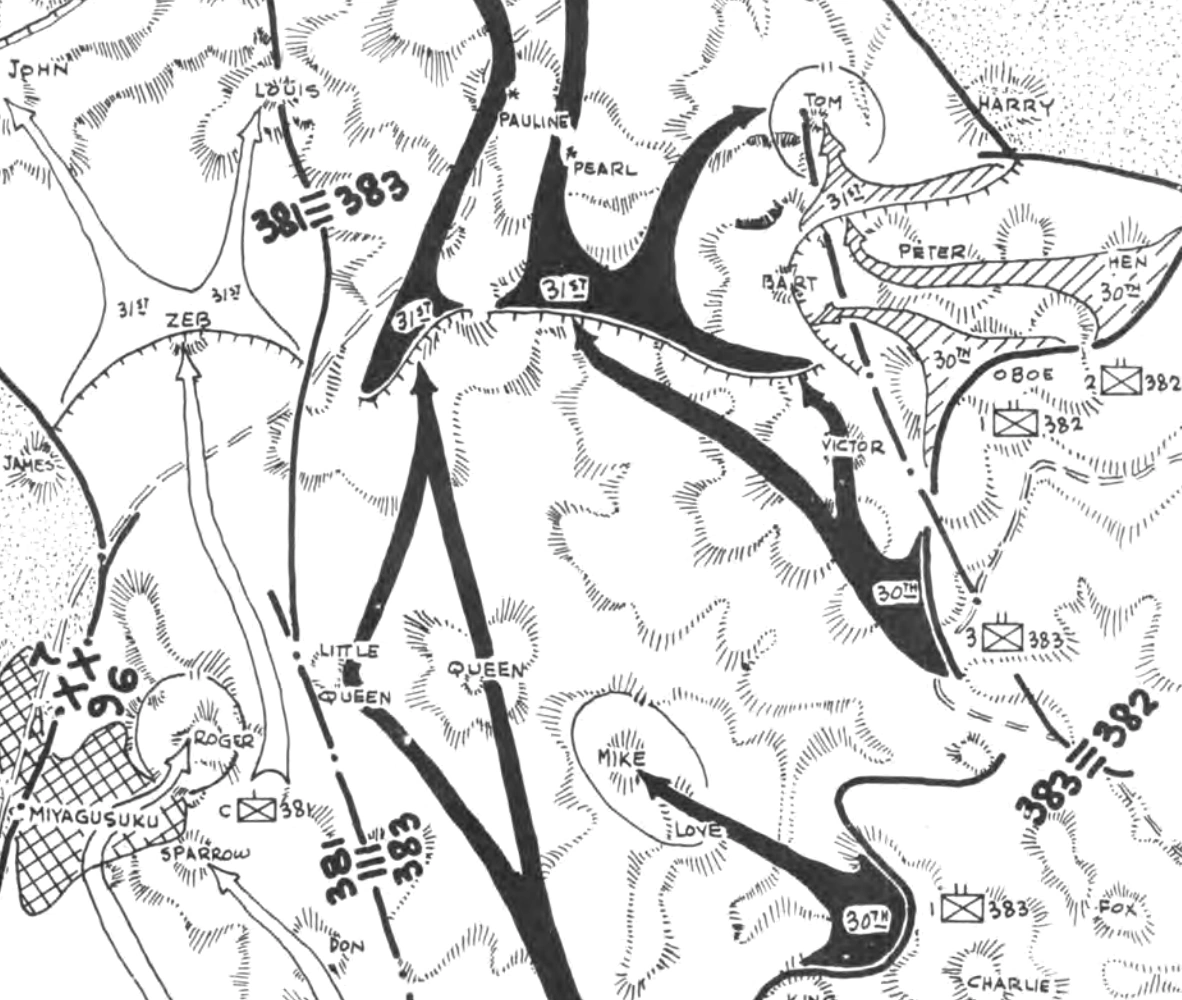
On May 18, the 382-IR was engaged in mopping up and eliminating close in enemy positions without any change in previous front lines. An enemy mine field at (8072-C5) was cleared during the day using Bangalore Torpedoes and tanks were then able to advance into the valley behind the Dick Hill. The 3/382 received heavy machine gun and mortar fire throughout the day from both, the Oboe Hill and the Flat-Top Hill which prevented any advance down the south slopes of the ridge southeast of the Dick Hill. Strong patrols were sent forward by the 1/382 to scour the area between the Baker Hill and the Victor Hill. These patrols received only light sniper fire and machine gun fire and some enemy artillery from positions in the vicinity of the Victor Hill.
In the 383-IR zone, there was no change in front lines as termite patrols and tank-infantry teams from both the 1/383 and the 2/383 operated along the south slopes of the Charlie Hill and the west slopes of the King Hill destroying enemy positions in this area. During the afternoon, these patrols received heavy fire from the vicinity of the Love Hill. Our tanks returned the fire and it is believed that several guns were destroyed. The only substantial gain made by the division was on the left flank in the zone of the 381-IR. The 3/381 advanced approximately 400 yards across the fingers extending toward the sea from the high ridge extending south from the Conical Hill. Medium tanks operating between the Conical Hill and the coastal road rendered excellent direct fire support against machine gun positions in the 8271-UPG Area. Despite this support, advances were very slow against the heavy machine gun and mortar fire opposing this battalion. Patrols from the 3/381 advanced as far as (8270-B2) without receiving fire from the Sugar Hill – (8271-P2), but enemy machine gun fire from the Hogback Ridge – (8271-P2, 4) prevented further advance and it was necessary for this patrol to return under the cover of a smoke screen.
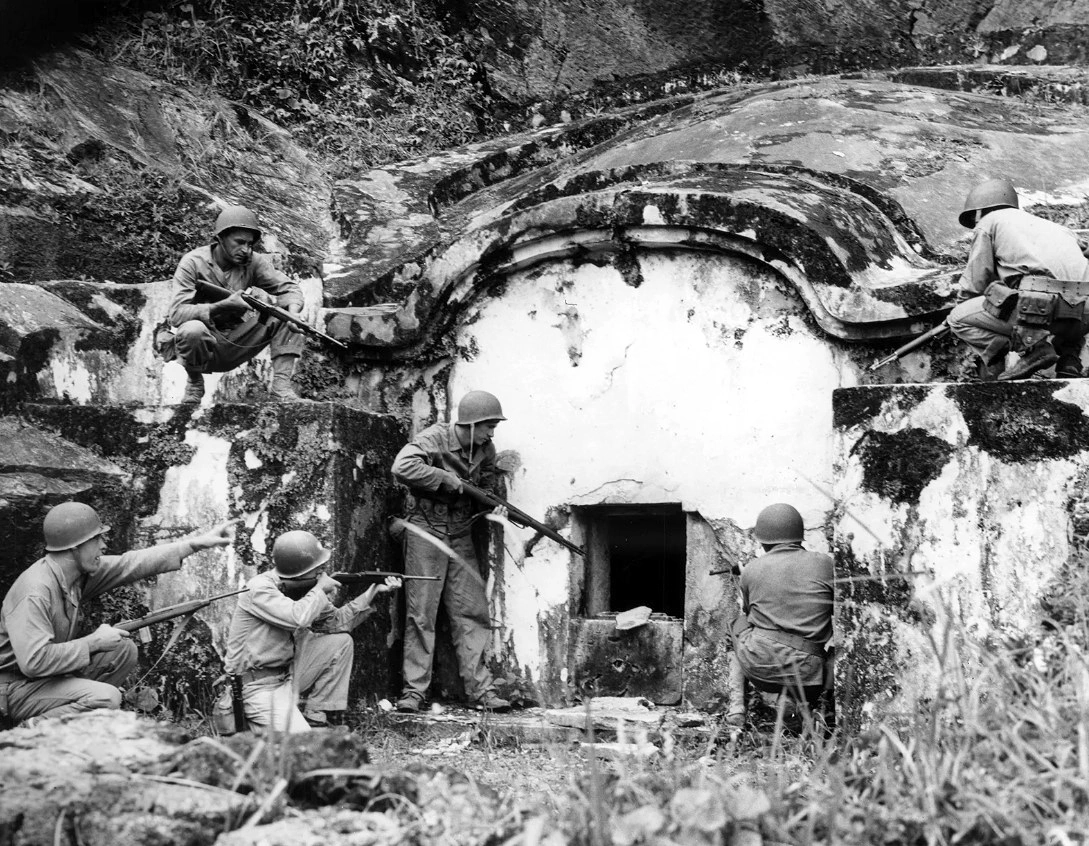

The Rains Came
Heavy rain set in during the night of May 18/19 resulting in very little enemy activity along the division front. However, the 2/382 on the division right flank engaged in hand grenade battles throughout the night killing an estimated sixty Japs. Little progress was made by the division on May 19, except on the left flank. In the 382-IR zone, heavy enemy fire from both the Oboe Hill and the Peter Hill – (8072-W1) prevented any material advance during the day. The regiment employed medium tanks, flamethrower tanks, assault guns, and infantry demolition teams throughout the day in mopping up enemy emplacements to their front. Despite heavy AT fire, the tanks destroyed at least fifteen caves and other emplacements.
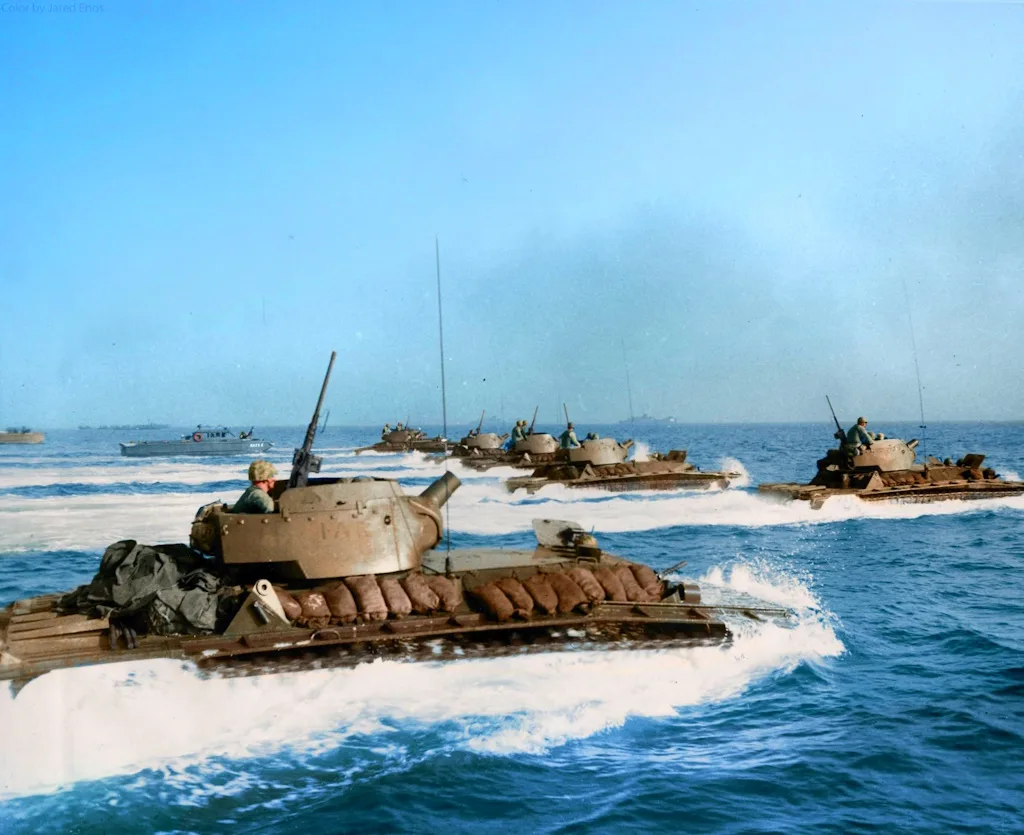
The 383-IR also continued its mop-up activities throughout the day in the the King Hill and the Charlie Hill area employing tanks and infantry demolition teams. Many machine gun emplacements were destroyed and numerous caves sealed. Due to this intensive mopping-up within their zone and the heavy enemy fire coming from their front, there was no change in the front lines of this regiment. After heavy neutralization fire by two platoons of medium tanks, six platoons of Amphibious Tanks and the fires of artillery and Infantry support weapons, the 381-IR resumed their attack against the Sugar Hill at 1100, with 3/381 in the assault. Strong assault demolition teams were pushed forward to destroy enemy machine guns previously located in the vicinity of their advance. Numerous enemy positions were destroyed although front lines were practically unchanged. Several strong hand grenade battles ensued across the top of the Hogback Ridge during the day’s battle. During the night May 19/20, numerous hand grenade battles characterized the action along the division front, despite intermittent showers throughout the period.
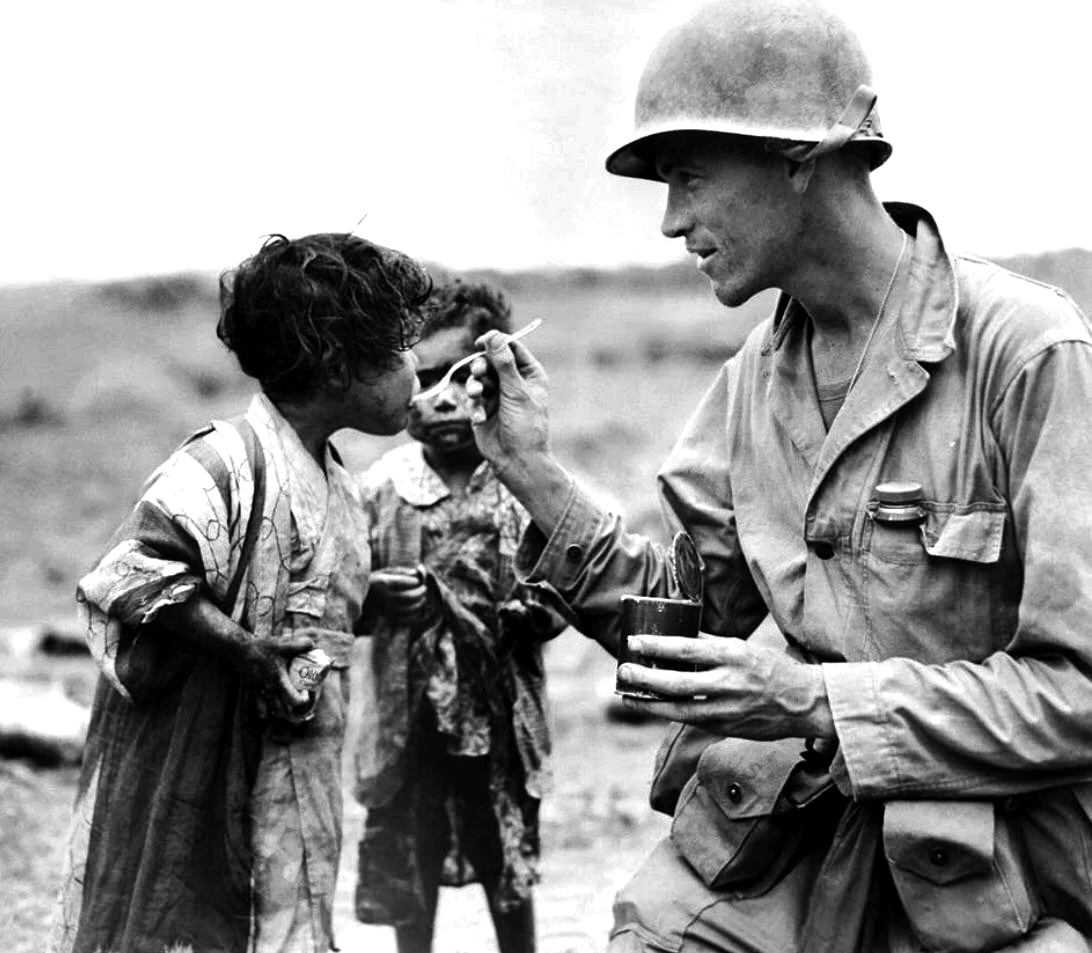

(Doc Snafu): It is to note that the Battle of Okinawa was a pivotal moment in World War II, representing the final and bloodiest large-scale confrontation between American and Japanese forces in the Pacific. As the United States sought to bring an end to the war, Okinawa became a crucial stepping stone for the planned invasion of mainland Japan. American soldiers and Marines fought and died in staggering numbers, facing not only relentless enemy resistance but also witnessing the suffering of Okinawa’s civilian population. This battle was not just a fight for military control but a desperate struggle against a brutal and fanatical adversary, one that was willing to sacrifice its own people in the name of imperial survival.
Japanese Atrocities on Okinawa (1945)
The Battle of Okinawa, fought from April to June 1945, was one of the bloodiest engagements of the Pacific War. As the last major battle before an anticipated invasion of Japan, it saw immense suffering not only among the combatants but also among Okinawa’s native population. The battle was characterized by brutal combat, mass suicides, and widespread atrocities committed by the Japanese military against the local Okinawan people—especially women and children. These actions were driven by both a desperate defense strategy and a deeply ingrained ideology of sacrifice.
The Suffering of the Okinawan Civilians
Okinawa was home to a distinct population with its own cultural identity, separate from that of mainland Japan. However, the Japanese military saw them as expendable. The Japanese Imperial Army forcibly conscripted men and boys into their ranks, arming them with crude weapons and sending them against the well-equipped American forces. Those deemed unfit for combat were often used as human shields or forced into dangerous labor, such as digging trenches and delivering ammunition under fire. Okinawan civilians were subjected to starvation and forced relocation as the Japanese used their villages as military strongholds. Entire families were driven from their homes into caves or open battle zones, exposing them to relentless American bombardments. The Japanese military prohibited surrender and actively punished those who attempted to seek refuge with American troops. They spread propaganda claiming that the Americans would rape, torture, and murder anyone who surrendered, instilling terror in the civilian population.
Atrocities Against Women and Children
One of the most horrifying aspects of the battle was the treatment of Okinawan women and children. The Japanese military saw them as either liabilities or tools in their fight against the advancing Americans. Many young girls and women were forced to become nurses in field hospitals with little to no training, where they faced severe shortages of food, water, and medical supplies. They worked under hellish conditions, often witnessing or suffering brutal treatment at the hands of Japanese officers. Rape and sexual violence were rampant, perpetrated by Japanese soldiers against Okinawan women. The military viewed these women as objects of pleasure before inevitable death. Survivors later testified about these assaults, though many remained silent due to the shame and stigma attached to such crimes in postwar Japan. Children suffered immensely as well. Some were conscripted as suicide bombers, ordered to carry explosives and throw themselves under American tanks. Others were forced into labor, carrying ammunition or being used as lookouts. When their usefulness ran out, they were often left to die, killed by Japanese troops who feared they would surrender and provide intelligence to the Americans.
Mass Suicides and Civilian Executions
Perhaps the most infamous atrocity committed by the Japanese on Okinawa was the forced mass suicides of civilians. In multiple villages, Japanese soldiers distributed hand grenades to civilians and ordered them to kill themselves rather than be captured by American forces. Those who hesitated or refused were often executed on the spot. Parents were coerced into killing their own children before taking their own lives. Testimonies recount fathers strangling their daughters and mothers drowning their infants in wells, all under the belief that it was a better fate than being captured. In the village of Zamami, entire families perished together, slaughtered by their own hands or at the hands of the Japanese military. Even elderly villagers, who posed no military threat, were slaughtered en masse. Some Okinawans resisted the pressure to commit suicide, choosing to surrender instead. However, those caught by Japanese soldiers were executed as traitors. Others were burned alive in caves where they had taken shelter after Japanese troops sealed the entrances with explosives.
By the time the battle ended in June 1945, an estimated 100.000 Okinawan civilians had perished—many due to Japanese atrocities rather than direct combat. The suffering of the survivors did not end with the battle; those who lived through the horrors of the war were often ostracized or ignored in postwar Japan, as the country sought to downplay its own war crimes. Even today, the memory of these atrocities remains a painful topic in Okinawa. The island’s history is often overshadowed by discussions of the American military occupation and strategic significance, yet the crimes committed by the Japanese Imperial Army continue to haunt the collective memory of the Okinawan people. Survivors and historians have fought to ensure that these stories are not forgotten, even as efforts to whitewash history persist in some circles. The Battle of Okinawa remains one of the darkest chapters in Japan’s wartime history. While the focus is often on the American invasion and the devastation caused by US bombing, the suffering inflicted by the Japanese on their own people must not be ignored. The Okinawan people were not just victims of war; they were also victims of a brutal ideology that saw them as disposable in the face of military defeat.

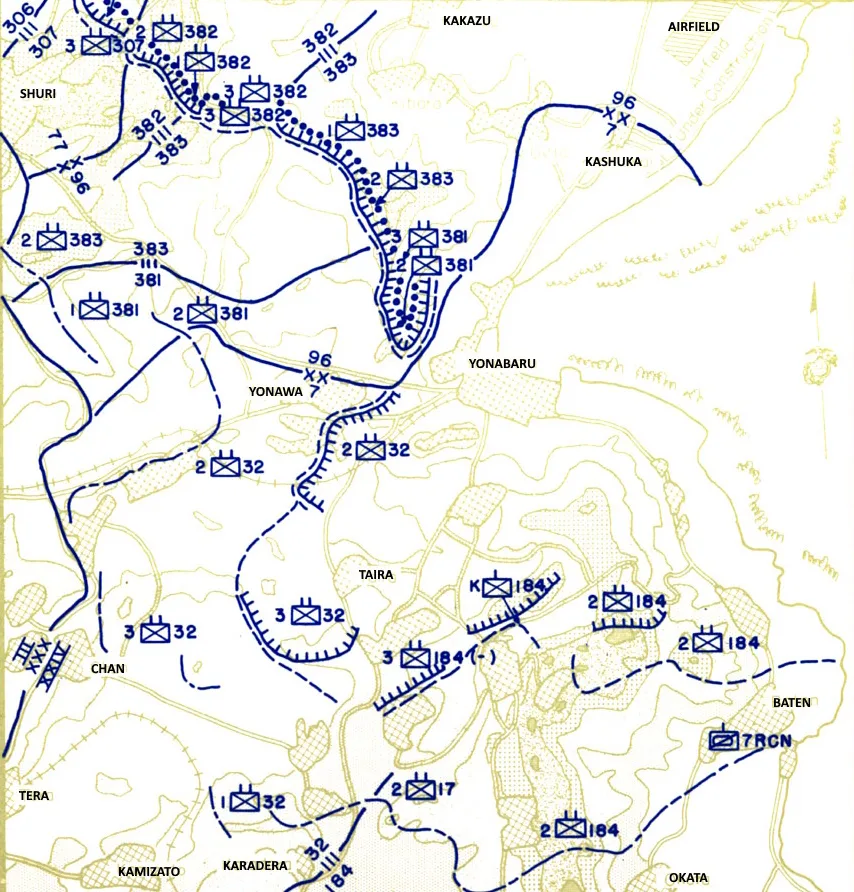
Japs Resist Bitterly
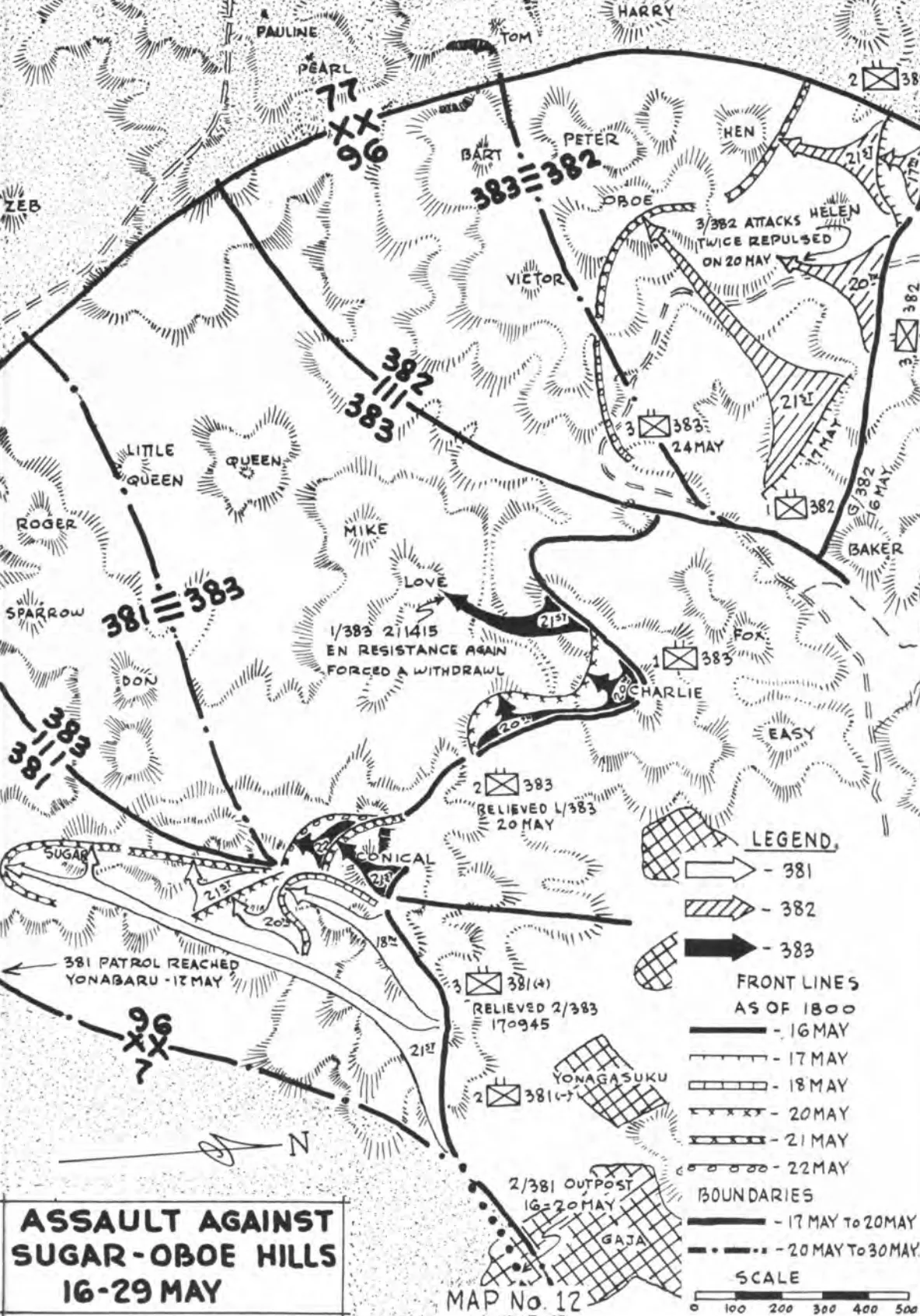 The attack on May 20 jumped off at 0730. Twice during the day, the 3/382 attempted to advance toward the Oboe Hill. In both attempts elements succeeded in advancing one hundred yards, but in both cases enemy mortar fire and grazing machine gun fire made this ground untenable and they were forced to withdraw. The regiment spent the remainder of the day in reducing the newly located enemy positions.
The 383-IR began their advance at 1045 after moving their front lines slightly back to permit a close-in air strike on south slope of the Charlie Hill. This air strike was very successful and the 1/383 attacked down the south slope of the Charlie Hill and by 1400 this battalion had cleaned out al enemy positions within their zone and had advanced their lines two hundred yards. The battalion spent the rest of the day consolidating their positions, and supporting the attack of the 2/383 against the King Hill. The 2/383, using medium tanks worked their way to the top of the hill against extremely heavy mortar fire and by 1800 were able to consolidate their front lines along the top of the King-Conical Hill Ridge.
The 3/381 resumed the attack in the direction of the Sugar Hill and advanced slowly along the east slope of the Hogback Ridge, and by 1200, left elements of this battalion had advanced two hundred yards and were engaged in bitter grenade battles along the ridge. One unit in this advance threw two hundred seventy five hand grenades in a two-hour period. During the afternoon the hand grenade battles continued incessantly with the enemy fighting desperately to hold every inch of ground. However, by 1800 this battalion had advanced three hundred yards and were still fighting for the last ground short of the Sugar Hill. As a result of these activities, the 381-IR on the division left advanced three hundred yards south along the Conical-Sugar Hill Ridge. The 382-IR reduced all enemy resistance on the south and cast slopes of the Dick Hill, while the 383-IR advanced two hundred yards on their right down the south slope of the Charlie Hill. On the left, this regiment pushed forward and consolidated their lines along the top of the King-Conical Hill Ridge.

Division Renews Attack

 Field Order #51 (Hq XXIV Corps) dated May 20, ordered the 96-ID to continue the attack to capture the high ground east of Shuri in its zone of action, making the main effort initially on the left. The division boundary was changed with the 7-ID coming in on the left flank. Upon receiving this order, Field Order #23 (Hq 96th Inf Div) was issued ordering a division attack at 0730 on May 21, with all three regiments abreast. The 382-IR was ordered to attack within a new zone of action to seize the Oboe Hill, the Peter Hill, and the Victor Hill. The 383-IR was ordered to attack within its new zone to clear out all enemy resistance from west slopes of the Conical Peak, and to seize the Love Hill and the Queen Hill. 381-IR, within its new zone, was ordered to attack and seize the Sugar Hill and the Roger Hill – (8170-G1).
After a heavy artillery preparation, the division jumped off at 0730 on May 21 amid intermittent showers. The 382-IR on the division right advanced steadily throughout the morning and by 0925, the 2/382 had advanced its right flank two hundred yards to (8072-G3) against moderate machine gun and mortar fire coming from the vicinity of the Harry Hill – (8072-U2). The 1/382, after passing through left elements of 3/382, pushed their forward elements seven hundred yards to (8072-X2, 4). This battalion received small arms fire from the top of the Oboe Hill, and machine gun fire from the south slopes of the Love Hill and the Mike Hill. At 1050, the 2/382 had two companies on the high ground at (8072-L) and were receiving heavy machine gun and mortar fire from the Harry Hill, and the high ground to their front. At 1130, elements of the enemy began pulling out from in front of this battalion, and the 1/332 then advanced to reach the top of the Oboe Hill where they fired on these retreating Japs. However, isolated groups of Japs made numerous counterattacks supported by extremely heavy machine gun and mortar fire all along the regimental front lines preventing any further advance during the day.
The 383-IR with the 1st and 2d battalions in the assault made the main effort on the regimental left, and by 0900, the 2/383 had secured the west slopos of Hogback Ridge. The 1/383 advanced forward one hundred yards and immediately ran into heavy machine gun fire from the vicinity of the Love Hill. However, with tanks to provide close fire support, the regiment renewed the attack at 1200, and by 1415, elements of the 1/383 were at the foot of the Love Hill. The enemy laid heavy artillery concentrations all along the regimental front lines, and the fire became so intense that at 1630, all elements in the center of the regimental zone were forced to withdraw to the north slopes of the King Hill
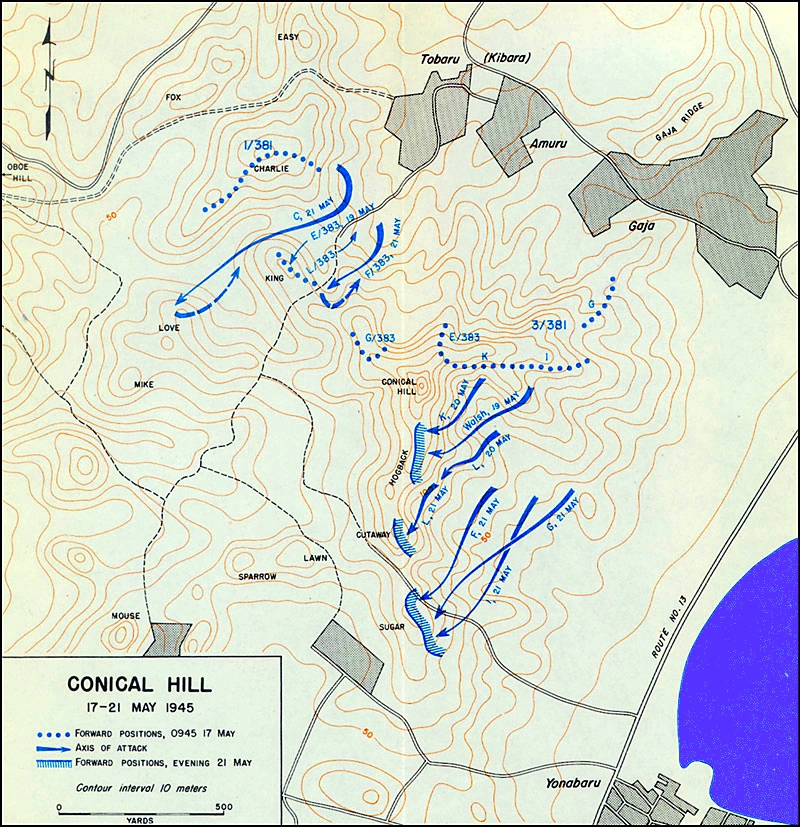
The 381-IR making the main effort along the left flank of the division zone of action advanced four hundred yards during the morning and by 1150, elements of the 3/381 were assaulting the top of the Sugar Hill. During the afternoon, the regiment advanced an additional four hundred yards securing the Sugar Hill, and by 1600 had elements two hundred yards north of the Yonabaru-Shuri-Naha-Highway. The enemy strong position on the Cutaway Hill – (8271-U) continued to pour heavy machine gun and rifle fire on all assault troops of both the 381-IR and the 383-IR, and it was not until after the Sugar Hill had been taken that this strongpoint was reduced. Heavy enemy fire from the positions in the vicinity of the Roger Hill halted any further advance by this regiment during the day. During this action the 381-IR was engaged in some of the most fierce hand-to-hand combat they had yet experienced on Okinawa.
As a result of the day’s attack, the 381-IR on the division left flank advanced eight hundred yards, securing the Sugar Hill and breaking the right flank of the enemy Shuri defenses by advances to within two hundred yards of the Yonabaru-Shuri-Naha Road. The 382-IR advanced eight hundred yards and secured the Oboe Hill. The 383-IR moved forward one hundred yards but was unable to make further advances due to the heavy enemy fire from the Love Hill, the west slopes of the Conical Hill, and the east slopes of the Victor Hill.

Heavy Rains Halt Advances
During the period of May 22/29, extremely heavy rains prevented the division from making any progress other than local gains. Supply and evacuation became critical, and front line elements had to hand carry all re-supply of ammunition, food and water up the steep slippery slopes. Roads became impassable and in many instances front line troops had to be supplied by air. However, during the period the enemy continued his bitter fight to hold his ground. Numerous attempts of infiltration and counterattacks were repulsed, and the enemy continually harassed our front lines with intermittent artillery and mortar fire. During the night of May 23/24, the enemy thrust a strong counterattack against the 1/382 on the Oboe Hill. These attacks were repulsed but some of the enemy had succeeded in penetrating through our lines inflicting heavy casualties upon our troops. On May 24, the 1/382 reorganized into one company of one hundred ninety eight men, and despite heavy enemy opposition these men succeeded in holding the Oboe Hill.
During the entire rainy period all three regiments sent strong patrols to their front to keep contact with the enemy and all front line battalions continued to mop up enemy positions within their zone. Visibility was extremely poor during this eight day period and the majority of artillery fire consisted of harassing missions on known enemy targets. In one instance, a forward observer from the 361-FAB burrowed through the slopes of the Sugar Hill in order to establish observation on the Roger Hill. All flat trajectory and supporting weapons and ammunition were brought forward as conditions permitted. In numerous cases tunnels were dug through the tops of hills and these guns were placed to fire directly into enemy emplacements and pillboxes.

Shuri Defenses Broken
A 99-ID attack was launched at 0800 on May 30 in an all out effort to destroy the enemy’s excellent Shuri defenses. During the morning, the 382-IR supported the advance of the 383-IR by fire and sent strong patrols to probe to their front. At 1230, with 1st and 2d battalions in the assault, the regiment began their attack in conjunction with the 307-IR (77-ID) attack on their right. Both of these battalions were temporarily held up at 1245 by a strong enemy force along the south slopes of Hen Hill – (8072-R1). Heavy fires were placed down on this force and at 1400 the group opposing the 2/382 attempted to withdraw across the front of the 1/382. It is estimated that approximately fifty to sixty of these retreating Japs were killed by the 1st Battalion. Immediately, ther 2/382 renewed their attack down the south slopes of the Hen Hill, and. by 1715 had reached the top of the Peter Hill and were engaged in mopping up and destroying Japs still in this area. Forward elements of this battalion continued the advance and by 1800 had secured the top of the Bart Hill – (8071-C3) and were engaged in a hot fire fight with the enemy still entrenched on the hill.

The 383-IR, began their attack at 0800 with the main effort on the left, and by 1030 the 2/383 had cleared out the enemy pockets along the west slopes of the Hogback Ridge and had secured the Conical-Love Hill Ridge – (8171-M2, O2). The attack of the 1/383, delayed until the enemy resistance at (8171-I) was overcome, began at 1100 to secure the Love Hill, and the Mike Hill. By 1200, one company had taken the Love Hill, while the 2/383 continued their advance to the Queen Hill against moderate resistance. Advances continued during the afternoon, meeting very little resistance on the left and heavy resistance on the right. At 1300, 3/383 jumped off in the attack to seize the Victor Hill and by 1400 elements were reported on top of this hill where they immediately encountered heavy resistance from an estimated platoon, and at 1800 they were still engaged in close-in fighting between the Victor Hill and the Bart Hill. Left elements of this battalion continued their advance to join up with the 2/382 at (8071-M.) After securing the Queen Hill, the 2/383 continued their advance to the south and by 1400 one company had reached the Littler Queen Hill – (8171-U4) with no enemy opposition. These hills were all secured by 1600, and the 2/383 moved on to the high ground at (8071-X) where they dug in for the night.
The 381-IR, with 1st and 2d battalions in the assault, advanced quite rapidly during the morning against moderate enemy resistance in the form of machine gun and rifle fire. By 1100, the 2/381, after considerable hand-to-hand combat in the town of Miyagusuku, secured the Roger Hill. The 1/381 secured the enemy strongpoint on the Cutaway Hill. Reserve elements were committed to contain and mop up this area while the balance of the battalion pushed rapidly on to capture the Don Hill – DON (8170-D2) and the Sparrow Hill – (8170-C5) meeting relatively light resistance. By 1200, this regiment secured the Roger Hill and the Sparrow Hill mass, and during the afternoon concentrated on mopping up enemy caves and installations which had previously been by-passed. With the new change in the Corps boundary between 96-ID, the 77-ID and the 7-ID, effective 1200 (TT May 30 Hq XXIV Corps), one company of the 1/381 moved forward to occupy the Zeb Hill – (8070-H2) and at 1800 this company was in defensive positions and tied in with 2/382 on the right and Fox Company 2/32 on the left.
As a result of these activities, the division advanced approximately one thousand two hundred yards during the day to clean out all enemy resistance north of the Yonabaru-Shuri- Naha Road within the division zone, except in the Pearl Hill and the Pauline Hill area (8071-KLPQ). Enemy resistance encountered was surprisingly light throughout the day except on the extreme right of the division zone, where the 382-IR fought against a fairly strong enemy position until late in the afternoon when this enemy began to withdraw.