


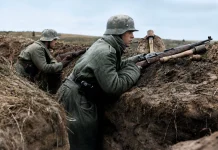


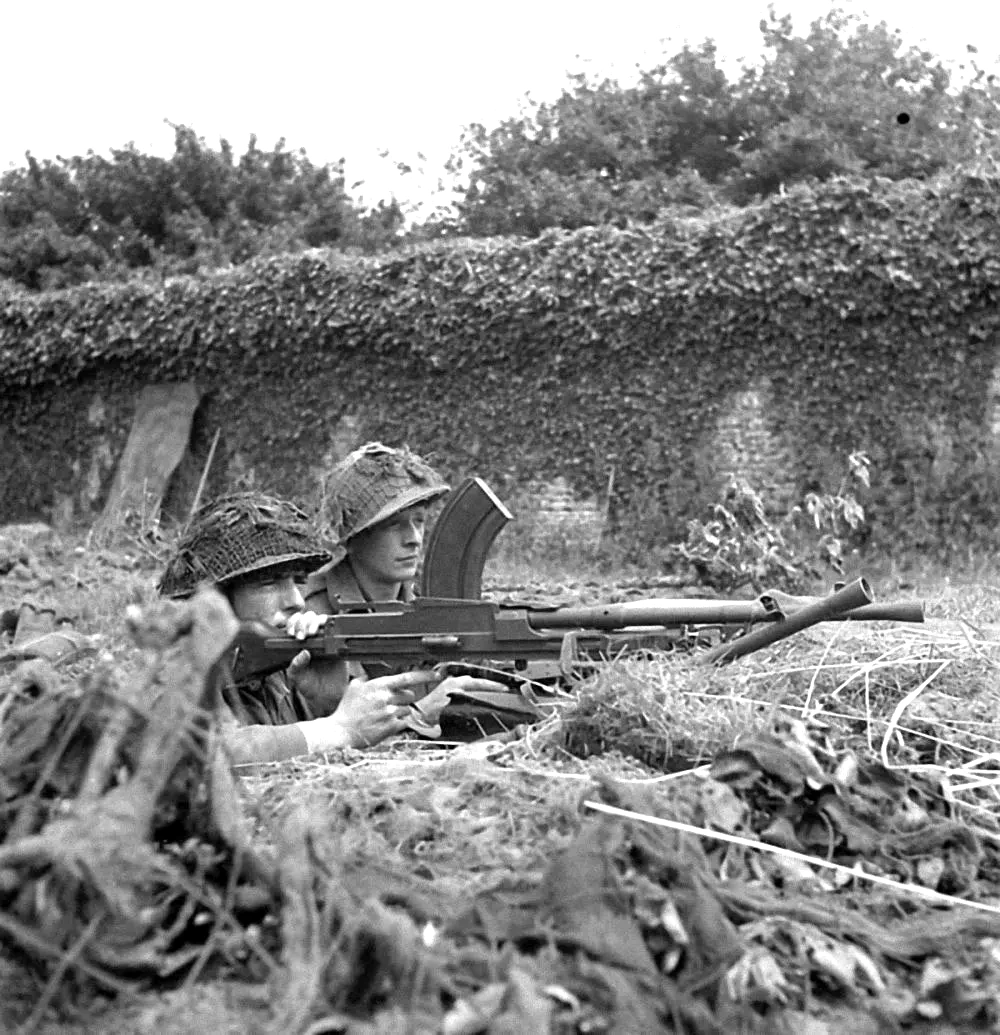
At approximately 0100, six Mark V Panthers of the 1st Company assembled in an all-around defence near the orchard of the Usine Cardonville, their engines idling. Thinking the flax factory compound free of Canadian troops, they were totally unaware of Dog Co RRR, led by Capt Brown, which was charged with defending it. The RRR riflemen maintained total silence to not alert the German tank crews. The gunners present within the attached RRR AT Platoon 6-pounders section also kept silent, uneasy at the prospect of alerting the Panthers and starting a firefight that they could potentially not win. The uneasy co-existence of the Canadian infantry and Panthers was broken shortly after 0230 when a RRR Dog Co rifleman shot down members of a dismounted Panther crew.(91) The Panthers then drove off and poured concentrated fire into the factory buildings, suppressing the RRR riflemen and the AT gunners. At this point had any German Panzergrenadier forces arrived, it is highly likely the Usine Cardonville would have fallen. None arrived as the Panthers raged, forcing Capt Brown and Sgt Major Jackson to hunker down in the main flax factory building. Without supporting infantry, the tanks could not evict Dog Co, even though they did inflict significant casualties on the Canadians. By staying calm and remaining in their positions, Dog Co withstood a deluge of high-explosive and machine gun fire.
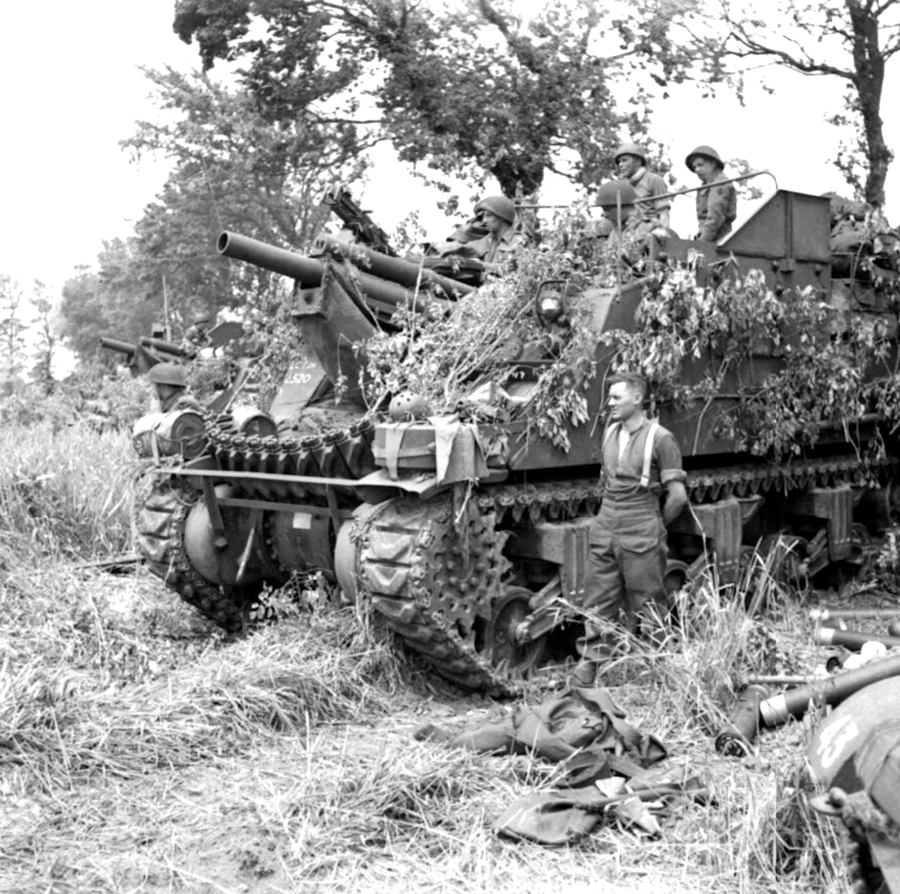
By 0400, an effective stalemate had occurred in Bretteville, Usine Cardonville and the general vicinity. Any further German infantry assault into the village of Bretteville was impossible and the RRR and RCA soldiers inside the village could not destroy the Panthers due to the darkness and distance they were from Canadian positions. Established German armored doctrine was very clear in stating that ‘tanks have to function as the fire bases while the infantry takes the vanguard role in the assault‘.(92) Wünsche led the Panther group in a manner entirely opposite to this maxim, attempting to replace the missing infantry with tanks. Neither German heavy artillery nor supporting mortar fire was present and the Panthers were forced to attempt to fulfill this role as well.
Observing the ineffectiveness of the Panthers at reducing the Canadian resistance, at 0350, Wünsche, possibly directed by Meyer, attempted one last time to influence events in his favour. He drove his Command Panther to the vicinity of Norrey to make contact with 3rd Company (1st Battalion 26.SS-Pz.Gren.Rgt), in the hope of rallying these infantry forces for a continued assault. No Panzergrenadiere could be found.(93) As his command tank was receiving heavy Canadian fire, he quickly drove back to Bretteville. Despite making the utmost effort for the better part of six hours, Meyer and Wünsche met at 0430 to make the call to pull all forces back to the vicinity of the village of Rots, their start point. On hearing the radio command to withdraw, both Pfeiffer and Berlin moved their Companies back to Rots.(94) While driving back from Point 68, the 4th Company again received heavy AT fire near the edge of Bretteville. Panther #425 was penetrated by a 6-pounder AT shell and burned out, wounding its commander, SS-Untersturmführer Johannes Hilig. Wünsche, on his return to Rots, was hit by fragments from a Canadian artillery round as he dismounted from his command Panther.(95) The intelligence log of the 13th Field Regiment, RCA, mentions engaging tanks over open sights at 0545 with 105-MM M-67 AT shells, but it is unclear if this fire came from an M-7 105-MM Priest or a 6-pounder AT gun. German accounts of the action do not specify the sources of the AT fire.(96) On arrival in Rots, the weakened Panther Company reorganised themselves and took up new defensive positions facing west.
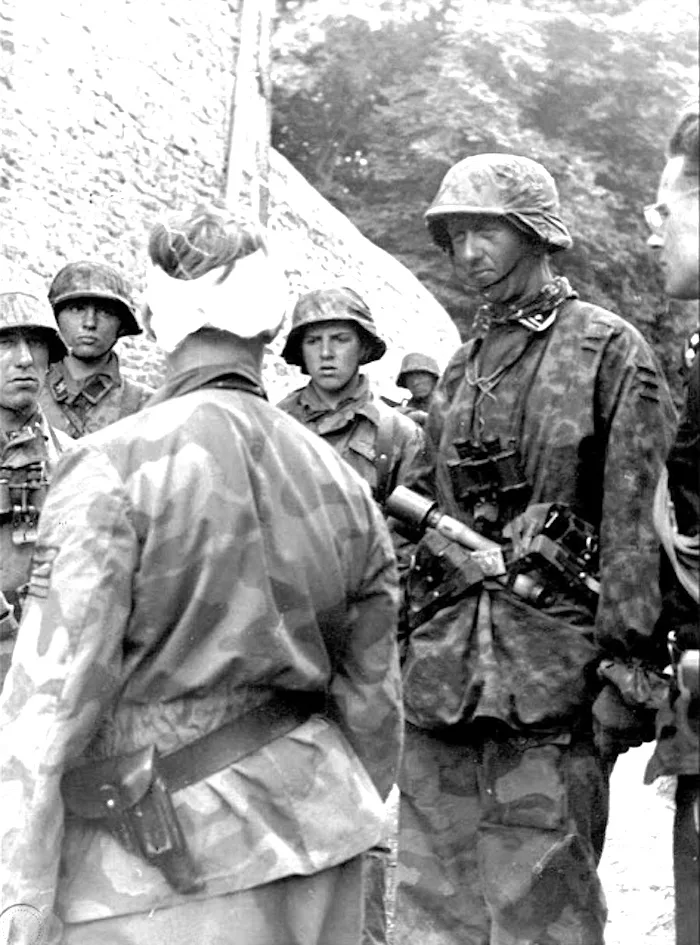
In an inexplicable conclusion to the third and final phase of the battle, some time after the withdrawal of Meyer and Wünsche, the 2nd Company (1st Battalion 26.SS-Pz.Gren.Rgt) finally made an attempt to attack the Usine Cardonville, illustrating the complete lack of any coordination with Meyer or the Panthers.(97) Capt Brown and Dog Co were put under extreme pressure by this assault that was, by Canadian accounts, very close to success when barely beaten back by fire from all available machine guns and very timely RCA artillery support.(98) To decisively beat back the attack, Lt Col Matheson, now finally in touch with Brown via radio, called in 105-MM artillery fire from the 13th Field Regiment, RCA. This fire landed virtually on top of Canadian positions but effectively drove the attackers back into their start lines.(99) Why the Germans waited until first light and the Panthers’ withdrawal before making their move is beyond comprehension. It illustrates a complete lack of any planning between Meyer, Wünsche, Monhke and Krause. RRR Dog Co, now reduced to roughly fifty men due to extensive casualties in the course of the earlier Panther bombardment and the morning battle, had prevailed again.(100)
Final German casualties in the Meyer-Wünsche Battlegroup were ninety-one total casualties, including thirty-one dead, the majority of these being in the 15th Recon Company (25.SS-Pz.Gren.Rgt). The 1st Battalion (12.SS-Pz.Rgt) suffered five Panthers completely destroyed: #427, #425, #418, #116 and an unknown fifth vehicle. Panthers #115, #128 and others were badly damaged, some having to be towed away from the battlefield.(101) One 20-MM Flakpanzer built on a tracked Czech 38T chassis was also destroyed, as well as at least one motorcycle combination and one truck. In the hapless 1st Battalion (26.SS-Pz.Gren.Rgt), total casualties were sixty-one, with twelve Panzergrenadiere being killed.
Canadian losses in the 3rd AT Regiment, RCA’s 94 (Composite) Battery included seventeen missing, five killed and five wounded, almost all from King Troop, which was overrun along with the RRR Carrier Platoon. At least eight Universal Carriers were destroyed and one was captured by the Germans. Accounts differ as to how many AT guns were lost, but a reasonable estimate would be a half-dozen. A Company of the Cameron Highlanders of Ottawa suffered eleven killed and ten wounded or missing. The 1st Battalion, Regina Rifle Regiment suffered forty-two dead and an unknown number of wounded.(102) French military historians Georges Bernage and Frederick Jeanne list total Canadian casualties as approximately 150 men for the 8/9 June nighttime battle. Among these were a number of soldiers shot after capture.(103) In addition, an unknown number of Canadian jeeps and trucks were destroyed.
Throughout the time the RRR held out at Cardonville, Norrey and Bretteville, no relief force of Allied armor arrived to support the unit in the thick of the six hour battle against vastly superior armored forces. No information has been found to establish if this option was ever considered by the 7th Canadian Infantry Brigade headquarters staff. The Anglo-Canadian armored practice of ‘harbouring’ in the hours of darkness forced the RCA units, Cameron machine gun crews and infantry forces of the RRR to fight it out the best they could without tank support. In response to RRR headquarters’ inquiries regarding armor reinforcement, the terse reply from 7th Canadian Infantry Brigade Headquarters was that ‘tank support would arrive at dawn‘.(104) To the average soldier in the midst of a firefight with multiple Panther tanks, and considering that said firefight lasted six hours, these words were cold comfort. That the brigade headquarters, with multiple Panthers within 100 meters, did not force the issue speaks to a steadfast reluctance to rapidly commit Canadian armoured reserves. The concept of night employment of armor was very much anathema to senior Canadian commanders, but given the circumstances its employment could hardly have made matters worse for the RRR defenders.(105)
In conclusion, this archive has sought to provide an improved historical understanding of the early German armoured assaults on the Normandy Bridgehead and to illustrate why these ad-hoc assaults often met with failure. The defeat of this German armored battlegroup occurred largely due to its failure to properly exercise established armored doctrine and allocate correct infantry and artillery resources to the operation. Though stronger German infantry forces were present to the south near Norrey and Cardonville, little if any coordination was made with them. Everything depended on the assault of the weak 15th Company to succeed. This failure in planning was compounded by a complete lack of heavy artillery fire support, despite German armored doctrine stating: ‘In spite of all their firepower, tanks are dependent on the support of extensive indirect fire‘.(106) The lack of a decisive impact made by the large group of Panthers illustrates the limitations of direct fire support.(107) The Canadian commander of the 7th Canadian Infantry Brigade, Brig Harry Foster, remarked that no attempt was made to exploit the flanks of the RRR battlegroup.(108) Rather than attacking the strong point of Bretteville, a wiser option would have been to bypass it altogether. Meyer’s attempt to use shock and armored firepower was met by an equally determined force who exploited the German weaknesses to the maximum. To quote Hubert Meyer, divisional historian of the 12.SS-Panzerdivision:
‘The daring surprise attack by the small Meyer/Wünsche Kampfgruppe had scored a significant initial success. The enemy had been maneuvered into a very difficult situation. However, because of the lack of German infantry, full advantage could not be taken of the situation. The tactic of surprise, using mobile, fast infantry and panzers even in small, numerically inferior kampfgruppen, had often been practiced and proven in Russia. This tactic, however, had not resulted in the expected success against a courageous and determined enemy, who was ready for defence and well-equipped‘.(109)
Despite the Panther crews attempting every possible means of crushing Canadian resistance, the lack of other supporting arms in the equation inhibited achievement of the desired result, in this case victory.

(90) Luxton, 1st Battalion the Regina Rifle Regiment, 40.
(91) Luxton, 1st Battalion the Regina Rifle Regiment, 4.
(92) Schneider, Panzer Tactics, 248.
(93) Reynolds, Steel Inferno, 99.
(94) Meyer, Grenadiers, 230.
(95) Zuehlke, Holding Juno, 207.
(96) Kriegstagebuch No. 1, I./SS-Panzerregiment 12., Vojensky Historicky Archiv; and Milner, Stopping the Panzers, 273.
(97) Mein, “Up the Johns”, 115.
(98) Zuehlke, Holding Juno, 207-08.
(99) Zuehlke, Holding Juno, 210. The 13th Field Regiment, RCA was led by Col. F. P. T. Clifford and equipped with twenty-four M7 Priest 105mm self-propelled
artillery pieces.
(100) Zuehlke, Holding Juno, 206.
(101) Cazenave, Panzerdivision Hitlerjugend, 190. Multiple Panthers were taken to the village of Venoix, the location of the Pantherabteilung Werkstattkompanie (Repair Company) for repairs.
(102) “Battalion Casualty List (sorted by date),” ReginaRifles.ca, accessed 6 November 2018, http://www.reginarifles.ca/bn_cas_list_d.htm.
(103) Bernage and Jeanne, Three Days in Hell, 127. An unknown number of Canadian prisoners were killed by their captors in the early part of the battle, most coming from the outlying skirmish line positions east of Bretteville that were overrun.
(104) War Diary, 1st Battalion, Regina Rifle Regiment, 9 June 1944 entry, RG 24 C-3, Volume 15, File 198, LAC. Tank support is recorded in the 9 June 1944 war diary entry as arriving at 0515 hrs.
(105) 21st Army Group, “The Armoured Division in Battle,” December 1944, WO 219/5326, File 461 (Vol 2) (SGS), The National Archives. Nowhere in this doctrinal note by Field Marshal Bernard Law Montgomery does it expressly forbid or warn against use of tanks in night actions.
(106) Schneider, Panzer Tactics, 247
(107) Schneider, Panzer Tactics, 247.
(108) Stacey, The Victory Campaign, 137.
(109) Meyer, 12. SS-Panzerdivision Hitlerjugend, 57.
(110) “SS-Rank Table showing equivalents in the German, American and British Armies,” Oradour-sur-Glane, 10th June 1944, accessed 12 January 2019, https://
www.oradour.info/appendix/ssrank01.htm.
Message from the Publisher
After an arduous journey marked by meticulous corrections, exhaustive image searches, and an unwavering commitment to excellence—all while maintaining the utmost professionalism and congeniality—it is undeniable that I have gone above and beyond to ensure this archive reaches publication, a feat so demanding that it unquestionably warrants a well-deserved coffee, or perhaps even two. Don’t you think so?
Thank You