


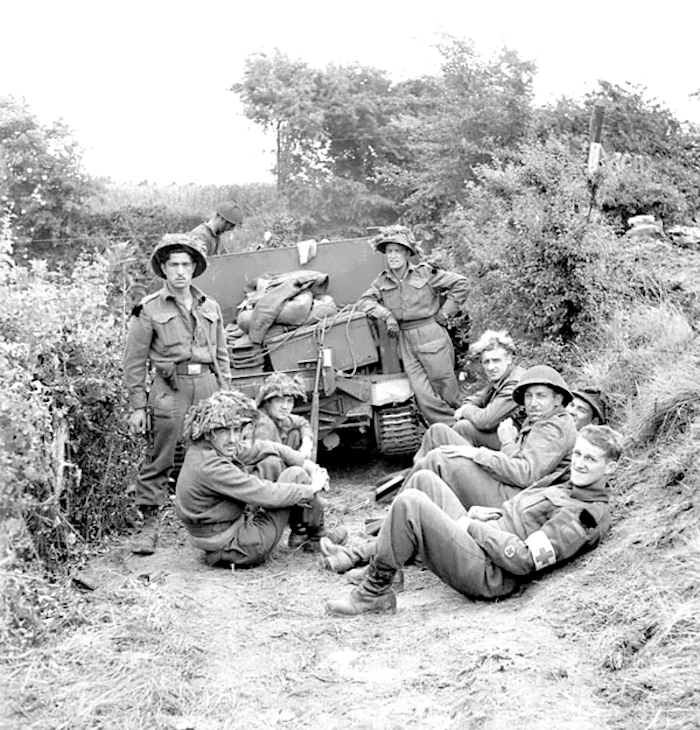
Anticipating an attack from this direction, the RRR Carrier Platoon with its tracked Universal Carriers of Support Company and two Cameron Highlanders Vickers machine gun crews had been dispatched by Lt Col Matheson to form a reinforced combat outpost to the east of Bretteville. Placing themselves 200 metres to the east of Maj Syme’s Baker Co, facing east near a rise along the RN 13 highway they had good fields of fire in a reverse slope position. It seems Matheson wished to detect and possibly disrupt any attack with these forces in a manner similar to what occurred near Norrey on the night of June 7/8. His plan was to utilise this reinforced combat outpost position to do so, in accordance with Anglo-Canadian infantry defensive doctrine.(59) But the attack on Norrey the night previous did not include Panther tanks and to what extent this grouping could be supported by Baker Co positions is unclear.(60) The Germans were rapidly approaching this improvised skirmish line at 2145, by which time the Canadians had not yet completed digging in. Eight 6-pounder AT guns of K Troop, 105 Battery of the 3rd Canadian AT Regiment, RCA, temporarily attached to 94 Battery to form a composite battery, appear to have been sited both south and north of the highway in support of the Carrier Platoon skirmish line and within the main positions of Baker Co.(61) The Canadians, on high alert, were ready for the Germans.
At this point first contact was made. The lead Panther, coming over the rise in the corn fields east of Bretteville along the RN-13 highway, stopped to observe on this crest. These Panthers, including #404 commanded by SS-Hauptsturmführer Hans Pfeiffer, received a violent volley of Canadian heavy machine gun and anti-tank fire.(62) Thus began the first phase of the Battle of Bretteville that lasted from 2145 to 2330, and consisted of a high intensity firefight between the Panthers Companie and the Canadian defenders as the Germans advanced on the village from the east and manoeuvred to the south as shown on the map below.
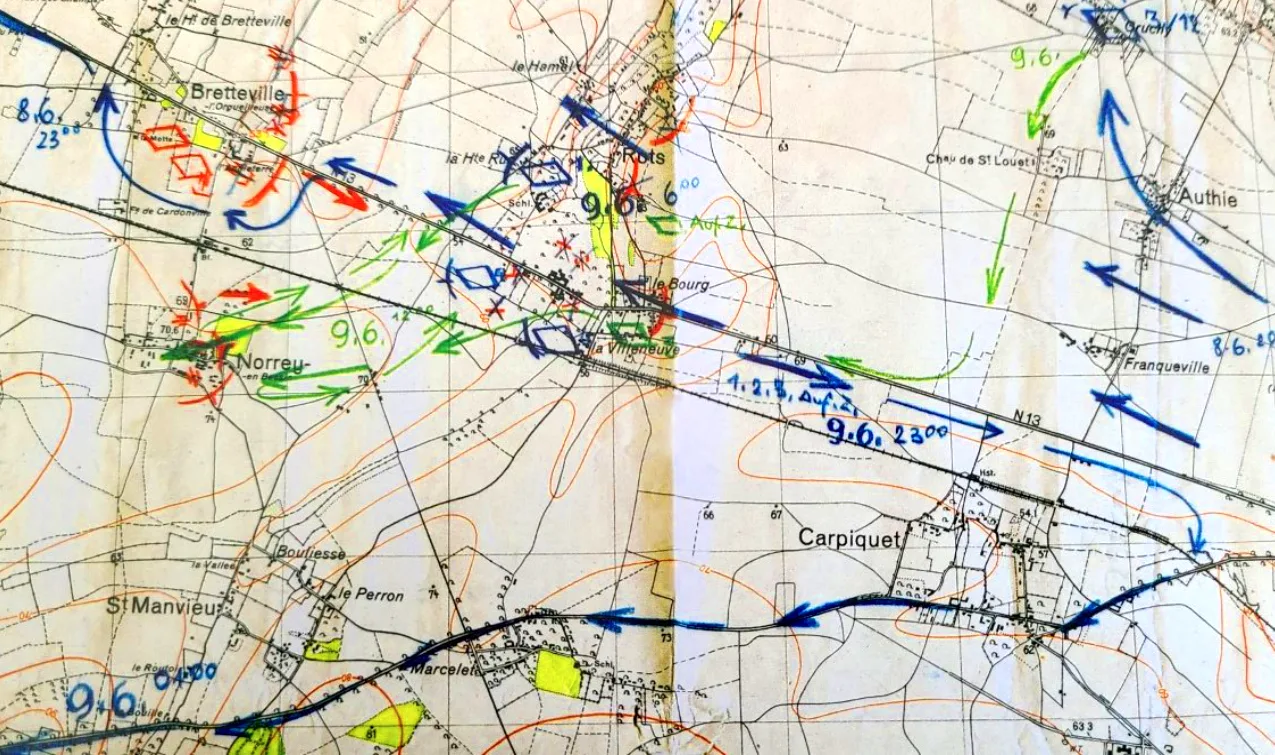
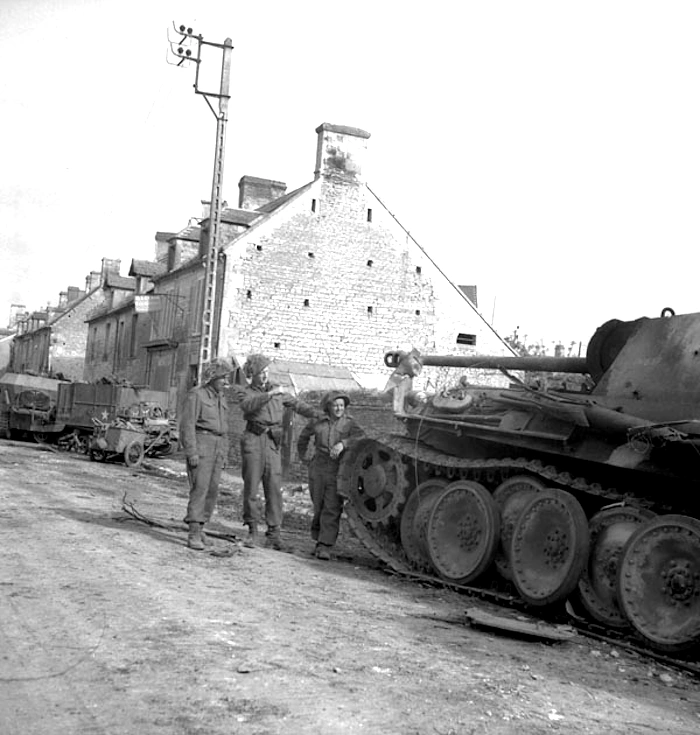
This firefight destroyed the majority of the outlying combat outpost of the RRR Carrier Platoon and Cameron Highlander machine gun crews as well as engaged the majority of positions of Baker Co to the east of Bretteville. More than one Panther tank was destroyed or disabled and heavy casualties were inflicted on the accompanying Waffen-SS Panzergrenadiers by the ferocity of the Canadian defensive fire. On receiving the first Canadian volley of AT shells and MG fire, Pfeiffer ordered the rest of 4th Company forward and ordered the village buildings be set on fire so as to expose Canadian positions in the fading light. Taking casualties in their positions on the rear hulls of the tanks, the Grenadiers dismounted and began to follow the tanks on foot. Panther #404, the Company commander’s vehicle, destroyed a lone Canadian Sherman tank located at the entrance to the village after a short firefight. It is unknown to what Canadian armored regiment this tank belonged, but it was not an artillery observation vehicle.(63) Many secondary sources have reported that at this point Pfeiffer’s tank was hit and set ablaze shortly afterward by a Canadian AT gun.(64) There is no evidence this occurred, however. Another Panther, the #427 of SS-Unterscharführer Klaus Hartmann, was certainly destroyed and did burn out. Canadian artillery from both the 12th and 13th Field Regiments, RCA, also joined the battle with defensive fire tasks, hammering the Germans.(65) The war diary of the 12th Field Regiment, RCA, describes a firing on Defensive Fire and Defensive Fire SOS tasks, Mike (Regiment) and Uncle (Division) targets practically all day and all night.(66)
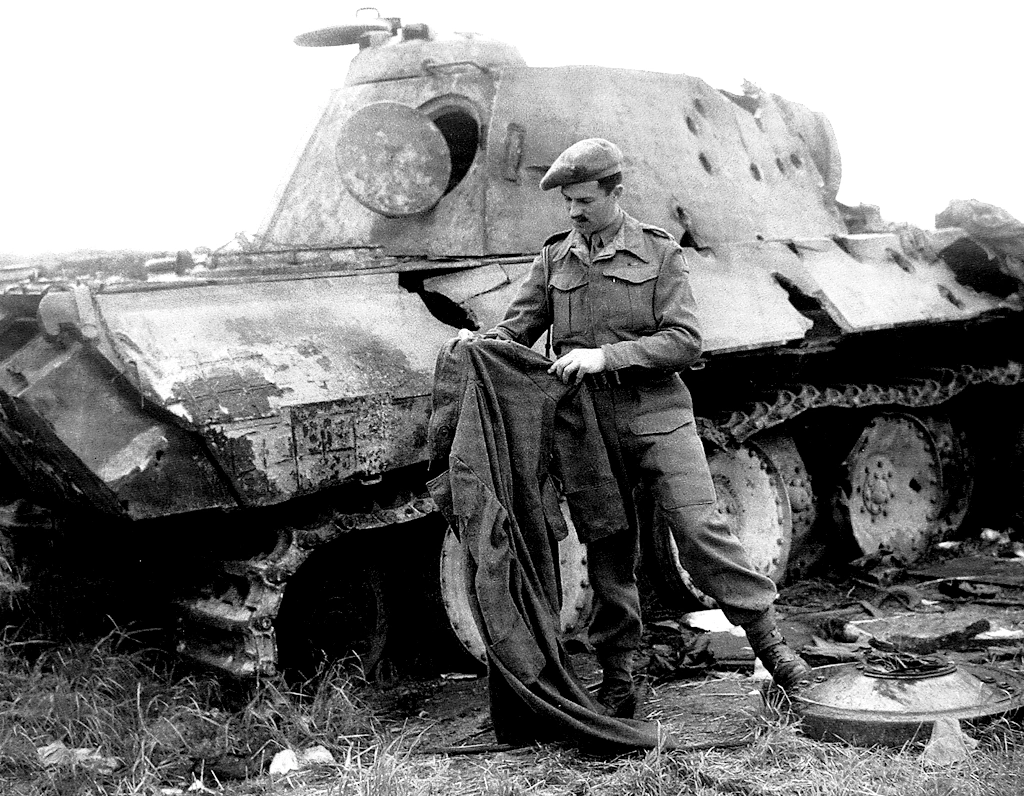
The 1st Panthers Company, moving west to the south of the 4th Company, also came into contact with the AT guns and MGs and joined in the intense firefight. Roughly twenty-five Panthers engaged the RCA AT gunners who were outnumbered by at least three to one. The Panthers’ machine gun and cannon fire raked the outlying RRR Carrier Platoon position and then drove right over it, destroying six Universal Carriers.(67) Any survivors ran back to the Baker Co positions, the advancing Panthers hot on their heels.
During this first portion of the firefight the German Panther crews also claimed to have destroyed or disabled four AT gun positions near Bretteville with high explosive rounds, utilising fire and movement in the semi-darkness. The crews were fighting in accordance with their armored doctrine, which stated: ‘When it comes to taking position and opening fire, targets are to be destroyed in rapid succession, following by a prompt change in position‘(68) All the 6-pounders of K Troop, 105 Battery of the 3rd AT Regiment, RCA, were thus silenced, vastly reducing the defensive power of the Canadians.(69) To rectify this inequality, the remaining RCA gunners of G Troop, 94 Battery began to manhandle their 6-pounders to face east to engage the Panthers.(70) Positioned to defend the remainder of the village, the crews frantically manoeuvred their guns to orientate them to the south and east and took up the fight.(71) The Panther crews, now bunching up in front of the village in the darkness, were following their doctrine that stated: ‘Limited intervals are needed in darkness as that visual contact can be maintained‘.(72) But by maintaining this close formation in the limited visibility of the burning village, they did not adequately disperse in the face of enemy fire. It was difficult for tactical spacing distances to be judged by the tank commanders in the low light of the late evening and their focus was on engaging the AT guns.
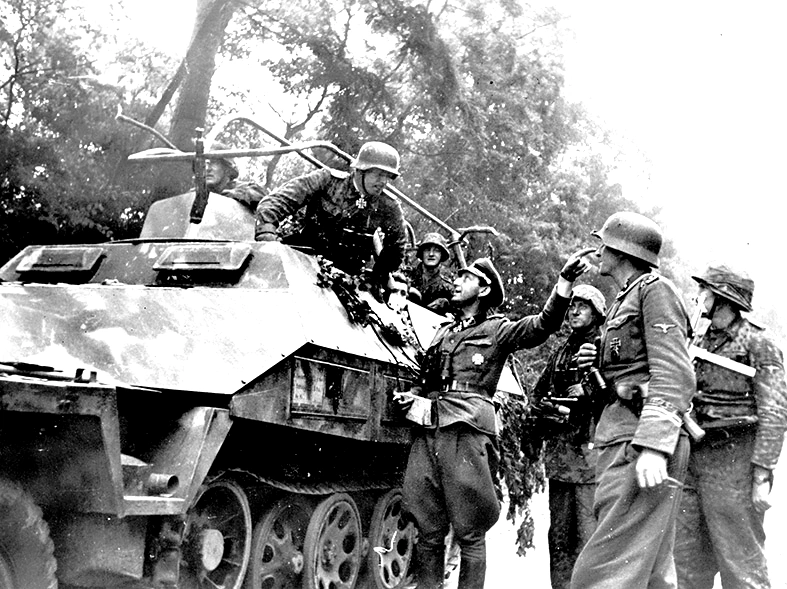
During this point in the battle, the six Wespe 105-MM self-propelled guns entered the fray. They took up positions on the rise or behind it and engaged the positions of Baker Co with some success. At this point during the firefight many Panthers were hit with AT shells, some multiple times. Wünsche, now joined by Jürgensen, then ordered the Wespen back to the village of Rots after they had fired several salvos, fearing they would be lost to the AT fire.(73) They then re-crossed the River Mue before midnight, having only lost a Kübelwagen and suffering a small number of casualties. It can be concluded that their direct contribution to the battle was minimal.
Closing in on the village, the mass of 4th Panthers Company were now bunched up in front of the objective. This made things easier for the Canadian RCA AT gunners targeting the tanks and for the RRR machine gunners who engaged German infantry near the tanks. The attached Panzergrenadiere of the 15th Company took heavy casualties as they attempted to dismount and fight their way on foot through the positions of Baker Co. Largely unseen by the tank crews, Baker Co riflemen waited for the Panthers to drive by before engaging the following Panzergrenadiere, as per the direction of the RRR commander, Lt Col Matheson. The 15th Company commander, SS-Hauptsturmführer von Büttner, was killed during the initial part of the firefight, he and his command team being shot off the rear deck of a Panther. Also shot was the driver of the motorcycle combination which Meyer was riding. The motorcycle was destroyed, the fuel tank explosion briefly setting Meyer’s uniform on fire. After recovering, Meyer was able to move on foot and communicate with the Panzergrenadier commanders, but he had no access to a radio to control or communicate with the armored group except by running up to the Command Panther of Wünsche.(74) His ability to lead and influence the battle at this point was temporarily diminished.
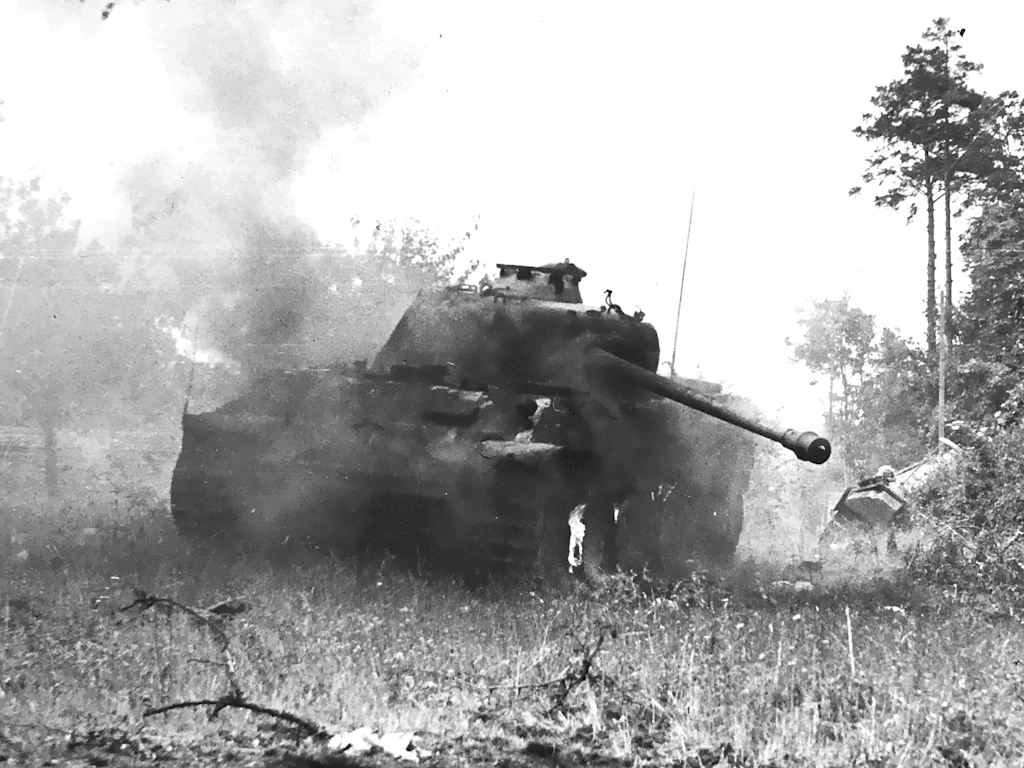
Just before midnight, whatever advances the Panzergrenadiere of the 15th Company had made towards Bretteville had stalled in the middle of the RRR Baker Co positions. The Germans found themselves pinned down in the ditches on each side of the highway, this being the only cover apart from treelines bordering fields. They were supressed by defensive small arms fire from the Canadian infantry positions that were difficult to locate in the darkness. While the Panthers drove over and past the Canadian positions, in the darkness each individual Canadian trench and foxhole could not be identified and engaged by the tank crews.

(59) War Office, “Infantry Training Part I: The Infantry Battalion: 1944. 26/G.S. 1070 Publication” (Ottawa: His Majesty’s Stationary Office, 1944), 43-44, accessed 8 January 2019, http://wartimecanada.ca/categories/training-manuals?tid=All&page=1. Combat outposts could be supported by other assets, such as anti-tank guns and medium machine guns, to increase their strength.
(60) Ben Kite, Stout Hearts: the British and Canadians in Normandy 1944 (Solihull, England: Helion and Company, 2014), 39. The Carrier Platoon of the RRR contained thirteen vehicles and it is unclear if all of them drove off east of Bretteville.
(61) Milner, Stopping the Panzers, 266; and Lee Windsor, Roger Sarty and Marc Milner, Loyal Gunners: 3rd Field Artillery Regiment (The Loyal Company) and
the history of New Brunswick Artillery, 1893 to 2012 (Waterloo: Wilfrid Laurier University Press, 2016), 344.
(62) Copp, Fields of Fire, 72.
(63) Kriegstagebuch No. 1, I./SS-Panzerregiment 12., 8 June 1944 entry, Vojensky Historicky Archiv.
(64) Milner, Stopping the Panzers, 268; and Kriegstagebuch No. 1, I. /SS-Panzerregiment 12., 8 June 1944 entry, Vojensky Historicky Archiv.
(65) Milner, Stopping the Panzers, 268.
(66) War Diary, 12th Field Regiment, RCA, 8 June 1944 entry, RG 24 C-3, Volume 14, File 461, Library and Archives Canada [LAC].
(67) Eric Luxton, ed., 1st Battalion the Regina Rifle Regiment: 1939-1946 (Regina: Regimental Association, 1946), 40; Margolian, Conduct Unbecoming, 107; and Zuehlke, Holding Juno, 202. A total of eight members of the Cameron Highlanders of Ottawa and RRR were found shot at close range, indicating a possible battlefield execution by members of the 15. Kompanie, SS-Panzergrenadierregiment 25.
(68) Schneider, Panzer Tactics, 92.
(69) Zuehlke, Holding Juno, 202.
(70) Zuehlke, Holding Juno, 199.
(71) Nicholson, The Gunners of Canada, 282.
(72) Schneider, Panzer Tactics, 13.
(73) Bernage and Jeanne, Three Days in Hell, 128-29; and Cazenave, SS-Panzer Regiment 12, 180.
(74) Meyer, Grenadiers, 228.
Despite having lost wireless communication with the 7th Canadian Infantry Brigade Headquarters shortly after the German attack began, the RRR battalion headquarters stood firm and continued to direct the fight as best it could. The remaining soldiers of Maj Syme’s Baker Co continued to fire from their surviving positions. The darkness was to their benefit as the Panther crew commanders had limited visibility. The RCA AT gunners also continued to fire, refusing to be supressed by Panther cannon and machine gun fire. RCA Sg Herman Dumas of G Troop, 94 Battery moved a 6-pounder from one position to another, firing it singlehandedly from his position along a Bretteville hedgerow, reportedly hitting at least four Panthers.(75) RCA Bombardier Cyril D. Askin also got a damaged 6-pounder working again and reportedly hit at least three Panthers.(76)
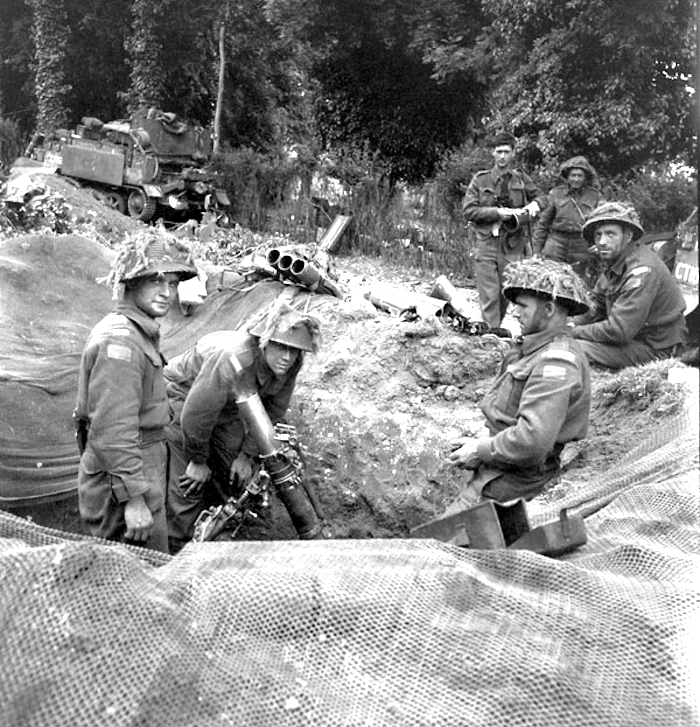
Vital to the efforts of the RCA 6-pounder crews were the actions of RRR Rifleman Frank Wolfe, who fired 2-inch mortar magnesium illumination flares all night, blinding the Panther crews and exposing the tanks for the AT guns.(77) Each 2-inch illumination round had a parachute attached, which lengthened the illumination effect.(78) While German doctrine insisted ‘signal flares, parachute flares or haystacks set on fire by gunfire will assist the tanks in locating the objective‘, the Canadian defenders also understood the benefits of these actions and used them against the Panther crews.(79)
Wünsche, after watching his armored group bombard the village with all weapons for at least ninety minutes, shortly before 2330 ordered an attack into the village when he perceived Canadian defensive fire to be weakening. This began the second phase of the battle, lasting from 2330 to 0200, which consisted of determined German armored and infantry thrusts into and around the village of Bretteville from the east and south. These assaults were successfully repulsed by the Canadian defenders, who inflicted high armored and infantry losses on the Germans. On reaching the eastern entrance to the village the 1st Platoon of the 4th Company, led by Panther #418 of SS-Unterscharführer Gerd Muhlhausen, began to push up the main street, followed by another Panther. The 2nd Platoon pushed left of the village while the 3rd Platoon remained in depth. As the two Panthers pushed down the main street, Meyer reorganised the 15th Company infantry forces to continue the assault. He assigned command of the Company, now vastly reduced from its original one hundred men, to SS-Untersturmführer Reinhold Fuss, commander of the 1st Platoon of the 15th Company. Meyer’s new order for the surviving Panzergrenadiere was as follows: the 1st Platoon was to assault right along the east-west road and the 2nd Platoon, under SS-Untersturmführer Fehling, was to assault left. Their objective was the Saint Germaine Church, located at the heart of the village. The 3rd Platoon under SS-Hauptscharführer Boigk was to be in depth.(80)
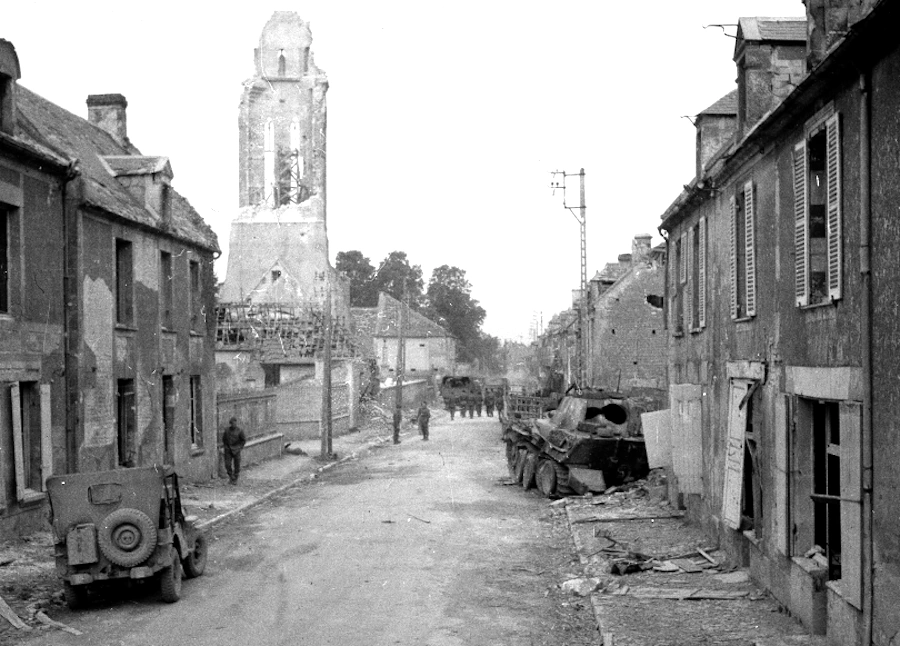
Shortly after the Panther #418 approached the RRR battalion headquarters and the positions of Able Co, it was hit at short range by a round from a Canadian PIAT. It was hit several more times by PIAT fire and then finally drove over a necklace of Type 75 AT grenades. This final explosion rendered it immobile.(81) The Panther crew was shot as they attempted to dismount and the burning hulk blocked traffic. Seeing this, the following Panther began firing on the houses near the first Panther, accidentally hitting it and setting it on fire.(82) Wünsche was thus forced to abandon his attempt to drive right through the village and ordered the remaining Panthers of the 4th Company to pull back and regroup to the east of Bretteville. Shortly after or at the same time the Panther #418 was destroyed, the re-formed Panzergrenadiere of the 15th Company launched their planned attack. The 1st Platoon managed to fight its way the centre of town after a small arms battle, but with only six men of the original force of thirty. The 2nd Platoon was stopped in its advance on the left flank by Bren light machine gun fire and pinned down, having run into the positions of Able Co near the left side of the eastern village entrance.(83) During both these advances Able Co put up fierce resistance with all available weapons. On reaching the church in the centre of town, all the reduced 1st Platoon party led by SS-Untersturmführer Fuss could do was hold on and await another push by the Panthers into the village. This armored support never arrived. Only a few members of this group would evade eventual death or capture.
On observing the 4th Panthers Company pull back to regroup, Canadian morale and resistance surged. The regrouped 4th Company responded to the increased Canadian fire by firing high explosive 75-MM shells and machine gun fire into the burning village from the south and onto suspected Canadian positions, causing further fires.(84) This second sporadic bombardment by the Panthers lasted an estimated forty-five minutes and must have not been too intense as the Panthers only carried seventy-nine rounds, half of which were high explosive. The 1st Company under SS-Hauptsturmführer Kurt-Anton Berlin was still engaging targets on the southern portion of the village at this point, having previously advanced on the south side of the RN-13.
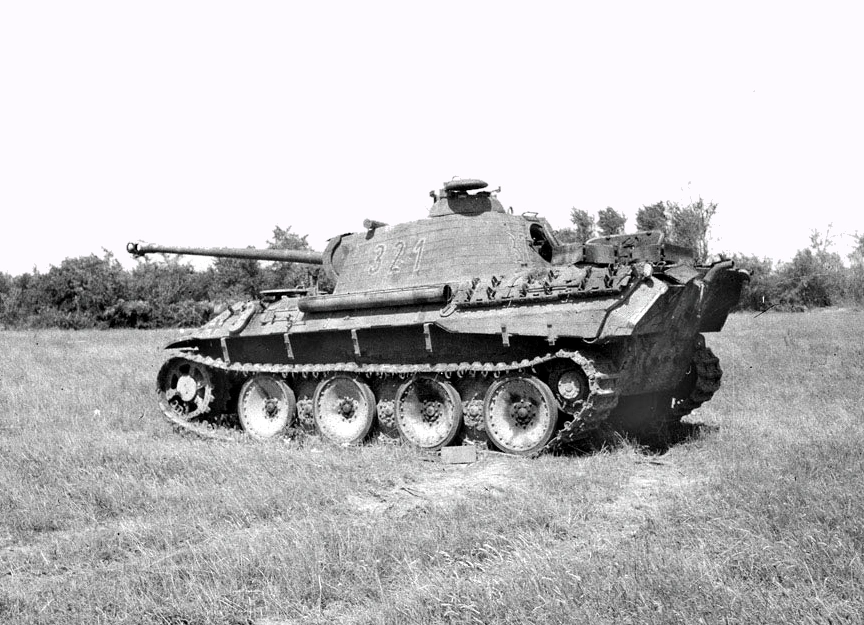
Following the failed drive through the village, at roughly 0045, the 4th Company was ordered to bypass the village to the south and capture the high ground northwest of Bretteville along the RN-13 west of the village. After this company passed by the south, the 1st Company was directed to continue to try to crush resistance from the southwest and to press into the village from this direction. The 4th Company travelled at high speed in wedge formation with turrets at 45 degrees. It was led by the 3rd Platoon, with the 2nd Platoon echeloned right and the 1st Platoon echeloned left. As the mass of tanks bypassed south of the village, they were silhouetted by the fires raging in the village and again received heavy AT gun fire. Despite receiving many hits, the 4th Company cleared the western entrance to the village and again straddled the RN-13. They then drove west onto the high ground to the north of the village of Putot, west of Bretteville. The 1st Battalion of the 12.SS-Panzer Regiment war diary stated that after reaching Point 68 to the north of Putot, the Panthers ‘came to a halt and occupied what they describe as a high feature‘ on which no enemy activity was detected.(85) The 4th Company then assumed an all-around defensive position.(86) While they did drive further northwest, they must have not driven far, for they never encountered the British 62nd AT Regiment positions north of Putot.
At 0045, just as the 4th Panthers Company was pushing south and bypassing the village to reach Point 68, the 1st Company was ordered to push south then north to fight its way into the village from the southwest. To get into position, some Panther Platoons travelled as far south as Norrey in their route and were observed by the Charlie Co of the RRR defenders but not engaged in the dark. The 1st Platoon of the 1st Company, however, pushed too close to the southern portion of Bretteville and was illuminated, receiving heavy AT fire which hit all three tanks in the company simultaneously. Panther #116 burned out in this exchange, the #115 was severely damaged and the #117, commanded by SS-Unterscharführer Rust, managed to survive despite many hits. The still mobile but damaged Panther #115 picked up the crew of #116 and withdrew back with the third Panther to the east of Bretteville, there meeting up with the Company CO, SS-Hauptsturmführer Kurt-Anton Berlin.(87)
Shortly after this, the 2nd Platoon of the 1st Company commanded by SS-Unterscharführer Teichert managed to push right into the village from the south, but was immediately immobilised by PIAT and AT fire. In an effort to save Teichert and his crew, a force of three Panthers of the 3rd Platoon pushed into Bretteville from the west to pick up the dismounted crew. A second Panther, tactical number unknown, was destroyed by AT gun fire in this attempt. Fighting furiously, the Panther crews supressed the Canadian positions enough to rescue the crew and retrieve Teichert’s Panther, which was towed away.(88) Following this a tank of the 3rd Platoon was badly damaged by AT fire, its turret cupola being shot off.(89)
Following a period of fighting in the village up to roughly 0200 H, the remaining Panthers of the 1st Company withdrew from the village surroundings. It is unclear who ordered the company to disengage and pull back to the southwest, and it may have pulled back due to its losses suffered in the village. Possibly Wünsche mistakenly felt that the village had been sufficiently supressed at this time to allow what remaining Grenadiere of 15th Company that were in the area to go in and ‘mop up’. Regardless, the remains of the 1st Company, less one platoon which had withdrawn, regrouped near the orchard of the Usine Cardonville complex shortly after 0200.
After the failed 15th Company two platoons assault into Bretteville, another set of bizarre incidents occurred in the village. First, two light trucks full of German Panzergrenadiere arrived in the centre of the village at 0300. This may have been the previously in-reserve 3rd Platoon of the 15th Company. The first truck was destroyed by the RRR Able Co infantry with a PIAT. The second truck reversed out of the village at full speed.(90) Lastly, at 0315, a German AAA 20-MM Flakpanzer moving through the village was destroyed in front of the burning hulk of the Panther #418, also by a PIAT fired from the second storey of a building. These reckless attempts speak to a possible mistaken German belief that only small pockets of Canadian resistance were remaining in the village.
(75) Zuehlke, Holding Juno, 199.
(76) Nicholson, The Gunners of Canada, 282. Bombardier Askin was killed in July 1944, but was mentioned in dispatches.
(77) Milner, Stopping the Panzers, 272.
(78) Jean Bouchery, From D-Day to V-E Day: The Canadian Soldier (Paris: Histoire and Collections, 2003), 124.
(79) Schneider, Panzer Tactics, 16.
(80) Bernage and Jeanne, Three Days in Hell, 110, 118-19.
(81) Zuehlke, Holding Juno, 203. RRR Able Company Rifleman Joe Lapointe, part of a PIAT crew, was instrumental in its destruction.
(82) Luxton, 1st Battalion the Regina Rifle Regiment, 40.
(83) Reynolds, Steel Inferno, 99.
(84) Cazenave, SS-Panzer Regiment 12, 182. The Panthers formed a firing line to south of Bretteville, with Wünsche to the rear in his command Panther, directing the fire.
(85) Kriegstagebuch No. 1. I./SS-Panzerregiment 12., War Diary Appendix No. 3, Vojensky Historicky Archiv. Translation by author.
(86) Cazenave, SS-Panzer Regiment 12, 182.
(87) Meyer, 12. SS-Panzerdivision Hitlerjugend, 55.
(88) Greentree, Hitlerjugend soldier versus Canadian Soldier, 56.
(89) Meyer, 12. SS-Panzerdivision Hitlerjugend, 5.