


Following the poor combat debut of this bataillon, events on the right flank of the 26.SS-Pz.Gren.Rgt became a secondary concern for the Germans on July 8. The regimental commander, SS-Obersturmbannführer Wilhelm Mohnke, was fully absorbed by events to the west in the village of Putot-en-Bessin. Here, combat between 2nd and parts of the 3rd Battalions of the 26.SS-Pz.Gren.Rgt and Canadian forces saw the Germans capture and subsequently be forced out of the village by a powerful counterattack. Also of concern was the ongoing challenge to establish a solid defensive line with the neighbouring Panzer-Lehr Division. Mohnke was travelling constantly and at one stage became enraged when the commander of 2nd Battalion of the 26.SS-Pz.Gren.Rgt sent back a large number of Canadian prisoners to his regimental headquarters after the Putot battle against his wishes. Tragically, many of these men would later be murdered as prisoners of war.(26)
What drive there was from S-Sturmbannführer Bernard Krause or his regimental headquarters to have his unit capture Norrey-en-Bessin or any RRR positions on June 8 is debatable. Certainly nothing was coordinated with his counterpart to the east, SS-Standartenführer Kurt Meyer, the commander of the neighbouring 25.SS-Pz.Gren.Rgt, who slept for portions of the late afternoon and evening of June 8.(27) Desperate to not let the Allies establish themselves in their beachhead, real or imagined time pressures spurred the Germans to attack with little in the way of supporting armour or artillery, utilising their infantry forces piecemeal as they arrived. Initial events portrayed a lack of planning and ability by the Waffen-SS to allocate the proper resources to accomplish missions. The lack of recent battlefield experience by the commander of the 26.SS-Pz.Gren.Rgt and an initial dismissive attitude towards the Canadian Army by members of his division may have contributed to this.(28)
During the early afternoon of June 8, Kurt Meyer, fresh from a somewhat successful June 7, counterattack on the 9th Canadian Infantry Brigade near Caen, conferred with SS-Brigadenführer Fritz Witt CO 12.SS Panzer Division), on his next objective. Witt directed Meyer to assist the 26.SS-Pz.Gren.Rgt, then heavily engaged in battle in Putot to the west, in clearing the localities of Norrey-en-Bessin and Bretteville.(29) Meyer decided that he would seize Bretteville in a night attack, cutting off Norrey, which could then be tackled by 1/26 SS-Pz.Gren.Rgt. Despite not reaching the beaches the previous day, Meyer was confident that overall victory against the landings could still be achieved, regardless of factors such as Allied air superiority. As previously noted, Mohnke was occupied by events on his regiment’s front and could not attend this meeting.(30) In a brief encounter at roughly noon, Witt also met with GFM Erwin Rommel (OBH Army Group B). As Canadian military historian Terry Copp recounts, Witt reported that one panzer battalion was waiting for dusk to attack Bretteville and Norrey-en-Bessin. The intent was to secure a start line for a multi-divisional thrust to the coast. The divisions involved in this future plan would be the 21.Panzer Division, the Panzer-Lehr Division and the 12.SS-Panzer Division. Rommel approved this plan before departing for his headquarters.(31)
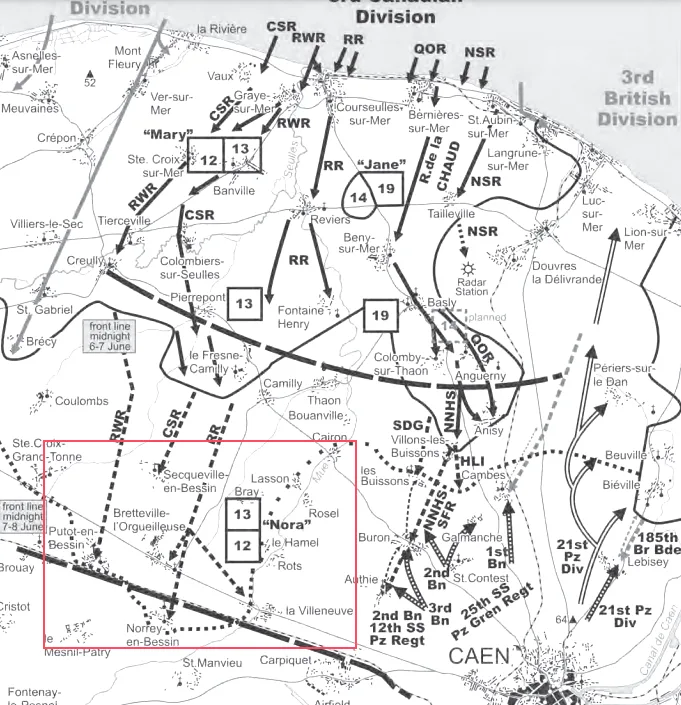
A significant gap existed between the frontline positions of the 25.SS-Pz.Gren.Rgt and the 26.SS-Pz.Gren.Rgt. The right wing of the newly arrived forces of the 26.SS-Pz.Gren.Rgt, the 1st Battalion, was centered on Saint Manvieau-Norrey, 6500 meters from other German forces.(32) In the eastern the 25.SS-Pz.Gren.Rgt zone, a makeshift flank of weak divisional support companies was strung out in a line from roughly Franqueville to Gruchy north-south.(33) This gap was a dangerous weak point and the overall German frontline distance needed to be shortened. The Bretteville-Norrey Canadian position was a dangerous salient that also needed to be dealt with. By taking Bretteville, Meyer would eliminate the gap in his division’s front, shorten it and secure the start line for further attacks.(34)
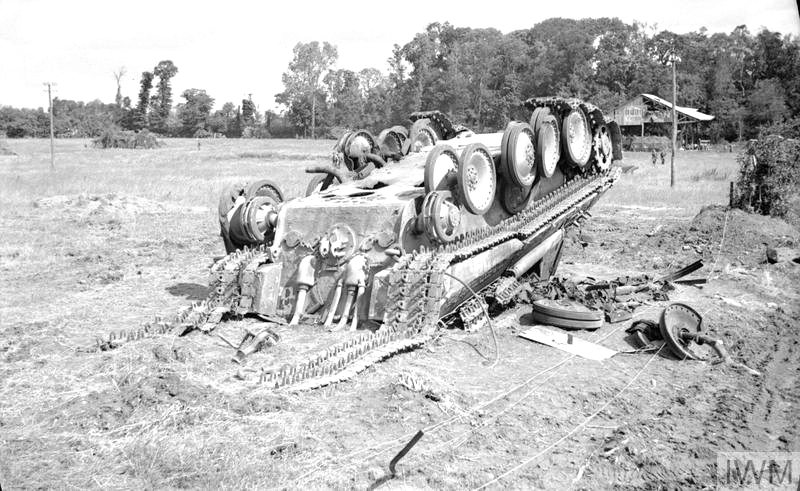
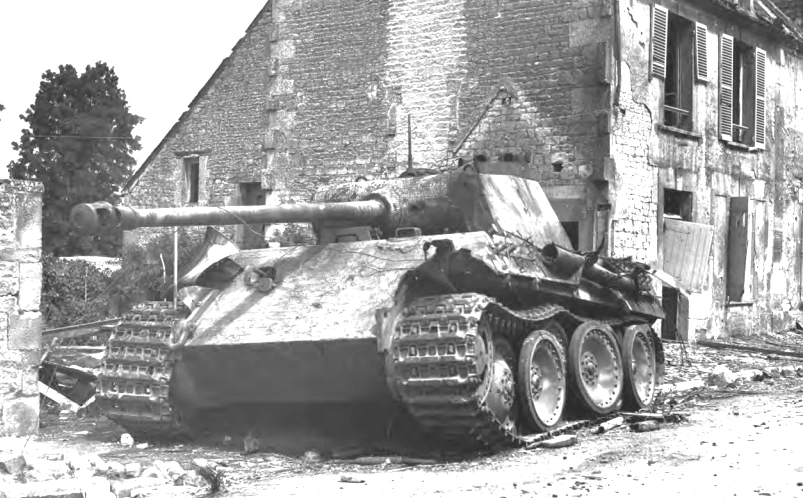
Continuing to plan with the regimental commander of 12.SS-Pz.Rgt (Max Wünsche), Meyer then set about assembling his task force. He was extremely short of infantry reserves. All that could be spared was the 15.Aufklärungs-Company (recon). This was a lightly armed force equipped with Volkswagen Schwimmwagens, motorcycles, staff cars and a few light trucks. It was led by SS-Hauptsturmführer Horst von Büttner.(35) Numbering near one hundred men, it had nowhere near the capability of a fully equipped panzergrenadier bataillon, three of which would the standard force required (3:1 ratio) for the task of successfully attacking an enemy battalion-sized strong point. Attached to this small infantry force was an overabundance of armor in the way of roughly twenty-five operational Mark V Panther of the 1st and 4th Company, led by SS-Hauptsturmführer Kurt-Anton Berlin and SS-Hauptsturmführer Hans Pfeiffer, both of them accompanied by SS-Sturmbannführer Arnold Jürgensen, the Battalion commander.(36)
There was nothing new about conducting a night attack involving tanks for Wünsche or Meyer who had practiced night attacks multiple times in Ukraine during the winter of 1943. Although German armored doctrine dictated that offensive operation in fog or dusk could be necessary if it serves to destroy an already shaken enemy and cause them to disintegrate completely the enemy in this case was not shaken nor were they about to disintegrate.(37)
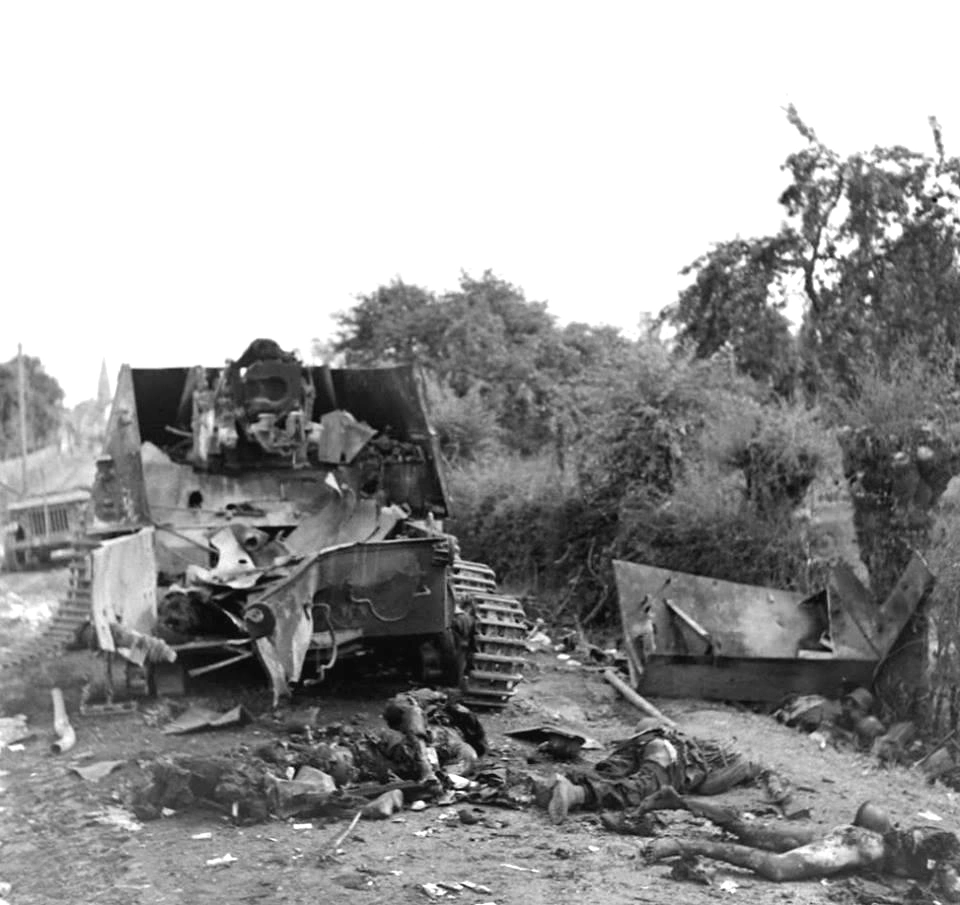
Much has been made of the number of tanks involved in the German battlegroup, with many sources differing on the amount. As previously noted, the Company only had sixty-six Panthers on hand at the time of the invasion versus its authorised level of seventy-nine tanks and not all Companies were up to strength.(38) A June 1, 1944, readiness report from the division states that of fifty Panthers on hand at that point, forty-eight were combat ready, a readiness rate of 96 per cent.(39) While considering this figure, it is important to observe that the tanks were brand new, combat operations had not begun and long route marches had not occurred. Also present was the six-vehicle strong 2nd Battery of the 12.SS-Pz.Art.Rgt with its Wespe self-propelled guns. This force was led by acting batterie-chef SS-Untersturmführer Erwin Hoke. Additional armoured fighting vehicles included at least one Czech 38t 20-MM Flakpanzer (AAA) of the Flak Panther Platoon.

(26) Howard Margolian, Conduct Unbecoming: The Story of the Murder of Canadian Prisoners of War in Normandy (Toronto: University of Toronto Press, 1998), 80-81.
(27) Meyer, 12. SS-Panzerdivision Hitlerjugend, 49-54.
(28) Milner, Stopping the Panzers, 237. SS-Standartenführer Meyer on the night of 6/7 June also made his famous “Little Fish” comment at the headquarters of the 716. Infantrie-Division.
(29) Meyer, Grenadiers, 227.
(30) Meyer, Grenadiers, 228.
(31) Copp, Fields of Fire, 72.
(32) Michael Reynolds, Steel Inferno: The 1st SS Panzer Corps in Normandy (New York: Dell Publishing, 1997), 95.
(33) Meyer, 12. SS Panzerdivision Hitlerjugend, 54. This screening force was made up of the 14. (Flak), 16. (Pioneer) and 15. (Recce) Kompanien of SS-Pz.Gren.Rgt. 25 and the divisional Begleitkompanie (Headquarters Escort Company).
(34) Milner, Stopping the Panzers, 259; and Meyer, 12. SS Panzerdivision Hitlerjugend, 54. As Canadian military historian Marc Milner notes: “The abandonment of [Canadian] positions along the Mue River valley left two Canadian field artillery regiments deployed around Bray fully exposed” (Stopping the Panzers, 261). With Meyer and Witt being focused entirely on Bretteville, no mention is made in the 12. SS-Panzerdivision Hitlerjugend divisional history of this possible opportunity to exploit this weak point in the Canadian front.
(35) Zuehlke, Holding Juno, 195.
(36) Cazenave, Panzerdivision Hitlerjugend, 181. Jürgensen was present. It is unclear if he was in his own command Panther, tactical number 155.
(37) Wolfgang Schneider, Panzer Tactics: German Small-unit Armour Tactics in World War II (Mechanicsburg: Stackpole Books, 2005), 13.
(38)Kriegstagebuch No. 1, I. /SS-Panzerregiment 12., 1944, Kriegstagebuch Appendix No. 3, Vojensky Historicky Archiv; and Cazenave, Panzerdivision Hitlerjugend, 181-90. As an example, 4. Kompanie only had three Züge (platoons) of a maximum of four Panthers each, maybe less, and possibly one Kompanie staff Panther for a total of between eleven and fifteen Panthers versus the authorised strength of seventeen.
(39) Niklas Zetterling, Normandy 1944 (Winnipeg: J.J. Fedorowicz, 2000), 351.
While Meyer should have taken care to further coordinate his operations by holding an orders group with the nearby infantry commanders of the 1/26.SS-Pz.Gren.Rgt Companies or contacted a liaison officer, no evidence exists that he did. The involvement of these Panzergrenadier units bordering his objective could potentially have been vital to his success or failure. Additionally, no evidence can be found regarding any sophisticated German indirect artillery fire plan or organised artillery support of the operation.(40)
Max Wünsche, meeting with the Panther Companies commanders late in the afternoon of June 8, briefed them on the upcoming attack on Bretteville and clearing the Le Bourg–Rots area due east of the village.(41) He made it clear to them they would be the vanguard of the attack. The allocation of roughly twenty-five operational Panthers and the Wespe Batterie to take a small village was a huge allocation of armored resources for the task at hand, especially by the German 1944 standards. This may have been in part to mitigate the weakness of the accompanying infantry forces and the poor performance to that point of 1/26.SS-Pz.Gren.Rgt, which had been badly repulsed at Norrey the previous night. The final armored objective decided by Wünsche and Meyer was to secure the high ground northwest of Bretteville, Point 68, after supporting the Panzergrenadiere in clearing the village area of enemy resistance. 2130, H-hour for the attack, was chosen, partially to negate the Allied air threat and partially to achieve surprise at last light with the violent swarming of armoured vehicles onto the objective as per German armored doctrine.(42) Several German tank commanders and Panzergrenadier Platoons commanders conducted recces of the Canadian dispositions near the River Mue in the afternoon of June 8. These movements were observed by the Canadians, who noted the positions and amount of armor moving in the area. Short but violent artillery bombardments, called concentrations, were called in on the Germans on several occasions that afternoon. These were directed by the RCA Forward Observation Officer (FOO) from the 13th Field Regiment, RCA, assigned to Baker Co, RRR, Lt T. J. O’Brennan.(43)
The area of Bretteville and Norrey defended by the RRR was made up of flat, open beet and wheat fields and was broken up by dense tree lines. Almost all the buildings were constructed of stone masonry, making each one a potential bunker. Around the villages were walls 2.5 meters tall that posed significant barriers to armored movement or infantry assault. South of Bretteville was the Caen-Bayeux railway line, which ran slightly northwest.(44) On his arrival in the area, Lt Col Matheson sited his headquarters in the centre of Bretteville. Capt Ron Shawcross’s RRR Able Co was positioned in the village itself and encircled the battalion headquarters located near the village church.(45) Baker Co, with its new commander Maj Eric Syme, was initially positioned in the neighbouring village of Rots to the east, but by the evening was pulled back to the open fields broken by tree lines 200 meters east of Bretteville, with its front positioned east.(46) Charlie Co under Maj Tubb was installed in Norrey-en-Bessin in an all-around defence. Dog Co, under its new commander Capt Gordon Brown, was initially placed in La Villeneuve, southeast of Rots, but was withdrawn at the same time as Baker Co. Its new defensive position was southwest of Bretteville at the Usine Cardonville, a flax factory north of the east-west railway line. This walled-in compound had an orchard beside it and contained a flax production facility.(47)
Interspersed within the RRR positions were the 6-pounder AT guns of the RRR Support Company’s AT Platoon and one complete battery (94 Battery with two troops) of the 3rd Canadian AT Regiment, RCA, also with 6-pounder AT guns. In accordance with Anglo-Canadian doctrine, each gun’s field of fire interlocked with other nearby AT guns to provide maximum firepower against any enemy armor.(48) The total strength for the RRR company positions was fourteen 6-pounders, an impressive amount of firepower. These were supplied with discarding sabot ammunition, which was more than adequate for penetrating nearly all German tanks apart from the frontal armor of the heavier Mark V Panthers and the Mark VI-1 Tiger.(49) While not a 17-pounder, the 6-pounder AT gun was a formidable weapon which could fire rounds at 2000 feet per second and had an accurate, flat trajectory. It also had a total of 90-degree traverse and could fire up to twelve rounds per minute. It was very mobile, easily manhandled into position and could be towed by a jeep or the tracked Universal Carrier. Further support was given by at least two platoons of Able Co, the Cameron Highlanders of Ottawa MG Regiment, with their Vickers medium machine guns. At least one medium machine gun was assigned to each company position. Seventeen-pounder AT guns of the two nearby batteries of the British 62nd AT Regiment, RA, were positioned to the northwest of Bretteville in depth 1500 meters away, but it is unclear if they partook in the nighttime battle.(50) Support in the way of indirect field artillery was supplied by the 12th and 13th Field Regiments, RCA, who were on call to carry out pre-planned defensive fire missions.(51) Each regiment had a full complement of twenty-four M-7 Priest 105-MM self-propelled guns and each RRR company position had an RCA FOO assigned to it.
As a result of the increased German activity during the afternoon of June 8, Lt Col Matheson expected an armored assault to be launched imminently and placed his battalion on high alert.(52) Of interest and overlooked in previous accounts of this battle is the proximity of the 7th Canadian Infantry Brigade headquarters to the positions of the RRR during the battle. No more than 200 meters from the headquarters of Matheson was the headquarters of Brig Harry Foster, located in the hamlet of Haut de Bretteville, attached to the northern part of the village.(53) Even though Canadian infantry had held Bretteville in force for more than a day, two bizarre incidents occurred at roughly noon on June 8. First, a German dispatch rider on a motorcycle, ignorant of German and Canadian positions and who held the village, was shot by the battalion commander, Lt Col Matheson, as he attempted to drive past the battalion headquarters near the church. Shortly afterward, a German Kübelwagen staff car drove up with a driver who dismounted and began to curiously look around. A PIAT (Projector, Infantry, Anti-Tank) infantry anti-tank weapon was fired at the vehicle and the driver was killed. These incidents have been recounted in various accounts as occurring in the midst of the battle that night, when in fact it is much more likely they occurred during the day. This appreciation is supported by the testimony of the former commanding officer of the 13th Field Regiment, RCA, who observed the Kübelwagen event while present
in Matheson’s headquarters.(54)

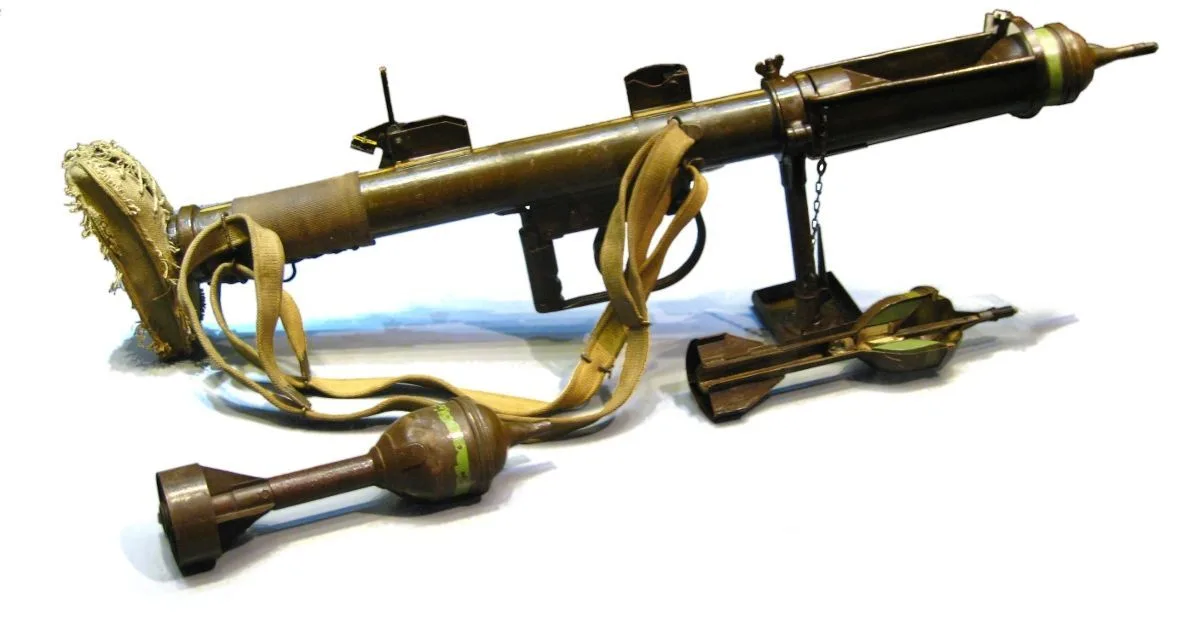
(Above): Projector, Infantry, Anti-Tank (PIAT) was a British infantry AT weapon widely used during World War II, including by Canadian forces in the Normandy Campaign of 1944. The PIAT was an important tool for infantry units, providing them with a portable solution to counter German tanks and fortified positions.
Development and Introduction: The PIAT was developed in 1942 by Maj Millis Jefferis to address the need for an effective infantry AT weapon. It was adopted by the British Army in 1943 and quickly distributed to Commonwealth forces, including Canadian units.
Design and Mechanism: Unlike conventional rocket-propelled systems, the PIAT used a spigot mortar mechanism. This design relied on a large spring to drive a steel rod (spigot) into the base of a shaped-charge warhead, igniting its propellant. Weight: Approximately 15 kg (33 lbs); Length: 99 cm (39 inches); Effective Range: AT Role: About 100 meters (110 yards); Against Static Targets: Up to 350 meters (380 yards). Note that the PIAT had significant recoil when fired, and cocking the spring mechanism required physical strength, which was challenging in combat conditions.
Normandy
AT Role: the PIAT was used effectively by Canadian soldiers during the intense fighting in Normandy, especially in urban and hedgerow combat where its relatively short range was less of a disadvantage. It could penetrate up to 75-MM (3 inches) of armor at 100 meters, sufficient to destroy or disable most German tanks of the period, including Panzer IVs and even some Tigers under optimal conditions. Canadian troops relied on the PIAT for ambush tactics, utilizing the cover of hedgerows and ruins to get close to German armored vehicles.
Versatility
Besides engaging tanks, the PIAT was often used against fortified positions, machine gun nests, and buildings. The high-explosive anti-tank (HEAT) warhead was particularly effective in creating breaches in enemy defenses.
Tactical Use
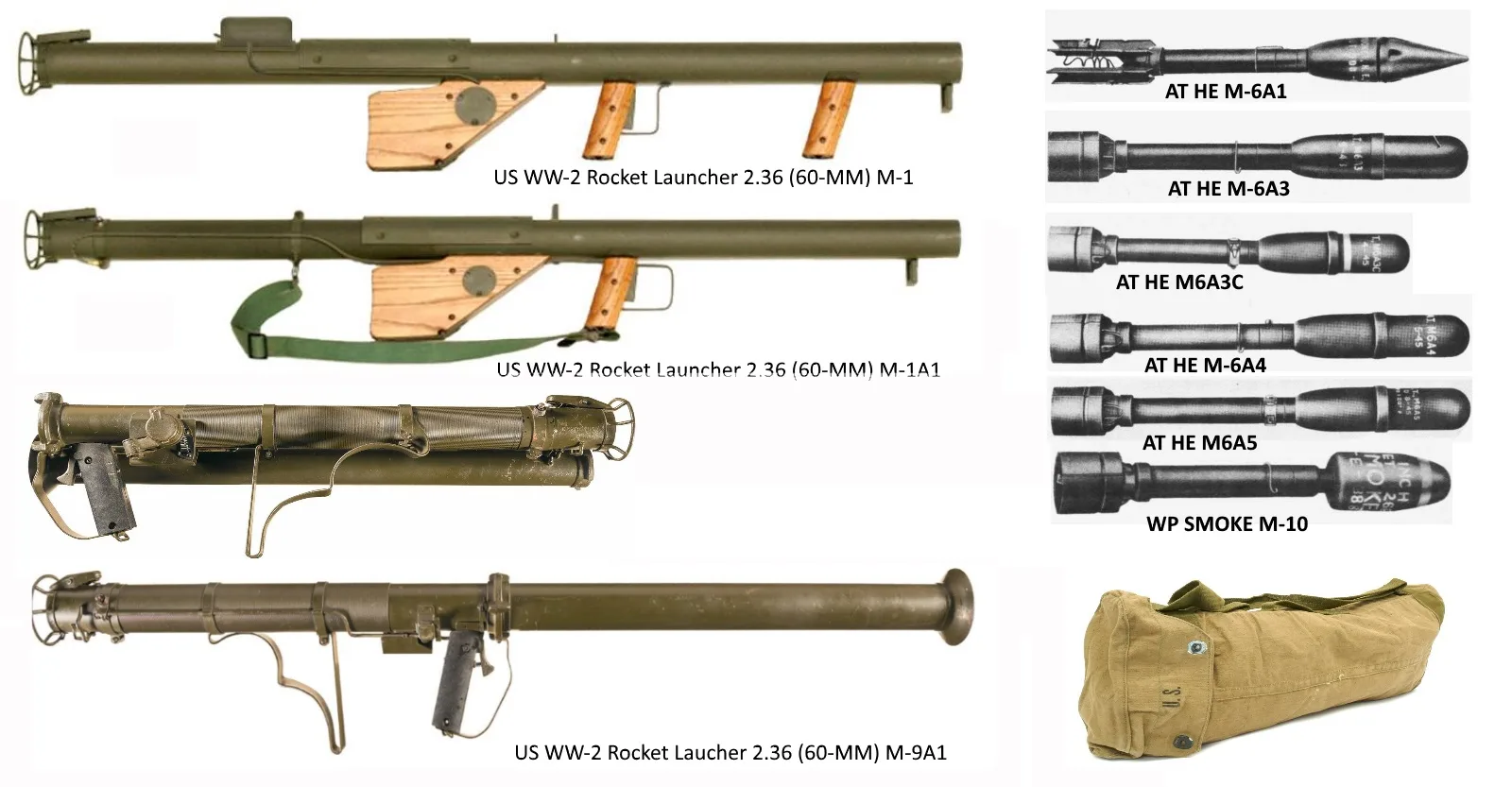
In the close-quarter environment of Normandy, Canadian troops valued the PIAT’s relative portability compared to heavier anti-tank options like the 6-pounder gun. Its silent operation (no backblast or loud report) was advantageous in ambushes, unlike the American Bazooka.
Ammunition Types
High-Explosive Anti-Tank (HEAT) Round
The primary munition for tank and armored target engagement. Used a shaped charge to focus explosive energy on a small area, allowing it to penetrate armor effectively. The warhead was about 1.1 kg (2.4 lbs) of explosive.
High-Explosive (HE) Round
Designed for use against personnel, fortifications, and unarmored vehicles. Less commonly used but valuable in clearing trenches or buildings.
As planned, at 2130, the Meyer/Wünsche Kampfgruppe began to advance from its assembly point at Saint Germain-la-Blanche Herbe.(55) As the Panthers assembled, no indirect artillery barrage to support their attack was fired, in direct violation of established wartime German combined arms armored doctrine, which stated: ‘In spite of all their firepower, tanks are dependent on the support of extensive indirect fire‘.(56) Doctrine was followed, however, with regard to basic Platoon tactics, with the Panther advance to contact being conducted in staggered formation on the Caen-Bayeux highway, (RN 13), an improved paved two-lane road.(57) Passing through Franqueville and driving west, the Panthers entered the hamlet of Le Bourg, attached to Rots to the north, and encountered no resistance.(58) SS-Sturmbannführer Arnold Jürgensen, the Platoon commander, then established his advanced headquarters there, taking no part in the initial combat that followed. The lead 4th Company reached this hamlet with the grenadiers of the 15.Recon Company of the 25.SS-Pz.Gren.Rgt riding on the rear engine decks at approximately 2140. The recon Panzergrenadier’s Schwimmwagens and motorcycles had been largely left in the rear, though some were present. SS-Hauptsturmführer Hans Pfeiffer, in one of the lead Panthers, then ordered the 4th Company into column formation and with himself in the lead crossed the village bridge over the River Mue, his company followed by the tanks of the 1st Company under S-Hauptsturmführer Kurt-Anton Berlin. On exiting the village of La Villeneuve west of the River Mue, wedge formation was resumed with the 4th Company on the north of the RN 13 and the 1st Company to the south, the tanks roaring through the open fields during last light at 35 KMH. SS-Hauptsturmführer Horst von Büttner, the commander of 15th Company, rode on the engine deck of one of the lead 4th Company tanks with his command staff. Meyer was himself riding in a motorcycle-sidecar combination near Wünsche’s Befehls Panther (command tank) on the main highway.
(40) Meyer, 12. SS Panzerdivision Hitlerjugend, 196. While the Wespe self-propelled guns were effective artillery assets, their value in the direct fire role in low light conditions would be limited and they did not have a large amount of ammunition, carrying only forty rounds per vehicle.
(41) Kriegstagebuch No. 1, I. /SS-Panzerregiment 12., 1944, 8 June 1944 entry, Vojensky Historicky Archiv.
(42) Schneider, Panzer Tactics, 54.
(43) Milner, Stopping the Panzers, 262.
(44) Milner, Stopping the Panzers, 235, 7th Canadian Infantry Brigade Front Map.
(45) Greentree, Hitlerjugend soldier versus Canadian Soldier, 44.
(46) Zuehlke, Holding Juno, 158. The RRR Baker Company Officer Commanding has often been listed as Lieutenant John Treleaven. Though the senior platoon
commander who led the company to Rots on 7 June, he relinquished command of the company to the newly arrived Major Eric Syme on 8 June 1944.
(47) Greentree, Hitlerjugend Soldier versus Canadian Soldier, 44; and Stewart A. Mein, “Up the Johns”: The Story of the Regina Rifles (North Battleford: Senate of the Royal Regina Rifles, 1992), 113. At this time two of the line companies in RRR were commanded by acting Officers Commanding, most of the majors becoming casualties in the previous two days.
(48) War Office, “Infantry Training Part VI: The Anti-Tank Platoon 1943 26/G.S. 1023 Publication” (Ottawa: His Majesty’s Stationary Office, 1943), 11, accessed 8 January 2019, http://wartimecanada.ca/categories/training-manuals?tid=All&page=1. Depth of all anti-tank assets in the infantry battalion defensive position was to be achieved in conjunction with deployed RCA anti-tank assets.
(49) Reynolds, Steel Inferno, 98.
(50) Milner, Stopping the Panzers, 261.
(51) G. W. L. Nicholson, The Gunners of Canada: The History of the Royal Regiment of Canadian Artillery, Volume II: 1919-1967 (Toronto: McClelland and Stewart, 1972), 282.
(52) Milner, Stopping the Panzers, 262.
(53) Bernage and Jeanne, Three Days in Hell, 113, Map of RRR and 7th Canadian Infantry Brigade headquarters dispositions.
(54) “Col. [F. P. T] Clifford, who claimed to witness the incident, says it happened at noon on 8 June, but the Reginas’ accounts all place it the following night in the midst of the Panther attack. See [Capt. Gordon] Brown’s account in [Jean] Portugal, We Were There [Toronto: Royal Canadian Military Institute Heritage Society, 1998], 852; interview with Clifford, 25 April 2002; and Reynolds, Steel Inferno, 79,” as cited in Milner, Stopping the Panzers, 273.
(55) Margolian, Conduct Unbecoming, 104; and Cazenave, SS-Panzer Regiment 12, 178.
(56) Schneider, Panzer Tactics, 247.
(57) Schneider, Panzer Tactics, 142, 247. German armoured doctrine stressed the use of indirect fire and to attach forward artillery observers.
(58) C. P. Stacey, The Official History of the Canadian Army in the Second World War, Volume III: The Victory Campaign (Ottawa: The Queen’s Printer and Controller of Stationary, 1960), 136.