

URGENT
May 7, 1944.
TOP SECRET
INDEXED
Your letter C/6299 of April 19 and previous correspondences about ‘assassination priorities’ for Overlord.
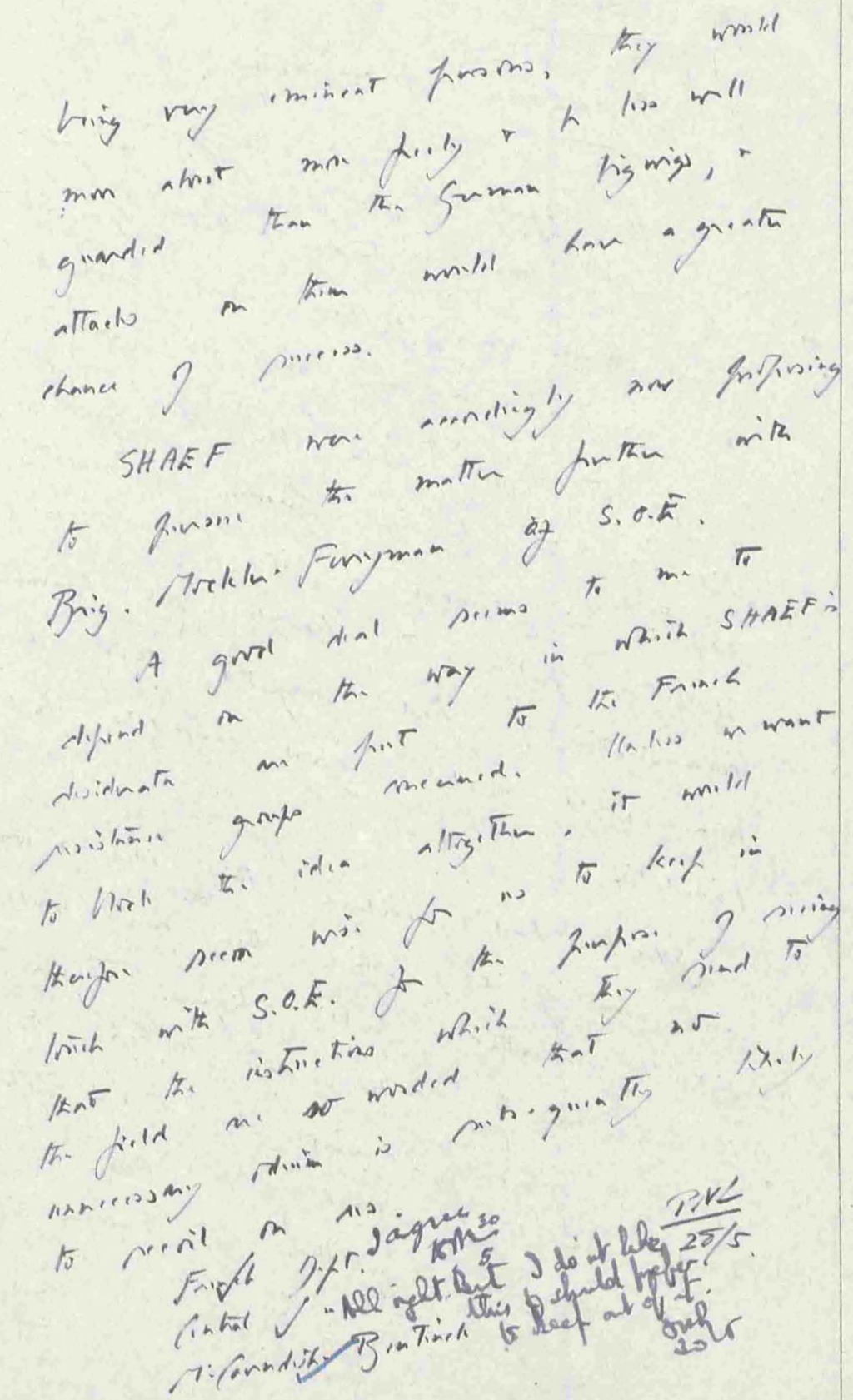
I discussed this question yesterday at SHAEF with Peake and the Deputy Chief of Staff. The latter is not thinking in terms of what we should do with anyone who may fall into Allied hands. The idea that he would like explored is whether there are any leading German personalities in France whose removal at the hands of French resisters before or after D-Day might help Allied operations. He has discussed the idea with Mockler-Ferryman of SOE who thinks that some of their agents in France would be ready to have a shot at it.
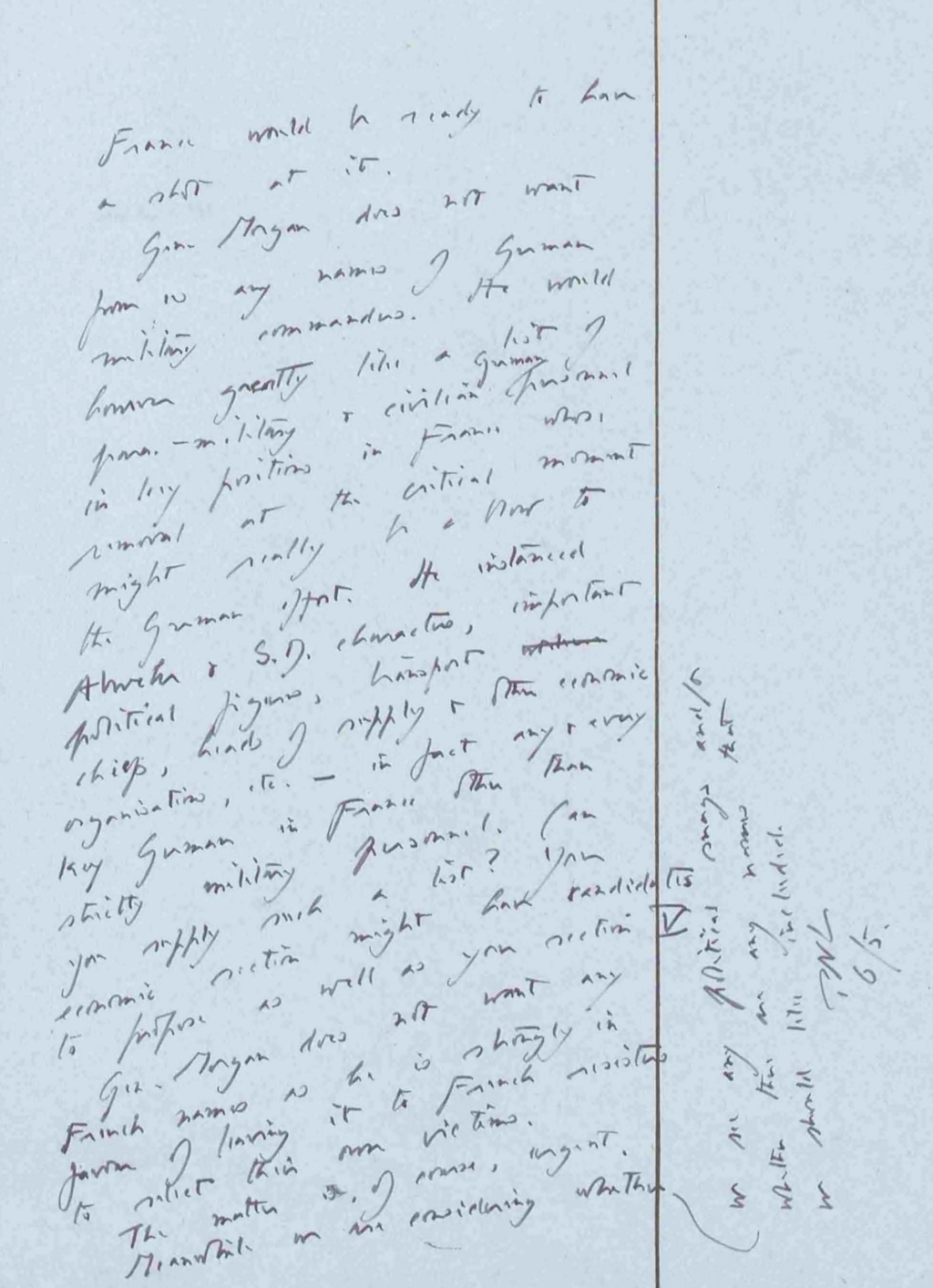
General Morgan does not want from us any names of German military commanders. He would however greatly like a list of para-military and civilian German personnel in key positions in France whose removal at the critical moment might really be a blow to the German effort. He instanced the Abwehr and the SD, characters, important political figures, transport chiefs, heads of supply and other economic organizations, etc. – in fact any and every key German in France other than strictly military personnel. Can you supply such a list? Your economic section might have candidates to propose as well as your Section V.
General Morgan does not want any French names as he is strongly in favor of leaving it to the French resisters to select their own victims. The matter is, of course, urgent. Meanwhile, we are considering whether we see any political snags and/or whether there are any names that we should like included.
(Signed) P.N. LOXLEY
May 9, 1944.
INDEXED
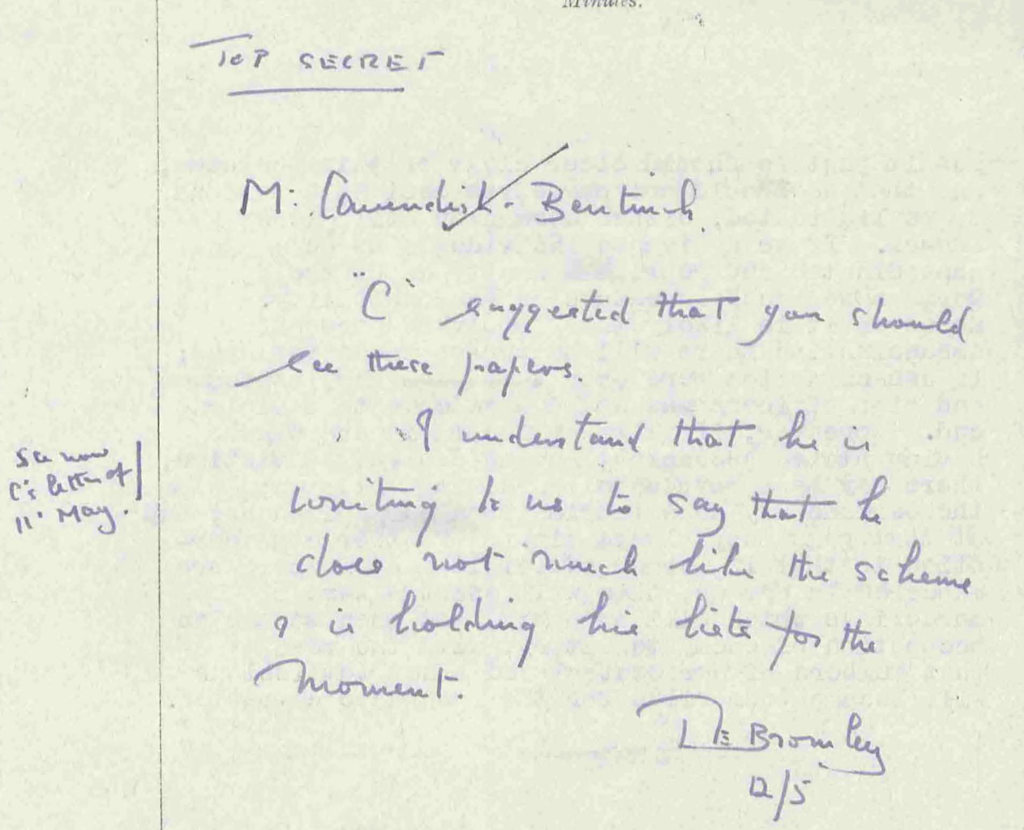
In the last paragraph of Peter Loxley’s letter to you of May 7, about assassination priorities, he said that we were considering whether we could see any political snags in the scheme and whether we had any particular views on names to be included in the list. This has now been done and we think that the names can be safely left to you as previously stated. The Departments here can see no political snags in General Morgan’s proposal, though they think that action may result in bloody reprisal, as has happened, for example, in parts of France been removed.
(Signed) T. E. Bromley
TOP SECRET
G/6456
LONDON
May 11, 1944.
I refer to your letter of May 7, regarding Assassination Priorities for Operation Overlord.
We have at your request prepared a list of names that represent the most important German personalities in para-military formations believed to be in France. We do not believe, however, that their removal will have much, or indeed any effect on the efficient functioning of so widespread and highly organized machine as that in which they are prominent officials.
In these circumstances do you still wish to be supplied with the list of names in question?
P.N. Loxley
I agree with C in disliking this scheme, not out of squeamishness, as there are several people in this world whom I could kill with my own hands with a feeling of pleasure and without the action in any way spoiling my appetite, but I think that it is the type of bright idea which in the end produces a good deal of trouble and does little good. The Poles have destroyed a number of German officials, but they are specialists in this type of work and have had more than sufficient provocation. The Czechs also destroyed a few German officials, but I think that they cursed the day when Heydrich was killed. Whenever the French have gone in for the liquidation of collaborators or enemy personnel this has resulted in bloody reprisals, and has I believe, been deprecated by the higher resistance authorities. If the French like to assassinate Germans or collaborators we should not deter them, but I submit that we should steer clear of this business and that we should not ourselves designate persons to be liquidated, either German or still less French. If we designate individuals to be assassinated and reprisals are taken by the Germans we incur a measure of responsibility.
Moreover, it is likely that for every successful assassination, there will be two or three failures; if assassination were easy many statesmen and high officers would have come to a violent end. Moreover, if we go on record in any way as having stated assassination and designated victims, there may be a revulsion of feeling later on; also the Germans may take reprisals on our prisoners, and at that game, they always win. A further consideration is that if German officials or officers are murdered in France, this will start a wave of murderings which will probably last when we are in occupation of enemy territory, with the result that members of our Control and other Commissions will become poor risks for the insurance companies.
May 13, 1944.
Sir A. Cadogan
The Chief of Staff at SHAEF has asked Mr. Peake to look into the question of assassination priorities for Overlord (German and French candidates) and Mr. Peake has requested the assistance of the Foreign Office and of C with particular regard to the provision of lists (Flag A). It was agreed in the Foreign Office that the Frenchs must be left to look after French candidates; as for the Germans, it was felt that while there might be no political snags, the proposal was not very attractive, since these assassinations would only provoke severe reprisals, as had already happened in France (Flag B).
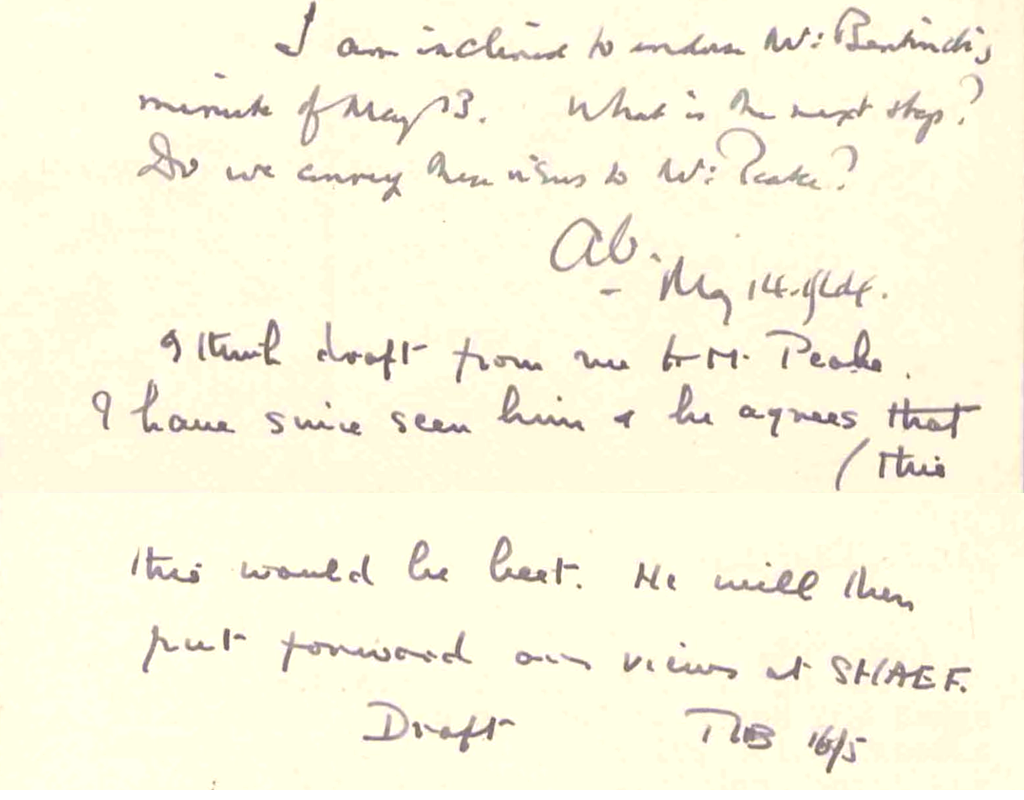
These doubts have been reinforced by a letter from C (Flag C) and by a minute by Mr. Cavendish-Bentinck (Flag D). I think that you should see these papers, since the proposal is of some consequence, as Mr. Cavendish-Bentinck’s minute shows, and SHAEF may perhaps not have considered its full implications.
(Signed) T. E. Bromley
May 14, 1944
T. E. B.
Mr. Peake, SHAEF
Central Department
French Department
Mr. Cavendish-Bentinck
(From Mr. Bromley)
FOREIGN OFFICE, S.W.1.
May 16, 1944
PERSONAL & TOP SECRET
As Loxley is away on leave I am answering your minute to him of April 15, about assassination priorities for Operation Overlord, on which he had started investigations before going away. While C‘s people would be able to produce lists, the general feeling here and in his Office is that the proposal is open to certain objections on the political side. Quite apart from the question of French candidates, who should, we think, be left to the French, the assassination of German candidates is likely to provoke bloody reprisals as has in the past happened, for example, in France, and in Czechoslovakia (Heydrich). If we designate individuals to be liquidated and reprisals are taken by the Germans, we incur a measure of responsibility. Moreover, it is likely that for every successful assassination, there will be two or three failures, as past records of these attempts show. Again, if we go on record in any way as having started assassination and having designated victims, there may be a revulsion of feeling later on and the Germans may also take reprisals on our prisoners, a game at which they always win.
A further consideration is that if German officials and officers are murdered in France, this may start a wave of murderings which will probably last when we are in occupation of enemy territory, with the result that the lives of members of our control and other commissions will also be endangered. Another point is that the removal of the most important German personalities in para-military formations believed to be in France will not have much effect on the efficient functioning of 80 widespread and 80 highly organized a machine as that in which they are prominent officials. For your own information, Sir Alexander Cadogan is inclined to agree with these views, and if you think that a more formal expression should be provided, this could, I think, be done.
INDEXED May 16, 1944.
C.B.P., Peake, Esq., C.M.C., M.C.
As Loxley is away on leave I am answering your minute to him of April 15 about assassination priorities for Operation Overlord, on which he had started investigations before going away. While C‘s people would be able to produce lists, the general feeling here and in his Office is that the proposal is open to certain objections on the political side. Quite apart from the question of French candidates, who should, we think, be left to the French, the assassination of German candidates is likely to provoke bloody reprisals as has in the past for example, in France, and in Czechosloveakia(Heydrich). If we designate individuals to be liquidated and reprisals are taken by the Germans, we incur a measure of responsibility. Moreover, it is likely that for every successful assassination, there will be two or three failures, as past records of these attempts show Again, if we go on record in any way as having started assassination and having designated victims, there may be a revulsion of feeling later on and the Germans may also take reprisals on our prisoners, a game at which they always win. A further consideration is that if German officials and officers are murdered in France, this may start a wave of murderings which will probably last when we are in occupation of enemy territory, with the result that the lives of members of our control and other commissions will also be endangered. Another point is that the removal of the most important German personalities in pare-military formations believed to be in France will not have much effect on the efficient functioning of so widespread and so highly organized a machine as that in which they are prominent officials. For your own information, Sir Alexander Cadogan is inclined to agree with these views, and if you think that a more formal expression should be provided this could, I think, be done.
Yours sincerely,
(SGD) T.E. BROMLEY.
Like Mr. Roberts, I dislike this and I not only would prefer to keep out of it but would also like to go on record as objecting. If SOE and SHAEF together like to put up French people to murder German transport experts let us keep clear of this business so that later on we can deny having had anything to do with it. Personally, basing my views on the experience of the past four years, I doubt whether the Foreign Office can ensure that the instructions which SOE sends into the field are so worded that no odium is subsequently likely to recoil on us. I am far from convinced that the liquidation of a number of the principal German transport experts in France will seriously interfere with German military communications after D-Day. Not even SOE would pretend that it would be possible to murder all the principal German transport experts and to feel certain that these experts have under-studies. The Germans have certainly already made their plans for maintaining their communications in France with alternative routes to be used in the event of those normally employed being knocked out. Consequently, I expect the German transport experts have probably already done their most useful work and that the liquidation of a proportion of them will not delay German troop movements to any worthwhile extent.
May 31, 1944.