



Back on Rock Hill, the 3/511 was making a series of attacks on Maloney Hill but all were repulsed. The men were tired and weak from a lack of food. Even walking down the muddy trail a few yards would exhaust them. Everyone had been wet from the time they had left Mahonag and the continuous rain and dampness had kept them wet. Most of the ponchos and shelter half tents had been utilized in making as much litter as possible for the many wounded laying at the aid station. On December 13, the skies cleared for the first time in many days and the liaison planes dropped rations and medical supplies for over an hour. After the first drop, every three men were issued one box of K rations. During the course of the ration drops, in the next few days, two men were killed by falling boxes and there were many other near misses. One of the men killed was a casualty in the aid station.
Earlier in the day a patrol had left the perimeter to reconnoiter a new trail to Mahonag, for the purpose of bringing more supplies to Rock Hill. By late afternoon, a message from the 2/511 at Mahonag, stated that the patrol had arrived safely and that a continuous line of supplies would be started in the morning, over the new trail. A coordinated attack was planned to retake the Maloney Hill. Two companies from the 2/511 at Mahonag would attack from their direction, and How Co would attack from Rock Hill. The plan for How Co was to leave Rock Hill under the cover of darkness to a position near Maloney Hill, where they could attack at dawn. The forward observer, from battery A of the 457-PFAB would be with the 2/511. The preparation for this attack by How Co was very poor and disorganized. In the early morning when the company was trying to organize everyone seemed to be confused. There was excessive and loud yelling by the subordinate leaders trying to assemble their men. Finally, after it was already daylight, the company started to move out. The lead elements had just started to leave the perimeter when they were met by Japs, who had crawled up to within a few yards of the outer foxholes. A sharp firefight took place, which lasted most of the morning.
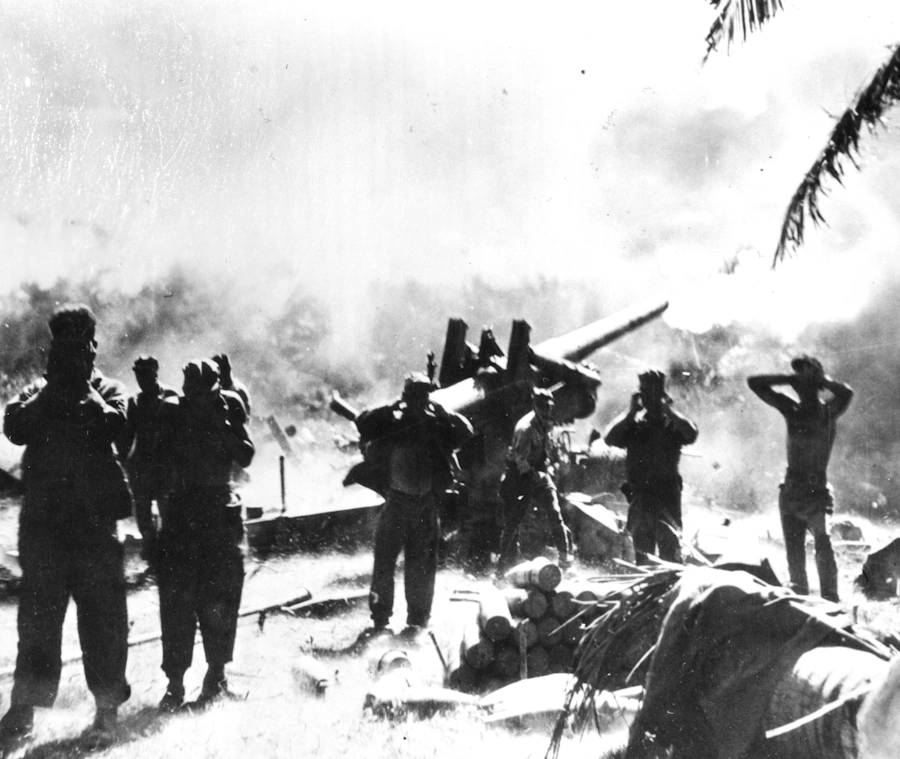
In the meantime, the two companies from the 2/511 were closing in on Maloney Hill but had not taken it. Easy Co was finally ordered to bypass it and join the rest of the regiment on Rock Hill. How Co had to withdraw because of approaching darkness. On the same day, word was finally received about George Co. Elements of the 32nd Infantry, pushing up towards our position had contacted them. These men had been without rations for ten days and most of them were suffering from malnutrition. A marine observer had been with the regimental CP and had contact with a battery of 155-MM back on the beach. These guns had not been used in close support due to the difficulty of adjusting fire into the jungles. The small daily allotment of ammunition had been expended on commanding terrain features some distance away. On the morning of December 18, a large concentration of fire from these 155-MMs was put on Maloney Hill. A short time later, Baker Co attacked the hill and took it without any opposition. This artillery fire, from the 155-MMs, had been very effective. A large number of dead Japs were scattered over the hill in their battered emplacements. An ambush had been set up on the Japs trail running off to the west and it accounted for around 100 Japs, as they retreated from the artillery fire.
CONTINUING THE ATTACK
With the mopping up complete, the regiment prepared to move out to the west. How Co was sent out on a recon in force to the west ridge about 800 yards from Rock Hill. An artillery concentration from battery A of the 457-PFAB was placed on the ridge prior to this attack. By 1800, How Co had withdrawn without being able to advance. On December 20, the 3/511 made a coordinated attack with Item Co going to the right and How Co going to the left. Prior to this, the 75-MMs, now firing at almost maximum range from Manarawat, had laid a very heavy volume of fire in support of this attack. The 81-MM mortar platoon had sent an observer with each of the companies and had cleared a position in the jungle to support the attack. Again only one mortar was used. Item Co made good progress, and by noon had reached the top of the ridge where the supply trail made a sharp turn to the right. (See Map D) On arriving here, it was discovered that the Japs had gone around their position and had infiltrated between them and How Co. A strong patrol from Item Co was sent down the trail to clear it of the Japs and to reach How Co. During this attack, Item Co received all the mortar support. It was necessary for the observer to crawl up the trail with the lead riflemen and place the fire on located points of resistance. The initial adjustment required a great deal of time because the bursts could not be seen. All the sensings had again to be made by sound.
S/Sgt Mille, a mortar section leader, was killed during this action while eliminating a machine gun close to him. After being slightly wounded by the machine gun just to his front, Sgt Mille brought in three rounds at a very close range. One of the rounds hit a tree a short distance away and killed him. The radios were out by this time and communication was by W130 wire. In a short while the wire ran out and communication was maintained by utilizing the Japs wire that was on the trail. By late afternoon, the ridge had been taken and the mortar platoon moved up and joined the new perimeter for the night. This was the last action by this platoon. The next day, the 2/511 passed through the 3/511 and continued the attack down the trail towards Ormoc. The attack was vigorously pushed for the next two days to prevent the Japs from reorganizing. Two bivouac areas were passed through that looked like they had just been vacated and two 75-MM field guns with approximately 100 rounds of ammunition were discovered.
At noon on December 22, the regiment was ordered by the division to hold up and let the 187th Glider Infantry Regiment passes through. At this point, Dog Co had advanced to the foothills and had to withdraw about 2 miles to allow the 187-GIR to take over. The 511-PIR spent the next two days collecting all the litter patients from Mahonag and Rock Hill, and by December 25, the regiment had cleared the mountains and had completed its mission.
