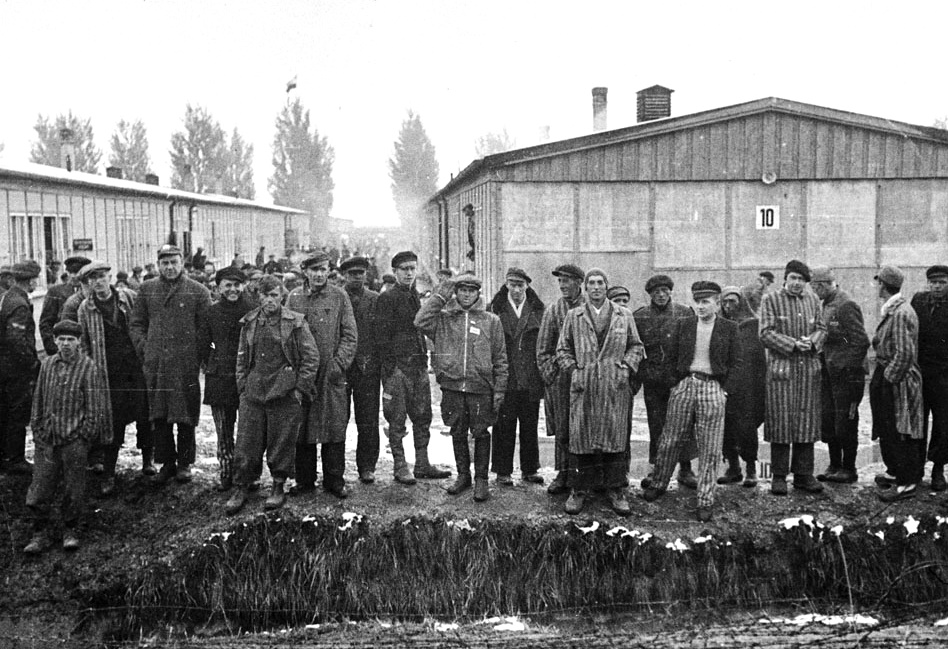





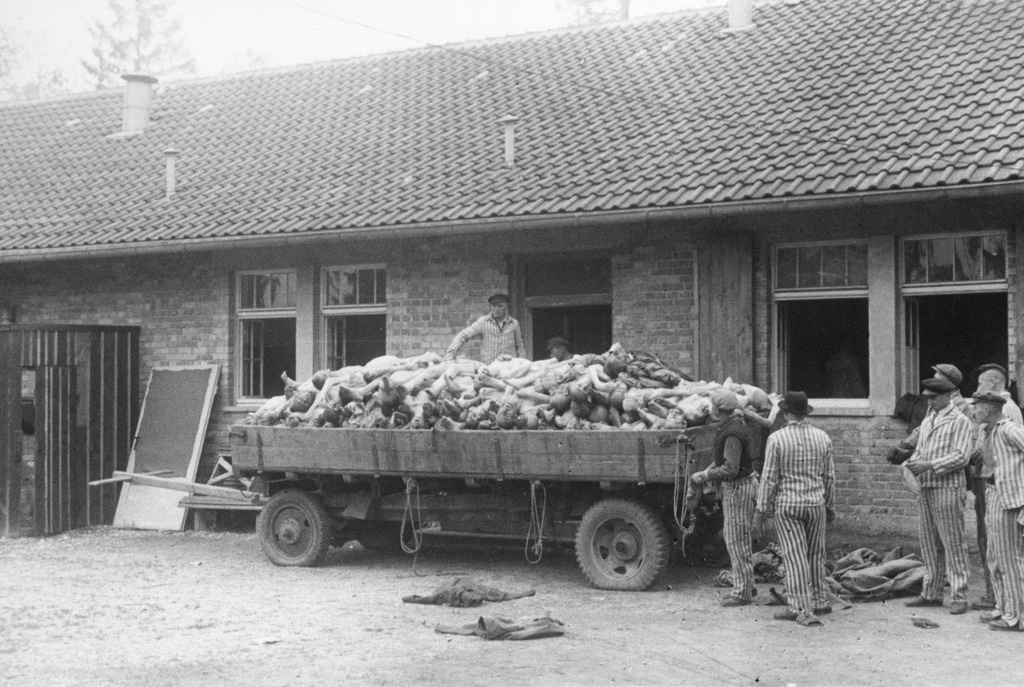
Krematorium: The Krematorium was operated by SS personnel of the Abteilung I-Kommandatur (Personal Staff Section) with the help of 7 to 10 specially chosen internees. These were usually Jews who were taken out of their barracks, and lodged in the so-called ‘dungeon’. They were well-fed and well-treated but had to work all day long in the Crematory. After five or six weeks when their knowledge of key personnel was such that they became dangerous, they were executed, and several more Jews were chosen to take up their functions.
Gun Executions: Most of the gun executions were used on Russian officers and soldiers. The non-commissioned officer in charge of the block (barracks) would call out the names, and the selected internees would fall out and would be marched to the gate which separates the internee compound and the administrative sections of the camp. Here the SS men who volunteered for the execution squad would lead them out to the Schießstand (shooting stand) near the Krematory, had the victims kneel, lower their heads, and were shot in the back of their necks. Eight to ten men at a time were executed in that manner. In September 1944, ninety-one Russian officers were executed in one day.
DIARY OF E. K.
One of the most interesting documents unearthed by this section of the CIC Detachment was a water-logged diary kept from November 1942 until recent days. This diary was written by E. K., an internee since 1940. In secret and under the greatest difficulties, E. K. was able to record the events of the day. The discovery meant certain death. The incidents and situations described were personal experiences of E. K. and his closest friends. The diary, written in German, is much too long to be incorporated as a whole in this report. Excerpts are submitted as an illustration of the tone of the whole and as an attestation to the acts of barbarism committed in the Dachau Concentration Camp. Both the author and his work may be in danger of German reprisals.
20 November 1942
These pages that I now begin to write would lead to certain death if ever they were found. But what is death? How few of those I knew here are still alive today, how close to death we all stand. I can die here any moment, even if I take the greatest care. Why should I, not endeavor, even amid these conditions, of this cruelty, to tell this gruesome story that no longer gives us goose flesh? I feel I know not why, the urge to write. I thought I would record all this for you so that when we will meet again sometime later, I would have nothing more to say. I would give you the pages and be silent–for I am tired of speaking. And now I hasten to begin, without regarding the danger it involves. My friends think I am secretly writing a poem, most likely a love poem, or one about flowers and stars. If they knew what I was doing, they would burn these pages out of fear. They would be right because I endanger their lives as well as my own; only they don’t know it. And if these lines were found, I should have to prove that they did not know my secret writing, for I only showed them harmless little verses.
21 November 1942
Something happened yesterday that excited even the most hardened of us, and that means something, for we have lost all feeling, nothing more can astonish us in any way. And so it was yesterday. Very few of us were moved, just those who were directly concerned. 500 invalids came yesterday from a camp near Danzig. To be an invalid among us prisoners means to be at death’s door. Later, when we are together, I will tell you more about that. 51 of these ‘invalids’ came in dead, but their bodies had already been partially eaten by the others, the remains and bones were thrown out of the chink in the cattle-truck door during the journey. Only a few unrecognizable parts of the body remained. The whole side was missing from one body, from others the nose, cheek, or genital organs. It must have been a terrible sight; I am so thankful I did not see it. All the corpses were photographed. Most likely the camp authorities did this to send evidence to Berlin. The prisoners, during the six days that their journey lasted, received only one piece of bread, six hundred grams, I believe. Hunger delirium broke out among them, as they had suffered for a long time from underfeeding. The officers of our guard, who otherwise make fun and joke about all these horrible things, except those concerning them were moved. This time they had seen something new: cannibalism, that they were not used to. The last remains of civilization surged against these facts and deeds, 49 of the survivors died yesterday, the day of their arrival. Soon there will be more and every day the number will increase. That they brought them here can only be explained by the fact that manpower is needed; so they move up all they can. Of those that can’t be revived … of those, I will speak to you later. Will you ever read these pages? Each page is a source of danger and who knows how many pages I will write, but even if I can put down all I experience … it is so hard to hide these pages. May a good power protect them and keep them in safety, so that one day I can give them to you, together with a heart of stone that was wrought for you secretly during days and days and that I wore for a long time. Perhaps these pages will survive me, and some stranger will bring them to you. The most beautiful flowers on my tomb, the tomb of my remembrance, for who dies here has no material grave. I have grown older. My temples are turning grey and age is changing my features. I sometimes notice it when I look at myself in the small mirror of the washroom. I am only 36 years old, but, like most of us, my hair turning grey … silver threads among the gold, as in the song.
22 November 1942
I must tell you something that shocked me so much today, I don’t know myself why. It is Sunday. We are standing on the roll call court and are waiting for the order to march out. Beside us, a few hundred Russians, or rather Ukrainians are led up. The two first lines are … children of 11 to 15. Their small bodies were clad in garments far too large for them; their pale faces with childish, half-joyful eyes, and their voices sound like the lark’s song in a churchyard. Last Sunday someone led past me a dying whimpering infant. I had to turn my face away … help here is quite impossible. These children, these young fellows worked in Wurtenburg, near Ulm. The food there was so scarce that they starved. They escaped in groups … they wanted to return home. Instead of that, they were sent here. Many of them are already dead. They are quite happy here … they say that the food here is better. They are quite happy about that, and that tells its tale. Hearts must grow hard here, otherwise one would cry from morning till evening.
8 December 1942
Today is already December the 8th. Nothing happens, only small, trivial things. At night, in bed, I drew the blankets over my head, but I heard what somebody was saying behind us. His friend is a litter bearer … the job doesn’t move him any longer. Yesterday as he was piling up the corpses, his attention was accidentally drawn to one face, it was his brother. How he must have been shocked although he was used to handling corpses. His brother had come from another camp without his knowing it. Someone came and pulled the blankets from my head. It was a Polish friend of mine. He told me about a priest, a schoolmate of his. Here in Dachau they met again. The priest was suddenly taken into the Revier–that is the name they give to the hospital here, to be experimented on. Research is being made here on boils. 26 priests of Polish and Czech origin died from these experiments. Despite this, the work went on just as the one on malaria. The priest secretly sent a short note to his friend. The last sentence was not legible, for, as he said, he had a 40° temperature. He did not ask for help because he knew all was lost. He only prayed that a way be found to prepare his family for the worst. He will be operated on Friday. The prisoners are inoculated with these boils and then when the illness is at its highest point, they apply the countermeasure. They are experimenting. Many hundreds will still die in this way and we must look on, helpless and unable to do anything. Each one must see how he can escape death, today, this very hour. Tomorrow, tomorrow cannot be known. And the day before yesterday another 300 invalids came in. It was Sunday, and, as I was at work, I did not see them. People told me they were merely living corpses, and those who saw them thought that within two days more than half would be dead. Another friend made me very sad today. His wife, whom he loves and who loved him, left his parents and her child and went to another country. He doesn’t know why. Would it be to work? He is weak and sensitive. I am surprised that he is still alive and now this happens to him. It is like an illness. The wives outside get tired of waiting and claim divorce. Now the men don’t receive their wives and children are lost to them, and with that, all ideals, hold on to life.
Just now a friend who works beside me told me that his father died. He was buried with full military honors. Now the mother doesn’t want to receive any more news from her son as he bears a part of the responsibility for his father’s death. What do these outside think we are … we here inside the camp? I know it has been spread about that only the most dangerous subjects, traitors and the like, among those the most severe cases, remain looked up here and in other camps. If only they saw us here if only they knew! They think that a few hundred people are still interned. But only here there are always between 8000 and 12.000 men. Despite the deaths, the number always remains about the same, as the Gestapo is working day and night. There are camps we have heard about that contain between 20.000 and 100.000 prisoners, men and women. It is a real shame. In other camps so many more die. Proportionately, few die here, on an average of 10 a day. That is being very cautious, but it gives a frightening total: one man out of every three has to die within the year.
10 December 1942
Yesterday, I saw again thin men creeping out of the front room of our barracks. They had stolen potato peelings out of the dustbin and filled their pockets with them. They were old and young men. Hunger hurts and the majority haven’t the willpower to master the gnawing of the stomach. But, as compared to other camps, this is heaven. One of our prisoners coming from Mauthausen told me today that there they had daily from 40 to 50 casualties out of a total of 4000 to 6000 men. On a certain winter day, the number went up to 180. Only those who have lived and seen all that can believe that.
17 December 1942
Actually, instead of many guards, we often only have 2 SS men, each with his Alsatian bloodhound when we march back to camp after work. How times change! Before, when we were 80 men, we had 18 guards, now we are 150. Man becomes scarce.
19 December 1942
They say that there are 3 cases of typhus in the camp. If that is true, we can still expect to witness all sorts of things.
20 December 1942
Two men died today in the camp from typhus. It is said 4 others caught the illness, Russians and Italians. Those nationals are cooped up in large numbers in the barracks and therefore have lice, the greatest agents of propagation of the illness, so many more cases can be expected. They are disinfecting. Can that be of any use? Yesterday, or the day before, Sister Pia was in camp. They said she was moved by the condition of the Polish priests. In one year, 800 of about 2000 men died. That is counting too little! 1200 could have died. They all look like skeletons. One of the bishops also died. Oh pity: When and how will I, at last, be able to tell all to you! But how can I find words to do it?
21 December 1942
The inmates had to run nude to the baths and had to return naked. (This is at the end of December). Sanitary measures, they call it! In addition, the camp was controlled for lice. 500 men were infected by lice. All their personal belongings were disinfected: shirts, coats, blankets, everything. Does it help? Perhaps … During the winter of 1941, in January, I stood naked among 500 men for one hour on the roll call court to be checked like animals whether we were transportable to the camp of Neuengamme, whose climate and work and conditions of this camp destroyed man so fast that time and again they had to get new slaves from Dachau and other camps.
22 December 1942
One of the former block leaders is said to be hospitalized in the Revier. It isn’t such a long time since he left for the front. We called him the ‘Hamburger’, a giant, brutal face, only 20 years old, and paws like those of a rhinoceros. Only a year ago or maybe it was this year, he beat a man to death because this man had eaten potato peelings, but he did not kill him slowly, as is customary; no, he killed him with one blow of his fist. He was too weak, the other too strong. He was also one of those who took pleasure in horse-whippings. Many have already been killed by him or have been hastened to death at the whipping place. They say that he lost one hand and one leg. Fate had caught up with him if it is true. Now he cannot either beat or kick anymore, I wonder if his heart has changed too.
25 December 1942
Our hospital, the Revier, has been put under quarantine. The sick ward is now in the bathroom. Typhus now seems to be getting serious. We went to the baths to bathe. A transport of invalids had arrived. On many of the invalids, the shoulder blades stuck out like wings. They did not walk … those who could keep themselves erect dragged their feet absent-mindedly. I thought of the time when I returned to this camp. What a wonder that I am still alive. I was talking to a friend today. Some years ago he left with a transport to Mauthausen. There were 1600 of them. Now after nine months, he too returned, as in another world. More dead than alive, he was … he and the remaining nineteen men. That means that 20 men remained out of 1600. Yes, Dachau is, despite everything, the golden camp.
25 December 1942
Our first holiday. We had to rise naked at 0700. Naked, we had to run 250 yards to the baths, holding our eating equipment in our hands. We stayed for 7 hours in the baths, naked, but the place was heated. We were disinfected. After 7 hours we returned to our blocks. The irritating gas here hurt our eyes so we had to go outside again. The barracks had been gassed for delousing. The entire night we were forced to sleep with windows open, but our eyes were watery, and our heads ached. A curious holiday, our first Christmas day. Today, they told me about Russia. One of my friends was an eyewitness. In this town lived about 350.000 Russians, of whom 90.000 Jews. They were driven out of the city, dressed only in shirts, in winter, in unbearable cold. There they had to dig graves, for women, men, and children. They were forced to stand in front of them. Then they were mowed down by machine guns. They were pushed into graves, living or dead, it didn’t matter, and were covered with earth. He said that in another village, they brought the people to a Jewish cemetery, and then when they were herded together, the cemetery was blown up. This is the news from the outside world. It isn’t pretty, but credible, for we know their methods.
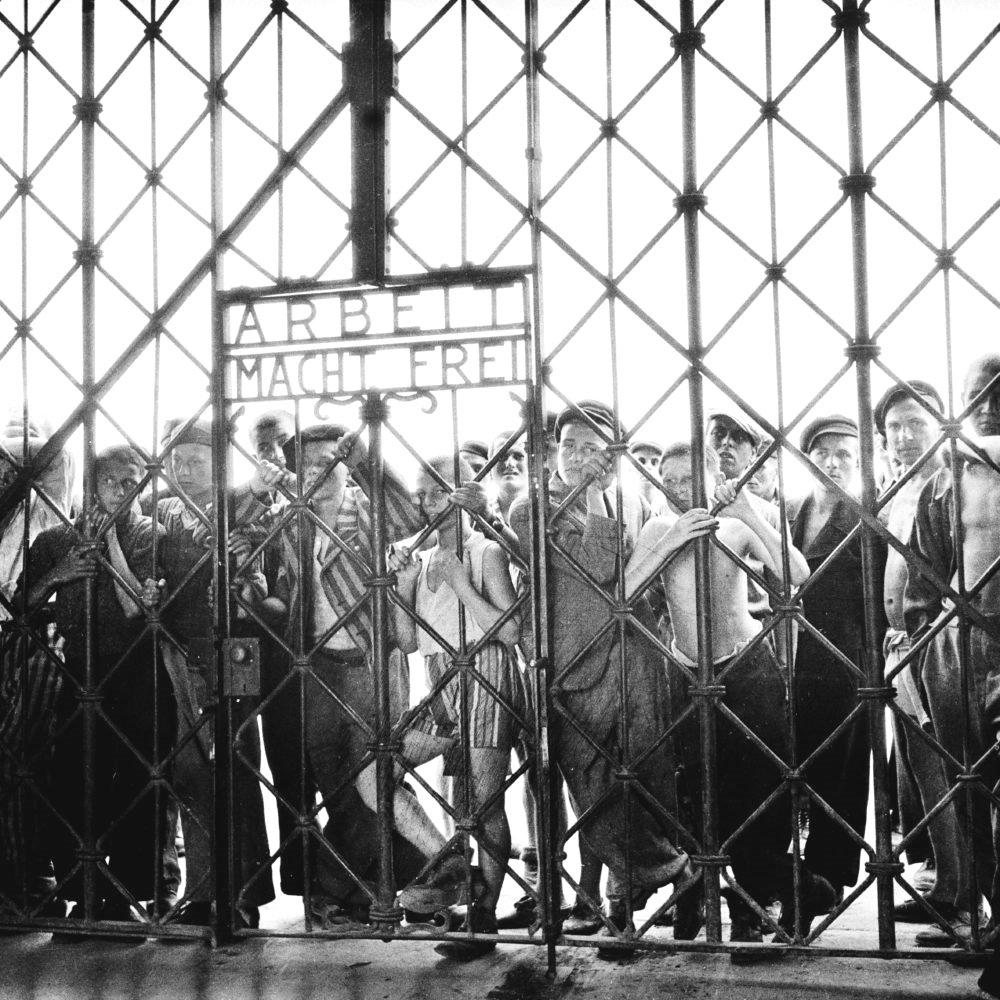
STATEMENT OF E. H.
I was detained for 9 months under special arrest in Bunker 11 in the men’s camp. During this time I occupied various cells. When I went to the door and spoke through the spy hole I could very easily talk to my cell neighbor, through this spy hole I could also see a part of the corridor. In this way, I got exact knowledge of what went on habitually in the ‘Bunker’. For a long time, I had as a neighbor Kurt Muller. It was this man’s job to do all the current secretarial work and to keep a list of prisoners up to date. One issue of this list went to the political section, the other remained in the prison. Regularly twice a week, usually Tuesday and Friday, a commission appeared. Sometimes there were delays so they sometimes came on Wednesday or Saturday. From October 16, 1942, to June 26, 1943, I believe I was under special arrest ‘Komm. Arrest’. In all this time it happened only once that the commission was 12 days without coming. This commission consisted of SS-Hauptsturmführer Aumeier, SS-Obersturmführer Schwarz, SS Obersturmführer Grabner, and secretaries of the political department. These changed. There was also SS-Obersturmführer Lachmann (I am not sure of this name). He usually wore a mufti and a hunting hat. He also had a lame leg. His place was in the first of the political section. This Lachmann carried the list of Muller in hand. They went from cell to cell and had them opened. I followed the process by ear and also watched through the peephole.
Each time a cell was opened the prisoner had to give his name. Lachmann examined his list and struck the name off. It happened also that the prisoner was asked how long he was in ‘Komm. Arrest’. It was always Aumeier who put this question, as he was chief of this group. I have never heard any other question being put. I have never heard of a prisoner being questioned as to the reason for his arrest. Neither have I ever noticed that apart from Muller’s list, they had any other papers or files with them. After the calling of the name SS-Hauptsturmführer Aumeier shouted: ‘Stay in or come out’. As the man came out, Aumeier decided ‘right’ or ‘left’. This indication was meant for two sentries of the pilot. sect. who kept watch. These saw to it that the prisoners placed themselves correctly. Occasionally, Aumeier also said to a prisoner coming out: ‘I am sending in pension’. Occasionally he also would start abusing them. His favorite term was ‘Bottle fly’. I the expression ‘Notified for punishment 1 or 2’ I have never heard. Also, I have never noticed any discussion about the prisoners among the members of the commission. Though I noticed that when they had finished with one wing of the building, the names of those who were to stand to the right or the left were read through once more. Then usually new changes would take place from right to left and opposite.
With these changes, there was some talk in the commission, but I could not hear what was being said; I soon noticed that the prisoners who were placed on the left were all sent for execution. I got to know it in this way, as those I knew who were placed on the right used to send me regards from the camp, while I heard from the above-mentioned Muller that those who were placed on the left were shot. Once I saw the execution myself, from a cell on the courtyard side, where I was by accident. The men came naked in the yard and had to place themselves on four rows, one just behind the other, in front of the black wall and the face turned to it. The women kept their panties. Then the posts fired. It did not make much noise. The men fell into a heap. The next batch had to place themselves in front of them and it went on like that till the day’s work was over. Dr. Kitt attended these executions as a physician. He was a tall spare man, and I am much mistaken if it was not Dr. Kitt. In one case he found that a man was still living. The sentry came back and gave him another shot in the neck. On the whole, there were up to 40 prisoners at each execution. Sometimes there were only 6 or 8. The whole process of clearing out the Bunker went on fast; it lasted about 1/2 hour.
While prisoners were leaving one cell, the next was already opened. It is hard to say what reasons were there for the executions, though it struck me that prisoners who had escaped were always executed. Those men could be recognized by the fact that they were brought in without shoes or socks. I should say, under reserve, that the people executed in this clearing out were thoroughly healthy, powerful men of all ages up to 40. I have seldom seen sick or weak people. The sick, even late in the evening, was taken to hospital and nursed till restored to health. I can remember cases where such men, thoroughly cured were then sent to be executed. For instance prisoner Gralla. He was a German from Kattowitz, a construction or mechanical engineer. I am myself a witness that SS-Obersturmführer Aumeier told him ‘Ha, Mr. Gralla, I am sending to pension’. Muller has also confirmed his death to me. This Gralla is not to be mistaken for his cousin, Dr. Gralla, who is still alive. Concerning the suppression of witnesses, I remember the following case. On Whitsunday 1942, several ‘capos’ were arrested on a charge of jewel smuggling. Among them was a prisoner whose Christian name was ‘Gustav’. He worked, I believe, in a car or ammunition factory. I seem to remember that he was from Hamburg. Age about 40, stature small, sagging. He had made statements against members of the SS and tried to get other prisoners to do the same.
These were very angry and would not do it. Two of them hanged themselves. The others were released and are at present soldiers. The talkative Gustav was shot. With these men was also a ‘capo’ with Jugo as his Christian name, from the gypsy camp. He still talked to me shortly before ‘Gustav’ was shot. The commission had then its usual membership. Under reserve, If I remember rightly the commanding officer, SS-Obersturmbannführer Hoss was at various times present at the process of clearing out the bunker. I can even remember one definite case. Sometime in March 1942, I heard then his voice in front of my cell door and saw him through the peephole. While by all other clearing outs, they also opened my cell, this time my door remained closed. I knocked on the door, to be able to speak to him. The door was not opened though. I only heard him ask: ‘How is H?’ Later on Gehring told me that the CO showed great interest in me, but he would not open the door and he laughed derisively; the witness of this case is the Pole, Maria M. who in those days shared my cell. I remember quite definitely that this took place at one of the usual clearing outs and that I had followed the forming up of the men to the right and left through my peephole. SS-Obersturmführer Schwarz was said to replace usually the CO of the commission, the procedure itself was supposed to be ordered from Berlin.
These ‘Bunker clearings’ had nothing to do with other executions. So-called ’emigrants’ were also executed. These were men, women, and even children of all ages. They came without exception late at night in the camp and were locked twelve and more in one-man cells. Once 15 women were locked in with me. They bore the traces of a long journey on them; they were dusty and dirty; they had luggage and crockery with them. These entrances were not put down by Muller,
the secretary, on his bunker’s list. They also received special treatment, receiving dinner a double ration, and warm food: this never occurred in the camp. These transports, called in camp slang ‘get through or heavenwards’ transports were usually shot in the very early morning at 0430 or 0500 before we arose.
The number of these transports varied between 120 and 150 people or more. Sometimes there also were smaller transports. I consider excluded from these transports men were ever chosen to perform at first some work in the camp (postponement of execution). I have never noticed that either in the evening or the morning an interpreter was present to question those people who did not understand any German. Also in some cases, they had to go through a quarantine cell on an upper floor, before they went into camp, or to go to Block 2. But this was never the case in my time. Moreover, their whole luggage remained in the cell and was fetched after the execution. It never occurred that there was a choice made among this luggage. Apart from these executions, there were also so-called punishment executions. Should anything grave occur – an evasion was considered a grave enough case – then out of every team of workers a few would be taken out, without any sort of choice. These men would be locked in, still in their working clothes, would not be put down on the entrance list, and then on the morrow shot at 0430 or 0500. I can still remember that once a prisoner who worked as a chimney sweeper was locked in and shot then in his typical working clothes. SS-Obersturmbannführer Grabner or Lachmann was always present at those executions.
Once I was myself taken to execution. Though I can’t say with certainty if in this case, it was a ‘clearing out’. It was a Thursday at 0800 or 0830. I was sick and still asleep. In the cell with me were Maria M. and Regenscheidt. As I slept I hadn’t heard whether other cells had been opened or not, SS-Oberscharführer Gehrige appeared and said: ‘H, get ready, you are going to be shot’. My two companions helped me dress. Outside in the corridor were 8 to 10 men, some of them in chains. Apart from Gehrige was a man called Porzel or some such name, nicknamed the ‘Devil’, a few members of the political section, and a strikingly great number of sentries with rifles. We walked out of the prison building, and down the camp alley, I at the head as the only woman. Suddenly Grabner and Aumeier who had not been there, met us. They were shocked at seeing me and made everyone go back. I suppose we were on our way to the execution place No. 2 which lay near the former administrative buildings. SS-Obersturmbannführer Grabner called me an hour later and told me the whole thing was a joke of SS-Oberscharführer Gehrige.
Death certificates were made out for the men shot in the clearing out. As I was in charge of their effects and had to send their belongings to the survivors, those documents came through my hands. For instance, on a given day: at 0802, Miss X died of typhus; at 0807, Mrs. Y died of appendicitis. I remember exactly the case of three German girls, known to me, who were placed under arrest by the authority of the political section, and never came out, certainly did not go to the hospital, as we could make sure of. A certificate of natural death was made out for them. (I cannot remember at present the names of those concerned). No mention was ever made of the reasons for their arrest. For the so-called emigrants, such documents could not be established, because the prison only placed the people from transport in the cells but did not have their names. At any rate, so Muller assured me. Apart from shooting in ‘Kommandantur Arrest’ there were also hunger, thirst, and injections. While I occupied a cell close to the ‘standing cell’, or was myself in the standing cell, the following German citizens died of hunger: Herbert Roman, Heinrich Roman (they were not related), Bruno Graf, and an ‘Obercapo’ from the ammunition factory.
Herbert Roman was from Hamburg. The following charge was laid against him: he had gone with a car into the women’s camp to take a load of corpses and had taken this opportunity to meet a girl from Hamburg, Margot Schmidt. Heinrich Roman was supposed to know something of an attempted murder against an SS sentry. The capo from the ammunition factory was supposed to have helped four Poles to escape. Bruno Graf was supposed to have robbed one chicken. These prisoners received food at first, then every fourth day, and at the end neither food nor drinks or the possibility of going to the toilet. It was a real torture to hear them complaining of thirst all through the night. The Capo died first after some 14 days. Then Bruno Graf died after he had been hung by the arms for 5 hours in the sun. Then followed Heinrich Roman and at last Herbert Roman who held out for 40 days. I supposed that the men who spent the night in the standing cell, and who worked all day long, could at least get him some water. SS-Sturmbannführer Aumeier and SS-Obersturmführer Grabner stood often in front of the standing cell. I often begged them, at least to liberate those Germans from their sufferings, but SS-Sturmbannführer Aumeier answered: ‘The hounds must die’. SS-Obersturmführer Grabner on the contrary remained quiet. After their death, I suffered great anxiety, because I had always in my ears their voices, complaining and the end reduced to a whisper. Also the state of frightful thinness, with long hair and beard, their corpses were terrible to look at. I saw this when they dragged a corpse on the ground past my cell door.