




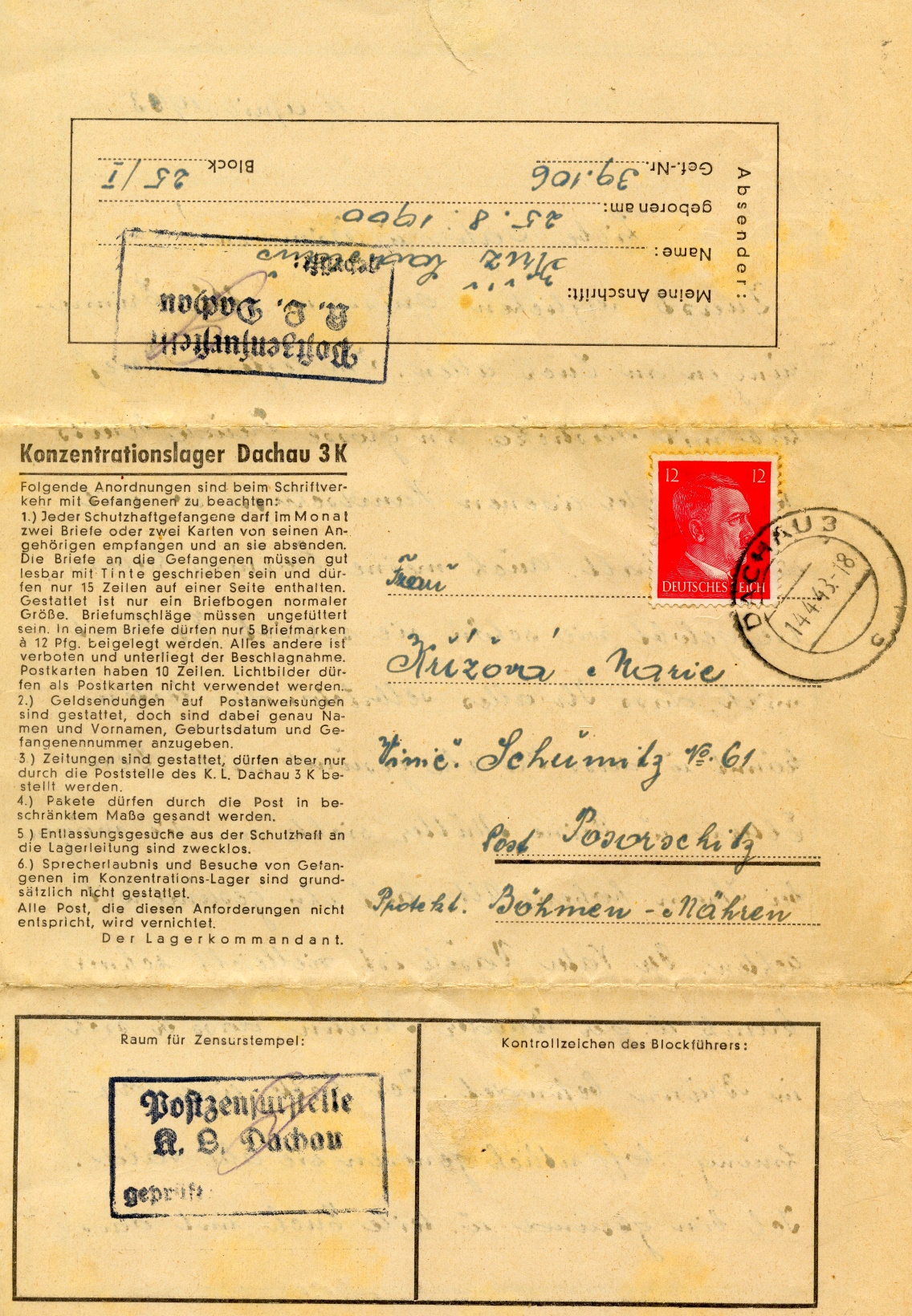
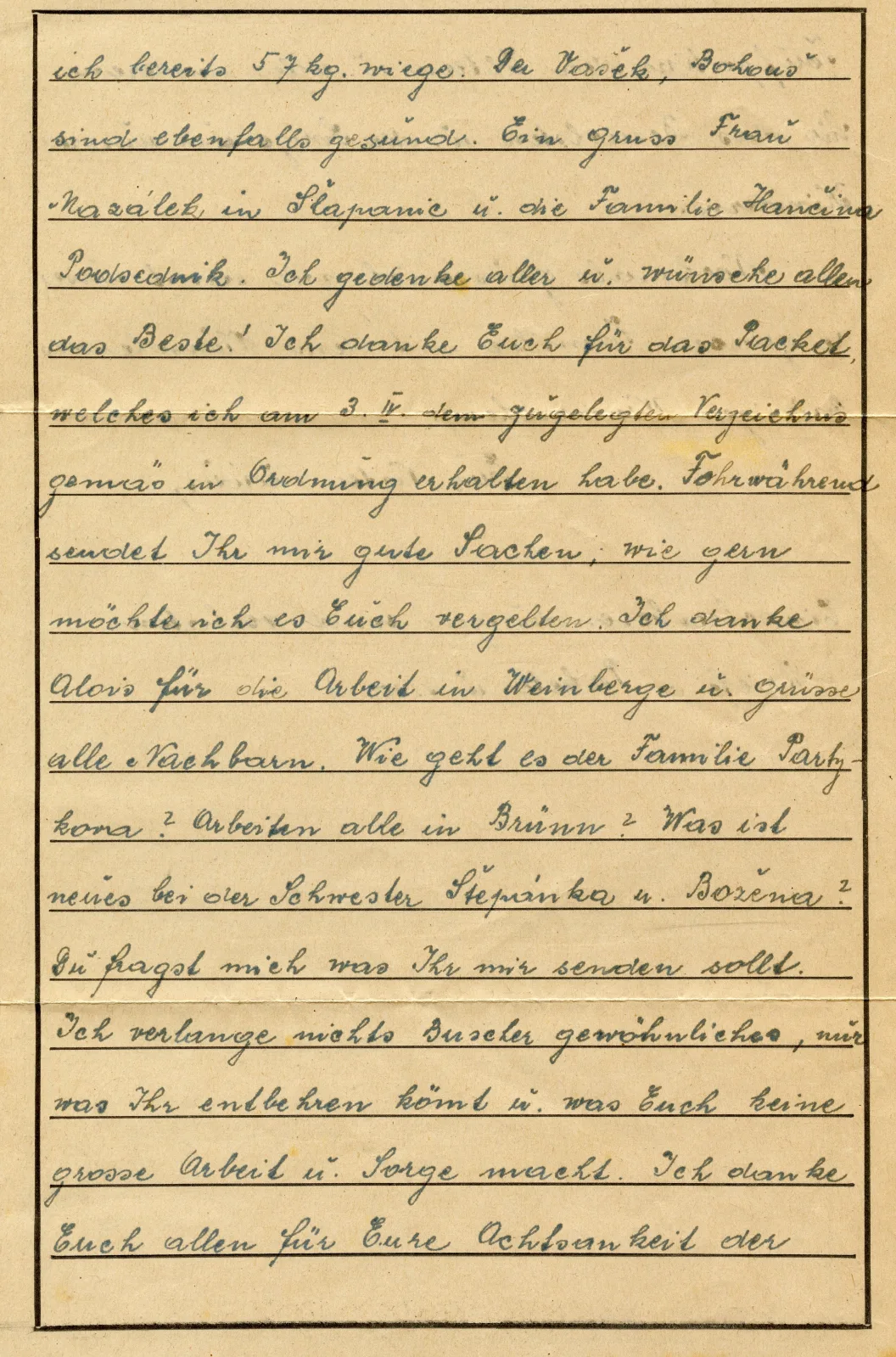
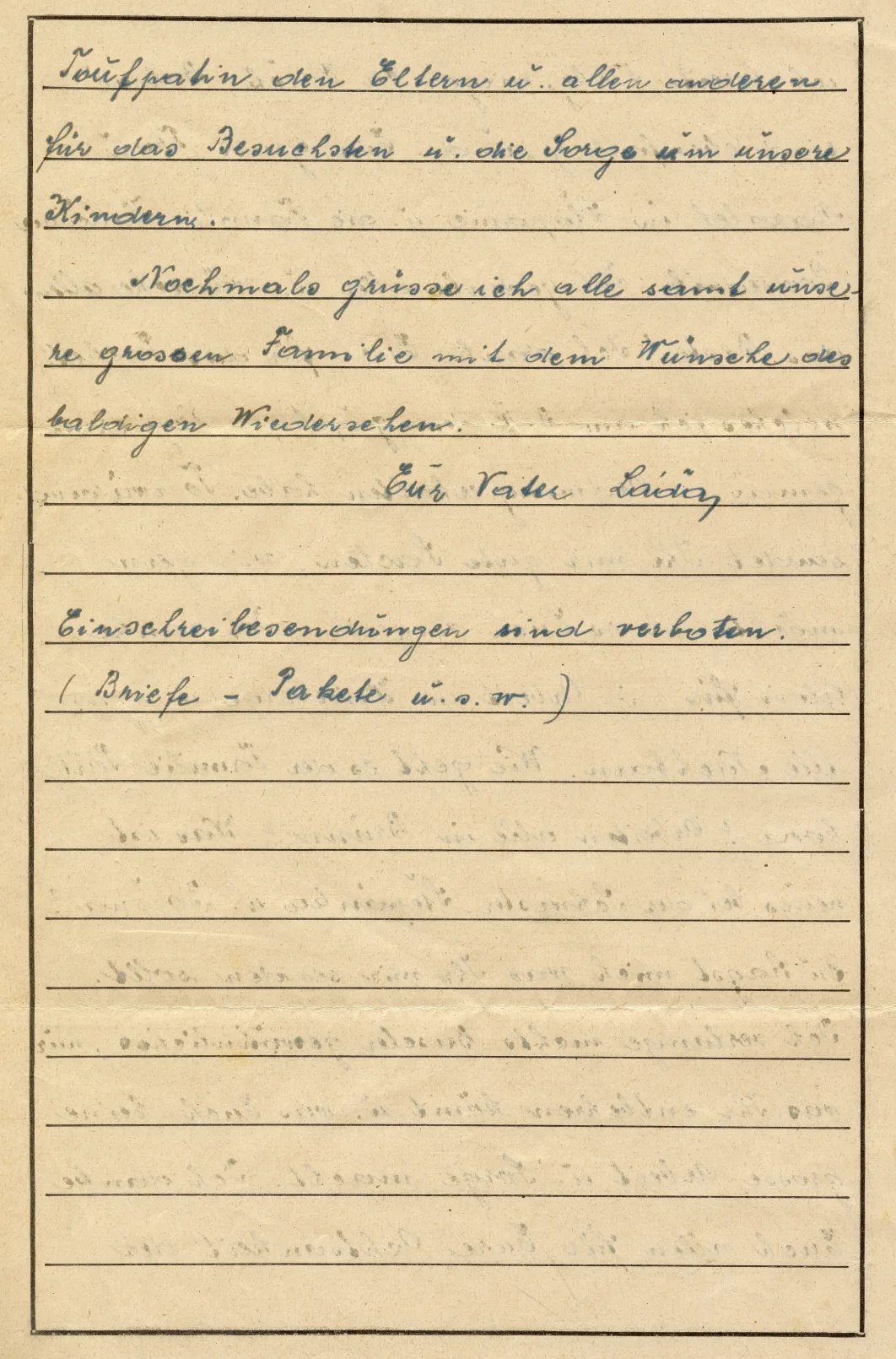
 (Information Provided by Michael D. Bulmash): Letter from Dachau Concentration Camp stationery signed, ‘Your father Vlacek’. This letter has markings showing censorship by the central mail office in Dachau and has a city postmark of April 14, 1943. As was typical, the inmate stationery bears printed warnings. It is stamped with a red German 12 pfennig stamp bearing the likeness of Nazi Führer Adolf Hitler — the kind of stamp the rules allowed relatives to send prisoners. There are normal mailing folds, two small holes in the vertical fold well away from the text, a few stains, and small edge splits at the horizontal folds. Printed letter forms were available to many concentration camp prisoners. Unlike inmates in internment camps and prisoners in war camps, concentration camp prisoners had to use a postage stamp to send out mail. Regulations printed on the face of this letter say: Concentration Camp Dachau 3K. The following regulations are to be observed in the correspondence with prisoners. (1) Every prisoner may receive two letters or two cards a month from his relatives and send them to them. The letters to the prisoners must be written very readably and be written in ink and may contain only fifteen lines on a page. Permitted is only one sheet of normal size. Envelopes must not be [security] lined. A letter may contain only five stamps at 12 pf. Everything else is forbidden and will be seized. Postcards have ten lines. Pictures may not be used as postcards. (2) Money remittances on postal orders are permitted but they must contain exactly the name and first name, the birth date, and the prisoner number. (3) Newspapers are permitted but may be delivered only through the postal office of the Concentration Camp Dachau 3K. (4) Packages may be sent through the mail to a limited degree. (5) Requests for release from prison that are directed to the camp administration are useless. (6) Permission to talk with the prisoners in the concentration camp is fundamentally not permitted. All mail that does not conform with these regulations will be destroyed.
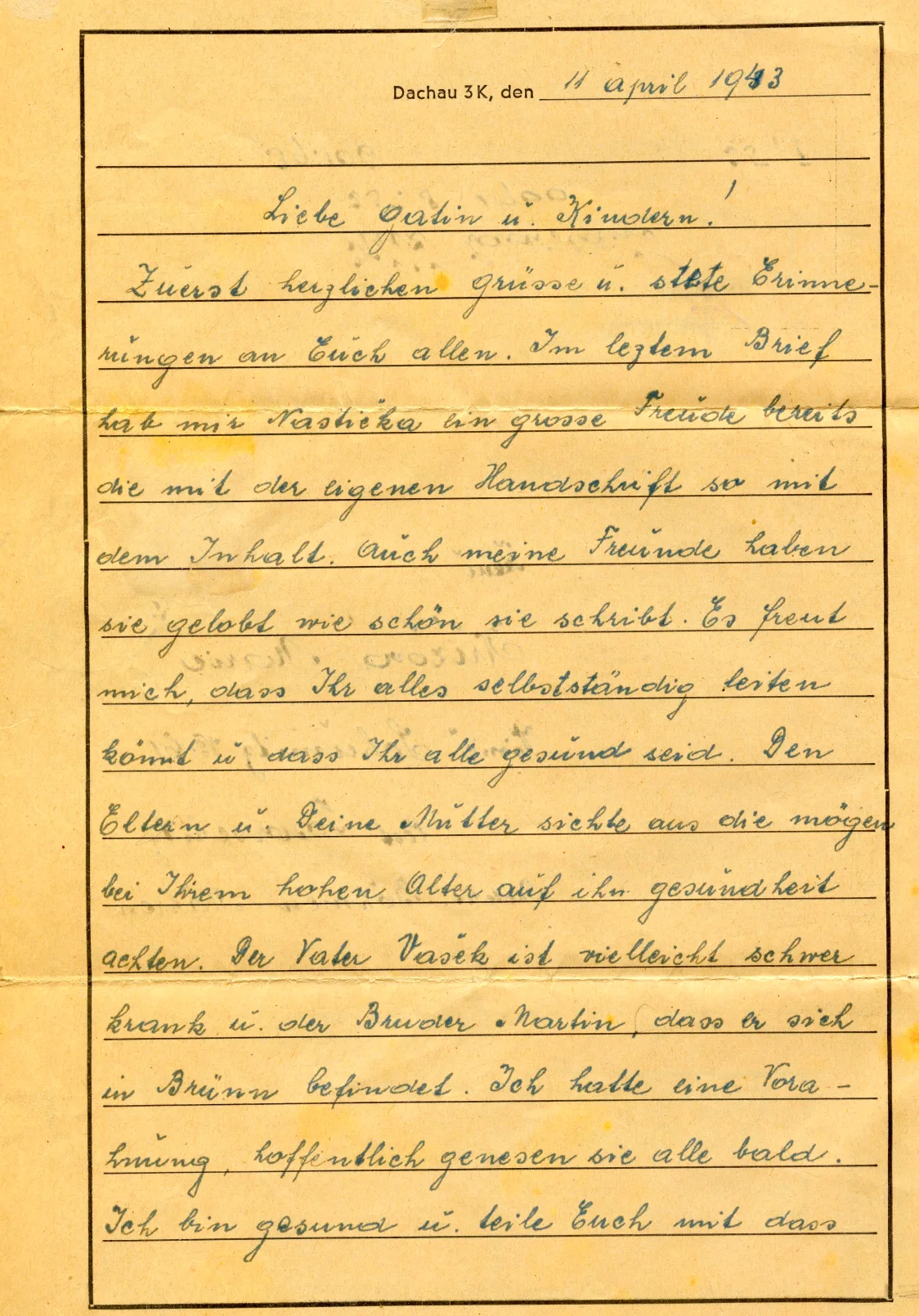
The sender of this letter was not Jewish and wrote to his family in the Protectorate of Bohemia and Moravia. Translation: ‘Dachau, April 11, 1943. Dear wife and children! First of all my heart has greetings and my constant remembering of you. And the rest of us… gave me particular pleasure because of her handwriting and well as with the contents. After my friend praised how pretty she writes. I’m glad that you can take care of everything on your own and that you are all in good health. Tell your parents and your mother that because of their advanced age, they should take good care of their health. The father Vasig is perhaps very ill and the brother Martin because he is… I had a premonition. I hope that they all will get well soon. I am well and I can tell you that I already weigh 57 kilos. Tell Vasig is also in good health. My regards to Mrs. Nasalek in Slapanic and the family of Hancina Porseonik. I think all of them and I wish everybody the best. I thank you for the package which I received on April 3, which I, according to the enclosed list, have received in good order. All the time you send me good things. How much I would like to repay you. I thank Alois for his work in the vineyard and say hello to all the neighbors. How is the family Partykona? Do they all work in Brünn? Is there any news of the sister Stepanka in Bosena? You ask me what you should send me. I don’t require anything… ordinary, only what you can spare and what doesn’t cause you much work or concern. I thank all of you for your attention. The godmother, the parents, and everybody else for their visit and their concern for our children. I again send you all my greetings, and all including the larger family, with the wish of a fond reunion.
Your father Vlacek.

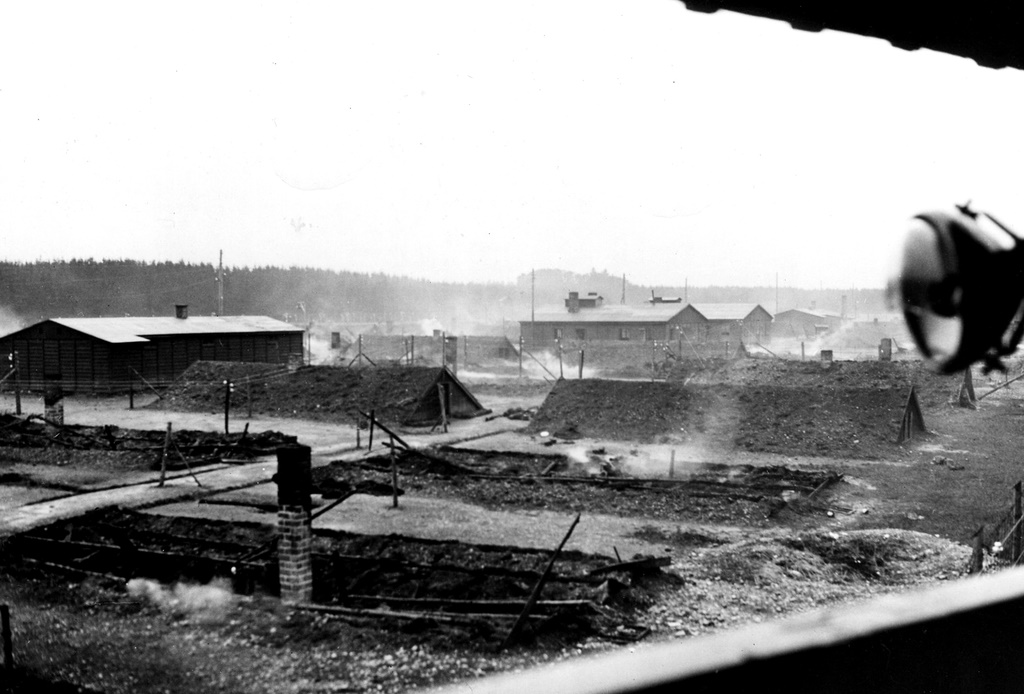
Although the population as a whole realized the utter bestiality of the SS and the nauseating occurrences beyond the barred gates of the Camp, they were afraid even to say anything – much less do something – because the shadow of the Camp hung over them as well. Several persons claimed that such cases had happened and that people were even afraid to watch prisoner transports being brought in for fear that they might be interned for the mere knowledge of the crimes. The whole system was based on the barbaric theory that ‘Dead men tell no tales’. These people admit that the town as a whole did a thriving business as a result of the presence of the Camp and its attendant SS Bonzen (Big Shots) – and it is perhaps not without significance that the most outspoken anti-Nazis were people who, so to speak, could afford to be so because their business did not bring them into daily contact with the SS. Es war alles sehr entsetzlich, aber was konnten wir tun? (It was all very horrible, but what could we do? (Martin Wittmann). Ein Schandfleck fur die ganze zivilisierte Menschheit. (A scandal for all of civilized humanity). With these words of the outraged Herr Josef Engelhard the attitude of those few people in Dachau who dared to protest – more or less openly – for all these years is comprehended. When asked how far he considered his fellow townsmen responsible for what went on in the Camp, he replied: Neunzig Prozent sind schmutzig und haben sich mit dem Blut unschuldiger Menschen besudelt (Ninety percent are dirty and have daubed themselves with the blood of innocent human beings).
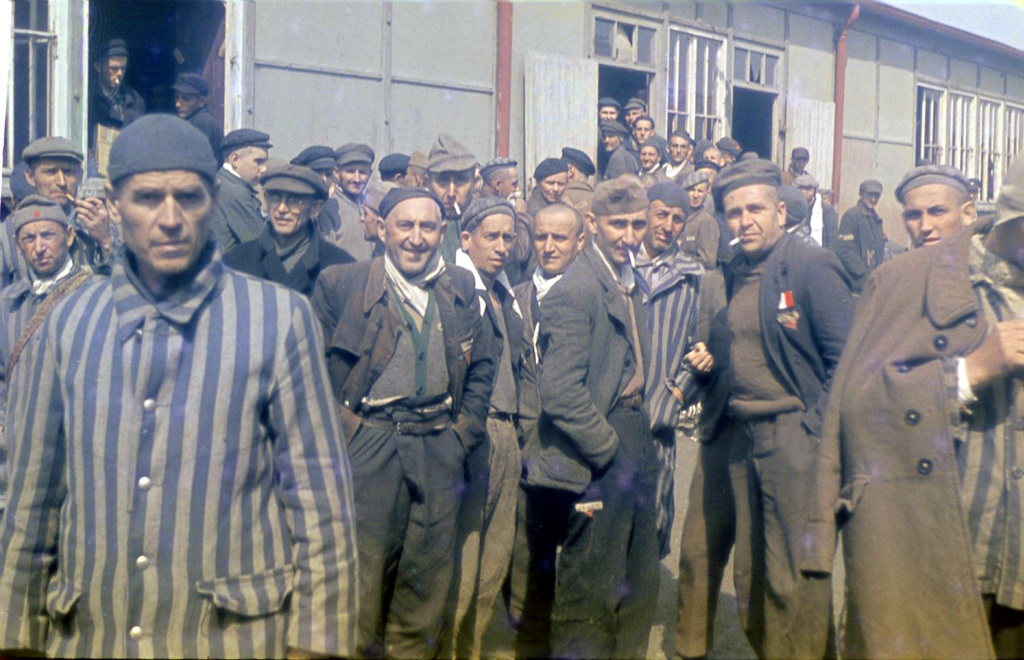
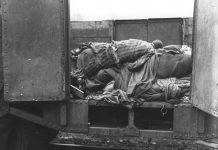
Engelhard lives on the street (called the Nibelungen Strasse, incidentally) along which the oars rolled to the Camp. His house is situated only a few hundred yards from the entrance to that Charnel house. He corroborated the stories of the inmates about the fearful cargoes that had been brought in through the years. They began to be horrible after 1938. The huge transports of Jews at that time were ‘too horrible to describe’. Shortly after the invasion ‘thousands upon thousands of Frenchmen’ were brought in. One such transport of French stopped directly in front of his house. When the doors of the boxcars were opened, most of the dead were beginning to decay. After the collapse of the Warsaw uprising, transports of Poles began to arrive in great numbers and indescribable states. The few who were alive in one such load scrambled out of the cars and – it was evident from his expression that Herr Engelhard still had difficulty in believing what his own eyes had seen – ‘Die haben Gras gefressen und aus Pfatzen getrunken’. (They ate grass and drank out of puddles). The old Social Democrat and president of his trade union who had never once raised his hand in a Nazi salute (this was confirmed by other people) said he was very much against executing Nazis. Das ist zu gut far dies Bande (That is too good for this gang). He suggests sending them to Siberia in transports ‘exactly like those that have been arriving daily in Dachau for years’. He added that he did not doubt that ‘Herr Stalin has much room for them and much for them to do’. He concluded by saying Endlich muss die ganze Nazi-Brut ausgerotten werden (Finally the entire Nazi Spawn must be exterminated).
In the opinion of this minority, the people are to blame for their cowardice. Old, gracious, and intelligent Eduard Grasal feels very strongly on this point. He has a right to talk. He was one of three men in the entire town who stood up in an open meeting and said he would not join the Storm Troops Because, my dear Major, I won’t – and with this, he walked out of the meeting. Weeks later dozens of people came to him and said ‘But if we had only known that they wouldn’t do anything to us, we would have stood up tool’. He cites this as an example: Feig und Feiglinge Die waren alle zu feig – Die wollten überhaupt nichts riskieren. Und es war so in ganz Deutschland. Die mutige sind an der Händen abzuzahlen. (Cowardly and cowards, They were all too cowardly – They didn’t want to risk anything. And that’s the way it was in all of Germany. The courage can be counted on the fingers of your hands).

CONCLUSION
No citizen of Dachau is without a deep sense that something was wrong, terribly wrong, on the outskirts of their town. The majority of them take the position described above. That they are honest in this attitude for the most part allows for no doubt whatever. Those who didn’t give a tinker’s damn what happened to the poor souls whom they saw pass through their streets for years – so long as business was good and the SS Hauptsturmführer paid his handsome rent – were really few. Today they are the ones who plead Ja – wir wussten überhaupt nichts was passiert da draußen (But we didn’t know what was going on out there). Da draußen – as if it were on another planet. They are liars, and guilty as sin – everyone. The very few who dared show some opposition ran a great risk and should be honored as the courageous men and women they are. It should be pointed out, however, in justice to the others, that they were (so far as this investigation could determine) people who could seclude themselves from the community without harming their source of income. Herr Engelhard, for example, worked for a firm that sent him traveling over all Southern Europe. Herr Grasal had a small importing business from Italy. They could both afford to isolate themselves (as they did) in their houses for years. Herr Grasal – who is the type who likes his Gemütlichkeit – said that he had never gone into a tavern for years for fear he ‘might talk too freely’. He gave up all the entertaining at his home seven years ago. By contrast, Herr Scherrer, who was not so extreme in his remarks, emerges as a man who has suffered far more and who had every bit as much courage. He made his living by running a restaurant. For a known anti-Nazi in a town that was a Nazi Hochburg and a cradle of the SS, this is no small achievement. Meine Nerven sind vollkommen zur Grunde gegangen he says. Small wonder. (My nerves are thoroughly shot).
If one is to attempt the tremendous task and accept the terrific responsibility of judging a whole town, assessing it en masse as to the collective guilt or innocence of all its inhabitants for this most hideous of crimes, one would do well to remember the fearsome shadow that hangs over everyone in a state in which crime has been incorporated and called the government.

Note from Doc Snafu: I think that everything must be done to ensure that this kind of crime never happens again, even if since 1945 it has happened several times. You have noticed that I have to switch to professional photographic equipment. Not that it’s a pleasure to have beautiful material, but simply to maximize the capture of detail in the photos of the future Then and Now section, but also the Militaria section. You can also all participate according to your means of fundraising for the acquisition of said material. For the years that I have been collecting militaria, I have a very nice collection specializing in pieces a little less common than what is usually presented on the Militaria sites. I’m considering – because everyone knows the ugly color of prisoner’s outfits in the camps and I would like someone to send me a complete outfit (if possible) because it’s on this prisoner’s outfit that I’m planning to do all my militaria pictures. This being a kind of label for my photos will perpetuate among young people, especially the meaning of the word Holocaust. You can therefore participate in fundraising for photo equipment, offer me a coffee, or send me an outfit (jacket and/or pants; beret, outfit for women or children. Thank you in advance.
Mail to: Gunter Gillot, Chemin du Puits 2, 4845 Sart-lez-Spa (Solwaster) Belgium
Some examples of Genocides on this planet
Bangladesh Genocide (1971) – estimated between 300,000 and 3 million deaths
Burundian Genocide of Tutsis (1972) – estimated between 100,000 and 300,000 deaths
Cambodian Genocide (1975-1979) – estimated between 1.7 million and 2.2 million deaths
Rwandan Genocide (1994) – estimated between 500,000 and 1 million deaths
Bosnian Genocide (1992-1995) – estimated between 25,000 and 30,000 deaths
Rohingya genocide in Myanmar (since 2017) – estimated between 10,000 and 50,000 deaths
There are other examples of violence and massacres that could be considered genocides, but are not always designated as such due to academic and political debates on the definition of the term ‘genocide’.

DACHAU, CONCENTRATION CAMP
CIC Detachment, Seventh Army
MEMORANDUM
On April 29, 1945, the liberation of the Dachau Concentration Camp, in Dachau Germany, presented to the Allied Armies a gruesome spectacle of wholesale bestiality and barbarism. A section of the Counter Intelligence Corps Detachment, Seventh Army, was dispatched to the camp for counterintelligence work and was requested to submit a report of general interest on the camp as documentary evidence for higher headquarters. The notorious Dachau Concentration Camp, the first to be organized by the Nazi Regime, is located 18 kilometers northwest of Munich, Germany. Up to 1933, it was used solely for the confinement of political prisoners, and in addition, men who were released from other German prisons were often confined here for ‘Protective Custody’, after completing their sentences. In 1936, when the Nazis were organizing for world conquest, people who did not cooperate with the program were interned there. Well, over 229.000 internees have passed through Dachau since 1933. Before the war, the number of internees varied from 6000 to 8000. There were Jews in
When the American troops arrived on April 29, 1945, there were approximately 32.500 estimated internees of all nationalities, the Poles predominating. During this period, the camp was notorious for its cruelty, but within the last six or eight months, some ‘token’ improvement was noted in the treatment of the internees. However, the new crematorium was completed in May 1944, and the gas chambers, a total of five, were used for the executions and the disposal of the bodies. Three weeks before the arrival of American troops, the more important records, papers, card index systems, etc., were burned or otherwise removed. In addition of the Dachau Camp, there were 21 subsidiary camps, all under the jurisdiction of the Dachau Administration.
