






ORGANIZATION
The organization of the camp was based on a system of indirect rule. There were two separate spheres of control: (a) the external control apparatus of the SS Guards, and (b) the internal control organization in the hands of the prisoners themselves. The organization of the SS Guards is comparatively unimportant. It followed the regular pattern of this para-military outfit. The key positions seem to have been the ‘camp commandant’, in charge of the entire SS establishment Dachau, next, the SS leader, in charge of the labor gangs and transports (Arbeitseinsatzfuehrer); and finally the position of the intelligence officer (Vernehmungsfuehrer) of the Political Division, in charge of security, discipline, and punishment. These men, however, and their subordinates exercised hardly any direct control whatsoever. Instead, they used as instruments for their rule the internal organization of the camp in the hands of the prisoners themselves. This internal organization of the prisoners followed the regular pattern of a Nazi hierarchical regime. It was headed by a camp senior (Lageraeltester); under the camp senior there were (a) the secretary (Lagerschreiber) and his staff, in charge of the records, (b) the chief of police (Polizeifuehrer) and the camp police (Lagerpolizei), and the Chief of the Labor Allocation Office (Arbeitseinsatz) and his staff, in charge of all aspects of work performed inside and outside the camp.
The Labor Office sent out the ‘work details’ (Arbeits Kommandos), of which there were about 160, each headed by a foreman called the ‘Capo‘. Together with the camp senior these agencies and their chiefs formed the central authority of the camp. The camp was further divided into ‘blocks’ (Blocks) and ‘cells’ (Stuben). And each block and each cell, in turn, had its ‘senior’ and ‘secretary’, called (Blockaeltester), (Stubenaeltester), and (Blockschreiber), (Stubenschreiber) respectively. This system of internal controls served the interests of the SS most effectively. To deal with the enormous number of prisoners, they only had to deal with the men of the central authority to whom the subsidiary camp authorities were responsible. The SS issued general orders; the particulars of carrying these orders out were left to the internal organization of the prisoners. It was the familiar Nazi technique of indirect rule. To guard against sabotage under this setup, the SS at Dachau, as everywhere else, employed its systems of prisoner spies and informants inside the camp and applied the most ruthless forms of terror whenever necessary. As agents the SS made particular use of the minority of criminal prisoners (about 700) – sometimes disguised by red patches as political prisoners.

Under these conditions, it is evident that being part of the camp administration afforded the best possible means of survival. In an official position, the individual enjoyed not only a certain sense of personal power and security, but could also negotiate deals that brought him and his friends certain small privileges in work, food, clothing, and living conditions. Hence, the struggle for survival in the camp to the extent that it was manifested in over actions frequently took the form of fighting for power through the camp administration. In this process, of course, certain groups emerged among the political prisoners who seized positions of control and exploited them for their benefit and for that of members of their group. Moreover, in an atmosphere, filled with terror, fear, threats, starvation, and death, many of the old legitimate political prisoners themselves became corrupted and degenerated to the level of criminals, i.e., used the brutal, criminal methods of the SS and the ‘greens’. There are numerous reports about thefts, beatings, and killings by political Capos in different positions. When this stage was reached where prisoners persecuted fellow prisoners instead of preserving a sense of common solidarity, the success of the SS method of control was, of course, complete.
However, it would be incorrect, as pointed out above, to identify these groups with any social or political label. Even when they abused their power to the excess of criminal activities, they never acted as representatives of a definite social or political group, but merely as people who, having succeeded in seizing a position of limited power, exploited this position for personal advantages and favors. That so many formerly genuine political prisoners succumbed to this pressure and sank to a criminal level of existence was one of the real tragedies in places like Dachau.

GROUPINGS OF PRISONERS
Labor Allocation Office: Of all the administrative agencies within the internal organization of the camp, the Labor Allocation Office (Arbeitseinsatz) was the key office. This office allocated the labor requirements for the different ‘work commandos’ (Arbeits Kommandos) and also determined the composition of the transports which were shipped out from Dachau. Both functions were of the highest importance insofar as the nature of work frequently determined one’s means of subsistence (e.g., agricultural workers were generally better fed and could smuggle food back into the camp) and insofar as transports were greatly feared since their destination was generally unknown. To the extent that the prisoners had any voice or pressure on their use and disposition, this was exercised through the labor office. The office was run entirely by prisoners. The staff consisted of a chief, several assistants, and a group of clerks. The office maintained files that contained all personal data pertinent to the allocation of individuals for work of various kinds. The three main sources of employment at Dachau were (a) work inside the camp, (b) work at the SS camp, and (c) work on farms and in factories in the area. The lists of people to be shipped off on transports were usually compiled from those prisoners who were not part of a regular ‘Working Commando’.
In operation, the SS Labor Leader (Arbeitseinsatzfuehrer) simply informed the chief of the Labor Office to have a certain number of men ready at a certain time for work or shipment on a transport. The selection of the men for the tiny given assignment was largely left to the Labor Office itself, which drew up its lists in consultation with the block and cell seniors. It would be easy, however, to exaggerate the extent to which the Labor Office enjoyed freedom of action in these decisions. In many matters, especially in the cases of transports that were politically important, the SS office would hand down a list of people whom it wished to have included in the assignment. Nevertheless, the positions in the Labor Office and the subsidiary command over the ‘Work Kommandos’ afforded sufficient power to serve as an incentive for individuals and groups to seize these positions and defend them against outsiders. Historically, these groups were Germans simply because Germans were the oldest inhabitants of the camp. As far as we could trace the developments back, some kind of a group or clique seems to have first formed in 1937 under an Austrian Socialist by the name of Brenner. The ‘Brenner Group’ in the Labor Office included both German and Austrian Socialists. After the release of Brenner, it was superseded by a combination of German Socialists and Communists under a certain Kuno Rieke (Socialist) and a certain Julius Schaetzle (Communist). This combination and their staff were in control of the Labor Office until June 1944 when Schaetzle was suspected of conspiratorial activities and shipped off in a transport. Rieke died shortly thereafter in the camp. A temporary regime succeeded the Rieke-Schaetzle group until September 1944 when a new regime gradually took over eliminating all Germans from positions of influence in the Labor Office. This last group, composed primarily of Alsatians, Lorrainers, French, Luxembourgers, Belgians, and Poles, is still in charge of the Labor Office today.

None of these groups can be considered underground; none of them represented a political body. There was no evidence that these people acted as members of a political group with a definite political program or purpose. These men held together in their small groups or clique for the personal advantages their position offered them in the generally miserable conditions of the camp. This is not to say that they did not try to take care of their friends. But the favors they could dispense were on such a personal basis and on such a low level of small physical improvements that they could never form the basis for any organized activity or relationship. It was simply part of the living conditions in the camp and part of the control system set up by the SS which placed certain groups of prisoners in positions of minor power. And these same factors were equally responsible for the degeneration of many of these men to a level of criminal activity against their fellow prisoners. Since Germans, being the oldest inmates, had generally seized control of most of the positions of influence in the administrative apparatus in the camp, the other national groups naturally developed distrust, antagonism, and frequently intense hatred of these German prisoners.
Other Posts of Control: The Germans, however, were not alone in charge of all the leading positions. The key post of the camp senior, for instance, was held by a certain Melazarian, an Armenian and former Red Army officer; and many of the block and cell seniors as well as the Capos of the ‘Work Kommandos’ were chosen from different nationalities. Melazarian had so completely sold out to the SS and was so generally hated by all the inmates of the camp that he was almost beaten to death after occupation and finally executed by American troops. The same fate befell the German chief of the camp police, a certain Wernicke. But even the generally rather strong feelings against Germans are not universal, for in place of Melazarian who was dismissed before our occupation, a certain Oskar Mueller was appointed ‘camp senior’. Although a German and a former Communist, Mueller enjoy the respect and admiration of the representatives of all national groups. At present, he is also a member of the ‘International Prisoners’ Committee’, to be discussed below. But as in the case of the people who abused their position of power, so in the case of Mueller who did not. His former political views, as he stressed, have nothing to do with his present activities in the camp. He has performed his functions for the benefit of all the inmates in the camp to save what can humanly be saved under the disastrous conditions of life in Dachau without any other aim or motivation.

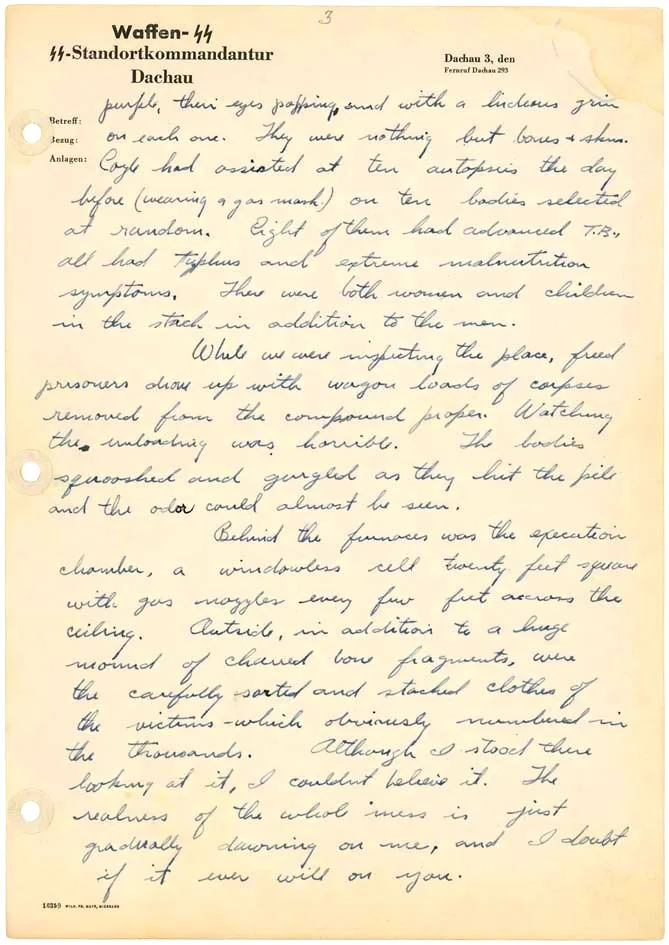
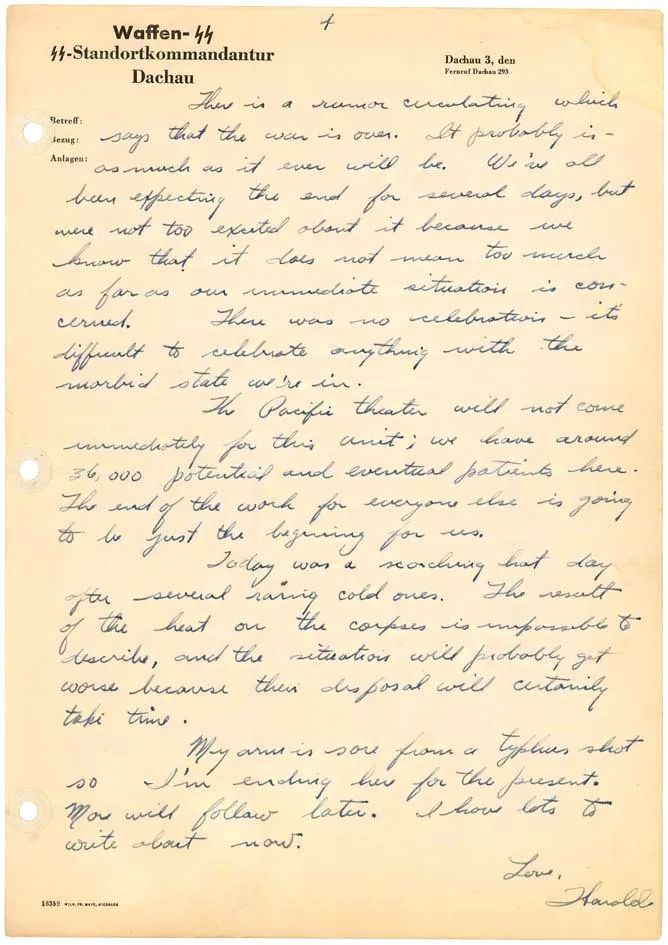
 (A letter from Pfc Harold Porter, 116th Evacuation Hospital, to his mother and father in Michigan).
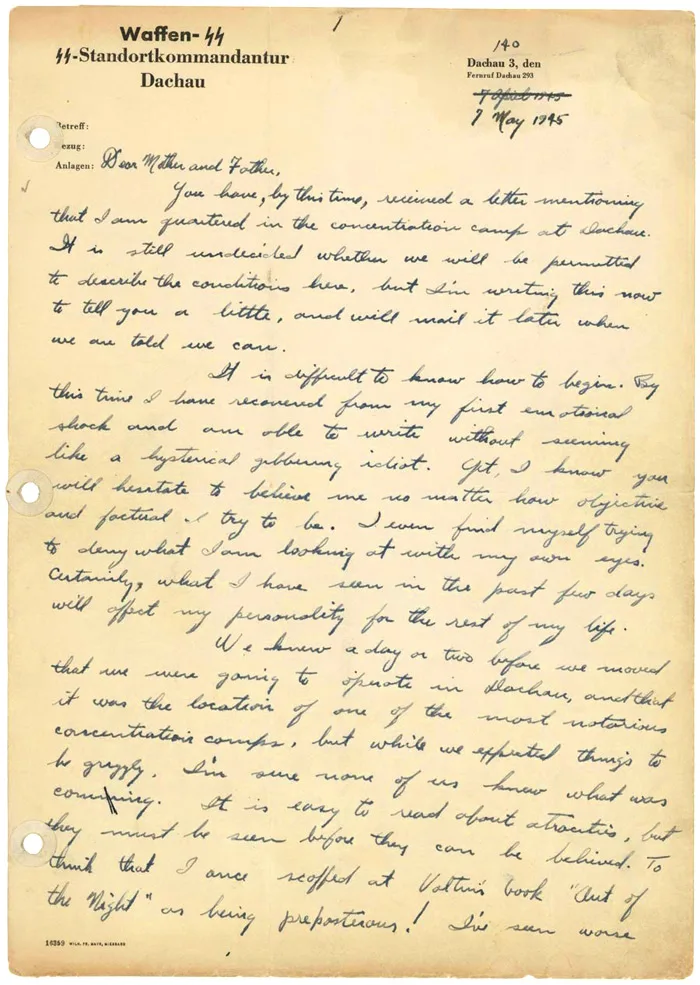
Dear Mother and Father,
You have, by this time, received a letter mentioning that I am quartered in the concentration camp at Dachau. It is still undecided whether we will be permitted to describe the conditions here, but I’m writing this now to tell you a little and will mail it later when we are told we can. It is difficult to know how to begin. By this time I have recovered from my first emotional shock and can write without seeming like a hysterical gibbering idiot. Yet, I know you will hesitate to believe me no matter how objective and factual I try to be. I even find myself trying to deny what I am looking at with my own eyes. Certainly, what I have seen in the past few days will affect my personality for the rest of my life. We knew a day or two before we moved that we were going to operate in Dachau and that it was the location of one of the most notorious concentration camps, but while we expected things to be grizzly, I’m sure none of us knew what was coming. It is easy to read about atrocities, but they must be seen before they can be believed. To think that I once scoffed at Valtin’s ‘Out of the Night’ as being preposterous! I’ve seen worse.
sights than any he described
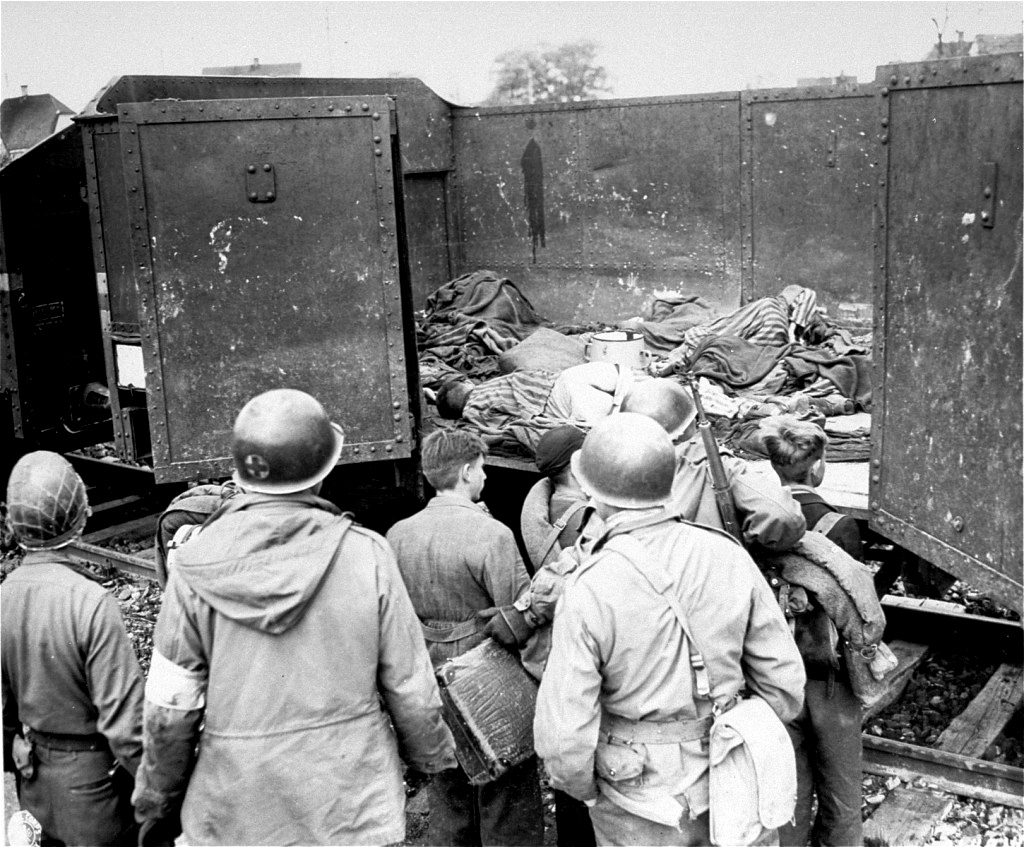
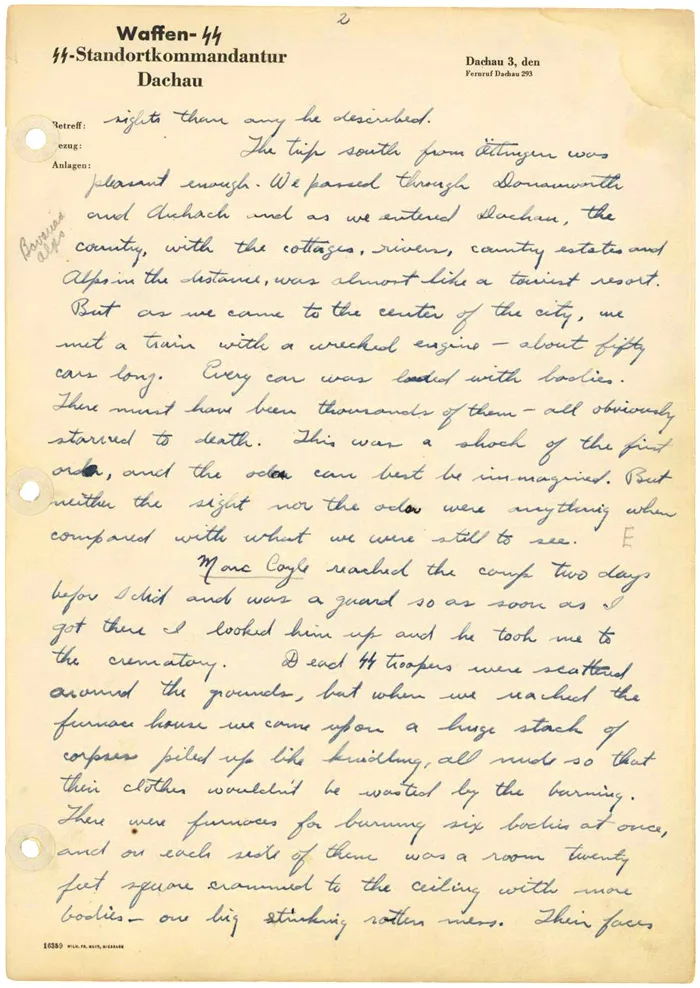
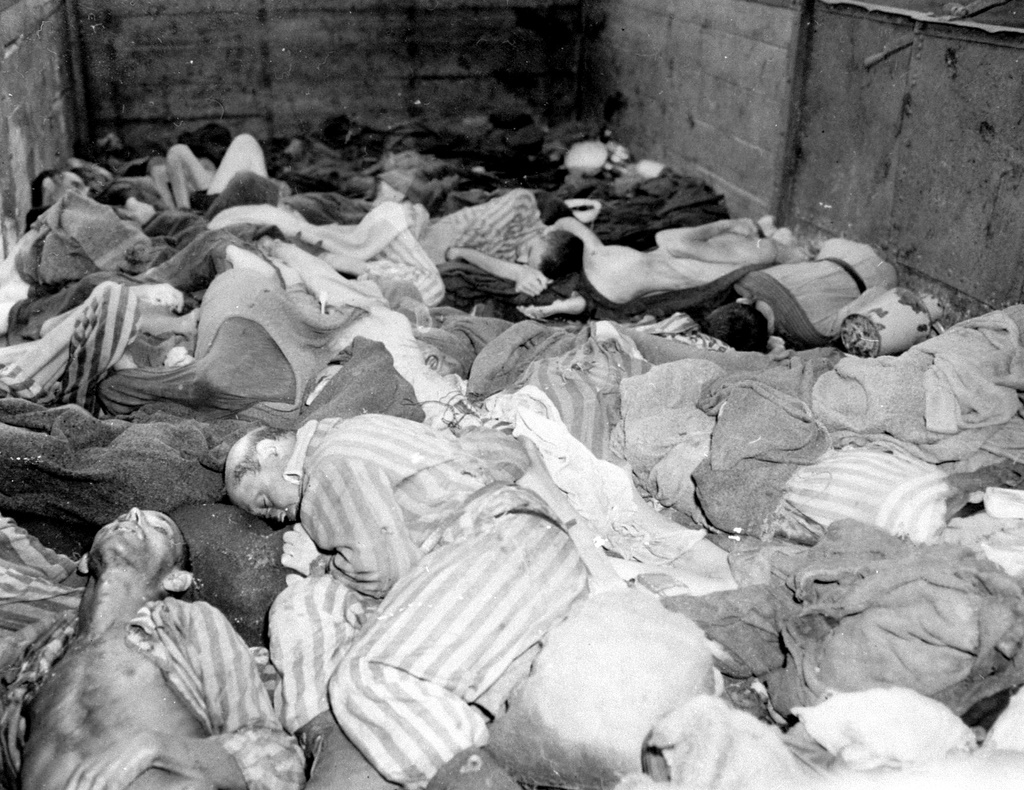
The trip south from Ottengen was pleasant enough. We passed through Donauworth and Aichach and as we entered Dachau, the country, with the cottages, river, country estates, and Alps in the distance, was almost like a tourist resort. But as we came to the center of the city, we met a train with a wrecked engine – about fifty cars long. Every car was loaded with bodies. There must have been thousands of them – all starved to death. This was a shock of the first order, and the odor can best be imagined. But neither the sight nor the odor was anything when compared with what we were still to see. Marc Coyle reached the camp two days before I did and was a guard so as soon as I got there I looked him up and he took me to the crematory. Dead SS troops were scattered around the grounds, but when we reached the furnace house we came upon a huge stack of corpses piled up like kindling, all nude so that their clothes wouldn’t be wasted by the burning. There were furnaces for burning six bodies at once and on each side of them was a room twenty feet square crammed to the ceiling with more bodies – one big stinking rotten mess. Their faces were purple, their eyes popping, and with a ludicrous grin on each one. They were nothing but bones & skin. Coyle had assisted at ten autopsies the day before (wearing a gas mask) on ten bodies selected at random. Eight of them had advanced T.B., all had Typhus and extreme malnutrition symptoms. There were both women and children in the stack in addition to the men. While we were inspecting the place, freed prisoners drove up with wagonloads of corpses removed from the compound proper. Watching the unloading was horrible. The bodies squooshed and gurgled as they hit the pile and the odor could almost be seen. Behind the furnace was the execution chamber, a windowless cell twenty feet square with gas nozzles every few feet across the ceiling. Outside, in addition to the huge mound of charred bone fragments, were the carefully sorted and stacked clothes of the victims – which numbered in the thousands. Although I stood there looking at it, I couldn’t believe it. The realness of the whole mess is just gradually dawning on me, and I doubt if it will ever be on you. There is a rumor circulating with says that the war is over. It probably is as much as it ever will be. We’ve all been expecting the end for several days but were not too excited about it because we know that it does not mean too much as far as our immediate situation is concerned. There was no celebrating – it’s difficult to celebrate anything with the morbid state we’re in.
The Pacific Theater will not come immediately for this unit; we have around 36.000 potential and eventual patients here. The end of the work for everyone else is going to be just the beginning for us. Today was a scorching hot day after several rainy cold ones. The result of the heat on the corpses is impossible to describe, and the situation will probably get worse because their disposal will certainly take time. My arms are sore from the typhus shot so I’m ending here for the present. More will follow later. I have lots to write about now.
Love, Harold

 National Groups: There was no organized activity in the camp in any other form. Even the national groups which formed more or less natural divisions in the camp did not develop any organic-national form. Bonds between prisoners speaking the same language and possessing the same national background naturally existed, but these personal bonds did not result in any organizational expression or overt activities of any sort.
Men of the same nationality stuck together to preserve their sanity and prolong their physical existence. With time, however, certain natural leaders emerged out of these national groups and these unofficially recognized leaders within the various nationalities, in turn, were eventually responsible for the only real organization which has existed in Dachau; the ‘International Prisoners’ Committee’ which is the highest prisoner authority in the camp today. There were no ‘international’ relations based on common political or social grouping.
For example, no kind of unifying element seemed to exist between Russian and German Communists, or between French and Polish Catholics. Nor did people of any one national group seem to show any marked preference for members of their own social class or political affiliation as distinguished from compatriots with a different social or political background.
This indifference clearly showed the leveling influence of life under the primitive, dangerous conditions of Dachau which gradually blurred all former sociological and political distinctions.
International Prisoners’ Committee (IPC): When American troops entered Dachau on the evening of April 30, they found an ‘International Prisoners’ Committee’ (IPC) functioning in the camp. The IPC was in complete control of the camp. Most of the SS Guards had fled together with most of those prisoner elements who had cooperated with the SS and had themselves been guilty of maltreatment and murder of fellow inmates. The origins of the IPC go back to sometime in September of last year when Allied military successes in the West promised the possibility of an early liberation of the prisoners. A small group of inmates employed in the camp hospital served as a nucleus for the IPC: an Albanian (Kuci), a Pole (Nazewski), a Belgian (Haulet), and a British-Canadian (O’Leary). They established contact with representatives of other nationalities Russian, French, etc., and also cooperated with one German, the above-mentioned Mueller, who was a recent arrival in the camp. Aside from Mueller, the ‘hospital nucleus’ of the future IPC, did not work with any German prisoners. They were too much afraid of the spies working among the Germans.