





Col Duncan said it had been found in the building and that it covered only a part of the area the lieutenant was to travel. ‘Some of the roads in the area are mined’, Duncan added, ‘don’t go on them’. It was a little touch of war humor for both of them knew that there were no maps to indicate which roads were mined and which were not. Lt Hess stopped at various command posts, and in each one found that no one knew any more about the situation or where the Germans were, where they were headed, what sort of stuff they had. Each officer and man had a different rumor, that the krauts were using all American vehicles and were attacking in American uniforms (Skorzeny Panzer-Brigade 150); that German paratroopers had cut the road into Stavelot and American tanks in there had been completely isolated. (Elements of Skorzeny Operation Greif – Elements of von der Heydte Kampfgruppe Operation Stosser). Some German paratroopers had been effectively dropped but some of them were rounded up by infantry troops and company clerks, truck drivers, and ordnance men who grabbed carbines and rifles to do it; there were four tank divisions attacking through or around our general area; that some Jerries had already reached Liège. And so on went the rumors. ‘The only way to find out what was going on was to get into Stavelot and see, and the first thing about getting to Stavelot was to find a way into the place’. Hess told me about it later. ‘I did, and I found Lt Hansen’s tanks behind some buildings in the town. He said he knew nothing of what was going on except that the Germans were mighty damn close because they kept shooting at him all the time. He was very anxious to learn what was happening elsewhere in the neighborhood, but I was, at least, able to tell him absolutely nothing.
For two or three days it was like that. No one knew exactly just what was going on, except what he could see for himself. The supply trucks, the jeeps, the half-tracks, the tanks, m~oed about on roads that weren’t on the maps, if anybody had a map, and were roads that might or might not be the right ones to use. The only way to find out who was at the other end was to go down them and see. And it was this terrific uncertainty, this unsettling ignorance of what and who was where with how much, this near total lack of control that was the worst thing about the whole business. There would be much cold in the Ardennes, there would be shooting, and there would be more confusion and uncertainty, but it was during those first few days that the tension and the discomfort were at their peak. Being on the defense, without any real knowledge of an enemy who is reported to be running wild on a fluid front, these were the things that tested every soldier called to face a tough situation of a war gone haywire after it had seemed to be going so well.
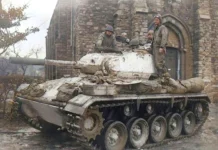
It was immediately apparent to those who could get some idea of the overall picture on December 18 that one of the most critical points in the 30th Division zone was the town of Stavelot just southwest of Malmedy. Murdering SS troops were already in control of a good part of the town as the 1/117-IR moved in from the north to assist the Novegian-American troops of Col Harold D. Hansen’s 99th Infantry Battalion (Separate) as well as the Engineers of Col David E. Pergrin’s 291st Engineer Combat Battalion supported by elements of the 825th Tank Destroyer Battalion and the 526th Armored Infantry Battalion (Separate). Lt Jean Hansen’s 3rd Plat Baker Co with three assault gun tanks saw the first action on reaching the northeastern limits of Stavelot. There was sharp fighting all afternoon, and by nightfall, two tanks were in position defending one side of the town square. The Germans were on the other side of the square. Twice during the night, some Germans tried to rush the lines across this space. The first attempt was stopped by tank commander Sgt Earnest Kirksey’s tommy gun and the rifle of a nearby doughboy standing guard. Their fire stopped a small German vehicle and some German infantry. Later an armored half-track filled with enemies tried to come through. A cannoneer, Pfc Roy R. Hemke, loaded and fired the 75 of his tank while an assistant driver, Pvt Donald Pokarth opened up with the bow machine gun. Morning light disclosed dead Germans lying in the uncrossed square amid the ruins of the half-track.

Other first assignments on December 18 sent Able 743 into Malmedy to guard all entrances to a town the Nazis very much wanted to hack, while two platoons of Baker 743 went west to the village of Masta. A hill site with a few houses and a large school building, Xhoffraix, north of Malmedy, had been selected as the place to quarter the rear echelon units of the Battalion. From Xhoffraix, Charlie and Dog 743 units received radio orders for a night move through Malmedy west to Stoumont. This night move was a risky business, crawling with almost no forward visibility over slender ribbons of the road with treacherous drops to the side. The tank-dozer came closest to disaster. It missed the road at one point, careened into a muddy ditch, tipped for a moment at a precarious angle at the edge of a sheer plunge down into a black valley hundreds of feet below, and then settled back down into the mud, stuck but safe. And so, on December 19, the 743 had its tanks assigned to infantry units and was deployed in and about Malmedy-Stavelot. The first round of the isolated, headlong fighting had begun.
Nobody was sure of it then, but in retrospect, it turns out that December 19 the same day the world heard about Bloody Bastogne where the surrounding elements of the 101st Airborne Division refused to surrender was the day the 1.SS-PD was stopped cold. Elsewhere the Americans were holding off the assaults on the north and south flanks. The enemy was not going to get throughout Malmedy, Stavelot or Stoumont to Liège. He was not going to take Luxembourg. The attack was being channeled as the Allied generals wanted it to be. A Nazi spearhead was still piercing west deep into Belgium and was approaching the Meuse River, but troops and more troops were getting set to stop the attack if it reached this river line. But for all the men in the tanks fighting around Malmedy knew, the Germans might be marching into Paris. The rumors were wild.
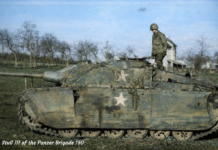
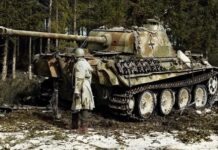
Able 743 was, sent out of Malmedy, where the situation seemed to be well in hand, to meet a more immediate enemy threat in a valley near La Gleize to the southwest. The 1st Platoon spotted the enemy tanks at great range and moved into a defensive position. Although the Nazi armor was too far for the effective range of the Sherman 75-MM, a shell fired by the German 88-MM from an estimated 2000 yards pierced the hull of one tank, passed completely through it, and out the other side. Three men in the tank were killed. As the infantry roadblocks began opening up on the advancing German armor, the l.SS-PD commanders changed their minds about coming any further and withdrew. It was typical of the Ardennes fighting that no one was sure just where the enemy went after they drew back into the cover of the woods. The 3rd Platoon of Baker 743 was still seeing stiff fighting in Stavelot. Slowly, literally house by house, the Germans were being driven back out of the town. Charlie 743 went into action at Stoumont where they occupied the high ground on the eastern edge of the town. Within 15 minutes of their arrival early in the morning, the Germans began a counterattack from the south and east with a force of 40 tanks and a battalion of infantry in half-tracks. In the sharp battle that then occurred, Lt Clyde S. Thornell, a platoon leader, received a shrapnel wound in the back but remained with his tank. It was sharp action, and at the end of it, Charlie 743 had knocked out a total of six Mark V Panthers, a big 150-MM self-propelled gun, and three half-tracks.
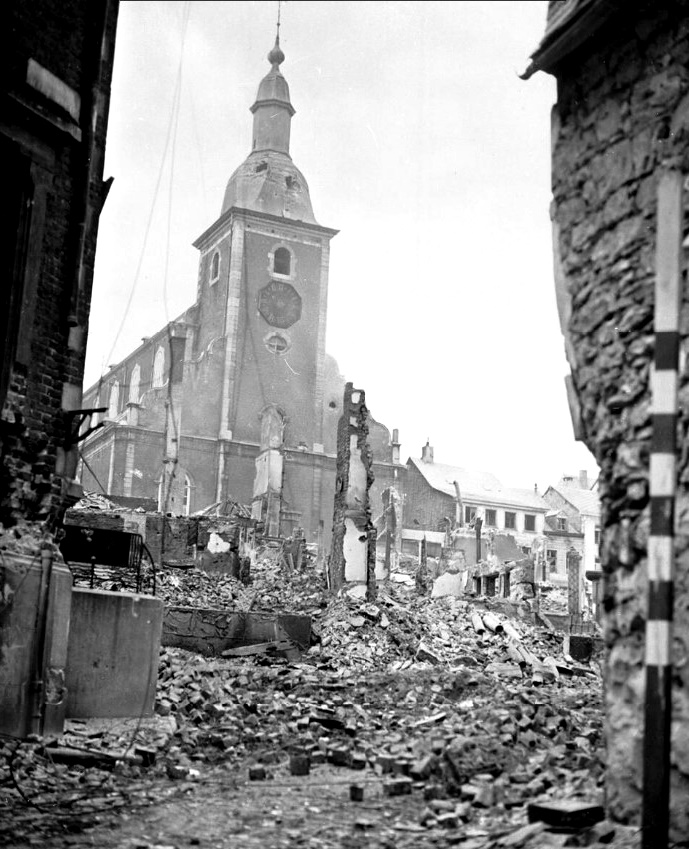
After the enemy advance had been halted, the situation at Stoumont quieted down. Charlie 743 had fought in the town for two hours pushing down fire which allowed friendly infantry to withdraw in order to reorganize Maj Philips observed another tank battalion – the 740th Tank Battalion up the road towards Spa, and he at once suggested to Gen Hobbs that he request its attachment from the Army. The Artny granted the wish and the 740th Tank Battalion relieved Charlie 743 after the German thrust at Stoumont had been halted. Charlie 743 went back into reserve for the night. In making its move in darkness, tank C-17 failed to make the turn onto a bridge crossing the small Wayay River river in Spa. The heavy Sherman toppled into the water. In the accident, the platoon leader, Lt Clifford H. Disbrow, and a member of his crew, Pvt Frank Ashley Jr, were killed. On December 20, a Combat Command of the 3rd Armored Division passed through Able 743’s positions to make two attacks at La Gleize. Neither attack was successful, thrown back by the now doubly desperate 1.SS-PD troops. In Stavelot, Baker 743 was moving slowly through the town as house by house, it supported the doughboys. And as the enemy was pushed out, the true story of German atrocities in Belgium began to be brought to light. At one corner there was a pile of 20 dead women and children, all brutally murdered. Scene after scene, the tankers saw with their own eyes the disgusting evidence left behind by SS bullies and murderers who shot and sometimes buttered helpless Belgian civilians. In one house, tankers saw what happened to a family who had a small baby. The infant kept crying during the night. This annoyed some SS men who had a command post in the adjoining home. The SS paid a quick visit. The bloody corpses were the mute evidence of what happened. The crying-baby excuse was one offered by a captured SS man himself.
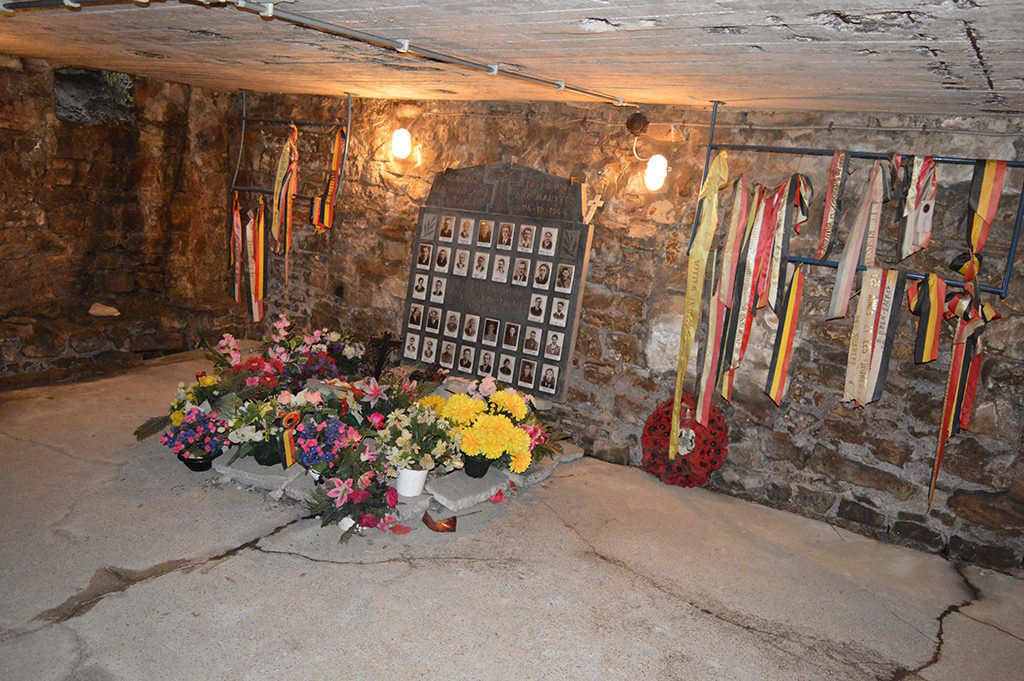
In the Ardennes, the true nature of the Germans under Hitler was revealed in all its shocking starkness. After Stavelot, it came as no surprise to the men to hear of and then see, the 84 American doughboys who had been shot down in cold blood in the snow of a field outside of Malmedy. The Germans couldn’t be bothered with prisoners. The warning came that specially trained squads of American-speaking Germans outfitted with captured American uniforms and equipment were trying to infiltrate the lines. It was expected that the Germans would try a paratroop attack in force. The enemy was at the end of his rope and would try anything. The American troops, admittedly surprised and confused when the Rundstedt blow first fell, now were grimly aware of the nature of the enemy. They were ready for anything. There were few German prisoners taken alive just at that time.
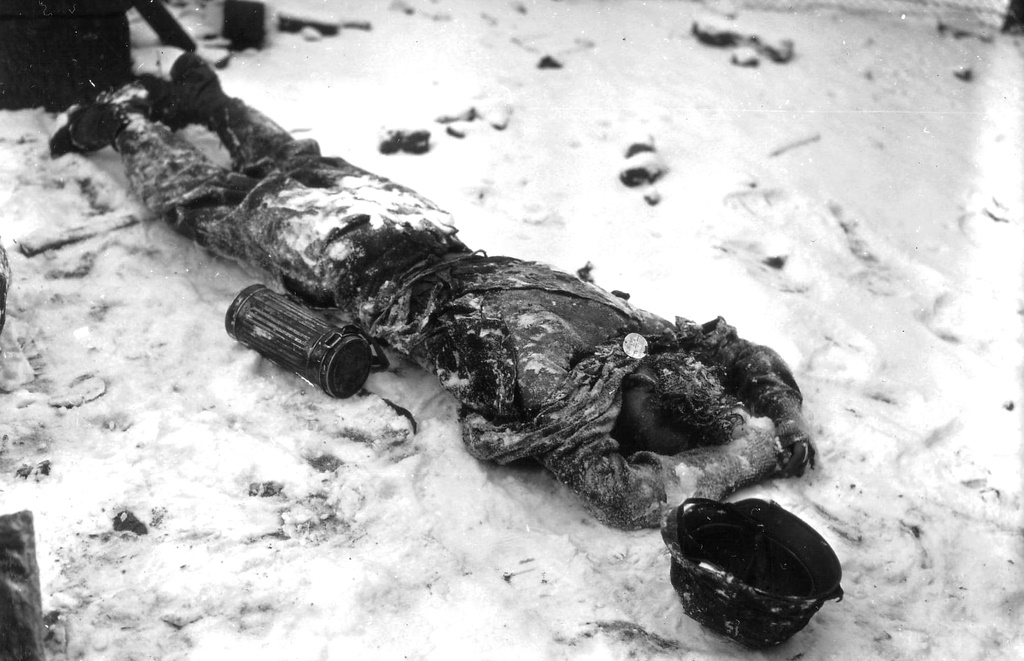
By December 21, Stavelot was cleared. The 30th Infantry Division and attached units had performed the first phase of its mission, to stop and hold the three-pronged assault through Malmedy, Stavelot, and Stoumont. The 743-TB once again had met the 1.SS-PD and had turned it back. On the day before Christmas, Task Force Harrison of the 30-ID with the infantry of the 119-IR and tanks of the 743-TB and the 740-TB, and elements of the 3-AD dealt a death blow to the 1.SS-PD. It caught most of what was left of the panzers. in a pocket at La Gleize and bagged 39 tanks; 70 half-tracks, and a large number of assault guns, artillery equipment, and various vehicles. It was the end of the Nazi threat which boasted the Germans would be back in Liège, Antwerp, and Paris by Christmas. The 24th of December was a turning point in another way. The skies over the snow of Belgium cleared. Out in huge force came the Allied planes. They found that von Rundstedt’s forces, which had gotten as far west as five miles from the Meuse River were now retreating east. In some instances, the retreating columns were bumper to bumper. As if glad of the opportunity, the Allied Air Force went to work. The German fortunes of war had run out.
End