




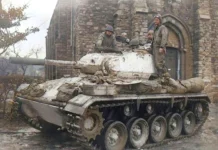
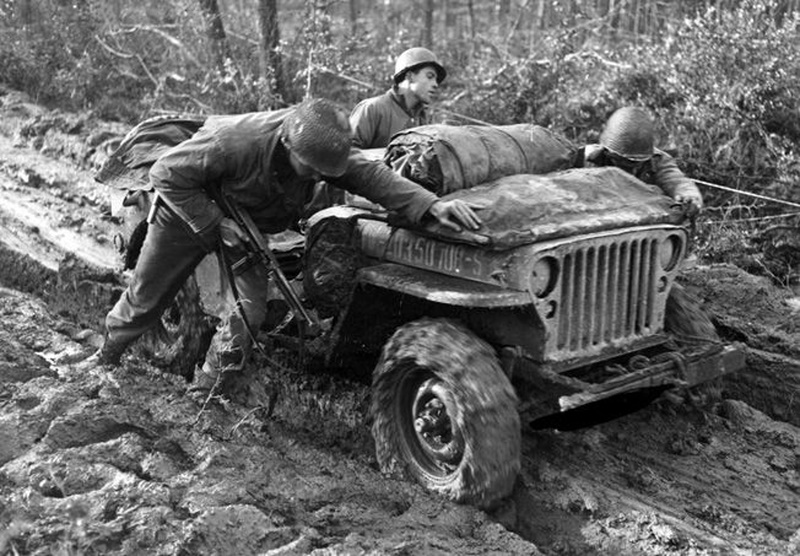
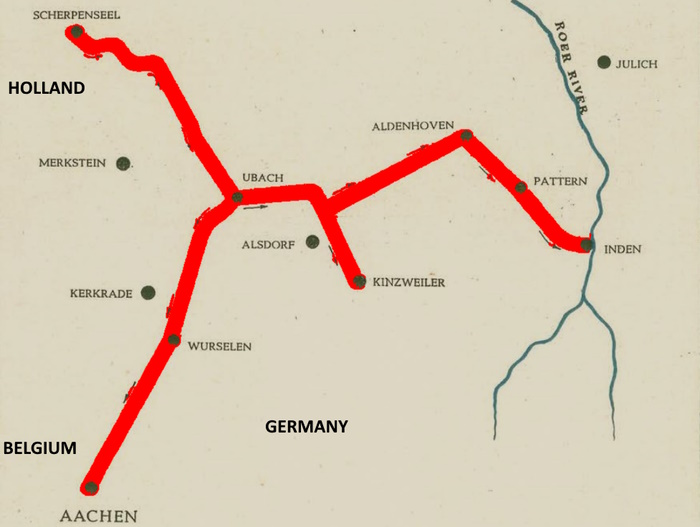
Murky weather continued and, of course, rain. Ground conditions were so bad by the day after Thanksgiving, November 24, that nothing was done but to hold defensive positions in the wet gloom until November 27 when the weather cleared. The infantry tried an advance on Alsdorf (Germany), a small town near the Roer‘s west bank but got pinned down by fierce machine gun fire. Baker 743 was prepared to move up, but the tanks were not called. There was an open area of flat fields for 2000 yards over which the tanks would have to move, and this field was receiving direct fire. It was decided to take the town by night. The night attack came at 1630 before dawn. The 1st and 3rd Platoons took part in this advance, a one-town jump from Pattern to Alsdorf. It was a tough move in the darkness, but it turned the trick. The dangerous open ground was covered without mishap, the tanks being led on foot by Baker 743’s commander, Capt Jean M. Ubbes. As dawn tried to break into the heavy sky, seven enemy tanks were seen leaving Alsdorf in a hurry, running east to escape across the Roer. One enemy tank was found abandoned inside the town. The objective was secured.
The four planes were friendly. ‘P-47s Thunderbolt’, said one of the assault gun platoons as he watched them sweeping low overhead. ‘They’re going to give Jerry a hard time this afternoon’. ‘There go their bombs!’ shouted another. It was November 29, nearing dusk in the late afternoon. And the bombs were dropping on Langendorf, a small town not far from the position where the assault guns were firing missions. The only trouble was, that Langendorf was occupied by American troops. When the bombs began dropping, an AAA unit in a beet field outside the town sent up a yellow identification signal. The P-47s were still circling. Crewmen in the assault gun tanks hunted around for their yellow identification panels and put them out on their rear decks. The signals did no good. Down came more bombs; straight on the assault gun position. When the P-47s flew off, eight men were casualties. One, Cpl Arlis E. Johnston, died of wounds. The commanding officer of the 230th Field Artillery Battalion, with which the assault guns had been working, suggested that the platoon be returned to the rear to reorganize. That night, the bomb-battered platoon pulled back.
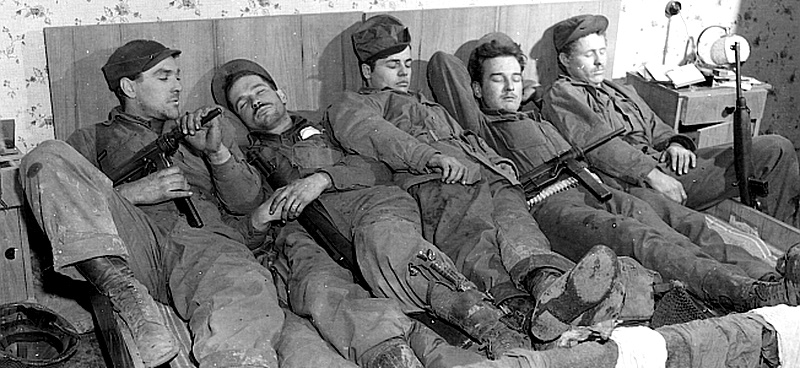
For the 30th Infantry Division, all offensive operations halted at the end of November at the brink of the Roer River in the flatlands of northern Germany. Defensive positions were maintained as higher headquarters planned the next phase of battling into the Wehrmacht’s secondary defenses west of the Rhine River. War became waiting. ‘War’, as Lord Gort once made an epigram of it, ‘consists of short periods of intense fright and long periods of intense boredom’. But soldiers know how to make the best of boredom. Most of the Battalion took up quarters in the town of Kellersberg (Germany), some six miles from the Roer Front. This town was the scene of one of Germany’s ‘modern’ housing developments. It also had been the scene of sharp fighting. The modern housing development was a little worse for wear. Here the men found time to fix up a few comforts of home. They cleaned out littered cellars patched up windows, and rigged up electric lights power was obtained from a ‘hot wire’ running from a nearby coal mine, got the German stoves working against the winter dampness, and fixed up beds and mattresses.
Whenever the sun decided to smile and sometimes when it didn’t the men got to their laundering. There were plenty of big tubs to be found in the mess left behind in a hastily evacuated town. In Headquarters Company a message center sergeant and an operations technician fifth grade went into business with an enterprising ‘Moe Lee’ laundry service. One room of a large schoolhouse was blacked out and became the movie theater. A new film was shown every day. A US0 stage show was set up for two performances on December 6, and this was the deepest any such unit had played inside Germany to that time. The sound of artillery (outgoing and friendly) accompanied the acts. There were 48-hour passes to Holland. On December 14, men from each company went back by truck to one of the Dutch Cities the Battalion had once helped to liberate – Heerlen. There a dance was given for them by the town where they were the guests of 80 English-speaking Dutch girls. Trucks transported 200 tankers for the occasion.
The first Christmas packages were beginning to arrive from home. The Battalion was beginning to accumulate an impressive collection of German home radios in working order, and the evenings were made cozy in blacked-out rooms, warmed by stove fires, with good radio programs over the shortwave channels. But it was not all rest, this waiting. A tank training school was again set up and put into operation. And the huge iron racks that were secret rocket launchers were installed on some of the Shermans, and there followed rocket-firing demonstrations. Officers mulled over possible plans of attack over the Roer. Recon parties went out to inspect routes and possible roads of approach. There was work to be done during the waiting – the incessant work of keeping the tanks in shape, of checking all vehicles, of cleaning all guns, ever prepared for combat on short notice – or no notice.
Nor did the war stop. The American Third Army took Metz (France), the mighty fortress of Central Europe, and continued to advance from the Moselle River to the German Frontier. The American Seventh and the French First Armies broke through at Saverne (France), seized Strassbourg (France), and pushed northeast to the German Border, smashing into Germany on December 7. The Reich was being ringed.

As one winter day passed into another, as December passed mid-month, the Battalion prepared for the master effort to cross the Roer and finish off the great number of troops the Germans were supposed to have for a last-ditch stand west of the Rhine. As the waiting passed, there was no loose thinking that this would be an easy effort. The memory of the last push through Germany after the Siegfried Line was too recent, too sharp. Each little town, hamlet separated from its neighbor villages by no more than a kilometer or two, had been defended by the Germans as if that one dot on the map was the most important fortress in all Central Europe. Each house became a pillbox, each clump of wood and knoll a strong point. Would it be this way all across Germany? Meanwhile, the men were out of the line. They were out of the mud and slime of German beet fields. They did not have to sweat out the easily defended secondary German roads, every road fixed in the calculations of enemy artillerymen. They weren’t fighting in the angled, tricky streets of those German coal towns spotted between the slag piles.
From the end of November to mid-December, it was a rest from such labor. Then came orders putting the Battalion on the alert. Another jump-off was coming up. But it wasn’t to fight through more German coal towns in the Rhine flatlands. From quiet waiting, the Battalion was going to jump down to extreme violence. All that the Battalion knew on December 16 as it hastily jettisoned its new 60-barrel rocket devices was that the Germans had begun an all-out counterattack in Belgium and the 30th Infantry Division was being called down to meet it. The Roer and all the elaborate plans were immediately forgotten. And the waiting was over.


On December 16, 1944, the German Field Marshal von Rundstedt unloosed a powerful army of the Nazi’s best remaining troops in an effort to burst through the mountainous Belgian Ardennes country, sweep on to Liège and Antwerp, and throw the whole Allied offensive out of gear. The VIII Corps had a thin holding line where the German Panzer Army hit. The 106th and 99th Infantry Divisions were overrun. In the Corps zone, three American divisions in all were badly battered. The Nazi threat was a serious one. The 30th Infantry Division was ordered to rush down to Belgium to help stem the drive. As a part of the 30th Infantry Division, the 743rd Tank Battalion was alerted to move on December 17. At 25 minutes past noon, Col Duncan received notice to alert all his units and be ready to move out within five hours. A quartering party, led by Gen Harrison, left Wurselen (Germany), two hours later. Maj Benjamin and Lt Paul J. Longheier represented the Battalion in the Belgium-bound quartering group.
The Battalion got ready to pull out. Once again the word went around to the men, action was coming up. This time there was a grim sound to the news. Only this much was known then, the Battalion was getting out of Germany. The enemy had counterattacked in strength in the VIII corps area in Belgium, had broken through our thinly held lines there, and had advanced eight miles in one day. The whole Allied balance along the Western Front was quickly shifted to meet the threat of this enemy attack. At 5 o’clock on the dreary cold afternoon, the unit was set to pull out. The vehicles were gassed up, all personal gear was packed, the trucks loaded, and the men ready. The order was awaited to move out. At 6, Col Duncan went to 30-ID’s Headquarters and was given the move order to be at 2 o’clock in the morning from the Battalion area at Kellersberg It was a sloppy, dirty night and shortly after midnight, the Battalion command group assembled its vehicles on the road in Kellersberg, lining up in a column in the pitch blackness that would he brightened for a few minutes at a time by flares dropped from enemy planes. These planes, unusually active, droned about in the rain. One lone bomb was dropped near the command unit before the march began.
At 0200 in the morning, the column moved out down the wet roads to Aachen (Germany) and kept moving south toward Eupen (Belgium). During the march, the column kept alert for enemy paratroopers. Aerial activity overhead was intensive. Flak and AAA fire was almost continuous to all sides, filling the dripping night with spurts of red tracers, and orange shell bursts, and the enemy planes contributed to the weird display with garish white chandelier flares.

It was still night when the head of the column reached the planned assembly area north of Eupen (Belgium). But here the Battalion commander was notified that the units would continue on into Belgium, through Eupen to a point one mile north of Malmedy. This new order was given to the operations officer Maj Philips, and the executive officer, Maj Benjamin. Col Duncan, Maj Philips, and Lt Longheier then went on ahead to the new area in the Recon half-track and two jeeps. The combat column then followed, not knowing what it was going to find ahead of them. By dawn, they were in the hills of the Belgian Ardennes and by 1000, were halted at the side of the road leading down into Malmedy. When the Battalion arrived in this position, the tank commander had no maps, no orders, and no knowledge of the position of either the enemy or our own troops. The Battalion commander went down into Malmedy to report to the Regimental Commander of the 117-IR there that the 743-TB (Verify) was available. So began the Battalion’s part in the Battle of the Bulge.
743rd Tank Battalion (Verify) vs 1.SS-Panzer-Division (LSSAH)
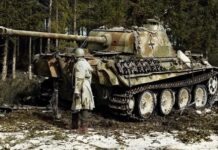
The first indication of the enemy outside Malmedy came from the air. Out of the east came a strange, bumbling drone, like a low-flying plane with a missing engine – V-1 Buzz Bombs. The things thundered over several an hour on their general way toward Liège. This was a real Buzz Bomb Alley. At night they could be seen furiously sputtering their course, the gas-oxygen propulsions flickering through the sky to mark their flaming way. But the real threat was on the ground. The buzz bombs were only a nuisance. Through Malmedy and Stavelot, however, the best troops the Nazis had, the 1.SS-Panzer-Division (LSSAH), were spearheading toward Stavelot and Liege. It was up to the 30th Infantry Division and attached units to collide with the 1.SS-PD head-on and stop them. Maj Philips summed the situation up as the tanks waited for orders on the road to Malmedy. The company commanders had been called to the head of the column. Maj Philips had a map of the area. He spread it out on the front plate of the staff command tank and he told the officers as much as he knew of the enemy positions. ‘This’, summed up the Maj, ‘is another Mortain (France) for us. I didn’t like it any better than you do, but that’s the story. It’s our job to meet the enemy, stop him, hold him, and destroy him. Then the company commanders were given their assignments.
The scenic beauty of the Belgian Ardennes is a tourist’s delight and a soldier’s terror. No battleground is beautiful to the man who must fight upon it. The narrow hinterland roads that climb and descend through stands of trees, skirting streams and cliffsides, might look well on an artist’s canvas, but wet and slippery, they are a dangerous stretch of hazards for the man at the controls of a tank, particularly at night, when he had to guess where the road stopped and a drop down the mountainside began. These wooded hills and deep furrows of valleys served, like the French hedgerows, to hide the positions and the movements of the enemy. Rundstedt had counted on them in his carefully considered plans. In such a country, he had already managed the job of keeping his army-sized attacking force a secret from Allied ground and air intelligence until he was ready to unleash it.

At the beginning of this counteroffensive, the Germans enjoyed a great fortune of modern warfare and cloudy thick skies which kept Allied planes from spotting their movements. Even so, patrols of fighters flying above the ‘soup’ went down through occasional holes in the cloud blanket to shoot up advancing Nazi columns. But the giant weight of the Air Corps was out of the early action – grounded by bad weather. The first job of the ground troops rushed down from the flatlands of Germany to the hills and forests of southwestern Belgium was to meet the enemy. When the enemy threat became a breakthrough and the true power of the attack was known, Rundstedt was committing his carefully hoarded 6.Panzer-Army and the Allies made a quick shift of divisions. The Supreme Allied Commander Gen Dwight D. Eisenhower regrouped his forces. He gave British Gen Montgomery control over all troops in the north and Gen Patton, commander of the American Third Army had the responsibility of the southern flank. Together, the mission of these two commands broadly was to channel the force of the German blow, contain it within the north and south flanks, keeping it grooved as an east-west shaft whose steel-tipped drive could be stopped after it lost some of its momenta 50 or 60 miles inside Belgium. It was a race against time, for if the Germans cracked through the flanks to exploit behind the Allied lines or rolled beyond the Meuse River to Antwerp, the Allies would be handed a crushing setback that would delay the war’s final campaigns against Germany for many months. And in this race, the Germans had gained a head start.
The 743-TB had reached the Ardennes and for the next week of action, all would be a strange and somewhat mad confusion. There was an entirely new feeling in this fighting. After months of being on the offensive, with German armies whipped and the end thought to be in sight, the men suddenly found themselves thrown on the defensive to fight for their lives. There was no belittling the seriousness of the situation. What was strangest of all was the almost complete lack of information. The wildest rumors sprang up. The Germans had cut the roads north of Malmedy, said rumor; the Germans had reached Liège, the Germans had dropped paratroopers and were fighting in Antwerp; the Germans were having gigantic success. The only thing that the Battalion could be certain of when it went into action in Belgium was that it was to face the 1.SS-PD the same nominal division it had faced and beaten at Mortain. After its licking in France, the 1.SS-PD had been reformed and refitted. This was the return bout.

There had been vague situations before, but none so mystifying as this. Some platoon leaders got maps of the area, but some men did not get maps for several days after the fighting started. For those who had to travel the steep, torturous roads without maps, it was like groping in the dark, often not knowing whether the road was in friendly or enemy territory. Tanks and platoons soon were scattered to all four winds, braced to hold vital roadblocks. And supplies had to get to these men. When our column finally came to a halt after the long and cold march, I had no idea where we were and I wasn’t alone in that, either, recalls Lt John D. Hess, transportation officer for the Battalion at the time of the breakthrough. ‘I checked the column and found that ten of my trucks were missing, probably had taken a wrong turn in the blackness of the preceding night. I went back in my jeep to hunt them up, and when I finally found them and returned, much of the column was on the road at the same spot I had left it. I learned then we were only a mile or so north of the town of Malmedy.
There were some who said Malmedy was in German hands, some who said it was in ours. Lt Col Duncan had gone down into Malmedy, and it was supposed that if the Germans weren’t there, he had set up his command post in the town. Down went Lt Hess into Malmedy, saw no Germans, but did find the Col set up in a large hotel room. ‘What’s the situation, sir?’ the transportation officer asked’ as he reported for Col Duncan was entirely candid. ‘I don’t know what the situation is beyond this: the Germans are on the loose and can be expected anywhere anytime. It’s our job to find out where they are and then stabilize a line to stop them and hold them. Col Duncan had sent one platoon of tanks into Stavelot, but the direct road between Malmedy and Stavelot was reported cut and the only inlet was by way of Francorchamps a most roundabout way over questionable roads. Off went Lt Hess to make a reconnaissance in his jeep, driven by Cpl Near, to find out if the supply trucks could be brought, to that platoon later in the day. Before he left the Col, however, the transportation officer asked for maps. The Col smiled and produced one dirty wrinkled sheet which was his entire map supply order.