




ATTACK PREPARATIONS
At about 1550, the radio silence, imposed for security reasons, was lifted. The artillery liaison officer, Capt James Lantz was immediately occupied by directing very accurate artillery fire on the plotted automatic weapons position and other suspected enemy targets. The accuracy of this fire was evidenced by the fact that the enemy could be seen moving away from the hill mass and a considerable lessening of the automatic weapons fire on the bridge site. Enemy movement of an estimated company strength was noticed some fifteen hundred yards to the east moving in the direction of Levens. These were immediately taken under fire by the artillery, directed by the FO in the grandstand seat, as far as observation was concerned. At 1545, a reinforced squad under the command of S/Sgt Craig, moved under cover along the east slope of the ridge to establish a roadblock on the Levens – La Roquette Highway. His orders were specific. He would establish a block, and prevent any enemy from either entering or escaping the town of La Roquette. He would remain in this position until relieved or ordered to return to the company.
At 1600 hours the company moved along the eastern slope of the ridge to a position in the rear of the town. Machine guns and 60-MM mortars were set up and prepared to cover the riflemen’s advance to the gate in the town’s wall. At this point it was discovered that two of the ammunition bearers for the machine guns had discarded half of their ammunition, (one box of 250 rounds, belted), their explanation being that during the night movement to the ridge, they were just so tired that they couldn’t carry it any longer! A last-minute visual reconnaissance of the town now revealed that instead of two streets there appeared to be three. This last was more of an alleyway between the wall and the rear of one row of buildings than a street, but nevertheless was a thoroughfare that had to be cleared. To this task, the first platoon (-) was assigned, and a reserve wag was constituted from among the various ammunition bearers of the weapons sections.
THE ATTACK OF LA ROQUETTE
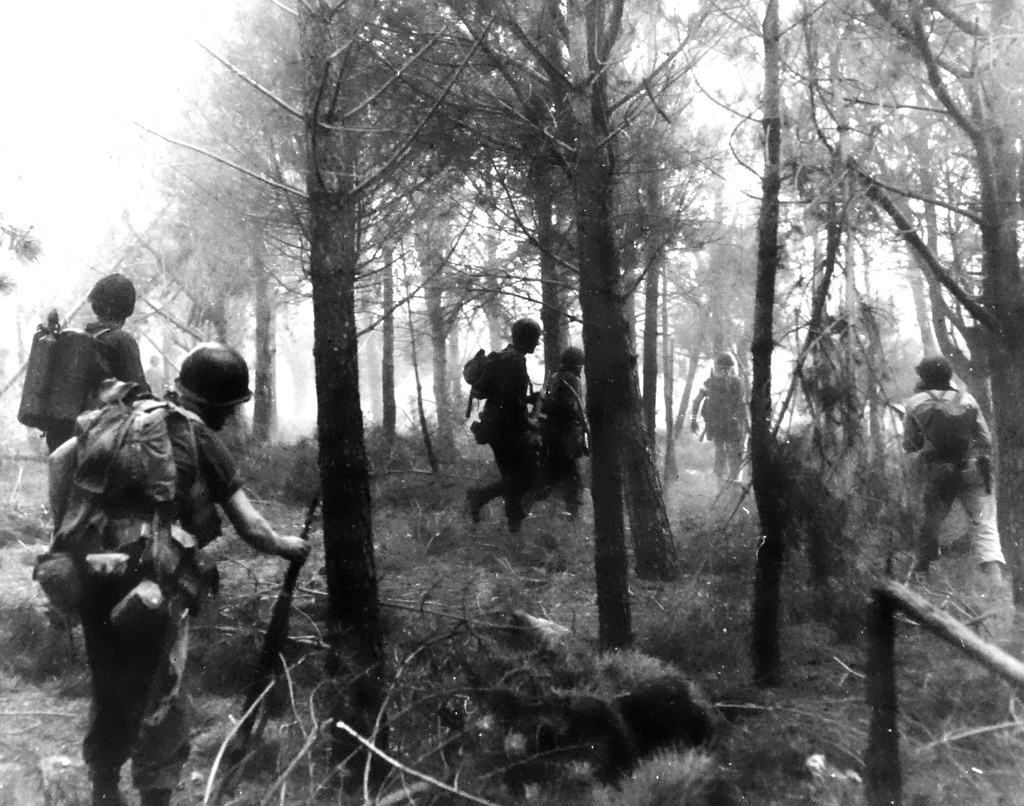
At 1625, the artillery preparation for the company attacking the bridge began and the leading elements of the Easy Co platoons moved from under cover and advanced towards the town up until this time it was believed that the enemy was totally unaware that any force could possibly be in his rear areas, however at this time he took notice and began to fire on the advancing troops with small arms and mortar. Fortunately for the attacking force, a large caliber mortar is not effective at a range of some two hundred fifty yards and little damage was done to the troops by the scattered small arms fire. The weapons crews on the ridge did not fare quite so well. A mortar round fell near one of the 60-MM mortar positions and seriously wounded one of the crewmen, but the weapons continued to fire to cover the advance.
Under the cover of supporting fires, and by the use of marching fire, the assault platoons rushed into the gate of the town and sped toward their assigned streets. Muted rifle reports, the sharp reports of the MK-2 Fragmentation hand grenades, and the billow of the M-15 White Phosphorus smoke marked the beginning of the clearing of the houses. The assault platoons made excellent progress for the first few houses, but by this time the enemy had recovered from his surprise at being assaulted from the rear and had turned his attention to the company. The platoon’s advances began to slow, halted and carried on only by the sheer powers of leadership and profanity of the platoon leaders. However, a later investigation proved that the personnel of the platoons had not been to blame. In the case of both of the major assault platoons no teams organized had been assigned for the house fighting that should have been an SOP order from the platoon leaders, (teams support each other from opposite sides of the street, one team clears a house, signals, and covers the advance of its sister team on the opposite side of the street).
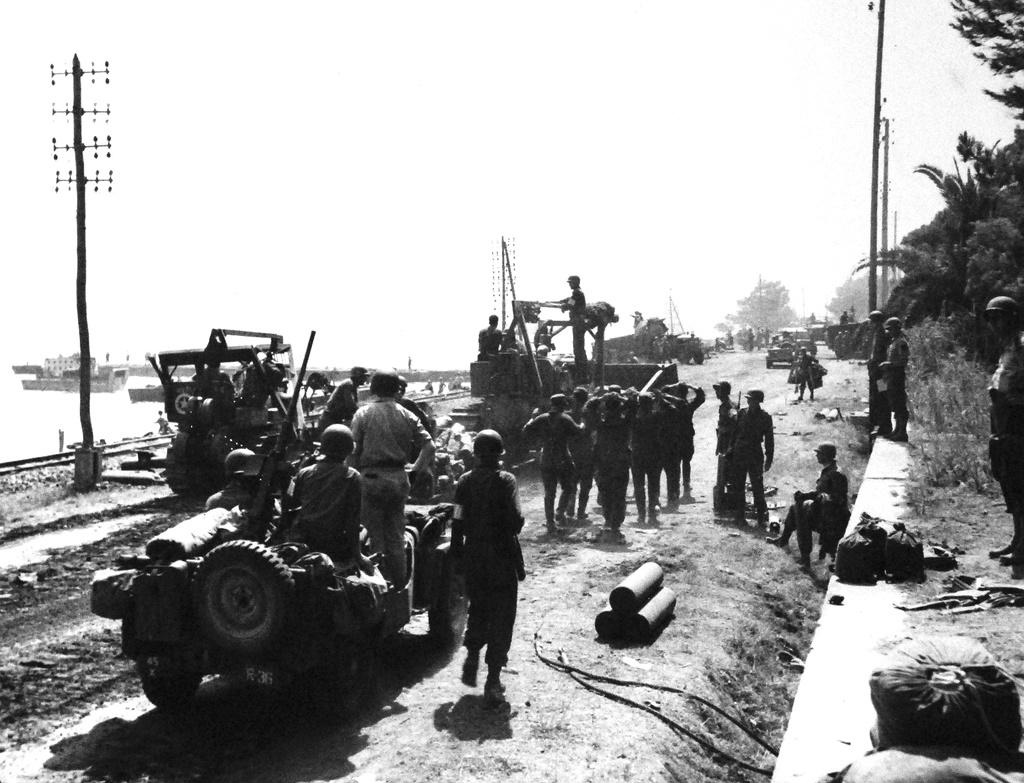
Another obstacle was encountered in the fact that squads were not fully clearing the houses. In the case of the third platoon, the clearing squads neglected to clear the upper story of some two or three houses resulting that the enemy dropping concussion grenades on the platoon leader and the support squad, causing several temporary casualties. Due to these neglected instructions, the advance of the company was held up some twenty to thirty minutes while readjustments could be made, this time of course was used to good advantage by the enemy who succeeded in moving his scattered forces to a more centralized position in the town. The first platoon on the northern portion of the town had succeeded in clearing the houses along its street by 1745 and radioed the command group that it was now on the western end of the town with approximately fifteen prisoners. It was instructed to hold fast and prepare to assist the advance of the remainder of the company if this could be done without firing into each other.
The weapons section was ordered into the town and displaced without incident to the east gate. Mortars were set up and told to be prepared to fire on order of the Company Commander only. The two major assault platoons, second and third, now radioed that their hand grenade supply was nearly depleted and asked for help in clearing the buildings. The only remaining firepower of the company was in the four light machine guns which were now out of action and had displaced into the eastern edge of the town. This section, together with members of the 60-MM mortar squads was formed into a provisional platoon and given the mission of aiding the advance of the third (left) platoon. Machine guns were formed into two teams, two would work down each side of the street, the mortar crewmen and machine gun ammunition bearers, though, armed with carbines would be the assault riflemen and clear the houses after the machine guns had sprayed the inside. Upon arrival at the third platoon area it was found that the platoon leader was suffering from a slight concussion from a grenade dropped from an upstairs window, and the platoon well scattered throughout several houses, mostly ones that had been previously cleared.
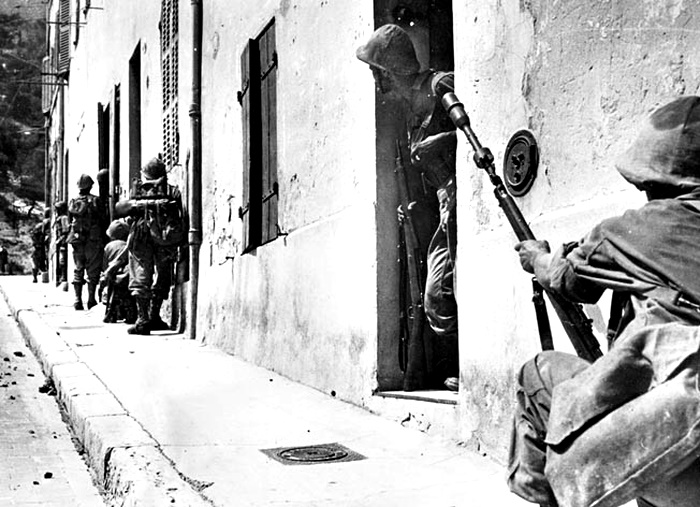
The provisional platoon moved forward and by a series of literally spraying the doorway and windows with machine gun fire from a hip-held position, allowing the carbine-carrying personnel to enter, that it was making a rather rapid advance. At this time the rifle platoon was reformed and with the combined force the attack swept swiftly along to the tune of numerous ‘Kamerad’ shouted from the enemy. A German Company Commander, a captain, was captured at approximately 1850 and informed that he would send out the order for all of his personnel to surrender by 1900 or a systematic annihilation of those who refused would follow as the battalion closed into the area. This he did and by 1930, only those that were wounded or dead remained in the area. Radio contact was established with the Battalion and they were informed that the town was clear. The battalion ordered a contact patrol sent down the road to meet the advancing units who had succeeded in forcing their way across the bridge with a minimum of casualties.
The attack on the town of La Roquette from the rear had caused what troops remaining on the hill mass east of the bridge to withdraw, as was later corroborated by PWs reports. It was now dark and any movement outside the town to the east was immediately challenged. Although the German commander had stated that his force was to be the last to withdraw after the destruction of the bridge, it was felt that some enemy force might attempt a spite attack before withdrawing to the next defensive line. Reinforcements were sent to the roadblock and the report was returned that the only action encountered had been a motorcycle that they had been forced to shoot to stop. Papers found in a dispatch case on the driver ordered the troops on the hill mass, east of the bridge, and the company in
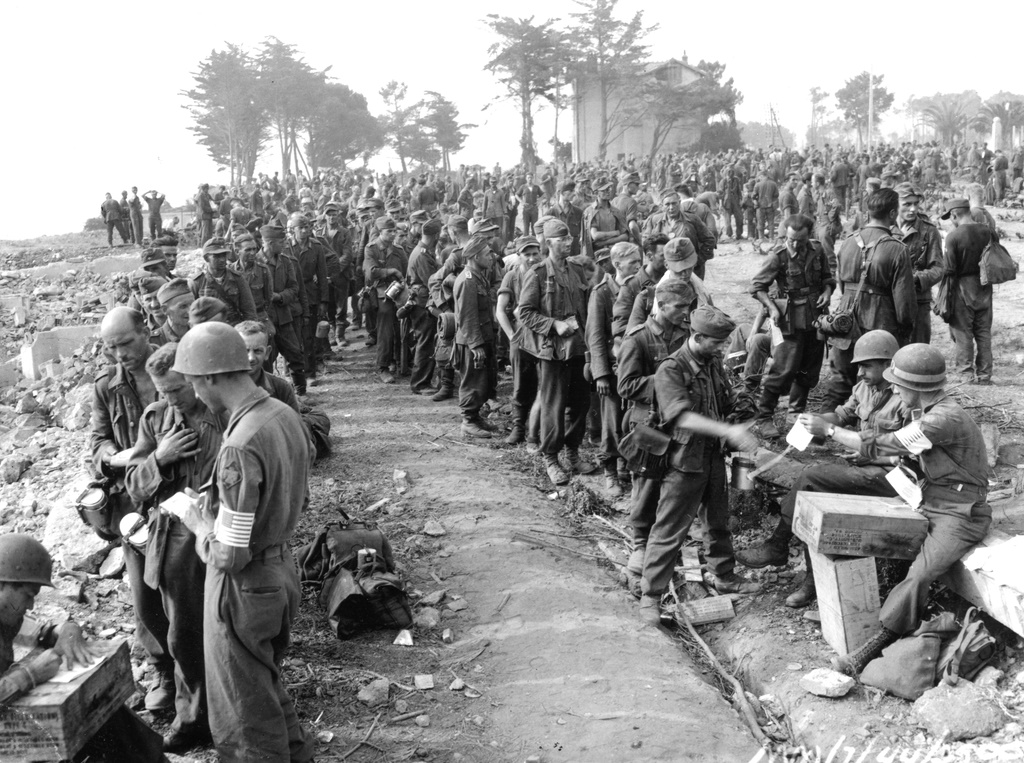
The 2nd Battalion passed through the Easy Co roadblock at 2000, and occupied the hill mass east of the bridge against a possible return by the enemy and to protect the passage of the remainder of the regiment across the bridge the next day. The next day an enemy 8-CM mortar was found to be emplaced in a circular pit dug in a walled courtyard. This weapon could be fired in any direction with complete safety to the crew and be assured of safety except for a direct hit. In a summary of this operation, Easy Co had succeeded in accomplishing its assigned mission and in doing had allowed the battalion to secure an undestroyed bridge, which furthered, by some days, the Allied advance to the east. Had the Company failed in this mission, casualties could have been extremely heavy in any attempts to secure the bridge by direct assault. The company and its attachments were complimented for a job well done by the Regimental Commander, Col Rupert D. Graves, and by the First Airborne Task Force commander, Gen Robert T. Fredricks. Enemy losses were 25 killed and 81 captured in the town of La Roquette. Easy Co losses were none killed, 10 wounded. An unknown number of enemies had been killed or wounded by the well-directed artillery fire on the hill mass overlooking the bridge.
End