




EASY COMPANY – PREPARATION AND ORDER
Upon receipt of the Battalion order, enemy activity increased in the Easy Co area. While the Company Commander and the attached officers discussed a plan of action the company busied itself with preparing for the operation. This was not an unusual undertaking for the men, as training at night operations and participation in numerous night movements had instilled the necessity of thorough preparation of men, weapons, ammunition, and plans. The attached Hq Co machine gun section, rocket section, and demolition personnel were absorbed in the scheme of events and preparation forged ahead. All weapons were oiled, checked, and further prepared for the river crossing. Ammunition was issued to all participating personnel. Machine gun ammunition boxes were submerged in water to assure the gunner that lid seals did not leak, and extra cardboard was inserted to prevent the belted ammunition from making any noise. All loose metal was either taped, tied, or discarded; 60-MM mortars were reduced to two, and extra ammunition was carried by the surplus crews; personnel were instructed to carry the very minimum of equipment and were issued grenade bags and extra M-15 white phosphorus and MK-2 fragmentation grenades; 2/5 K rations would be carried and a hot meal fed before departure, the first since leaving Italy.
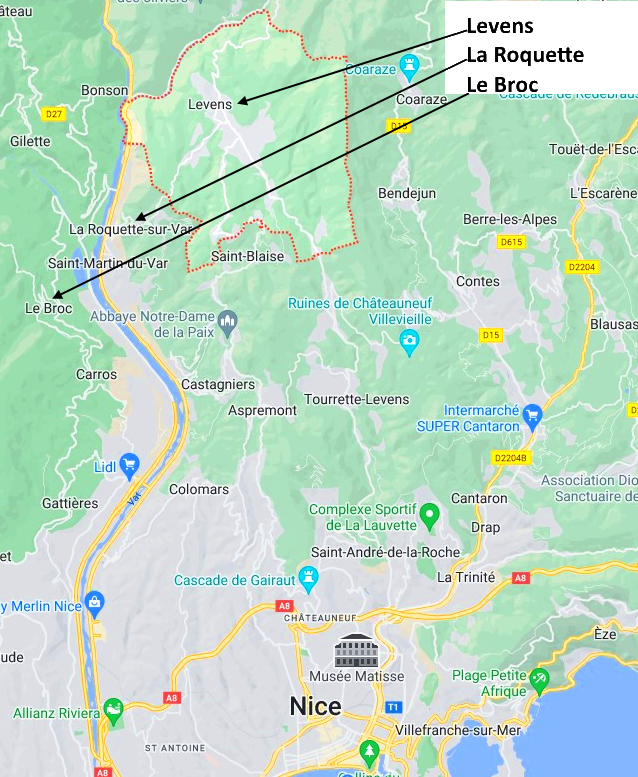
The attack plan of Easy Co was simple in nature. Easy Co (+) would depart La Broc at 0130 hours, August 28, in order of 1st Platoon, Command Group, 2nd Platoon, Weapons, and 3rd Platoon, bringing up the rear and securing the tail. The company would cross the Var River at the indicated ford, move to a position 500 yards in the rear of La Roquette, would remain there until 1600 hours, at which time would cut the La Roquette – Levens Highway and attack the town from the rear at 165O.
NARRATION
THE MOVE TO THE RIVER CROSSING
The weather at 0130 hours, August 28 was clear, with a sliver of a moon. None of the usual fog had fallen and the bed of the river could be felt by the damp chill rising from the stream. At 0130 hours, the Company passed through the security detachments of La Broc in single file, led by Louie and the I&R Section guides, and followed the tortuous path down the mountainside to the river crossing site. One can well imagine the difficulty of moving a group of men in the dark of night on flat terrain, increase this some hundredfold, and the picture will equal the column of men moving down the side of the mountain, with equipment, over a rock-strewn path.
Progress was slow and control was difficult. As radio silence would be observed this necessitated the passage of orders verbally along the column. This resulted in some confusion as to the original intent of the message but, did not seriously impede the progress down the mountain. A further difficulty was encountered in low-hanging bushes slapping each person in turn and catching on items of equipment, causing no end of uncomplimentary ejaculations from the men. Another situation caused some concern as the path became more precipitous. Loose rocks would become dislodged by the passage of the men and would roll several yards down the steep slope, causing what seemed to be a young avalanche. Orders were passed back along the column and urged the selection of proper footholds, and in addition, the rate of descent was slowed considerably. This corrected the major portion of these incidents and possibly eliminated the possible detection of the Company’s advance to the water’s edge.
For some forty-five minutes, the column slipped, slid, and grunted its way to the floor of the river bed and emerged on the narrow east bank of the Var River. The river fog caused the river to assume the appearance of some gigantic snake lazily moving to an unknown destination, but the peaceful appearing stream nearly cost the lives of five men by its swift undercurrent.
THE RIVER CROSSING
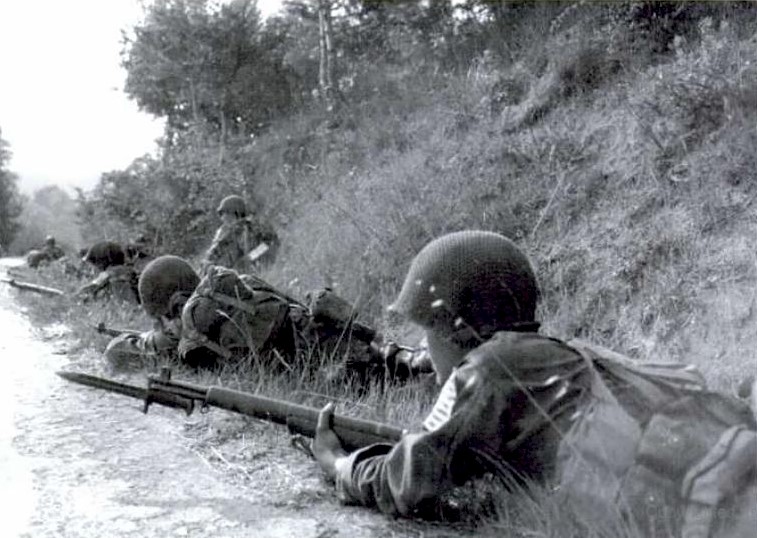
After a fifteen-minute rest halt the column moved downstream for some six hundred yards to the so-called ford known to Louie and the I&R Section guides. All personnel were instructed to take a last-minute check of equipment and were told to form a human chain upon entering the water by holding to the back of the person’s harness to their front. Individual arms were to be held out of water insofar as possible to assure their ability to function should the need arise in the immediate future. It had been decided to cross two columns each in a single file to expedite the company reorganization on the eastern edge of the water, and the company was being so organized for the crossing. The water at this point was reported to be at a low stage due to lack of rain, and 75 to 150 feet in width. The personnel of the company had been told to expect water to a depth of not more than three feet.
A reconnaissance and security patrol was sent across to determine the best crossing and secure the eastern edge of the water to allow the main body of the Company to cross. The patrol crossed and by pointing chins to the sky managed to keep from drowning. The patrol leader sent two of the tallest of his patrol back to the Company Commander to inform him of the fact. Coupled with this unexpected depth was the fact that the river at this point was flowing some five to six miles per hour, which was to be a dangerous undertaking for foot troops with no safety ropes. The I&R Section guides together with Louie were accosted by this fact and asked if there could possibly be a mistake in the location of the crossing site. Company Commander was assured that this was the intended site, however, it was found that the I&R Section, who had been charged with determining the depth, width, and velocity earlier in the evening, had failed to make a physical reconnaissance and had relied upon the word of the French FFI guide. Louie, when asked specifically if he had actual personal knowledge of the crossing said that he personally had never crossed at this particular spot but had been told by the FFI Commander of this area that it was shallow and easily affordable.
The men were informed of this development and instructed as to the depth, width, and velocity. Squad leaders were told to make certain that all short men would be behind a tall person in the crossing column. To guard against losing the heavier-loaded weapons crews, two columns were to be used as before but the weapons group would now cross two to three yards upstream from the riflemen. This would give some protection to the crewmen should they lose footing and be carried downstream by the swift current. Both columns entered the river and had advanced approximately three-quarters of the distance across without mishap when a crew member of a 60-MM squad, carrying a tube and extra ammunition, lost his footing and was swept downstream. In an effort to save the man, the person next in the column had hung on to the man’s harness and was jerked from his feet. In a like manner, the next three were jerked from their feet and carried downstream. Fortunately the riflemen, with a firm grip and not as heavily loaded, grabbed or were grabbed, by a passing body. All persons were saved but the individual weapons of four of the riflemen were lost in the stream.
The column moved without further incident to the eastern edge of the water. Watersoaked and gasping for breath the column moved some fifty feet east of the water and halted to reorganize. The security patrol leader reported that he had encountered no mines and that he had advanced some one hundred yards to the east and had heard no sound that would indicate that the area was physically occupied or patrolled. Louie assured the commander that no German patrols were due to pass this general area for some thirty minutes. The column was quickly organized into the original single column for control and prepared to move to the eastern bank of the river bed.
FROM THE RIVER TO THE RIDGE
The next checkpoint on the night movement was a large culvert some six to eight feet in diameter located some two hundred to three hundred yards to the east of the present position. This culvert allowed a small stream to flow under Highway 202 paralleling the Var River. The FFI guide and a careful study of the terrain from the west bank during the daylight hours had indicated that this pipe was free of any wire or other man-made obstacles, and due to this, had been tentatively selected as a possible crossing into the enemy positions. Reconnaissance proved this to be false, and other places of entry through the concertina and barbed wire had to be found. Louie vowed that though he had been wrong on the ford and the culvert, that of a certainty he knew of a breach in the wire on the east bank. For the first time since the beginning of the operation, the FFI produced positive intelligence. The breach proved to be clear of mines and completely through the wire barrier. The column approached the gap and security elements was sent both up and down the road to prevent enemy patrols from arriving at the time the column would be crossing the road. The FFI guide had assured the company commander that patrols were not due in this area for some time, but due to his wrong information on two previous occasions, it was felt that he could be wrong again.
No noise was made as the column moved across the roadway and moved as rapidly as possible away from the roadway. The guide had chosen an evidently little-used trail through one of the small fields bordering the river. This was evidenced by the sticks, stones, and various other obstacles that caused the column to stumble and mutter as it proceeded to its objective. There was no evidence that the movement had been sensed or discovered by the enemy, as no shots or illuminating shells had been fired. The only noise in the night was an occasional spatter of artillery or mortar fire and the stuttering rip of a German MG–42 and the answering heavy pounding of an American machine gun. From the noise, it was apparent that the bridge was still an undecided issue. From this point, the ridge where the company would spend the day in hiding was strictly enemy territory. This particular section of terrain had been screened from view from the far bank and it was now up to Louie, a careful map study, and a great deal of prayer that someone would not kick a trip-flare and expose the maneuver to the enemy.
It was now 0550 hours on August 28, with the company still approximately one mile from the ridge and daylight at 0455. The FFI guide continued to lead off in the right direction with supposed knowledge of the course he was following. After marching for some twenty uneventful minutes the Artillery Forward Observer, Capt James Lantz, remarked that a small wooden footbridge the column was then crossing looked strangely familiar, and indeed it was. Louie had become lost and had wandered in a circle. At this time the Command Group oriented themselves with the aid of a covered map and informed Louie that he was free to leave and complete his secondary mission of coordinating the FFI Forces in a harassing mission in the rear areas. Needless to relate, his services had not been appreciated.
Guided by an azimuth and dead reckoning the column moved out for the ridge. For some thirty minutes, the column wound upwards and at 0620, the head of the column could see the outline of the ridge top ahead. Patrols were dispatched to secure the area and the column moved into the selected area. With the fear of being exposed by the dawn, the platoons were hurriedly given an area among the boulders, last-minute instructions were given on security and the long wait began.

THE DAY ON THE RIDGE
Dawn found the exhausted company securely nestled among the granite boulders on the ridge top and to all appearances in a position that was impenetrable except too heavy artillery concentrations or direct air strikes. With the coming of first light, it was found that the town of La Roquette could be seen situated some six hundred yards to the north and west, enthroned on the very top of an extension of the ridge line on which the company was located. A hog-back, or saddle, could be seen connecting the town’s ridge top with that of the company’s fairly open, minus any large boulders, and offering an approach directly to the rear gateway to the town. There was a difference of some one hundred feet in elevation between the town and the company’s location, which gave an additional advantage of being able to partially see into the interior of the town proper. To the rear (east) of the position, at a range of some two thousand yards was another ridge line, slightly higher and extending as far as the eye could see. It was hoped that the enemy did not have this terrain occupied, as observed from this vantage point could permit a keen eye to notice an attack forming the coming afternoon.
To the south was a canyon up which the company had advanced the night before. To the north was the hill mass overlooking the bridge. The enemy had this mass occupied in force. From the present position, a fairly accurate location was made of some of the automatic weapons locations causing no end of trouble to the forces still on the west bank of the river. The morning serenade of mortar and light artillery opened up on the bridge site. It was noticed that at least one large caliber mortar was firing from within the town. Although a portion of this town could be seen, the gun could not be accurately located but was marked down as a number one objective in the town. As yet no definite orders had been issued to the platoon leaders in regard to specific objectives within the town proper. Until this time, no plan had been formulated due to a lack of knowledge of the interior of the walled town.
The FFI guide Louie had provided a crude map of the town layout but after his other mistakes no one was willing to take anything that he had dealings with as gospel. An observation into the town from this vantage point revealed that the town was divided by two streets, each approximately two hundred yards in length, with the stone houses side by side with no alley room. The width of the street appeared to be some fifteen to twenty feet. Two gates led into the town one from the east and one from the north, each capable of passing an automobile. From this position, visual reconnaissance was carried out down to the assault squad leaders but was restricted in movement to prevent possible detection of movement by the enemy.
Based on this visual reconnaissance orders were issued to the company. Two platoons would be used in the assault. One platoon (-) would remain initially in reserve to the east of the town on the ridge and be prepared to enter the town and advance down either of the two streets. Weapons, both MG and mortar, would go into position in the rear of the ridge and cover the advance of the assault platoons. The rally point would be in the town square. Each squad leader was informed that if his squad became lost or separated due to heavy fighting or darkness, he would take one house, clear it, and remain until the company could extract his unit or direct it to the main body. The second platoon was elected to be the right street unit and the third platoon would be left. To each were attached two rocket launchers for breaching stone walls. The first platoon, minus the roadblock squad, would be in support and would remain in position on the ridge. Due to the hour of the attack, it was felt that with the coming of darkness, the entire company would be brought into the section of town that had been cleared and would remain as a compact unit until the town was either captured, cleared, or the company forced to retire.