


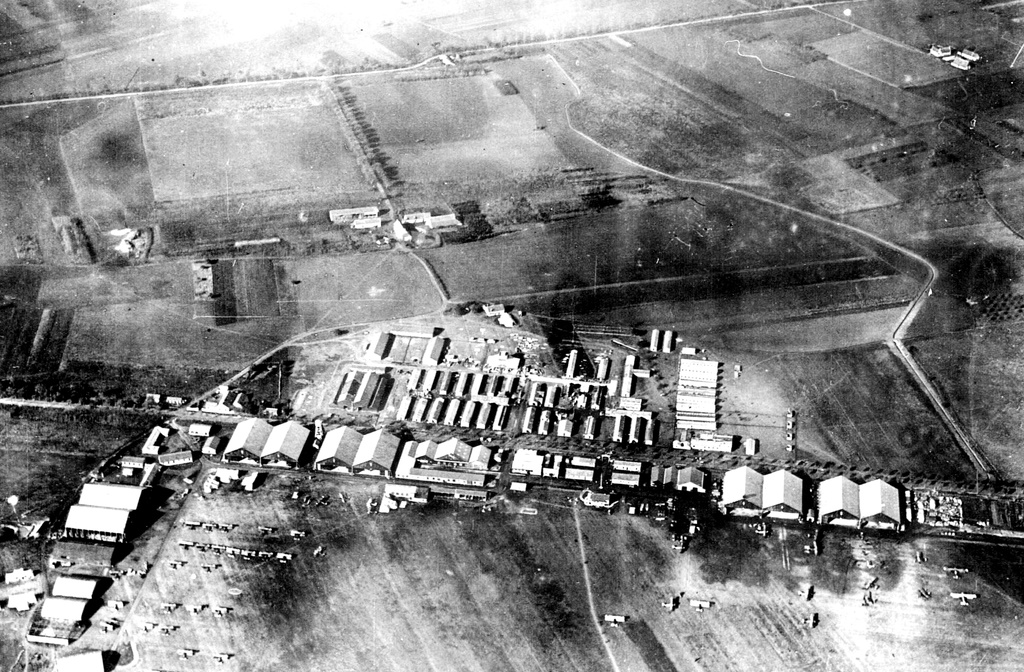
It was 2200 when I hit the high road near Souilly – back thru Bar-le-Duc – soon after, a flat tire – and not long after, another one – the last so I made up my mind to limp in on the rim, over 40 km. Off to the left, I could occasionally see the quick sharp spark that indicated field guns in action – star shells – and from time to time, a fusée (rocket) in front of me and to the south. I saw six bright lights on the hill at the Epiez Airdrome, pointing north and into the wind. At the same time, a motor sounded overhead, and soon the light on the machine appeared, it turned up the valley, gradually came down, circled behind the lights, dropped its flare to show it was a friendly plane, then apparently landed. At 0500, I was home.
March 24 (Sunday). Thanks to my absence yesterday, this beautiful spring Sunday has been a busy one – a thousand papers had accumulated – finally at 1700, I broke away for a walk. News of the battle is what might be expected – the Germans have advanced 5 or 6 km in some places.
March 25 (Monday). Took Chas. Manly, who built the motor on Langley’s aîrplane, another Curtiss man, and Capt Tilt, all sent over here on behalf of the Aircraft Production Board (Established May 1917, superseded by the Aircraft Board, October 1917, acted as a clearing house for proposals concerning the aircraft program: (purchase, production, and manufacture of aircraft and aircraft accessories), visited the Epiez and the Rozières airdromes and stopped at Amanty for lunch with Anderson and the 1st Corps School – saw their new biplace Spads, one of whose 220 HP Hispano-Suiza engine is already out of commission. We returned via Void, Toul, and Ochey where we took over the damage done to the British plant by the Boche bombers. The Boches has advanced 25 or 30 km – I wonder if he is going to break through and destroy the British Army. It does not seem possible – and yet if the Boches does not, it means he has lost the fight, and perhaps the war.
March 28 (Thursday). A board of which I am president, visited a proposed airdrome sîte this afternoon at the Farm St Anne south of the Toul-Nancy Road. Boche planes had been over the place in the morning and again early in the afternoon, so the air was pretty busy with French planes when we arrived. A beautiful broad road runs thru the woods and across the neck of the plateau between Pierre and Sexey-les-Bois. Evidently, this has recently been fitted up, in case the troops had to occupy the heights on the edge of the plateau overlooking the Meuse River. During the past week, there has been a great movement of troops from here and thru here, going west. The roads to the west are so crowded that traveling is slow work. Maj Lyster, Maj Wardwell, and Maj Miller of the Construction Department are with us for a few days. It seems absurd that after nearly 4 years of the war, the Boches should be the ones making a great drive and the Allies on the defense. It must all end just one way, but at this rate; the end may be far off.
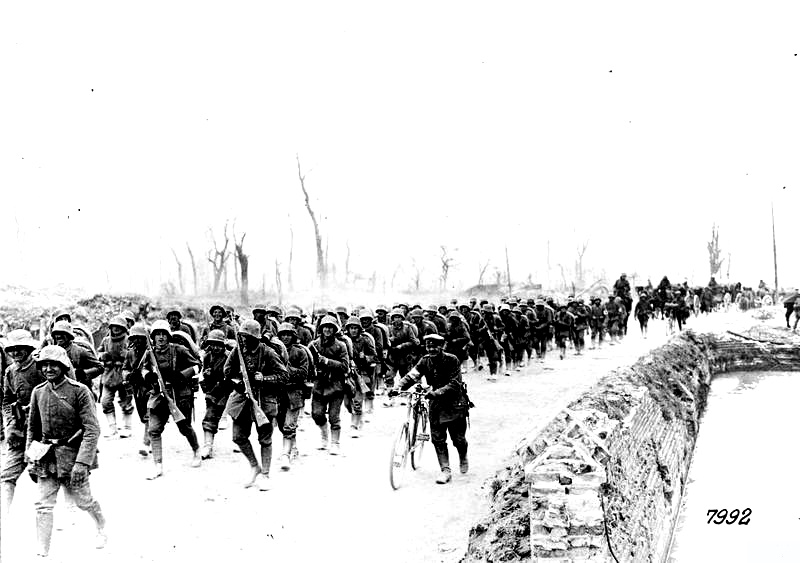
March 31 (Sunday). Yesterday morning we were treated to an interesting sight. The 26th Division went thru on motor trucks going to the front to relieve the 1st Division which goes over toward Amiens to take part in the great battle with the Boches. Truck after truck rolled by loaded up with our men – happy and ready to exchange a smile or a jest. This division has just recently come în from the Soissons sector where it was on the front for its battle training. Maj John Greenway, one-time Yale pitcher and end-stopped for lunch with us yesterday, joining the Engineers of the 1st Division. Lt Col Fravel of the Balloon Section was thru here, I took him to Neufchateau to see Col Mitchell but missed him. The youngsters had quite a party last night in the Mess – Jennings, Fels, et al., Page dined with us and joined us in a game of bridge – amusements are few and far between.
(The 26th Division was the second US combat division in France, its headquarters having arrived on October 23, 1917. Some of îts components had arrived as early as the last 10 days of September. The division was the first of the 35 National Guard divisions to reach France)
April 1 (Monday). Yesterday afternoon, the Board visited a proposed airdrome near Charmes and turned it down. Tonight I dined and played bridge with Page, Wardwell, and Joralemon at the 1st Air Depot. Troops on the move, keeping (sic) going thru here on the way to the front. My landlord, looking at some of our 26th Division men going by in trucks thought they were all picked men and ‘beaux garçons’ (good-looking fellows). Van Horn was away for several days leaving me in charge. Today I was up against the proposition of sending the 1st Aero Squadron under Royce to Ourches, to operate by the 4th under an ultimatum of GHQ, or prepare it to go to the Somme to take part in the big battle which still goes on. The rain has helped to stop the Germans but principally the fact that the Allies’ artillery has now reached there and taken up its position in strength, and the reserve Ally divisions are rapidly coming on the ground.

April 2 (Tuesday). To Ourches in the morning to meet Royce and see whether possible to comply with GHQ’s ultimatum to get the 1st Squadron to the line. It Tooks as tho’ a miserable little detail – telephone connection is the only thing to stand in the way. On my return, found a word to go to Balloon School. Stopped at I Corps HQs (I Corps was formed on January 20, 1918, under Gen Hunter Liggett), to see about phones for Ourches – Mitchell was not in, but saw Pulsifer and explained about getting Squadron to Ourches – then saw Voris about phones. Maj Hubbell is there looking situation over now. The balloon school situation is surely mixed up. My advice was for Mygatt to go to Tours and settle it.
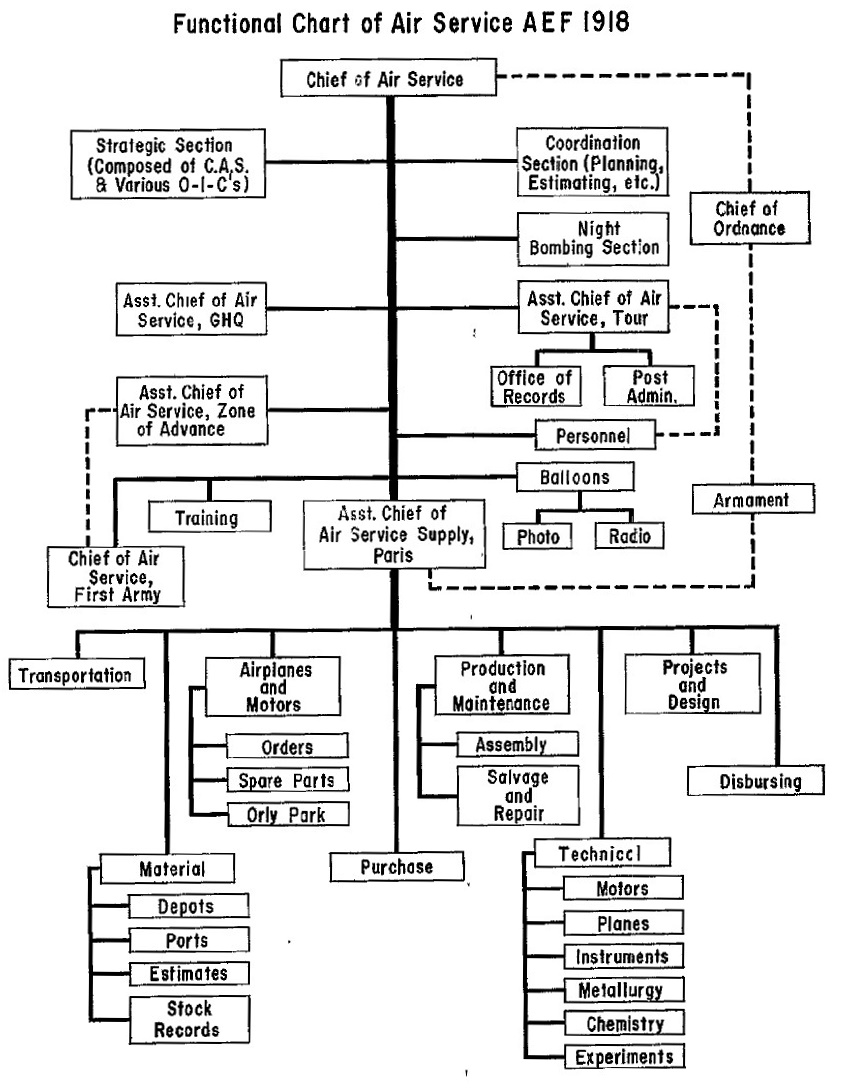
April 3 (Wednesday). Looked over W. D. Smith’s organization tables and diagrams which cover the walls of his office – a beautiful mural decoration. Stopped to see Craig at I Corps HQs – missed the telephone people all around. A busy afternoon – dispatched aboard to inspect the 1st Squadron at Amanty – and phoned Royce to move to Ourches in the morning. I’ll get the 1st Squadron ready by tomorrow night if it can be done. Maj Hubbell phoned from Neufchateau today about the phones, I find it is Jimmy Hubbell who used to ride around the Congregational Church Mansfield, Ohio when he was a small boy – on his velocipede – son of Dr. Hubbell, the minister.
April 5 (Friday). A phone message from Chaumont yesterday afternoon said Col Day was on his way from Chaumont. It proved to be Van Horn and Monell but prevented my getting to Ourches and Neufchateau. However today we all went over and found the 1st Observation Squadron installed – took Royce to I Corps HQs and reported the 1st Squadron ready for service (1st Squadron flew its first patrol over the lines on April 11). Dined with Van Horn, Monell, and Maj Watson, who is studying psychology or something of aviators.

Editor’s Note
The second German offensive of 1918 was the Lys offensive, April 6 – April 27. The enemy’s attack, between Langemarck and La Bassée, was designed to split the British forces away from the French and to destroy the British as a preliminary to rolling up the French. The Germans repeatedly broke through the thin British lines but were never able to exploit their successes, and the Allied defenses were soon stiffened by the arrival of British and French divisions from the now-quiet Somme Front. The Germans narrowly missed a great victory. Again, American troops played a very small part in the battle, with only two Engineer units and the 28th Aero Squadron (all attached to the British) seeing action. No other Air Service units participated in the Lys affair. However, during the period the 94th Pursuit Squadron, flying French Nieuports, began active service at the front on April 4, flying from Epiez, and moving to Toul on April 7. On April 14, two 94th Pilots, Lt Alan Winslow and Lt Douglas Campbell, each shot down an enemy plane; on April 11, the 1st Aero Observation Squadron began operations over the front from its base at Ourches, southwest of Toul; and at the beginning of May, the 95th Pursuit Squadron went into action, also from Toul.
Thereafter, a steadily growing number of Aîr Service units entered combat; however, under orders from the Allied High Command, they flew almost entirely in the quiet Toul sector and so were not directly involved in the Allied air operations against the great German offensives of the late spring and early summer until the 1ast of those drives, which began on July 15.
April 10 (Wednesday). Several airdrome hunts have taken the Board out the last few days. This morning Monell, Joralemon, Capt Dudoré, and I called on Capt Etournaud at Mirécourt and received some interesting information on the result of their hunts. They are to give us maps showing possible sites, from which we can select those best located. The great offensive began again and the Boches are gradually pushing ahead – he is only 9 miles from Amiens now and it looks as tho’ he would get it. Where do (sic) all his manpower and fresh divisions come from?
April 13 (Saturday). Jouett came in yesterday; going up to see Baker Company (Balloon). Maj Huffer, in command of the 94th Pursuit Squadron at Toul (after the American combat units moved into the Toul area during April, Mitchell moved his I Corps Air Service HQ from Neufchateau to Toul), came in yesterday. This, our first pursuit squadron to go to the line on April 4, is now operating with its Nieuports. Lufbery is with it and brought down his 1st Boche yesterday morning just over the line northwest of Nancy. (Lufbery never received official credit for this victory. If he had received the credit it would have been his 18th, not his 17th, as he was credited with 17 victories while with the Lafayette Escadrille; also, the
victory would have been his first with the 94th).
There are some young Boche pursuit pilots across the line and our men expect to have some easy victories. One of the 1st Aero Squadron Spads flown by Lt A. J. Coyle was attacked yesterday north of Toul, but dove and got away. Van Horn & Monell left today for Chaumont and Tours, leaving me on the lid.
April 14 (Sunday). Just as I arrived in Toul this morning at about 0900, word came in that two Boches were down outside of town. I rode on out, past hurrying crowds, to the airdrome where our 94th Pursuit Squadron started to operate a couple of days ago. Met Maj Huffer, the squadron commander, just starting in with the two Boche pilots – one a nice looking young fellow over 20, who, when I asked ‘official?’ in my best (or worst) German, replied in perfect French je suis adjutant. The other was a big husky typical German, 24 years old – 1ying on a stretcher placed across the doors of the car. His face was badly burned, his legs too, and one ankle had an ugly break. As he was suffering, I told Huffer to hurry on in and turn them over to the French.
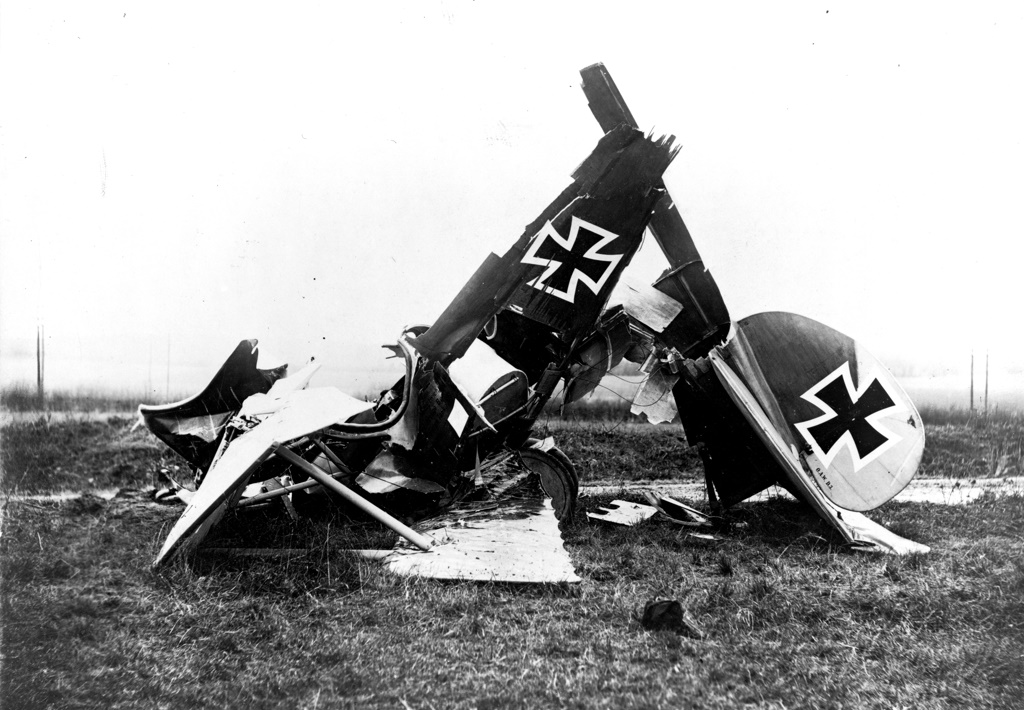
At the side of the airdrome, or just across the road from it was one Albatross; it had evidently turned over in landing as the top surface was damaged and the top of the tail broken. Campbell, the pilot who brought it down was there – souvenir hunters were already starting in. On a field on the opposite side of the airdrome, were the smoldering remains of the other Albatross. Marr explained that an alert came in over the phone, Winslow and Campbell jumped into their machines and were up just in time to meet the two Boches who were lost (it was not very clear) and thought they were over Metz. Winslow and Campbell attacked them at 200 meters. Winslow got the first and brought him down with a few shots from his machine gun. Then both went after the other, Campbell set fire to his gasoline tank with a bullet, and brought him down in flames.
(An account of the Winslow-Campbell affair which appears in Rickenbacker’s Fighting the Flying Circus, differs slightly from Lahm’s account, as does Winslow’s own account given in Sweetser, American Air Service. All accounts agree, however, on the two important points: that the victories were the first by American-traîned pilots flying with an American Air Service unit, and that Winslow got the first of the two German planes. Recent research by Dr. Maurer Maurer of the USAF Historical Division has shown that on February 5, 1978, 2/Lt Stephen M. Thompson, a member of Maj Ralph Royce’s 1st Aero Squadron, while on a one-mission loan to a French bombing unit as bombardier-gunner, shot down a German plane near Saarbrucken. Thompson, therefore, appears to own the distinction of being the first American in a US Army uniform to bring down an enemy plane in aerial combat; at the time, however, he was flying with a French unit even though he belonged to an American unit, nor was he a pilot).
He was lucky not to be any higher than he was, or he would have
been completely burned up before he got to the ground. Naturally, all were enthusiastic and the spirit of the 94th was at a high pitch. These are the first Boches brought down by our own American-trained pilots. I picked up Paegelow and Jouett and went on up thru Commercy to Lahaymeix where we found MacCawley, Wrenn et al and Dog Company 2nd Balloon Sqdn all installed and their balloon inflated. Capt Bérard met us with the observers from the other company (81st) and airplane observers from a squadron of the 2 Army Aéronautique.
After lunch, we took MaCawley and went on to Div. HQs – saw Gen Bundy, Preston Brown, Duke Bridges, Pearson (asst. adj. general) et al and arranged about Dog Company. The General invited me for dinner, then told me the following interesting story. Three companies of Boche shock troops raided the 9th Infantry Regiment just north of St Mihiel yesterday and started back across No Mans Land with 25 of our men as prisoners. Our men decided not to go, one jumped to one side, knocked down his captor, took his gun, and killed him. A free for all fight followed, at the end of which our 25 men all returned to our lines with 8 of their captors as prisoners, and leaving a pile of dead and wounded Boches on the ground. There is no need for comment – the Boche must begin to think he has run up against a real man in the American soldier. Unfortunately, 250 marines were done up yesterday in a gas attack because they took off their masks too soon.
Note
This archive is so huge that I have to cut it into 2, 3, or maybe 4 parts.
This is the end of part one.
