March 3 (Sunday). Took Lt Jennings and Mr. Eaton with me and reached Baker Company at about 1100. Found Paegelow there. Butler had relieved McFarland in command by Mitchell’s order. French Company was to leave tomorrow. Went on and had lunch with Frank at Beaumont. We visited the detachment of 70 men which Capt Quesenberry, Lt Gallagher, and Lt Daley are to take over to raid the Boches. Frank read them the order of the French 32nd Corps Commander praising the work of the battalion a couple of days ago when they killed 2 officers and about 15 men of a Boche raiding party. Clémenceau and several generals were out this mornings decorating five of our officers and men for their good work. Item Company’s first sergeant was in a dugout and was told by a Boche officer to come out. As he did so, the Boche threw a hand grenade that blew off his helmet – then the first sergeant put two pistol bullets thru the Boche officer’s chest. All the raiding parties for tonight are in fine condition. For ten days they have been practicing on a model of the Boche trenches till every man knows just where he is to go and what he has to do.
We dropped in to see Lt Col Griffith, commanding the 3rd Battery. He was in the Philippine Constabulary but is not Col Griffith I knew there. A French lieutenant of the Moroccan Division is acting as an expert adviser in preparing for the raid. He has already made six himself, one of them about where the 18th party goes over tonight and is covered with medals, ribbons, palms, and stars. At 2100, we went down to Lt Col Elliott’s dugout în Seicheprey, to see that the final preparations were complete. The raiding detachment came thru at 2300 and was given a good hot cup of coffee apiece. They were a fine-looking lot – not one but showed he was ready and eager for the zero hours to arrive. Some were smiling and light-hearted, most of them serious but determined, – not one showed a sign of faltering. One came up to Frank and handed him 75 Frs to keep for him, as he did not want the Boches to get rich off of him. His name was McDonald of How Company.
At 2330, they left their overcoats in the dugout and filed off in the black darkness for their positions in the first-line trenches. I dropped over to see Pearson Sands in the adjoining shelter. He commands an artillery battalion. At 0005, five minutes before the appointed hour, a phone message from Quesenberry said it will take another hour and a half to complete the arrangements, the tubes are not in place! The engineers failed to get the two torpedo tubes out that were to cut the wires and let the two sections of the party thru. It was too late to hold the artillery – and five minutes later the latter cut loose. For 30 minutes it rained shells on the Boche lines – no one will ever know how many it killed.
Then, for 15 minutes more, ît continued a gradually slackening fire. All we could do was sit around and feel alternate like turning a barrage on our engineers, then kicking ourselves. A phone message from the 16th Infantry Regiment said exactly the same thing had happened over there and their party could not go over. The Boches’ artillery response was very feeble. At 0200, the show was over. Frank put it about right when he said it was an amateurish attempt at something our people did not know how to do. I left at 0330, in a driving snowstorm with Hoods and another correspondent, reaching Colombey at 0500 on Monday the 4th.
March 4 (Monday). Van Horn and Monell are away today, so I am holding down the lid. Hayward, the balloon supply officer reported today and is attached to the 1st Air Depot.
March 5 (Tuesday). Launched with Milling at the Training Section Mess – after trying to straighten out the location of personnel with him, took Dennis Currie and ran over to Bar-sur-Aube to talk over the instruction of Artillery observers with Churchill. We dined with Bev. Browne et al in their chateau and ran back to Chaumont after dinner.
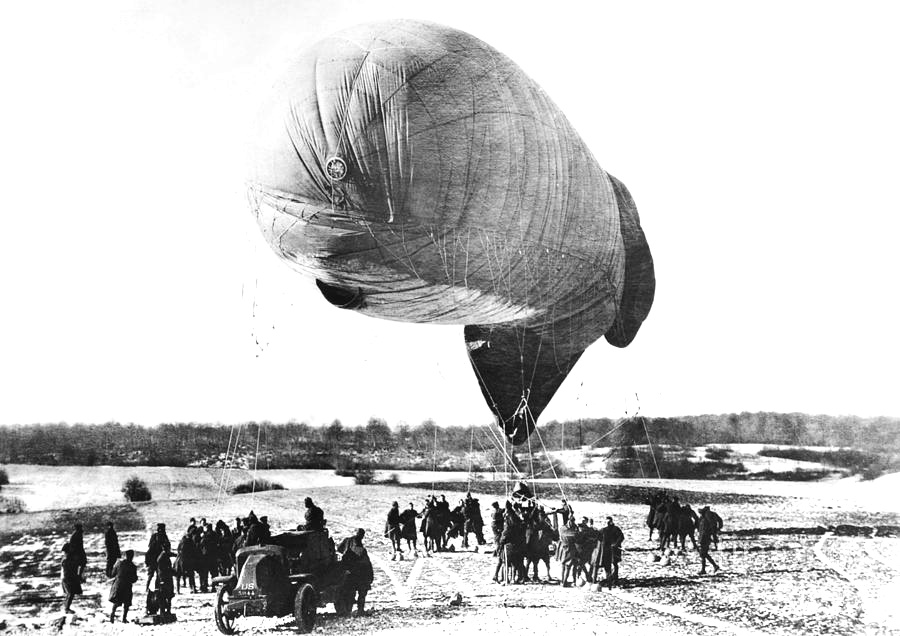
March 3 (Wednesday). In the Fiat for Le Valdahon. Thu Langres (at Langres were located a number of AEF schools, among them the AEF Staff College School, the Signal Corps Radio School, and the Intelligence Officers School), behind a moat and thick walls up on the top of a hill which must give a beautiful view in good weather. Some of our young officers were out for infantry instruction – armed with rifles. Thru Gray and at 1140 reached Besançon, folded into the hills where the Saone River comes thru. We stopped at the Restaurant Verguet (on Churchill’s recommendation), în a courtyard in the middle of the town. Drank a bottle of Chateau Chalon which is the noted ‘vin du pays’. On reaching the higher country after leaving Besançon, the sun came out and when we approached Etalans, the French 84th Balloon Company stood out in front of us. Cit. Montgomery and Payne came by on their way to Bourbon. They were curious to see the balloon, so I took them to the Company and found Lt Crivelly, the Australian, Lt Babcock of the 51st Brigade, now an asset observer instructor. I took Montgomery up for a half-hour to initiate him into the air. It was a beautiful day for it – perfectly clear for miles, with dozens of little villages around us, the Camp du Valdahon not far away, the gun emplacements and targets showing up black in the snow.
A trench mortar battery was firing, the smoke of its bursts plainly visible – and large black spots in the snow where the shells were falling. But the climax of the setting was the line of snow-white Alps way off to the east, with their bases and summits standing out, a line of haze halfway up. They had to call us down by telephone or we would have stayed up till dark. A lieutenant showed me his School-rooms, etc., his own homemade hangar for the balloon – met our 2nd Brigade Observers who are being trained in the Company Babcock mixed a punch which we drank to him and the Australian Lt Crive11y who had slipped one over on the Company commander by each jumping with a parachute in the morning. I suggested ‘4 jours de salle de police’ (four days in the guard room) for Babcock, the Australian is to lose a ‘permission’ (leave) and Paris, but we drank their health just the same.
Reached the camp at Valdahon late – found Gen Irwin at his quarters – Bowley, Tommy Merrill regimental commander, Hyatt now an artillery captain, John Black who has been an assistant instructor and will probably leave with Bowley’s regiment, Breuster is now an lt col. I have heard of the Artillery Firing Center here, but the half was never told. Beautiful stone and cement buildings, steam-heated (altogether too much so for me, after living in the chilly houses of Chaumont and Colombey – good beds, running water, electricity. Over 300 officers were in the mess.
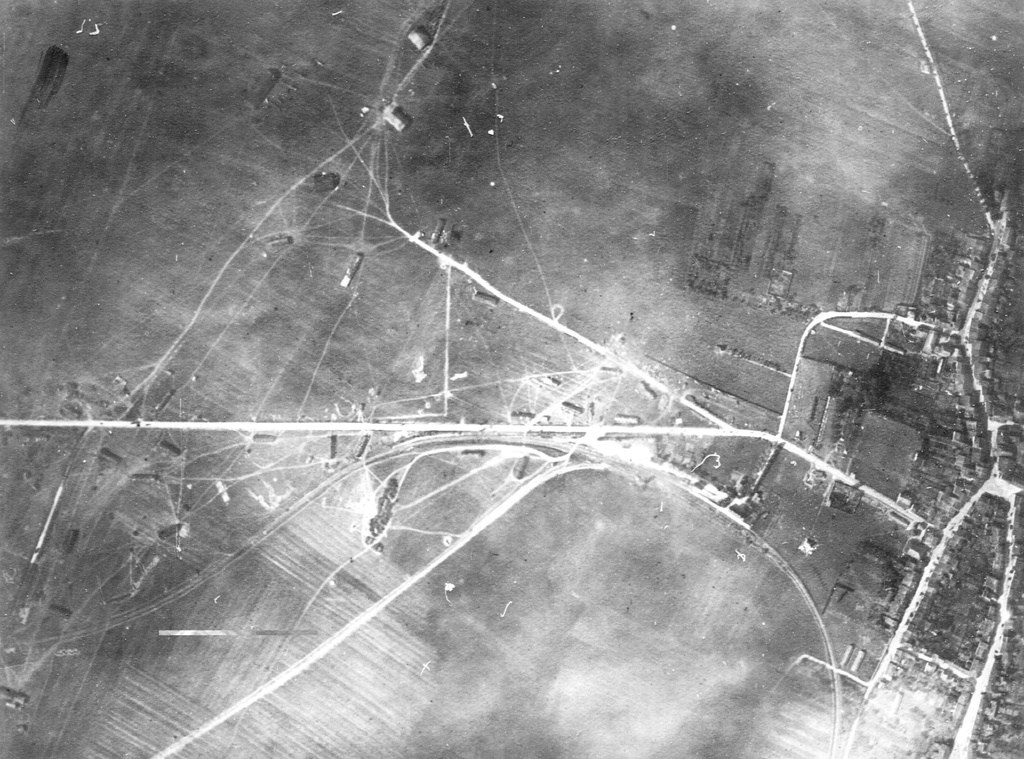
March 7 (Thursday). Capt Lambert of the French Mission took me over to the flying field, where I met Lt Quir Montfollet who showed me over the installation. Left Valdahon, stopped in Chaumont to see Milling (Hoffman there} – dinner at Neufchateau at the Allied Officer’s Club. Paegelow, Miller, Hall there. Left at 2115 and 7 kilometers out was held up by a locked rear wheel, the result of a bad emergency brake, as I had a good driver, at the end of 3 hours he succeeded with some assistance in removing the brake and we limped into Colombey at 0100.
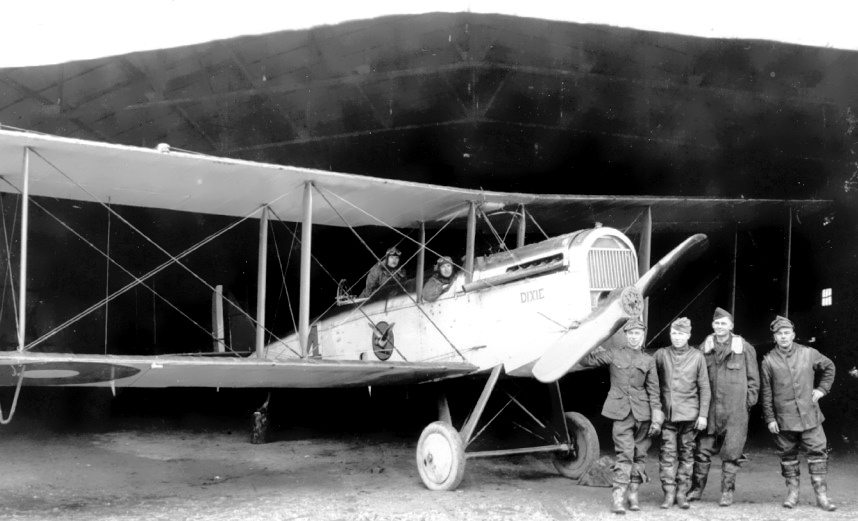
March 10 (Sunday). Capt Huntington, Joralemon, and I stopped in Tantonville and talked to Col Dickie, the British Royal Engineers about the construction of their airdromes. The British put in an elaborate system of underground drains, and are using large numbers of East Indian laborers – it takes a very large number. Outside of Tantonville, we visited a British airdrome where we saw photos the squadron took yesterday showing the burst of their bombs in Mainz where 11 of their D.H. 4’s went on a raid yesterday. All their machines returned safely and were not bothered once by either Boche planes or antiaircraft guns. We visited airdromes at Roville and Xaffevillers.
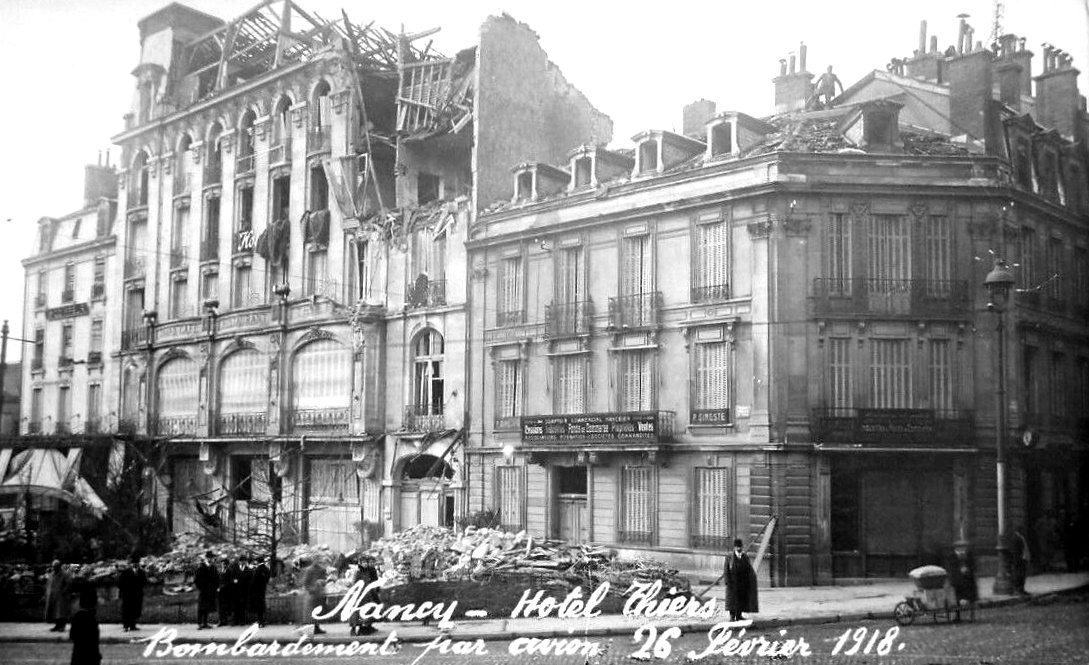
On thru Lunéville and up to Nancy. The Boche bombs tore up this place in their raid a couple of weeks ago. Several houses are completely demolished – one bomb appears to have just about force enough to demolish one house and break the windows of all those in the vicinity. Except for the demolished houses, Nancy presents a gay sight on this bright and balmy spring day. The streets are crowded with officers, soldiers, and civilians, the latter mostly women necessarily. All the cafés are crowded – we stopped to look at the beautiful Place Stanislaus, the showplace of the city. Ran back to Colombey in a little over 3/4 hour. Foulois came in today – saw him at Van Horn’s this evening. The end of a perfect day (unless the Boche’s bomb us tonight).
March 12 (Tuesday). With Capt Huntington, we ran over to see Ourches. (Ourches became a major airdrome for observation squadrons). Capt Maguire is in charge of construction – it will soon be ready for our ist Squadron (observation). (Construction was something of a problem, but once the 1st Squadron had moved in there should have been no maîntenance problem, for – according to its Maj Ralph Royce – the 1st had quite a reputation for scrounging. At Amanty it stole an entire barracks building, piece by piece). Vaucouleurs, not far south of it, has 2 constructing officers, and a Wisconsin Machine Gun Company landed just before we reached there. Work will begin at once for our pursuit group.
March 13 (Wednesday). Left at 1300 for the French 8th Army. At Flavigny I stopped and met Maj Delafond, Commandant Aéronautique of the 8th Army. As Commandant Perrin was away, I met Lt Lemoine at the Hotel d’Angleterre in Nancy, who took me to visit his balloon No. 58, the only one in the sector. Lt Nixon and Lt Gould of the US 67th Artillery Brigade are under instruction here. From here, we passed thru ruined villages and passed many scattered soldiers’ graves, the witnesses of the September 1914 times. At Maixe, we found the 73rd Balloon Company to with Lt Neibling and Lt Lindeman of the 67th Brigade, both very enthusiastic over their work and glad to be in the Balloon Service. From here, we ran into Lunéville where I stopped at the 42nd Division HQs – saw Lt Col Hughes, Asst Chief of Staff; Col Douglas MacArthur, the Chief of Staff who was mildly gassed during a French-American raid on March 9, is laid up; Capt Powers, the acting Division Adjutant, proved to be the former 7th Cavalry sergeant major. Jim Shannon was there temporarily on an inspection tour. Gen Menoher was not in. Ran Lemoine back to Nancy and got home in 2030. Charley Thompson went thru here today. He is handling Air Intelligence at GHQ.
March 14 (Thursday). The Boches treated us to a little long-range divertissment (sic) tonight by bombing Pont St Vincent.
March 15 (Friday). Left with Commander Jenkins of the British Navy, who had spent a long time in the US buying aîrplanes for the British Government now Lord Northcliffe’s representative in France, and going back to the US shortly. To Arcis-sur-Aube where I took over our night bombardment airdrome that is to be. Then on into Mailly. Stopped with Gen Coe (Murphy away at Nice, recuperating from the grippe) and had an interesting discussion in the evening over the war and what will end ît – Gen Chandler thinks it will have to be done by going after the submarines at their bases and the bombing squadrons at their bases.

March 16 (Saturday). We went with Ayres, one of Gen Coe’s aides, to see a 21-inch howitzer mounted on a raïlroad mounting. It is a tremendous weapon, and shoots a 3500 lb. projectile, to a range of 19 kilometers (about 12 miles). The recoil is taken up by the whole mounting moving on the car – the latter moves about 6 feet every time the gun is fired. At Haussimont, I found Dog Company, 2nd Balloon Squadron with Lt McCawley in command, The Company is in artillery barracks and occupied în putting up hangars for our airplane squadron at the same place. The squadron consists at present of 2 non-flying officers and 100 men. No machines. The French squadron is still here and training some 18 artillery observers. Our balloon company is an enthusiastic one – now that they have their equipment, they hope to get into operation.
We lunched with them – then on to Fère-en-Champenoise, thru the region of the Battie of the Marne. What country for fighting, and particularly for killing. Open fields, fairly level, woods on the edge from which the Boches mowed down the French lines. At Fère we turned north toward Villeneuve, passing just east of the Marais de St Gond (swamp) where the hardest fighting took place. We could see the Mondemont Hill off to our left. Evidence of the fight that told the story better than anything else, were the graves – single, in pairs, in groups, in places a long lîne with a single cross in the middle – evidently, a trench had been dug and filled with bodies. As we went north, the French insignia on the graves changed to plain black and white separated by a diagonal, which indicates German. ‘Un officer Allemand inconnu’ (unknown German officer), or ‘Un Soldat Allemand inconnu’ (unknown German soldier) was the usual inscription – all the graves were extremely well kept, with a wire stretched around – many of the French had wreaths on them.
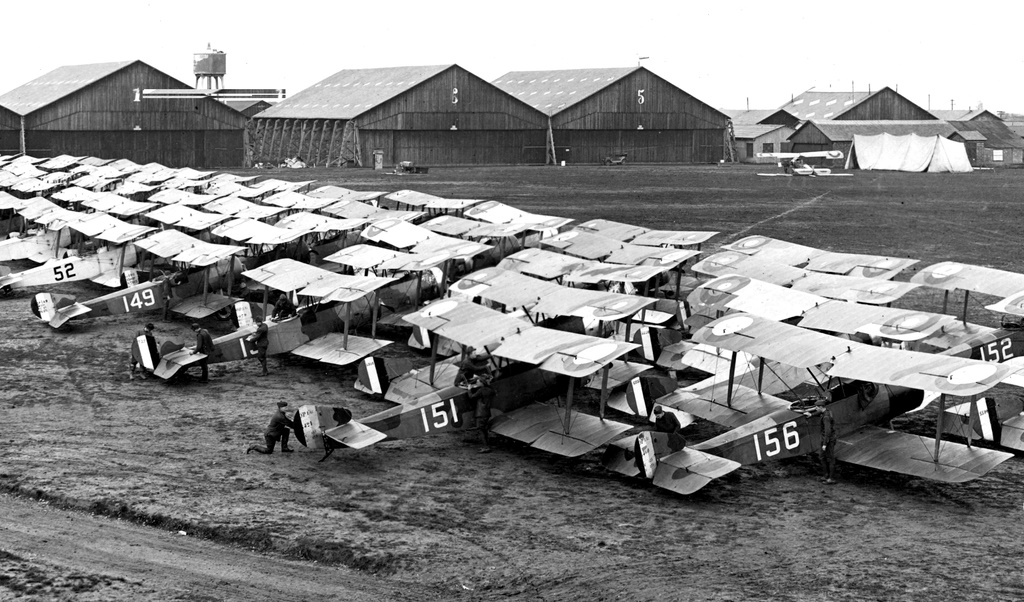
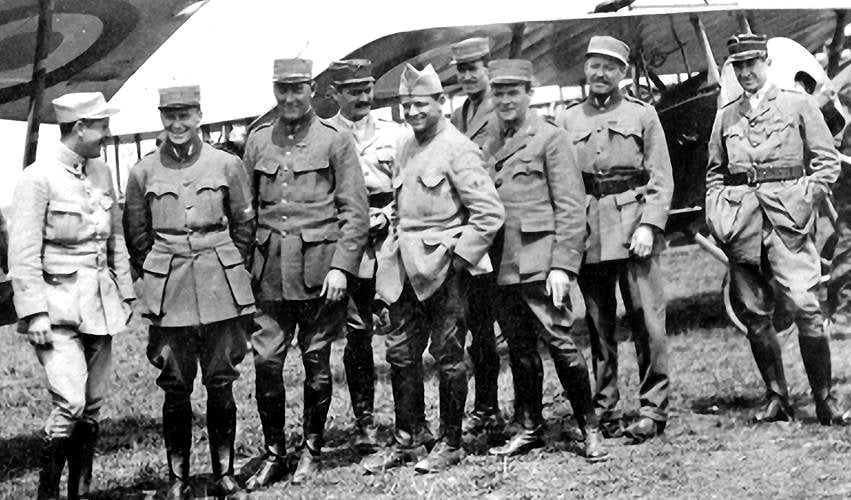
At Villeneuve, we found Atkinson in command of the 1st Pursuit Organization and Training Center, with Davenport Johnson, Philip Roosevelt, etc., and the 94th and 95th Squadrons (The Air Service fighter build-up had begun in February 1918 when the 94th and 95th Pursuit Squadrons arrived in France. Because of the lack of combat planes and/or guns neither unit flew an armed mission until April, at which time individual members flew an occasional combat sortie in a borrowed French fighter plane). They are all good flyers – one of the squadrons (94th) has the Type 28 Nieuport with 150 HP Rhone engine, and the other, (95th), has no machines as yet. This is the center of a French combat group, the Ménard, and our men are patrolling with them, getting valuable experience. Johnson told us of his flight with Capt James E. Miller when the latter was lost. They had attacked 2 Boches, Johnson’s gun jamed, a Boche drove Miller down, and he did not see him again (Miller, badly wounded, died on March 10, in a German hospital. He was a member of the 95th Aero Squadron. He made the flight with Johnson in a borrowed Spad on March 9). We had a beautiful evening ride into Chalons, tho’ the last 10 kilometers on a flat tire. Stopped at the Hotel de la Haute Mère Dieu, where Jenkins and I had a beautiful front room with a bath and hot and cold running water – too good to be true.
March 17 (Sunday). To Cuperiy and found Mygatt just starting off for a trip to the front. We joined him – at Suippes and met Capt Noyes of our engineer reserves, putting in 10 days with the French Division. Took the Souain Road out of Suippes – this is in view of the Boche trenches, so is heavily camouflaged, with cloth along the sides, and strips hanging vertically across the road every few yards. Numerous flaps cut in the cloth let the air through. Before reaching Souain, We left the car and walked about 1 Km across the country behind a line of artillery emplacements and dugouts, to the CP of Lt Col Breton, coming to the French 74th Infantry. I remember this right as the Rouen regiment of 24 years ago and the Colonel said its depot is still there. We were guided thru the trenches dug into Souain, now merely a pile of stones, with a graveyard at one side. At the east end of the pile of stones, we came to a broad stairway leading down into the ground. A doctor met us and asked us to wait until they started the gas motor which operates the electric lighting system. In a moment we were led down and thru a whole series of tunnels, sheet iron lined, and painted a clean white.
 This is a forward dressing station of 60 beds. Leading off from the maîn tunnel are numerous smaller ones, some just wide enough for two lines of 4 beds each, head to foot with a very narrow passage between; one was the dressing room and I thought the dressing table still looked rather red, another the linen room with piles of clean white linen, another the quarters of 2 doctors, another where the gasoline engine operated and all as white and neat and clean as Lakeside Hospital – only underground and all very cramped. We returned and lunched with Col Breton and staff, then had a good view of the front-line trenches from an observation post near his HQs. Jenkins and I returned to Cuperly, then over to La Noblette where Thaw was just sending his Lafayette Squadron off on patrol. This is now an American Squadron, the 103rd Aero Squadron, and is working very well with the Villeneuve Group, the US 1st Pursuit. Capt Collins of the Squadron, who was killed the other day when they were on their way to cut off the Boche machine that bombed Paris, is the youngster who came into my office în Paris last November dressed in a blue ‘poilu’ (French Soldier) uniform about twice too big for him and said he had just lost his clothes and everything he owned when their quarters burned up in the middle of the night near Dunkerque. They all say he was a very clever flyer and was rapidly making his mark. After a confab with Thaw about the transfer of some of his pilots, and a cup of tea with Marr, Hi11, Soubiran, and others, we left at 1800, took the old Roman Highway past Attila’s Camp (The great Hun leader, defeated by the Roman-Allies army under Aetius nearby Chalons, 451 AD) thru a beautiful stretch of country to Bar-le-Duc. This is a favorite Boche bombing ground, and many buildings in the middle of the town are demolished. A missing window pane in my room, a souvenir of the Boches’ last visit, made it chilly when I turned in.
March 18 (Monday). As Jenkins is not an early riser, I had time to get my breakfast and make some purchases including a dozen glasses of the far-famed Bar-le-Duc gooseberry preserves. At 1000, we left for Colombey – stopped to watch the 16th Infantry drilling in the fields met Col Hines on the road, stopped at Frank’s Parker HQs at Treveray; he was lecturing to two of his companies at the Y.M.C.A., s0 we went on into Colombey, after four perfect spring days spent in the most agreeable way I know of, motoring thru sunny France and seeing the interesting sides of the Great War. Chandler and Bérard arrived at the same time we did – on a trip around the circuit. In the evening I called Van Horn’s and met a Mr. Larned and a couple of others, out of Secretary Baker’s party who are supposed to be gathering information. They visited Baker Company today and each had a trip in the balloon.
March 19 (Tuesday) Pursuant to a telegram from the Chief of Air Service (Foulois) and as a result of Col Mitchell’s criticism of Baker Company, I took Yon this morning and made a thorough inspection of the Company. About 1500 while în the basket trying out one of the observers, I saw some cars stop below and when we got down, found Secretary of War Baker; Gen Harbord, Chief of Staff; Gen Bullard, 1st Division Commander; Gen Buck, 2nd Brigade Commander; and Gen Summerall, 1st Artillery Commander. Secretary Baker was very much interested in hearing about the balloon, and when I told Gen Harbord about our shortage of men, he told me to call him Thursday on the phone and he tho’t we could get some from the Division. A rain storm came up at this minute so they went on up toward the front, the balloon was put away, then Yon and I returned home. Joralemon and I dined at the French Mission mess tonight with Armengaud, Yon, Fleury, Lemoine, and Pepin.

Editor’s Note
There were five German offensives on the Western Front in 1918. The first of these was the Somme Offensive, March 21 – April 6. The German attack, on a 55-mile front between the Scarpe River and the Oise River, had as its immediate objective the capture of Amiens. The assault involved practically the entire British Third and Fifth Armies and the extreme left of the French; before the Germans were stopped they had driven a salient almost 40 miles deep into the Allied lines and had come extremely close to splitting the British and French armies. However, they were not able to take Amiens. During this offensive, two events of major importance occurred. One, the Allies established genuine unity of command when, on March 26, they gave Gen Foch (France) authority to coordinate Allied activities, an authority which was strengthened on April 3. The other, on March 28, Gen Pershing arranged for the American 1st, 2d, 26th, and 42d Divisions, then training în France, to move into the lines; however, the 1st Division was the only one used for the time being, the others being placed in quiet sectors where they relieved French divisions. Actual American participation in the Somme Offensive was very limited, consisting almost wholly of gallant defensive work by the 6th Engineer Regiment.
The US 17th, 22d, 28th, and 148th Aero Squadrons (these units and six other squadrons had been trained in Texas by members of the Royal Flying Corps) served with the British Royal Flying Corps during the operations but saw only limited action. Other units of the slowly growing combat Air Service were moving into the quiet Toul sector, which seemed to be a good place for blooding the new American forces.
March 22 (Friday). Armengaud announced this afternoon that the great German offensive had begun and that the British are being attacked on the southern 65 km (40 miles) of their line – the French in the Verdun sector. We discussed nothing else at the mess tonight, and after dinner walked out on the hi11 near the Depot to see what we could. It was a little misty so we could see nothing, but the guns kept up a continuous roar, apparentiy coming from all along the line in front of us, and to the east and west. Perhaps this means the end of the war – but who wins? No one can believe that the Germans can break thru’ – if they do, it means rolling up their line and isolating the whole British Army to the north. No doubt reinforcements will go from the French and it seems impossible that the Germans should succeed. The report says they have already advanced 3 or 4 km, which is to be expected in any large attack, as the front lines are usually only held temporarily for observation.
March 23 (Saturday). Off în a Johnny Walker – stopped in Commercy to call on Mr. Rene Grosidier, the Mayor, but he was in Paris. Arrived at Souilly just at noon, after two flat tires. Met Mr. Davison, head of the Red Cross and his party in the square as I came in. Just at that moment a Boche plane was over us, not very high and well surrounded by Archie bursts (AAA). We all stopped to watch it when another plane appeared which turned out to be a French one, and then we saw one of the most interesting of all sights, an aerial duel. The Boche was a two-seater, photographer probably, the French a Spad. The latter dived and attacked, and the former turned tail and opened up with his rear machine gun – the smoke from the guns showed us just when they fired. The Frenchman then went off to the side and circled to get his altitude, made another feint as if to attack, apparently changed his mind, and left the Boche to sail off home. Does not look as tho the French had much to say about the mastery of the aîr in this section.
Lunched with Maj Renaux (another old dirigible pilot like Néant) and the officers of the Aéronautique of the French 2nd Army. All much interested in the news of the drive on the British – the communique shows the Germans made an initial advance, as was to be expected, and that the British had pretty heavy 1osses, some 16.000 men, but the officers here say that at Verdun they lost 13.000 on a smaller front at the beginning of the attack in 1916, so the proportion is not bad. After lunch, we started north toward Verdun, picked up the sector commander, and then visited the Company where Lagen and Temple are under instruction as winch officers. This is not a good Ally air sector, Boche planes were over us more or less all the time. Lt Husson, the instructor in this Company, is half English and has been an instructor at the Naval Balloon School, Roehampton (England) so is well qualified to instruct our man here. Again running south of Verdun, we visited the French 81st Balloon Company at Ancemont where I found our 2nd Artillery Brigade observers – they had just arrived a couple of days before. Three additional ones, detailed by mistake are not at all happy. On to Sommedieue when I found Gen Irwin who had just arrived in the morning.
Arranged with him about the extra balloon and airplane observers being returned to their batteries. We had picked up Capt Bérard, the adjoint aérostier (balloon observation officer) of the sector, and I established the liaïson right there between our Artillery and the balloon companies. Waldo Potter, the Brigade Adjutant, and Hyatt came up. Stopped at the Division HQs, and talked to Gen Bundy for a few minutes – Citation Montgomery there. A flat tire stopped us, but Payne came along and gave us a lift to the 81st Company. I dropped Capt Bérard at the airdrome at Souilly where I found John Black and three of the other artillerymen detailed thru error to the observation airplanes. They received the news that they were to be relieved with mingled and widely varying emotions. One, in particular, said he had been applying for it regularly, had regularly been turned down, and now he does not want to leave at all.