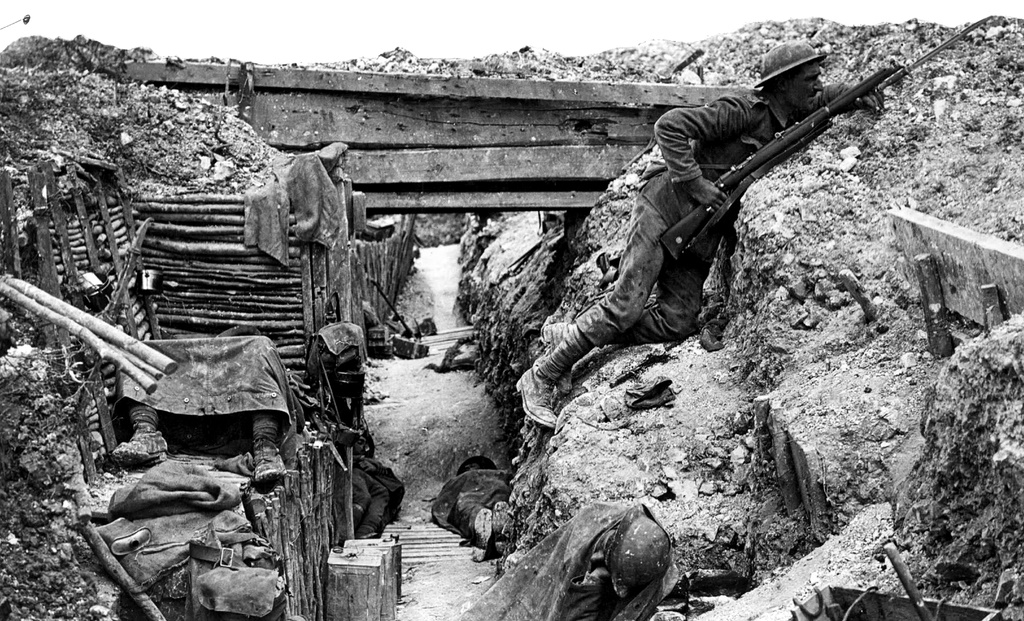
2. Combat and Pursuit (Chasers). The primary duty of pursuit was to secure and maintain control of the air, keeping it free of enemy pursuit planes so that friendly planes, balloons, and ground troops might operate without interference or danger from enemy aviation, and, concurrently, to drive the enemy’s observation planes and balloons from the sky and thereby to blind his command and his ground forces. In addition, the pursuit attacked ground troops with machine gun fire and bombardment. Pursuit planes were mostly single-seaters, carrying only the pilot, but some were two-seaters (biplace pursuit) with a pilot and a gunner; in either case, the plane was fast, maneuverable, and well armed with machine guns. The pursuit was the romantic branch of the air service. The aviation heroes of World War I – the ‘knights of the blue’, the ‘aces’, the Rickenbackers, Richthofens, Guynemers, and Bishops – all were pursuit pilots.
3. Bombardment. The bombardment was of two sorts, day and night. Both kinds normally used bombers, that is, planes that were specially designed for carrying a load of high explosives and which were larger, slower, and less maneuverable than pursuit planes and which had either one or two engines (occasionally more). Some day bombardment was carried out by observation-type planes, and even by pursuit planes, which bombed bridges. railheads, troop concentrations, trains, and other military objectives, and assisted in ground strafing. During World War One, bombing operations were almost wholly tactical in nature, being directed against the battlefield and the area adjacent to it through which troops and supplies were moving to the battlefield; they were not strategic (that is, they were not directed against the enemy’s sources of supply, population, and capacity to wage war) except on rare occasions, notably during the last few months of the war when the British Independent Air Force began to bomb well inside enemy territory.
On September 20, the British started an attack a few miles east of Ypres; the action was a part of what is generally known as the ‘Third Battle of Ypres‘. Fighting was very severe between September 26 and October 1 (the period when Lahm was in the area) – the German artillery assault of October 1 was unusually violent – and casualties were heavy, but no significant gains were made.

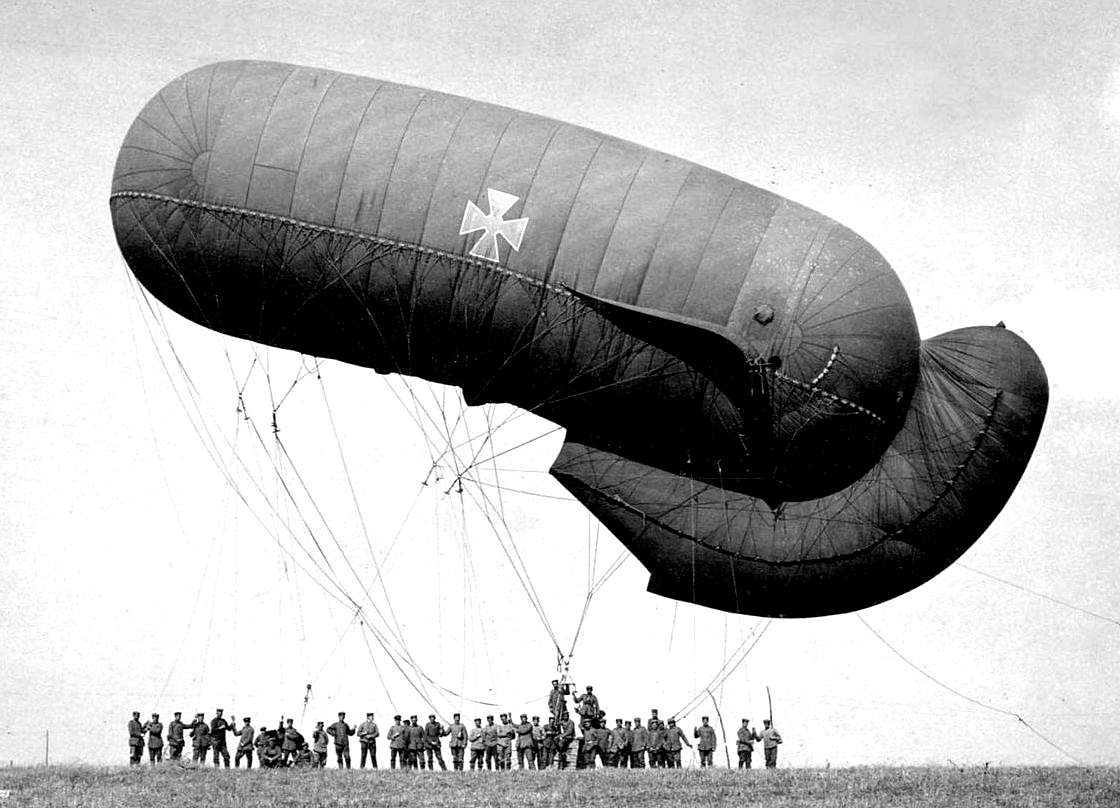
September 25 (Tuesday). Visited all five balloon companies and all but two sections of the eleven in the Second Army. The 47th section (11th Balloon Company) intelligence balloon was entirely in the open, unprotected, with no bed, and no ground cloth. It was interesting to see the different ways the different balloons were handled, Maj Neame came in from a high depot – in charge of all supplies to the Expeditionary balloons in France. Early to bed for the ‘big push’ tomorrow.
September 26 (Wednesday). This is the day of the drive. We were all wakened at 0500 for the start at 0650, but the visibility was miserable so we all went back to bed as we could see nothing. The push came off and was very successful. I talked about equipment with Maj Neame. Took a car and went forward on the Diekebush Road to Trois Roîs where the 47th intelligence balloon had pushed forward. While waiting there, a squad of 300 German prisoners came along, being taken to the rear. They looked in good physical condition as a rule, but were of all ages; from 20 or 21 to forty or more. The officers were less healthy appearing; one out of six or eight looked really husky. The officers were put into wire pens separate from the men while they stopped. As the detachment passed me, the odor was something to remember for a long time. I had heard of it, and it is not exaggerated.
Ambulances bringing in the wounded passed us. Aïrplanes were overhead all the time. This is the section (No. 47) that lost 3 balloons in a week recently. In the afternoon Maj Neame and I took a car to where Maj Mahler of the 6th Balloon Company was just starting to observe. I went forward a little, left our car back of the site of Wytschaete, then with steel helmets and gas masks went forward into what had been the town. The remains of the church and those of the hospice were all that was left to indicate a town. We Found all the remains of the German occupation of this section as a stronghold, however. Reinforced concrete pillboxes, concrete dugouts, sometimes with walls nicely plastered, sometimes steps leading forty feet down into the lower dugouts.
British soldiers were living in some – part of heavy artillery troops stationed all around here. On the way back we stopped to see the crater of one of the Messines Ridge Mines. It was a great hole, 100 yards across and 50 feet deep. There were scores of these along the ridge of which this is not the largest. In this vicinity are a number of signs ‘Unexploded Mine’, and ‘No camps to be located within 200 yards’. All the mines did not go off in June when the ridge was blown up. (Doc Snafu) One was ignited by thunder in 1963, and three others are still waiting to go off today, 2023). They said 200 men were buried by one of these explosions – and are still buried. As usual, airplanes are very active over us and the German Archie (AAA) is after them. I counted 50 Archie puffs as they tried to get one British machine but they did not prevent him from getting away even then.
Mahler was in the mounted infantry during the Boer War, was in the South African parliament when this war broke out, came back and went to the front in an infantry regiment, was badly gassed and when he recovered, went into the balloon service. When up this afternoon, he reported trains arriving at service and reinforcements evidently coming in there – the trains were shelled and driven out at once. ‘Flaming Onions’ (German phosphorus-coated projectile) past Ypres indicated that the Germans were after a British bomber. Two airplanes went past here showing their lights – one of them dropped a parachute with an intensely bright light in it that floated down very gradually and even after it was on the ground, continued to light up the surroundings for a long time. We thought he had lost his way and was signaling to the aerodrome for a light to guide him home. Tonight the whole artillery on this front started a big ‘Strafe’ (Punish in German). Evidently, the Germans are counterattacking.
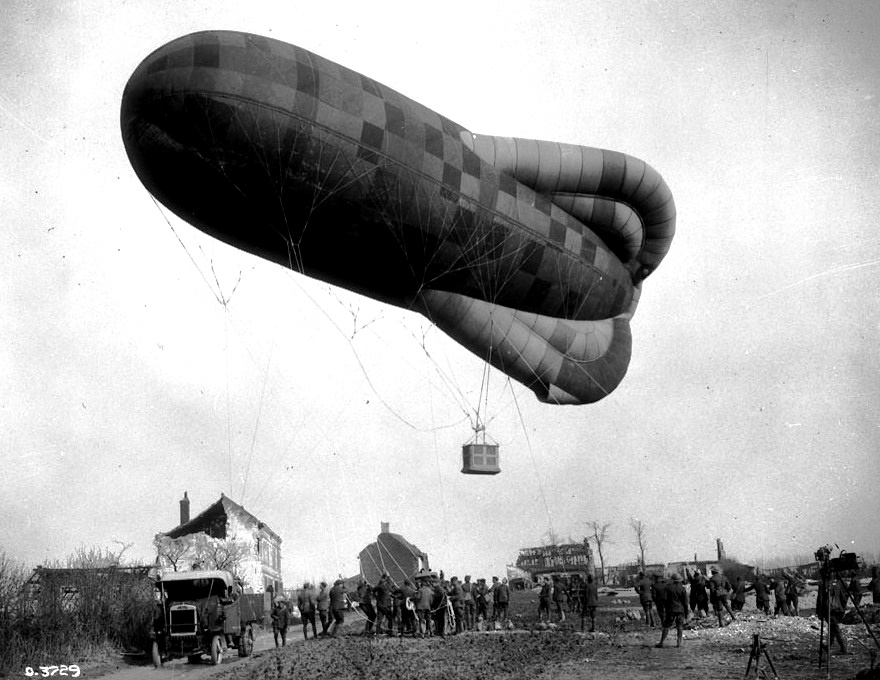
September 27 (Thursday).This afternoon, I went forward with Col MacNeece to look for new sites for the balloons. They are moving forward on account of the advance made in the drive last Tuesday. I went to Ypres – which is simply desolated – passed the Cavalry School, all in ruins, on to Potijze, back through ‘Hellfire Corner’ where the railroad to Roulers crosses the Menin Road. O1d trenches, barbwire, and especially shell holes everywhere. A couple of dead horses lying beside the road outside Ypres. As we came up to the town, a traffic policeman (soldier) warned us to put on our steel helmets. We went to a chateau, the has of a corps, in the rear of the line here. I counted 16 balloons in the aîr at once this afternoon; 11 in this were from the 2nd Army, two in the next Army south, and 3 in the 5th Amy to the north. We stopped at the 47th section on the way back and I went up with Lt Pearson, a Canadian from Winnipeg.
The visibility was not good, but at 3000 feet I had a good view of the neighboring country. Trenches showed up below us particularly well. It was after 1800 and the air in front of us was simply filled with Ally (Allied) airplanes. Once, I counted over 100 Archie bursts in a group, when the Huns tried to bring down some machines. 5 smoke screens went up to the south and east of us. Huns moving artillery or troops. Ally guns were booming under us all the time, and occasionally a flash showed behind the Hun lines. As the winch went out of commission with magneto trouble just when we were ready to come down we had to stay up for 1 1/4 hours (till after 1900) and had a beautiful view of a barrage fire. It opened up very suddenly in the British 5th Army to the north – thousands of angry flashes, especially among the field guns up behind the trenches, but the larger flashes of the big guns to the rear also, and a perfect roar. Then the smoke and dust cloud where the barrage struck the Hun trenches. He immediately put up his red S.0.S. signals and his green lights to tell his artillery to open up and lengthen the range. In a few moments, the British 2nd Army opened up a barrage, more intense than the 5th Army’s.
The Hun seemed to call for help as loud as he could, for he simply showered the sky with his red and green lights, rising from the middle or in front of the barrage. Occasionally a shell burst behind the Ally lines. One large ammunition dump went up in the 5th Army and several small ones were on both sides of the line. We were finally hauled down by running the cable over blocks attached behind a tender and two lorries (motor trucks), the machines running back and forth across the open and laying the cable out on the ground. Tonight the Huns were bombing. The sky toward Poperinghe was full of sharp little flashes as the Ally Archies burst, and north of Ypres searchlights and tracer machine gun bullets filled the air, looking for the Hun plane. Just after I went to bed, some bombs exploded quite near. I learned in the morning that a Hun dropped some on Locre, about a quarter of a mile from here. The Archies and machine guns in this neighborhood were loud and incessant for a while. Down, in the 25th section last night, a Hun plane with its engine off, planned down the road, pumping with a machine gun.
September 28 (Friday). Had lunch with Gen Webb-Bowen back at his HQ today. He is located in a beautiful chateau not far from 2nd Army Hqs, and commands the air service of the British 2nd Army – very cordial and not at all formal. A flight of 4 tri-places was starting for the lines as we came back. Two hours later, I saw them from Montrouge on their way back – two of them stunting hard. Lt Eglinton, just appointed recording officer of one of the 5 Wing Companies came thru today, just joining. He has just been relieved as an airplane observer. He was up over Lille recently with a fighter when a Hun plane came at them from above. The pilot made the mistake of heading up to fire at him and was himse1f shot thru the artery in his leg and thru the wrist. He phoned to the observer that he was all right, but a couple of minutes later the latter found the pilot was unconscious and the machine starting to dive. He climbed out on the left of the pilot to get the stick and succeeded in bringing the machine to the ground from 12000 feet, smashing it up, but getting out alive.
The pilot was dead. Lt Col Murphy, commanding the aïrplane wing of the 2nd Army, dined with us tonight – a real Irishman and very droll. We heard a Hun plane over us during dinner, then heard his machine gun popping and a bomb was thrown somewhere in the vicinity. Meanwhile, the searchlights all around us began looking for him, the Archies burst above us, and the lines of tracer bullets began to shoot up. He remained within hearing for a long time, and seemed to come back over us at one time, but the searchlights and guns were unable to find him.
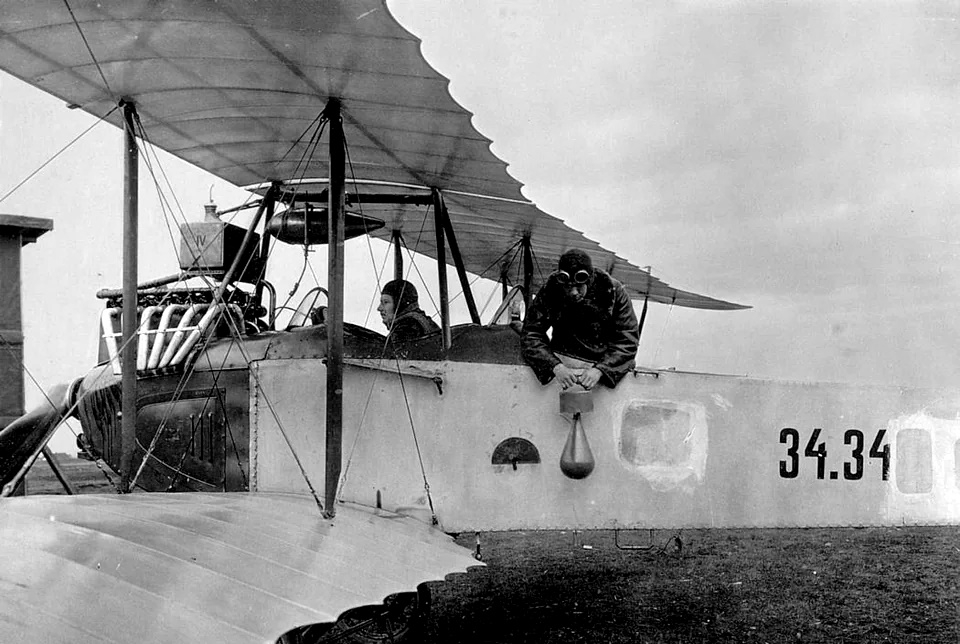
September 29 (Saturday). Visited an aerodrome at Bailleul where there are two corps reconnaîssancé squadrons and an Army combat squadron of airplanes. RE 8 (Recon Experimental) with a Vickers machine gun for the pilot and a Lewis machine gun for the observer was their type of machine – equipped with radio sending and a hole under the observer for aiming the camera; a bomb holder underneath was not often used. 12 cyl. air-cooled British government engine, 135 HP. Capt Shuemaker, the radio man, îs an American – been in Philippines Constabulary, wants to transfer to our service. Their photography is very interesting. A box with sixteen plates is attached to the camera. An electrical connection exposes the plate, and another drops it into an empty box at the side and puts in a new plate.
September 30 (Sunday). Just as I was leaving Montrouge yesterday afternoon, I looked back at 12 British balloons in the air. I reached Arques at 1900, met by Capt Worthington in command of the Balloon Repair Section (part of 1st Aîr Depot under Lt Col Collier). We had two or three Hun alarms during the evening but saw none. This morning I saw the part of the plant, then went with Maj Neame (who came down from HQs at Candas) over to the Balloon Stores Section to discuss telephones. In the afternoon, I went over equipment and organization with Worthington. In the evening, we all went into the town of St Omer for dinner at the Bertin Restaurant. It was a lively scene – packed with British officers, all hilarious – you would never know there is a war in the country. The gayety came to a sudden and decisive end, however, when the Hun alarm sounded and a large bomb exploded in the neighborhood, shaking the whole building.
Suddenly there was a rushing sound – Worthington yelled ‘Drop down’, which I promptly did. There was a roar and crash – a 100-kilo bomb dropped by one of the Hun planes had exploded somewhere near us. It is more interesting really than being torpedoed – there is much more noise. We found the tender, took off the governor, and burned the road for Arques. The machine gun opposite the officers’ quarters was popping as we came up. They had fired at a Hun that one of the searchlights picked up. Then for an hour, we stayed by the gun, listening to the Hun planes above us and dodging the fragments of Archie shells falling around us. The Hun planes (there were 5 or 6 of them) came and went, sometimes over us, sometimes over St Omer, sometimes a long way off, but the burst of the Archie shells and the beams of the searchlights, together with the noîse of the Hun engines, told pretty well where they were, although we saw none. Seven bombs were dropped that night on the town, one of them on Hospital #4, killing three wounded patients and the sergeant-major. Another killed some men at the Rairlroads Station. A full moon and a beautiful clear night made it easy for the Huns. This is the 11th anniversary of the Gordon Bennett Balloon Race – also a fu11 moon night.
October 1st (Monday). I was going over the gas plant when word came that I was to be at the Chateau, at 1115. Bid a hasty adieu to the Repair Section (also Worthington’s brother, a sergeant in the French Air Service, pilot on artillery machine near the coast, who dropped in for the night – he is from Chicago). By auto to Hesdin where I lunched with Maj Neame and other officers of Gen Trenchard’s staff at the little chateau on the farm where they live. Motored to the British 2nd Aircraft Depot at Candas where they have a well-fitted repair shop for all motor vehicles – also stores for the British 34th Army Air Service. Went over the new Caquot winch with them. To Amiens which I found full of officers and men, British and French, going and coming from left, a few of our engineer troops among them. Caught at 1830 the train for Paris, was one of 10 in a 7-person first-class compartment. I was in Paris 2030; found Col Frank Parker, my sister Katherine Lahm Parker, and the babes (Katherine and Ann) at the Hotel Roosevelt, also Conrad Babcock. Frank left in his car for Compiègne – we talked a long time, then I read my mail till after midnight – and to bed in a good bed for a very comfortable night’s sleep – first for several nights.
October 2 (Tuesday). Phoned Katherine on Major and Mrs. Mahan (US Attaché), then to Aviation Headquarters, 45 Avenue Montaigne, – met Col Bolling who explained about my order, that they did not want me to cover the same ground that had already been covered here. Found Robertson, Carroll, Warwick Greene, Pulsifer. East is in charge of lighter-than-air service here. Bolling said they had already purchased French equipment for 8 balloon companies. Called Chaumont (AEF GHQ) on the phone and Churchill said to report down there. Ran into Augustus Post and Mr. Veit of the Aero Club Mission. They want to visit the Lafayette Squadron, establish a resting place for convalescent aviators, etc. Dropped in at the Aero Club and had a talk with Besançon.
October 3 (Wednesday). Eight o’clock train for Chaumont. East, Graves on the same train, Found Gen Kenly, Churchill, Billy Mitchell, Page, Harmon, and also Birdseye Lewis. Reported and Gen Kenly said go ahead with my trip. Aviators are living in a beautiful chateau, Chamarandes, – down in the valley right on the banks of the Marne River, some two miles from the center of town. It was built by Louis XV for Mlle Marie Leszczynski (the daughter of the last king of Poland whom Louis XV married in 1725), but no one knows exactly when. There are some weird and wonderful paîntings on the walls. Slept in a canopied French bed belongs to Hoffman, an aviator who is temporarily away. Went to a dance tonight given by the American nurses of the Roosevelt Unit at the Base Hospital here. Saw Col Ireland and Col Bradley. Lunched with McCoy. He had Col Alvord, Logan, Col Chambrun, and Mme. Johnson, a Y.M.C.A. singer.
October 4 (Thursday). Dictated my report on the British balloon service. Dined with Bill Read at the Intelligence Mess – Nolan, Conger, Moreno, et al.
October 8 (Monday). Moved up to Col Rogers’ Q.M. Mess Friday – Maj Castleman and Maj Chambers, Lt Echols. Dined at the Operations Section Mess Sunday night with Col Walker, Heintzelman, Exton, Barber, and Drum (just back from the last British drive). Spent all day Saturday questioning Capt Yon, the balloon expert, at Hqs. Yesterday, Sunday, received my program or itinerary from the French government. Frank Parker came in from Compiègne yesterday. This (GHQ AEF and Hq Air Service AEF) is surely a busy place – everyone has been working Sundays until Gen Pershing issued an order that only one officer of each office would be on duty on Sundays. Frank and I lunched at McCoy’s – Col Chambrun, another French colonel, Logan, Gen John Biddle, Capt Boal from Pennsylvania – just landed. Left for Paris at 1500. No room at the Roosevelt Hotel so I went to the Mercedes Hotel.
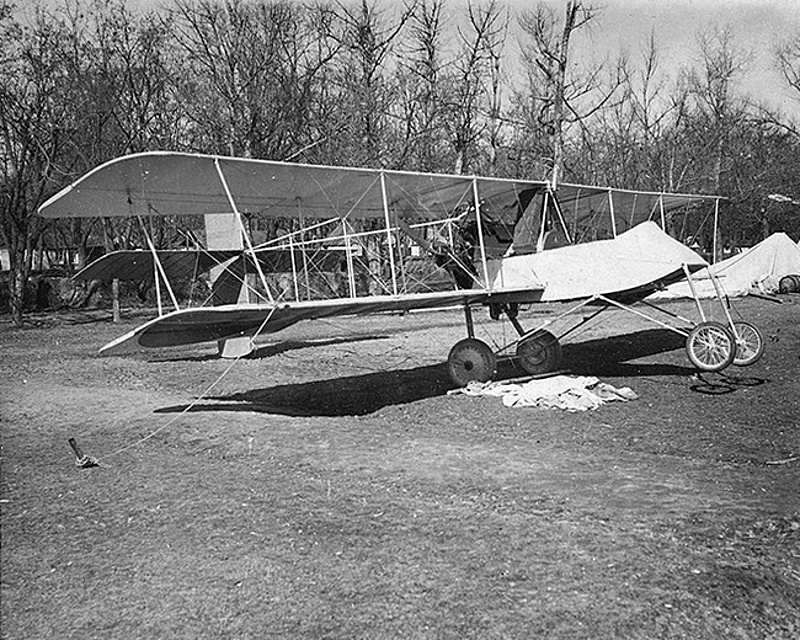

October 9 (Tuesday). Spent the day at the French Balloon School in Chalais-Meudon inspecting plants, etc. Lt Col Richard in command, Capt Caquot who made the balloon and winch, Capt Le Tourneur, dirigible designer, in charge of the balloon department. With Col Richard and Capt Caquot to visit the St Ouen and Asnières gas plants in the afternoon. East & Mr. Foster, an artist and camouflage man with me.
October 10 (Wednesday). Spent the day at Chalais-Meudon with East. They have some interesting souvenirs in the balloon house – the nacelle of the balloon ‘La France’, pieces of the envelopes of the ‘Lebaudy’ and the ‘République’ etc.
October 11 (Thursday). To see Remington manager – also to Underwood Company, about stenographers for AEF. To the department to see Emma and the concierges (the apartment located at 13 rue St Florentin belonged to my father). East and I spent the afternoon at St Cyr – Maj Gaucha is in command. Col Richard came over from Chalais-Meudon to see parachute experiments. Col Voyer and Col Godard, both balloon acquaintances were there.
October 12 (Friday). Visited St Cyr again in the morning to see telephone and winch instructions – gas plant etc. Then to the 2nd Reserve Dépot de Ravitaillement (supply depot) – Maj Bois in command – the depot and distributing point for balloon material. To Paris by noon – in the office in the afternoon. Dined with Chapman and Helen Nicholson Bream at the Café de Paris – then took them to the Olympia. Helen is driving a motor for the Y.M.C.A. which operates a canteen for the US Marines near Neufchateau.
October 13 (Saturday). Spent Saturday and Sunday in the office, getting in touch with things. Augustus Post came in Sunday morning to see about visiting Chalais-Meudon.
October 15 (Monday). East and I left at 0800 in an auto, arrived at Compiègne at 1000, received by Capt Poupart in Frank’s office in the chateau (HQS of French Armies). Met the head of the French Air Service, Col Duval, and also the foreign officers in mission, Italian, Belgian, Jap., and Roumanian. This Chateau was built in the 18th Century by one of the Louis. Napoleon I, used it, and cut a beautiful walk allee toward the east for his second wife to resemble a similar place in the chateau in Austria where she had lived. Napoleon III occupied it and put a large N on the facade. A Boche plane came over about 7000 feet up and was shelled while we were in the park. Capt Miron brought us over to Vauxbuin near Soissons to the HQ of the French 6th Army Air Service. Maj Gérard is in charge of all the 6th Army Aîr Service. Met my first Saumur classmate 1906-1907, Capt Montcabrier here in the aviation office.
Went to one of the balloon companies at Crouy. Then into our lodgings at the Hotel du Soleil d’Or where we are very comfortably situated. The steam heat, electric light, and bells have not been put into commission as yet since the proprietaire’s return but we had plenty of bedding and slept warm. The window glass has all been broken by shell fire no doubt, so cloth has been put in its place. The people were driven out of town way back at the beginning of the war. Last January the hotel keepers came back to within 9 kilometers and in June after the drive when the lines were moved away from the edge of town, they returned. Parts of Soissons are badly damaged by shell fire.
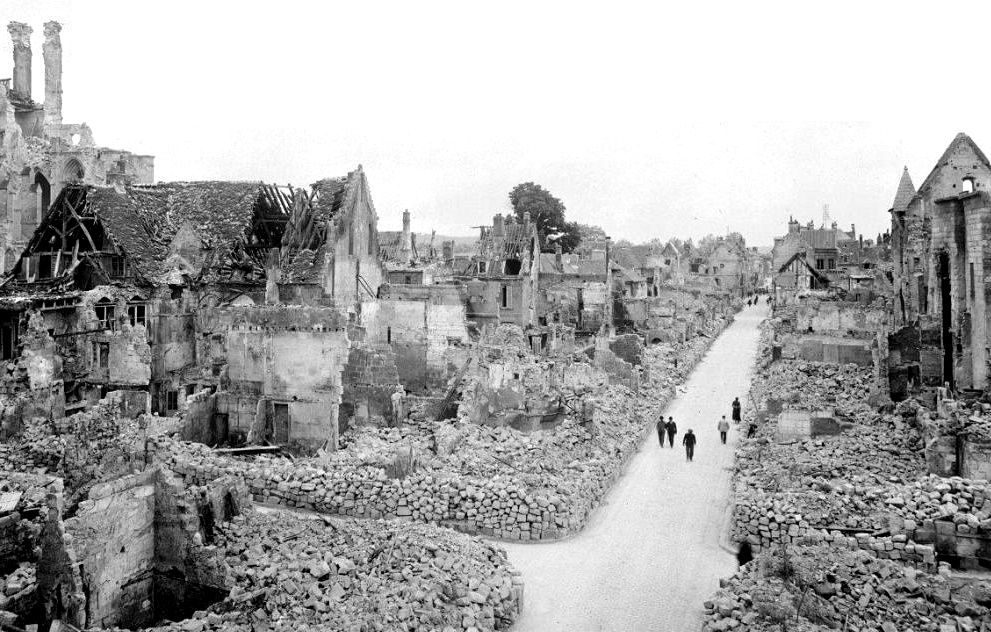
October 16 (Tuesday). Spent the morning at Vauxbuin going over organization etc – after dinner, we visited the Air HQs of the French 11th Army Corps. Their reconnaissance squadrons are there. Then to three French balloons, the 45, the 88, and the 23, all of which were in the air. We came back into Soissons about dark – one balloon was still in the air when we lost sight of it.
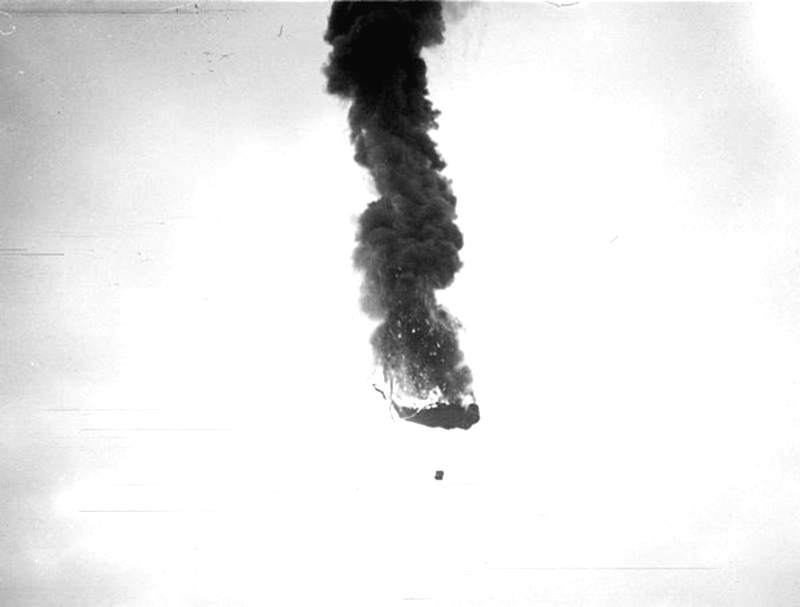
October 17 (Wednesday). Spent the morning at Vauxbuin. Went out on a hill back of the town to see an attack pulled off at 1130 on the Boche balloons. At that time, each Boche balloon was attacked by two airplanes, while others chasers, flew above them to cover their attack. We saw two out of about 8 Boche balloons fall in flames, leaving a large black cloud of smoke behind. After lunch, we visited the balloons at the right end of the line. There were about 26 in sight in 3 armies. While we were on our way, a Boche shell brought down the third from the right end of the line. They were shelling when a captain arrived. He had it brought down and I went up to 1000 meters to see a shoot. A 120-MM battery fired a dozen shots on a road junction just beyond. I could spot all but three of the shots with an 8-power glass. We saw a concentrated fire on a village back of the German lines. The Boches were doing the little firing, tho they did put three six-inch shells at the balloon, none of which missed us by very much and one of which burst about 200 ft. directly under us. The next balloon had 3 fired at it, all of which shook us up a little too. The lines of the front trenches were quite plain on the plateau along which runs the Chemin des Dames. Laon and Reims were plainly visible. Stopped to see a couple of balloon beds on the way back. A new balloon was already nearly inflated in the company that had its balloon shot down this afternoon. Stopped in Braine to see the tube and gasoline dump.
October 18 (Thursday). Started the day with a letter to my wife (Gertrude Lahm). To the 2nd Park Aeronautique ten miles south of Soissons with Maj Gérard. This is the supply station and repair shop for all aeronautical materials of the French 6th Army. Returned to the LaFayette Esquadrille (sic) for luncheon with Thaw, Lufbery, Rockwe11, Lovell, Peterson, and Dudley Hill. (Originally the Escadrille Americaine; a pursuit squadron of French air arm made up of American volunteers. On February 18, 1918, the unit was transferred to the US Air Service, becoming the 103d Aero Squadron. Most of the unit’s personnel transferred with it. The story of the original Escadrille has been told by James Norman Hall and Charles Nordhoff in ‘The Lafayette Flying Corps’ (Boston, 1920), which also contains biographical sketches and data on the unit’s combat flyers)
They took us out to see the lions which are very cute – one is the size of a good-sized St Bernard, only much heavier. This is Whiskey-Soda is much smaller. After lunch, we looked at their 200 HP Hispano-Suiza, single-seater Spads. East went up in a two-seaters Spad from the adjoining French squadron. They flew over the lines at an altitude of 12000 feet, dove at a Boche fired at him but he got away. Returning to the field, the pilot looped and did a few other stunts before landing. Later in the afternoon, another pilot of the same squadron took me up for ten minutes looping, renversements (half roll), followed by a half loop, turnovers, etc. I was strapped în but did not need to be as centrifugal force would have held me in. It seemed very easy and simple. He cut the engine on the loop after we were entirely over and headed practically straîght down. The Boches shelled the town again this morning – wounded a ‘plankton’ (orderly) in the street and demolished a house.
October 19 (Friday). Capt took us to see an advanced telephone central located 10 meters underground north of Pommiers. I first entered a trench, then down a stairway into the ground, along dark passageways until we reached the center where two switchboard operators were operating a system of 150 lines, connecting up with various other centrals, aero, artillery, and even directly to a baïloon in one case. We followed another passage on the way out led by numerous small rooms, each with a table, two chairs, and a phone. This is where a division commander and his staff will be located during the attack. On our return, we stopped at Belleau to see a main exchange, larger than the forward one, with four regular switchboard operators on duty. I learned that Exton, Heintzelman and Birnie are in town. Met Gordon Robinson on the street – he is in command of 200 American Trucks drivers on duty with the French here. To Paris via Soissons. Frank Parker, Gen Atterbury – a raïlroad authority – at dinner.
October 20 (Saturday). Started organizing Balloon Department in HQs, Line of Communication getting in touch with what East had already done.