


September 1 (Saturday). Boat races this morning. I officiated as a judge. Dr. Wells of the Yale Unit with a crew made up of soldiers, most of whom had rowed on the Yale crew, easily won his heat. The others were close and exciting. The course was from the ship around a Dutch vessel about 1/4 mile away, and back again. The finals were at 1400 – a straightaway course of nearly a mile from a neutral vessel at anchor, ending at our ship. The Yale crew was supposed to have a walk away, but the best they could do was to come in second some three lengths behind the winners. Dr. Dillard won with a crew of husky soldiers, some of whom were supposed to have been college oarsmen. The bay, or upper basin, as they call this part, is full of neutral shipping – largely Norwegian, Swedish & Dane, and ‘Belgian Relief’ ships are always coming and going.
September 2 (Sunday). A transport crossed our stern this afternoon, loaded down with black soïdiers which we understand are Jamaïcans.
September 6 (Thursday). Promptly at 5 o’clock yesterday afternoon the 1st officer at the bow gave the signal to raise the anchor. At the same time, we could see the five other troop ships in the Upper Basin with us, hoisting the anchors and getting underway very, very slowly. It was truly an inspiring sight. Then as we started down the narrow channel we speeded up – past a British cruiser whose crew gave us three Hip Hip Hurrahs! past the town with the people waving and cheering – at all the little cottages on the Dartmouth side the people were out waving American flags, handkerchiefs, tablecloths, and all cheering. Past the Megantic loading Canadian troops at the docks, past the ship with the black troops from Jamaica – then out through the two submarine nets – past the old citadel – then we saw our escort just ahead of us – the Almaganzar, a converted cruiser with six six-inch guns on each side. As darkness came on it was a great sight – all our lights were covered except a couple at the stern pointed to the rear. A very large red half of a moon came up and made the other ships look like great white phantoms. This morning, when I went on deck, thirteen ships, including ourselves were in sight. It now seems to be a sort of ‘go as you please’, with no attention paid to formation. Our converted cruiser is more to protect us against raîders – not against submarines; we seem to be moving at a good rate, with perfect weather. Covering the lights necessitates closing the port holes at night, and as a result, the air is not good, but I have arranged with my steward to come in and open mine as soon as it is light enough to be safe.
September 8 (Saturday). Everyone was on the alert today when our cruiser suddenly swung out of the column, dropped to the rear, and started signaling with her lights. It was guessed to be everything including submarines and raiders, but we were disappointed to find it was simply for the purpose of checking up to see if the convoy was traveling properly. Today, we started varying the direction, evidently to fool the submarines. For instance, the leading ship suddenly swerves and makes an S, the others following suit. This ship is worse than transport for rumors – we live on them – a large fresh crop springing up every day. First, we hear that the freighter traveling opposite us on the port side is a mystery – that she is never in port until just as the convoy is ready to move, then that she is never seen loading – (tho she sits very deep in the water and is evidently heavily 1oaded), that she is an armed vessel în disguise.
September 11 (Tuesday). Bridge, shuffleboard, reading, walking, & my evening massage make up the day – yes, and my officer’s class which meets at 0830 to exercise for a quarter of an hour before breakfast. Maj Flint of the New Haven unit asked me to take ît, and it is made up largely of his surgeons. Today, it has turned decidedly cool and a flannel shirt under a coat is none too much. ‘The Red Planet’ (by W. J. Locke), ‘My Home on the Field of Honor’ (by Francis Wilson’s daughter – Frances Wilson Huard), ‘A Hilltop on the Marne’ (by Mildred Aldrich), and best of all ‘The Marne Campaign’ (by Frederich E. Whitton) with excellent maps, are the war books I have read since coming aboard – all of them are well worth reading.
September 12 (Wednesday) Orders today direct that life preservers be carried at all times so we all go round with them in our hands, even to meals. Some put them on as a convenient way of carrying them. Mr. Marsh, who rents Warwick Castle and has turned it into à convalescent hospital, wears a non-sinkable vest and keeps it on, together with part of his clothes, night as well as day. He has made this trip six times since the beginning of the war.
September 13 (Thursday). This morning the destroyer flotilla was sighted from the bridge. In a few minutes, ten of them came down upon us, circled around, and to the great joy of those looking on, one of them hoisted the Stars and Stripes. Soon they had distributed themselves, and three of us, the Baltic, Belgic, and Megantic, the three fastest ships, each with an American destroyer as an escort, left the fleet and steamed ahead. By 0830, the fleet was only a line of smoke columns in the distance. Today, we have zigzagged, made S’s, swung, and shifted into all sorts of formations with the other two ships. The little destroyers are sometimes on our flanks, sometimes ahead, and are generally darting around like wasps or flies. In the rather heavy sea, they roll and pitch, sometimes looking as though they would leave the water altogether and fly, they seem so light.
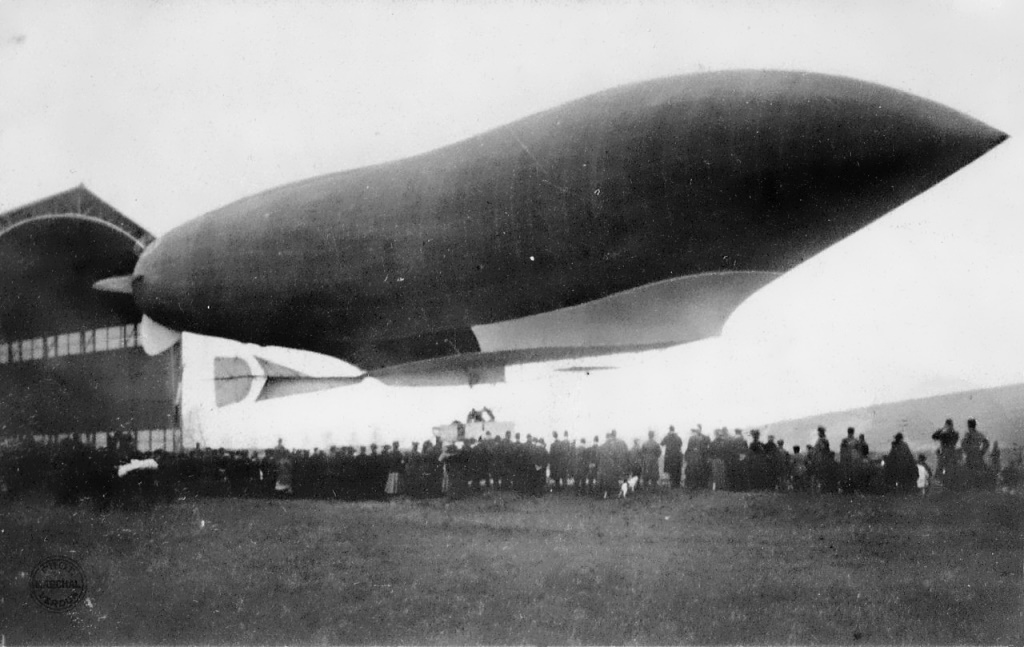
September 14 (Friday). We lost the other two ships in the fog last night but today picked up the Megantic with her destroyer – the Belgic with hers is some way back. At about 1400, we sighted land – the Welsh Coast and light – an overturned lifeboat was passed about 1100. Now it is reported that a submarine sank a 15000-ton ship early this morning, on our course, and that the lifeboat was hers. At about 1430, a balloon was sighted on our port bow. Later it passed to our left and went on out in the direction of the submarine reported. It was a peculiar shape – apparently, of the three-lobe variety, blimp – it stood at times at an angle of ten or fifteen degrees or more, sometimes with the nose up, but generally pointed down. In the meantime, a second came along and passed over us about 300 feet up. It was a ‘blimp’ with a beautiful cigar shape – No. 5572 – two passengers, single propeller above and behind the car – a gun mounted forward. Two horizontal stabilizers like the French airship ‘Patrie’, vertical stabilizer underneath the gas bag with rudder at its rear – bag about 160 feet long, aluminum covered bag, short car.
September 16 (Sunday). That was a 6000-ton ship sunk on our course Friday morning. At 0630 that day, the bridge sighted a submarine and our destroyer went after it, but returned and went on with us. At 1900, Friday, we suddenly received a severe shock that shook the whole ship. There was not the slightest doubt in our minds as to what it was – we were hit by a torpedo – no one needed to say so. We started out into the passageway and then the signal sounded to go to the boats – five blasts of the whistle. We went. As a matter of fact, I had less trouble getting there than I had usually had at drill. There was not the slightest confusion or crowding. I found Capt Galbraîth & Lt Gillian already at our station. I counted 37 men which was the correct number. I saw the patrol boat and our destroyer off to our left a few hundred yards – the destroyer No. 38 let out one of its black smoke screens. I watched the side of our ship to see if we were sinking and could tell that if we were, it was very slow. I gave permission to two or three of the men to go below and get more clothes – one had his life preserver on over only his undershirt.
After twenty minutes of waiting, Bowen came along and asked what was doing. As I did not know, we both started for the bridge to find out. We found the mate who told us that the patrol boat had fired two shots at a submarine, that the destroyer had dropped a ‘depth charge’ on it, that we had felt the concussion of the depth charge and had not been struck at all. The destroyer had reported dropping the depth charge, then told us we were ‘not damaged and to continue on our course’. I went back to the men and told them what the mate had said, then dismissed them and went down to my own dinner. We heard the captain continue to think we were struck until he went down himself and examined the hull of the ship. When the ‘depth charge’ went off, which gave us such a jolt, the destroyer was seen to jump – it must have shaken her up a lot. Several amusing things occurred. One big Britisher exclaimed as he started for his boat, Why they’ve closed the bar; One load of nurses standing by their boat were told by someone to climb in. With the assistance of a steamer chair, they did. Then calmly sat there waiting. There was not a single man, crew, or passenger, in their boat. Finally, Someone came by and saw them sitting there, so said What on earth are you doing in that boat? Get out of it. Which they did. One reassuring fact remains, that a lifeboat suspended by the bow and stern as these are, will hold up under îts load – I had rather doubted it, especially as some of them looked pretty old.
There was not the slightest confusion, no one displayed anything but the greatest calm and self-control. The nurses in particular were given credit for their coolness. I turned in at two but was kept awake some time by the starting and stopping of the engine as we came in over the bar at the mouth of the Mersey River. When I woke up on Saturday we were in the river at Liverpool but did not get to the wharf till about 1100. Finally, the Q.M. took me off with my baggage. We went to the North Western Railroad Station, then started a search for the British Army official from whom I was to get my transportation – he was not to be found and the sergeant refused to give it out. At 1356, I found the proper official and I had my transportation, made a flying getaway, and left on the two o’clock train, reaching London at 1845. Galbraith who is an assistant Q.M. met me at the station with the Q.M. car and brought me to the Rubens Hotel on Buckingham Palace Road, where I am very comfortably installed în a room and bath for 9 shillings and 6 pence a day. (about $ 2.5 US) Maj Rethers is the Q.M.
This morning, I went to the Embassy and made out mileage vouchers, etc. Saw a large number of ambulances loaded with wounded come out of the Liverpool Station. Some of the first were sitting up – the others were all lying on stretchers with various bandages on. Soldiers are everywhere, any number of them in their blue convalescent uniforms. The country coming up from Liverpool was so green and peaceful looking – herds of cattle grazing in the fields, farmers harvesting the grain, it was hard to believe the war was on the land until we came to the Stations, where there were always soldiers. London, however, is military. All-day Soldiers on their way to or from Victoria Station have been passing the hotel, going from or coming to ‘Blighty’ with their heavy packs on their backs, trench helmets hanging on behind, and guns over the shoulder – a very business-looking outfit. Among the wounded convalescent, the number of one-legged men is particularly noticeable. As far as I could see, the people in the street did not show their ‘burden’ – all appeared happy enough. Met Col Patterson in the hotel tonight. He spent six months in the US some ten years ago, was entertained by President Roosevelt at the White House, spent some time at Fort Riley and Springfield Arsenal, and knows many of the 7th Cavalry and 6th Field Artillery. While all stores and theaters are closed today, London has a very gay and lively appearance with so many people and so many uniforms in evidence.
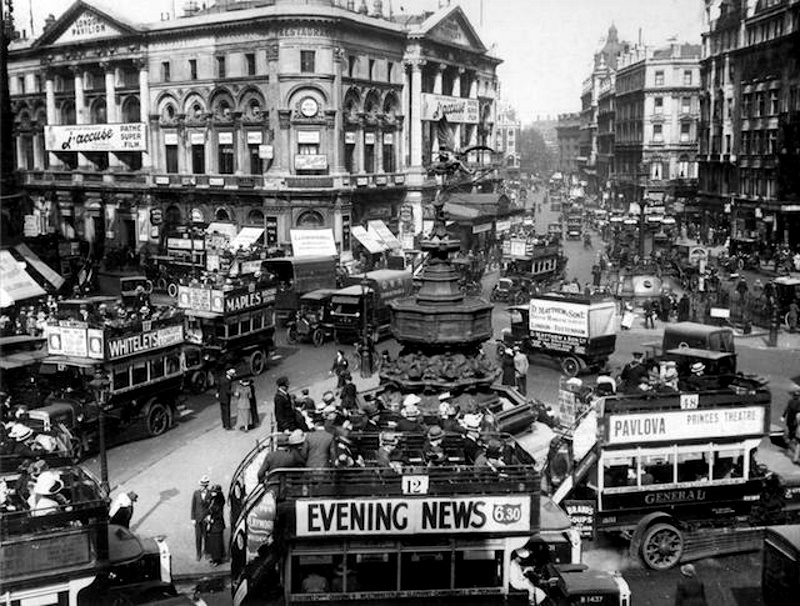
September 17 (Monday). Ordered a uniform overcoat this morning from Tom Jones, 6 Regent Street, for 6 £, 15 sh. (about $33 US). Then went to the Embassy and spent the rest of the day while Gen Lassiter, the Attaché, tried to connect with the War Office and get me officially launched on my way to Roehampton. He had not succeeded by 1900, so dictated a letter to the War Office to be delivered tomorrow. I found out W. A. Gibbons, an asset to the attaché was an applicant for the balloon service; he was formerly with the US Rubber Company and is in good touch with the balloon service here. He has already submitted several reports and has covered a good deal of the ground I had mapped out, which will save me some time. Met Capt Dunning and Capt Warburton of the Reserve, also Drexe1, the old flyer, who is handling the Aviation end here. I spent some time collecting information that Gibbons had filed.
September 18 (Tuesday). I went to the embassy and found I was to call on Gen Brancker, Air Board, Cecil Hotel. He said I could be at Roehampton (a suburb in SW London at which were located the Royal Naval Air Service Balloon School and an Army Balloon School) at 1000 tomorrow and that he would arrange to send me to the Hqs in France on an airplane. I am to let Gen Charlton know when I am ready to go. Spent a couple of hours with Brewer at his place where he is manufacturing Ogilvie airspeed indicators. Saw his wind tunnel, with the model of a kite balloon set up to measure suction on the top surface at various points. This is for the purpose of finding pressure on the gas bag from within, at various points. At the Aero Club – met Mr. Handley-Page, who builds bomb-dropping airplanes – is now working on one with a 120-foot Span, and 4 Sunbeam engines of 500 HP each. He has already lifted 21 men to 2000 feet with a single 500 HP machine.
September 19 (Wednesday). Took a tube at Victoria Station for Hammersmith (a School in SW London), phoned the British Balloon School, and Col Bovill sent his car for me. Capt Vanderbyl who has played championship tennis in New York and California showed me around and took me to lunch. Lt Neville J. Rich, the telephone man, gave me a lot of information about their phones, and showed me around – also Lt Pratt who took me up in a tree, the observing point for a landscape map, 1/80, that he was constructing on the ground. He set off some of his explosives, including a little wooden fuse, shot from a small mortar, about 16 inches long and 3 in diameter. The fuse is a hollow piece of wood 1 1/8 in. diam., 3 1/2 în. long with a hole about 5/8″ diam. bored in the center. A fuse is led into one end of this, and in the other, (open) end is put 1/10 of a gram of powder, then a cork plugs up the end. When the mortar is fired, it throws out the wooden projectile, at the same time igniting the fuse at its base. When it is about 50 to 60 feet up, its own charge blows out a strong puff of smoke to imitate a shrapnel charge bursting in the air. Lt Rogers showed me his store room, a tent hanger containing balloon stores – also, blankets, stoves, etc. which are carried by the balloon supply officer. Saw the transport for two sections going to Mesopotamia shortly. No balloons observing as they had just moved to Richmond Park from Roehampton – The Navy is taking over that part. Col Bovill sent me in his car to the Brewers. Borrowed a pair of pajamas and spent the night with them.

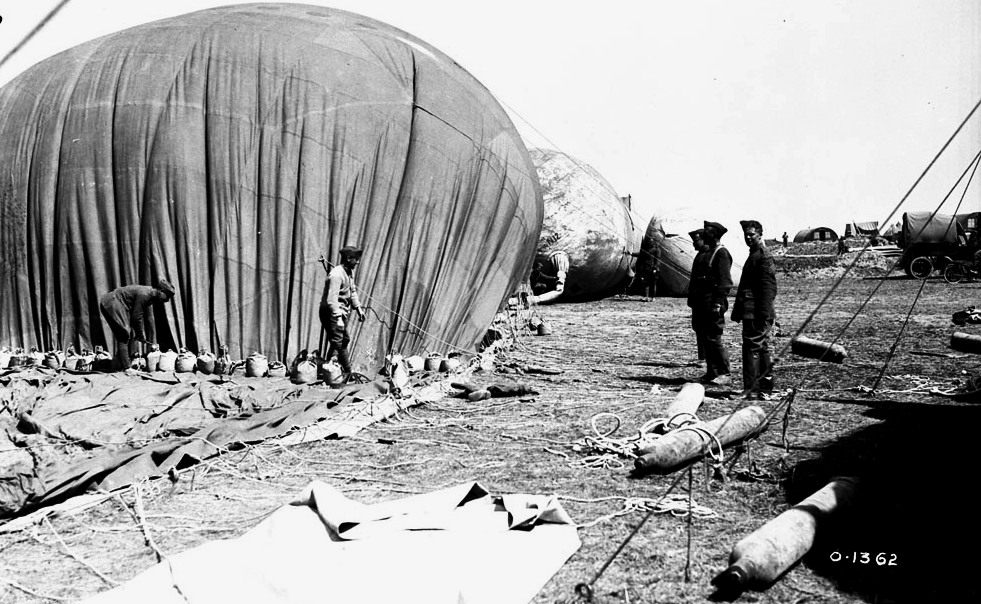
September 20 (Thursday). Mrs. B. left at 0800 to go to London, ‘doing her bit’, 5 1/2 days în the week. A car took B. and me to the Balloon School RNAS (Royal Naval Air Service) at Roehampton. Capt Delacomb in command; had met him in Paris at the balloon race in 1906 and again in Brussels in 1907. He was most cordial – showed me around – about 80 student officers, 700 to 800 enlisted men, and three kite balloons in the air two hours at a time with observers in training. Navy has a heavier cable, heavier rigging, heavier oval car with map board on the outside, one had celluloid windshield entirely around the front end, with cloth pocket to fit field glasses into. They work at 1000 feet regularly in the Navy, but tow their balloons so have much heavier strains. Have had a balloon up from the ground in a 110-mile wind, and an observer in a 75-mile air speed when towed from a ship. They have put a pointed tail on one of their Caquots (captive observation balloon invented by Capt Albert Caquot of France), taken off the ‘trouser legs’, and so cut down the resistance considerably.
They have an interesting device for observing gunfire on a board with a small ship on ît. By pressing levers, little rope ends come up out of round holes in the table, over or short of the ship, then the observer corrects the range. The ship can be set at an angle and then he estimates the angle. He has a revolving table in front of him with the degrees marked on it. A small lake in the rear of the headquarters has a fleet of German battleships, cruisers, submarines, etc. on it. A balloon car suspended in the air, some 150 yards away is the observing point. Their course is only about two months long, they have to rush men out to the ships for balloon patrol duty as soon as they can get them there. Lt Diel took me up in a Caquot to 1000 feet, wind up to 40 MPH made the car sway a good deal, but I could use the glasses and tell that a train three miles away was a ‘goods’ train. He cut away one of the parachutes – the sandbags caught in the maneuvering ropes so that bags, ropes, and parachute were all horizontal for a moment – then cleared, opened in about 60 Feet, and reached the ground easily, tho swaying badly all the way down due to the bad get-away.
Had lunch with Capt Delacomb – the headquarters îs în a beautiful chateau, given up by its owner for their use. Brewer gives a lecture three times a week at the School about ballooning. A ribbon was recently given to an observer who spotted a submarine on the surface 27 miles away – was towed to it by the destroyer, and other destroyers surrounded it dropped depth bombs – and ‘strafed’ it. From what I gather so far, the Kite Balloon service is not looked on with the highest favor by the Army, but about five months ago, grew sudden1y popular with the Navy and now they want their School to turn out a lot of it for patrolling the submarine areas and for use on their capital ships. Silicol Generators (used to generate gas for balloons using ferrosilicon) are unpopular. Gas has impurities that damage rigging and balloons. They much prefer commercial products in tubes. Shortage of tubes seems to be the only reason for having silicol generators. 11 parachutes were seen in the air at one time when Hun airplanes came thru clouds and ‘strafed’ 5 to 6 Kite Balloons at once.
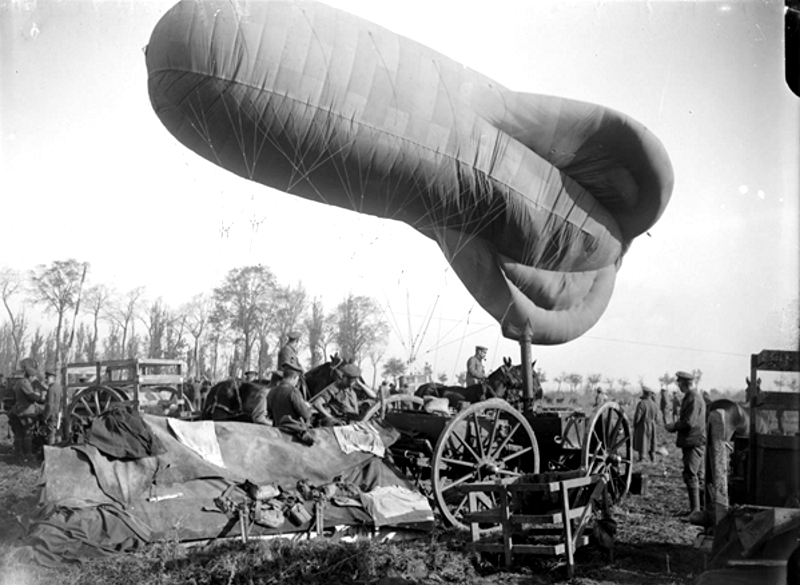
September 21 (Friday). Andover junction 1040. Met by the adjutant of No. 1 School of the Balloon Training Wing. He took us in a car 12 miles to Lark Hill, Salisbury, where Maj Parker, the commandant of the School, received us. The School is not large – it has ordinarily about 15 student officers, and 150 men – there were 3 balloons there. German prisoners were doing a lot of work on road walks etc. They were a well-fed, contented-looking lot – also rather intelligent and husky 1ooking. The men are quartered in a can-comment barracks, with similar buildings to the School. Students remain only for about one month – are instructed in bagging down balloons, folding parachutes, map reading on the ground, and particularly map reading and observing shoots from the air. Maj Parker took me up to 1500 feet where for an hour we read the map and watched troops drilling, and artillery firing. Unfortunately, they were not having a shoot today. Everything is necessarily somewhat simple and crude, as it is only a cantonment.
There is one tent or a canvas hangar with a permanent wooden frame, packed earth balloon bed, and board floor around it. Two balloons were bagged down in openings cut in the edge of a small wood. The winch was permanent. They had a good telephone and chart room lorry and a portable silicol plant in operation. They showed me the inspection and packing of a parachute, and cut away one with a dummy attached. It did not open as readily as I expected, took 9 1/2 seconds or about 200 ft., and landed from 1000 feet (wind at the balloon, 30 MPH) in 59 seconds. Maj Parker took me to Salisbury where I caught the 1613 train to the Waterloo Station.
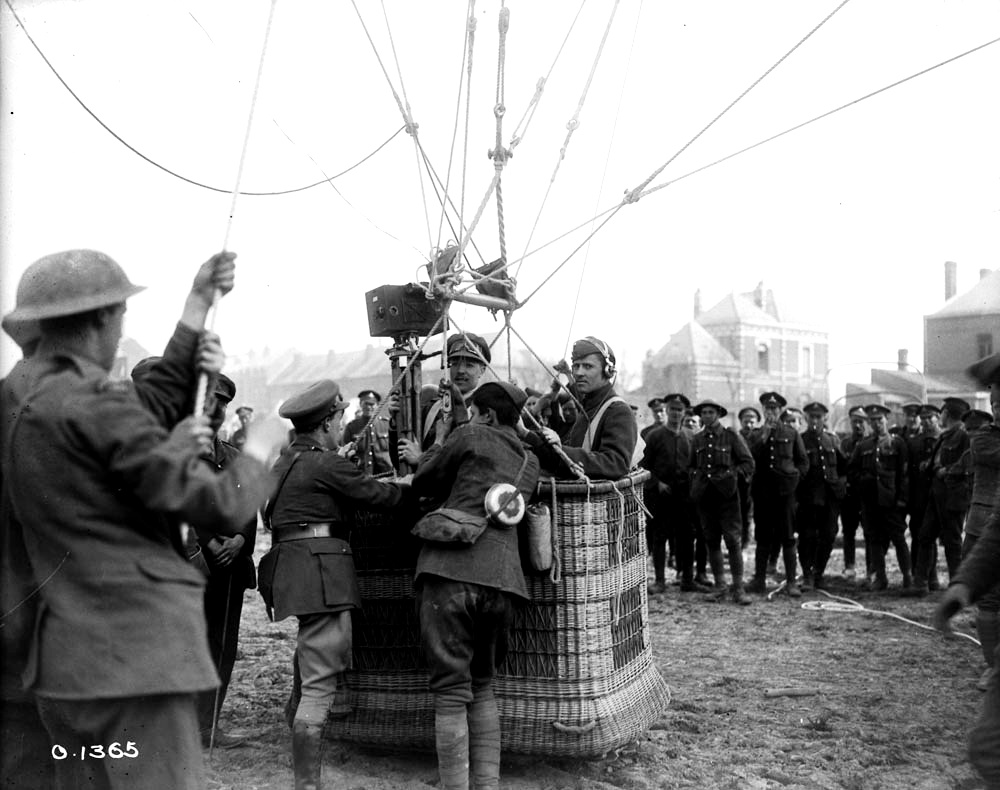
September 22 (Saturday). Col Bovill sent his car for me at 0900 to go to Queen’s Court, where Maj Price has the Balloon Stores Depot. He has the supply of all balloon troops in the British Army. Went to the Air Board where a lieutenant gave me my transportation to Lympne (Folkestone -Dover) and instructions for Monday’s trip across the Channel.
September 23 (Sunday). Went to the Embassy on the morning to get off a letter to Chandler and the various papers, plans, etc. that I have been accumulating. On Friday they had an accident at the Army School at Roehampton. One Kite Balloon broke loose, then carried away three others which were attached and used in an experiment. Two men on the handling guys of the first balloon failed to let go. One was carried up 1000 feet when he had to let go and dropped within 5 yards of where Maj Price was standing. The other man managed to attach himself in some way to the handling guy and hung on for three-quarters of an hour when he let go at an altitude of 12000 feet. They are looking for a big Hun raid over the city next week at the time of the full moon. The papers are already beginning to talk about it. Some of the theaters are going to give no-night performances at that time.
September 24 (Monday). Arrived at Westenhanger near Folkestone at 1108, met by a car, and taken to Army Acceptance Depot at Lympne. This is a large depot where machines are delivered for forwarding to France. 12 large hangers, brick, G.I., about 75 ft wide by 150 ft long. As many as 45 or 50 machines are forwarded by air to St Omer in one day from this depot. Lt Baker, very young, took me across in a Bristol fighter, 250 HP Rolls-Royce 8 cylinders engine, speed 110 MPH. Left ground 1430, circled once to gaîn 1000 feet, then headed toward Folkestone – 3000 ft. when we reached the Channel and crossed at that height. A blimp was cruising along the British coast, destroyers in columns of 3’s near the French Coast. Numerous small crafts in the Channel. Reached the French Coast near Calais at 1455 and were over St Omer British Army Aircraft Depot No. 1 at 1515.
It was Lt Baker’s 3rd crossing that day. An Italian airplane (not a Caproni) that had left Turin at 0630 circled over Lympne at 1400, then continued its non-stop run to London. Met Gen Trenchard, in charge of all British air service in France, Lt Col Collier în command of the Depot No. 1. A British ‘Archie’ AAA shell had made a hole about 8″ deep in front of Hqs in the morning, putting numerous holes in an adjoining hanger door and sending 4 men to the hospital; another ‘Archie’ had gone thru the hospital from roof to cellar, failed to explode, but went thru the bed beside a sick man; they were firing at a Hun plane 20000 ft (sic) over St Omer. This depot receives all machines flown over from England, rebuilds damaged machines, and salvages parts. It is an immense place. Spads, Nieuports, Bristols, Sopwiths – all types were there, but especially the chasers. The British 2nd Air Brigade Hq sent me to Montrouge. This is Hqs of the British 2nd Balloon Wing, Lt Col M. F. MacNeece, Commanding. Passed Army Hqs Second Army, Air Brigade Hqs, numerous transport stations, and dumps.

EDITOR’S NOTE
By this time, and for the remainder of the war, each of the major fighting nations maintained a large air arm. The principal functions of these air forces were as follows:
1. Observation. The purposes of observation were to control friendly artillery fire and, through photographic and intelligence missions, to observe and report on friendly troop location and movement, enemy ground and air activity, the terrain, and related matters. Most observation, especially where distance was a factor, was handled by two-seater aircraft, equipped with radio and visual signal equipment, armed with fixed guns în front and movable guns in the rear cockpit, and carrying, when necessary, photographic equipment; the remaining observation was carried out by observers in captive balloons. Now that the use of cavalry was no longer feasible, air observation was the eyes of the Army.

